756
SECURING MAPREDUCE PROGRAMMING PARADIGM IN
HADOOP, CLOUD AND BIG DATA ECO-SYSTEM
DR. ANITHA PATIL
Professor, Department of Computer Engineering,
Pillai HOC College of Engineering and Technology, Rasayani
E-mail: [email protected]
ABSTRACT
In the wake of technologies like cloud computing, virtualization and big data, MapReduce is the new programming paradigm used for processing voluminous data known as big data. MapReduce computations take place in thousands of commodity computers associated with cloud. Thus it can exploits Graphics Processing Units (GPUs) associated with cloud with its parallel processing abilities. Enterprises in the real world are shifting from traditional computing to cloud computing and traditional data mining to big data analytics. The rationale behind this is the exponential growth of data. Storing and processing such data needs big data eco-system associated with cloud computing. In this context, MapReduce programming model is supported by distributed programming frameworks like Hadoop. However, it is very challenging to secure MapReduce computations from malicious attacks. In the literature many secure cloud storage mechanisms are found. However, securing MapReduce programming paradigm in Hadoop and big data eco-system is still to be explored. In this paper, we proposed an algorithm based on differential privacy to protect big data from malicious Mapper and Reducer. We built a prototype application to demonstrate proof of the concept. The result showed the utility of the proposed approach.
Keywords:-Big Data, Mapreduce Programming, Hadoop, HDFS
1. INTRODUCTION
In the recent past, enterprises started giving more importance to data and data analytics for making strategic decisions. Since there is exponential growth of data in the real world applications, it became essential to have good eco-system that can be used to store and manage big data which is characterized by volume, velocity and variety. The emergence of cloud computing has enabled big data processing by providing large shared pool of computing resources in pay as you go fashion. At the same time, Hadoop kind of distributed programming framework came into existence. This framework supports storing and processing massive amount of data and exploit parallel processing with thousands of commodity computers [1]. Since big data processing needs computational power and storage, cloud computing became handle for achieving it. With cloud computing, virtualization, big data, Hadoop and other big data platforms an eco-system is made in distributed environment.
MapReduce is the programming model used for big data processing. It is the new programming approach which contains map and reduce tasks and the work is done in distributed environment by
many commodity computers. As explored in [5], Amazon is providing it own MapReduce programming model known as Elastic MapReduce which is based on Hadoop. Therefore Hadoop is the framework used for processing big data by supporting MapReduce programming. However, there are security concerns when mapper or reducer is compromised. Map and reduce tasks are vulnerable to various kinds of attacks. In this paper we considered privacy attacks on mapper and reducer.
757 Hadoop, MapReduce, Big data and cloud computing eco-system. Section 3 presents the distributed eco-system. Section 4 provides details of the proposed algorithm. Section 5 presents experimental results. Section 6 concludes the paper and provides directions for future work.
2. RELATED WORKS
This section focuses on cloud and big data eco-system in distributed environment. It reviews literature on the related topics. Wang et al. [1] studied the utility of MapReduce programming paradigm across different data centres in distributed environment. They used two big data example for processing. They include the big data associated with Large Hardon Collidor (LHC) and High Energy Physics (HEP). They extended Hadoop and named it as G-Hadoop which exploits multiple data centres. Zhao et al. [2] exploited G-Hadoop with cryptography and SSL for secure big data processing across different data centres. It also simplified job scheduling and authentication procedures.
Xavier et al. [3] investigated on different virtualization system that is used for MapReduce clusters. Virtualization is the technology used to leverage utility of computing resources. They focused on container based virtualization as it prevails in the real world MapReduce frameworks. They found high performance with Linux Container (LXC). Katal et al. [4] on the other hand studied the need for big data processing is MapReduce programming paradigm. They also specified issues and challenges related to big data processing. They described existing big data projects related to Big Science, Government, Private Sector, and international development. With respect to data analytics, they found challenges such as volume, storage, analysis, significance, best practices, technical challenges and skills needed. Karande et al. [5] studied the advantages of Hadoop cluster optimizations for big data analytics with high performance. They used Amazon S3 for storage and Elastic MapReduce (EMR) for processing big data using MapReduce programming paradigm.
Fernandez et al. [6] explored the term big data,
cloud computing, distributed programming
frameworks and the usage of MapReduce. They proposed a big data framework that can help in working with big data in terms of data mining and extracting business intelligence. Vavilapalli et al. [7] studied resource navigator named YARN which is associated with Apache Hadoop. It
decouples programming and resource management for more effective processing of big data. In fact YARN is Hadoop’s compute platform which delegates many scheduling functions in order to bring about effectiveness in the programming model. Kumar et al. [8] focused on the K-Means algorithm execution with Hadoop cluster for actually verifying and validating MapReduce functionality in distributed environment. It does mean that traditional K-Means algorithm is executed in parallel processing environment with MapReduce programming.
Grolinger et al. [9] studied various challenges that arise when big data is processed in MapRedce programming frameworks. The main challenges they identified are data storage, analytics, online processing, privacy and security issues. Kambatla et al. [10] threw light into various trends in big data analytics. The trends are examined in terms of hardware platforms to have data analytics, virtualization technologies, software stack for analytics applications, and application scope in the emerging applications. Miller et al. [11] investigate on open source frameworks for big data analytics. They found the frameworks such as Apache Hadoop, YARN, GPS, Pregel, and Apache Spark. Scala-based frameworks found by them include Spark, Kafka and Samza, and Scalation. Mythreyee et al. [12] studied the relationship between cloud and big data processing.
758 Big data and the usage of Hadoop are explored in [16] where layered architecture of big data system is proposed. Data aware caching mechanism for big data processing in Hadoop environment is investigated in [17]. The caching mechanism reduces database hits and produces more efficient query results with least latency. Huang et al. [18] focussed on the security of distributed environment where Hadoop or YARN is used for big data processing. They focussed on the security threat known as DoS and provide useful insights related to the effect of DoS attacks. Lee and Lee [19] used Hadoop MapReduce programming framework for measuring Internet traffic in scalable fashion. Zaharia et al. [20] studied the unified engine for big data processing known as Apache Spark. This framework is capable of providing big data processing capabilities in order to add big value to organizations.
Sharma and Navdeti [21] studied on the security issues and the process of securing big data in Hadoop. They focused on different security solutions provided by distributed frameworks. The
security solutions include authorization,
authentication, encryption of data which is at rest, encryption of data in transit, and audit trials. The frameworks against which these security solutions are examined include Hue, Zookeeper, Oozie, Pig, Hive, HBase, HDFS and MapReduce. Vasconcelos and Freitas [22] studied the performance of MapReduce with different platforms such as OpenVZ, KVM, and OpenNebula. They found that KVM performed better with respect to I/O benchmarks. Siddique et al. [23] focused on Apache Hama which is an emerging framework for big data applications. It follows a programming model known as bulk synchronous parallel programming model. Assuncao et al. [24] studied trends in big data and cloud while Pandey et al. [25] focused on big data storage and processing in Hadoop environment.
Idrissi and Aboerezq [26] explore cloud computing focusing on skyline queries for determining cloud services that meet user needs. Lemouddeen et al. [27] studied security issues in cloud computing. They found top ten threats as data breaches, data loss, insecure interfaces, malicious insiders, service hijacking, abuse, technology vulnerabilities, Denial of Service (DoS) and insufficient due diligence. Sudha and Viswanatham [28] focused on the security threats in cloud computing at network level, host level, application level and data level. Fayoumi [29] studied cloud to understand its load balancing
issues and traffic and security goals. Kumar and Anand [30] investigated on workflow scheduling in cloud computing and found that security is a concern in using cloud.
Sari and Kurniawan [31] explored cloud
computing infrastructure for knowledge
management process. Simamora et al. [32] investigated the possible adoption of cloud computing for leveraging businesses with a case study. Kumar and Aramudhan [33] focused on trust based resource allocation in cloud computing for effective management of resources. Ghani et al. [34] focussed on green cloud computing for environmental friendly and energy efficiency. With green computing, they measured Data Centre
Productivity (DCP) and Water Usage
Effectiveness (WUE). Manogga et al. [35] on the other hand explored cloud to have successful e-Learning platforms that provide access to knowledge base without time and geographical restrictions.
More on security issues in the cloud and Hadoop eco-system is found in [40], [41] and [42]. MapReduce security is the focus of the work in [41] and [42] while [40] provides general cloud security details. As found in the literature there is need for protecting data from adversaries. This paper provides differential privacy based solution to secure MapReduce operations in Hadoop.
3. ECO-SYSTEM FOR BIG DATA
PROCESSING
This section provides important details related to big data, big data processing, MapReduce
programming model, Hadoop and cloud
computing.
3.1 Big Data and Need for It
759 include sensor networks deployed in strategic areas, online transactions, click streams, satellites and other online applications where data is continuously produced.
Big data is the normal data that we see day to day only. But it assumes certain characteristics known as Volume, Variety and Velocity (V3). Here it is very easy to understand the Volume factor. The data is very huge and measured in petabytes or higher measurement. The big data is in different format with number of dimensions and heterogeneity. This feature is known as Variety. It is available in the form of structured data, unstructured data and semi-structured data. Big data is also associated with another feature known as velocity. It refers to the fact that data comes from different sources and in fact data is streamed
continuously with certain speed. In order to process big data an environment with thousands of commodity computers is needed. This can be provided by cloud computing.
Big data needs storage of different kinds of data. Relational data is stored databases which is
traditional approach. Relational Database
[image:4.612.99.517.360.577.2]Management System (RDBMS) is sufficient for storing relational or structured data. However, commercial applications expect high scalability and response time. There should be provision to hand unstructured and semi-structured data as well. With respect to relational model, SQL language is used to perform operations and retrieve data. Data mining and data analytics on big data can provide comprehensive business intelligence to make strategic decisions.
Figure 1: Shows How Bias Conclusions Are Made [36]
As illustrated in Figure 1, each individual has limited view or blind view on the thing they see and they made biased conclusions. The tail of elephant is understood as a rope. This is the problem when the whole picture is not visible or not considered. This simple example shows the importance of processing big data instead of using a part of data for performing data mining operations. When big data is considered for mining, it has complete data and processing such
data needs a cloud eco-system containing different frameworks or technologies such as Hadoop, Hadoop Distributed File System (HDFS), MapReduce programming framework, and cloud computing.
3.2 Cloud Computing
760 resources on demand in pay per use fashion. Cloud has large shared pool of computing resources that are provisioned to be used by people or organizations and pay as they use. The cloud computing technology is based on top of virtualisation technology [27]. Cloud computing has certain essential characteristics. They are on demand self service, broad network access, resource polling, rapid elasticity and measured service. Cloud has services to be rendered such as Platform as a Service (PaaS), Infrastructure as a Service (IaaS) and Software as a Service (SaaS). It has various deployment models such as private cloud (owned by an organization and public cannot access it), public cloud (anyone can access it), community cloud (group of organizations can access it) and hybrid cloud which is made up of private cloud and public cloud [31].
3.3 Big Data Platforms
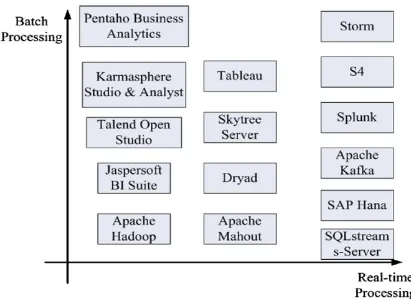
Handling big data needs special platforms. Figure 2 shows various platforms and their relationship with batch processing and real time processing. Out of them one of the most powerful platforms which are widely used for handling big data using MapReduce programming paradigm is Apache Hadoop. It is a framework for distributed programming. Reliability and high scalability are advantages of Hadoop. Dryad is another parallel programming framework. Like Hadoop it is used as a platform and infrastructure. Good programmability and high performance execution engine are advantages of Dryad. Apache Mahout is the framework which provides machine learning algorithms that can be used with big data. Baspersoft BI Suite is the business intelligence software which is cost effective and scalable. Pentaho Business Analytics is the business analytics platform which is flexible, robust, scalable and best used for knowledge discovery from big data.
Figure 2: Big Data Platforms For Batch And Real-Time Processing [37]
Skytree Server supports advanced analytics with its machine learning features. It can be used to handle massive data for high speed processing. Tableau is used for business analytics and data
[image:5.612.94.505.340.639.2]761 with collaboration. Talend Open Studio is data management and application integration platform which is easy to use with graphical environment. All the platforms aforementioned are meant for batch processing. The platforms for real time processing of big data include Storm, S4, SQL Stream Server, Splunk, Apache Kafka, and SAP Hana. Storm is the real time computation system which is highly scalable, easy to set up and fault-tolerant. S4 is meant for processing continuous unbounded data which is pluggable, scalable and fault-tolerant. SQL Stream Server on the other hand is used for sensor, telematics and M2M applications which are SQL based supporting big data stream processing. Splunk is meant for collecting and harnessing machine data which is highly scalable ease to use and fast. Apache Kafka is a public-subscribe system in distributed environment. It is best used for high throughput stream processing. SAP Hana is the platform that can be used by business in the real time. It supports real time analytics and fast in-memory computing.
3.4 Apache Hadoop
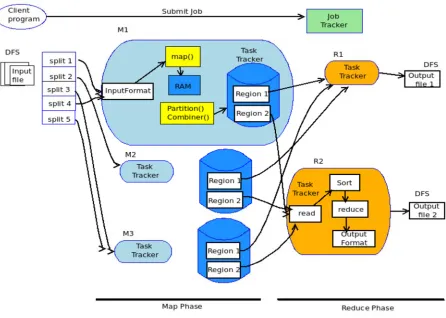
[image:6.612.96.542.365.683.2]Hadoop is one of the widely used distributed programming frameworks. It is being used by Google, Facebook and other companies to deal with big data effectively. It supports a novel programming model known as MapReduce. This programming paradigm has two important tasks. They are known as Map task and Reduce task. The MapReduce framework as shown in Figure 3 supports processing of big data with its support for parallel processing. Thousands of commodity computers associated with Hadoop are utilised for processing massive data is short span of time. When big data workload is given, Hadoop splits the data into multiple pieces and each piece of work is assigned to a worker node. The worker nodes complete their job and return the results. The whole process contains two important activities known as Map and Reduce.
762 The input data is stored in HDFS which is distributed file system associated with Hadoop. HDFS can provide access to data stored in different servers which are geographically distributed. Job Tracker and Task Tracker are two important components involved in the process. Job Tracker is responsible to track the job as a whole while task tracker takes care of given task which is part of a job. In the map phase the workload which
[image:7.612.113.504.228.416.2]is split into multiple pieces are executed by thousands of commodity computers or worker nodes. The intermediate results are given to reduce phase. Then the reduce phase performs operations like sorting or summarizing and produce final output. The final output is also stored in HDFS. Figure 4 provides an illustration of functionality of MapReduce.
Figure 4: Illustrates Mapreduce Functionality With Word Cloud Application
Word count is the typical application to
demonstrate the utility of MapReduce
programming paradigm. The purpose of the program is to count the occurrences of each work in a document corpus. Document corpus may be all e-Books in the world that constitutes big data. Manually doing this task takes number of years of time. When such input is given to MapReduce framework, it can easily handle it and provide output in few seconds. The rationale behind this speed is the usage of thousands of computers with parallel processing. First of all, the given document corpus is split into number of parts. Each part is passed to a map task. The map task is carried out by a commodity computer located somewhere in the world in distributed environment. The map task counts the occurrence of each word in the given portion of big data. It produces intermediate output which contains key/value pairs. Key is nothing but a word and value is its count. The Map phase in Figure 1 shows duplicate keys as well when the result of all worker nodes is observed. That is the reason, the intermediate output needs to be sorted. It is done in
the sort or shuffle phase. Similar keys are grouped together. Now it is easy to move to reduce phase where the count of each word with duplicates are summed up to produce final word count. The final world count for all words in big data document corpus is saved to HDFS.
3.5 Security Issues with MapReduce
Programming Paradigm
763
4. PROPOSED ALGORITHM
EDGAR dataset contains unique values that are generally targeted by adversaries to leak identity information. To overcome this problem, we proposed an algorithm that is based on differential privacy mechanisms studied in [38]. In the
EDGAR dataset IP address is very sensitive with which adversaries can get private information related to the company which has participated in e-filings. Our algorithm achieves privacy by incorporating noise to reducer output and protects privacy the output data from attacks.
Algorithm 1: Differential Privacy Algorithm
1 BigData_Noise(key k, values vector D)
2 Initialise output vector D’
3 For each value in D do
4 For k in 1 to n
5 If value appears only once Then
6 value = unique value
7 Add value to D’
8 end if
9 end for
10 result = ReduceTask(D’) x (1+R( ))
11 return output
As shown in Algorithm 1, differential privacy is applied to big data for securing data from privacy attacks. The big data is studied a unique values are identified. The IP values are unique and sensitive in nature in the given dataset. Differential privacy is used to protect big data from malicious mapper or reducer. Noise is added to output of reducer to ensure the privacy of data. Key and value lists in the reducer are separated to avoid malicious attacks. Adversary tries to create a strange value in order to have required sensitive identity. With noise addition as part of differential privacy, the attack is prevented.
5. EXPERIMENTAL RESULTS
Experimental setup includes a Cent OS where Hadoop is installed locally. Map and Reduce functionalities are provided as per the algorithms proposed. Genuine case and adversary cases are experimented and evaluated for number of times. The experimental results are presented in Table 1. Experiments are made with big data in the form of EDGAR dataset collected from [39]. The dataset contains information of electronic flings of companies of USA. The proposed algorithm takes the data and performs access count of every IP. In genuine case mappers and reducers produce
expected output. When an attacker is intended to the presence of an IP such as 105.50.115.124, the attack is prevented by adding noise to the data as adversary injects some data for which IP is expected to be known. The results of experiments are presented in Table 1.
Table 1: Results Of Experiments
IP Genuine Count Count in Presence of Attacker
101.75.91.112 32455 32454
105.50.115.121 6453 6452
105.50.115.122 8765 8764
105.50.115.123 11345 11344
105.50.115.124 13567 13566
105.50.115.125 6543 6542
105.50.115.126 8436 8435
105.50.115.127 3480 3479
105.50.115.128 15654 15653
764 purpose of attack. The adversary fails to know the presence of absence of the IP 105.50.115.124. The differential privacy value for the IP in presence of attacker is computed as follows. The epsilon value
is computed as 8.85x10 . Then the differential
privacy equation is reduced to genuine count of given IP+[(1+ )+R]. With R value considered to be 2.00000000001, the final result when applied the formula is 13566. This result is highlighted in Table 1. The results are actually an excerpt from big data results. To show proof of the concept, the experimental results are presented.
In the literature differential privacy is used widely for different purposes. However, in this paper, we used it as part of our algorithm to protect MapReduce operations from malicious activities. It is used to ensure that the MapReduce framework will not disclose sensitive information to adversaries who try an attack to know require information.
6. CONCLUSIONS AND FUTURE WORK
In this paper we discussed about big data, cloud
computing and MapReduce programming
paradigm. From the literature review, we came to know security issues related to big data processing. To overcome privacy attacks on the big data being processed in MapReduce programming, we proposed an algorithm based on differential privacy. The algorithm provides mechanisms to have secured processing of big data in both Map and Reduce tasks. In other words, it adds noise in presence of an attacker to defeat the purpose of privacy attack. EDGAR dataset is used for making experiments. Hadoop environment is used for implementation of differential privacy algorithm. We built a prototype application to demonstrate proof of the concept. The empirical results reveal the utility of the proposed system. In future we intend to extend our research on rogue worker nodes and data nodes and how to handle such nodes in big data eco-system. Another direction is to investigate further to know how far log analysis helps in detecting and finding attacks on MapReduce infrastructure.
REFERENCES
[1] Lizhe Wanga, Jie Taoc, Rajiv Ranjan d, Holger Martenc, Achim Streit c, Jingying Chene and Dan Chena, “G-Hadoop: MapReduce across distributed data centers
for data-intensive computing”, IEEE, 2013,
p1-14.
[2] Jiaqi Zhaoa, Lizhe Wangb, Jie Taoc, Jinjun Chend, Weiye Sunc, Rajiv Ranjane, Joanna Kołodziejf, Achim Streitc and Dimitrios Georgakopoulose, “A security framework in G-Hadoop for big data computing across
distributed Cloud data centres”, Journal of
Computer and System Sciences, 2014, p1-14. [3] Miguel G. Xavier, Marcelo V. Neves and Cesar A. F. De Rose, “A Performance
Comparison of Container-Based
Virtualization Systems for MapReduce
Clusters”, ACM, 2014, p1-9.
[4] Avita Katal, Mohammad Wazid and R H Goudar, “Big Data: Issues, Challenges, Tools
and Good Practice”, IEEE, 2104, p1-6.
[5] Yanish Pradhananga,Shridevi Karande and
Chandraprakash Karande, “High
Performance Analytics of Bigdata with
Dynamic and Optimized Hadoop
Cluster”, IEEE, 2016, p1-7.
[6] Alberto Fernandez, Sara del Rio, Victoria Lopez, Abdullah Bawakid, Maria J. del Jesus, Jose M. Benítez and Francisco Herrera, “Big Data with Cloud Computing: an insight on the computing environment,
MapReduce, and programming
frameworks”, ACM, 2014, p1-31.
[7] Vinod Kumar Vavilapallih, Arun C Murthyh, Chris Douglasm, Sharad Agarwali ,Mahadev Konarh, Robert Evansy, Thomas Gravesy, Jason Lowey, Hitesh Shahh, Siddharth Sethh ,Bikas Sahah, Carlo Curinom and Owen O’Malleyh San, “Apache Hadoop YARN:
Yet Another Resource Negotiator”, ACM,
2013, p1-16.
[8] Amresh Kumar,Kiran M.,Saikat Mukherjee and Ravi Prakash G, “Verification and Validation of MapReduce Program model for Parallel K-Means algorithm on Hadoop
Cluster”, International Journal of Computer
Applications, 72, 2013, p1-8.
[9] Katarina Grolinger, Michael Hayes, Wilson A. Higashino, Alexandra L'Heureux, David S. Allison and Miriam A.M. Capretz, “Challenges for MapReduce in Big
Data”, IEEE, 2014, p1-10.
[10] Karthik Kambatla, Giorgos Kollias, Vipin Kumar and Ananth Grama, “Trends in big
data analytics”, IEEE, 2014, p1-13.
[11] John A. Miller, Casey Bowman, Vishnu Gowda Harish and Shannon Quinn, “Open Source Big Data Analytics Frameworks
Written in Scala”, IEEE, 2016, p1-5.
[12] Mythreyee S,Poornima Purohit and
765
Cloud Computing Environment”, IJARIIT, 2017,
p1-7.
[13] Ngu Wah Win and Thandar Thein, “An Efficient Big Data Analytics Platform for
Mobile Devices”, IJCSIS, 2015, p1-5.
[14] Erkang Chenga, Liya Maa, Adam Blaissea, Erik Blaschb, Carolyn Sheaffb, Genshe Chenc, Jie Wua and Haibin Linga, “Efficient Feature Extraction fromWide Area Motion
Imagery by MapReduce in Hadoop”, ACM,
2015, p1-9.
[15] Seyed Reza Pakize, “A Comprehensive View
of Hadoop MapReduce Scheduling
Algorithms”, ijcncs, 2014, p1-10.
[16] Harshawardhan S. Bhosale, Prof. Devendra and P. Gadekar, “ A Review Paper on Big
Data and Hadoop”, ijsrp, 2014, p1-7.
[17] Yaxiong Zhao, Jie Wu, and Cong Liu, “Dache: A Data Aware Caching for Big-Data
Applications Using the MapReduce
Framework”, Tsinghua Science and
Technology, 2014, p1-12.
[18] Jingwei Huang, David M. Nicol, and Roy H. Campbell, “Denial-of-Service Threat to
Hadoop/YARN Clusters with
Multi-Tenancy” IEEE, 2014, p1-8.
[19] Yeonhee Lee and Youngseok Lee, “Toward Scalable Internet Traffic Measurement and
Analysis with Hadoop”, ACM, 2013, p1-8.
[20] Matei Zaharia, Reynold S. Xin, Patrick Wendell, Tathagata Das, Michael Armbrust, Ankur Dave, Xiangrui Meng, Josh Rosen,
Shivaram Venkataraman, Michael J.
Franklin, Ali Ghodsi, Joseph Gonzalez And Scot, “Apache Spark: A Unified Engine for
Big Data Processing”, ACM, 59, 2016,
p1-10.
[21] Priya P. Sharma and Chandrakant P. Navdeti, “Securing Big Data Hadoop: A Review of
Security Issues, Threats and
Solution”, IJCSIT, 5, 2014, p1-6.
[22] Pedro Roger Magalhaes Vasconcelos and
Gisele Azevedo de Araujo Freitas,
“Performance Analysis of Hadoop
MapReduce on an OpenNebula Cloud with
KVM and OpenVZ
Virtualizations”, ICITST, 2014, p1-7.
[23] Kamran Siddique, Zahid Akhtar, Edward J. Yoon, Young-Sik Jeong, I, Dipankar Dasgupta, And Yangwoo Kim, “Apache Hama: An Emerging Bulk Synchronous Parallel Computing Framework for Big Data
Applications”, IEEE, 4 , 2016, p1-9.
[24] Marcos D. Assuncaoa, Rodrigo N.
Calheirosb, Silvia Bianchic, Marco A. S. Nettoc and Rajkumar Buyyab, “Big Data Computing and Clouds: Trends and Future
Directions”, ACM, 2014, p1-44.
[25] Arpit Gupta,Rajiv Pandey and Komal Verma, “Analysing Distributed Big Data through
Hadoop Map Reduce”, IEEE, 129, 2015,
p1-7.
[26] Abdellah Idrissi And Manar Abourezq,
“Skyline In Cloud Computing”, Journal of
Theoretical and Applied Information Technology, 60 (3), 2015, p1-12.
[27] M. Lemoudden, N. Ben Bouazza, B. El Ouahidi, D. Bourget, “A Survey Of Cloud Computing Security Overview Of Attack
Vectors And Defense Mechanisms”, Journal
of Theoretical and Applied Information Technology, 54 (2), 2013, p1-6.
[28] S.Sudha, V.Madhu Viswanatham,
“Addressing Security And Privacy Issues In
Cloud Computing”, Journal of Theoretical
and Applied Information Technology, 48 (2), 2013, p1-13.
[29] Ayman G. Fayoumi, “Performance
Evaluation Of A Cloud Based Load Balancer
Severing Pareto Traffic”, Journal of
Theoretical and Applied Information Technology, 32 (1), 2011, p1-7.
[30] P. Kumar And Sheila Anand, “An Approach To Optimize Workflow Scheduling For
Cloud Computing Environment”, Journal of
Theoretical and Applied Information Technology, 57 (3), 2013, p1-7.
[31] Ratna Sari, Yohannes Kurniawan, “Cloud Computing Technology Infrastructure To Support The Knowledge Management
Process”, Journal of Theoretical and Applied
Information Technology, 73 (3), 2015, p1-6. [32] Bachtiar H. Simamora, M.Sc., Ph.D., Julirzal Sarmedy, S.Kom, “Improving Services Through Adoption Of Cloud Computing At
Pt Xyz In Indonesia”, Journal of Theoretical
and Applied Information Technology, 73 (3), 2015, p1-10.
[33] V.Suresh Kumar, Dr. Aramudhan, “Hybrid Optimized List Scheduling And Trust Based
Resource Selection In Cloud
Computing”, Journal of Theoretical and
Applied Information Technology, 69 (3), 2014, p1-9.
[34] Imran Ghani, Naghmeh Niknejad, Seung Ryul Jeong, “Energy Saving In Green Cloud
Computing Data Centers: A
766 Information Technology, 74 (1), 2015, p1-16.
[35] Danny Manongga, Wiranto Herry Utomo, Hendry, “E-Learning Development As Public
Infrastructure Of Cloud
Computing”, Journal of Theoretical and
Applied Information Technology, 62 (1), 2014, p1-6.
[36] Xindong Wu,Xingquan Zhu,Gong-Qing Wu, “Data Mining with Big Data”, IEEE, 26 (1), 2014, p.97-107.
[37] C.L. Philip Chen , Chun-Yang Zhang, “Data-intensive applications, challenges, techniques and technologies: A survey on Big Data”, Elsevier, 2015, p.32-44.
[38] R. Agrawal and R. Srikant, “ Privacy-Preserving Data Mining. In Proceedings of the ACM SIGMOD Conference on Management of Data. Dallas,Texas”, ACM SIGMOD international conference on Management of data, 2000, pp.439-450. [39] Securities and Exchange Commission,
“EDGAR Log File Data
Set”, Available: https://www.sec.gov/data/ed gar-log-file-data-set. Last accessed 10 November 2016.
[40] Amritpal Singh and Rajdavinder Singh Boparai. (2017). A Review on Big Data and Cloud Computing Security. IJESC. 7 , P11365-11369.
[41] Pires, R., Gavril, D., Felber, P., Onica, E., and Pasin, M. (2017). A lightweight MapReduce framework for secure processing with SGX. IEEE, p1-8.
![Figure 1: Shows How Bias Conclusions Are Made [36]](https://thumb-us.123doks.com/thumbv2/123dok_us/8904858.956362/4.612.99.517.360.577/figure-shows-bias-conclusions.webp)