5987
IT PRE-ENTREPRENEUR'S FOUNDING DECISION MAKING
AND PSYCHOLOGICAL MECHANISM
1KYUNGYOUNG OHK, 2JAEWON HONG*
1Department of Consumer Economics, Sookmyung Women’s University,
Seoul 04310, Korea
2Department of Global Trade, Gyeongnam National University, Jinju 52725, Korea
E-mail: 1[email protected], 2[email protected]
ABSTRACT
This study explored IT pre-entrepreneur’s decision making process between psychological perception of self and behavioral intentions toward founding. For this purpose, we investigated the influence of career development, job attitude, and job self-esteem on founding intention. The results of the analysis are summarized as follows. First, job attitude and job self-esteem are positively influenced by career development. This suggests that career development can increase job attitude and job self-esteem. Second, job attitude which influenced by career development have positively effects on founding intentions. But, job self-esteem does not influence on intentions of founding. Third, career development positively influences on job self-esteem, but job self-esteem has no effect on intention of founding. Therefore, it is necessary to make efforts to improve job attitude rather than job self-esteem in order to activate start-up business of IT pre-founder. This study has important implications for analyzing the cognitive mechanism in the decision-making process of IT pre-entrepreneur. So this study is expected to help the development of entrepreneurial decision making information system for IT start-up.
Keywords: IT pre-entrepreneur, Decision making, Psychological mechanism, Founding information system, IT Star-up
1. INTRODUCTION
In a review of trends in the entrepreneurship literature, a number of scholars have expressed relationship of entrepreneur personal perception and entrepreneurship process. Krueger [1] showed that psychologically personal perception is central to understanding the entrepreneurship process, and entrepreneurial intentions might be viewed as the first step in an
evolving the entrepreneurship process.
Entrepreneurial decision making associated with the intention to engage in entrepreneurial behavior influenced by psychologically personal perception, so it should be understood as a process that influences entrepreneurial decision making and entrepreneurial intent [2-4].
However, existing studies on founding have separately examined. In other words, it is the individual factors (internal factors) and social factors (external factors). So there is a limit to revealing the mechanism. Also, it should reflect the difference between IT and other entrepreneurs. For instance, IT start-up is more risk and
high-return, high value-added, and high entry barriers than other start-up.
Therefore, in terms of entrepreneurial decision making, it is necessary to segment the characteristics of founders and to analyze the cognitive mechanisms of entrepreneurial intentions. In the process of entrepreneurial decision making, the characteristics of the attitude of the founder can be explained by the effect hierarchy model. If the
founder forms a high involvement in
entrepreneurship and has knowledge and
information, the entrepreneur strongly believes in entrepreneurship. Therefore, it is necessary to
induce them to positive emotions for
entrepreneurship and strongly attract them to entrepreneurial behaviors. On the other hand, if founders are less involved in entrepreneurship, it is necessary to reinforce their low beliefs with positive feelings through entrepreneurial actions. And if the founder cares about experience, positive emotions through experience should lead to a process that motivates behavior and beliefs.
pre-5988 founder’s cognitive mechanisms in terms of learning, experience, and involvement level of founders and their cognitive mechanisms in decision- making process.
2. RESEARCH BACKGROUND
2.1 Psychological Mechanism on Founding Cognitive mechanisms in entrepreneurial decision making can be analyzed on the basis of various theories. Social cognitive theory describes in three areas: interest, choice, and performance. The interest model is that expectations for social success can have a positive impact on decision-making. The choice model affects decision-making by creating self-esteem and social success expectations in personal characteristics such as gender, race, personality, and experiences of learning in their environment. The performance model mean that decision-making can vary depending on the level of sustainability and predictability of performance for the pursuit of social success [5].
Shane and Rakesh [6] take the view that understanding firm foundings also requires linking to individual‐level processes, and they suggest that
careers are an important mechanism linking individual‐level processes to firm foundings.
2.2 Founding Intention of IT pre-Entrepreneur In entrepreneurial decision making, entrepreneurial intention refers to intentional behavior of founding. And the intention of founding is a core concept that mediates entrepreneurial attitude toward entrepreneurial behavior [4, 7]. In other words, forming a decision-making act to establish a new organization is a key concept of the founding process [8-12].
Schwarz et. al. [13] explored students' entrepreneurial intent focus on three constructs to predict the entrepreneurial intent, i.e. general
attitudes (toward money, change, and
competiveness), the attitude toward
entrepreneurship, and the perception of the university environment and regional start‐up infrastructure. Zellweger et. al. [14] found that transitive likelihood of career intent depends on degree of entrepreneurial self-efficacy and the independence motive.
[image:2.612.126.511.402.691.2]In IT start-up, the form of doing business is more focus on products with new technology or new ideas than other start-up.
5989 2.3 Decision Making Information System
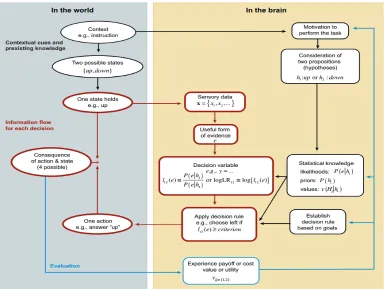
The elements of decision process are described in terms of probability theory in Figure 1 [15]. In other words, a simple decision element between the two alternatives, the left represents the elements of the world. Right represents the element of the brain's decision process. The black element sets the situation. The red elements form crystals. The blue element evaluates and, if possible, updates the decision process [15].
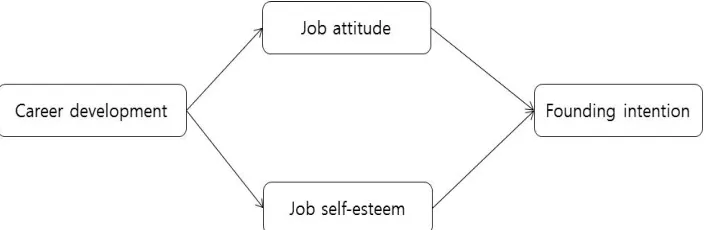
Based on the above research, hypothesis and the research model were set as follows.
Hypothesis1. Career development will have a positive effect on job attitude.
Hypothesis2. Career development will have a positive effect on job self-esteem.
Hypothesis3. Job attitude will have a positive effect on founding intention.
[image:3.612.131.485.243.358.2]Hypothesis4. Job self-esteem will have a positive effect on founding intention.
Figure 2: Conceptual Construct of Research Model
3. METHODOLOGIES
3.1 Data Sets
This study is based on the Youth Panel
Survey provided by Korea Employment
Information Service. This survey is conducted to collect basic data reflecting the school life, social and economic activities, and household background of young people, and to contribute to the
establishment of employment policy and
development of related research for youth unemployment relief. The youth panel survey has
been undergoing a follow - up survey since the preliminary survey in 2001.
The data used in this study are data on youth panel data of the Korea Employment Information Service in 2014. This study selected only four-year college students to minimize variance among respondents. We also excluded missing data for the items. Table 1 shows the characteristics of the sample based on the number of respondents.
Table 1: Characteristics of respondents
Gender Senior Junior Sophomore Freshman Total
Male 272 198 132 20 622
(%) (27.5) (20.0) (13.3) (2.0) (62.8)
Female 263 83 19 3 368
(%) (26.6) (8.4) (1.9) (0.3) (37.2)
Total 535 281 151 23 990
(%) (54.0) (28.4) (15.3) (2.3) (100.0)
3.2 Operational Definition of Variable
In this study, the dependent variable is the intention of founding. And the independent
variables are job attitude, job self-esteem, and career development.
5990 This variable was measured by binomial scale (1=founding, 0=no founding). The self-esteem for job was defined by degree of believing himself/herself relate to work. And this was measured by 2 items ‘I can overcome any difficult situation’, and ‘I can analyze exactly what went well or wrong’ (strongly no=1, strongly yes=6). The attitude of job was measured by the attitude of
social recognition and achievement (very not important=1, very important=5).
And, the development of career was
measured by three items ‘I make a plan before start
[image:4.612.89.526.206.387.2]work’, ‘I have a clear career plan for my age’, and ‘I think about what career is promising in the future’ (strongly no=1, strongly yes=6).
Table 2: Operational Definition of Variable
Variable Definition Measure
Founding intention
(FI) Firm type someone want work for in the future
founding=1, no founding=0
Career development (CD)
Make a plan before start work
strongly no=1, strongly yes=6 Have a clear career plan for my age
Think about what career is promising in the future
Job attitude (JA)
Attitude of social achievement for job very not important=1, very important=5 Attitude of social recognition for job
Job self-esteem (JS)
Can overcome any difficult situation
strongly no=1, strongly yes=6 Can analyze exactly what went well or wrong
4. RESULTS
4.1 Characteristics of Variable
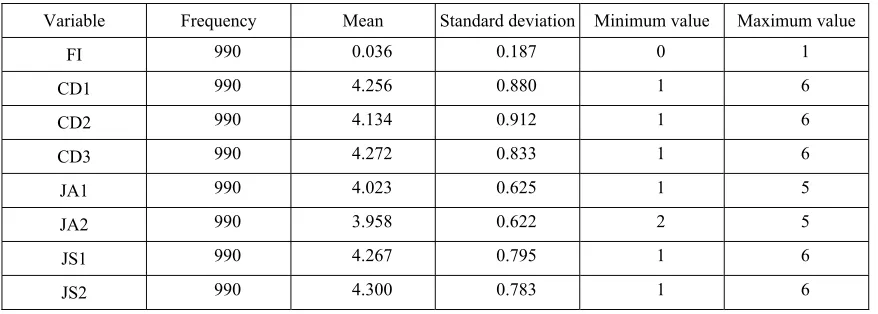
The mean of each variable was as follows. The mean of founding intention (FI) was 0.036, Career development (CD) was 4.134 to 4.272, Job
attitude (JA) was 3.958 to 4.023, and Job self-esteem (JS) was 4.267 to 4.300. In this analysis, founding intention (FI) was very low (M=0.036, STD=0.187), because it was based on university students only.
Table 3: Statistics of Variable
Variable Frequency Mean Standard deviation Minimum value Maximum value
FI 990 0.036 0.187 0 1
CD1 990 4.256 0.880 1 6
CD2 990 4.134 0.912 1 6
CD3 990 4.272 0.833 1 6
JA1 990 4.023 0.625 1 5
JA2 990 3.958 0.622 2 5
JS1 990 4.267 0.795 1 6
JS2 990 4.300 0.783 1 6
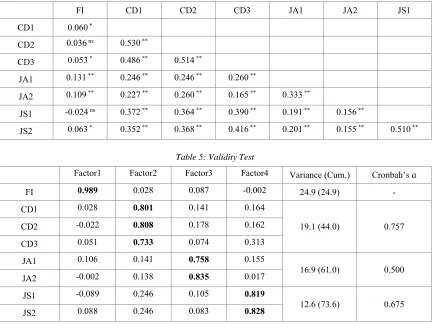
In the correlation analysis between each variable, there was a significant correlation in overall. However, for some variables such as CD2 and JS1, correlation with founding intention (FI) was not significant. In general, the correlation coefficient is positive, ranging from 0.1 to 0.5.
4.2 Validity of Measurement
[image:4.612.88.527.489.646.2]5991 0.5, indicating that there is an internal consistency marginally. In addition, since the factor loadings of each variable are over 0.5 and they are loaded
meaningfully, it is judged that there is the discriminant validity between items. So we used these variables in the research model.
Table 4: Correlation between Variables
FI CD1 CD2 CD3 JA1 JA2 JS1
CD1 0.060 *
CD2 0.036 ns 0.530 **
CD3 0.053 * 0.486 ** 0.514**
JA1 0.131 ** 0.246 ** 0.246** 0.260**
JA2 0.109 ** 0.227 ** 0.260** 0.165** 0.333**
JS1 -0.024 ns 0.372 ** 0.364** 0.390** 0.191** 0.156 **
[image:5.612.91.526.153.482.2]JS2 0.063 * 0.352 ** 0.368** 0.416** 0.201** 0.155 ** 0.510**
Table 5: Validity Test
Factor1 Factor2 Factor3 Factor4 Variance (Cum.) Cronbah’s ɑ
FI 0.989 0.028 0.087 -0.002 24.9 (24.9) -
CD1 0.028 0.801 0.141 0.164
19.1 (44.0) 0.757 CD2 -0.022 0.808 0.178 0.162
CD3 0.051 0.733 0.074 0.313 JA1 0.106 0.141 0.758 0.155
16.9 (61.0) 0.500 JA2 -0.002 0.138 0.835 0.017
JS1 -0.089 0.246 0.105 0.819
12.6 (73.6) 0.675 JS2 0.088 0.246 0.083 0.828
4.3 Results of Empirical Analysis
Before conducting this analysis, we examined the precedence and trailing relationship of variables under the conceptual research structure set in the hypothesis.
The analysis result appeared that job attitude had influence on founding intention significantly (p<.000, β=.187). Also, career development had influence on a job attitude significantly (p<.000, β=.557). This result implies
that a career development and job attitude are required for IT pre-entrepreneur.
In this model, the indirect effect of career development on founding intention was 0.104.
Table 6: The Mediation Effect of Job Attitude on Founding Intention
Path Coefficient (β) S.E t-value p-value Career development → Job attitude 0.557 0.037 9.419** 0.000
Job attitude → Founding intention 0.187 0.021 4.234** 0.000
p=0.106, df=8, χ2=13.189, χ2/df=1.649, AGFI=0.988, GFI=0.996, NFI=0.987, RMR=0.007, CFI=0.995,
5992
Table 7: Effect Type on Job Attitude and Founding Intention
Career development Job attitude
Direct Indirect Total Direct Indirect Total Job attitude 0.557 0.000 0.557 0.000 0.000 0.000 Founding intention 0.000 0.104 0.104 0.187 0.000 0.187
JA1 0.000 0.302 0.302 0.543 0.000 0.543
JA2 0.000 0.347 0.347 0.623 0.000 0.623
CD1 0.683 0.000 0.683 0.000 0.000 0.000
CD2 0.750 0.000 0.750 0.000 0.000 0.000
CD3 0.710 0.000 0.710 0.000 0.000 0.000
On the other hand, career development had influence on a self-esteem significantly (p<.000, β=.676), but self-esteem had not influence on
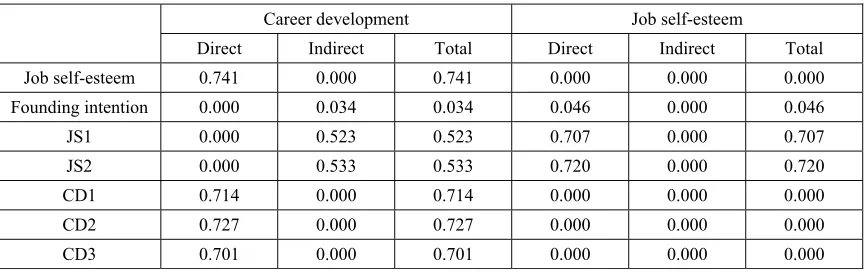
founding intention significantly (p<.220, β=.015). In this model, the indirect effect of career development on founding intention was 0.034.
Table 8: The Mediation Effect of Self-esteem on Founding Intention
Path Coefficient (β) S.E t-value p-value Career development → Self-esteem 0.676 0.048 13.996** 0.000
Self-esteem → Founding intention 0.015 0.012 1.228 0.220 p=0.010, df=8, χ2=20.002, χ2/df=2.500, AGFI=0.982, GFI=0.993, NFI=0.985, RMR=0.009, CFI=0.991,
**p<0.01
Table 9: Effect Type on Self-esteem and Founding Intention
Career development Job self-esteem
Direct Indirect Total Direct Indirect Total Job self-esteem 0.741 0.000 0.741 0.000 0.000 0.000 Founding intention 0.000 0.034 0.034 0.046 0.000 0.046
JS1 0.000 0.523 0.523 0.707 0.000 0.707
JS2 0.000 0.533 0.533 0.720 0.000 0.720
CD1 0.714 0.000 0.714 0.000 0.000 0.000
CD2 0.727 0.000 0.727 0.000 0.000 0.000
CD3 0.701 0.000 0.701 0.000 0.000 0.000
To understand the relative influence of the variables, the structural equation model analysis was performed. In this analysis, the relationship between variables was similar to the above analysis. However, the relative size was different. In other words, career development showed a significant influence on job attitude (β=.357, p<.01) and job self-esteem (β=.668, p<.01). And its effect on job self-esteem was larger than job attitude. On the other hand, in the relation of the founding intention, job attitude affects founding intention, but job self-esteem does not.
This result means that although job self-esteem can be improved through career
development, it cannot improve founding intention through improved job self-esteem. Therefore, it needs to make efforts to improve job attitude in order to induce their founding intention in IT industry.
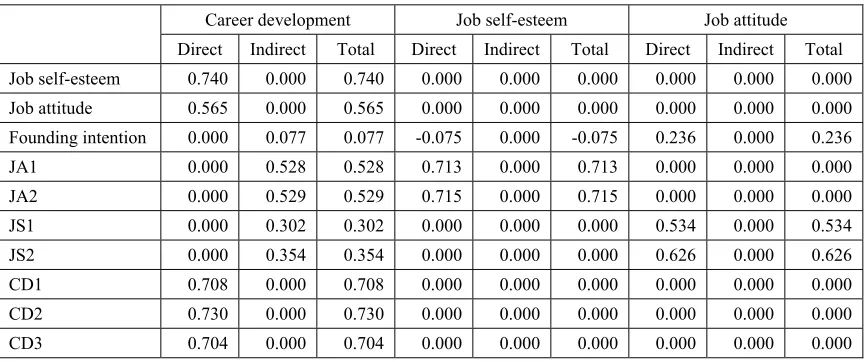
In last model, the indirect effect of career development on founding intention was 0.077, and job self-esteem -0.075, job attitude 0.236 respectively.
[image:6.612.91.524.408.545.2]5993
Figure 3: Result of Structural Equation Model
Table 10: Result of Research Model by Structural Equation Modeling
Path Coefficient (β) S.E t-value p-value Career development → Job attitude .357 .036 9.852** 0.000
Career development → Job self-esteem .668 .047 14.080** 0.000
Job attitude → Founding intention .113 .027 4.141** 0.000
Job self-esteem → Founding intention -.025 .016 -1.599 0.110 χ2=29.958, df=17, χ2/df=1.76, p=0.027, GFI=0.992, AGFI=0.984, CFI=0.992, NFI=0.982, RMR=0.009,
[image:7.612.91.524.424.605.2]**p<0.01
Table 11: Effect Type on Self-esteem, Job Attitude, and Founding Intention
Career development Job self-esteem Job attitude Direct Indirect Total Direct Indirect Total Direct Indirect Total Job self-esteem 0.740 0.000 0.740 0.000 0.000 0.000 0.000 0.000 0.000 Job attitude 0.565 0.000 0.565 0.000 0.000 0.000 0.000 0.000 0.000 Founding intention 0.000 0.077 0.077 -0.075 0.000 -0.075 0.236 0.000 0.236 JA1 0.000 0.528 0.528 0.713 0.000 0.713 0.000 0.000 0.000 JA2 0.000 0.529 0.529 0.715 0.000 0.715 0.000 0.000 0.000 JS1 0.000 0.302 0.302 0.000 0.000 0.000 0.534 0.000 0.534 JS2 0.000 0.354 0.354 0.000 0.000 0.000 0.626 0.000 0.626 CD1 0.708 0.000 0.708 0.000 0.000 0.000 0.000 0.000 0.000 CD2 0.730 0.000 0.730 0.000 0.000 0.000 0.000 0.000 0.000 CD3 0.704 0.000 0.704 0.000 0.000 0.000 0.000 0.000 0.000
5. DISCUSSION
This study analyzed the relationship between psychological perception of self and behavioral intentions toward founding for the purpose of exploring the IT pre-entrepreneur’s cognitive mechanism in entrepreneurial decision-making information system. And this study expanded the result of previous study of IT pre-entrepreneur [16-17].
5994 students can change attitude of job through education of career development, and it can induce founding from IT pre-entrepreneurs. Third, career development positively influences on job self-esteem, however job self-esteem has nonsignificant effect on intention of founding. This suggests that education of career development can enhance self-esteem. But, it is difficult to induce founding from IT pre-entrepreneurs. Therefore, it is necessary to make efforts to improve job attitude rather than job self-esteem in order to activate start-up business of IT pre-founder.
This study has important implications for analyzing the cognitive mechanism in the IT pre-entrepreneur’s decision-making process. So this study is expected to help the development of entrepreneurial decision making information system for startup. However, this study has some limitations that did not reflect various respondents to university students only.
ACKNOWLEDGMENTS
This research was supported by 2016 Entrepreneurship Research Program through the Sookmyung Women's University Entrepreneurship Center (SEC) funded by the Small and Medium Business Administration University Entrepreneurial Center.
REFRENCES:
[1] Krueger, N., “The impact of prior entrepreneurial exposure on perceptions of new venture
feasibility and desirability”, Entrepreneurship:
Theory and practice, Vol. 18, No. 1, 1993, pp.
5-22.
[2] Ajzen, I. and M. Fishbein, Understanding Attitudes and Predicting Social Behavior, New Jersey, Pearson, 1980.
[3] Ajzen, I. and M. Fishbein, Equity in Attitude Formation and Change, in J. Greenberg and R. L. Cohen (eds.), Equity and Justice In Social Behavior, New York, Academic Press, 1982. [4] Krueger, N. F., M. D. Reilly, and A. L. Carsrud,
“Competing Models of Entrepreneurial
Intentions”, Journal of Business Venturing, Vol.
15, No. 5, 2000, pp. 411-432.
[5] Bandura, A., “Social Cognitive Theory: An
Agentic Perspective”, Annual Review of
Psychology, Vol. 52, 2001, pp. 1-26.
[6] Shane, Scott, and Rakesh Khurana. “Bringing individuals back in: the effects of career
experience on new firm founding”, Industrial
and corporate Change, Vol. 12, No. 3, 2003, pp.
519-543.
[7] Fishbein, M. and I. Ajzen, Belief, Attitude, Intention, and Behavior: An Introduction to Theory and Research, New York: Addison-Wesley, 1975.
[8] Veciana, J. M., M. Aponte, and D. Urbano,
“University Student's Attitudes towards
Entrepreneurship: A Two Countries
Comparison”, International Entrepreneurship
and Management Journal, Vol. 1, No. 2, 2005,
pp. 165-182.
[9] Van Gelderen, M., M. Brand, M. Van Praag, W. Bodewes, E. Poutsma, and A. Van Gils, “Explaining Entrepreneurial Intentions by Means of the Theory of Planned Behaviour”,
Career Development International, Vol. 13, No.
6, 2008, pp. 538-559.
[10] Schwarz, E. J., M. A. Wdowiak, D. A. Almer-Jarz, and R. J. Breitenecker, “The Effects of
Attitudes and Perceived Environment
Conditions on Students' Entrepreneurial Intent”,
Education Training, Vol. 51, No. 4, 2009, pp.
272-291.
[11] Turker, D. and S. S. Selcuk, “Which Factors Affect Entrepreneurial Intention of University
Students”, Journal of European Industrial
Training, Vol. 33, No. 2, 2009, pp. 142-159.
[12] Franco, M., H. Haase, and A. Lautenschläger, “Students' Entrepreneurial Intentions: An
Inter-Regional Comparison”, Education Training,
Vol. 52, No. 4, 2010, pp. 260-275.
[13] Schwarz, E. J., Wdowiak, M. A., Almer-Jarz, D. A., & Breitenecker, R. J., “The effects of attitudes and perceived environment conditions on students' entrepreneurial intent: An Austrian
perspective”, Education+ Training, Vol. 51, No.
4, 2009, pp. 272-291.
[14] Zellweger, Thomas, Philipp Sieger, and Frank Halter, “Should I stay or should I go? Career choice intentions of students with family
business background”, Journal of Business
Venturing, Vol. 26, No.5, 2011, pp. 521-536.
[15] Gold, J. I., & Shadlen, M. N. (2007). The neural basis of decision making. Annu. Rev. Neurosci., 30, 535-574.
[16] Moon, J., K. Ohk, S. Park, J. Hong, The Pre-entrepreneur’s Decision Process on Founding, 2nd International Conference on Intelligent Information System and Technology (ICIIST 2017), Qingdao, China, February, 2017.
[17] Ohk, K., J. Hong, “Analysis of Start-up Environment in Start-up Decision Process for
prep Entrepreneur”, International Journal of
IT-based Management for Smart Business, Vo. 4,