Smith, Tim J. (2010) Film (cinema) perception.
In:
Goldstein, B.E.
(ed.)
Encyclopedia of Perception.
Thousand Oaks, U.S.: Sage.
ISBN
9781412940818.
Downloaded from:
Usage Guidelines:
Film (Cinema) Perception
Film (Cinema) perception refers to the sensory and cognitive processes employed
when viewing scenes, events, and narratives presented in edited moving-images.
Dynamic visual media such as film and television have increasingly become an integral
part of our everyday lives. Understanding how our perceptual system deals with the
differences between these mediated visual experiences and the real-world helps
understand how perception works in both situations. There are many differences between
film and reality but this entry will focus on three:
1. Film creates the illusion of motion through the rapid presentation of still images.
2. Film creates the illusion of continuity across a cut.
3. Film represents scenes and events across edited sequences of shots filmed at
different places and times.
While this list is not exhaustive these three differences are critical for understanding
how we perceive film. This entry will provide a brief overview of these differences and
current theories about how they are dealt with by our perceptual system.
Moving Pictures
Movies consist of a series of still images, known as frames projected on to a screen
at a rate of 24 frames per second. Even though the frames are stationary on the screen and
are momentarily blanked as a new frame replaces the old we experience film as a
continuous image containing real motion. The two perceptual phenomena contributing to
Persistence of vision refers to the continued perception of light – resulting in an
‘after image’ - after the stimulus light has been turned off. During film projection the
light is obscured by the closing of a shutter as the film moves from one frame to the next.
This creates an alternation between light (shutter open – frame projected) and darkness
(shutter closed) 24 times per second. Persistence of vision “fills in” the dark interval, but
only partially, because a shutter rate of 24 frames per second results in a noticeable
flicker. Early film used shutter rates between 12 and 24 frames per second earning them
the nickname ‘The Flicks’. Modern film projectors eradicate this flicker by blanking each
frame three times increasing the flicker rate above the critical flicker fusion rate of 60 Hz
and ensuring that the perception of light is continuous due to persistence of vision.
The motion we perceive in film is apparent because it is based on static visual
information not real motion. Apparent motions can be broadly classified as long-range
and short-range according to the conditions under which they are perceived. Long-range
apparent motions, such as beta movement are perceived when two objects are alternately
presented at two different locations around 10 times a second. The two objects are
perceived as a single object moving smoothly between the two locations. Because of the
slow rate of presentation and the large distances covered by the apparent motion,
long-range apparent motions are thought to be processed late in the visual system and require
inferences based on knowledge of real motion and the most likely correspondences
between objects in the image sequence.
Short-range motions occur when static images depicting only slight differences in
understand the motion and is the same system used to perceive real motion. It is
commonly believed that the apparent motion perceived in films is beta movement.
However, while beta movement, along with other long-range motion phenomena such as
apparent rotations and transformations may occur during film perception they cannot
account for the majority of motion perceived in film. The 24Hz presentation rate used in
film is too fast for long-range motion and film frames are too complex, making the task
of identifying corresponding objects in subsequent frames too difficult. Instead, apparent
motion in film is due to the same short-range motion system used to detect real motion.
Motion detectors in the early visual system respond in the same way to the retinal
stimulation caused by real motion and by rapidly presented (>13Hz) static images that
depict only slight differences in object location. This results in a sensory experience of
film that is indiscernible from reality.
Editing and the illusion of continuity
In film, we perceive scenes and events as continuous even though they are
presented across multiple viewpoints that change instantaneously across edits. This
illusion is referred to as continuity. The mismatch between the psychologically perceived
continuity and the spatiotemporally discontinuous nature of the visual information was
first noted by the psychologist Hugo Münsterberg in 1916. Münsterberg hypothesised
that some of these violations are acceptable because a cut away to a different viewpoint
within a scene mirrors the attentional shift a viewer would naturally perform when
observing the same scene in the real-world.
If an edit is to function as an analogue for an attentional shift the viewer needs to be
depicted scene. Such a constructivist account of film was advocated by Julian Hochberg
and Virginia Brooks. They suggested that questions arising from the events depicted in
the previous shot motivate a cut to a shot that answers the question and allows the viewer
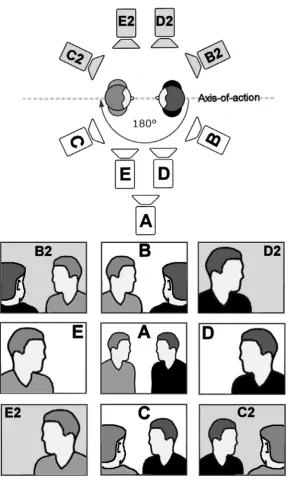
to conceptually link the two shots. For example, when filming the conversation depicted
in Figure 1, a cut between shot B and C can be motivated by a sudden head-turn of the
character in black, creating the perceptual enquiry: “Is he about to speak?”. Recent
evidence by Tim Smith and John Henderson has shown that when cuts are preceded by
motion onsets viewers orient quicker to the content of the new shot and are less aware of
the editing compared to cuts without such attentional cues. Smith and Henderson named
this phenomenon edit blindness.
Editing conventions (such as the 180º rule depicted in Figure 1) rely heavily on our
natural tendency to attend to social features of dynamic visual scenes. Tim Smith has
shown that when multiple viewers are presented with videos of real-world scenes their
attention will synchronize as they attend to people and track them over time. This
attentional synchrony enables film editors to predict where multiple viewers will attend
in order to replicate their attentional shifts through editing. Recent neuroimaging
evidence has also indicated that this synchronization may extend to how the film is
processed. Uri Hasson and colleagues used neuroimaging to record the brain activation of
multiple viewers while watching feature films. They observed a high degree of
synchronization in brain regions responsible for such processes as language
comprehension, emotion, and face perception. While such synchronization does not
idea that there is a high degree of consistency in the perceptual enquiries we employ
[image:6.595.167.457.156.643.2]when processing dynamic visual scenes.
Figure 1: The 180° editing rule. Once the space of the scene has been established by
The perceptual construction of space
One of the assumed benefits of adhering to classical editing conventions is that they
aid viewer comprehension of the depicted space. For example, the 180 rule states that
when filming a scene all shots should be filmed from the same side of the axis of action,
e.g. the line joining the characters involved in the conversation. Any sequence which
crosses the line (e.g. a cut from a white to a gray camera; Figure 1) is believed to confuse
the viewer and lead to disorientation. This hypothesis has received support from an
experiment conducted by Uta Frith and Jocelyn Robson. Children were presented with
simple films that either adhered to or broke the 180º rule. They found that the children
who saw the conventional version were able to reconstruct the film more accurately than
children shown the unconventional version. Hochberg & Brooks explained such an effect
as evidence of the viewer’s inability to construct a coherent spatial representation of the
scene because A) crossing the line removes landmarks such as background features
which would normally be used to identify the relationship between shots and B) violates
viewer expectations about the location and direction of objects on the screen such as the
left-right relationship of the conversational partners in Figure 1.
However, recent evidence from Dan Levin & Dan Simons has questioned the
degree to which we attend to, encode, and monitor details within a film. Participants were
shown a video depicting two people having a conversation. Every time a cut to a new
shot occurred at least one continuity error was inserted such as the disappearance of a
scarf. When participants first watched the film without being told that there might be a
viewers failed to notice that the actress changed across the cut. Levin & Simons
interpreted these findings as indicating that, rather than maintaining a highly detailed and
coherent representation of the depicted scene viewers only encode a small amount of the
depicted visual information. Instead, continuity of space and time is assumed and
perceptual inferences about the location and form of minimal details such as people and
their movements are monitored to test the validity of the continuity assumption. If this
inferred continuity hypothesis is true, the role of the editing conventions may be to
facilitate these perceptual inferences and ensure that they can be satisfied following a cut.
One important condition for continuity seems to be the location of objects on the
screen. d’Ydewalle and colleagues recorded viewer eye movements while they watched
videos edited with or without violations of the 180 rule. They observed a peak in saccadic
eye movements (i.e. attentional search) following cuts which violated the rule. They
concluded that viewers anticipate the screen location of objects and when these
expectations are violated (e.g. a cut from B to C2 in Figure 1) viewers have to repair their
representation, leading to a break in perceived continuity. The critical nature of
attentional shifts across cuts for the inference of continuity was formalized by Tim Smith
as the Attentional Theory of Continuity Editing. Viewer attention throughout a film
specifies which visual features are represented in memory, how perceptual enquiries are
formulated and tested and whether continuity can be inferred from the satisfaction of
minimal expectations across cuts.
Modern cinema and television are an integral part of our everyday lives. However,
have received very little psychological attention. With new psychological methods such
as eye tracking and neuroimaging at our disposal perhaps now is the time for
Münsterberg’s 1916 declaration of film as the domain of the psychologist to finally come
true.
Dr. Tim J. Smith
University of Edinburgh
See also Art and perception, Attention, Change detection, Depth perception in
pictures/film, Event perception, Motion perception
Further Readings and References
d'Ydewalle, G., Desmet, G., & Van Rensbergen, J. (1998). Film Perception: The
processing of film cuts. G. Underwood (Ed.), Eye guidance in reading and scene
perception (pp. 357-367). Oxford: Elsevier.
Frith, U., & Robson, J. E. (1975). Perceiving the language of films. Perception, 4(1),
97-103.
Hasson, U., Landesman, O., Knappmeyer, B., Vallines, I., Rubin, N., & Heeger, D. J.
Hochberg, J., & Brooks, V. (1978). The Perception of Motion Pictures. In E. C.
Carterette, & M. P. Friedman (Eds.), Handbook of Perception, Vol. X. (pp. 259-304).
New York: Academic Press.
Levin, D. T., & Simons, D. J. (2000). Perceiving stability in a changing world:
Combining shots and integrating views in motion pictures and the real world. Media
Psychology, 2, 357-380.
Münsterberg, H. (1916). The Photoplay: A Psychological Study. New York: D. Appleton
and Company.
Smith, T. J. (2006) An Attentional Theory of Continuity Editing. Doctoral thesis.
University of Edinburgh.
http://homepages.inf.ed.ac.uk/s9732397/publications/smith_ATOCE_2006.pdf
Smith T. J. & Henderson J. M. (2008) Edit Blindness: The relationship between attention
and global change blindness in dynamic scenes. Journal of Eye Movement Research
2, 1-17.