5273
3D MEDICAL IMAGE VISUALIZATION AND VE MODEL TO
DETERMINE THE PATHOLOGY ZONE OF TUMOR
EVIDENCE-BASED USING SOME NUMERICAL METHODS
AND SIMULATION
1NORMA ALIAS, 2YASEEN ALWESABI, 1MAIZATUL NADIRAH MUSTAFFA,
1SHAMYSHATU, 1WALEED MUGAHED AL-RAHMI
1Ibnu Sina Institute for Scientific &Industrial Research (ISI-SIR), Faculty of Science, Universiti Teknologi
Malaysia, 81310, UTM Skudai, Johor, Malaysia
2Department of Systems Science and Industrial Engineering, State University of New York at Binghamton,
Binghamton, NY 13902, USA
E-mail: [email protected], 2[email protected], 1[email protected],
ABSTRACT
This paper presents some integrated mathematical modeling and simulation for visualizing a 3D medical image and estimating the volume of tumor growth. Thus, these two indicators will determine the pathology zone and to provide revised evidence-based on tumor histology, location, growth and the treatment effect. There are three phases of modeling and simulation for volume visualization of the 3D tumor. The first phase is converting from 2D signal images to 2D digital images based on edge detection of the tumor. Geodesic Active Contour (GAC) model based on additive operator splitting (AOS) will be used to detect the contour line of a brain tumor on 2D images. The second phase is pre-constructing of 3D digital image from the 2D images by applying two numerical models such as an image manifold model (IM) and volume estimation model (VE). The third phase is implementing the numerical simulation and visualizing the 3D medical image on a hardware and software computational platform. The numerical comparison of VE and IM will be investigate using some performance measurements and interpretation in terms of VE, RMSE, run time and computational complexity cost. In this case study, the medical image is based on a set of 2D MRI brain tumor images from Kubang Krian Hospital Malaysia (HKK). The numerical results will determine the pathology zone and to provide revised evidence-based on tumor informatics. As a conclusion, this paper proof an alternative numerical model is superior to construct and visual the 3D medical images. Thus, volumetric image estimation from the 2D image and extended to a 3D volume image is essential for accurate evaluation of the high resolution 3D medical images.
Keywords: Pathology Zone, Numerical Simulation, edge detection, 3D Visualization
1. INTRODUCTION
The previous research [1] was focused on high resolution of 2D GIS and medical images by using AOS and GAC techniques. Some multi-dimensional partial difference equation with parabolic type has been used for visualizing the tumor growth in 2D and 3D [1-3]. The validation of most of the modeling and simulation has based the set of 2D MRI medical images from HKK. The previous research is limited to governing the advance mathematical modelling as the tool of prediction of the tumor growth. Based on this limitation, this paper proposes some integrated
5274 to estimating the volume of tumor growth via visualization of a 3D digital?. The algorithm for edge detection on MRI image is proposed by [30]. An excellent study on AOS has been done in [10-13].
Our goal is to build a fast and reliable model to measure the volume of tumor and determine the pathology zone of tumor evidence-based, based on the GAC-AOS technique. Most of this work has been done with 2D medical images. Based on this limitation, we propose to select and combine images by constructing the 3D medical image visualization using manifold model. A classical snakes model originally works by [14] has been improved to give a stable boundary detection, which is known as GAC model based on semi-implicit AOS scheme. Thus, the manifold model is capable of smoothing and de-noising the boundary detection of image patterns of pathology zone from medical scans.
Generally, the manifold model is a generative model for the high dimensional medical image. Some manifold model has been established in the recent image literature [15]. The manifold model has been successfully employed by Davis et al as a feature to estimate the structural changes caused by aging. However, in practice, it is difficult to compute the geodesic distance directly in the high-dimensional space. To overcome the difficulty, [15] implemented high-dimensional data onto the low-dimensional manifold space [16-18]. In addition, it has been shown that the implementing of geodesic distance in high-dimensional manifold space can yield more accurate measurement computational of the similarity between images [15] and AOS scheme provides near the execution time for the shape completion [19]. In terms of that, it motivates us to visualize the 3D medical image and determine the pathology zone of tumor evidence-based using manifold models evidence-based on GAC-AOS techniques.
The main interest of this paper is to estimate the volume of medical images using manifold model and VE model. This leads a series of this paper where we are starting with detection of pathology zone of tumor evidence, then smoothing and measure the volume of the tumor using manifold models compare with VE model. VE of the tumor is important in many neurological applications [20], thus it becomes an interesting research for a mathematician to apply mathematical approaches into medical applications. Manifold model and VE model are an effective technique in image analysis and 3D medical image construction. Based on embedding 2D images, IM model maps 2D images
into a 3D image [21-24]. Likewise, VE model provides the practical improvements to the reliability of medical diagnosis process by constructing the 3D visualization of brain tumors [25]. The selected contour line of 2D MRI brain tumor images will be used to construct the 3D image by applying the IM and VE models.
This paper has three phases which organized as follows: The first phase is converting from 2D signal images to 2D digital images which will be explained more in Section 2. The second phase consists of constructing 3D digital image from the 2D images using the IM model and VE model. The third phase is the implementation of numerical simulation and 3D medical image visualization. A set of numerical result and discussion are provided in Section 5. Finally, we conclude our work in Section 6.
2. EDGE DETECTION MODELING FOR
DIGITAL 2D IMAGE
The first phase of this work consists of converting from 2D signal images to 3D digital images based on edge detection of the tumor. The process of pathology zone extraction in some cases is very difficult and time-consuming. In order to decrease the computation time, we extracted the region of interest around the image center with the size of 256×256 pixels. MATLAB software was used to carry out the extraction process. The pixels of 2D brain tumor images will be decomposed by Geodesic Active Contour (GAC) model based on additive operator splitting (AOS). Thus, GAC-AOS will use to detect the contour line of a brain tumor on 2D images.
Geodesic active contour (GAC) model was first introduced by [26] as a segmentation framework, derived from energy-based snake active contours and performing contour extraction via the computation of geodesic. We use the GAC model to detect the pathology zone of tumor evidence-based. The model was given by:
v ug(x)u u x g div u t
u
on
)
,
0
(
x
(1)Subject to
u
(
x
,
0
)
u
0
x
on ,(2)
where u to controls the interior and
5275 point increase proportionally to the algebraic
curvature, v is a positive real constant and a
correction term and g
x is the stopping function.Then, an additive operator splitting (AOS) model is employed to further improve the efficiency of the flow-field smoothing by doing some modification on a implicit scheme. Modifying the semi-implicit scheme:
km I k I k u u A I
u . .
1 1 1
(3) We get
k m I k I k u u A m I mu 1. . . .
1 1 1
(4) GAC-AOS model is the integrating modeling between GAC model and AOS model [13]. The AOS model will overcome the weaknesses of GAC model where the AOS model derives to the linear system of equations in the formof a matrix; Au f as stated in the equation
below.
The evaluation in x-direction [1, 27],
x
u
u
v
g
u
x
u
x
u
k j i k j i k j i k j i g u k j i g u k j i k j i k j i g u k j i g u k j i k j i k g u k g u k , , 1 1 , , 1 , , 1 1 , , 1 , , 1 , ) (2
2
2
2
2
2
1
I N J I J I (5)The evaluation in y-direction [30] [2],
u
y
u
u
v
g
y
u
y
u
k j i k j i k j i k j i g u k j i g u k j i k j i k j i g u k j i g u k j i k j i k g u k g u k , , 1 , 1 , , 1 , 1 , 1 , , 1 , 1 , ) (2
2
2
2
2
2
1
I N J I J I (6) In this case study, the medical image is based on a set of 2D MRI brain tumor images from Kubang Krian Hospital Malaysia (HKK). The 3D image was produced from 2D images slices. To build a 3D image we have to convert the signal data from MRI image to a digital data based on the Partial Differential Equation (PDE) involving Boundary Value Problem (BVP) of (6):1
0
,
2 2
t
f
u
t
u
and
0
(7)
Definitely, the centered difference
5276
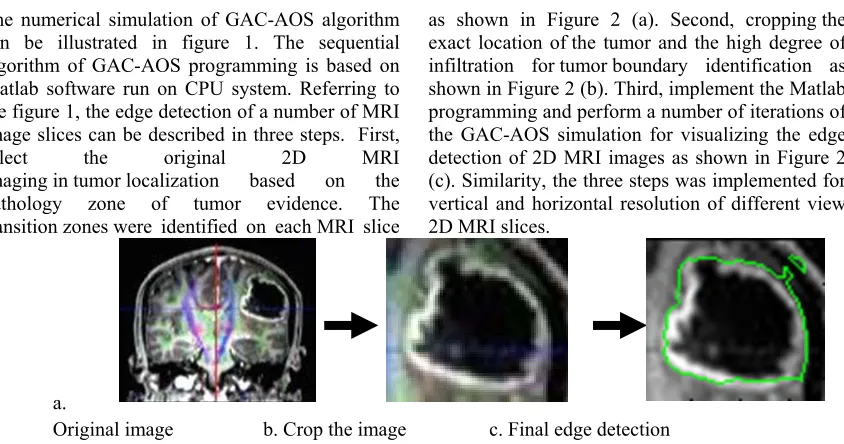
Figure 1: Flow chart of the GAC-AOS algorithm on 2D MRI images image
The numerical simulation of GAC-AOS algorithm can be illustrated in figure 1. The sequential algorithm of GAC-AOS programming is based on Matlab software run on CPU system. Referring to the figure 1, the edge detection of a number of MRI image slices can be described in three steps. First,
select the original 2D MRI
imaging in tumor localization based on the
pathology zone of tumor evidence. The transition zones were identified on each MRI slice
as shown in Figure 2 (a). Second, cropping the exact location of the tumor and the high degree of infiltration for tumor boundary identification as shown in Figure 2 (b). Third, implement the Matlab programming and perform a number of iterations of the GAC-AOS simulation for visualizing the edge detection of 2D MRI images as shown in Figure 2 (c). Similarity, the three steps was implemented for vertical and horizontal resolution of different view 2D MRI slices.
a.
Original image b. Crop the image c. Final edge detection
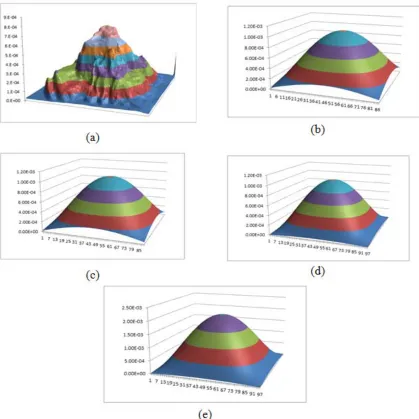
[image:4.612.99.521.484.706.2]5277 Furthermore, previous research has done an edge detection of breast cancer using 2D Helmholtz equation. Figure 2 proved that the equation is successfully applied in visualizing the early detection of breast cancer growth [28]. The four numerical methods were applied for solving
[image:5.612.100.519.167.586.2]the discretization of 2D Helmholtz equation such as AGEB, AGED, GSRB and JB method. The comparison of numerical performance was proven that AGEB is superior in terms of execution time, RMSE, accuracy and convergence rate [28].
Figure 3:
The 2D Helmholtz equation for detecting the breast cancer growth using: (a) MRI image; (b) AGEB; (c) AGED (d) GSRB and (e) JB method3. PREPROCESS OF CONSTRUCTING MODELS FROM 2D IMAGE INTO 3D IMAGE
The second phase is preprocessing of constructing 3D digital image from the 2D images by selecting 2D-images and then applying edge detection technique. Based on two different platforms, namely 3D slicer software and
5278
3.1 IM Model
The IM model describes an approach of 3D model reconstruction from 2D MRI image. There are two main steps have to performed before constructing 3D images. Namely, images selection process and
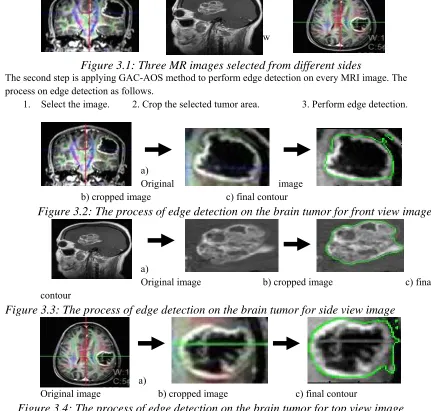
edge detection by using GAC-AOS method. Figure 3 illustrates the image selection by constructing forms from three points of view; front view, side view and top view of 2D MRI images.
a. Front view
[image:6.612.126.475.163.238.2]b. Side view c. Top view
Figure 3.1: Three MR images selected from different sides
The second step is applying GAC-AOS method to perform edge detection on every MRI image. The process on edge detection as follows.
1. Select the image. 2. Crop the selected tumor area. 3. Perform edge detection.
a)
Original image
b) cropped image c) final contour
Figure 3.2: The process of edge detection on the brain tumor for front view image
a)
Original image b) cropped image c) final
[image:6.612.85.516.181.592.2]contour
Figure 3.3: The process of edge detection on the brain tumor for side view image
a)
Original image b) cropped image c) final contour
Figure 3.4: The process of edge detection on the brain tumor for top view image
The full scale of the image after we paste the result in the original image illustrated in Figure 3.5.
[image:6.612.118.501.613.708.2]5279
3.2 VE Model
[image:7.612.102.519.159.320.2]VE model is a robust strategy to visualize 3D medical images and geographical images. This professional technique converts 2D images into a 3D image. The route of converting based on the main following aspects as shown in Figure 5 by [25].
Figure 3.6: Demonstration chart to compute the VE for (a) two brain tumor contours; (b) three brain tumor contours.
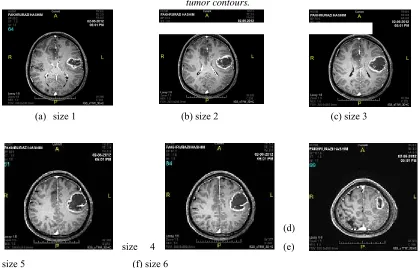
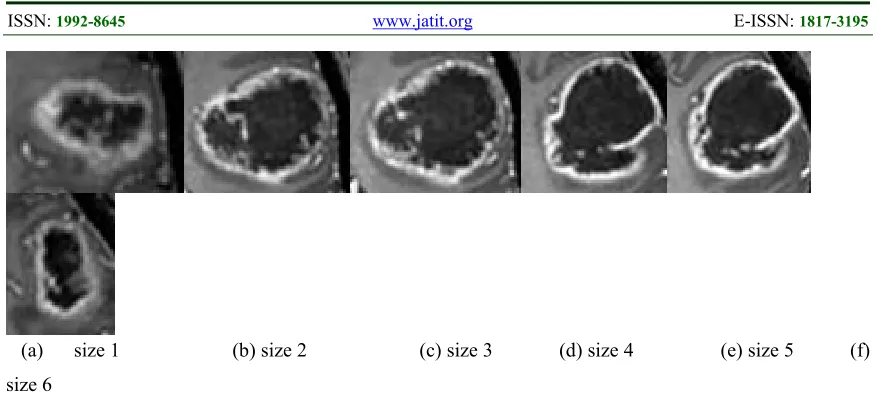
(a) size 1 (b) size 2 (c) size 3
(d)
size 4 (e) size 5 (f) size 6
Figure 3.7: Six real 2D-MRI images selected from different sizes
Figure 3.7 (a) until 3.7 (f) show a brain tumor with six different sizes. The selected images will be used to calculate the volume of the brain tumor. Firstly, we need to apply GAC-AOS method to detect the
[image:7.612.88.508.349.617.2]5280
[image:8.612.87.526.68.265.2](a) size 1 (b) size 2 (c) size 3 (d) size 4 (e) size 5 (f) size 6
Figure 3.8: Six cropped brain tumor at different sizes
Figure 3.8 (a) until 3.8 (f) show the edited brain tumor using crop technique. We need to edit the figure because we need to reduce the time consume during the edge detection process. This is because we have 43 figures of a brain tumor and we need to
run the edge detection process for all the figures. After the processes have been done, then we will select the best figures to perform volume calculation. All the result of edge detection are shown in Figure 3.9 below:
(a) size 1 (b) size 2 (c) size 3 (d) size 4 (e) size 5 (f) size 6
Figure 3.9: Edge detection on a brain tumor at different sizes
Figure 5.3(a) until 5.3(f) show the result of edge detection on a brain tumor. The green line shows the contour of the edge detection. Once we have done with edge detection processes, we need to use these contour to calculate the volume of the tumor. The expected volume of the brain tumor is designed according to the formula:
ni i
v
V
1
(8)
Where n is the number of slices of a brain tumor
contour, and vi is the volume of the zone between
the segments of image slice and it is calculated according to the trapezoid volume formula:
A
A
A
SA
i
n
D
v
i,
1
,
2
,
3
,...,
3
1
2 2 1
1
(9)
Where i is the number of contours. D is the distance
between the two brain tumor contours. A1 is the
areas of a brain tumor contour in slice i. A2 is the
area of a brain tumor contours in slice i +1. Then,
after constructing models from a 2D image into the 3D image, we can precede to the next phase where
we want to prove that the considerationnumerical
method and simulation are enabling to construct and visual the 3D medical images.
4. 3D MEDICAL IMAGE SIMULATION,
CONSTRUCTION, VISUALIZATION
AND VE
The third phase is implementing the numerical simulation and visualizing the 3D medical image on a hardware and software
computational platform. The numerical
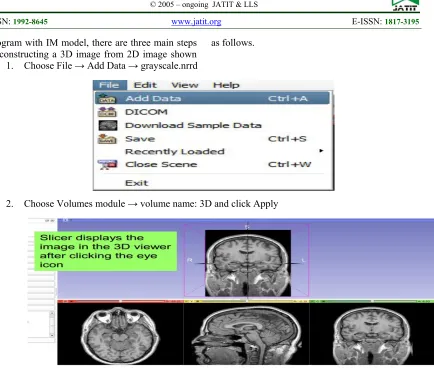
[image:8.612.84.528.364.460.2]5281 program with IM model, there are three main steps
in constructing a 3D image from 2D image shown as follows.
1. Choose File → Add Data → grayscale.nrrd
2. Choose Volumes module → volume name: 3D and click Apply
3. Creating Models: Editor module → choose Master Volume, then select Level number and color in
Edit Selected Label Map window. Click Threshold → choose range, then click Make Model.
Besides, the process of visualization and volume calculations using VE model is illustrated in MATLAB code. Firstly, creating the Matlab file to save all the data including selected images.
[image:9.612.102.536.57.439.2]Secondly, running the programming in Matlab to calculating the volume of a brain tumor by using 3 selected images. Finally, obtaining the volume result as shown in diagram b).
Figure Surface of 3D brain tumor visualization by using VE and IM
5. NUMERICAL RESULTS AND DISCUSSION
The contribution of this paper illustrates
the main characters of both models.
Thus,
volumetricimageestimationfrom the
2Dimageand extended to
3D volume
image isessential for accurate evaluation of the high
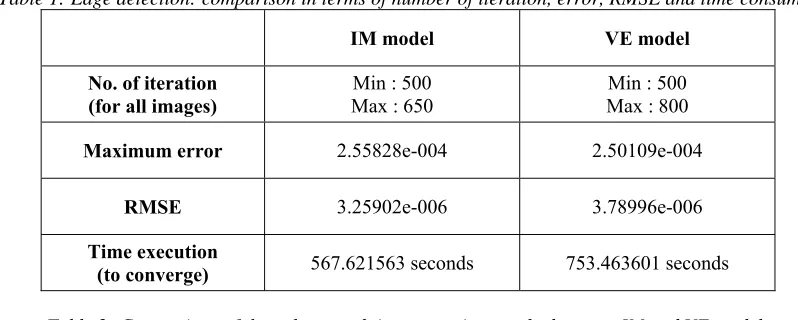
resolution 3D medical images. Additionally, the comparison of the numerical analysis demonstrates the numerical measurements in terms of maximum error, RMSE, volume, and time execution. Table 1 and Table 2 show the comparison of edge detection
5282
and volume computations between IM and VM models.
Table 1: Edge detection: comparison in terms of number of iteration, error, RMSE and time consumes
IM model VE model
No. of iteration
(for all images) Max : 650 Min : 500 Max : 800 Min : 500
Maximum error 2.55828e-004 2.50109e-004
RMSE 3.25902e-006 3.78996e-006
Time execution
[image:10.612.102.501.112.272.2](to converge) 567.621563 seconds 753.463601 seconds
Table 2: Comparison of the volume and time execution results between IM and VE models
The results in Table 1 show that IM is better than the VE in terms of edge detection process. Besides, in terms of maximum error, RMSE, and volume calculation they are comparable. In contrast, VE is better than IM in terms of volume computations as shown in Table 2. Therefore, the results in Table 1 and Table 2 proved that an alternative numerical model is superior to construct and visual the 3D medical images. This study consistent with study via [30] explores two-way relations between visualizations in mathematics and mathematical simulation. In this research we proposed some integrated mathematical modeling and simulation for visualizing 3D digital medical image. Thus, we suggest for future work to more researches on simulation and visualization of 3D of different samples.
6. CONCLUSION
Based on the numerical results above, the
conclusion of this paper is the
volumetric image estimation from a 2D image and extended to the 3D volume image is essential for accurate evaluation of the high resolution 3D
medical images. The three phases are integrated mathematical modeling and simulation for visualizing 3D digital medical image and estimating the volume of tumor growth is well
suited to determine the pathology zone and to provide revised evidence-based on tumor histology, location, growth and the treatment effect. In addition, we have successfully converted the 2D signal images to 2D digital images based on edge detection of the tumor and detect the contour line of a brain tumor on 2D images using GAC-AOS model. Then, the 2D slices images of brain tumor that obtained from the first phase will be constructed into 3D digital image using the IM model and VE model. Thus, by implementing the numerical simulation and visualizing the 3D medical image on a hardware and software computational platform, we obtained results of comparison among IM and VE models. It is shown that VE model is faster than IM to estimate the volume of tumor growth and determine the pathology zone. As a conclusion, this paper proof an alternative numerical model is superior to construct and visual the 3D medical images.
ACKNOWLEDGMENTS
We would like to thank the Research Management Centre (RMC) at Universiti Teknologi Malaysia (UTM) for funding this project under grant number PY/2015/05399 / R.J130000.7826.4F795. We also would like to thank the Ibnu Sina Institute for Scientific and Industrial Research (ISI-SIR), Faculty of Science, Universiti Teknologi Malaysia
for supporting this research.
IM model VE model
Volume 1.953.648 mm3 1.567.432 mm3
Tumor volume 122.103 mm3 97.964,5 mm3
5283
REFERENCES
[1] N. Alias, H. F. S. Saipol, A. C. A. Ghani, and M. N. Mustaffa, “Embedded system for high performance digital temperature sensor on
distributed parallel computer system”,
Advanced Science Letters, 20(2): 2014. pp.
406-411.
[2] N. Alias, N. M. Said, S. N. H. Khalid, D.S.T. Ching, and P.T. Ing, “High performance visualization of human tumor growth software”, 2014, pp 1-18.
[3]R. Shahril, “Two dimensional active contour model on multigrids for edge detection of
images”, Universiti Teknologi Malaysia,
Faculty of Science. PhD Thesis, 2012
[4] K.K. Al-Shayeh, and M.S. Al-Ani, “Efficient 3D Object Visualization via 2D Images”,
International Journal of Computer Science and Network Security (IJCSNS), 9(11): 2009,
pp. 234-239.
[5] A. Angelopoulou, A. Psarrou, J. Garcia-Rodriguez, S. Orts-Escolano, J. Azorin-Lopez, and K. Revett, “3D reconstruction of medical images from slices automatically landmarked with growing neural models”,
Neurocomputing, 150, 2015, pp. 16-25.
[6] M.S. Chung, and S.Y. Kim, “Three-Dimensional Image and Virtual Dissection
Program of the ‘Brain”, Yonsei medical
journal, 41(5): 2000, pp. 299-303.
[7] K.H. Höhne, and W.A. Hanson, “Interactive 3D segmentation of MRI and CT volumes using
morphological operations”, Journal of
computer assisted tomography, 16(2): 1992,
pp. 285-294.
[8] A. G. Schreyer, H. Herfarth, R. Kikinis, J. Seitz, J. Schölmerich, A. Geissler, and S. Feuerbach, “3D modeling and virtual endoscopy of the small bowel based on magnetic resonance imaging in patients with
inflammatory bowel disease”, Investigative
radiology, 37(9): 2002, pp. 528-533.
[9]S. Smith, and I. Williams, “A Statistical Method
for Improved 3D Surface Detection”, Signal
Processing Letters, IEEE, 22(8): 2015, pp.
1045-1049.
[10] D. Barash, M. Israeli, and R. Kimmel, “An Accurate Operator Splitting Scheme for
Nonlinear Difusion Filtering”, Springer,
2001.
[11] P.L. Combettes, and J.-C. Pesquet, “Proximal splitting methods in signal processing, in Fixed-point algorithms for inverse problems
in science and engineering. Springer. 2011,
pp. 185-212.
[12] D. Krishnan, P. Lin, and X. Tai, “An efficient operator splitting method for noise removal in
images”, Commun. Comput. Phys, 1(5):
2006, pp. 847-858.
[13] J. Weickert, B.T.H. Romeny, and M.A. Viergever, “Efficient and reliable schemes for
nonlinear diffusion filtering”, Image
Processing, IEEE Transactions, 7(3): 1998,
pp. 398-410.
[14] M. Kass, A. Witkin, and D. Terzopoulos,
“Snakes: Active contour models”,
International journal of computer vision, 1(4):
1988, pp. 321-331.
[15] Y. Cao, Y. Yuan, X. Li, B. Turkbey, P.L. Choyke, and P. Yan, “Segmenting images by combining selected atlases on manifold”,
Medical Image Computing and Computer-Assisted Intervention–MICCAI 2011.
Springer. 2011, pp. 272-279.
[16] J.B. Tenenbaum, V. De Silva, and J.C. Langford, “A global geometric framework for
nonlinear dimensionality reduction”, Science,
290(5500): 2000, pp. 2319-2323.
[17] S.T. Roweis, and L.K. Saul, “Nonlinear dimensionality reduction by locally linear
embedding”, Science, 290(5500): 2000, pp.
2323-2326.
[18] X. Niyogi, “Locality preserving projections”,
neural information processing systems. 2004.
MIT.
[19] T. Deschamps, R. Malladi, and I. Ravve, “Fast evolution of image manifolds and application to filtering and segmentation in 3D medical
images”, Visualization and Computer
Graphics, IEEE Transactions, 10(5): 2004,
pp. 525-535.
[20] J. West, J. Warntjes, and P. Lundberg, “Novel whole brain segmentation and volume
estimation using quantitative MRI”, European
radiology, 22(5): 2012, pp. 998-1007.
[21] A. Kuleshov, and A. Bernstein, “Tangent bundle Manifold Learning for image
analysis”, Sixth International Conference on
Machine Vision (ICMV 13). International
Society for Optics and Photonics, 2013. [22] T.W. Liao, and E. Triantaphyllou, “Recent
advances in data mining of enterprise data:
algorithms and applications”, World
Scientific, Vol. 6. 2008: pp. 1-17.
5284 [24] S.M. Robbins, “Anatomical standardization of
the human brain in euclidean 3-space and on the cortical 2-manifold. 2004: McGill University.
[25] k. Krechetova, A. Glaz, and A. Platkajis, “3D Medical Image Visualization and Volume
Estimation of Pathology Zones”, 14th
Nordic-Baltic Conference on Biomedical Engineering and Medical Physics. Springer, 2008.
[26] V. Caselles, R. Kimmel, and G. Sapiro,
“Geodesic active contours”, International
journal of computer vision, 22(1): 1997, pp.
61-79.
[27] M.Z. Zawanah, “Alternating Group Explicit Method For Edge Detection On Brain And Breast Tumor Images”, in Mathematics2013, University Teknologi Malaysia: Malaysia. [28] Asnida, “The Parallelization of Helmholtz
Equation Related to Breast Cancer Growth”,
2015, University Teknologi Malaysia:
Malaysia.
[29] S. Pieper, M. Halle, and R. Kikinis. “3D Slicer in Biomedical Imaging: Nano to Macro”,
IEEE International Symposium. 2004. IEEE.
[30] Sazdanovic, “Diagrammatics in Art and
Mathematics”, Symmetry, 4(2), 2012, pp.