Volume 35– No.1, December 2011
ABSTRACT
Adulteration is one of the major physical contaminations. Adulteration is the mixing of inferior quality material or superior substance to the superior product, which reduces the nature, quality and originality in taste, color, odor and nutritional value causing ill effects to the health of the consumers. This paper proposes to replace the existing methods to identify adulteration with VLSI implementation. Digital color imaging is versatile, reliable and a low-cost tool for color-based classification of fresh product, with the potential to replace other, more costly techniques. In this paper, different types of food samples are selected and the images are acquired and calibrated. This is kept as a reference image. Then the sample which is to be tested whether it is adulterated or not is checked by comparing it with the reference image. The color variation in the process shows the adulteration. By using this system we can identify the adulteration. In the Very Large Scale Integration (VLSI) implementation, these images are compared with standard images stored inside the Field Programmable Gate Array (FPGA) with suitable algorithm. It is helpful for high-speed comparison of images according to the pixel intensity value. The design is implemented using Very high speed IC Hardware Description Language (VHDL). FPGA Vertex4 has been used for the hardware implementation. The proposed method is an improvement over traditional software package based approaches.
General Terms
VLSI
Keywords
SENSORS,VHDL,FPGA
1.
INTRODUCTION
The deliberate contamination of food materials with low quality, cheap, non-edible or toxic substances is called food adulteration. The substance which degrades (lowers) the quality of a food is called an adulterant. Adulteration results in two disadvantages for the consumer
1. Overpaying for substandard food stuff [1].
2. Some adulterants are injurious to health and can even result in death.
The main motive of adulteration is to gain undue profits. Chemicals, which cause harmful reaction when consumed by animals or humans, are said to be toxic. It turns out that almost everything is a toxicant or “poison” if consumed at a high
enough level. The use of chemicals in the production and processing of food and food products not only affects the quality, but also disguises the deterioration and constitutes deliberate adulteration which is potentially very harmful to health. It is advised that food additives like coloring matter, preservatives, artificial sweetening agents, antioxidants, emulsifiers/stabilizer, flavors/flavor enhancers etc., if used should be of approved quality and processed under good manufacturing practices[2]-[4].
An adulterant is a chemical substance which should not be contained within other substances (e.g. food, beverages, and fuels) for legal or other reasons. Adulterants may be intentionally added to more expensive substances to increase visible quantities and reduce manufacturing costs or for some other deceptive or malicious purpose. Adulterants may also be accidentally or unknowingly introduced into substances. The addition of adulterants is called adulteration. The word is only appropriate when the additions are unwanted by the recipient, otherwise the expression would be food additive. Adulterants when used in illicit drugs are called cutting agents, while deliberate addition of toxic adulterants to food or other products for human consumption is known as poisoning.
The proposed work uses photographs (food sample images) taken through web camera (digital signal) connected to computer. The field images (just received) are compared with the Standard images already stored in the FPGA. Identification action is initiated when both images matches. Slowly analog transducer can come to a halt. The emerging DIP technologies will introduce the present control system.
This paper discusses the VLSI implementation of Digital Image Processing (DIP) based adulteration identification in food samples. In Section 2, types of various contaminations to food samples are represented. In Section 3, analog sensors based measurement and error analysis is discussed. Section 4, discusses chemical reaction based adulteration detection. In Section 5, the proposed VLSI based system is discussed. In Section 6, Results and Discussions are discussed. Finally conclusion is drawn in section 7.
2.
TYPES OF CONTAMINATION
2.1
Chemical Contamination
Chemicals, which cause a harmful reaction when consumed by animals or humans, are said to be toxic. It turns
FPGA Implementation of Dip based Adulteration
Identification in Food Samples
G.Rajakumar
Dr.D.Manimegalai
Department of ECE Department of IT
Francis Xavier Engineering College National Engineering College Tirunelveli-627 003, India Kovilpatti - 628 503, India
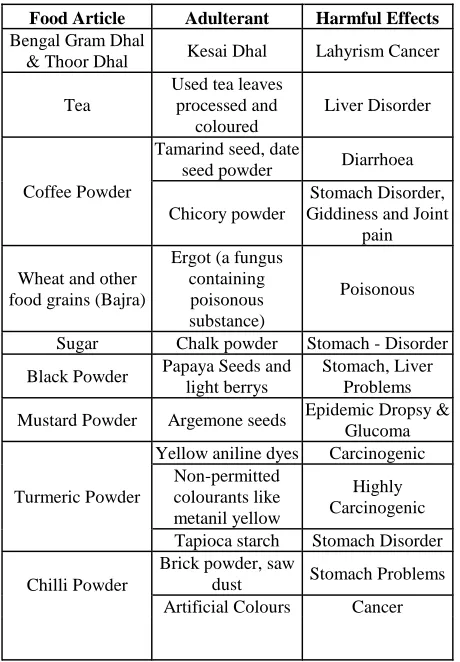
Table 1 Various Types of Adulterant and their Harmful Effects
out that almost everything is a toxicant or “poison” if consumed at a high enough level. The use of chemicals in the production and processing of food and food products not only affects the quality, but also disguises the deterioration and constitutes deliberate adulteration which is potentially very harmful to health. It is advised that food additives like colouring matter, preservatives artificial sweetening agents, antioxidants, emulsifiers/stabilizer, flavors/flavor enhancers etc., if used should be of approved quality and processed under good manufacturing practices [5].
2.2
Microbiological Contamination
It has been stated that microbiological contaminated food is perhaps the most prevalent health problem in the contemporary world. For safe food microbiological criteria should be established and freedom from pathogenicmicroorganisms must be ensured, including the raw materials, ingredients and finished products at any stage of production/processing. Accordingly the microbiological examination of the food products has to be adopted widely. The microbiological criteria must be applied to define the distinction between acceptable and unacceptable food. Consuming old, used, residual, fermented, spoiled, contaminated, toxic and bacterial infected food causes food poisoning. Infants are more susceptible to food poisoning [6].
2.3
Metallic Contamination
Metals are one of the many unintentional contaminants of food. When present beyond small quantities, they are toxic. They find their way into food through air, water, soil, industrial pollution and other routes. Metals may enter from utensils also. Enamelware of poor quality contributes antimony and galvanized utensils zinc. A major source of tin contamination is tin plate, which is used for making containers for all types of processed foods. Canned foods if acidic and foods stored in tins after opening, change in colour or develop a metallic flavor that is unpalatable. A small quantity of metal is added when food is cooked in aluminium utensils. Copper is an essential trace element required by the human body but copper contaminated food is toxic [7].
2.4
Other Contaminants
1. Fumigants are used to sterilize food under conditions in which steam heating is impractical. Ethylene oxide is a commonly used fumigant, which reacts with food constituents to produce or destroy essential nutrients. It reacts with inorganic chloride to form ethylene chloro hydride, which is toxic. 2. Various solvents are used for the extraction of oil from oil seeds. But solvents like trichloro ethylene react with the foodstuff being processed with the formation of toxic products. 3. During processing of food, their lipids can undergo numerous changes on prolonged heating, oxidative and polymerization reactions take place, which decreases the value of the processed products.
4. Smoking of meat and fish for preservation and flavoring is an old practice. This processing contaminates the food with polycyclic aromatic hydrocarbons such as benzopyrene, many of which are carcinogenic.
5. Lubricants, packing materials etc. also contaminate food. 6. A number of chemicals are intentionally added to foods to improve their nutritional value, maintain freshness, impact desirable properties or aid in processing. They also contaminate food if excessive in quantity [8]-[11].Table 1 shown Various Types of Adulterant and their Harmful Effects.
3.
ANALOG SENSORS BASED
MEASUREMENT AND ERROR
ANALYSIS
A transducer is normally designed to sense the specific measurand and to respond only to this measurand. However, in some cases, measurand may even be calculated by their relationship to the measurand sensed by the transducer. For example, pressure transducer measures pressure; displacement transducer measures displacement; acceleration transducer measure acceleration, however, displacement transducer can be used to measure position; displacement transducer can be used to measure velocity and acceleration transducers can be used to measure velocity. The higher and lower limits of measurand value form the range of transducer. A measurement cannot be made without errors in analog sensors. These errors can be only minimized but cannot be eliminated completely. It is essential to know the different errors that can possibly enter into the measurement.
Food Article Adulterant Harmful Effects
Bengal Gram Dhal
& Thoor Dhal Kesai Dhal Lahyrism Cancer Tea
Used tea leaves processed and
coloured
Liver Disorder
Coffee Powder
Tamarind seed, date
seed powder Diarrhoea Chicory powder
Stomach Disorder, Giddiness and Joint
pain Wheat and other
food grains (Bajra)
Ergot (a fungus containing poisonous substance)
Poisonous
Sugar Chalk powder Stomach - Disorder Black Powder Papaya Seeds and
light berrys
Stomach, Liver Problems Mustard Powder Argemone seeds Epidemic Dropsy &
Glucoma
Turmeric Powder
Yellow aniline dyes Carcinogenic Non-permitted
colourants like metanil yellow
Highly Carcinogenic Tapioca starch Stomach Disorder Chilli Powder
Brick powder, saw
Volume 35– No.1, December 2011
3.1
Gross Errors
Gross errors are largely due to human factors such as misreading of instruments, incorrect adjustment and improper application of instruments. The computational errors are also grouped under these types of errors. When human beings are involved in measurement, gross errors will inevitably be committed. Complete elimination of gross errors is probably impossible in analog meters. This error is almost eliminated in auto ranging digital meters. One common gross error frequently encountered in measurement work involves the improper selection of the instrument. [12].
3.2
Systematic Errors
Systematic errors are due to shortcomings of the instrument and changes in external conditions affecting the measurement. These are classified into two categories.
Instrumental errors
Environmental errors
Instrumental errors arise out of the changes in the properties of the components used in the instrument. This can be avoided by calibrating the instrument frequently. Environmental errors are due to the changes in the environmental conditions such as temperature, humidity, pressure and electrostatic and magnetic fields. Dynamic errors are caused by the instrument’s slow response in following the changes in the measured variable. Systematic errors have definite magnitude and direction [13].
3.3 Random Errors
Random errors are unpredictable errors and occur even when all systematic errors are accounted for. Although the instrument is used under controlled environment and accurately pre-calibrated before measurement, it will be found that the readings vary slightly over a period of observation. This change cannot be corrected by any method and it cannot be explained without detailed investigation.
4.
CHEMICAL REACTION BASED
ADULTERATION
DETECTION
METHOD
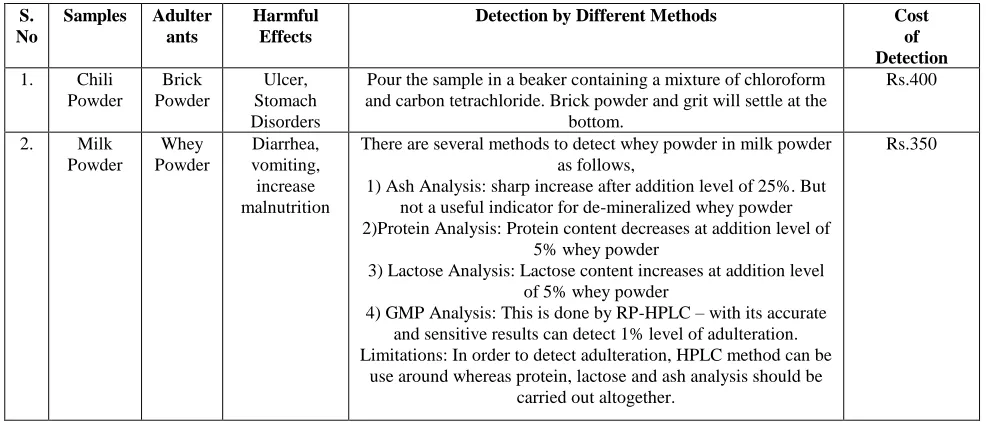
The various chemical reaction based adulteration detection methods and the cost involved for the same is shown in Table 2. The rapid test is taking 2 gm of the sample in a test tube, add few ml of solvent ether and shake. Decent ether layer in to a test-tube containing 2 ml of diluted HCl and shake it. The result is a pink to red color red lower acid layer in chili powder. Remark is 8.69 percent or the respondents used sub branded Apex chili powder. These dyes are toxic and intake of excess could lead to abnormalities of eyes, bone, skin, lungs etc. The inclusion of undeclared or unapproved color additives renders a spice adulterated, and if the color is undeclared, the spice is also misbranded. Recent examples include turmeric and other color additives in paprika, Sudan Red I in chili powder, and various color additives in saffron. Such instances may present a public health risk. Table 2 shown Chemical Reaction Based Adulteration Detection and Cost.
5.
PROPOSED VLSI BASED SYSTEM
[image:3.612.70.563.498.709.2]The general block diagram of proposed system as shown in Fig.1. Camera is placed 20 cm altitude from the bottom of the stand. The intensity of light source is 10 candelas and maintained the room temperature. The bottom surface color is white. The samples are placed on the white surface. First, original Chilli Powder sample photo is taken by camera and converted in to bit file format then stored in Field Programmable Gate Array (FPGA). Next, various level of Brick Powder adulterant added to Original Chilli Powder sample is taken by camera and converted in to bit file format provide to FPGA. Finally, Chilli Powder sample is compared to Brick Powder adulterant added to Original Chilli Powder sample by using distance vector matrix algorithm. This algorithm execution is based on pixel by pixel comparison in FPGA. While comparing two images, whether the difference is occur
Table 2 Chemical Reaction Based Adulteration Detection and Cost
S. No
Samples Adulter
ants
Harmful Effects
Detection by Different Methods Cost
of Detection
1. Chili Powder
Brick Powder
Ulcer, Stomach Disorders
Pour the sample in a beaker containing a mixture of chloroform and carbon tetrachloride. Brick powder and grit will settle at the
bottom.
Rs.400
2. Milk Powder
Whey Powder
Diarrhea, vomiting, increase malnutrition
There are several methods to detect whey powder in milk powder as follows,
1) Ash Analysis: sharp increase after addition level of 25%. But not a useful indicator for de-mineralized whey powder 2)Protein Analysis: Protein content decreases at addition level of
5% whey powder
3) Lactose Analysis: Lactose content increases at addition level of 5% whey powder
4) GMP Analysis: This is done by RP-HPLC – with its accurate and sensitive results can detect 1% level of adulteration. Limitations: In order to detect adulteration, HPLC method can be
use around whereas protein, lactose and ash analysis should be carried out altogether.
the sample is adulterated otherwise not adulterated.Fig 1 shown general block diagram of proposed system
Difference=0(Food sample not adulterated)
[image:4.612.81.306.88.242.2] [image:4.612.315.560.279.499.2]Difference=1 (Food sample is adulterated)
Fig. 1: General Block Diagram of proposed System
5.1 Distance Matrix Algorithm
2 (1)
Where
= Difference yi = Standard Image
fi = Field Image
6.
RESULT & DISCUSSION
Simulated Environment: Family: Vertex4 Device: XC4VLX15
Synthesis Tool: XST (Verilog/VHDL) Package: SF363
Simulator: Modelsim SE-VHDL Image Size: 256*256
RAM size: 2 GB Processor: Core2Duo
Table 3 Camera Property
Property Value
Dimension 4000 X 3000
Width 4000 pixels
Height 3000 pixels
Horizontal Resolution 300dpi
Vertical Resolution 300dpi
Bit Depth 24
Compression Resolution Unit 2 Color Representation Compressed
bit/pixel
sRGB
Camera Maker nokia
Camera Model N8-00
F-stop f/2.8
Exposure-time 1/8 sec
ISO-Speed ISO-494
Exposure bias Focal length 6mm
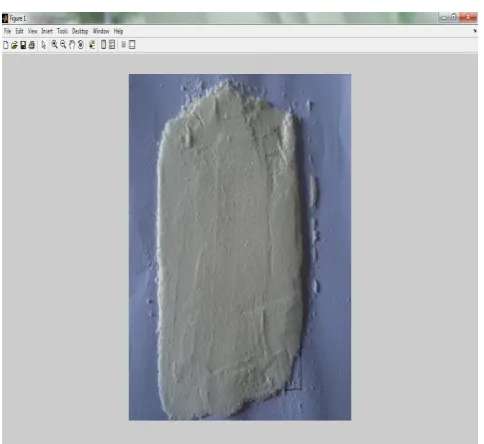
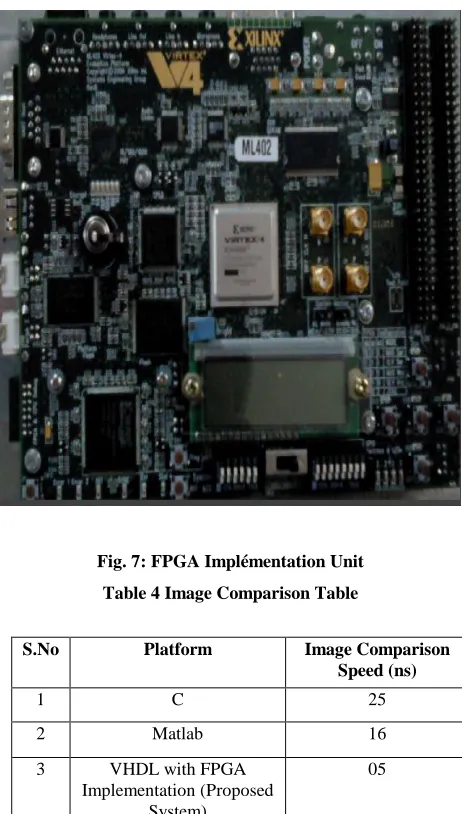
Figs 2 to Fig 5 are shown the pixel intensity is varying from original chilli powder to Brick Powder adulterant added to Original Chilli Powder. The adulterated chilli powder sample image appearance is dim compared to original sample image. The comparison takes place pixel by pixel of the image based on distance vector matrix algorithm. The speed and accuracy of comparison two images is high by using this algorithm. The process is applicable to milk powder adulteration identification. FPGA based image comparison is speed compare to traditional software based approach. Fig 6 represent the processing element of proposed system using VHDL.Fig 7 shown FPGA implementation unit. Table 3 displays the camera properties of sample image. Finally table 2 represents the image comparison table 4.
Fig. 2: Original Chilli Powder
Image
taken from Food sample adulterati
on using CCD
camera
RS-232 Cable FPGA
(High Speed Image Comparison
Algorithm Implementat
Volume 35– No.1, December 2011
Fig. 3: Brick Powder adulterant added to Original Chilli Powder
Fig. 4: Original Milk Powder
Fig. 5: Whey Powder adulterant added to Original Milk Powder
[image:5.612.322.559.53.272.2][image:5.612.77.319.303.525.2] [image:5.612.330.554.315.576.2]
Fig. 7: FPGA Implémentation Unit
Table 4 Image Comparison Table
S.No Platform Image Comparison
Speed (ns)
1 C 25
2 Matlab 16
3 VHDL with FPGA
Implementation (Proposed System)
05
7.
CONCLUSION
In this paper a new methodology has been proposed for designing FPGA implementation of DIP based high speed adulteration identification in food samples and it has reduced the computation or execution time. If we are comparing the image based on threshold value in MATLAB it will take more time but the proposed methodology guarantees to reduce the time for comparing the image. Thus by using the proposed system we can identify the adulteration. This system is very much useful for the government and may be used by common people either at home or work stations. This system is based on digital image processing technique, so it can replace the analogue sensors and makes the process very easy for the user. FPGA implementation is helpful for faster way of identifying the adulteration. Even though, comparison algorithms are successful at software level, better results can be achieved by implementing them in VLSI based hardware.
8.
REFERENCES
[1] Jaiswal.K, 2010”Injuriousadulterants/Contaminants in Foods and their Health Effects”, Director of Laboratories.
[2] Justin Diraviam.A, Dr.S.P.Victor, G.Rajakumar, Dr. K. Rajappan and Dr.D.Manimegalai 2011 “Replacing Various Analog Signal Sensors with Digital Cameras” International Journal of Computer and Electrical Engineering, Vol.3, No.1, PP-84-92.
[3] Kim Y. Han H. Hahn, 2011” Embedded implementation of image-based water-level measurement system”, IET Comput. Vis., Vol. 5, Iss. 2, pp. 125–133.
[4] Parisa Darvish Zadeh Varcheie and Guillaume-Alexandre Bilodeau, 2011” Adaptive Fuzzy Particle Filter Tracker for a PTZ Camera in an IP Surveillance System”, IEEE Transactions on Instrumentation and Measurement, Vol. 60, No. 2, PP.354-371.
[5] RajaKumar.G, Dr.D.Manimegalai, 2010 “Analysis and Implementation of DIP based Online Control and Monitoring System for Displacement in Control Value”IEEE Proce.of International Conference on Communication Control and Computing Technologies-ICCCCT 10, PP -397-403.
[6] Rubén Usamentiaga, Daniel F. García,, Julio Molleda, Francisco G. Bulnes, and Jesus M. Pérez, 2011” Temperature Measurement Using the Wedge Method: Comparison and Application to Emissivity Estimation and Compensation”, IEEE Transactions on Instrumentation and Measurement, Vol. 60, No. 5,PP.1768-1778.
[7] Somatilake.S, A.N.Chalmers, 2007” An image-based food classification system”, proceedings of image and vision computing, Newzealand.
[8] Stefan J. Rupitsch and Bernhard G. Zagar, 2011 “Iteration Methods to Precisely Locate Edges of Hot Objects Using Simple Infrared-Sensing Elements,” IEEE Trans. on Instrumentation and Measurement, Vol. 60, No. 1, PP.268-274.
[9] Velaga Sreerama Murthy, K.Tarakanath, D. K. Mohanta and Sumit Gupta, 2010” Insulator Condition Analysis for Overhead Distribution Lines Using Combined Wavelet Support Vector Machine (SVM)”, IEEE Transactions on Dielectrics and Electrical Insulation Vol. 17, No. 1, PP.89-99.
[10]Xiaojing Song, Lakmal D. Seneviratne and Kaspar Althoefer, 2011,” A Kalman Filter-Integrated Optical Flow Method for Velocity Sensing of Mobile Robots”, IEEE/ASME Transactions on Mechatronics, Vol. 16, No. 3, PP.551-563.
[11]Youlu Wang, Senem Velipasalar and Mauricio Casares, 2010” Cooperative Object Tracking and Composite Event Detection With Wireless Embedded Smart Cameras”, IEEE Transactions on Image Processing, Vol. 19, No. 10, PP.2614-2633.
[12]Zeljko Hocenski, Ivan Aleksi, Robert Mijakovic 2009” Ceramic Tiles Failure Detection Based on FPGA Image Processing” IEEE International Symposium on Industrial Electronics (ISlE), Seoul Olympic Parktel, Seoul, Korea,PP. 2169-2174.
[13]Zhang Tao, Yu Feng-ping and Quan Hao-jun, 2010 ” An Optimized High-Speed High-Accuracy Image Matching System Based on FPGA”, Proceedings of the IEEE International Conference on Information and Automation,PP. 1107-1112.