An Approach for Multi-Core Real Time
Parallel Processing
Shyamal G. Mundada
Department of Computer Science Engineering Ramdeobaba College Of Engineering and
Management Nagpur, India
M.B.Chandak
Head & Associate Professor, Department of Computer Science Engineering Ramdeobaba College Of Engineering and
Management Nagpur, India
ABSTRACT
Multi-core architectures, which have multiple processing units on a single chip, are widely used as a way to achieve higher processor performance. They have potential to deliver increased performance over single-core processors. Multi-core processors have become mainstream in processor design. In multiprocessing, only inter task parallelism can be achieved. But, computation-intensive real-time systems must exploit intra-task parallelism to take full advantage of multi-core processing. In this paper, the problem of scheduling periodic parallel tasks with implicit deadlines on multi-core processors is addressed. A task decomposition method that decomposes each parallel task into a set of sequential tasks is discussed. In this paper, a general model for deterministic parallel tasks, where a task is represented as a DAG with different nodes having different execution requirements is discussed. First, a DAG generation method for the tasks is discussed and secondly, task decomposition that splits a DAG into sequential tasks is discussed.
General Terms
Real Time Scheduling
Keywords
Multi-core Processing, Real Time Scheduling, Directed Acyclic Graph.
1.
INTRODUCTION
In Recent Years, Multi-core Processor Technology has improved dramatically as chip manufacturers try to boost performance while minimizing power consumption. This development has shifted the scaling trends from increasing processor clock frequencies to increasing the number of cores per processor. For example, Intel has recently put 80 cores in a Teraops Research Chip (Intel, 2007) with a view to making it generally available, and ClearSpeed has developed a 96-core processor (ClearSpeed, 2008). While hardware technology is moving at a rapid pace, software and programming models have failed to keep pace. For example, Intel (2007) has set a time frame of 5 years to make their 80-core processor generally available due to the inability of current operating systems and software to exploit the benefits of multi-core processors. As multi-core processors continue to scale, they provide an opportunity for performing more complex and computation-intensive tasks in real-time. However, to take full advantage of multi-core processing, these systems must exploit intra-task parallelism, where parallelizable real-time tasks can utilize multiple cores at the same time. By exploiting intra-task
parallelism, multi-core processors can achieve significant real-time performance improvement over traditional single-core processors for many computation-intensive real-time applications such as video surveillance, radar tracking, and hybrid real-time structural testing (Huang et al., 2010) where the performance limitations of traditional single-core processors have been a major hurdle.
Many models of parallelism have been used in programming languages and Application Program Interfaces, but few of them have been studied in real-time systems. An existing technique for real time scheduling considers a synchronous task model, where each parallel task consists of a series of sequential or parallel segments. This model is treated as synchronous, since all the threads of a parallel segment must finish before the next segment starts, creating a synchronization point. However, the task model is restrictive in that, for every task, all the segments have an equal number of parallel threads, and the execution requirements of all threads in a segment are equal. Most importantly, in this task model, the number of threads in every segment is no greater than the total number of processor cores. The restrictions on the task model make the solutions unsuitable for many real time applications that often employ different numbers of threads in different segments of computation.
One more technique for real time scheduling on multi-core processors considers a more general synchronous task model. Here also, tasks contain segments where the threads of each segment synchronize at its end. However, in contrast to the restrictive task model addressed, for any task in this model, each segment can contain an arbitrary number of parallel threads. That is, different segments of the same parallel task can contain different numbers of threads, and segments can contain more threads than the number of processor cores. The execution requirements of the threads in any segment can vary. This model is more portable, since the same task can be executed on machines with small as well as large numbers of cores.
In this paper, a general task model is considered, where tasks are represented by general DAGs where threads (nodes) can have arbitrary execution requirements. The paper is organized as follows. Section 2 reviews related work. Section 3 describes the task model and DAG generation. Section 4 presents the task decomposition. Section 5 offers conclusions.
2.
RELATED WORK
deadlines based on application-specific criteria) has been studied for various parallel task models and for various optimization criteria [11]–[13].Hard real-time scheduling (where the goal is to meet all task deadlines) is intractable for most cases of parallel tasks without resource augmentation [14].
The problem of scheduling implicit-deadline periodic task sets on multiprocessor systems under fork-join structure was introduced in [6]. A task stretch transform was defined which is to be performed by OS scheduler. Partitioned fixed priority scheduling algorithm was used for scheduling periodic fork-join task set. The problem of scheduling periodic parallel task by considering intra task parallelism was addressed in [5]. A synchronous task model was considered .A new task decomposition technique was introduced to transform each parallel task into a set of sequential tasks. These tasks were then scheduled using global EDF and partitioned deadline monotonic scheduling. All parallel segments in a task have an equal number of threads which cannot exceed the number of processor cores. It transforms every thread to a subtask, and proves a resource augmentation bound of 3:42 under partitioned Deadline Monotonic (DM) scheduling. For the synchronous model with arbitrary numbers of threads in segments, our earlier work in [6] proves a resource augmentation bound of 4 and 5 for global EDF and partitioned DM scheduling, respectively. For the unit-node DAG model where each node has unit execution requirement, this approach converts each task to a synchronous task, and then applies the same approach. A scheduling method, ‘spread-cognizant’ was proposed in [13] that decreases average and maximum spreads in global EDF scheduling algorithms. The scheduling mechanism for individual threads of multithreaded real time tasks was discussed.
In this paper, a more general model of deterministic parallel real-time tasks is considered where each task is modeled as a DAG, and different nodes of the DAG may have different execution requirements.
3.
PARALLEL TASK MODEL
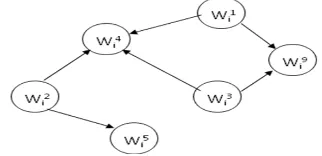
Parallel implicit-deadline real time tasks are considered for scheduling, where the deadline of a task equals to their period, and each task of this model is represented by a directed acyclic graph (DAG), which is a collection of subtasks and directed edges, which represents the execution flow of the task and the precedence constraints between the subtasks. Precedence constraint means that each node can start its execution when all of its predecessors have finished theirs.
A set of ‘n’ periodic parallel tasks is considered to be scheduled on a multi-core platform consisting of m identical cores. The task set is represented by τi ={ τ1, τ2,….,τn }.Each task τi, 1≤ i ≤n,
is represented as a Directed Acyclic Graph(DAG),where the nodes stand for different execution requirements, and the edges represent dependencies between the nodes. A node in τi is
denoted by Wij; 1 ≤ j ≤ ni, with ni being the total number of
nodes in τi . The execution requirement of node Wij is denoted
by Ei j
. A directed edge from node Wi j
to node Wi k
, denoted as Wij → Wik, implies that the execution of Wik cannot start unless
Wi j
has finished execution. Wi j
in this case, is called a parent of Wik, while Wik is its child. A node may have 0 or more parents
or children. A node can start execution only after all of its parents have finished execution. Figure 1 shows a task τi with ni
= 6 nodes.
[image:2.595.343.504.74.152.2]
Fig 1 A parallel task τi represented as a DAG
The total execution requirement of τi is the sum of the execution
requirements of all of its nodes, and is denoted by Ci (time
units). The period of task τi is denoted by Pi. The deadline Di of
each task τi is considered implicit, i.e., Di = Pi. Task set τ is said
to be schedulable by algorithm A, if A can schedule τsuch that every τi ε τ can meet deadline Di. Representing jobs and
their precedence constraints as a DAG is very convenient. It gives some interesting information about the problem like the degree of parallelism that application can attain the minimum amount of time required by the application (the critical path of the graph), etc. These properties can be used for the development of heuristics to solve scheduling problems.
There are various graph generation algorithms which can be used in the validation of scheduling algorithms. A random graph is obtained by starting with a set of n vertices and adding edges between them at random. Different random graph models produce different probability distributions on graphs. Most commonly used methods are the Erd˝os-Rényi methods. There are two methods G(n,p) and G(n,M).We consider G(n,p) for graph generation.
It is the most intuitive and most widely utilized graph generation method. For given n number of vertices, the G (n,p) method generates a graph where each element of the (n,2) possible edges is present with independent probability p. Erdos and Renyi first defined this method for non-oriented graphs, but it is easy to adapt this for DAG generation:
Algorithm: G (n,p) method
Require: n ε N; p ε R.
Ensure: a graph with n nodes.
Let M be an adjacency matrix n x n initialized as the zero matrix.
for all i = 1 to n do
for all j = 1 to i do
if Random() < p then
M[i][j] = 1
else
M[i][j] = 0
return the graph represented by M.
4.
TASK DECOMPOSITION
and release offsets such that when they execute as individual subtasks all dependencies among them in the DAG (i.e., in the original task) are preserved. Thus, an implicit deadline DAG is decomposed into a set of constrained deadline sequential subtasks with each subtask corresponding to a node of the DAG.
4.1
Related Terms
4.1.1
Execution Requirement of task
Ci: It is the sum of the execution requirements of all
nodes in Ti.
Ci,v : Maximum execution time of task Ti on a multi-core
platform where each processor has speed v.
4.1.2
Critical path length
Pi: It is the Sum of the execution requirements of the
nodes on a critical path. Denotes Minimum execution time of task τi .
4.1.3
Utilization of task
4.1.4
Density of task
4.2
Decomposition Technique
In the decomposition, each node of a task becomes an individual sequential subtask with its own execution requirement and an assigned constrained deadline. To preserve the dependencies in the original DAG, each node is assigned a release offset. Since a node cannot start execution until all of its parents finish, its release offset is equal to the maximum sum of the release offset and deadline among its parents. That is, a node starts after its latest parent finishes. The (relative) deadlines of the nodes are assigned by distributing the available slack of the task. The slack for each task considering a multi-core platform where each processor multi-core has speed 2 is calculated. The slack for task τi , denoted by Li, is defined as the
difference between its deadline and its critical path length on 2-speed processor cores.
Li = Di − Pi,2 = Ti − Pi,2 = Ti − Pi / 2
For task τi, the deadline and the offset assigned to
node Wij are denoted by Dij and Φij, respectively. Once
appropriate values of Dijand Φijare determined for each node
Wij (respecting the dependencies in the DAG), task τi is
decomposed into nodes. Upon decomposition, the dependencies in the DAG need not be considered, and each node can execute as a traditional multiprocessor task. Hence, the decomposition technique for τi boils down to determine Dijand Φijfor each
node Wij.
Consider DAG given in Figure 1, here we assign execution requirement to each node as Ei1=4, Ei2=2, Ei3=4,
Ei4=5 and Ei5=3. First, DAG τi is represented as a timing
diagram τioriginal. Specifically, τioriginal indicates the earliest start
time and the earliest finishing time of each node. For any node Wijthat has no parents, the earliest start time and the earliest
finishing time are 0 and Ei j
, respectively. For every other node Wij, the earliest start time is the latest finishing time among its
parents, and the earliest finishing time is Ei j
time units after that. For example, in τi of Figure 1, nodes Wi1,Wi2, and Wi3 can start
execution at time 0, and their earliest finishing times are 4, 2, and 4,respectively. Node Wi4 can start after Wi1 and Wi2
complete, and finish after 5 time units at its earliest, and so on. Thus, Figure 2(a) shows τioriginal of the DAG τi of Figure 1.
The calculation of Di j and Φ
i j
for each node Wi j
involves the following two steps. In Step 1, for each node, distribution of slack among different parts of the node is done. In Step 2, the total slack assigned to different parts of the node is assigned as the node’s slack.
Step 1 (slack distribution): In DAG τi, a node can
execute with different numbers of nodes in parallel at different time. Such a degree of parallelism can be approximated based on τioriginal .For example, in Figure 2(a), node Wi5executes with
Wi 1
and Wi 3
in parallel for the first 2 time units, and then executes with Wi4 in parallel for the next time unit. In this way,
identification of the degrees of parallelism at different parts of each node is carried out. Intuitively, the parts of node which execute with a large number of nodes in parallel require more slack. Therefore, different parts of a node are assigned different amounts of slack considering their degrees of parallelism and execution requirements. Later, the sum of slack of all parts of a node is assigned to the node itself. To identify the degree of parallelism for different portions of a node based on τi∞,
assignment of slack to a node in different (consecutive) segments is done. In different segments of a node, the task may have different degrees of parallelism. In τi∞, starting from the
left, a vertical line at every time instant is drawn where a node starts or ends (as shown in Figure 2(b)). This is done using a breadth-first search over the DAG. The vertical lines now split τi∞ into segments. For example, in Figure 2(b), τi is split into 2
segments (numbered in increasing order from left to right).Once τi∞ is split into segments, each segment consists of an equal
amount of execution by the nodes that lie in the segment. Parts of different nodes in the same segment can now be thought of threads that can run in parallel, and the threads in a segment can start only after those in the preceding one finish. Such a model is thus similar to the synchronous task model used in [6]. This model is denoted by τisyn. Assignment of slack to the segments
is done, and finally addition of all slack assigned to different segments of a node is carried out to calculate its overall slack.
Distribution of slack is done among the nodes based on the number of threads and execution requirement of the segments where a node lies in τisyn. For every j-th segment of
τisyn, we calculate a value dij, called an intermediate subdeadline
.That is, each thread in the segment gets this “extra time” beyond its execution time.
Step 2 (deadline and offset calculation): Intermediate sub deadlines to (the threads of) each segment of τisyn are
assigned in Step 1. Since a node may be split into multiple (consecutive) segments in τisyn, now we have to remove all
Now let a node Wij of τibelong to segments k to r (1 ≤
k ≤ r ≤ si) in τisyn. Therefore, the deadline Dij of node Wij is
calculated as follows.
Dij = dik+ dik+1 + ... +dir
The execution requirement Ei j
of node Wi j
is
Eij =eik+eik+1 + ... +eir
Node Wi j
cannot start until all of its parents complete. Hence, its release offset Φij is determined as follows.
Φij
=
Appropriate deadline Dij and release offset Φij to each node Wij
of τi are assigned. The DAG τi is now decomposed into nodes.
Each node Wij is now an individual (sequential) multiprocessor
subtask with an execution requirement Eij, a constrained
deadline Dij, and a release offset Φij.
Fig 2 (a) τioriginal : Timing diagram for DAG τi
Fig 2 (b) Slack distributions in τisyn
5.
CONCLUSIONS
With the advent of the era of multi-core computing, real time scheduling of parallel tasks is crucial for real-time applications to exploit the power of multi-core processors. While recent research on real-time scheduling of parallel tasks has shown promise, the efficacy of existing approaches is limited by their restrictive parallel task models. To overcome these limitations, in this paper generalized parallel task model for real-time scheduling is presented. A general synchronous parallel task model is considered where each task consists of segments, each having an arbitrary number of parallel threads. Then a novel task decomposition algorithm is discussed which decomposes each task into a set of tasks which can be scheduled on multiple cores.
6.
REFERENCES
[1] R. I. Davis and A. Burns, “A survey of hard real-time scheduling for multiprocessor systems,” ACM Comp. Surv., vol. 43, pp. 35:1–44, 2011.
[2] A. Saifullah, K. Agrawal, C. Lu, and C. Gill, “Multi-core real-time scheduling for generalized parallel task models,” in RTSS ’11.
[3] K. Lakshmanan, S. Kato, and R. R. Rajkumar, “Scheduling parallel realtime tasks on multi-core processors,” in RTSS ’10.
[4] “OpenMP,” http://openmp.org.
[image:4.595.81.525.188.548.2][6] X. Deng, N. Gu, T. Brecht, and K. Lu, “Preemptive scheduling of parallel jobs on multiprocessors,” in SODA ’96.
[7] K. Agrawal, Y. He, W. J. Hsu, and C. E. Leiserson, “Adaptive task scheduling with parallelism feedback,” in PPoPP ’06.
[8] J. M. Calandrino and J. H. Anderson, “On the design and implementation of a cache-aware multicore real-time scheduler,” in ECRTS ’09.
[9] J. M. Calandrino, J. H. Anderson, and D. P. Baumberger, “A hybrid real-time scheduling approach for large-scale multicore platforms,” in ECRTS ’07.
[10] J. H. Anderson and J. M. Calandrino, “Parallel real-time task scheduling on multicore platforms,” in RTSS ’06.
[11] C.-C. Han and K.-J. Lin, “Scheduling parallelizable jobs on multiprocessors,” in RTSS ’89.
[12] S. Baruah, “Techniques for multiprocessor global schedulability analysis,”in RTSS ’07.
[13] J. Goossens, S. Funk, and S. Baruah, “Priority-driven scheduling of periodic task systems on multiprocessors,” Real-Time Syst., vol. 25, no.2-3, pp. 187–205, 2003.
[14] S. Baruah, “The non-preemptive scheduling of periodic tasks upon multiprocessors,” Real-Time Syst., vol. 32, pp. 9–20, 2006.
[15] Jos´e Carlos Fonseca, Lu´ıs Nogueira, Cl´audio Maia, and Lu´ıs Miguel Pinho,”Real-Time Scheduling of Parallel Tasks in the Linux Kernel”
[16] D.I. George Amalarethinam and G.J. Joyce Mary, “A new DAG based Dynamic Task Scheduling Algorithm (DYTAS) for Multiprocessor Systems”, in International Journal of Computer Applications (0975 – 8887) Volume 19– No.8, April 2011
[17] D.I. George Amalarethinam1 and G.J. Joyce Mary, ”DAGEN - A Tool To Generate Arbitrary Directed Acyclic Graphs Used For Multiprocessor Scheduling”, in International Journal of Research and Reviews in Computer Science (IJRRCS) Vol. 2, No. 3, June 2011
[18] C.-C. Han and K.-J. Lin, “Scheduling parallelizable jobs on multiprocessors,”in RTSS ’89.
[19] K. Jansen, “Scheduling malleable parallel tasks: An asymptotic fullypolynomial time approximation scheme,” Algorithmica, vol. 39, no. 1,pp. 59–81, 2004.
[20] W. Y. Lee and H. Lee, “Optimal scheduling for real-time parallel tasks,”IEICE Trans. Inf. Syst., vol. E89-D, no. 6, pp. 1962–1966, 2006.
[21] S. Collette, L. Cucu, and J. Goossens, “Integrating job parallelism in real-time scheduling theory,” Inf. Process. Lett., vol. 106, no. 5, pp.180–187, 2008.
[22] G. Manimaran, C. S. R. Murthy, and K. Ramamritham, “A new approach for scheduling of parallelizable tasks inreal-time multiprocessor systems,” Real-Time Syst., vol. 15, no. 1, pp. 39–60, 1998
[23] S. Kato and Y. Ishikawa, “Gang EDF scheduling of parallel task systems,” in RTSS ’09.
[24] N. Fisher, T. P. Baker, and S. Baruah, “Algorithms for determining the demand-based load of a sporadic task system,” in TCSA ’06.
[25] J. Goossens, S. Funk, and S. Baruah, “Priority-driven scheduling of periodic task systems on multiprocessors,” Real-Time Syst., vol. 25, no. 2-3, pp. 187–205, 2003. [26] Daniel Cordeiro, Grégory Mounié, Swann Perarnau, Denis
Trystram, Jean-Marc Vincent, Frédéric Wagner, ”Random graph generation for scheduling simulations” in simutools’10
[27] N. S. Arora, R. D. Blumofe, and C. G. Plaxton, “Thread scheduling for multiprogrammed multiprocessors,” in SPAA ’98.
[28] Ricardo Garibay-Martínez, Luis Lino Ferreira, Luis Miguel Pinho,”A Framework for the Development of Parallel and Distributed Real-Time Embedded Systems “