© 2017, IRJET | Impact Factor value: 5.181 | ISO 9001:2008 Certified Journal | Page 1509
AN EXPERIMENTAL STUDY ON SINTERED FLY ASH AGGREGATE
CONCRETE MODIFIED WITH NANO ALUMINIUM OXIDE ( AL
2O
3)
S.RAMESH REDDY
1, I.KRISHNARCHANA
2, Dr. V. BHASKAR DESAI
31
Professor, Dept of Civil Engineering, Brindavan Institute of Technology & science, Kurnool,A.P and Research
Scholar, JNTUA College of Engineering, Anantapuram – 515002, A.P.
2
M.Tech Student, JNTUA College of Engineering, Anantapuram – 515002, A.P.
3
Dept. of Civil Engineering, JNTUA College of Engineering, Anantapuram – 515002, A.P.
---***---ABSTRACT -
Concrete plays major role in theconstruction industry and with rapid increase of urbanisation utilization of concrete is increasing at a rapid phase and precious natural resources are depleting and also production of cement releases green house gases like carbon-di-oxide. For the generation of electricity world is more dependent on Thermal plants which are generating huge volume of fly ash which also contributes to the environmental pollution which are otherwise being used as land fill. An attempt is made to prepare light weight concrete by replacing 100% natural aggregate with Sintered fly ash aggregates and also to use cement with partial replacement of cement (11%) with three numbers of pozzolanic materials like Silica Fume, Slag and Fly ash in equal proportions along with varying percentage of Nano Aluminium Oxide at 0, 0.5, 1, and 1.5 on 11% of cement. Shear strength is a property of major significance and various attempts have been made to develop MODE-II (Sliding shear) test specimen geometries for investigating the shear type of failures. Out of these the best suited is suggested as Double Centred notch (DCN) specimen proposed by Sri Prakash Desai and Sri Bhaskar Desai.
Key Words
:
Nano Al2O3,Flexural strength, Mode-II Fracture, compressive strength, Light weight aggregate.
I. INTRODUCTION:
Due to continuous usage of naturally available aggregates within short length of time these natural resources get depleted and it will be left nothing for future generations. Hence there is a necessity for preparing artificial aggregates making use of waste materials from agricultural produce and industrial wastes. From the earlier studies it appears that much less attention has been made towards the study of using artificial coarse aggregate. An attempt has been made to use sintered fly ash aggregates as coarse aggregate and partial replacement of cement with three numbers of pozzolanic materials like Silica Fume, Slag and Fly ash in equal proportions along with varying percentage of Nano Al2O3.
II. REVIEW OF LITERATURE:
A brief review of available studies related to the present strength properties of cementitious materials is presented
© 2017, IRJET | Impact Factor value: 5.181 | ISO 9001:2008 Certified Journal | Page 1510
As per Bryan, Dennis. S. P (2), Natural lightweight aggregates may be defined as inherently low density natural mineral materials. The primary user is the construction industry where weight reduction equates to cost savings. Principal products in which natural lightweight aggregate is utilized because of its lower density include lightweight Portland cement concrete and lightweight concrete masonry units. In addition, due to location, some natural lightweight aggregates compete with normal weight constructions aggregates for uses such as road base and common backfill material.
Owens, P.L. (3) had stated that Light weight aggregate concrete was used for structural purposes since the 20th century. As per this study, the Light weight aggregate concrete is a material with low unit weight and often made with spherical aggregates. The density of structural Light weight aggregate concrete typically ranges from 1400 to 2000 kg/m³ compared with that of about 2400 kg/m³for normal weight aggregate concrete.
Prakash Desayi, Raghu Prasad B.K, and Bhaskar Desai.V, (4,5,6,7&8) arrived at Double Central Notched specimen geometry which fails in predominant Mode-II failure. They also made finite element analysis to arrive at stress intensity factor. Using this DCN geometry lot of experimental investigation using cement paste, mortar, plain concrete was carried out.
Arvind Kumar, DilipKumar (9)To increase the speed of construction, enhance green construction environment we can use lightweight concrete. The possibility exists for the partial replacement of coarse aggregate with Sintered fly ash aggregate to produce in thermal power plants west material. Sintered fly ash is compatible with the cement.
S.Shanmugasundaram(10) ‘Considering the depletion of natural sources and the effect on environment, the disposal problems involved in disposing fly ash, light weight characteristics of fly ash aggregates with good
mechanical properties (Compression strength, Split Tension strength and Flexural strength) as seen in the investigation, a particular attention may be focused on the usage of fly ash aggregates in concrete.
A.H. Shekari and M.S. Razzaghi(11),Nano-particles can improve durability and mechanical properties of high performance concrete. The contribution of NA on improvement of mechanical properties of high performance concrete was more than the other Nano-particles. All of the examined Nano- particles had noticeable influence on improvement of durability parameters.
Nazari, et al (12) Nano-Al2O3 particles blended concrete had significantly higher compressive strength compare to that of the concrete without Nano-Al2O3 particles. It is found that the cement could be advantageously replaced with Nano-Al2O3 particles up to maximum limit of 2.0% with average particle sizes of 15 nm. Although, the optimal level of Nano-Al2O3 particles content was achieved with 1.0% replacement. Partial replacement of cement by Nano-Al2O3 particles decreased workability of fresh concrete; therefore use of super plasticizer is substantial.
From the brief literature summery conducted hence it appears that much less attention has been paid earlier on the study of Sintered fly ash aggregate concrete modified with Nano material such as Al2O3. Hence the present investigation has been under taken.
III. MATERIAL PROPERTIES:
© 2017, IRJET | Impact Factor value: 5.181 | ISO 9001:2008 Certified Journal | Page 1511 specific gravity 2.1, Fly ash with specific gravity 2.7, Slag
with specific gravity 2.86, and Nano Al2O3 particles with 15nm was used. Portable water was used for casting all specimens of this investigation. A view of constituent materials is shown in plate. 1 to 7.
3.1 PROPERTIES OF SINTERED FLY ASH
AGGREGATE:
Sintered fly ash aggregate is used as coarse aggregate. The coarse aggregate procured from Litagg company, Ahmadabad is used in this investigation. The properties are as follows.
The coarse aggregate is having 8- 12mm normal size, Fineness modulus 6.24, bulk porosity 35-40%, round shape pellets, aggregate strength >4.0 MPa, bulk density 800 kg/m3 and water absorption <16%. Sintered fly ash aggregates in comparison with natural aggregate resulted in the concrete made with Sintered fly ash aggregates to be lighter than normal concrete.
IV.EXPERMENTAL INVESTIGATION:
An experimental study has been conducted on concrete with 100% replacement of conventional natural aggregate by light weight aggregate i.e. Sintered fly ash aggregates along with partial replacement of cement by 11% of its weight by three number of pozzolanic materials (Silica fume, fly ash and Slag) in equal proportions along with Nano material (AL2O3) at varying percentages on 11% of cement (replaced with pozzolanic materials) at 0, 0.5, 1, and 1.5. Concrete of M20 design mix is used in the present investigation. In addition to presenting conventional strength properties such as cube compressive strength, modulus of elasticity etc., by casting and testing standard cubes. Mode-II fracture studies are also conducted and results are presented.
4.1 CASTING OF SPECIMENS:
The M20 concrete mix is designed using IS method which gives a mix proportion of 1:1.49:2.88 with water cement ratio of 0.50. Four different mixes are designated as follows:
To proceed with the experimental program initially steel moulds of size 150mmx150mmx150mm were cleaned brushed with machine oil on all inner faces to facilitate easy removal of specimens afterwards. First fine aggregate and cement along with admixtures silica fume, slag, fly ash and Nano -Al2O3 in required percentages were mixed thoroughly and then Sintered fly ash aggregates were added with them. All of these were mixed thoroughly by hand mixing. Each time 150mmX150mmX150mm cube specimens out of which 12 DCN specimens with replacement of cement by 11% of its weight by pozzolanic materials (Silica fume, fly ash and Slag) and Nano Aluminium oxide Al2O3) with varying percentages (0%, 0.5%,1%, and 1.5%) on 11% weight of cement and made 4 mixes for each percentage, and for each mix 3 plain cubes, 3 plain beams are casted. Fig.1 shows the DCN specimen arrangement of different notches. The concrete was poured into the moulds in three layers with eachlayer being compacted thoroughly with tamping rod 25 times each time to avoid honey combing. Finally all specimens were kept on the table vibrator after filling up the moulds up to the brim. The vibration was effected for 7 seconds and it was
Name of the MIX
% Volume replacemen -t of coarse aggregate
% of Admixtures in equal proportions
% of Nano (Al2O3) on 11% of cement
% of cement
KA1 100 0 0 100
KA2 100 11 0.5 88.945
KA3 100 11 1.0 88.890
© 2017, IRJET | Impact Factor value: 5.181 | ISO 9001:2008 Certified Journal | Page 1512 maintained constant for all specimens and all other castings.
The steel plates forming notches were removed after 3 hours of casting carefully and neatly finished. After 28 days of curing the specimens were taken out of water and and were allowed to dry under shade for fewhours.
Fig 1. Details of DCN test specimen geometry
V. TESTING OF SPECIMENS:
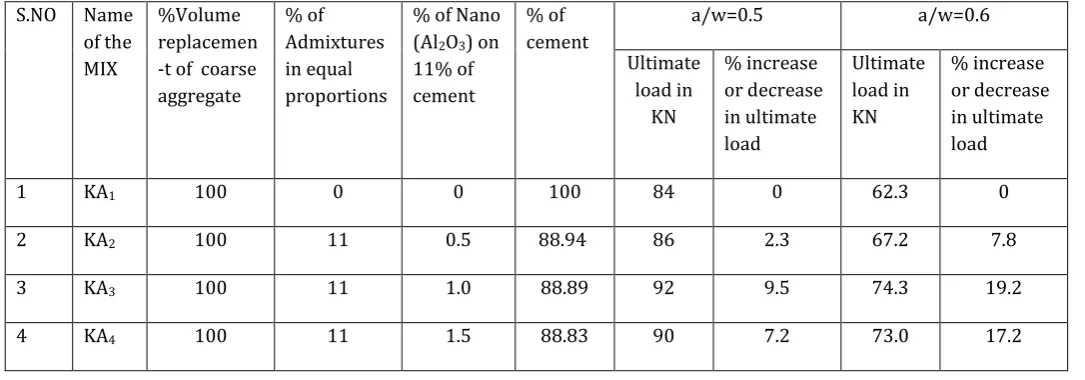
The cube specimens are kept vertically on compressive testing machine. The load is applied uniformly until the specimens fail, and ultimate loads were recorded. The test results of cubes are furnished in table 1. Flexural strength test was carried out on prismatic beam specimens of size 500mm*100mm*100mm. The beam specimen was tested using Two Point loading system. The test results were represented in table.2. The results of modulus of elasticity are furnished in table no 3. For testing DCN specimens of size 150mmx150mmx150mm, notches were introduced at one third portion centrally as shown in fig. 1 during casting. The compression test on the DCN cubes was conducted on 3000KN digital compression testing machine. The rate of loading applied is 0.5 KN/sec. Test results shown in table.4. and table.5 and graphically in fig.5.Uniformly distributed load was applied over the central one third part between the notches and square cross section steel supports were provided at bottom along the outer edges of the notches, so that the central portion could get punched/sheared through along the notches on the application of loading.
5.1 DISCUSSION OF CRACK PATTERN AND TEST
RESULTS:
In case of cubes under compression test initial cracks are developed at top and propagated to bottom with increase in load and then the cracks were widened at failure along the edge of the cube and more predominantly along the top side of casting.
In the flexural test beams have been failed in flexural mode. As the load increases the flexural cracks initiates in the pure bending zone and the first cracks appears almost in the mid span. As the load increases, existing cracks propagated areobserved, and new cracks have developed along the span. Final failure occurs in the middle portion.
During testing of DCN specimens, for most of the specimen’s initial hair line cracks started at the top of one or both the notches, and as the load was increased further, the cracks widened and propagated at an inclination and sometimes to the middle of the top loaded zone. Simultaneously the cracks formed at the bottom of one or both the notches and propagated downwards at visible inclination. In some cases cracks branched into either side at the two edges of the supporting square bar at the bottom or at the edge of the loaded length at top or at both places.
5.1.1 INFLUENCE ON COMPRESSIVE
STRENGTH:
The cube compressive strength of concrete with 100% Sintered fly ash aggregates with 0% admixtures and Nano Aluminium-Oxide is 24.8 N/mm2. With replacement of 11% cement with three numbers of pozzolanic materials in equal proportion along with varying percentage of 0.5% and 1% Nano Aluminium-Oxide content on 11% of cement the cube compressive strength is 30.3N/mm2and 35.40N/mm2 and the increase in strength is 22.20% and 42.80%. When Nano Aluminum Oxide is increased to 1.5% there is a small drop in the cube compressive strength of concrete.
© 2017, IRJET | Impact Factor value: 5.181 | ISO 9001:2008 Certified Journal | Page 1513 Flexural strength results are represented in Table.2.
and graphically in Fig.3.It is observed that there is increase in strength up to 1% of Nano Aluminium-Oxide with constant 11% admixtures and there after decrease in the flexural strength.
5.1.3 INFLUENCE ON MODULUS OF
ELASTICITY:
Moduli of elasticity results based IS Code are represented in table.3. and graphically in Fig.4.after 28 days curing.
5.1.4 INFLUENCE ON IN-PLANE SHEAR
STRENGTH:
The variations of ultimate loads versus various percentage of Nano Aluminium-Oxide are presented in Fig.5. These are presented for different a/w ratios (i.e., 0.3, 0.4, 0.5, 0.6). From these diagrams it is observed that with the increase in the a/w ratio there is decrease in ultimate load and there is increase in ultimate loads up to 1% of Nano Aluminium-Oxide and there after slightly decreased for all a/w ratios.
5.1.5 INFLUENCE ON DENSITY:
Density of Sintered fly ash aggregate with Al2O3 is nearly 16% less than conventional aggregate concrete.
TABLE-1: CUBE COMPRESSIVE STRENGTH RESULTS S.NO Name
of the MIX
% Volume replacement of coarse aggregate
% of Admixtures in equal proportions
% of Nano (Al2O3) on 11% of cement
% of cement
Cube compressive strength N/mm2
% increase or decrease in compressive strength
1 KA1 100 0 0 100 24.80 0
2 KA2 100 11 0.5 88.945 30.30 22.2
3 KA3 100 11 1.0 88.890 35.40 42.8
4 KA4 100 11 1.5 88.835 35.00 41.2
TABLE-2: FLEXURAL STRENGTH RESULTS
S.NO Name of the MIX
% Volume replacement of Coarse aggregate
% of Admixtures in equal proportions
% of Nano (Al2O3) on 11% of cement
% of cement
Flexural strength in N/mm2
% increase or decrease in Flexural strength
1 KA1 100 0 0 100 3.20 0
2 KA2 100 11 0.5 88.945 3.38 5.6
3 KA3 100 11 1.0 88.890 3.80 18.8
© 2017, IRJET | Impact Factor value: 5.181 | ISO 9001:2008 Certified Journal | Page 1514
TABLE-3: YOUNG’S MODULUS BASED ON IS CODE S.NO Name
of the MIX % Volume replacement of Coarse aggregate % of Admixtures in equal proportions
% of Nano (Al2O3) on 11% of cement % of cement Youngs Modulus E=5000√fck in
*104 N/mm²
% increase or decrease in Youngs modulus
1 KA1 100 0 0 100 2.49 0
2 KA2 100 11 0.5 88.945 2.75 10.4
3 KA3 100 11 1.0 88.890 2.98 19.7
[image:6.595.27.570.322.509.2]4 KA4 100 11 1.5 88.835 2.95 18.5
TABLE -4: ULTIMATE LOAD IN MODE-II FOR DCN SPECIMENS WITH a/w RATIOS = 0.30, 0.40 S.NO Name
of the MIX %Volume replaceme -nt of Coarse aggregate % of Admixtures in equal proportions
% of Nano (Al2O3) on 11% of cement
% of cement
a/w=0.3 a/w=0.4
Ultimate load in KN % increase or decrease in ultimate load Ultimate load in KN % increase or decrease in ultimate load
1 KA1 100 0 0 100 119 0 106 0
2 KA2 100 11 0.5 88.945 120 0.8 119 12.3
3 KA3 100 11 1.0 88.890 132 10.9 123 16.1
4 KA4 100 11 1.5 88.835 130 9.3 120 13.2
TABLE -5: ULTIMATE LOAD IN MODE-II FOR DCN SPECIMENS WITH a/w RATIOS = 0.50, 0.6 S.NO Name
of the MIX
%Volume replacemen -t of coarse aggregate
% of Admixtures in equal proportions
% of Nano (Al2O3) on 11% of cement
% of cement
a/w=0.5 a/w=0.6
Ultimate load in KN % increase or decrease in ultimate load Ultimate load in KN % increase or decrease in ultimate load
1 KA1 100 0 0 100 84 0 62.3 0
2 KA2 100 11 0.5 88.94 86 2.3 67.2 7.8
3 KA3 100 11 1.0 88.89 92 9.5 74.3 19.2
[image:6.595.28.571.538.728.2]© 2017, IRJET | Impact Factor value: 5.181 | ISO 9001:2008 Certified Journal | Page 1515
TABLE- 6: DENSITY RESULTS
PLATES
Fig.2.compressive strength of cube after 28 days curing period
Fig.3.Flexural strength after 28 days curing period S.NO Name of the
MIX
% Volume replacement of coarse aggregate
% of Admixtures in equal proportions
% of Nan0 (Al2O3) on 11% of cement
% of cement
Density in kg/m3
Percentage increase or decrease in Density
1 KA1 100 0 0 100 2044 0
2 KA2 100 11 0.5 88.945 2025 -0.929
3 KA3 100 11 1.0 88.890 2027 -0.832
4 KA4 100 11 1.5 88.835 2048 0.196
Plate1. Cement plate2.Fine aggregate
Plate3.Sintered fly Plate4. Nano Al2O3 ash aggregates
Plate5.Slag plate6.Silica fume
© 2017, IRJET | Impact Factor value: 5.181 | ISO 9001:2008 Certified Journal | Page 1516
Fig.4.Young’s modulus based on IS Code after
28-days curing period
Fig.5.Super imposed variation between ultimate load and percentage replacement of Al2O3 at 28 days curing
period
VI. CONCLUSIONS:
From the limited experimental study of the following conclusions are seen to be valid:
1. The target mean strength of M20 concrete is 26.60 N/mm2. From the experimental study it is observed that the 28 days cube compressive strength of modified concrete with 100% Sintered fly ash aggregate is 24.80 N/mm2 and with replacement of cement by 11% with three numbers of pozzolanic materials i.e., Silica fume,
Slag and Fly ash in equal proportions and 1% of Nano Al2O3 the cube compressive strength of modified concrete rises to 42.80 N/mm2 which is much higher than target mean strength of M20 concrete.
2. With the increase in percentage of Nano Al2O3up to 1% and with constant 11% pozzolanic materials replacing the cement there is increase in flexural strength and Young’s modulus and further increase in Nano Al2O3 content there is decrease in both values.
3. It is observed that with the increase in the a/w ratio there is decrease in ultimate load and there is increase in ultimate loads up to 1% of Nano Aluminium-Oxide and there after slightly decreased for all a/w ratios.
4. The light weight concrete prepared by 100% Sintered fly ash aggregate as coarse aggregate is no way inferior to the natural aggregate and also consumption of cement can be reduced by about 11%.
REFERENCES
1. Clarke, J.L. Design Requirements. Structural Light weight Aggregate Concrete, Chapman & Hall, London, pp. 45-74, 1993.
2. Bryan, Dennis. S. P, “Occurrence and uses of natural lightweight aggregate in the Western United States”, Lightweight aggregate in Western United States, January 1989, pp. 89-193.
3. Owens, P.L. (1993). “Light weight aggregates for structural concrete,” Structural engineering.
© 2017, IRJET | Impact Factor value: 5.181 | ISO 9001:2008 Certified Journal | Page 1517 materials- part – I : Studies on specimens of some
new geometries”, Journal of Structural Engineering, Vol.26, No.1, April 1999, pp.11-18.
5. Prakash desayi, B.K.Raghu Prasad and V.Bhaskar Desai, “Mode – II fracture of cementitious materials- part – II: Fracture toughness of cement paste, mortar, concrete and no-fines concrete. Journal of structural engg Vol. 26, No. 1, April 1999, pp. 19-27. 6. Prakash desayi, B.K.Raghu Prasad and V.Bhaskar
Desai, “Mode – II fracture of cementtiotus materials- part – III: Studies on shear strength and slip of cement paste, mortar, concrete and no-fines concrete. Journal of structural engg Vol. 26, No.2, July 1999, pp. 91-97.
7. Prakash desayi, B.K.Raghu Prasad and V.Bhaskar Desai, conducted Mode-II fracture of cementitious materials- part-IV: Fracture toughness, shear strength and slip of fibre reinforced cement mortar and concrete. Journal of structural engg. Vol. 26, No. 4, Jan 2000, pp. 267-273.
8. Prakash desayi, B.K.Raghu Prasad and V.Bhaskar Desai, conducted Mode-II fracture of cementitious materials- part-V: Size effect on fracture toughness shear strength and slip of cement mortar and concrete reinforced with and without fibers. Journal of structural engg, Vol, 27, No. 2, July 2000, pp.99-104.
9. Arvind Kumar and Dilip Kumar “Strength Characteristics of Concrete with Sintered fly ash Aggregate” Journal of IJSRD Volume 2, Issue 7,Sept-2014.
10. S.Shanmugasundaram ‘Study on Utilization of Fly Ash Aggregates in Concrete’
11. A.H. Shekari and M.S. Razzaghi, ―Influence of NanoParticles on Durability and Mechanical Properties of High Performance Concrete, Islamic Azad University,Qazvin Branch (QIAU), Procedia Engineering Vol.14, pp. 3036–3041, 2011.
12. Ali Nazari, ―Influence of Al2O3 Nanoparticles on the Compressive Strength and Workability of Blended Concrete, Department of Technical and Engineering Sciences, Islamic Azad University, Journal of American Science Vol.6(5), pp. 6-9, 2010.