© 2017, IRJET | Impact Factor value: 6.171 | ISO 9001:2008 Certified Journal | Page 1669
Android -based Smart Student Attendance System
Mohammed A. Jabbar Hameed
Assistant Lecturer, College of Information Engineering, Al-Nahrain University, Iraq
3. Android Features
User Interaction: Android Provides beautiful, attractive and comfortable user interaction.
Connectivity: Android supports different connectivity technologies like Bluetooth, Wi-Fi, and WiMAX.
Messaging: SMS, MMS and android cloud to device messaging framework is available in android operating system.
Web browser: Browser present in android operating system depends on web kit in mix with Chrome's V8 JavaScript engine supporting.
Java support: Most of the android applications are written in java language but there is an absence of java virtual machine in the platform of that DVM is presented. DVM is specially designed for android and battery powered mobiles.
Multitasking: Android supports multi-tasking, which provides flexibility of running from one application to another or running different applications simultaneously.
Hardware Support: Android supports video or still cameras, touchscreens, GPS, accelerometers, gyroscopes, magnetometers, proximity and pressure sensors, thermometers.
4. Proposed Student Attendance System
4.1 System Tools:
Android Studio has been used as a development environment. Java, PHP and HTML have been used as programming and scripting languages. While, MySQL has been used as a Database management system. WAMP server has been used as a localhost. And CSS as a script for finetuning the screens appearance.
4.2 System Database
Database of the proposed system consists of five tables: users, students, courses, departments and attendance logs. Figure (1) shows the schema of these relational database. ---***---Abstract - Student attendance system is the system of
tacking the attendance of the student on basis of presence in class. Successful industries, schools, universities begin by engaging students and making sure that they will come regularly so the attendance rate become very important. In this paper, a smart student attendance system is designed and implemented based on android operating system. In compression with other traditional attendance systems, the proposed system provides faster, cheaper and reachable system for online student attendance and generate the attendance report automatically.
Key Words: android, student list, session, instructor, course management.
1.INTRODUCTION
Student attendance system is the system of tacking the attendance of the student on basis of presence in class. Successful industries, schools, universities begin by engaging students and making sure that they will come regularly so the attendance rate become very important.
The attendance is important because students are more likely to succeed in academics when they attend class consistently. It’s difficult for the lecturer to build students' skills and progress if a large number of students are frequently absent.
Because of the advancement of technology today has immersed itself towards education. The presence of technology has reached its maximum of providing sustainable technology towards quality education through delivery and effective learning and smart devices have become a way of life especially in higher education academic fields be able to develop their system into smart attendance.
2. Android Operating System
© 2017, IRJET | Impact Factor value: 6.171 | ISO 9001:2008 Certified Journal | Page 1670
Fig -1: Database Schema
4.3 System Users:
There are three types of system users: Administrator, Reporter and Instructor. Any user who wants to use the attendance system must get user name and password which admin grants it.
Attendance system consist from three parts, first part is admin session, who can login to system and edit on all database tables. The second part is instructor session, who login to system for marking attendance and third part is reporter session, that also login to system to show attendance and report all these tasks.
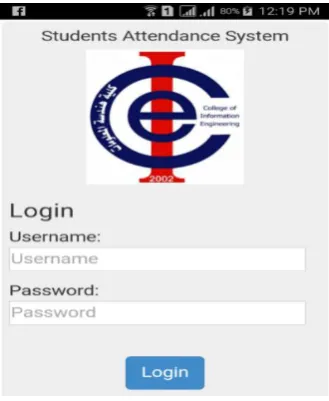
The homepage of the system is the login page. When user open the system login page will prompt, as shown in Figure (2), It involves three input types: Text fields, button and labels. Two text fields for username and password.
Fig -2: Login Page
A.Administrator Session
After entering the user name and password, the system will redirect the admin into the "Dashboard" page. It contains buttons for Department, Courses, Users, students and logout as shown in figure (3). These buttons are used for adding, deleting and editing; department, course, student and user respectively. The proposed system suppose that current academic system consists of four classes, and two semesters. Figures (4), (5) ,(6) and figure (7) shows managing these sections.
Fig -3: Admin Dashboard
[image:2.595.49.282.74.275.2] [image:2.595.353.531.220.434.2] [image:2.595.364.530.463.697.2] [image:2.595.91.256.530.731.2]© 2017, IRJET | Impact Factor value: 6.171 | ISO 9001:2008 Certified Journal | Page 1671
Fig -5: User Management Page
Fig -6: Departments Management Page
Fig -7: Students Management Page
B.Instructor Session
For taking the students attendance for particular department and class, instructor must be log in the system. After submitting the username and password of the instructor, the system will redirect that instructor to "take attendance" page as shown in figure (8). After selecting a department, class, semester, and the current course, all names of students at that class will appear in students list as shown in figure (9).
Fig -8: Take Attendance Page
Fig -9: Students List Page
[image:3.595.357.530.201.415.2] [image:3.595.77.243.308.467.2] [image:3.595.356.529.449.668.2] [image:3.595.80.243.508.716.2]© 2017, IRJET | Impact Factor value: 6.171 | ISO 9001:2008 Certified Journal | Page 1672
Fig -10: Attendance Statistics Page
C. Reporter session
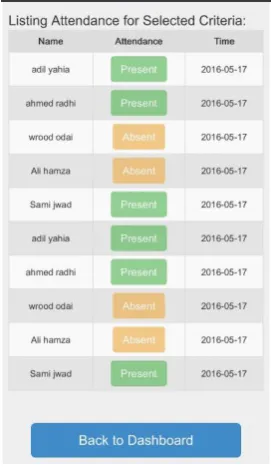
The third user of the system is the Reporter. This user responsible for extract a report of attendance, for a particular course, as shown in figure (11), or student in specific course, as shown in figure (12).
Fig -11: Student attendance State
[1] Mohd Heikal Husin, "Smart Attendance Systems Using
Technologies", October, 2009.
[2] Rakhi Joshi, "Android Based Smart Learning and
Attendance Management System", June 2015.
[3] Ganiyu R. A., "Mobile Operating Systems and Application
Development Platforms", July10, 2014.
[4] "AndroidArchitecture",http://www.tutorialspoint.com/
andoird/andoird_ architecture.htm.
[5] Usha Rani& Ramya Krishna, "Overview of Android For
User Applications", November 2014.
[6] Juliana Puentes Giraldo, "programming language
definition", 6 May, 2014.
[7] Gary Sims, "I want to develop Android Apps ", January
18, 2016.
[8] Tim Berners-Lee,"SGML/HTML docs, X Browser",
[image:4.595.91.256.90.317.2]December 9, 1991.
Fig -12: Student attendance Report
5. CONCLUSIONS
In term of performance and efficiency, the proposed has provided a convenient method of attendance marking compared to traditional method of attendance system. In addition, it is user friendly system as data manipulation and retrieval can be done via user interface, making it universal attendance system. And adaptive for implement in any educational system.
[image:4.595.91.227.447.681.2]© 2017, IRJET | Impact Factor value: 6.171 | ISO 9001:2008 Certified Journal | Page 1673
[9] Lerdorf Ramus," PHP on Hormones – history of PHP
presentation", April,2007.
[10] Matthew David, "Mobile app development tools" ,24 Nov
2015.
[11] Neeraj Sharma, "Database Fundamentals " First Edition
November 2010.
[12] Mark Matthews, "MySQL and Java Developer’s
Guide",5th edition march 2003.
[13] Wang Nina, " Building the WAMP Platform", May 2011.
BIOGRAPHIES
Mohammed A. Jabbar Hameed