© 2017, IRJET | Impact Factor value: 5.181 | ISO 9001:2008 Certified Journal
| Page 223
COMPARATIVE STUDY ON BITUMEN MODIFICATION USING SYNTHETIC
AND NATURAL FIBER
Midhila V S
1, Veena G Raj
1, Teena George
21
Final year B Tech student
2
Asst. Professor, Dept. of civil Engineering, Sree Buddha college of Engineering Elavumthitta Pathanamthitta,
Kerala, India
---***---Abstract -
Transportation sector is showing immensegrowth in the recent decades, modern vehicles introduced require a more stable platform to run better. In terms of road construction, we are not yet reaching the modernized standards adopted by other countries and usage of modern and innovative road construction materials are yet to be used in transportation infrastructure sector. The available roads are also getting damaged due to improper maintenance of top layer of the road and no bond strength between the bitumen and coarse aggregate. To avoid this kind of cracks and failure of surface bitumen, this is the main binder in the road construction need modification. In this study, there is a comparison between the bitumen modification using synthetic fiber and natural fiber. The bitumen used is the VG-30 which has a penetration value of 50-70 mm. The synthetic fiber used is polypropylene fiber and the natural fiber is the sisal fiber.
Key Words: VG-30 Bitumen, Sisal fiber, PP fiber, marshall stability test
1. INTRODUCTION
A decent roadway framework is a fundamental segment of a strong and stable economy for a developing nation like India. Being the second largest growing economy in the world, road infrastructure in India is developing at a very fast rate. As the present day interstate transportation has fast, high traffic activity, substantial load and channelized traffic movement, bituminous asphalts roads are subjected to different sorts of distresses and the roads laid with conventional bituminous mixes decreases. Due to this riding quality also gets reduced, which results in exorbitant vehicle operating costs and frequent maintenance interventions due to early failure of pavements. Due to variation in climate, rainfall intensities terrain condition, and soil characteristics providing durable roads have always been a problem for a country like India. To solve the problems associated with pavements a good amount of research is throughout the country in this field.
The problems can be reduced by modifying conventional bituminous mix by adding various types of modifiers like polymers and fibers which will strengthen the bonding between the aggregates provided by the binder. This
enhances the stone to stone contact resulting in an increasing resistance to crushing and resulted in a stiffer and tougher mix with considerable improvement in compressive strength. Utilization of changed bitumen with added substances like polypropylene (PP) fibers, sisal fibers etc. are picking up fame as method for controlling asphalt distresses. Improvement of polypropylene fibers as modifiers has prompted propelled characteristics known for its great procedure ability, low cost, vital binding property, low density and control of properties of materials at submicron level. By the use of natural fiber, it shows higher compressive strength than the conventional mix, increasing the resistance to crushing with superior water resistance property.
1.1 Literature Review
Ravi K Sharma found that polymer Modified Bitumen have a high elastic recovery (79%), higher rutting resistance and the Marshall stability increases by 27%.
Sumi S and N Unni krishnan found that interest in the natural fibers has resulted in the development of large number of modification techniques to bring them at par and even superior to synthetic fibers and also the applications of natural fibers in engineering projects extend from light weight composites to ground engineering applications.
Mahesh M Barad found that thermal behavior of the polypropylene shows that it softened easily without any evolution of gas around 130-1400C, this has been scientifically verified.
Anzar Hamid Mir found that plastic will increase the melting point of bitumen. It strengthened the road construction, increased the road life and road quality. Disha Rajyaguru, Rohit Kumar, Prof. C. B. Mishra found that 5% of PP of 12mm length is better than other percentages because the air void increased to 17.45%.
P Teja Abhilash and K Tharani found that By adding 5% of bitumen content and 0.2% of fiber, properties of mix is improved by using sisal fiber with BC
© 2017, IRJET | Impact Factor value: 5.181 | ISO 9001:2008 Certified Journal
| Page 224
2. EXPERIMENTAL PROGRAM
The experimental study was carried out with the objective to find out the good modifier for bitumen.
2.1 Methodology
Material collection
Testing of bitumen for the properties
Preparing modified bituminous concrete mix using synthetic and polypropylene fiber
Marshall stability test for normal and modified bitumen
Comparative review of modified bitumen
Material properties
[image:2.595.317.552.146.408.2]The tests were conducted to ascertain various properties of selected aggregates and VG-30 bitumen and modified bitumen using sisal fiber and PP fiber.
TABLE 1
PROPERTIES OF NORMAL BITUMEN (VG – 30)
Property Obtaine
d Value Value Specified (IS 73:2006) Penetration 68.67
mm 50-70 mm
Softening Point 51.5oC 47oC (min) Viscosity 129 sec 70 sec (min) Ductility 88cm 40 cm (min) Specific Gravity 1.04 0.97-1.20
TABLE 2
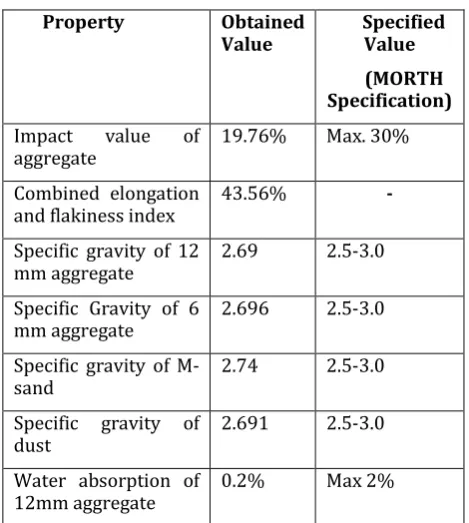
PROPERTIES OF AGGREGATES
Property Obtained
Value Specified Value (MORTH Specification) Impact value of
aggregate 19.76% Max. 30%
Combined elongation
and flakiness index 43.56% - Specific gravity of 12
mm aggregate 2.69 2.5-3.0 Specific Gravity of 6
mm aggregate 2.696 2.5-3.0 Specific gravity of
M-sand 2.74 2.5-3.0
Specific gravity of
dust 2.691 2.5-3.0
Water absorption of
12mm aggregate 0.2% Max 2%
Polypropylene fibers were selected as synthetic fiber for obtaining FRBC. The fibers were 100% virgin homo-polymer containing no reprocessed olefin material and were specifically engineered and manufactured in an ISO 9002 facility.
TABLE 3
PHYSICAL AND CHEMICAL PROPERTIES OF POLYPROPYLENE FIBERS
Properties Results
Absorption Nil
Fiber Length 10mm
Melt Point 324°F
Thermal Conductivity Low Acid and Salt Resistance High Specific Gravity 0.91
Modulus (Young’s) 0.5 (3.5 kN/mm) Ignition Point 1,100°F
Electrical Conductivity Low
Alkali Resistance Alkali Proof
© 2017, IRJET | Impact Factor value: 5.181 | ISO 9001:2008 Certified Journal
| Page 225
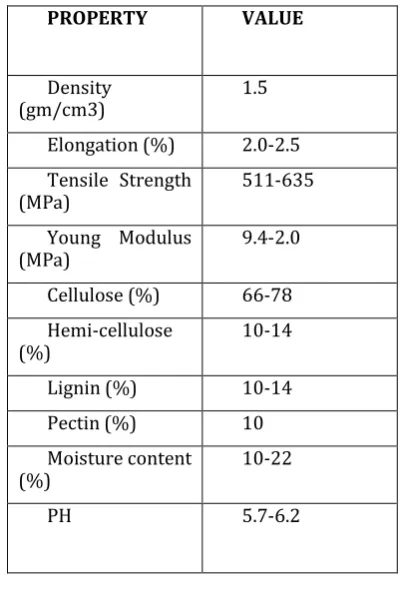
TABLE 4PHYSICAL AND CHEMICAL PROPERTITES OF SISAL FIBERS
PROPERTY VALUE
Density
(gm/cm3) 1.5
Elongation (%) 2.0-2.5 Tensile Strength
(MPa) 511-635
Young Modulus
(MPa) 9.4-2.0
Cellulose (%) 66-78 Hemi-cellulose
(%) 10-14
Lignin (%) 10-14
Pectin (%) 10
Moisture content
(%) 10-22
[image:3.595.60.262.142.439.2]PH 5.7-6.2
TABLE 5
PROPERTIES OF BITUMEN MIXED WITH SISAL FIBER
Property 0.1% of sisal fiber 0.2% of sisal fiber 0.3% of sisal fiber
0.4% of sisal fiber
Penetration 41.33
mm 75.67 mm 40 mm 37mm
Softening
point 63
0C 730C 840C 890C
Viscosity 180
sec 290.3 sec 488 sec 590 sec
Ductility 64 cm 53
cm 46 cm 36 cm
TABLE 6
PROPERTIES OF BITUMEN MIXED WITH POLYPROPYLENE FIBER
Property 0.1 % of PP fiber
0.2 % of PP fiber
0.3 % of PP fiber
0.4 % of PP fiber
0.5 % of PP fiber
0.6 % of PP fiber Penetratio
n (mm) 61 60 58 54.5 53 49
Softening
point (0C) 48 50 50.5 51 52 55.5 Viscosity
(sec) 77 85 90 98 110 150
Ductility
(cm) 86 71 55 50 44 37
Aggregates which possess sufficient strength, hardness, toughness were chosen, keeping in view the availability and economic consideration. Aggregates of size 12mm (A), 6mm (B), M-sand (C) and quarry dust (D) were selected and graded. Based on the individual grading of aggregates, a suitable gradation for the mix was arrived upon as shown in Table 7 shows the gradation curve of the selected proportion of aggregates.
TABLE 7
FINAL GRADATION OF AGGREGATES
Sieve
size (mm) %finer specifications MORTH
19 100 100
13.2 93.43 90-100
9.5 80.10 70-88
4.75 70.35 53-71
2.36 57.98 42-58
1.18 39.67 34-48
0.6 30.11 26-38
0.3 20.56 18-28
0.15 11.99 12-20
0.075 5.57 4-10
[image:3.595.49.273.495.702.2]© 2017, IRJET | Impact Factor value: 5.181 | ISO 9001:2008 Certified Journal
| Page 226
The following proportions were obtained:Aggregate A- 25% Aggregate B- 15% Aggregate C- 22% Aggregate D- 38%
[image:4.595.34.544.44.843.2]X axis Particle Size (mm)
[image:4.595.37.269.117.380.2]Fig: Gradation Curve
TABLE 8
MARSHALL STABILITY TEST RESULTS OF BITUMEN
Binder Content
(%)
Flow value
(mm)
Stability Value
(kN)
5 2.45 18.01
5.5 2.33 19.92
6 2.36 17.25
6.5 2.91 15.73
TABLE 9
MARSHALL STABILITY TEST RESULTS OF BITUMEN MIXED WITH SISAL FIBER
Binder
Content (%) Flow value (mm) Stability Value (kN)
5 1.74 17.59
5.5 2.40 19.92
6 2.77 17.24
[image:4.595.327.538.160.269.2]6.5 3.25 14.76
TABLE 10
MARSHALL STABILITY TEST RESULTS OF BITUMEN MIXED WITH POLYPROPYLENE FIBER
Binder
Content (%) Flow value (mm) Stability Value (kN)
5 1.86 18.38
5.5 3.01 20.46
6 4.52 18.67
6.5 3.31 17.75
3. RESULTS AND DISCUSSIONS
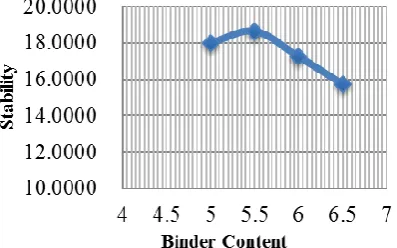
The curves obtained from the tests on bitumen without and with sisal fiber and PP fiber are shown in Figures below. It may be noted from these figures that modification of bitumen with fiber increases the stability and decreases the binder content.
Test Results for Normal Bitumen
Fig.1: Stability Value vs Binder Content
Fig.2: Binder Content vs Vv
Y axis
[image:4.595.42.541.392.793.2] [image:4.595.324.523.405.529.2] [image:4.595.55.270.467.593.2]© 2017, IRJET | Impact Factor value: 5.181 | ISO 9001:2008 Certified Journal
| Page 227
Fig.3: Binder Content vs Flow ValueFig.4: Binder Content vs Bulk Specific Gravity
From these graphs by taking the maximum stability, range of flow value, range of void content and mid-range of bulk specific gravity, the optimum binder content for normal bitumen is taken as 5.9%.
Test Results for Modified Bitumen with Sisal Fiber
Fig.5: Stability value vs Binder Content
Fig.4.6: Binder Content vs Vv
Fig.7: flow value vs binder content
Fig.8: Binder Content vs Bulk Specific Gravity
From these graphs, the optimum binder content of modified bitumen with sisal fiber is obtained as the 5.8%.
Test Results for Modified Bitumen with Polypropylene Fiber
Flow
Value
(mm)
Binder Content
Binder Content
Gm
Binder Content
Flow
Value
(mm
)
© 2017, IRJET | Impact Factor value: 5.181 | ISO 9001:2008 Certified Journal
| Page 228
Fig.9: Stability value vs Binder ContentFig.10: Binder Content vs Vv
Fig.11: Binder Content vs Flow Value
Fig.12: Binder Content vs Bulk Specific Gravity
From these graphs, the optimum binder content of modified bitumen with PP fiber is obtained as 5.3%.
3. CONCLUSIONS
The trends obtained in these laboratory tests are in good agreement with the results reported in the literature. The result shows that fiber improves the fatigue life by increasing the resistance to cracking and permanent deformation. The fiber reinforcement thus provided additional tensile integrity in the mixes and hence increasing the strain energy absorption thereby inhibiting the formation and propagation of cracks.The major conclusions that can be drawn from the present study are as follows:
The tests on normal bitumen were conducted and the properties were obtained.
The properties of bitumen modified with sisal fiber for 0.1 to 0.4% were obtained and found out the optimum percentage as 0.3%.
The properties of modified bitumen with PP fiber for 0.1% to 0.6% were obtained and found out that 0.5% is the optimum percentage.
The properties of aggregates and the filler material were tested and fixed the mix ratio as 25:15:22:38 (12 mm aggregate: 6 mm aggregate: M-sand: dust).
The Marshall Stability test for normal bitumen and modified bitumen with sisal and PP fiber was conducted.
It is found out that 5.9% is the optimum binder content for normal bitumen
5.8% and 5.4125% are the optimum binder content of modified bitumen with sisal and PP respectively.
From this work, it was found out that by adding fibers as modifiers in bitumen the stability value increases and also the binder content can be reducing certain amount.
Among the synthetic and natural fiber, best modifier is the synthetic fiber.
Among these the main advantage is that PP fiber is that which is one of the plastic material so by utilizing plastic waste PP fiber is obtained from the waste there by reducing the plastic waste.
Also have a disadvantage that while heating the
PP fiber it causes some sort of pollutions.
Besides that, PP fiber is a good modifier.
ACKNOWLEDGEMENT
The authors thanks Dr Gouri Antherganam, Head of the Civil Engineering department for the help provided during preparation of the paper
14.0000
16.0000
18.0000
20.0000
22.0000
4
4.5
5
5.5
6
6.5
7
Sta
bil
it
y
Binder Content
0
2
4
6
8
10
12
4.0 4.5 5.0 5.5 6.0 6.5 7.0
Vv
Binder content
2.34 2.36 2.38 2.4
4.5 5 5.5 6 6.5 7
Binder Content
Binder Content
Gm
Flow
© 2017, IRJET | Impact Factor value: 5.181 | ISO 9001:2008 Certified Journal
| Page 229
REFERENCES
[1] Disha Rajyaguru, Rohit Kumar, Prof. C. B. Mishra
(2016),” Contribution of Polypropylene Fibers in Modification of VG 30 Bituminous Mix”, International Journal of Engineering Sciences & Research Technology [877]
[2] Noor Zainab Habib, Ibrahim Kamaruddin, Madzalan
Napiah and Isa Mohd Tan (2011), “Effect of Mixing Process on Polypropylene Modified Bituminous Concrete Mix Properties”, International Journal of Civil, Environmental, Structural, Construction and Architectural Engineering Vol:5, No:10.
[3] Noor Zainab Habib, Ibrahim Kamaruddin, Madzalan
Napiah and Isa Mohd Tan (2011), “Rheological Properties of Polyethylene and Polypropylene Modified Bitumen”, International Journal of Civil and Environmental Engineering 3:2
[4] Shivraj Sarjerao Patil (2015), “Experimental Study on
Bitumen with Synthetic Fiber”, Journal of Information, Knowledge and Research in Civil Engineering, ISSN: 0975 – 6744| NOV 14 TO OCT 15 | Volume 3, Issue 2.
[5] Sumi S, N Unnikrishnan (2014), “Natural Fibers in