© 2017, IRJET | Impact Factor value: 5.181 | ISO 9001:2008 Certified Journal | Page 3505
ANALYSIS OF RIVET FASTENED RECTANGULAR HOLLOW FLANGE
CHANNEL BEAMS
Megha Merry Joy
1, Jeena Mathew
21
P G student, Department of Civil Engineering, SNGCE College of Engineering and Technology, Kerala, India
2Assistant Professor, Department of Civil Engineering, SNGCE College of Engineering and Technology, Kerala, India
---***---Abstract -
The widely researched litesteel beam is no longer produced due to the expensive manufacturing cost associated with the dual electric resistance welding process, poor shear capacity and also due to lateral distortional buckling effects. Hence an alternative method to produce equivalent sections are adopted which is called rivet fastened rectangular hollow flange channel beams (RHFCB). Due to its simple and flexible manufacturing process, the designers can effectively choose different plate sizes, thickness and steel grades for web and flange elements to achieve the most efficient section. Without web openings in beams, building services have to be located under the joists leading to increased floor heights. Hence web openings are essential in beams and its effect on load bearing capacity of the channel section is important.The load carrying capacity of these hollow flange sections is found to decrease with the inclusion of web openings in the beams. A cost effective method of eliminating the detrimental effects of a large web opening is to attach suitable stiffeners around the web openings; thereby enhancing the strength of the section. The paper presents effect of web holes in beams and the effect of CFRP stiffeners on the load carrying capacity.Key Words: Rivet fastened rectangular hollow flange channel beam, Litesteel beam, CFRP.
1. INTRODUCTION
The use of cold-formed steel members in low rise building construction has increased significantly in recent times. It has been suggested that in the future more than 70% of steel buildings will be constructed using cold-formed steel. Cold-formed steel manufacturers have continuously utilized thin, high strength steels and new manufacturing technologies to develop advanced, lightweight sections that are more structurally efficient and cost effective in order to improve the market share for cold-formed steel construction. Cold-forming process is simple, efficient, economical and environmentally friendly, and is capable of manufacturing very effective sections compared to hot-rolled, open steel sections. Over the years, the use of cold-formed steel structures in construction has increased rapidly, associated with a significant increase in their research.
1.1 Litesteel Beam
Litesteel beam (LSB) is manufactured from a single strip of high-strength steel using a combined cold-forming and dual electric resistance welding process. The LSBs combine the stability of hot-rolled steel sections with the high strength to weight ratio of cold-formed steel sections, and are very efficient as structural beams since the hollow flanges are positioned away from the center.
1.2 Rivet Fastened Rectangular Hollow Flange
Channel Beam
The rivet fastened RHFCB is a mono-symmetric section where the rectangular hollow flanges are cold-formed first and then connected to a web plate using inexpensive, self-pierce rivet fastening
2. OBJECTIVES
• To compare the load bearing capacity of Litesteel beam with rivet fastened RHFCB.
• To determine the load bearing capacity of rivet fastened RHFCB’s with different number of web openings.
• To study the effect of CFRP Plates as stiffeners on the load carrying capacity of rivet fastened RHFCB’s.
3. EXPERIMENTAL INVESTIGATIONS
© 2017, IRJET | Impact Factor value: 5.181 | ISO 9001:2008 Certified Journal | Page 3506
3.1 Litesteel beam
3.1.1 Geometrical Parameters
•
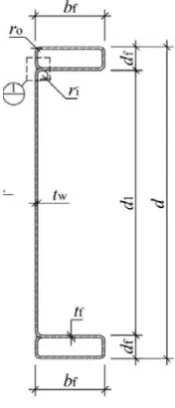
Full depth (d) = 200mm• Flange width (bf) = 60mm
• Flange depth (df) = 20mm
• Web thickness (tw) = 1mm
• Flange thickness (tf ) = 1mm
[image:2.595.328.507.137.500.2]• Total span = 1000mm
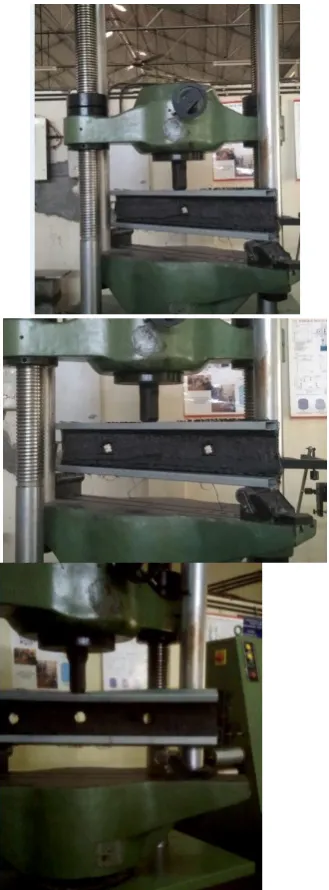
[image:2.595.55.234.148.447.2]Fig - 1: Experimental setup of litesteel beam
Fig - 2: Cross sectional details of litesteel beam
3.2 Rivet fastened RHFCB
3.2.1 Geometrical Parameters
•
Full depth (d) = 200mm• Flange width (bf) = 60mm
• Flange depth (df) = 20mm
• Web thickness (tw) = 1mm
• Flange thickness (tf ) = 1mm
• Lip length (lf) = 20mm
• Additional web height (lW) = 10mm
[image:2.595.111.199.488.693.2]• Total span = 1000mm
Fig - 3: Experimental setup of Rivet fastened RHFCB
[image:2.595.375.477.523.752.2]© 2017, IRJET | Impact Factor value: 5.181 | ISO 9001:2008 Certified Journal | Page 3507
3.3 Effect Of Web Holes On Rivet Fastened RHFCB
[image:3.595.71.248.176.678.2]In this part specimen with web holes were investigated. Web holes of 50mm diameter is created at L/2, L/4 and L/8 of the specimen. Effect of number of web holes on rivet fastened RHFCB are studied.
Fig - 5: Experimental setup of Rivet fastened RHFCB with one web hole, two web holes and three web holes
3.4 Effect of CFRP stiffeners along the beam
length
Here in this study the effect of CFRP stiffeners on the web buckling when the number of holes are increased. Web holes of 50mm is created at L/2, L/4 and L/8 distance on the specimen.
In order to prevent the buckling behavior or to reduce the buckling effect by inclusion of web openings, stiffeners need to be provided.
CFRP stiffeners are provided because they are light weight and has high tensile modulus which provides elasticity behavior than steel. Hence CFRP stiffeners are adopted.
[image:3.595.369.534.285.731.2]© 2017, IRJET | Impact Factor value: 5.181 | ISO 9001:2008 Certified Journal | Page 3508
4. RESULTS AND DISCUSSIONS
4.1 Buckling Capacity of Litesteel Beam and Rivet
Fastened RHFCB
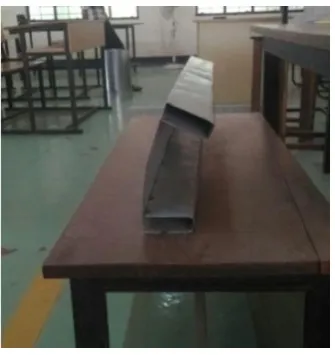
[image:4.595.319.543.249.361.2]In this section, buckling load of litesteel beam and rivet fastened RHFCB is investigated. Litesteel beam failed at 3.4 kN whereas rivet fastened RHFCB failed at 4.8 kN. It can be seen that the litesteel beam failed at considerably lower load than that of rivet fastened RHFCB. Since no welding failure occurred Continuous welding or spot welding do not contribute to the load carrying capacity in LSB. No flange crushing mechanism was observed because the load immediately transferred to the web and thus web buckled at very low load. Flanges in LSBs does not contribute to the load carrying capacity. Hence rotation of flanges were observed .For rivet fastened RHFCB , Flange crushing mechanism was observed because of the stiffness provided by the lips riveted to the web plate. And the additional web element. Hence flanges are strong enough to resist buckling of web.
Fig - 6: Web buckling in litesteel beam
Fig - 7: Flange crushing in rivet fastened RHFCB
4.2
Effect of Web Holes on Rivet Fastened
RHFCB
In this section, effect of changes in number of web holes of 50mm diameter on the buckling load of rivet fastened RHFCB is studied.
[image:4.595.36.204.390.568.2]The results shows that by increasing the number of holes, the buckling load of the rivet fastened RHFCB decreases continuously. It is evident that an increase in the number of holes when the diameter of web hole causes a considerable reduction in the buckling load of rivet fastened RHFCBs
Fig - 8: web buckling in rivet fastened RHFCB
[image:4.595.308.563.405.518.2]Fig - 9: Flange crushing in rivet fastened RHFCB with one web hole
[image:4.595.332.536.587.687.2]© 2017, IRJET | Impact Factor value: 5.181 | ISO 9001:2008 Certified Journal | Page 3509 Fig -11: Flange crushing in rivet fastened RHFCB with
[image:5.595.37.253.232.297.2]three web holes
Fig - 12: Web buckling in rivet fastened RHFCB with three holes
4.3 Effect of CFRP Stiffeners along the Beam
Length
In this section, effect of CFRP stiffeners along the beam length on the buckling load of rivet fastened RHFCB is studied. For this, three specimens were manufactured and holes are provided.
[image:5.595.299.567.296.607.2]It is evident that while providing CFRP plate stiffener the web buckling didn’t occur and the specimen failed at much higher load than that of without CFRP. Thus the buckling load got increased. The results obtained in this study is compared with the results of specimen without stiffener.
[image:5.595.36.244.501.579.2]Fig -13: Flange crushing in rivet fastened RHFCB with one hole and CFRP (No web buckling)
Fig -14: flange crushing in rivet fastened RHFCB with two holes and CFRP No web buckling)
Fig - 15: Web buckling in rivet fastened RHFCB with three holes and CFRP
Table - 1: Buckling Load And Mode Of Failure
No: of holes Buckling Load (kN) Specimen With CFRP Stiffener Along The Beam Length Buckling Mode
Specimen With CFRP Stiffener Along The Beam
Length Buckling Load (kN) (Without CFRP Stiffener) Buckling Mode (Without CFRP Stiffener)
1 4.4
(I)Flange Crushing
(Ii)No Web Buckling 3.5
(I)Flange Crushing
(Ii) Web Buckling
2 4
(I)Flange Crushing
(Ii)No Web Buckling 3.2
(I)Flange Crushing
(Ii) Web Buckling
3 4
(I)Flange Crushing (Ii) Web Buckling 3 (I)Flange Crushing (Ii) Web Buckling
5. CONCLUSIONS
[image:5.595.39.232.629.703.2]© 2017, IRJET | Impact Factor value: 5.181 | ISO 9001:2008 Certified Journal | Page 3510 The application of these beams include roof purlins and floor
joists in variety of industrial, commercial and residential buildings. These openings provided for facilitating building services, causes reduction in shear strength. The effect of web opening is that it not only introduces stress concentration but also significantly reduces buckling load. From the studies on rivet fastened RHFCBs, it is observed that the buckling load of the beam is decreased considerably when web holes are provided in the beam. By the use of CFRP stiffeners along the beam length, buckling load gets increased by 20% for one web hole and two web holes and 25% for three web holes.
REFERENCES
1. Mahen Mahendran,Poologanathan Keerthan (2015), Web crippling tests of Rivet Fastened Rectangular hollow flange channel beams under two flange load cases, Advances in Structural Engineering ,95, 262–275.
2. Mahen Mahendran,Poologanathan
Keerthan(2013) Experimental studies of the shear behavior and strength of LiteSteel beams with stiffened web openings,,Science Direct ,49,840–854
3. Poologanathan Keerthan, Mahen
Mahendran(2016) Section moment capacity tests of rivet fastened rectangular hollow flange channel beams,Science Direct,125,252-262
4. Edward Steau ,Mahen
Mahendran,Poologanathan Keerthan (2016)Web crippling study of rivet fastened rectangular hollow flange channel beams with flanges fastened to supports, Advances in Structural Engineering,95,1– 15
5. Poologanathan Keerthan, Mahen
Mahendran(2016) Finite element modeling of rivet fastened rectangular hollow flange channel beams subject to local buckling, Science Direct ,55, 311-327 6. Santhif Kumar (2016) Web Crippling Test of Cold Formed Steel Channels using CFRP Under Various Load Cases, International journal for scientific research and development,1588-1591