Error Analysis of 2-tier
M
-ary Star QAM Modulation in
Shadowed Fading Channels
Sourjya Dutta
Polaris Networks Salt Lake Electronics ComplexKolkata 700091, India
Iti Saha Misra
Deptt. of Electronics and Telecommunication Engg. Jadavpur University
Kolkata 700032, India
ABSTRACT
The error performance of the 2-tier star shaped Quadrature Amplitude Modulation scheme overK andKGfading channels
are analyzed and evaluated. Novel closed form expressions for Symbol Error Rate (SER) have been derived for M-ary 2-tier circular Star QAM transmitted over the K and KG
fading channels. The expressions derived are in the form of sum of single definite integrals of hypergeometric functions which are calculated using numerical methods. The expressions are validated by extensive Monte Carlo simulation. A simple relationship between SER and bit error rate (BER) is proposed and experimentally verified. Using the expressions for SER, the optimum values of ring ratio are calculated for various values of M. It has also been established that the error performance of 2-tier Star QAM is considerably superior to that of the M-ary Square QAM for high and moderate fading.
General Terms:
Digital Modulation, Wireless Channel
Keywords:
Star Quadrature Amplitude Modulation (QAM), Rayleigh-Gamma(K), Nakagami-Gamma(KG), Fading, Shadowing, Symbol Error Rate(SER), Bit Error Rate(BER) 1. INTRODUCTION
Various statistical models are used to study the effects of multipath fading and shadowing that severely degrade the performance of wireless communication systems. Effects of small-scale multipath fading on communication systems have been widely studied. The analysis of the effect of shadowing in wireless communication systems had been impeded by the complex mathematical form of the log-normal distribution conventionally used to quantify this phenomenon.
In relatively recent works the K and the KG fading models
have been found to be a suitable replacement of the log-normal distribution to estimate the combined effects of shadowing and small-scale fading in wireless media [1, 2, 3]. Moreover the Generalized-K distribution is also being used to model the effect of turbulence in free space optical (FSO) communication channels [4, 5]. The mathematical forms of these distributions
allow closed form integration and hence system parameters can be efficiently computed using numerical techniques. Error analysis of lower orderM-ary Phase Shift Keying (PSK) and squareM-ary Quadrature Amplitude Modulation (MQAM) schemes forKand KGchannels is found in [3, 6, 7]. Similar analysis for higher order
and complex modulation schemes are absent in literature. M-ary QAM schemes are spectrally efficient modulation schemes which ensures higher data rates without requiring extra bandwidth. It has been pointed out in [8] that the widely used squareMQAM scheme will have a high chance of false phase locking in channels where both amplitude and phase of the transmitted signal may vary considerably. The authors in [8] have contended that theM-ary Star QAM modulation scheme will be better suited for vehicular environments. In [9] it has been shown that theM-ary Star QAM scheme gives a better performance in heavy fading channels like the Rayleigh channel and also simplifies the receiver structure as automatic gain control (AGC) and carrier recovery are no longer required. As given in [10], the M-ary Star QAM overcomes the problem of high peak-to-average power ratio (PAPR) present in square and rectangular QAM schemes. In recent academic literature [11, 12, 13, 14] the Star QAM modulation has been studied for applications in optical communication. Additionally in [15] it has been pointed out that circular QAM schemes provide better performance than rectangular QAM for quantum detection. Error analysis of Star MQAM schemes in small-scale multipath fading channels can be found in [16, 17, 18] but to the best of our knowledge error rate estimation of Star QAM in shadowed fading channels is absent in current literature. The aim of this paper is to analyse the combined effects of shadowing and multi-path fading on the performance of 2-tierM-ary Star QAM schemes. The contributions of this paper are :
i. Derivation of numerically computable expressions for average SER of StarMQAM considering the effects of both multipath fading and shadowing.
ii. Derivation of an efficient relationship between average SER and average BER for the 2-tier Star QAM.
iii. Proposing optimum values of ring ratio for different constellation sizes in composite multi-path and shadow fading channel.
iv. To compare the error performance of the Star and the Square constellations in the discussed propagation model.
I
Q
S0 S1 S8 RO RIFig. 1. Signal constellation of 2-tier 16-ary Star QAM.
of the average SER inK and KG fading channel is shown in
Section 3. The relationship between SER and bit error rate (BER) is given in Section 4. The optimum values of ring ratio for the Star QAM scheme are presented in Section 5.Numerical results and discussions are presented in Section 6; Section 7 concludes the paper.
2. SYSTEM MODEL
2.1 2-tier StarMQAM Scheme
The 2-tierM-ary Star QAM scheme, as shown in Figure 1, has the signalling points distributed over two amplitude levelsRIand
RO and on each amplitude level there areM/2signalling points
which are placed at a constant phase difference(4π/M). Thus a signalling point (si) of a Star QAM constellation can be given as,
si=ri.ejθi, (1)
where,
ri{RI, RO}
and
θi=4Mπi, i= 0,1, ..., M
2 .
The signalling points are uncoded, i.e. for the 16-QAM in Figure 1 s0= 0000,s1= 0001,s8= 1000 and so long. The modulated wave is baseband transmitted over the wireless channel.
2.2 Channel Model
The uncoded dual ring M-ary Star QAM signal is transmitted over a wireless channel along with AWGN. The signal in this wireless channel is corrupted due to both short-term (multipath) and long-term (shadow) fading. The short-term fading is assumed to be slow compared to the signal variation. The received baseband signal can be given byz = sX+nwheresis the transmitted symbol,Xis a random variable following a fading statisticsfγ(γ)
andnis the Gaussian distributed additive noise.
When only channel degradation due to short term fading is considered, the probability density function of the signal amplitude can be given byfγ(γ)wherefγ(γ)can be the Rayleigh distribution
or the Nakagami-m distribution given in [19]. When long term fading is considered, the power of the envelope which is assumed to be constant for multipath fading varies according to the lognormal distributionfY(y). Thus the joint pdf of the random variableXis
given as,
fX(γ) =
Z ∞
0
fγ|Y(γ|y).fY(y)dy. (2)
But with lognormal distribution there is no closed form solution forfγ(γ)for the envelope of the received signal power. As shown
in [1], the two parameter Gamma pdf can be used as a suitable substitute for lognormal pdf. From [20] the Gamma pdf can be given in terms of average SNRγ0as,
fY(y) = 1 Γ(c)γ
−c
0 y
c−1exp
−y
γ0
;y≥0, (3)
wherecis the shape parameter of the Gamma distribution andΓ(.)
is the gamma function [21].
Considering the envelope of the signal to follow the Rayleigh distribution and the power of the envelope to follow the Gamma distribution given by eqn.(3), the channel as given in [20] can be modelled as the Rayleigh-Gamma orKdistributed channel given as a function of SNR(γ)as,
fX(γ) = 2
γ0Γ(c)
γ γ0
c−21 Kc−1
2 r γ γ0
;γ≥0, (4)
where Ka(.) is the the modified Bessel function of the second
kind. TheKfading channel has been generally used for RADAR and satellite applications [22, 23]. As is evident from eqn.(4), for theKdistribution; the severity of the short term fading cannot be changed. Hence theK fading channel is not suitable for fading analysis where the fading characteristics vary. Thus for terrestrial applications a more general channel model is required.
The Nakagami-Gamma orKGchannel model can be used for more
generalized estimation of the combined effects of short-term and long-term fading. The envelope of the received signal follows the Nakagami-mdistribution and the power of the envelope follows the Gamma distribution. TheKGfading distribution function, as
shown in [1, 20], can be given as a function of SNR(γ)as,
fX(γ) = 2γ0
Γ(c)Γ(m)m
mγm−1(mγ0γ)c−2mK
c−m
2
rmγ
γ0
;γ≥0,
(5) wheremis the Nakagami shape parameter andm ≥ 0.5. From [24]Ka(.)is related to the Meijer-G functionGmnpq (.)by,
xµK
ν(x) =G2002
1 4x 2 − 1 2µ+
1 2ν,
1 2µ−
1 2ν
!
. (6)
To facilitate calculations we use eqn.(6) in eqn.(5) and rewrite the KGdistribution function as
fX(γ) = 1 Γ(c)Γ(m)
m γ0G 20 02 mγ γ0 −
c−1, m−1
!
;γ≥0. (7)
3. SER CALCULATION OF STARMQAM INK
AND GENERALIZED-KFADING CHANNELS
M-ary Star QAM in AWGN channel is derived in [16] as,
Pe(γ) = 1 2π
4
X
k=1
Z θk
0
exp [−A(θ, k).γ]]dθ, (8)
where,
A(θ, k) = αkM sin
2φ
k 2(1 +L2)sin2(φ
k+θ)
, (9)
andαk,φk and θk are geometry dependent parameters given in
[16].Mis the total number of signalling points on the constellation and L is the ring ratio [16, 17].αk,φkandθkare either constants
or functions of M and L. The expression put forth in [16] can be easily computed by numerical method and gives an exact approximation of the SER for lower order M-ary Star QAM schemes.
The SER,Pe(γ), in a fading channel characterized by the fading
distributionfX(γ), is given by,
P(γ) =
Z ∞
0
Pe(γ).fX(γ).dγ. (10)
3.1 SER in Rayleigh-Gamma(K)Fading Channel
The average SER in the Rayleigh-Gamma(K) channel can be obtained by substituting eqn.(4) and eqn.(8) in eqn.(10). Thus the average SER in theKchannel is the solution of integral given by,
Pe(γ0)
K = 1 2π k=4 X k=1
Zθk
0
Z ∞
0
2
γ0Γ(c)
γ γ0
c−21
×Kc−1
2 r γ γ0
×exp (A(θ, k)γ)dγdθ. (11)
Using the relation [24]
Z ∞
0
xm2e−αxKm 2√x=
Γ(m+ 1) 2α
1
α
m2−1
.W−1
2c,−12(c−1)
1
α
(12)
to compute the inner most integral of eqn.(11), the final closed form expression for SER inKfading channel is given as,
Pe(γ0)
K = 1 2π k=4 X k=1
Z θk
0
1
A(θ, k)γ0
×exp
1 2A(θ, k)γ0
×W−1
2c,−12(c−1)
1
A(θ, k)γ0
dθ, (13)
whereWa,b(z)is the Whittaker function.
3.2 SER in Nakagami-Gamma(KG)Fading Channel
The average SER in Nakagami-Gamma (KG) fading channel can
be computed by substituting eqn.(7) and eqn.(8) in eqn.(10). The
average SER is the solution of the integral given by,
Pe(γ0)
KG = 1 2π k=4 X k=1
Z θk
0
Z ∞
0
1 Γ(c)Γ(m)
×
m γ0
exp (A(θ, k)γ)
×G20
02 mγ γ0 −
c−1, m−1
!
dγdθ. (14)
Using the relation [24]
Z∞
0
x−ρe−βxGmnpq αx
a1, ..., ap
b1, ..., bq
!
=
βρ−1Gmn+1
p+1q αx
ρ, a1, . . . , ap
b1, . . . , bq
! (15)
for computing the inner most integral, the closed form expression for SER inKGfading channel is given as,
Pe(γ0)
KG = 1 2π k=4 X k=1
Z θk
0
1 Γ(c)Γ(m).
m γ0
× 1
A(θ, k)G
21 12
m γ0A(θ, k)
0
c−1, m−1
!
dθ.
(16) Computing the average value of SER using eqn.(16) becomes computationally expensive in MATLAB 2012 because MATLAB exports the Meijer-G function from the MuPad utility. From [21] we get the relation
G21 12 x a b, c !
= Γ(b−a+ 1)Γ(c−a+ 1)x12(b+c−1)
×e12xWk,m(x),
(17)
where,k=a−0.5(b+c+ 1)andm= 0.5(b−c). Using eqn.(17) we can rewrite eqn.(16) as,
Pe(γ0)
KG = 1 2π k=4 X k=1
Zθk
0
m γ0A(θ, k)
12(c+m−1)
×exp
m
2γ0A(θ, k)
×W−1
2(c+m−1),−12(c−m)
m A(θ, k)γ0
dθ. (18)
As expected, puttingm= 1in eqn.(31) we get eqn.(13). This is in conformance to the fact that theKdistribution is a special case of theKGdistribution.
4. BIT ERROR RATE ANALYSIS
Table 1. Average Asymptotical Optimum Ring Ratio inKGFading Channel.
M Loptin AWGN AverageLoptinKG
8 2.414 2.390 16 1.765 1.805 32 1.390 1.445 64 1.196 1.255
By maximuma prioriprobability (MAP) estimate the upper bound of BER is given by,
Pb(u)≤ 1
log2(M) M
X
j=1
d(cj, cu).Aj|u (19)
where,cuis the symbol received andcjis the symbol decoded and
Aj|u=P(cjisdecoded|cuisreceived) (20)
and d(cj,cu) is the Hamming distance between symbolcjandcu.
Under conditions of severe and moderate channel degradation it can be assumed that in case of a symbol error all the otherM − 1symbols are equi-probable receiver output. Thus the probability that symbol u is sent and j is decoded is given as,
Aj|u=
SER(γ0)
M−1 , (21)
where SER(γ0) is the symbol error rate as a function of average input SNR (γ0 ) as given in Section3. The average SER(γ0) is independent of j . Thus eqn. (19) can be simplified as,
Pb(u)≤
SER(γ0) (M−1)log2M
M
X
j=1
d(cj, cu) (22)
Eqn. (22) can be further simplified by substituting,
M
X
j=1
d(cj, cu) =m.2m −1
(23)
where,m=log2(M), the number of bits per symbol. Substituting equation (23) in equation (22),Pbis given as,
Pb≤
M
2(M−1)SER(γ0) (24)
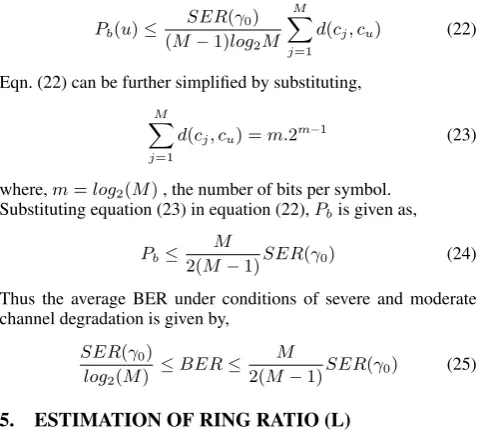
Thus the average BER under conditions of severe and moderate channel degradation is given by,
SER(γ0)
log2(M) ≤BER≤
M
2(M−1)SER(γ0) (25)
5. ESTIMATION OF RING RATIO (L)
The ring ratio (L) is a crucial parameter in the design ofM-ary Star QAM systems. In AWGN channel the optimum value of ring ratio can be simply derived by equating the distance between a constellation point and its neighbours, i.e. from Figure 1 we equate the distance betweens0 ands1 ands0 ands8. The relation can be easily computed using geometric methods as given in [27] for 16-ary Star QAM. Generalizing the expression the optimum ring
ratio in AWGN is given by,
Lopt= 2.sin
2π M
−1 (26)
For fading channels there is no direct formula to compute the optimum ring ratio (L). We need to employ the expressions for SER to estimate the optimum value of L. For a given value of SNR(γ), the value of L for which SER is minimum is computed programmatically. This is repeated for different values of SNR(γ). As shown in [17], the value of the optimum ring ratio assumes an asymptotic value for higher SNR. This asymptotic value is considered as the optimum value of L. Following this approach the asymptotic valuesLoptin theKGfading channel is computed.
The function under the integral in eqn.(31) is a hypergeometric function and hence a direct numerical search becomes computationally expensive and impractical. To overcome this a combination of numerical and empirical method is utilized to compute the asymptotic values ofLopt. Initially a few values of
SNR are chosen over a large range (0 to 50dB). As we get an estimation of the asymptotic value ofLoptfrom this set of data, we
decrease our range and take equal number of data points over that range. For example if from the first test we see that the optimum value of L starts assuming asymptotic values from 30dB, then in the next iteration we will decrease our range to 25dB to 40dB and find the variation ofLfor minimum SER in this range. Repeating these steps we can calculate the accurate value ofLoptfor theKG
fading channel.
Obviously the value of Lopt varies with c and m. In order to
facilitate system design an average value ofLopthas been proposed
for each value ofM. The values ofLoptfor different values ofc
andm(1≤m≤5,1≤c≤5)are within a range of±10%of the proposed mean values given in Table5.
6. RESULTS AND DISCUSSIONS
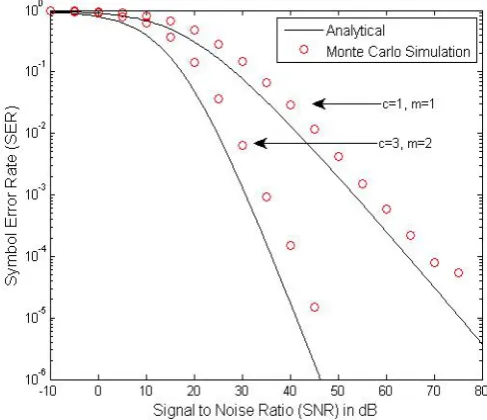
To establish the analytical results of Section3 extensive Monte Carlo simulations are preformed using MATLAB. Independent and identically distributed generalized K variates can be easily generated by extending the method shown in [28] using Gamma variates. LetGθ be a gamma distributed random variate with the
probability density function,
fX(x;θ) = Γ−1(θ)x(θ−1)ex. (27)
The generalized-Krandom variates with parametersmandccan then be generated by,
KG= 2p
p
(Gm×Gc), (28)
where,
p=p 1
|c−m|+ 1. (29)
Fig. 2. Average SER vs. average SNR (γ0) of 8-ary Star QAM in
Generalized-Kfading channel for several values ofmandc(L=2.390).
Fig. 3. Average SER vs. average SNR (γ0) of 16-ary Star QAM in
Generalized-Kfading channel for several values ofmandc(L=1.805).
[image:5.595.318.563.76.290.2]From Figure 6 and Figure 7 it is seen that the estimation of BER using eqn.(25) is in close conformance to the Monte Carlo simulated results for high and moderate channel degradation. The importance of this result lies in the fact that BER is generally considered as the figure of merit of communication systems. To the best of the authors’ knowledge, similar analysis for the circular QAM family is absent in current literature.
Fig. 4. Average SER vs. average SNR (γ0) of 32-ary Star QAM in
Generalized-Kfading channel for several values ofmandc(L=1.445).
Fig. 5. Average SER vs. average SNR (γ0) of 64-ary Star QAM in
Generalized-Kfading channel for several values ofmandc(L=1.255).
6.1 Comparison with SquareMQAM
The SER of MQAM has been computed in [3] but the final expression in terms of the Meijer-G function is difficult to compute using MATLAB 2012. A close approximation of bit error rate (BER) for MQAM in AWGN channel has been given in [29] as,
BERM QAM(γ)≈0.2 exp
− 1.6γ
M−1
[image:5.595.318.562.348.558.2] [image:5.595.56.301.358.570.2]
Fig. 6. UB and LB of average BER vs. average SNR (γ0) of 16-ary Star
[image:6.595.319.562.78.290.2]QAM in Generalized-K fading channel for high and moderate channel degradation (L=1.805).
Fig. 7. UB and LB of average BER vs. average SNR (γ0) of 64-ary Star
QAM in Generalized-K fading channel for high and moderate channel degradation (L=1.255).
Following similar steps as in Section 3.2 we get the expression for BER of squareMQAM inKGfading channel as,
BERM QAM(γ0)
KG
=0.4
mM−1
1.6γ0
12(c+m−1)
×exp
1 2
m(M−1) 1.6γ0
M−1
Fig. 8. Comparison of Error performance of 16-ary Star and Square QAM inKGFading Channel for varying channel conditions ( L=1.805 for Star
QAM ).
The BER of Star MQAM can be estimated by the analytical expressions presented in Section 4.
In our comparitive analysis we have considered the target BER to be10−6. From Figure 8 it is seen that for m = 1 and c = 1 an advantage of 2.10dB is achieved by the use of StarMQAM. Whereas form = 2andc = 4the SNR advantage over Square MQAM is 0.95 dB. From Figure 9 we find that for 64-ary schemes the advantage provided by StarMQAM over SquareMQAM is 6dB form= 1andc= 1and 3dB form= 2andc= 4.
In light of the results it is contend that the StarMQAM scheme gives a considerable advantage over the popularly used Square MQAM scheme in conditions of high and moderate fading. The advantage decrease with the decrease in the amount of fading (increase inmorc). For very high values ofmandc(i.e. for light fading) the SquareMQAM has a better error performance. It can be noted that the results discussed here are similar in trend as the results discussed in [9, 17] for short-term fading channels.
7. CONCLUSION
The error rate performance of coherentM-ary 2-tier Star QAM signalling under long-term fading conditions is presented in this paper. The expressions are in terms of finite summation of single definite integrals of hypergeometric functions which can be computed using numerical techniques. The paper presents a novel approach to calculating the bit error rate of the Star QAM scheme from the expressions of SER. The paper also establishes the fact that StarMQAM signalling has better error performance than SquareMQAM in theKandKGfading channels. The Star
[image:6.595.55.301.353.564.2]Fig. 9. Comparison of Error performance of 64-ary Star and Square QAM inKGFading Channel for varying channel conditions ( L=1.255 for Star
QAM ).
8. REFERENCES
[1] P Mohana Shankar. Error rates in generalized shadowed fading channels.Wirel. Personal Commun., 28(3):233–238, 2004.
[2] A Abdi, H Allen Barger, and M Kaveh. A simple alternative to the lognormal model of shadow fading in terrestrial and satellite channels. InProceedings of IEEE VTS 53rd Vehicular Technology Conference (VTC 2001), pages 2058–2062, Rhodes, Greece, 2001. IEEE.
[3] Petros S Bithas, Nikos C Sagias, P Takis Mathiopoulos, George K Karagiannidis, and Athanasios A Rontogiannis. On the performance analysis of digital communications over generalized-K fading channels. IEEE Commun. Lett., 10(5):353–355, 2006.
[4] TA Tsiftsis. Performance of heterodyne wireless optical communication systems over gamma-gamma atmospheric turbulence channels.Electron. Lett., 44(5):373–375, 2008. [5] HE Nistazakis, TA Tsiftsis, and GS Tombras. Performance
analysis of free-space optical communication systems over atmospheric turbulence channels. IET Commun., 3(8):1402–1409, 2009.
[6] Ali Abdi and Mostafa Kaveh. Comparison of DPSK and MSK bit error rates for K and Rayleigh-lognormal fading distributions.IEEE Commun. Lett., 4(4):122–124, 2000. [7] George P Efthymoglou, Nikolaos Bissias, and
Valentine A Aalo. On the error rate analysis of dual-hop amplify-and-forward relaying in generalized-K fading channels.J. Electr. Comput. Eng., 2010:31, 2010.
[8] PR Gould, WT Webb, and R Steele. Communications to the home via Star QAM. InProceedings of IEE Colloquium on Customer Access-the Last 1.6 km, pages 7–1, London, 1993. IET.
[9] W.T.Webb and R. Steele. Variable rate QAM for mobile radio. IEEE Trans. Commun., 43(7):2223–2230, 1995.
[10] N. Wu, H. Wang, J. M. Kuang, and C. X. Yan. Performance analysis and design optimization of non-data-aided carrier frequency estimator for APSK signals. IEICE Trans. Commun., E95-B(6):2080–2086, June 2012.
[11] Mariia Sorokina, Stylianos Sygletos, Andrew D Ellis, and Sergei Turitsyn. Optimal packing for cascaded regenerative transmission based on phase sensitive amplifiers. Optics Express, 21(25):31201–31211, 2013.
[12] Noriko Iiyama, Jun-ichi Kani, Jun Terada, and Naoto Yoshimoto. Feasibility study on a scheme for coexistence of dsp-based PON and 10-gbps/λPON using hierarchical star QAM format.J. Lightwave Technology, 31(18):3085–3092, 2013.
[13] Hongyu Zhang, Pooi-Yuen Kam, and Changyuan Yu. Optimal ring ratio of 16-star quadrature amplitude modulation in coherent optical communication systems. In Proceedings of 16th OptoeElectronics and Communications Conference (OECC), 2011, pages 577–578, Kaohsiung, 2011. IEEE. [14] Hongyu Zhang, Pooi-Yuen Kam, and Changyuan Yu.
Performance analysis of coherent optical 8-star QAM systems using decision-aided maximum likelihood phase estimation. Optics Express, 20(8):9302–9311, 2012.
[15] Youngjun Kim and Young-Chai Ko. Detection of quantum circular QAM signals. In Proceedings of the International Conference on ICT Convergence (ICTC), 2013, pages 1078–1082, Jeju Island, Korea (South), October 2013. IEEE. [16] Sourjya Dutta and Aniruddha Chandra. Accurate SER
expressions for M-ary dual ring star QAM in fading channels. In Proceedings of International Conference on Communications, Devices and Intelligent Systems (CODIS), 2012, pages 1–4, Kolkata, India, 2012. IEEE.
[17] Xiaodai Dong, Norman C Beaulieu, and Paul H Wittke. Error probabilities of two-dimensional M-ary signaling in fading. IEEE Trans. Commun., 47(3):352–355, 1999.
[18] I. S. Barbounakis and A. M. Papadakis. Closed-form SER expressions for star MQAM in frequency non-selective Rician and Nakagami-mchannels.Int. J. Electron. Commun., 59(7):417–420, November 2005.
[19] Marvin K Simon and Mohamed Slim Alouini. A unified approach to the performance analysis of digital communication over generalized fading channels. Proc. IEEE, 86(9):1860–1877, 1998.
[20] Danijela Aleksi´c, Mihajlo Stefanovi´c, Zoran Popovi´c, Dragan Radenkovi´c, and Jovan D Risti´c. On the K and KG fading
channels.Serbian J. of Electr. Eng., 6(1):187–201, 2009. [21] Harry Bateman and Arthur Erd´elyi.Higher Transcendental
Functions. Krieger, Melbourne, 1981.
[22] GA Lampropoulos, A Drosopoulos, N Rey, et al. High resolution radar clutter statistics. IEEE Trans. Aerosp. Electron. Syst., 35(1):43–60, 1999.
[23] D Lewinski. Nonstationary probabilistic target and clutter scattering models. IEEE Trans. Antennas Propag., 31(3):490–498, 1983.
[24] Izrail S Gradshteyn and IM Ryzhik. Table of Integrals, Series and Products.Academic, New York, (1.421), 1980.
Communications Conference (MILCOM91), pages 571–575, McLean, VA, USA, October 1991.
[26] Lei Xiao and Xiaodai Dong. The exact transition probability and bit error probability of two-dimensional signaling.IEEE Trans. Wireless Commun., 4(5):2600–2609, 2005.
[27] L. N. Binh. Dual-ring 16-star QAM direct and coherent detection in 100 Gb/s optically amplified fiber transmission: simulation.Opt. Quantum Electron., 40(10):707–732, August
2008.
[28] D Robert Iskander and Abdelhak M Zoubir. Estimation of the parameters of the k-distribution using higher order and fractional moments [radar clutter]. , IEEE Trans. Aerosp. Electron. Syst., 35(4):1453–1457, 1999.