Interference Temperature Constraint-based Radio
Resource Allocation for the Network Coded Cognitive
Cooperative Network (NCCCN)
M. Shamim Kaiser
Institute of Information Technology Jahangirnagar University Dhaka-1342, Bangladesh
Shamim Al Mamun
Institute of Information Technology Jahangirnagar University Dhaka-1342, Bangladesh
Kazi M. Ahmed
Telecommunicatons, SET Asian Institute of Technology Pathumthani-12120, Thailand
ABSTRACT
Demand for higher data rate wireless applications has led to scarcity in radio frequency spectrum. Spectrum access achieves near-optimal spectrum utilization efficiency with the advent of cognitive radio technology. In cognitive radio network (CRN), each cognitive user, also called secondary user (SU), senses and uses radio spectrum opportunistically while regulating the interference constraint. This article focuses the radio resource allocation considering interference temperature constraints for the network coded cognitive cooperative network (NCCCN). Analog network coded (ANC) Orthogonal-Frequency-Division-Multiplexing (OFDM) improves the capacity of the cognitive co-operative network (CCN). Moreover, CCN enhances the spec-trum utilization efficiency. Power allocation optimization prob-lems have been formed that maximize the data transmission rate of NCCCN under the total transmit and peak-interference pow-ers or the total transmit and average-interference powpow-ers. The spectral efficiency of the proposed network is compared with the spectral efficiency of CCN without ANC. Simulation results show that the proposed NCCCN enhances spectral efficiency in compared to the CCN without ANC.
General Terms:
Numerical Analysis, Radio Resource Allocation
Keywords:
Cognitive radio, power allocation, analog network coding, inter-ference temperature, spectrum utilization
1. INTRODUCTION
Radio frequency spectrum is a natural resource for wireless net-works. Government agencies allocate this licensed spectrum to wireless applications. This licensed band is divided into several sub-band and then allocated to wireless nodes, called primary users(P U s), of that application. With the wide spread deploy-ment of various wireless applications radio spectrum has become a scare resource. After scanning the radio frequency spectrum, it would be found that some sub-band are unoccupied or partially occupied[1, 13]. This leads to under utilization of scare radio spectrum [6, 13]. Cognitive radio technology offers a novel tech-nique to increase spectrum utilization efficiency [12, 9, 14]. In a cognitive radio network, secondary users(SU s) are capable of sensing the radio environment to identify unoccupied or
par-tially occupied sub-bands and then provides a mean for making those sub-bands available forSU s. TheSU scoexist withP U s
as long as the interferences to theP U sare below specific thresh-olds [9, 14, 11].
The next Generation (xG)wireless network demands high quality of service (QoS) in the multi-path fading environment [7]. Ana-log network coding (ANC) is a promising technique to improve capacity in wireless network. Orthogonal-Frequency-Division-Multiplexing (OFDM) improves system performance by reduc-ing inter-symbol interference of multi-path propagation environ-ment. Thus ANC and ODFM are promising techniques to im-prove the QoS of the xG wireless network.
A single wireless link with multiple antenna improves spectral efficiency greatly. Multiple antenna concept may be impracti-cal for portable mobile node, because of limitation on size and power. To overcome this limitation cooperative transmission has been proposed [9]. It utilizes the broadcast nature of the wire-less communication channel and realize the almost similar per-formance of multiple antenna in each node.
ANC based protocol cooperative relaying is proposed for wire-less sensor network in [2]. Authors showed that significant gain and throughput have been achieved with the use of network cod-ing [15]. Outage probability analysis of cooperative relaycod-ing pro-tocol with and without network coding has been studied in [3]. The power allocation optimization problem is formulated un-der transmit power and interference constraints for the unun-derlay transmission [14]. They proposed an optimal power allocation (OPA) policy for multi-carrier cognitive radio network. In [9], authors have allocated power to OFDM based cognitive cooper-ative network (CCN). They found that the spectral efficiency of the CCN is better than that proposed in [14].In [[4],[5]], Interfer-ence temperate constraints were modeled for spectrum access in CRNs. The authors proposed a non-binary receiver centric con-straint model for spectrum access.
Power allocation considering ANC and interference constraint for OFDM based CCN has not been investigated. The power al-location in the underlay CCN is different from the conventional power allocation algorithms. In this paper, the capacity maxi-mization problem subject to transmit and interference condition is also two fold like the optimization problem proposed in [9]. We demonstrate that our proposed approach improves spectrum utilization efficiency compared to traditional approaches.
A B
C a b
[image:2.595.319.561.95.345.2] [image:2.595.61.295.113.197.2]c
Fig. 1. A considered NCCCN where a primary userA
communicates with userBvia user/nodeC. Sharing the same channel, A secondary useracommunicates with userbvia userc.
III; Section IV presents discussion and results. The concluding remarks and future work is included in section V.
2. SYSTEM MODEL
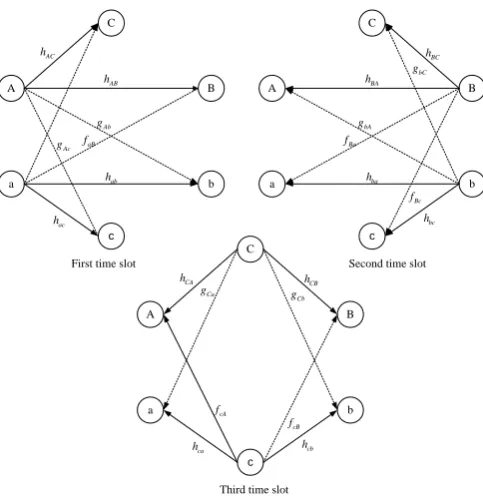
Fig. 1 shows a distributed deployment of a CCN which lies in the coverage area of a relay based cellular network. Cognitive radios orSU sform ad-hoc network which share radio spectrum withP U sin cooperative manner. In order to form power alloca-tion optimizaalloca-tion problem, we consider twoSU s(denoted bya
andb) communicates with each other via a best positioned relay (denoted byc) whereas a mobile station (denoted byA) commu-nicates with the base station (denoted byB) via a best positioned relay (denoted byC). In the first time slot, wireless node= trans-mits and wireless nodes<andℵreceive; in the second time shot, wireless nodeℵtransmits and wireless nodes<and=receive; in the third time slot<forwards the transmission of<and ℵ
(Fig.2). Here= ∈ {A, a},ℵ ∈ {B, b}and< ∈ {R, r}The total number of OFDM subcarriers isN. It is assumed that the channel fading model is multipath Rayleigh, amplify-and-forward (AF) relaying is employed at the relay node, channel coefficients are symmetric, complex additive white gaussian noise with mean zero and varianceσ2and each wireless node has learnt required
parameter form common signaling control channel (CSCC). Us-ing similar deduction of [8], the signal to noise plus interference (SNIR) of the received signal at the nodebandaof the NCCCN, i.e.,γn
a→bandγ
n
b→a, in the three time slot is given by
γn
a→b =
κnPn
c|hna,b|2
σ2+µnPn
p|gA,bn |2
+
κnPcn|hna,c|2
σ2+µnPn
p|gnA,c|2
(1−κn)Pn
c|hnc,b|2
σ2+(1−µn)Pn
p|gnC,b|2
κnPn
c|hna,c|2
σ2+µnPn
p|gA,cn |2
+ 2 (1−κn)P
n
c|hnc,b|2
σ2+(1−µn)Pn
p|gC,bn |2
, (1)
and
γbn→a =
(1−κn)Pn
c|hnb,a|
2
σ2+ (1−µn)Pn
p|gnB,a|2
+
(1−κn)Pn
c|hnb,c|2
σ2+(1−µn)Pn
p|gnB,c|2
κnPn
c|hnc,a|2
σ2+µnPn
p|gC,an |2
(1−κn)Pn
c|hnb,c|2
σ2+(1−µn)Pn
p|gnB,c|2 + 2
κnPn
c|hnc,a|2
σ2+µnPn
p|gnC,a|2
, (2)
whereµnand κnare power allocation proportional factors of the P U and SU respectively, Pn
p and Pcn are the total link power of the P U and SU respectively, hn
u,v is the channel gain of the u → v link at n-th subcarrier, where (u, v) ∈ {(a, c),(b, c),(a, b),(b, a),(c, a),(c, b)}, gn
U,v is the channel gain of theU → vinterference link at n-th subcarrier, where
(U, v)∈ {(A, c),(B, c),(A, b),(B, a),(C, a),(C, b)}. The
op-A
C
B
a b
c
AC
h
AB
h
ab
h
ac
h
Ab
g
Ac
g faB
A
C
B
a b
c
BC
h
BA
h
ba
h
bc
h
bA
g
bC
g
Ba
f
Bc
f
A
C
B
a b
c
CB
h
CA
h
ca
h hcb
Ca
g
Cb
g
cA
f
cB
f First time slot
Third time slot
Second time slot
Fig. 2. A simplified version of Fig. 1 where left node transmits information to relay and right node in the 1st time slot. Right node
transmits information to relay and left node in the 2nd time slot. Relay node forwards the information in the 2rd time slot.
timal value ofµandκncan be determined using Eqn. (10) of [8].
Eqn. (1) can be simplified as
γan→b =
κnPn
c|hna,b|
2
σ2+µnPn
p|gA,bn |2
+ Pn
c
(1−κn)|hnc,b|2κn|hn
a,c|2
(1−κn)|hn
c,b|2+2κn|hna,c|2
σ2+Pn
p|g2n|2
, (3)
where|gn
2|
2=2(1−µn)|gC,bn |2κn|hna,c|2+(1−κn)Pcn|hc,bn |2µn|gnA,c|2
(1−κn)|hn
c,b|2+2κn|hna,c|2 .
In the worst case, the maximum equivalent channel gain of the interference link fromP U toSU, i.e., |gn|2, is given by
|gn|2 = max(µn|gn
A,b|
2,|gn
2|2) and the equivalent channel
gain ofacb link, i.e.,|hn|2, is given by|hn|2 = κn|hn
a,b|2+
(1−κn)|hn
c,b|2κn|hna,c|2
(1−κn)|hn
c,b|2+2κn|hna,c|2. Eqn. (3) can be simplified as γn
a→b =
Pn
c|hn|2
σ2+Pn
p|gn|2
, (4)
The channel capacity ofa→blink usingn−th subcarrier, i.e.,
Σn
a→b, can be written as
Σn
a→b=
1
3log2(1 +γ
n
a→b). (5)
3. INTERFERENCE TEMPERATURE MODEL
[image:2.595.57.286.538.706.2]pro-Tolerable interference T o le ra b le in te rf er en ce 3 P 6 P 9 P i SNIR j SNIR k SNIR N F 3 NF 9 Frequency Power (dB) N F 6
Fig. 3. An interference temperature model which shows the tolerable interference temperature to enable additional communication without the degrading ongoing communication.
vides opportunity to increase over all capacity of the system.
SU shave to keep the average interference perceived by aP U -receiver below some value. One possible limitation of Interfer-ence Temperature model is that it can only regulate average or maximum interference but it can not regulate absolute interfer-ence. Let us consider SU nodesaandbare communicating with each other via secondary relay nodecand they are sharing fre-quency bands or carriers with the PU nodesA,B andC. The transmission inn-th carrier is admissible if
γn a→b> γ
n
a→b|threshold,
or equivalently
Qn
max< Pmaxn −γan→b|threshold−N Fn
wherePn
maxis the maximum power of then-th subcarrier,Qnmax is the peak interference temperature level,γn
a→b|thresholdis the
SNIR threshold, andN Fnis the noise figure at the n-th sub-carrier. This is the allowable interference in carriernwhich is illustrated in Fig. 3 Thus the tolerable co-channel interference is
Qn
max< Pmaxn −γna→b|threshold−N Fn. If we haveMpairs of interfere then tolerable co-channel interference is
Qn max
M < (Pn
max−γ
n
a→b|threshold−N Fn)
M . (6)
4. POWER ALLOCATION ALGORITHM
4.1 One Primary and One Secondary Links
The sum capacity maximization problem forSU scan be written as max N X n=0 B 3Nlog2
1 + P
n
c|hn|2
σ2+Pn
p|gn|2
. (7)
The constraints are
N
X
n=0
Pcn≤Pmax, (8)
Pcnf
n2≤
Qnmax, (9)
1 N N X n=0 Pn cf
n2≤Q
ave, (10)
where
|fn|2
= maxhκn(|fn
aB|
2
,|fn
aC|
2),(1−κn)(|fn
cA|
2
,|fn
cB|
2
)i.
1 c P 3 c P 4 c P 5 c P 6 c P n c P 2 1 max 1 Q f 2 2 max 2 Q f 2 3 max 3 Q f 2 4 max 4 Q f 2 5 max 5 Q f 2 6 max 6 Q f 2 max n n Q f 21 1 2 12 || || P Pg h σ + 22 2 2 22 || || P Pg h σ + 23 3 2 32 || || P Pg h σ + 24 4 2 42 || || P Pg h σ + 25 5 2 52 || || P Pg h σ + 26 6 2 62 || || P Pg h σ + 22 2 || ||
nn P n Pg h
σ
+
1 2 3 4 5 6 n
Pow
[image:3.595.67.295.104.256.2]er
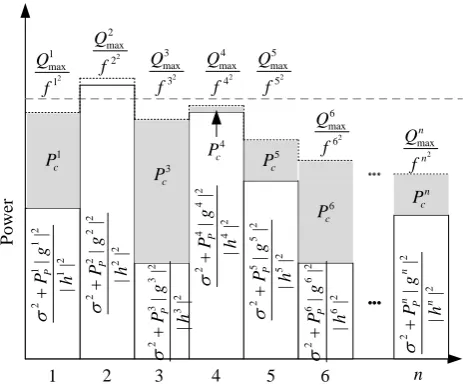
Fig. 4. Multi-level water filling algorithm for the power allocation on different sub-carriers based on the interference temperature
limit.
Qn
maxandQaveare the peak and average interference temper-ature levels respectively. Eqn. (8) ensures the sum of the allo-cated power over subcarriers is less thanPmax; Eqn. (9) is the maximum amount of interference temperature atn-th subcarrier is less thanQn
max, whereQnmax =Pmaxn /(kN Bc)andPmaxn is the maximum allocated transmit power overn-th subcarrier; Eqn. (10) is the average interference level over all subcarriers which is less thanQave.
4.1.1 Total-transmit and Peak-interference-powers. In this case, the sum capacity maximization problem is optimized sub-ject to the total transmit-power, given in Eqn. (8), and peak interference-power, given in Eqn. (9). The average interference level over all subcarriers is relaxed. The solution of this opti-mization problem can be written as [9].
Pn
c =
" Ξ λ −
σ2+Pn
p|gn|
2
|hn|2
#Qnmax
f n2
, (11)
whereΞ = B
3Nln 2,λis the non-negative Lagrange multiplier. It
is chosen such that
N
X
n=0
Pn
c(λ) =min
" Pmax,
N
X
n=0
Qn max
|fn|2
#
. (12)
4.1.2 Total-transmit and Average-interference-powers. In this case, the sum capacity maximization problem is optimized sub-ject to the total transmit-power, given in Eqn. (8), and average interference-power, given in Eqn. (10). The peak interference power condition is relaxed. The solution of this optimization problem can be written as [9].
Pi
c=
" W λ+η|fn|2 −
σ2+Pn
p|gn|
2
|hn|2
#+
. (13)
4.2 One Primary andM-Secondary Links
The sum capacity maximization problem for the multipleSU
can be formulated as
max
N
X
n=0
M
X
m=0
B
3N log2 1 +
Pn
cm|h
n
m|2
σ2+Pn
p|gn|2+
PM
j=0Pcnj|h
n
j|2
!
(14)
wherej6= m,M is the total number of activeSUlinks,Pn
cm
andhn
mare the power and link gain of them-thSUusingn-th subcarrier respectively.
The constraints are
M
X
m=0
N
X
n=0
Pn
cm ≤Pmax, (15)
M
X
m=0
Pcnmf n m
2≤
Qnmax, (16)
M
X
m=0
1 N
N
X
n=0
Pn
cmf
n m
2≤
Qave, (17)
wherefn
mis the maximum equivalent channel gain of the inter-ference link fromm-th SU to PU usingn-th subcarrier. For the total-transmit and peak-interference-powers, the solution of the optimization problem can be written as [9], [10] .
Pn
cm=
" Ξ λ−
σ2+Pn
p|gn|2+
PM
j=0Pcnj|h
n
j|2
|hn
m|
2
#
Qnmax
f nm2
,
(18)
whereΞ = B
3Nln 2,λis the non-negative Lagrange multiplier. It
is chosen such that
N
X
n=0
Pcnm(λ) =min
" Pmax,
N
X
n=0
Qn max
|fn
m|
2
#
. (19)
Spectral efficiency, denoted byηn,γcan be defined by the follow-ing metric
ηN,γ =
N υN,γ
, (20)
whereυN,γis the number of channel as a function ofNandγ. Eqn. 20 evaluates the number of communication pairs that can be supported by each channel. The higher the value ofηN,γ, the better the spectrum efficiency.
5. SIMULATION AND RESULTS
This section includes the simulation results for the proposed NC-CCN by means of Monte-Carlo simulations. We consider all the wireless nodes use OFDM based transmission, the channel fad-ing model is 3-Rayleigh-multipath, the number of subcarriers, i.e.,N= 16,Qi
max=Qmaxand the distribution of noise power over all the subcarrier is same. The simulation is run for5000 -times. Optimal (OPT) power allocation algorithm follows multi-level water-filling whereas sub-optimal (SUB) power allocation follows even power allocation. The power allocation of primary network can be either OPT or SUB whereas the power allocation in a NCCCN can also be either OPT or SUB.Thus the spectral efficiency of aSU with respect toP U depends on OPT/OPT; SUB/OPT; OPT/SUB and SUB/SUB. The simulation parame-ters for both NCCCN and CCN without NC are considered same for the fair comparison.
0 0.5 1 1.5 2 2.5 3 3.5 4
0 0.5 1 1.5 2 2.5
Pmax
Sp
ec
tr
al
ef
fi
c
ien
c
y
[
bps
/H
z
]
[image:4.595.318.558.101.234.2] [image:4.595.114.284.242.331.2]NCCCN; OPT/OPT; Imax=inf CCN; OPT/OPT; Imax=inf NCCCN; OPT/OPT; Imax=1/N CCN; OPT/OPT; Imax=1/N NCCCN; SUB/OPT; Imax=1/N CCN; SUB/OPT; Imax=1/N NCCCN; OPT/SUB; Imax=1/N CCN; OPT/SUB; Imax=1/N NCCCN; SUB/SUB; Imax=1/N CCN; SUB/SUB; Imax=1/N
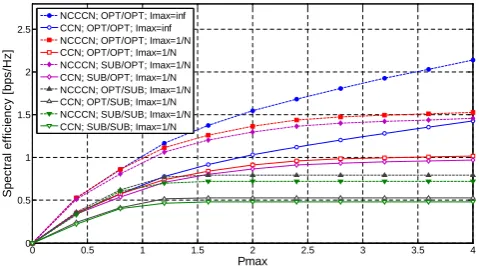
Fig. 5. Effect ofPmaxon spectral efficiency consideringImax.
Fig. 5 shows the effect ofPmaxon spectral efficiency for dif-ferent constraint ofImax. When no maximum-interference con-straint is imposed, i. e.,Imax=∞, the spectral efficiency ofSU is highest and follows logarithmic trend. On the other hand, when the maximum-interference temperature constraint is considered, i.e.,Imax= 1/N, the spectral efficiency ofSUfollows the log-arithmic trend for smaller value ofPmaxbut becomes flat for higher value ofPmax for all OPT/OPT; SUB/OPT; OPT/SUB and SUB/SUB cases. The maximum-interference temperature constraint imposes limit on maximum power allocation to avoid interference to the primary network. The dash-sign curves repre-sent the spectral efficiency of the proposed network whereas the solid-sign curves represents the spectral efficiency of CCN with-out ANC. The spectral efficiency [bit-per-second/Hz] of the pro-posed NCCCN is better than that of CCN without ANC [9]. The ANC requires less radio resources compared to traditional CCN to finish a bi-directional communication. It is also found that the spectral efficiency of OPT/OPT is better than that of SUB/OPT; OPT/SUB; SUB/SUB for the interference limited case. Fig. 6 shows the effect ofPmaxon spectral efficiency for differ-ent constraint ofIave. When no average-interference constraint is imposed, i. e.,Iave=∞, the spectral efficiency ofSUis high-est and follows logarithmic trend. On the other hand, when the average-interference temperature constraint is considered, i.e.,
Iave = 1/N, the spectral efficiency ofSU follows the loga-rithmic trend for smaller value ofPmax but becomes flat for higher value ofPmax for all OPT/OPT; SUB/OPT; OPT/SUB and SUB/SUB cases. The average-interference temperature con-straint imposes limit on power allocation to avoid interference to the primary network. It is also found that the spectral effi-ciency of OPT/OPT is better than that of SUB/OPT; OPT/SUB; SUB/SUB for the interference limited case. The proposed NC-CCN also performs better than that of NC-CCN without ANC [9] in this case.
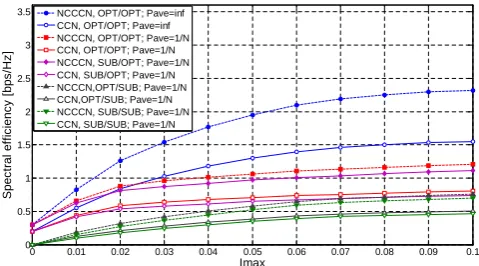
Figs. 7 and 8 show the effect ofImax on spectral efficiency consideringPmaxandPaveconstraints respectively. In terms of spectral efficiency, the proposed NCCCN outperforms the CCN considered in [9].
The relay position also effect the spectral efficiency as shown in Fig. 9. In all cases the spectral efficiency is the maximum if relay is placed midway between source and destination. It proves the Lemma in [9]
Fig. 10 shows the sum capacity as a function of number of SUs. The sum capacity initially increases with the number of SUs. When the number of active SU link is less than 4, The sum ca-pacity increases with SU links as shown in Fig. 10. On the other hand, when the number of active SU link is higher than 8, the interference from SU links to PU link increases. Thus the sum capacity/user decreases.
0 0.5 1 1.5 2 2.5 3 3.5 4
0 0.5 1 1.5 2 2.5
Pmax
Spec
tr
a
l ef
fi
c
ien
c
y
[
bps
/H
z
]
[image:5.595.324.548.105.233.2]NCCRN;OPT/OPT; Iave=inf CRN;OPT/OPT; Iave=inf NCCRN;OPT/OPT; Iave=1/N CRN;OPT/OPT; Iave=1/N NCCRN;SUB/OPT; Iave=1/N CRN;SUB/OPT; Iave=1/N NCCRN;OPT/SUB; Iave=1/N CRN;OPT/SUB; Iave=1/N NCCRN;SUB/SUB; Iave=1/N CRN;SUB/SUB; Iave=1/N
Fig. 6. Effect ofPmaxon spectral efficiency consideringIave.
0 0.01 0.02 0.03 0.04 0.05 0.06 0.07 0.08 0.09 0.1 0
0.5 1 1.5 2 2.5
Imax
Spec
tr
a
l ef
fi
c
ien
c
y
[
bps
/H
z
]
[image:5.595.58.297.105.239.2]NCCCN; OPT/OPT; Pmax=inf CCN; OPT/OPT; Pmax=inf NCCCN; OPT/OPT; Pmax=1/N CCN; OPT/OPT; Pmax=1/N NCCCN; SUB/OPT; Pmax=1/N CCN; SUB/OPT; Pmax=1/N NCCCN; OPT/SUB; Pmax=1/N CCN; OPT/SUB; Pmax=1/N NCCCN; SUB/SUB; Pmax=1/N CCN; SUB/SUB; Pmax=1/N
Fig. 7. Effect ofImaxon spectral efficiency consideringPmax.
0 0.01 0.02 0.03 0.04 0.05 0.06 0.07 0.08 0.09 0.1 0
0.5 1 1.5 2 2.5 3 3.5
Imax
Spec
tr
a
l ef
fi
c
ien
c
y
[
bps
/H
z
]
NCCCN, OPT/OPT; Pave=inf CCN, OPT/OPT; Pave=inf NCCCN, OPT/OPT; Pave=1/N CCN, OPT/OPT; Pave=1/N NCCCN, SUB/OPT; Pave=1/N CCN, SUB/OPT; Pave=1/N NCCCN,OPT/SUB; Pave=1/N CCN,OPT/SUB; Pave=1/N NCCCN, SUB/SUB; Pave=1/N CCN, SUB/SUB; Pave=1/N
Fig. 8. Effect ofImaxon spectral efficiency consideringPave.
ofM and SNIR threshold. When the number of communication pairs increase, i.e., network becomes more congested, spectral efficiency decreases for the same value of SNIR. It means that spectrum requirement increases if the network becomes more congested. But in all the cases spectral efficiency decreases with the increase in SNIR threshold which proves the Eqn. 20.
6. CONCLUSION
In this paper, we proposed the network coded-cognitive coopera-tive network (NCCCN). The power allocation optimization prob-lem is formed under peak and average interference constraints considering interference temperature constraints. The proposed system performs better than the single hop cognitive radio net-work. Simulation results shows that the optimal power allocation achieves higher data rate than suboptimal power allocation. The
0 0.1 0.2 0.3 0.4 0.5 0.6 0.7 0.8 0.9 1 0
1 2 3 4 5
Relay Position
S
p
ec
tr
a
l ef
fi
c
ienc
y
[b
ps
/H
z
]
[image:5.595.324.549.282.410.2]NCCCN, OPT/OPT Imax=inf CCN, OPT/OPT Imax=inf NCCCN, OPT/OPT Imax=1/N CCN, OPT/OPT Imax=1/N NCCCN, SUB/OPT Imax=1/N CCN, SUB/OPT Imax=1/N NCCCN, OPT/SUB Imax=1/N CCN, OPT/SUB Imax=1/N NCCCN, SUB/SUB Imax=1/N CCN, SUB/SUB Imax=1/N
Fig. 9. Effect of relay position on the spectral efficiency
2 4 6 8 10 12 14
0 1 2 3 4 5 6 7
Number of SU Pairs
S
pec
tral
E
ff
ic
ienc
y
[b
ps
/H
z
]
[image:5.595.59.297.282.414.2]NCCCN, OPT/OPT; Pave=inf CCN, OPT/OPT; Pave=inf NCCCN, OPT/OPT; Pave=1/N CCN, OPT/OPT; Pave=1/N NCCCN, SUB/OPT; Pave=1/N CCN, SUB/OPT; Pave=1/N NCCCN,OPT/SUB; Pave=1/N CCN,OPT/SUB; Pave=1/N NCCCN, SUB/SUB; Pave=1/N CCN, SUB/SUB; Pave=1/N
Fig. 10. Effect of number of active SUs on the SUs capacity.
4 6 8 10 12 14
1.4 1.6 1.8 2 2.2 2.4 2.6
SNIR threshold in dB
S
p
ec
tr
a
l ef
fi
c
ienc
y
[b
ps
/H
z
]
NCCN, OPT/OPT, Imax=inf,M=6 NCCN, OPT/OPT, Imax=inf,M=8 NCCN, OPT/OPT, Imax=inf,M=10
Fig. 11. Effect of SNIR threshold on the spectral efficiency.
performance of the system decreases as the number of SU in-creases. We can extend our work considering bit allocation and Optimal power allocation based on outage probability analysis.
Acknowledgement
The early version of this work has been presented orally in WiCOM 2011, China and WCNIS 2010, China. We would like to thank all antonymous reviews for their suggestions.
7. REFERENCES
[image:5.595.58.298.454.587.2] [image:5.595.322.547.465.592.2][2] Y. Chen, S. Kishore, and J. Li. Wireless diversity through network coding. InIEEE WCNC, USA, 2006. IEEE Press. [3] S. Valentin D. H. Woldegebreal and H. Karl. Outage prob-ability analysis of cooperative transmission protocols with-out and with network coding: inter-user channels based comparison. InMSWiM ’07: Proceedings of the 10th ACM Symposium on Modeling, analysis, and simulation of wire-less and mobile systems, USA, 2007. ACM.
[4] FCC. Establishment of interference temperature metric to quantify and manage interference and to expand available unlicensed operation in certain fixed mobile and satellite frequency bands. ET Docket 03–222, Notice of Inquiry and Proposed Rulemaking, Dec 2003.
[5] FCC. Establishment of interference temperature metric to quantify and manage interference and to expand available unlicensed operation in certain fixed mobile and satellite frequency bands. ET Docket 03–289, Notice of Inquiry and Proposed Rulemaking, Nov 2003.
[6] FCC Spectrum Policy Task Force. Fcc report of the spec-trum efficiency working group, Nov. 2002.
[7] H.Gacanin and F.Adachi. Broadband analog network cod-ing.IEEE Transations on Wireless Communications, 9(5), May 2010.
[8] M. S. Kaiser and K. M. Ahmed. Performance analysis of network coded bidirectional relaying in ofdm networks. In
ICECE 2010, USA, 2010. IEEE Press.
[9] M. S. Kaiser, K. M. Ahmed, and R. A. Shah. Power allo-cation in ofdm-based cognitive relay networks. InIEEE
In-ternational Conference on Wireless Communications, Net-working and Information Security (WCNIS), pages 202– 206, USA, 2010. IEEE.
[10] M. Shamim Kaiser. Power allocation for the network coded cognitive cooperative network. InIEEE International Con-ference on Wireless Communications, Networking and Mo-bile Computing (WiCOM), pages 1–5, USA, 2011. IEEE. [11] S. Katti, I. Maric, A. Goldsmith, D. Katabi, and M. Mdard.
Joint relaying and network coding in wireless networks. InIEEE international Symposium on Information Theory, USA, 2007. IEEE Press.
[12] J. Mitola. An integrated agent architechture for sofeware define radio.Ph.D. Thesis, KTH Royel Institute of Tech-nology, Sweden, 2000.
[13] S. F. Shirazi, S. H. Shirazi, S. M. Shah, and M. K. Shahid. Hybrid spectrum sensing algorithm for cognitive radio network.International Journal of Computer Applications, 45(17), 2012.
[14] K. Son, B. C. Jung, and D. K. Sung. Opportunistic underlay transmission in multi-carrier cognitive radio systems.IEEE WCNC, 2009.