
Munich Personal RePEc Archive
Adoption and Impact of
MobileIntegrated Business Processes
-Comparison of Existing Frameworks and
Analysis of their Generalization Potential
Pousttchi, Key and Thurnher, Bettina
University of Augsburg
2007
Online at
https://mpra.ub.uni-muenchen.de/3243/
Adoption and Impact of Mobile-Integrated Business Processes –
Comparison of Existing Frameworks and Analysis of their
Generalization Potential
Key Pousttchi, Bettina Thurnher
Mobile Commerce Working Group
Chair of Business Informatics and Systems Engineering (WI-SE) University of Augsburg
Universitaetsstrasse 16, 86135 Augsburg, Germany {key.pousttchi, bettina.thurnher}@wi-mobile.de
Abstract
The integration of mobile workplaces in the (electronically mapped) intra-enterprise value
chain is a major and still increasing corporate IT issue. Although the usage of mobile
tech-nologies for this purpose is far behind expectations and numerous failures can be observed,
still little work has been done on theory building in this area.
In this contribution we identify and compare existing frameworks for adoption and impact of
mobile technology to support mobile business processes. The hypotheses underlying these
frameworks are challenged with experiences from three long-term case studies which are
di-verse in industry, company size and other factors in order to scrutinize their potential for
gen-eralization. The outcome is a set of hypotheses that show robustness against variation of major
parameters and thus may be suitable to serve as a basis for a generalized and unified
frame-work on mobile-integrated business processes.
1
Introduction
Usage and relevance of information technology (IT) in enterprises have changed
fundamen-tally in recent decades. Instead of isolated IT usage limited to an operational level (e.g.
produc-tion planning or machine-tool steering), vast electronificaproduc-tion and networking in many
the introduction of complex ERP systems while in smaller companies rather through the use of
smaller industry-specific software packages. Resulting potentials include for instance common
data management, integrated workflow management or contemporary availability of
aggre-gated, edited corporate data (business intelligence). However, a major problem occurs as soon
as single business processes (or even only parts of these) are executed mobile and thus can no
longer be fully supported by the use of stationary IT. As a result, the integration of mobile
workplaces is a major and still increasing corporate IT issue. While mobile information and
communication technologies are available to fill in the gap, their actual usage for this purpose
is far behind expectations. What is more, among the actually activated projects numerous
fail-ures can be observed (e.g. [Cogn05; Aber04]). Despite the high relevance of the topic theory
building is not advanced at all. Our extensive research in high-ranked relevant literature1 showed only little results (see section 2). Two frameworks were proposed: (a) [WaCh04] is
deductively suggesting an adoption framework and examining it with an industry-specific
sur-vey (for a detailed description see section 2.1) and (b) [GeSh04] is deductively suggesting an
impact assessment framework and examining it with one specific case study (for a detailed
description see section 2.2).
The research objective of this paper is to investigate these two frameworks and scrutinize their
potential for generalization. In order to do this, the underlying hypotheses are one by one
chal-lenged with the experiences from three in-depth case studies on mobile-integrated business
processes which are diverse in industry, company size and other factors. The outcome is a set
of hypotheses that show robustness against variation of major parameters and thus may be
suitable to serve as a basis for a generalized and unified framework on mobile-integrated
busi-ness processes. In the context of this paper, the term mobile business processes (MBP) refers
to any business process which is (partly or completely) executed mobile and thus can not be
fully supported by the use of stationary IT [GuPo05]. The term mobile-integrated business
processes (MIBP) refers to any MBP that is fully supported by mobile IT [PoTh05].
The contribution is organized as follows: In section 2 the adoption framework from [WaCh04]
and the impact assessment framework from [GeSh04] are introduced. In section 3.1 the
1Literature research comprised the following resources: MIS Quarterly (MISQ), Journal of the AIS
Communi-method and the used case studies are explained. In section 3.2, the two frameworks are
com-pared and in sections 3.3 and 3.4 the respective hypotheses of the two frameworks are
exam-ined. In section 4 the conclusion is drawn.
2
Existing Research
2.1 The Adoption Framework
The adoption framework of [WaCh04] is derived from previous research in the field of
strate-gic choice theory and upper-echelon theory. Upper-echelon theory emphasizes the role of the
firm’s management in actively shaping organizational strategies [Chil72]. These research lines
provide a theoretical foundation for understanding organizational decisions about innovation
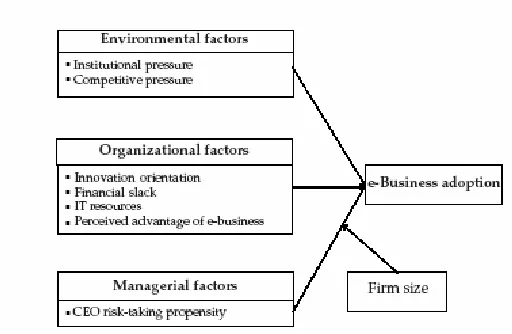
adoption. [WaCh04] identified critical factors that influence e- and mobile (m) business
adop-tion by travel agencies and suggested a three level framework that states that differences
be-tween the technology adoption behaviours of firms can be fully captured only if the influential
factors at multiple levels (environmental, organizational, and managerial) are taken into
con-sideration [ToKl82; Roge95]. Moreover a firm’s strategic orientation and the personal
charac-teristics of its top managers influence its approach to innovation adoption. The framework was
tested according to 7 hypotheses in a case study. In the study 137 completed questionnaires of
the Taipei Association of Travel Agents were returned. Additionally a second study was
de-picted in this paper where they investigated to what extent the idea of mobile e-business is
understood and accepted by travel agency CEO in Taiwan.
The findings show that no firm had a clear plan for mobile e-business. However, the CEO did
point out that mobile advertising through the Short Messaging Service (SMS) would be the
first mobile application despite the technological limitations of currently available mobile
de-vices. Although the CEO agreed that the expansion to mobile e-business is only “a matter of
time,” [WaCh04, p. 56].
Fig. 1 Framework of e- and m-Business Adoption for Service Firms
The analysis of the data has been executed via hypothesis testing with statistical methods e.g.
R-square and mean centering method proposed by Cronbach. Seven independent and two
de-pendent variables (DV) have been defined: DV1 measures the firm’s intention to develop e-
and m-business applications and DV2 measures the degree of e- and m-business
implementa-tion.
2.2 The Impact-Assessment Framework
The impact-assessment framework of [GeSh04] is derived from the task/technology fit model
[GoTh95] and the technology acceptance model [Davi89]. Moreover research on technology
innovation [ToKl82] has been used by [GeSh04] to point out the importance of matching
in-formation systems with the organizational tasks to be supported or automated, as a precursor to
system use and subsequent benefits. Recent research of Goodhue and Thompson’s work has
been extended and integrated with the technology acceptance model [DiSt98; DiSt99;
MaKe98]. Other researchers have applied Zigurs and Buckland’s framework to gain further
in-sights on the success factors of group work [HoMO93]. The research framework combines the
idea of task/technology fit with the general notion of impacts of information technology on
organizations. The framework consists of four factors: technology, task, usage and impact to
which a mobile business application is investigated. The parameters of each factor are depicted
in Fig. 2. [GeSh04] validated the framework according to 9 propositions in a case study on a
mobile e-procurement platform at a Fortune 100 company. The authors interacted with
mem-bers of the project management group on a regular basis during the period from August 2001
to March 2002 to obtain information about the project, including objectives, progress, and
used WAP-enabled cell phones. The study was conducted in Asia, USA and Europe. The
[image:6.595.162.460.154.325.2]sug-gested framework of [GeSh04] consists of the following elements:
Fig. 2 The Impact-Assessment Framework [GeSh04]
The analysis of the data has been executed mainly via qualitative results from the interviews and quantitative measures like the amount of mobile tool usage for specific tasks. Moreover [GeSh04] analysed the correlations of the variables of their propositions.
2.3 Other Related Work
More recent research shows that mobile technologies and research in mobile applications are
of increasing importance in various fields of applications e.g. [ScPL06; FoGK05]. [ChNa04]
investigated the value of mobile business applications in domains like fast food restaurants,
facility management, maintenance and housekeeping, insurance companies, support of sales
force, logistics, mobile-marketing campaigns, real time weather information for the army and
even the application of mobile technology for the efficient handling of formula one races.
Ob-viously there are differences in the judgment about the impact of mobile-business applications
in different branches. Whereas [WaCh04] found out that there was no need for mobile
applica-tions in 2004 for Taiwanese travel agencies [ChNa04] found out that mobile applicaapplica-tions are
widely applied in various branches. The amount of increasing research [ScPL06; WaCh04;
ChNa04; GeSh04] and the improved mobile technology (device, connectivity, performance)
indicate that mobile business applications are gaining importance. Therefore we want to verify
in this paper if the hypothesis and the framework suggested by [WaCh04] are applicable to
mobile business applications.
3.1 Method
Our research approach is based upon theory building from case studies [Eise89]. This
ap-proach is especially appropriate for obtaining complex details and novel understandings about
a specific phenomenon under investigation. Case study research is appropriate for examining
practice-based problems, since it allows a researcher to capture the knowledge of practitioners
and use it to generate theory [BeGM87; Cres03; Eise89].
The overall aim of our research is to contribute to theory building in the area of MIBP. We
consider case study research as a suitable approach for the investigation of MIBP impact and
adoption factors as it provides the opportunity for longitudinal research and in-depth
investiga-tion especially of socio-technical interdependencies. Both [WaCh04] and [GeSh04] suggest
further research should test the framework applicability in different industry domains and
dif-ferent organizations. Thus, we selected case studies to be most diverse in order to validate the
limits of the frameworks. As a comparison of the case studies themselves is not intended
nega-tive effects of this diversity do not occur. As a common characteristic, the examined MBP in
all three case studies is technical customer service provision. Most important differences are
industry and organization size. All three case studies have been longitudinal studies and lasted
from 6 to 15 months. Within the studies, methods like expert and user interviews as well as
questionnaires have been applied to collect data. Interviews have been transcripted and fed
back to the interviewees in order to reduce possible errors. For data gathering CEO, CTO,
pro-ject managers and end users of the mobile application have been questioned with
semi-structured questionnaires in personal or via-phone interviews. In the large company four
per-sons have been interviewed, in the medium-sized company two and in the small one again
four. Moreover, in the small IT service company we conducted an in-depth usability and tool
acceptance study with 30 users [PoTh06]. Table 1 provides an overview of the examined case
studies.
Case Study 1: Telecommunication Service Provider
For the first case study we investigated a mobile dispatching and order handling system of a
major European Telecommunication Service Provider. 12,000 technicians have been equipped
with standard commercial PDA. The introduction of MIBP was conducted in iterative steps
from the year 2000 until now. Legacy systems have been substituted by mobile client-server
architecture (although service order generation and handling are still conducted on separate
include installation, maintenance and repair of telecommunication products. Service orders are
dispatched automatically considering skill level, location, optimal routing, urgency and the
respective Service Level Agreements (SLA). Order information is then transmitted via GPRS
on the PDA. 50% of the orders are dispatched prior to the working day, the rest during the day.
Case Study 2: Municipal Utility Company
For the second case study we investigated a major German Municipal Utility Company and its
mobile service, maintenance and invoicing process. About 1,000 technicians have been
equipped with standard industry PDA. MIBP were introduced a one year project with the
sup-port of a specialized consulting company. Typical tasks of the utility technicians are e.g.
instal-lation and maintenance of meters for gas or electricity in private, public or industry buildings.
Due to special restrictions and the need of managerial control, dispatching stayed manually:
Technicians come to the office, receive their schedule and then head off to customers. During
the day they are now able to receive new jobs, accept or deny them and send status reports.
Case Study 3: IT Service Provider
For the third case study we investigated an Austrian IT Service Provider for hard- and software
installation and maintenance. 40 IT service technicians have been equipped with mobile
de-vices. The system was implemented with an Application Service Provider (ASP),
implementa-tion took 6 month. Field technicians use a browser-based soluimplementa-tion on the mobile device in
or-der to receive their jobs for the day which can be rescheduled via an implemented push-mail
function. Main tasks of an IT service technician include repair, maintenance and installation of
different hard- and software. A major driver for MIBP introduction was to shorten issuing the
invoice, for which especially the record of working/driving time and used spare parts is
essen-tial.
Com-pany
Service Busi-ness Com-pany Size Architec-ture Imple-mentation process Dis- patch-ing Telecom-munication Service Provider Technical customer service B2B and B2C Large Client/server system; separate IS B2B/B2C Backend and client Automati-cally Municipal Utility Company Technical customer service B2B and B2C
Medium Client/Server Backend and Client Manually IT-Service Provider Technical customer service
B2B Small ASP solu-tion,
3.2 Comparison
This section will provide a comparison of the two frameworks introduced in section 2. The
following table opposites the most relevant characteristics:
E-Business Adoption Framework Impact-Assessment Framework
Measures the adoption behaviour of new technologies according to the tree factors: environment, organization and managerial
Suggest Propositions which are tested according to validate the framework
Aims at identifying critical factors that influence e-business adoption in travel agencies
Aims at identifying factors that influence successful m-business application usage
Approach: Case Study Research Approach: Case Study Research Hypothesis testing Qualitative Research which quantitative
implications
Limitations Limitations
Further empirical studies in other application domains should be executed to validate the generalizability of the framework
Further empirical studies in other application domains should be executed to validate the generalizability of the framework No evolution of the framework has been done
considering mobile applications
Respondents have been partially self selected
Tab. 2 Comparison of the e-business adoption- and impact-assessment framework
[WaCh04] applied quantitative validation of hypothesis with 137 completed questionnaires
from different companies whereas [GeSh04] applied a more qualitative approach using
inter-views among 17 partially self-selected respondents within one case study.
3.3 Validation of the adoption framework
In this section we will first introduce the hypotheses and the findings of [WaCh04] and than
state differences and common findings in comparison with the three case studies.
The 7 hypothesis of [WaCh04] are:
Hypothesis 1: Institutional pressure is positively related to a firm’s adoption of e-business.
Institutional pressure can come from governmental bodies, trade associations, consulting
com-panies, business media and other stakeholders. [WaCh04] found no significant relationship
between institutional pressure and either intention to develop business or degree of
e-business implementation. Consequently, H1 is not supported.
Case Study findings: In our three case studies we could not find any concrete evidence for institutional pressure. As the technical service market is not regulated by governmental bodies but under private company management institutional impacts play a minor role. However for practical implications we found some anecdotal evidence that increased institutional pressure would increase DV1 and DV2 especially if pressure comes from financial stake-holders.
has only a marginally significant relationship (p < 0.10) with the intention to develop
e-business. Arguably, H2 is supported.
Case Study findings: In our case studies DV1 and DV2 have been supported. Due to very short Service Level Agreement (SLA)-fulfilment times in the technical service branch in general efficient and effective process or-ganisation for the dispatching of technicians, spare parts and invoicing are essential for longitudinal market viabil-ity. We could further investigate that over the period of investigation (in the longest case 15 months) more and more technical service companies adopted mobile technology and in the same time the amount of mobile solution providers increased. Mobile technology is a critical success factor for long-term market viability; especially for small companies technology leadership is vital.
This applies to all three case studies and company size did not have an influence on these findings.
Hypothesis 3: A firm with a high level of innovation orientation is more likely to adopt
e-business than a firm with a low level of innovation orientation.
Innovation orientation is positively associated with intention (as proposed in H3), but not with
degree of implementation. Consequently one can conclude that innovation orientation has little
to do with a firm’s “real” involvement in e-business.
Case Study findings: The case studies revealed that the DV1 can be supported and DV2 can only be supported partially in small and medium-sized (SME) companies. This is due to the fact that smaller companies often lack the resources for innovation (e.g. no specific R&D department) and the investment power is reduced. In large organizations we could investigate the same phenomena as [WaCh04]. Due to the relatively slow decision proc-esses in large companies it is difficult to implement innovative approaches like e- and mobile business even though the intention to adopt e-business might be very high. Especially in large organizations the role of the man-agement and the amount of manman-agement commitment and sometimes pressure to implement mobile and e-business technology plays an important role. If management commitment or pressure is given DV1 and DV2 can be supported.
Hypothesis 4: The perceived advantage of e-business is positively related to a firm’s adoption
of e-business.
This hypothesis is partially supported, a significant positive relationship was found between
perceived advantage of e-business and intention to adopt e-business.
Case Study findings: In our case study we could observe that in the SME companies the degree of e-business implementation is higher than in large organizations. The small and medium sized companies implemented e- and mobile business applications once the intention to adopt e-business was given. In the large technical service pro-viding company more hesitation to implement e- and mobile business applications could be observed.
In the present study DV1 was supported while DV2 was not. A significant positive
relation-ship was found between perceived advantage of e-business and intention to adopt e-business.
Financial slack is positively associated with the degree of e-business implementation.
How-ever, the proposed positive relationship between financial slack and intention to adopt
e-business is not supported. Instead, there is a negative correlation between the two variables.
The more financial slack, the more implementation can be done.
Case Study findings: In our case study mobile application projects have been tackled when sufficient financial resources have been available. Once the resources could be provided DV1 and DV 2 had a positive correlation and the intention to develop e- and mobile applications lead to higher degree of application implementation.
Hypothesis 6: IT resources have a positive effect on a firm’s adoption of e-business.
The last organizational factor, IT resources, has positive relationships with both DVs and H6 is
supported.
Case Study findings: This could also be observed in the case studies and is mainly due to the presence of IT knowledge and already (partially) existing infrastructures (e.g. Servers). Once IT knowledge about the implemen-tation of an e- or mobile business application was present the reluctance towards mobile tool implemenimplemen-tation decreased as the CEO and CTO have been more confident that the investment will pay off rather quickly.
Hypothesis 7: CEO risk-taking propensity has a positive effect on a firm’s e-business
adop-tion. The effect is moderated by firm size; it is stronger in smaller firms than in larger firms.
The firm size moderates the relationship between CEO risk-taking propensity and each DV.
The relationship is positive when firm size is small and negative when firm size is large.
Case Study findings: These findings are align with the results of our case studies. We identified that the more direct a CEO can decide upon an e- or mobile commerce strategy the more likely it was that those strategies have been adopted. Moreover for SME the competitive advantage gained through faster service processes is vital to keep up with competitors and large organizations.
3.4 Validation of the impact-assessment framework
In this section we will first introduce the propositions and the findings of [GeSh04] and than
state differences and common findings in comparison with the three case studies.
The nine propositions of [GeSh04] are:
Proposition 1: Users will first use mobile business applications for notification and
communi-cation purposes rather than for data processing and information access.
For this proposition limited support could be found in the Case Study. The users showed
approval requests.
Case Study findings: In the case studies we could support this findings and identified that typically mobile devices like mobile phones or PDA are first used for communication purposes and then for e.g. to access the company ERP systems or CRM systems, but this depends on the management directives within a company. If the manage-rial pressure is rather high and mobile tool usage is fostered strongly we observed that in SME a former paper-based process can be replaced through mobile tool usage in a short period of time. From a business process reen-gineering perspective this is a bomb-dropping strategy [HaCh93] and can cause employee reluctance as the proc-ess change might be too fast for stepwise adoption.
Proposition 2: There is a trade-off between portability and usability of mobile devices,
effec-tively limiting the usage of mobile business applications to simple activities.
This proposition could be supported by the Case Study findings. While users acknowledged
the portability of the device, its usability drew criticism. Over two-thirds of the respondents
indicated that the small screens and limited keyboards were significant or very significant
lim-iting factors. [GeSh04] investigated that the usability judgement depends highly on the used
device. “While a number of users commented that screens and keyboards were too small, one
of them experienced a different situation. This participant, who had access to a phone with a
larger colour screen and full keyboard, was in fact positive about the usability of the
applica-tion” [GeSh04 p. 30]. Users preferred to use the tool for simple tasks, such as notification and
approval requests.
Case Study findings: The findings in the three case studies support proposition 2. Tool usability is an enabler for innovative applications and especially for mobile applications as they are used while the user is in a mobile condi-tion (walking, standing, and driving). Therefore usability requirements are even more sophisticated than for stan-dard desktop applications [PoTh06].
Proposition 3: System performance and user support have a positive impact on the usage of
mobile business applications.
This proposition could be supported. System performance and user support had a positive
im-pact on the usage of the mobile business application, but in the present case poor performance
was found to have a negative impact on usage. Some user reported that the downloading time
is longer on the mobile device than on the desktop-based application which made it hard to
justify the effort.
the system is in a preliminary status and performance rates are not the same as in the real-life running system. In our case studies usability and performance have been identified as a major facilitator for mobile tool acceptance.
Proposition 4a: Employees performing highly structured tasks tend to use mobile business
applications for data processing.
The approval tasks of the finance and accounting approvers were much more structured than
the tasks of the approving managers. Compared to approving managers, finance and
account-ing approvers indicated a higher percentage of approvals that could be submitted via the
mo-bile application, providing evidence for proposition 4a.
Case Study findings: In the application domain of technical service support proposition 4a holds as well. The tasks of service technicians are highly structured and therefore mobile tool support can easily be implemented. The typical task set of a service technician consist of order acceptance/denial, documenting the repair,- driving time as well as the used spare parts and transmit the data to the head office. In case of requests (e.g. further details to the order or unclear information) the technician calls the dispatcher or back office. Well structured tasks are easy to be executed via a mobile tool. As the modality functions are limited on a mobile device the workflow should be supported efficiently with a mobile tool.
Proposition 4b: Employees performing unstructured tasks tend to use mobile business
applica-tions to access information and for communication purposes.
In the study of [GeSh04] approving managers indicated a higher percentage of approvals
where the mobile application could support communication and access to information this
provides evidence for proposition 4b.
Case Study findings: The case study findings support this proposition as well. In our study sells representatives especially in the small company used the mobile applications to access current prices and information about the customer e.g. prior communication. The tasks of sells personnel are far less structured than the tasks of technical support stuff. The necessary information depends on the actual information and can hardly be planned in advance. Consequently the case study findings support the findings of [GeSh04] in proposition 4.
Proposition 5: The frequency with which a task is performed has a positive impact on the
us-age of mobile business applications.
In the study of [GeSh04] finance and accounting approvers generally indicated a higher
num-ber and dollar volume of approvals than managing approvers. This difference in volume
re-flected the fact that finance and accounting approvers basically performed approvals on a
full-time basis, whereas managers had a broader set of responsibilities. In line with Proposition 5,
one would expect finance and accounting approvers to be more optimistic about the mobile
e-procurement application than approving managers. For the data set, however, the correlation
approvers found the mobile application less useful than approvers who had lower levels of
repetitiveness. Evidence gained from user comments indicated that a combination of frequency
of task performance and mobility can have greater explanatory power of usage than each
fac-tor alone. However it is unclear if this proposition can be dismissed but it is likely that the
judgment of the users has been influenced by factors like general enthusiasm for the new
tech-nology and difficulties in establishing system access.
Case Study findings: In our case studies we found clear evidence for proposition 5 in the SME companies in the large organisation tool usage was hindered in the beginning due to a high mobile tool reluctance of the techni-cians. In the large organization tool acceptance and workflow change needed far more time than in the SME. One might argue that this is only due to the size of an organization but we could also investigate that the degree of employee involvement in the design and implementation of a mobile application, especially the workflow design have highly positive influence of tool acceptance and the frequency of tool usage. Another factor that could be observed as relevant was that the system was fully implemented and not in a prototype state when the end user started to use it for operative tasks. Therefore performance and access issues to the system did not arise.
Proposition 6: Employees who are more mobile tend to use mobile business applications more
often to perform their tasks than employees who are less mobile.
As mentioned above some of the 17 users stated that a combination of frequency and mobility
can have greater explanatory power of usage than each factor alone. Unfortunately [GeSh04]
do not indicate how many users made such statements. However there was a positive
correla-tion (0.3) between mobility (time out of the office) and intended usage of the mobile
e-procurement application for approval processes.
Case Study findings: In our case studies this could be verified and especially the CEO and CTO of all three case study companies used their PDA or mobile phones extensively when on business trips.
Proposition 7: The use of mobile business applications is positively related to the perceived
need to handle emergency situations.
For this proposition a variation among users regarding the question of what constituted an
emergency situation could be revealed. However only some anecdotal evidence could be
found to support this proposition.
Proposition 8: The use of mobile business applications increases employee productivity and
operational efficiency.
This proposition could be supported but [GeSh04] suggest that future research should consider
both direct effects on the user and indirect effects on employees interacting with the user.
Case Study findings: From a process management view we followed a holistic approach and investigated the whole process from the order generation to the invoice delivery to the customer [TuPo04]. Within this process the service technician is not integrated into the process chain while doing repair and maintenance jobs at the cus-tomer’s site. Mobile technology provides the possibility that a service technician stays integrated in the business process e.g. company order generating system, ERP-Systems while being physically mobile for task execution. Consequently we could investigate that large gains in efficiency and effectiveness could be gained in the invoicing and dispatching processes. Invoicing used to be cumbersome as the necessary data (working-, driving time and amount of used spare parts) used to take one working week (5 days) to be transferred from the paper-based forms to the desktop application and to be available for further processing. Due to reduced redundant data entry the error prone process of work protocol transcription could be optimized e.g. about 10 min per day per technician in the small company. Additionally the dispatching (allocation of jobs to a specific service technician) was inefficient as the dispatcher had to make three calls on average to reach a free technician as the status e.g. repair progress and location was only traceable via phone calls. After the mobile tool integration dispatching could be done far more efficient in 85% of all calls via the mobile tool without phone calls and the whole invoicing cycle could be re-duced from 10 days down to 4 working days on average.
Proposition 9: The use of mobile business applications improves organizational flexibility and
the ability to handle emergency situations.
[GeSh04] found out that no clear understanding of the value of increased flexibility and the
ability to handle emergency situations existed among the users. Some anecdotal evidence
could be found that users appreciated the fact that the application allowed to keep in touch
with co-workers while out of the office.
Proposition 1: use for notification and communication purposes Limited Proposition 2: trade-off between portability and usability Yes Proposition 3: impact of performance and user support on device usage
Yes (strong evidence)
Proposition 4a: highly structured task increase foster mobile tool usage for data processing
Yes Proposition 4b: unstructured tasks foster mobile tool usage for information and communication purposes
Yes Proposition 5: task frequency has an impact on mobile tool usage Unclear Proposition 6: mobile employees tend to use mobile tools more
often
Yes Proposition 7: mobile tool usage is positively related to the need of handling emergency situations
Sometimes (anecdotal evidence)
Proposition 8: mobile tool usage increases employee productivity and efficiency
Yes Proposition 9: mobile tool usage increases organizational
flexibility and the ability to handle emergency situations
Sometimes (anecdotal evidence)
Tab. 3 Summary of the findings for [GeSh04]
3.5 Suitability for generalization
In general, generalization potential for both frameworks is extremely good. Not only has to be
stated that a vast majority of the hypotheses could be validated with the three diverse case
studies, but even case study research revealed that some propositions (like e.g. [GeSh04]
proposition 7 and 9) could be supported whereas the original study with its limited validation
effort only showed anecdotal evidence.
Case Study research is less rigour than an experiment design with hypothesis testing and
statis-tical analysis. However, correctly applied it is able to provide convincing evidence and valid
implications with regard to practice, especially if long-term in-depth studies are possible. The
detailed results of the validation are shown in Tab. 4.
Moreover the frameworks can be used in industry context for the analysis of business
proc-esses to evaluate their mobilization potential and therefore serve as decision support for
Frame-work/Findings [WaCh04]
Case Study Findings [WaCh04]
Framework/Findings [GeSh04]
Case Study Find-ings [GeSh04]
H1: no evidence anecdotal evi-dence
P1: limited evidence Support
H2: DV2 DV1 + DV2 P2: support Support
H3: DV1 DV1 P3: strong evidence Strong evidence
H4: DV1 DV1 + DV2 P4a: support Support
H5: no evidence DV1 P4b: support Support
H6: DV1 + DV2 DV1 + DV2 P5: unclear Clear evidence in SME; partially in large organization H7: DV1 + DV2 DV1 + DV2 P6: support Support
P7: anecdotal evidence Support
P8: support Support (strong
evidence) P9: anecdotal evidence Support
Tab. 4 Comparison of [WaCh04], [GeSh04] with the Case Study Findings
Beyond the validation of the hypotheses 1 to 7 and the propositions 1 to 9 the difficult and
critical issues within the field of mobile technology are to measure the degree and speed of
technology adoption within the mobile arena. Again in depth, long-term case study research
can provide further insights and deeper understanding of the socio-technological
interdepend-encies. Additional research in this area is necessary and we would like to encourage
research-ers in the field of mobile-integrated business processes to conduct further joint studies.
4
Conclusion
The research objective of this paper was to investigate the adoption framework from
[WaCh04] and the impact assessment framework from [GeSh04] and scrutinize their potential
for generalization. In order to do this, we challenged the underlying hypotheses one by one
with the experiences from three in-depth case studies which are diverse in industry, company
size and other factors.
The outcome is a set of hypotheses (shown in table 4) that shows robustness against variation
of major parameters.
Above the level of single hypotheses, both frameworks showed an unexpected high potential
for generalization in the area of technical customer support over diverse industries and
com-pany sizes. While on a tactical level, further validation outside of technical customer support is
supposed, the next step is to form a generalized and unified framework on mobile-integrated
business processes using the validated hypotheses and validate this with a large-scale empirical
Literature
[Aber04] The Mobile Field Service Benchmark Report - Bridging the Chasm Between the Field
and Back Office. http://www.aberdeen.com/summary/report/
benchmark/mobileFS-093004.asp, Last Access: 2006-07-12.
[BeGM87] Benbasat, Izak; Goldstein, David. K.; Mead, Melissa: The case research strategy in
studies of information systems. In: MIS Quarterly 11 (1987) 3, pp. 369-386.
[Chil72] Child, John: Organizational structure, environment, and performance: The role of
strategic choice. In: Sociology (1972) 6, pp. 1–22.
[ChNa04] Chen, Lei-da; Nath, Ravi: A framework for mobile business applications. In: The
International Journal of Mobile Communication 2 (2004.) 4, pp. 368-381.
[Cres03] Creswell, John W.: Research Design: Qualitative, Quantitative, and Mixed Methods
Approaches. 2nd edition, Sage Publications Inc. Chennai India 2003.
[Davi89] Davis, Fred D.: Perceived usefulness, perceived ease of use, and user acceptance of
information technology. In: MIS Quarterly 13 (1989) 3, pp. 319–341.
[DiSt98] Dishaw, Mark.T.; Strong, Diane M.: Supporting software maintenance with software
engineering tools: A computed task-technology fit analysis. In Journal of Systems and
Software 44 (1998) 2, PP. 107–120.
[DiSt99] Dishaw, Mark.T.; Strong, Diane M.: Extending the technology acceptance model with
task-technology fit constructs. In Information & Management 36 (1999) 1, pp. 9–21.
[Eise89] Eisenhardt Kathleen M.: Building Theories from Case Study Research. In Academy of
Management Review 14 (1989) 4, pp. 532-550.
[FoGK05] Fouskas, Konstantinos G.; Giaglis, Georg M.; Kourouthanassis, Panos E.: A roadmap
for research in mobile business: In: International Journal of Mobile Communications.
3 (2005) 4, pp. 350–373.
[GeSh04] Gebauer, Judith; Shaw, Michael: Success Factors and Impacts of Mobile Business
Applications: Results from a Mobile e-Procurement Study. In: IJEC. 8 (2004) 3, pp.
19–41.
[Gogn05] Cognito Limted: Mobile Data: Avoiding the costly pitfalls. http://www.cognito.co.uk,
Steinhage, V. (Hrsg.): INFORMATIK 2005 - Informatik LIVE! Band 2 - Beiträge der
35. Jahrestagung der Gesellschaft für Informatik e. V. (GI) 19.-22. September 2005 in
Bonn. LNI. Bd. P-68, Bonn 2005, pp. 523–527.
[GoTh95] Goodhue, Dale L.; Thompson, Ronald L.: Task-technology fit and individual
performance. In: MIS Quarterly 19 (1995) 2, pp. 213–236.
[HaCh93] Hammer, Michael; Champy, James: Reengineering the Corporation – A Manifesto for
Business Revolution. New York 1993.
[HoMO93] Hollingshead, Andrea B.; McGrath, Joseph E.; O’Connor, Kathleen M.: Group task
performance and communication technology: A longitudinal study of
computer-mediated versus face-to-face groups. In: Small Group Research 24 (1993) 3, pp. 307–
333.
[MaKe98] Mathieson, Kieran; Keil, Mark: Beyond the interface: Ease of use and task/ technology
fit. In: Information & Management 34 (1998) 4, pp. 221–230.
[Roge95] Rogers, Everett M.: Diffusion of Innovations, 4th edition, Free Press New York 1995.
[PoTh05] Pousttchi, K., Thurnher, B.: Einsatz mobiler Technologien zur Unterstützung von
Geschäftsprozessen (WCI). Berlin (2005), pp. 101 – 120.
[PoTh06] Pousttchi, K., Thurnher, B.: Understanding Effects and Determinants of Mobile
Support Tools: A Usability-Centered Field Study on IT Service Technicians. ICMB.
IEEE. Copenhagen, Denmark 2006, S.1-8.
[ScPL06] Scornavacca, Eusebio; Prasad, Mishul; Lehmann, Hans: Exploring the organisational
impact and perceived benefits of wireless Personal Digital Assistants in restaurants. In:
The International Journal of Mobile Communication 4 (2006) 5, pp. 558-567.
[ToKl82] Tornatzky, Louis G.; Klein, Katherine J.: Innovation characteristics and innovation
adoption-implementation: A meta-analysis of findings. In: IEEE Transaction on
Engineering Management 29 (1982) 1, pp. 28–45.
[TuPo04] Turowski K. ; Pousttchi, K.: Mobile Commerce – Grundlagen und Techniken.
Heidelberg 2004.
[WaCh04] Wang, Sophia; Waiman, Cheung: E-Business Adoption by Travel Agencies: Prime
Candidates for Mobile e-Business: In: International Journal of Electronic Commerce. 8
![Fig. 2 The Impact-Assessment Framework [GeSh04]](https://thumb-us.123doks.com/thumbv2/123dok_us/8040097.771203/6.595.162.460.154.325/fig-the-impact-assessment-framework-gesh.webp)
