www.hydrol-earth-syst-sci.net/18/3055/2014/ doi:10.5194/hess-18-3055-2014
© Author(s) 2014. CC Attribution 3.0 License.
A new framework for resolving conflicts over transboundary rivers
using bankruptcy methods
K. Madani1, M. Zarezadeh2,3, and S. Morid3
1Centre for Environmental Policy, Imperial College London, London SW7 2AZ, UK
2Department of Civil, Environmental and Construction Engineering, University of Central Florida, Orlando, FL 32816, USA 3Department of Water Resources Engineering, Tarbiat Modares University, Tehran, Iran
Correspondence to: K. Madani ([email protected])
Received: 23 October 2013 – Published in Hydrol. Earth Syst. Sci. Discuss.: 15 November 2013 Revised: 20 May 2014 – Accepted: 3 July 2014 – Published: 15 August 2014
Abstract. A novel bankruptcy approach is proposed for re-solving transboundary river conflicts in which the total wa-ter demand or claim of the riparian parties is more than the available water. Bankruptcy solution methods can allocate the available water to the conflicting parties with respect to their claims. Four commonly used bankruptcy methods in the economic literature are used here to develop new river bankruptcy solution methods for allocating water to the ri-parian parties of river systems. Given the non-uniform spa-tial and temporal distribution of water across river basins, the proposed solution methods are formulated as non-linear net-work flow optimization models to allocate water with respect to time sensitivity of water deliveries at different locations in a river network during the planning horizon. Once alloca-tion optimizaalloca-tion solualloca-tions are developed, their acceptability and stability must be evaluated. Thus, a new bankruptcy al-location stability index (BASI) is developed for evaluating the acceptability of river bankruptcy solutions. To show how the proposed river bankruptcy framework can be helpful in practice, the suggested methods are applied to a real-world transboundary river system with eight riparians under various hydrologic regimes. Stability analysis based on the proposed stability evaluation method suggests that the acceptability of allocation rules is sensitive to hydrologic conditions and de-mand values. This finding has an important policy implica-tion suggesting that fixed allocaimplica-tion rules and treaties may not be reliable for securing cooperation over transboundary water resources as they are vulnerable to changing socioe-conomic and climatic conditions as well as hydrologic non-stationarity.
1 Introduction
Conflicts are integral to managing transboundary rivers due to the externalities associated with growing demand and de-velopment in riparian states. There are 148 riparian countries creating about 276 transboundary river basins in the world (De Stefano et al., 2012). These basins cover over 45 % of the Earth’s land surface and provide about 60 % of the global river flows (Wolf et al., 2006). To facilitate cooperation over transboundary rivers, over 400 international agreements were signed in the 20th century (De Stefano et al., 2012), reflect-ing a great potential for cooperation over transboundary nat-ural resources (Wolf et al., 2006). However, the stability of these agreements could be affected by socioeconomic and political changes in the riparian states as well as climatic and hydrologic variations. Dinar et al. (2010) reported 112 complaints about water deficit in transboundary river sys-tems during droughts and floods in the 1950–2005 period, underlying the vulnerability of cooperation over transbound-ary water systems to abnormal hydrologic conditions.
Game theory – the mathematical study of competition and cooperation – is a useful method for studying transboundary river management problems. Both non-cooperative and co-operative game theory methods have been used in the past to study transboundary water conflicts (Parrachino et al., 2006; Madani, 2010).
non-cooperative game theory concepts include the conflict over flooding of Ganges and Brahmaputra rivers between India and Pakistan (Rogers, 1969), the lower Mekong river basin conflict between Cambodia, Laos, Thailand, and Viet-nam (Dufournaud, 1982), the Jordan river conflict between Jordan, Israel, Lebanon, Palestine, and Syria (Madani and Hipel, 2007), and the Nile river conflict between Burundi, Congo, Egypt, Eritrea, Ethiopia, Kenya, Rwanda, Sudan, Tanzania, and Uganda (Elimam et al., 2008). These meth-ods normally rely on qualitative information to find the likely outcomes of conflicts based on various stability definitions, which incorporate a range of decision makers’ (players’) characteristics such as risk attitude, foresight level, and in-formation quality (Madani and Hipel, 2011; Madani, 2013). While these methods provide valuable insights into strategic conflicts and can help find possible resolutions to the conflict, their results are not necessarily quantitative and in most cases are only appropriate for studying as games with discrete so-lutions (strategies or actions).
Cooperative game theory solution methods normally seek to allocate the incremental benefits of cooperation (cost sav-ings, added values, etc.) among the cooperating parties. In the context of transboundary river management, coopera-tive game theory concepts can be used to develop func-tional water allocation schemes. Example transboundary river conflicts analyzed by cooperative game theory include the Ganges river conflict between Bangladesh and India (Kilgoure and Dinar, 2001), the Euphrates and Tigris rivers conflict between Iraq, Syria, and Turkey (Kucukmehmetoglu and Guldmen, 2004), and the Syr Darya river basin conflict between Kyrgyzstan, Uzbekistan, and Kazakhstan (Teasley and McKinney, 2011). Cooperative game theory methods are appropriate for quantitative problems with a continuous solution domain.
Different resource allocation methods have been employed in the water resources literature to increase systems’ effi-ciency and minimize conflicts. Social welfare maximization is perhaps the mostly commonly used approach for water allocation in the literature. Based on this approach, a so-cial (central) planner seeks to maximize the system-wide benefits assuming there is perfect cooperation among the water users. The social planner approach pays minimal at-tention to individual gains and distribution of total benefits among the beneficiaries, making it less practical (Madani and Hooshyar, 2014).
Market mechanisms and cooperative game theory schemes are among the other water allocation methods that are used to make the social planner’s solution practical. These meth-ods focus on redistribution of the incremental benefits of cooperation and create win–win allocation solutions that make cooperation attractive to individual rational beneficia-ries (Madani and Hooshyar, 2014). While these methods are promising, their application is limited to problems in which utility information is available for all parties and the incre-mental benefits of cooperation can be determined.
There-fore, challenge remains in developing cooperative schemes for managing shared water systems for which utility infor-mation might not be readily available, agreeable, or reliable (common in transboundary river systems).
Operations research-based allocation methods (Madani et al., 2014a; Read et al., 2014) have also been employed in the water resources literature to allocate water. These meth-ods are appropriate for problems with both discrete and con-tinuous solutions and can be applied with and without util-ity information. However, as shown by Read et al. (2014), they seek distribution of dissatisfaction in an “optimal” way, disregarding the stability of allocation solutions. Therefore, their acceptability is questionable, making them less practi-cal in real world.
Bankruptcy methods (O’Neil, 1982; Aumann and Maschler, 1985; Dagan and Volij, 1993) comprise another group of allocation methods used in the water resources literature for water allocation in the presence and absence of utility information (Sheikhmohammady and Madani, 2008; Ansink and Ruijs, 2008; Ansink and Weikard, 2012; Madani and Zarezadeh, 2012; Mianabadi et al., 2013; Madani and Dinar, 2013). These methods are promising due to their cooperative game theoretic nature and their attention to indi-vidual gains under different conditions (e.g., homogeneity of claims). However, as will be discussed in the following section, the previous applications of bankruptcy methods do not set an appropriate basis for using these methods for solving transboundary river allocation problems with temporal and spatial flow variability.
The objective of this paper is to bridge the gap of pre-vious transboundary conflict resolution studies by develop-ing a new bankruptcy-based water allocation mechanism that: (1) does not necessarily require the players’ utility in-formation (e.g., economic benefits of each beneficiary from the allocated water); (2) its application is not limited to prob-lems in which cooperation must result in extra quantifiable benefits and (3) provides allocations solutions with respect to the temporal and spatial variability of water flows in trans-boundary river systems.
2 River bankruptcy problem 2.1 General description
(O’Neil, 1982; Aumann and Maschler, 1985; Dagan and Volij, 1993) to solve water resources bankruptcy problems (Sheikhmohammady and Madani, 2008; Ansink and Ruijs, 2008; Sheikhmohammady et al., 2010; Grundel et al., 2011; Ansink and Weikard, 2012; Madani and Zarezadeh, 2012; Mianabadi et al., 2013; Madani and Dinar, 2013).
Bankruptcy methods can be categorized as cooperative game theory solutions (Sheikhmohammady and Madani, 2008). Nevertheless, these methods are different in princi-ple from the commonly used cooperative game theory meth-ods such as Nash–Harsanyi bargaining solution (Harsanyi, 1959), Shapley value (Shapley, 1953), and the nucleo-lus method (Schmeidler, 1969), among others. While the bankruptcy methods focus on allocation of the total deficit (the difference between the total claim and the value of the available resource) among the parties, commonly used coop-erative game theoretic solution methods have been primarily developed for allocation of the incremental benefits of co-operation among the cooperating parties. Therefore, they are not readily applicable to the bankruptcy situations with no in-cremental benefit from cooperation, or to cases in which the available information about the utilities of the parties from their resource shares are missing or are not reliable.
In some river basins, developing agreeable utility func-tions to estimate the utility (e.g., economic gain) of each ri-parian from its water use is very challenging due to the lack of trust and information as well as the absence of cooperative tendencies in the region. Therefore, river sharing games are often played as zero-sum games in which parties are mainly bargaining about their volumetric shares from the river, while in reality, due to the difference in the non-linear utility func-tions of the parties these games are not zero-sum (Madani, 2011; Madani and Lund, 2012). In fact, the zero-sum per-ception of the riparian parties is one of the main reasons for competition rather than cooperation, which makes economi-cally efficient cooperative game theoretic institutions or other mechanisms such as water trading and markets impractical and unacceptable. To address these issues, bankruptcy meth-ods can be applied for developing water allocation solutions. Although bankruptcy methods provide solutions which are economically less efficient than those provided by common cooperative game theory methods, they are potentially more publicly acceptable and practical. Most bankruptcy methods are based on common sense and are relatively easy to un-derstand by the general public, unfamiliar with the economic principles and fairness rationales of the mathematically so-phisticated cooperative game theory methods. This advan-tage has been the main reason for the success of some of the bankruptcy methods in practice since ancient times in dif-ferent eras and locations. The proportional cutback principle is an example of one of the oldest bankruptcy methods that has been widely used for water resources management dur-ing droughts in different areas of the world (e.g., qanat water allocation in the Persian Empire and groundwater allocation in California.)
2.2 Essential elements
The two essential elements of a bankruptcy problem include (1) the amount of resource available and (2) the values of beneficiaries’ claims. In most water resources bankruptcy problems, the first element simply equals the available water to be allocated to the beneficiaries in a given location at a spe-cific time. Also, finding the claim values is straightforward in some water systems (e.g., claims of groundwater users in the case of groundwater bankruptcy are determined based on their groundwater rights in a regulated system). Therefore, bankruptcy solutions have been already used in the literature for solving water allocation problems with known (predeter-mined) claims and/or without temporal and spatial variabil-ity in resource availabilvariabil-ity/access (Sheikhmohammady and Madani, 2008; Ansink and Ruijs, 2008; Sheikhmohammady et al., 2010; Grundel et al., 2011; Ansink and Weikard, 2012; Mianabadi et al., 2013; Madani and Dinar, 2013). Neverthe-less, solving transboundary river bankruptcy problems with original bankruptcy methods can be challenging for two rea-sons: (1) the lack of an acceptable method by all parties to estimate the credible claims of the beneficiaries and (2) the temporal and spatial change of the flow along the river basin. 2.3 Claims
Determination of the beneficiaries’ claims in transboundary water systems is challenging and highly controversial due to the lack of information, unreliability of parties’ claims and narratives, and absence of a globally acceptable framework for determining the credible claims of riparian parties. Thus, in Sect. 4 this paper suggests three different possible claim estimation methods for transboundary river bankruptcy prob-lems with potential applications in real-world water conflicts. 2.4 Physical constraints: spatial and temporal
variability
Classical bankruptcy methods assume homogenous resource accessibility and are appropriate for one-shot allocation problems. Therefore, they are not necessarily applicable to problems with temporal and spatial heterogeneity in resource availability. Due to the change of the flow over time and space, especially in river systems with multiple tributaries, water availability might be limited at a given location at a specific time. Therefore, original bankruptcy methods may produce infeasible allocation solutions for river systems.
equals”, it considers “no restrictions on the possible net-works between sources and agents” (Ilkılıç and Kayı, 2012). Therefore, their model is not generally applicable to river sharing problems in which the physical characteristics of the resource (river) system impose restrictions on networks be-tween sources (river sections) and agents (riparian parties). In another study, Ansink and Weikard (2012) proposed a sequential allocation approach for solving river bankruptcy problems using classical bankruptcy methods. However, their method is only applicable to linear river systems with a sin-gle tributary, and is based on some assumptions which might limit its applicability to complex multi-tributary transbound-ary river systems involving equally powerful parians seek-ing equal treatment of the equals (Mianabadi et al., 2013; Zarezadeh et al., 2014).
This paper proposes a new approach for solving trans-boundary river bankruptcy problems with consideration of the constraints imposed by the temporal and spatial variabil-ity of water flows within river networks. The general char-acteristics of the proposed method are discussed in the next section. While transboundary water allocation motivates this work, the proposed method is applicable to other bankruptcy problems with temporal and spatial resource availability con-straints. Suggested examples of such problems by Ilkılıç and Kayı (2012) include aid relief during and after disasters, util-ity (gas, electricutil-ity, water) distribution in supply shocks, and common property fisheries.
2.5 Acceptability
Given that the developed bankruptcy allocation solutions have no practical value unless they are acceptable and consid-ered to be fair by the beneficiaries, evaluating the acceptabil-ity of the developed solutions is essential. Ex post analysis of the stability of allocation solutions is common in the wa-ter resources liwa-terature (e.g., Dinar and Howitt, 1997; Teasley and McKinney, 2011; Madani and Dinar, 2012; Read et al., 2014; Madani and Hooshyar, 2014). Once different alloca-tion solualloca-tions are developed, the stability of solualloca-tions is nor-mally evaluated using quantitative measures to determine the solutions with higher potential acceptability. Alternatively, an axiomatic (ex ante) approach can be adopted for allo-cation stability evaluation. Based on this approach, which is more common in the economics literature, the attractive-ness of allocation rules is evaluated based on their proper-ties such as monotonicity or independence properproper-ties, with respect to various possible perturbations of the problem at hand (Herrero and Villar, 2001; Thomson, 2003).
Ideally, the results of both approaches should coincide and this needs to be verified by future research. Nevertheless, the water resources literature tends to commonly use the ex post approach, finding it more attractive from the practical stand-point. In practice, developing a compromise over an ex ante approach, before clarifying to the beneficiaries what their actual gains would be, more challenging unless decision is
made by an authorized intervener (e.g., social planner, gov-ernment, or regulator), whose decision is enforceable and ac-ceptable by all parties. In the ex post approach, on the other hand, multiple allocation solutions with transparent utility in-formation (i.e., volumetric gains in case of river bankruptcy) can proposed to the negotiators. This expands the feasible solution set and creates more opportunities for cooperation through providing “substance” to negotiations (Bruce and Madani, 2014).
What makes the application of an ex ante approach even more complex in of river bankruptcy problems is the asym-metric accessibility of the resource (water) at a given time and location. Therefore, even if the solution properties are reasonable, the actual solutions (volumetric allocations in this case) will be affected by the physical limitations of the system. Thus, the same solution principles might not yield similar results in two river bankruptcy problems with simi-lar claims and total water availability as the physical aspects of the system can make the actual allocations different, i.e., water might not be available at a given location at a given time, as desired based on the allocation rule. This makes the axiomatic approach less practical as it does not guaran-tee feasible allocation solutions based on a given allocation rule, failing to provide clear information to the parties about their actual gains. Therefore, an ex post stability evaluation method is proposed and used in this study.
While various methods have been used in the literature to evaluate the stability and acceptability of water alloca-tion solualloca-tions (Dinar and Howitt, 1997; Madani and Dinar, 2012; Read et al., 2014), these methods cannot be readily used to evaluate the acceptability of bankruptcy solutions. Therefore, a new quantitative stability evaluation method is developed in this study to evaluate the potential acceptability of the proposed bankruptcy solutions.
2.6 Robustness
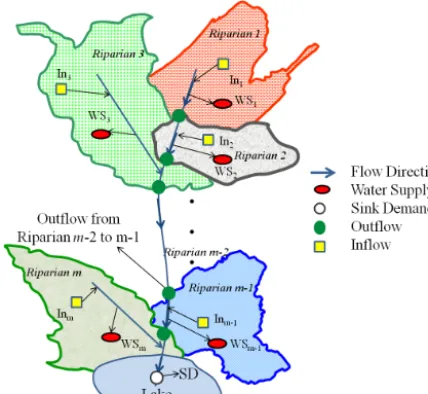
Figure1. Schematic map of a trans-boundary river network
Figure 1. Schematic map of a transboundary river network.
fixed allocation rule can provide acceptable allocations that are insensitive to hydrologic variability.
3 River bankruptcy allocation models
Figure 1 shows a schematic of simple transboundary river system with multiple tributaries, a lake (sink) at the outlet andmriparians (i=1, 2, . . . ,m), each having different types of water demand (e.g., domestic, agricultural, and environ-mental). Water bankruptcy occurs when the total demand of the riparians exceeds the stock of water. Bankruptcy rules can be applied to allocate the available water to the riparians with respect to their water demands (claims). In river sys-tems, however, the classic bankruptcy rules might produce infeasible allocation results due to spatial and temporal flow variability and water access heterogeneity. Thus, bankruptcy rules must be modified to account for the physical character-istics of the river network. We propose developing non-linear network flow optimization models that facilitate application of four commonly used bankruptcy methods, namely pro-portional (P), adjusted propro-portional (AP), constrained equal award (CEA), and constrained equal loss (CEL) rules to river bankruptcy problems, with respect to the water availability constraints. These models have the following general char-acteristics:
1. Each bankruptcy optimization model is based on a spe-cific bankruptcy rule.
2. An allocation solution developed by a river bankruptcy optimization model is always unique.
3. The allocation solution set developed by a bankruptcy optimization model is always feasible, considering
the temporal and spatial flow variability in the river network.
4. The allocation solutions developed by a river bankruptcy optimization model are expected to satisfy the composition properties suggested by Ansink and Weikard (2013) for river bankruptcy problems. Nonetheless, composition properties have not been used in this study to derive the bankruptcy solutions. 5. The bankruptcy optimization models seek “equal
treat-ment of the equals” to the extent possible. This means that the bankruptcy optimization models minimize hydro-hegemony (Zeitoun and Warner, 2006) in the sys-tem by equal treatment of all riparians regardless of their location in the system (upstream vs. downstream) and level of contribution to the total flows. This char-acteristic makes the proposed framework different in essence from the methods proposed by Ansink and Weikard (2012) and Mianabadi et al. (2013).
6. In the absence of water availability restrictions, a bankruptcy optimization model based on a given bankruptcy rule produces allocation results that are identical to allocation solutions based on that bankruptcy rule. In other words, when allocation based on a given bankruptcy rule is feasible, original bankruptcy solutions match the solutions produced by the corresponding bankruptcy optimization model. 7. In presence of water availability restrictions (when the
application of original bankruptcy solutions methods in-feasible allocation solutions), bankruptcy optimization models minimize the difference between their allocation solutions and the solutions based on the corresponding original bankruptcy rules.
8. Water allocations to riparians with equal claims are not necessarily equal in river bankruptcy problems, due to the uneven access to water along the river system. 9. A bankruptcy optimization model can be applied to any
river network, irrespective of its physical characteristics (shape, number of tributaries, number of riparians, etc.). 10. Each river bankruptcy optimization model satisfies the following initial, mass balance (flow continuity), and non-negativity constraints:
Ti,t=Ii,t+Oi−1,t ∀i, (1)
Oi,t =Ti,t−Si,t ∀i, (2)
O0,t=0, (3)
[image:5.612.60.274.69.266.2]Si,t ≥0 ∀i, (5)
Si,t ≤Ti,t ∀i, (6)
m X
i=1
Si,t≤Et, (7)
Et=
m X
i=1
Ii,t−Dt, (8)
where fori=1, 2, . . . ,min a given time stept:Ti,t is the total available water in ripariani’s territory (decision variable);Ii,t is the ripariani’s contribution to the river
system through the tributaries originating in its territory (known variable);Oi,t is the total outflow from
ripar-ianito the downstream riparian state (i+1) (decision variable);Si,t is the allocated water supply to riparian i in each month (decision variable);Dt is the sink
de-mand at the system’s outlet (known variable); andEt is
the total asset water (available water) to be shared in the bankruptcy problem.
While the sink node at the system’s outlet can be treated as a riparian, here we assume that the environmental need of the sink has a high priority. Therefore, Eq. (4) ensures that the lake’s environmental demand is fully met.
11. A bankruptcy optimization model is only appropriate for a bankrupt river system in which the total demand exceeds the total available water. This makes Et ≤
m P
i=1
Ci,t a necessary condition for validity of the
opti-mization model, whereCi,t is the claim (demand) of
ri-parianiin time stept(known variable).
12. The amount of water allocated to a riparian partyi(by a river bankruptcy optimization model) never exceeds its claim/demand. Thus, all bankruptcy optimization mod-els satisfy the following constraint:
Si,t ≤Ci,t ∀i, (9)
In the case of downstream excess flow, i.e., when wa-ter availability is more than the claim of the down-stream riparian, this riparian must be excluded from the river bankruptcy problem, as technically this riparian is not expected to be subject to any conflict of water allocation.
Sections 3.1–3.4 present the mathematical formulations for each of the proposed river network bankruptcy optimiza-tion models. All river bankruptcy optimizaoptimiza-tion models are subject to Eqs. (1)–(9). One advantage of using a network bankruptcy model is that it can be applied to any river net-work with any shape. Thus, the river netnet-work should not necessarily match the natural river system and it can include water diversion/transfer infrastructure (already developed or under consideration during allocation negotiations). It must
be noted that while the proposed models have been devel-oped for river networks, they are generally applicable to any network bankruptcy problem in which the agents’ accessibil-ity to the resource can be determined based on the network structure.
Given the time sensitivity of water deliveries, water solu-tions must be found using an appropriate time-step to prevent disruption in water deliveries to any riparian party. In sys-tems without enough storage capacity to regulate and carry over water, smaller time-steps (e.g., months) can be used as the basis of allocations. In this case, allocations are time spe-cific and can be done for each time-step independently, i.e., the bankruptcy rule is applied to a given time-step (e.g., 1 month) during the planning horizon (e.g., 1 years), based on the water availability and claims in that month only, regard-less of the allocations in other months. In regulated systems, operations are more flexible. Thus, bankruptcy rules can be applied to the whole planning horizon
Bankruptcy optimization models in this case is that spe-cific concerns of the riparian parties during the planning horizon as optimization constraints. Examples of such con-straints would be minimum acceptable water supply, mini-mum environmental flow, minimini-mum reservoir storage/energy head for hydroelectricity generation, maximum/minimum temperature, minimum acceptable reliability/resiliency of water supply, and maximum acceptable vulnerability of wa-ter supply at particular points within the river network in a given time (e.g., day, week, month) during the planning hori-zon (e.g., year).
In this study, the proposed modeling framework is applied to an unregulated system for which bankruptcy (cutback) al-location decisions in each time-step are independent from other time-steps.
3.1 Proportional (P) rule
The P rule satisfies an equal proportion of the creditors’ claims. Based on this ancient bankruptcy method, the equal portion (λPi,t)is calculated by dividing the total available re-source by total demand. TheP rule’s water allocation opti-mization model for river systems is proposed in the following mathematical form:
Minimize λPt−
m Y
i=1
λPi,t, (10)
subject to:
λPi,t =
Si,t
Ci,t ∀i, (11)
λPi,t ≤λPt ∀i, (12)
where fori=1, 2, . . . ,min a given time stept:λPi,t is the
ripariani’s proportional allocation coefficient (decision vari-able), andλPt is the maximum proportional allocation
minimize the latter variable. The second term in the objec-tive function ensures that the model has a unique solution and the agents’ allocation coefficients (λPi,t)are as close to each other as possible. The minimum objective value for a given problem is achieved when the riparians’ allocation co-efficients are equal. In that case,λPt =λPi,t and the
propor-tional allocation coefficients match the proporpropor-tional cutback rate under the original bankruptcy rule, which is equal to
Et m
P
i=1 Ci,t
. This case occurs when the flow variability does not make the original bankruptcy rule infeasible.
3.2 Adjusted proportional rule (AP)
Based on this rule (Curiel et al., 1987), what remains for ben-eficiaryionce all other creditors are satisfied is the basis for allocation. To determine the initial amount of allocation to creditori, the summation of claims of all other beneficiaries is compared with the available stock of water. In the case of surplus, the initial allocation to riparianiis equal to the re-maining water stock once the demands of all other riparians are satisfied. Otherwise, the initial allocation toiis set to 0. It is assumed that the initial allocation calculated through this procedure is agreeable by all beneficiaries. Once initial allo-cations are determined, claims are revised. The revised claim of a given beneficiary is set equal to the minimum of the remaining water stock and the difference between the ben-eficiary’s initial claim and its initial allocation. The P rule is then applied to the remaining water stock and the revised claims.
The mathematical formulation of the AP rule’s river bankruptcy optimization model is proposed as follows:
Minimize λAPt−
m Y
i=1
λAPi,t, (13)
subject to:
Ri,t = X
j6=i
Cj,t ∀i, (14)
υi,t=
Et−Ri,t+ |Et−Ri,t|
2 ∀i, (15)
Ci,t∗ =Min(Ci,t, Et) ∀i, (16)
λAPi,t =
Si,t−υi,t Ci,t∗ −υi,t
∀i, (17)
λAPi,t ≤λAPt ∀i, (18)
λAPt ≤
Et−6im=1υi,t
6jm=1,j6=i(Cj,t∗ −υj,t) ∀i, (19)
where fori=1, 2, . . . ,min a given time stept:Ri,t is the
summation of all riparians’ claims excluding ripariani;υi,t
is the initial allocation to riparian i (amount of water con-ceded to riparianiby all other riparians);λAPi,tis the riparian
i’s AP allocation coefficient (decision variable), andλAPt is
the maximum AP allocation coefficient (decision variable). Similar to theP rule’s optimization model, the minimum ob-jective value is achieved when the original bankruptcy solu-tion is feasible and the optimized allocasolu-tions match the al-locations under application of the original bankruptcy rules. The second term in the objective function ensures having a unique solution and minimizes the differences between the allocation coefficients of the riparians.
3.3 Constrained equal award rule (CEA)
This ancient rule, adopted by rabbinical legislators (Dagan and Volij, 1993) allocates the minimum ofλCEAt andCi,t to
all beneficiaries, provided that the sum of allocations equals the total available resource. CEA tries satisfying the lower claims to the extent possible in order to minimize the num-ber of unsatisfied creditors. This rule is supposed to favor the lower claims, normally belonging to weaker beneficia-ries who can be more affected by losses (Madani and Dinar, 2013). Based on CEA, the initial allocation to all beneficia-ries is equal to the lowest claim, provided that the sum of ini-tial allocations does not exceed the demand. The fully satis-fied creditor is then excluded and the process continues with the remaining creditors after updating their unsatisfied claims as well as the remaining resource value. At any stage (includ-ing the initial stage) when allocat(includ-ing an amount equal to the lowest claim to all remaining creditors is not feasible (due to insufficiency of remaining resource) the remaining resource is distributed equally among all remaining creditors.
The mathematical formulation of the CEA rule’s river bankruptcy optimization model is proposed as follows:
Minimize λCEAt−
m Q
i=1
λCEAi,t
(λCEAt)m
−1, (20)
subject to:
λCEAi,t=Si,t ∀i, (21)
λCEAi,t≤λCEAt ∀i, (22)
where fori=1, 2, . . . ,min a given time stept:λCEAi,tis the
feasible allocation to the ripariani (decision variable), and
λCEAt is the highest feasible allocation to the creditors
(de-cision variable). The second term in the objective function is to enforce a unique solution and to minimize the difference between the allocations which would be equal in the absence of resource accessibility limitations. Given thatλCEAt can be
more than 1 (different from theλPt andλAPt which are
3.4 Constrained equal loss rule (CEL)
This rule can be viewed as the opposite of CEA, as it gives priority to satisfying the highest claims (more powerful cred-itors) first. Once the highest claim is satisfied, the process is repeated with the remaining resource and creditors. The pro-cess stops at any stage (including the first stage) if the avail-able resource is not sufficient to satisfy the highest claim of the remaining creditors. At this stage, the remaining resource is split equally among the remaining creditors. By doing this, CEL allocatesCi−λCELi to all beneficiaries whose claims
are bigger thanλCELt, allocating 0 to those who do not fall in
this category. Thus, the final allocation to each beneficiary is equal to max0, Ci−λCELi .
The CEL rule’s river bankruptcy optimization model is proposed as follows:
Minimize λCELt−
m Q
i=1
λCELi,t
(λCELt)m
−1, (23)
subject to:
λCELi,t =Ci,t−Si,t ∀i, (24)
λCELi,t ≤λCELt ∀i, (25)
where fori=1, 2, . . . ,min a given time stept:λCELi,t is the
unmet claim of the ripariani(decision variable), andλCELt
is the maximum unmet claim of all riparians (decision vari-able).
4 Example: the Qezelozan-Sefidrud river system bankruptcy problem
The proposed framework is applied to develop bankruptcy-based water allocation schemes for resolving a real-world transboundary river conflict in Iran. The Qezelozan-Sefidrud river basin (Fig. 2) is located at the intersection of the Iran’s Alborz and Zagros mountain ranges, with an area about 59 400 km2, making it the largest basin of the nation. The basin overlaps with eight provinces (Kurdistan, Hamadan, Zanjan, Eastern Azerbaijan, Ardebil, Tehran, Qazvin, and Gilan) and the river provides the basis for important eco-nomic activities in these provinces. The river eventually flows into the Caspian Sea in north of Iran, which is the largest enclosed body of water in the world and the source of more than 90 % of the world’s caviar supply (Madani et al., 2014b). Supplying the required environmental flows of the Caspian Sea is essential to the health of its valuable ecosystem.
[image:8.612.311.547.68.245.2]The study basin is not international. Nevertheless, inter-provincial or interstate basins are effectively equivalent to international basins as long as their boundaries do not match political boundaries and they are managed by more than one authority. The Qezelozan-Sefidrud river system is an exam-ple of a transboundary river basin, in which serious conflict
Figure 2. Qezelozan-Sefidrud river system and its eight riparian
provinces.
Figure 3. Estimated monthly claims of the riparian provinces based on the three proposed claim calculation method 0 0.05 0.1 0.15 0.2 0.25
1 2 3 4 5 6 7 8 9 10 11 12
C
la
im
(
10
6 m 3)
Month Future Uses
Historical Uses Planned Uses
Oct Nov Dec Jan Feb Mar Apr May Jun Jul Aug Sep
Hamadan 0 20 40 60 80 100
1 2 3 4 5 6 7 8 9 10 11 12
C
la
im
(
10
6 m 3)
Month Historical Uses Planned Uses Future Uses
Oct Nov Dec Jan Feb Mar Apr May Jun Jul Aug Sep
Kurdistan 0 50 100 150 200 250
1 2 3 4 5 6 7 8 9 10 11 12
C
la
im
(
10
6 m 3)
Month Historical Uses Planned Uses Future Uses
Oct Nov Dec Jan Feb Mar Apr May Jun Jul Aug Sep
Zanjan 0 50 100 150 200
1 2 3 4 5 6 7 8 9 10 11 12
C
la
im
(
10
6 m 3)
Month Historical Uses Planned Uses Future Uses
Oct Nov Dec Jan Feb Mar Apr May Jun Jul Aug Sep
East. Az. 0 10 20 30 40 50
1 2 3 4 5 6 7 8 9 10 11 12
C
la
im
(
10
6 m 3)
Month Historical Uses Planned Uses Future Uses
Oct Nov Dec Jan Feb Mar Apr May Jun Jul Aug Sep
Ardabil 0 2 4 6 8 10
1 2 3 4 5 6 7 8 9 10 11 12
C
la
im
(
10
6 m 3)
Month Historical Uses Planned Uses Future Uses
Oct Nov Dec Jan Feb Mar Apr May Jun Jul Aug Sep
Qazvin 0 20 40 60 80 100
1 2 3 4 5 6 7 8 9 10 11 12
C
la
im
(
10
6 m 3)
Month Historical Uses Planned Uses Future Uses
Oct Nov Dec Jan Feb Mar Apr May Jun Jul Aug Sep
Tehran 0 150 300 450 600 750
1 2 3 4 5 6 7 8 9 10 11 12
C
la
im
(
10
6 m 3)
Month Historical Uses Planned Uses Future Uses
Oct Nov Dec Jan Feb Mar Apr May Jun Jul Aug Sep
Gilan
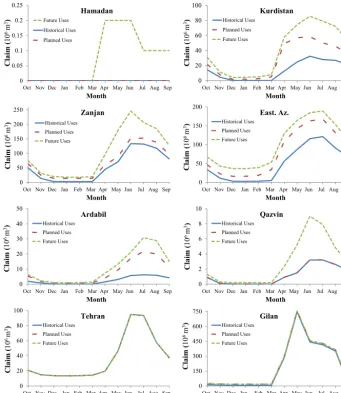
Figure 3. Estimated monthly claims of the riparian provinces based on the three proposed claim calculation methods.
1. Historical uses: based on this alternative, historical uses of the river system, revealed by the historical water use data are set as the claims of the riparians. The water use values are calculated based on the difference between the recorded inflows and outflows of each province at the hydrometric stations. This alternative sets the lower claim boundary for each riparian.
2. Planned uses: Iran is currently the world’s third dam builder with respect to the dams it has under construc-tion (Madani, 2014). Several water storage projects are under development at different locations in the ripar-ian states of the Qezelozan-Sefidrud river system. These projects have been approved by the central government, and are receiving financial support from the central and provincial governments. Each project has an associated estimation of sectoral water demands (i.e., domestic, agricultural, industrial, and environmental) used for the calculation of the required storage capacity. Based on
this alternative, the total claim of each riparian is set equal to the total documented water demands of differ-ent river system-related reservoirs within the watershed boundaries, which are already in operation or under de-velopment.
3. Future uses: beside projects under construction, each ri-parian state has plans for getting approval for construct-ing additional water storage infrastructure to meet its increasing water demand as a result of development. Based on this claim estimation alternative, water de-mands of these additional facilities will be added to the water claims calculated based on alternative 2 only if the construction plans of these facilities have been pub-licly announced. This alternative sets the upper claim boundary for each riparian.
Figure 4. Total annual claims (including Caspian Sea’s water demand) based on three different claim estimation methods and total annual water yield under three different hydrologic scenarios
0 2 4 6 8 10 12 14 16
Historical Planned Future Claims
10
9 m 3 per
Y
ear
Wet
Normal Dry
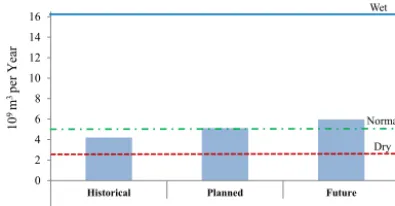
Figure 4. Total annual claims (including the Caspian Sea’s water
demand) based on three different claim estimation methods and to-tal annual water yield under three different hydrologic scenarios.
on the three proposed methods. Detailed calculations of the water claims based on proposed claim determination alterna-tives can be found in Zarezadeh (2011).
Given that allocation solutions can be sensitive to cli-matic/hydrologic conditions, three different water availabil-ity scenarios, representing three distinct hydrologic condi-tions, normal (average), dry, and wet, were initially con-sidered for solving the example river bankruptcy problem. In the normal scenario, river flows are based on the aver-age monthly river discharges during the 1956–2006 period. Dry scenario flows match the average monthly river dis-charges during the major drought of 1998–2001 in the re-gion. The wet scenario flows are based on the monthly flows during the 1968–1969 period. The annual river discharge un-der the wet scenario will be sufficient to meet the historical, planned, and future claims of the riparian states as well as the Caspian Sea’s (sink) water demand (Fig. 4). Therefore, river bankruptcy problem is solved only for the normal and dry cases.
Due to the unclear status of water rights/claims and the future status of reservoir networks in the Qezelozan-Sefidrud river system, this system is considered to be unregulated, dis-regarding the possible benefits resulting from coordination of reservoir operation strategies in the basin. The problem is solved using a monthly time-step and allocations are de-termined in each time-step separately. Under this approach, the total allocation to each riparian over the whole planning horizon (e.g., one year) is the summation of bankruptcy allo-cations in the existing time-steps within the planning horizon (e.g., twelve months).
Figure 5 indicates the monthly water yield of the Qezelozan-Sefidrud river system under the normal and dry conditions as well as the total monthly claims of the riparian parties (including the Caspian Sea’s water demand). This fig-ure clearly shows the water bankruptcy status of the example river system for almost half of the year, especially in warmer months with higher agricultural water demands.
[image:10.612.70.268.67.170.2]The four proposed bankruptcy optimization models in Section 3 were run under two hydrologic scenarios to calcu-late bankruptcy allocations under normal and dry conditions. The models were first run on a monthly basis to calculate the
Figure 5. Total monthly claims (including Caspian Sea’s water demand) based on three different claim estimation methods and total annual water yield under normal and dry hydrologies
0 0.5 1 1.5
1 2 3 4 5 6 7 8 9 10 11 12
10
9 m 3 pe
r M
ont
h
Month Historical Uses
Planned Uses
Future Uses
Dry Year Flows
Normal Year Flows
[image:10.612.310.545.67.165.2]Oct Nov Dec Jan Feb Mar Apr May Jun Jul Aug Sep
Figure 5. Total monthly claims (including the Caspian Sea’s
wa-ter demand) based on three different claim estimation methods and total annual water yield under normal and dry hydrologies.
monthly allocations. The summation of 12 monthly alloca-tions based on each model with a given set of claims under a given hydrology determines the corresponding annual allo-cation of each province. The annual bankruptcy alloallo-cations based on different bankruptcy models, claims, and hydrolo-gies are presented in Fig. 6.
As expected based on the definition, the CEL method fa-vors the creditor with the highest claim (in this case, the downstream Province of Gilan). The opposite is true for the CEA method which gives priority to satisfy the claims of the creditors with lower claims (in this case, the provinces up-stream of Gilan). The AP andP methods can be considered as moderate allocation methods which result in allocations that are between the high and low allocations estimated by the other two methods. In comparison withP, the AP method allocates a higher share to the parties with lower claims and a lower share to the parties with higher claims, trying to ad-dress the bias toward higher claims in theP method. The difference between the allocation values for different claims and hydrologies underline the sensitivity of bankruptcy allo-cation schemes to the difference in claim values and hydro-logic conditions.
5 Stability evaluation
Figure 6. Satisfied annual water claim (%) of the riparian provinces based on different bankruptcy solution methods for different claims and hydrologies (a: historical claim in normal
year, b: historical claim in dry year, c: planned claim in normal year, d: planned claim in dry year, e: future claim in normal year, and f: future claim in dry year)
0 10 20 30 40 50 60 70 80 90 100
Ham Kur Zan E Azar Ard Qaz Teh Gil
S at is fi ed D em an d % Province
Pro CEA CEL AP
(a) 0 10 20 30 40 50 60 70 80 90 100
Ham Kur Zan E Azar Ard Qaz Teh Gil
S at is fi ed D em an d % Province Pro CEA CEL AP (b) 0 10 20 30 40 50 60 70 80 90 100
Ham Kur Zan E Azar Ard Qaz Teh Gil
Sat is fi ed D em an d % Province Pro CEA CEL AP
(c) 0 10 20 30 40 50 60 70 80 90 100
Ham Kur Zan E Azar Ard Qaz Teh Gil
Sat is fi ed D em an d % Province Pro CEA CEL AP
(d) 0 10 20 30 40 50 60 70 80 90 100
Ham Kur Zan E Azar Ard Qaz Teh Gil
Sat is fied D em an d % Province Pro CEA CEL AP
(e) 0 10 20 30 40 50 60 70 80 90 100
Ham Kur Zan E Azar Ard Qaz Teh Gil
Sat is fied D em an d % Province Pro CEA CEL AP
(f)
Figure 6. Satisfied annual water claim (%) of the riparian provinces based on different bankruptcy solution methods for different claims and
hydrologies: (a) historical claim in a normal year, (b) historical claim in a dry year, (c) planned claim in a normal year, (d) planned claim in a dry year, (e) future claim in a normal year, and (f) future claim in a dry year.
Table 1. Plurality index of different bankruptcy solutions for different claims and hydrologies.
Claim
Hydrology
Normal Dry
P AP CEL CEA Winner P AP CEL CEA Winner
Historical 0 0 1 6 CEA 0 0 1 6 CEA
Planned 0 0 1 6 CEA 0 1 1 5 CEA
Future 0 1 1 6 CEA 0 2 1 5 CEA
The higher the allocation to a riparian state, the more pre-ferred the allocation rule (bankruptcy method) by that state. Table 1 shows the plurality index (number of votes received) of each bankruptcy solution method for different claim val-ues under different hydrologies. The assumption is that each party selects the allocation scheme that gives it the highest share. Given that the Hamadan Province has no historical or planned claim, its vote is only counted when future claims are considered. Based on the plurality index, the CEA method, which highly satisfies the riparians with lower claims (ma-jority in this case) in both normal and dry conditions, is the winner. However, given the absolute objection of the most powerful province, i.e., Gilan, to this method, which allo-cates low shares to this province, this solution is not practical
without strong intervention of the central government or pro-viding strong cooperation incentives to Gilan.
The majority does not necessarily win in multi-participant decision-making problems with asymmetric powers, espe-cially when the minority group is powerful. Therefore, the plurality index might not be appropriate for identify-ing the feasible solution when there is a power imbalance among the beneficiaries. Other methods can be used to quan-tify the potential acceptability of allocation solutions (Read et al., 2014). Loehman et al. (1979) used the following power index (αi), originally developed by Shapley and
[image:11.612.129.467.428.518.2]Table 2. Bankruptcy allocation stability index (BASI) values of different bankruptcy solutions for different claims and hydrologies.
Scenario
BASI
Normal Dry
P AP CEL CEA P AP CEL CEA
Historical 0.11 0.10 0.07 0.15 0.90 1.00 1.33 1.27 Planned 0.31 0.31 0.21 0.43 1.11 1.01 1.68 0.77
Future 6.57 6.49 3.48 9.65 1.01 0.95 1.54 0.73
to coalition members:
αi= xi
−xi0 P
j N
(xj−xj0)
iN,X
iN
αi=1, (26)
wherexi is the allocated cooperative benefit share to player
i,xi0 is the status quo (non-cooperative) gain of playeri, and
N is the set of all players.
A high power index value reflects less power or a higher willingness to cooperate. A stable allocation solution can be achieved when power is distributed more or less equally among the players (Dinar and Howitt, 1997). Therefore, the coefficient of variation of powers, also known as the stability index(Sα)is used as an indicator of the stability of allocation
solutions:
Sα =
σα
α, (27)
where σα is the standard deviation of powers andα is the mean power. The lower the index, the more stable the alloca-tion solualloca-tion.
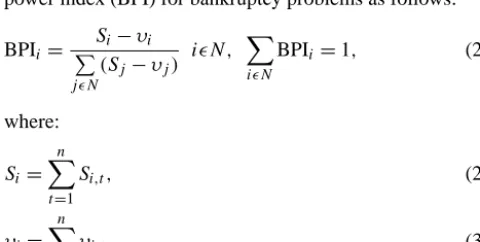
Given that cooperation in bankruptcy problems does not have incremental benefits and parties’ gains are zero in the status quo, the power index is not readily quantifiable in bankruptcy problems. Therefore, we propose a modified power index (BPI) for bankruptcy problems as follows: BPIi=
Si−υi P
j N
(Sj−υj)
iN, X
iN
BPIi=1, (28)
where:
Si =
n X
t=1
Si,t, (29)
υi=
n X
t=1
υi,t, (30)
BPIi is the bankruptcy power index (BPI) of ripariani,υi
is the sum of the conceded water to riparian i by all other riparians in all time-steps in the overall planning horizon,N
is the set of riparians, and nis the number of time-steps in the planning horizon (n=12 months in the study example).
The bankruptcy allocation stability index (BASI) is then equal to the coefficient of variation of BPIs, which can be
used to evaluate the potential acceptability of a bankruptcy solution:
BASI=σBPI
BPI, (31)
whereσBPIis the standard deviation of riparian powers and BPI is the mean power. The higher the index, the less stable the allocation solution.
Table 2 shows the BASI value for each bankruptcy solu-tion under a given hydrology for a unique claim set. Based on this table, the CEL method is the most stable method un-der the normal hydrology even though this method is not the most popular method (based on the popularity index). Given that stability (feasibility) is more important than popularity (social optimality) in conflict resolution (Read et al., 2014) we can conclude that CEL is the best mechanism for water allocation in this bankruptcy example. Nevertheless, the sta-bility of CEL is sensitive to hydrological conditions and this method becomes the least stable allocation method under the dry conditions. Under the dry hydrology, theP rule is the most stable with lower demands. As demands increase, the CEA method (the most popular method) becomes more sta-ble. The changes in stability of allocation rule, with changes in demand and hydrology show that the stability of alloca-tion mechanisms is sensitive to both the hydrologic condi-tions (water availability) and the claim set characteristics. Future studies can focus on understanding the correlations of the BASI of allocation rules with the claim set characteristics (magnitude of claims, heterogeneity of claims, etc.) and the resource availability conditions.
6 Conclusions
Considering the non-uniform spatial and temporal vari-ability of water flows, resulting in unequal access to water in river systems, non-linear optimization models were proposed for solving river bankruptcy problems. Four river bankruptcy network flow optimization models were developed based on four conventional bankruptcy rules, i.e., proportional (P), ad-justed proportional (AP), constrained equal award (CEA), and constrained equal loss (CEL), for transboundary water allocation. The models can be applied to any river network (or bankruptcy network) problem, irrespective of its shape and resource variability/accessibility conditions.
Acknowledging the difference in the notion of fairness and the possibility of the rejection of suggested allocations by the beneficiaries, who find certain allocation rules un-fair, there is a need for evaluating the acceptability of dif-ferent bankruptcy solutions. While popularity of each solu-tion is a simple indicator of its potential acceptability, it was argued that in the case of asymmetric powers, the majority cannot necessary determine the feasible solution, especially when powerful parties do not support the most popular so-lution. Therefore, a new index (bankruptcy allocation sta-bility index (BASI)) was formulated for evaluating the po-tential acceptability/stability of allocation solutions with re-spect to the distribution of claims and dissatisfaction among the beneficiaries.
The evaluation of the stability of different bankruptcy al-location solutions for different water demand and hydrologic scenarios in the example case suggested that acceptability is sensitive to both water demand (claim) and water avail-ability. This finding has a significant policy implication for transboundary water management, suggesting that inflexible water allocation agreements and treaties that have been de-veloped based on stationary assumptions are not resilient, especially in face of expected socioeconomic and climatic changes.
Acknowledgements. The authors would like to thank Erik Ansink
and the two anonymous reviewers for their constructive comments. The second author thanks the Hydro-Environmental and Energy Systems Analysis (HEESA) Research Group for their hospitality and extensive support during her research visit.
Edited by: K. Stahl
References
Ansink, E. and Ruijs, A.: Climate change and the stability of water allocation agreements, Environ. Resour. Econom., 41, 249–266, 2008.
Ansink, E. and Weikard, H. P.: Sequential sharing rules for river sharing problems, Social Choice Welfare, 38, 187–210, 2012. Ansink, E. and Weikard, H. P.: Composition properties in the river
claims problem, MPRA Working Paper 51618, 2013.
Aumann, R. J. and Maschler, M.: Game theoretic analysis of a bankruptcy problem from the Talmud, J. Economic Theory, 36, 195–213, 1985.
Bruce, C. J. and Madani, K.: Successful Collaborative Negotia-tion over Water Policy: Substance versus Process”, Department of Economics, University of Calgary, Working Paper 2014-36, 2014.
Curiel, I. J., Maschler, M., and Tijs, S. H.: Bankruptcy game, Zeitschrift für Operations Research, 31, A143–A159, 1987. Dagan, N. and Volji, O.: The bankruptcy problem: a cooperative
bargaining approach, Mathemat. Social Sci., 26, 287–297, 1993. De Stefano, L., Duncan, J., Dinar, S., Stahl, K., Strzepek, K. M., and Wolf, A.T.: Climate change and the institutional resilience of international river basins, J. Peace Res., 49, 193–209, 2012. Dinar, A. and Howitt, R. E.: Mechanisms for allocation of
environ-mental control cost: empirical tests of acceptability and stability, J. Environ. Manage., 49, 183–203, 1997.
Dinar, S., Odom, O., McNally, A., Blankespoor, B., and Kuruku-lasuriya, P.: Climate Change and state grievances: the resiliency of international river treaties to increased water variability, Insti-tute of Advanced Study Insights Working Paper Series, Durham University, 3(22), 2010.
Dufournaud, C.: On the Mutually Beneficial Cooperative Scheme: Dynamic Change in the Payoff Matrix of International River Basin Schemes, Water Resources Research, 18, 764–772, 1982. Elimam, L., Rheinheimer, D., Connell, C. and Madani, K.: An
an-cient struggle: a game theory approach to resolving the Nile con-flict, in: Proceeding of the 2008 World Environmental and Water Resources Congress, edited by: Babcock, R. W. and Walton, R., Honolulu, Hawaii, American Society of Civil Engineers, 1–10, 2008.
Grundel, S., Borm, P., and Hamers, H.: A Compromise Stable Ex-tension of Bankruptcy Games: Multipurpose Resource Alloca-tion, CentER Discussion Paper, 2011-029, p. 17, 2011.
Harsanyi, J. C.: A bargaining model for the cooperative n-person game, in: Contributions to the Theory of Games, 4, edited by: Tucker, A. W. and Luce, D. R., 324–356, Princeton, NJ: Prince-ton University Press, 1959.
Herrero, C. and Villar, A.: The three musketeers: Four classical so-lutions to bankruptcy problems, Mathemat. Social Sci., 42, 307– 328, 2001.
Ilkılıç, R. and Kayı, C.: Allocation rules on networks, Working Pa-per 118, Universidad del Rosario, 2012.
Kilgour, D. M. and Dinar, A.: Flexible water sharing within an inter-national river basin, Environ. Resour. Econom., 18, 43–60, 2001. Kucukmehmetoglu, M. and Guldmen, J.: International water re-sources allocation and conflicts: the case of the Euphrates and Tigris, Environ. Plann., 36, 783–801, 2004.
Loehman, E., Orlando, J., Tschirhart, J., and Winstion, A.: Cost al-location for a regional wastewater treatment system, Water Re-sour. Res., 15, 193–202, 1979.
Madani, K.: Game theory and water resources, J. Hydrol., 381, 225– 238, 2010.
Madani, K.: Modeling International Climate Change Negotiations More Responsibly: Can Highly Simplified Game Theory Mod-els Provide Reliable Policy Insights?, Ecol. Econom., 90, 68–76, 2013.
Madani, K.: Water management in Iran: What is causing the loom-ing crisis?, J. Environ. Stud. Sci., doi:10.1007/s13412-014-0182-z, in press, 2014.
Madani, K. and Dinar, A.: Cooperative Institutions for Sus-tainable Common Pool Resource Management: Applica-tion to Groundwater, Water Resour. Res., 48, W09553, doi:10.1029/2011WR010849, 2012.
Madani, K. and Dinar, A.: Exogenous Regulatory Institutions for Sustainable Common Pool Resource Management: Application to Groundwater, Water Resour. Econom., 2–3, 57–76, 2013. Madani, K. and Hipel, K. W.: Strategic insights into the Jordan river
conflict, Proceeding of the 2007 World Environmental and Water Resources Congress, Tampa, Florida, edited by: Kabbes K. C., ASCE, 2007.
Madani, K. and Hipel, K. W.: Non-cooperative stability definitions for strategic analysis of generic water resources conflicts, Water Resour. Manage., 25, 1949–1977, 2011.
Madani, K. and Hooshyar, M.: A game theory-reinforcement learn-ing (RL) method to develop optimal operation policies for multi-reservoir systems, J. Hydrol., doi:10.1016/j.jhydrol.2014.07.061, in press, 2014.
Madani, K. and Lund, J. R.: A Monte-Carlo game theoretic ap-proach for Multi-Criteria Decision Making under uncertainty, Adv. Water Resour., 35, 607–616, 2011.
Madani, K. and Lund, J. R.: California’s Sacramento-San Joaquin Delta conflict: from cooperation to chicken, Water Resour. Plann. Manage., 138, 90–99, 2012.
Madani, K. and Zarezadeh, M.: Bankruptcy Methods for Resolving Water Resources Conflicts, 2012 World Environmental and Wa-ter Resources Congress, 2247–2252, ASCE, Albuquerque, New Mexico, Edited by: Loucks, E. D., 2012.
Madani, K., Sheikhmohammady, M., Mokhtari, S., Moradi, M., and Xanthopoulos, P.: Social Planner’s Solution for the Caspian Sea Conflict, Group Decision and Negotiation, 23, 579–596, 2014a. Madani, K., Rouhani, O. M., Mirchi, A., and Gholizadeh, S.: A
Ne-gotiation Support System for Resolving an International Trans-boundary Natural Resource Conflict”, Environ. Model. Softw., 51, 240–249, 2014b.
Madani, K., Read, L., and Shalikarian, L.: Voting Under Uncer-tainty: A Stochastic Framework for Analyzing Group Deci-sion Making Problems, Water Resour. Manage., 28, 1839–1856, 2014c.
Mianabadi, H., Mostert, E., Zarghami, M., and van de Giesen, N.: Transboundary water resources allocation using bankruptcy the-ory; Case study of Euphrates and Tigris Rivers, Proceedings of the Transboundary water management across borders and in-terfaces: present and future challenges International Conference & Workshops (TWAM, 2013), 16–20 March, Aveiro, Portugal, 2013.
O’Neill, B.: A problem of rights arbitration from the Talmud, Math-emat. Social Sci., 2, 345–371, 1982.
Parrachino, I., Dinar, A., and Patrone, F.: Cooperative game theory and its application to natural, environmental, and water resource issues: 3. Application to Water Resources. World Bank Policy Research Working Paper No. 4074, WPS4072, 2006.
Read, L., Madani, K., and Inanloo, B.: Optimality versus Stability in Water Resource Allocation Negotiations, J. Environ. Manage., 133, 343–354, 2014.
Rogers, P.: A game theory approach to the problems of international river basins, Water Resour. Res., 5, 749–760, 1969.
Shapley, L. S.: A value for n-person games, Annals of Mathemat-ics Studies, 28, 307–318, and in Contributions to the Theory of Games, Vol. 2, edited by: Kuhn, H. W. and Tucker, A. W., Prince-ton: Princeton University Press, 1953.
Shapley, L. S. and Shubik, M.: A method for evaluating the distri-bution of power in a committee system, Am. Pol. Sci. Rev., 48, 787–792, 1954.
Sheikhmohammady, M. and Madani, K.: Sharing a multi-national resource through bankruptcy procedures, Proceeding of the 2008 World Environmental and Water Resources Congress, Honolulu, Hawaii, edited by: Babcock, R. W. and Walton, R., 1–9, Ameri-can Society of Civil Engineers, 2008.
Sheikhmohammady, M., Kilgour, D. M., and Hipel, K. W.: Model-ing the Caspian Sea Negotiations, Group Decision and Negotia-tion, 19, 149–168, 2010.
Schmeidler, D.: The nucleolus of a characteristic function game, SIAM J. Appl. Mathemat., 17, 1163–1170, 1969.
Teasley, R. L. and McKinney, D. C.: Calculating the benefits of trans-boundary river basin cooperation: the Syr Darya basin, Wa-ter Resour. Plann. Manage., 137, 481–490, 2011.
Thomson, W.: Axiomatic and game-theoretic analysis of bankruptcy and taxation problems: A survey, Mathemat. Social Sci., 45, 249–297, 2003.
Wolf, A. T., Kramer, A., Carius, A., and Dabelko, G. D.: Water Can Be a Pathway to Peace, Not War. Woodrow Wilson International Center for Scholar. No. 1., available at: www.wilsoncenter.org/ topics/pubs/NavigatingPeaceIssue1.pdf, 2006.
Zarezadeh, M.: Water Allocation in the Qezelozan- Sefidrood Basin under Climate Change Using Bankruptcy Approach for Conflict Resolution, M. S. thesis, Dep. Of Water Resources Engineering, Tarbiat Modares University, Tehran, Iran, 2011.
Zarezadeh, M., Madani, K., and Morid, S.: Interactive comment on “Resolving conflicts over trans-boundary rivers using bankruptcy methods” by M. Zarezadeh et al., Hydrol. Earth Syst. Sci. Dis-cuss., 10, C8199–C8199, 2014.