Georgia State University Georgia State University
ScholarWorks @ Georgia State University
ScholarWorks @ Georgia State University
Finance Dissertations Department of Finance
12-7-2012
Two Essays on the Board's Uncertainty About the Contracting
Two Essays on the Board's Uncertainty About the Contracting
Environment and CEO Compensation Contracts
Environment and CEO Compensation Contracts
Bunyamin Onal
Georgia State University
Follow this and additional works at: https://scholarworks.gsu.edu/finance_diss
Recommended Citation Recommended Citation
Onal, Bunyamin, "Two Essays on the Board's Uncertainty About the Contracting Environment and CEO Compensation Contracts." Dissertation, Georgia State University, 2012.
https://scholarworks.gsu.edu/finance_diss/21
PERMISSION TO BORROW
In presenting this dissertation as a partial fulfillment of the requirements for an advanced degree from Georgia State University, I agree that the Library of the University shall make it available for inspection and circulation in accordance with its regulations governing materials of this type. I agree that permission to quote from, to copy from, or publish this dissertation may be granted by the author or, in his/her absence, the professor under whose direction it was written or, in his absence, by the Dean of the Robinson College of Business. Such quoting, copying, or publishing must be solely for the scholarly purposes and does not involve potential financial gain. It is understood that any copying from or publication of this dissertation which involves potential gain will not be allowed without written permission of the author.
NOTICE TO BORROWERS
All dissertations deposited in the Georgia State University Library must be used only in accordance with the stipulations prescribed by the author in the preceding statement.
The author of this dissertation is:
Bunyamin Onal
35 Broad St., Atlanta, GA 30303
The director of this dissertation is:
Dr. Omesh Kini Department of Finance
TWO ESSAYS ON THE BOARD’S UNCERTAINTY ABOUT THE CONTRACTING ENVIRONMENT AND CEO COMPENSATION CONTRACTS
BY
BUNYAMIN ONAL
A Dissertation Submitted in Partial Fulfillment of the Requirements for the Degree
Of
Doctor of Philosophy
In the Robinson College of Business
Of
Georgia State University
GEORGIA STATE UNIVERSITY ROBINSON COLLEGE OF BUSINESS
Copyright by Bunyamin Onal
ACCEPTANCE
This dissertation was prepared under the direction of Bunyamin Onal’s Dissertation Committee. It has been approved and accepted by all members of that committee, and it has been accepted in partial fulfillment of the requirements for the degree of Doctoral of Philosophy in Business Administration in the J. Mack Robinson College of Business of Georgia State University.
H. Fenwick Huss, Dean
DISSERTATION COMMITTEE
Dr. Omesh Kini (Chair) Dr. Mark Chen
Dr. Chip Ryan
ABSTRACT
TWO ESSAYS ON THE BOARD’S UNCERTAINTY ABOUT THE CONTRACTING ENVIRONMENT AND CEO COMPENSATION CONTRACTS
BY
BUNYAMIN ONAL
July 16, 2012
Committee Chair: Dr. Omesh Kini
Major Academic Unit: Department of Finance
Essay 1: To delegate or not to delegate to stock markets: The case of boards with related industry expertise
Abstract: I examine the extent to which boards with expertise in related product markets, i.e., downstream (customer) or upstream (supplier) industries, delegate their monitoring and advisory functions to stock markets. Directors from related industries (DRIs) are argued to have greater access to information about the input and output product markets of the firm. This, in turn, is predicted to reduce the reliance on stock-based compensation, a costly mechanism, particularly for firms that depend more on information about product markets and whose stock prices are not very informative about product markets. The evidence documented in this paper is largely consistent with these predictions. A number of additional tests suggest that this evidence is not likely to be explained by the potential conflict of interests between the firm’s stockholders and DRIs. Hence, I conclude that boards with related industry expertise delegate to stock markets to an optimally lesser extent due to their informational advantages.
Essay 2: Stock-based CEO compensation following conglomerate acquisitions
SPECIAL THANKS AND DEDICATIONS
I owe my most special thanks to my main adviser and mentor Omesh Kini for his patience, wisdom and endless support. I am also extremely grateful to my committee members Mark Chen, Nishant Dass, Vikram Nanda and Chip Ryan for their encouragement, guidance and cooperation. I would like to thank profusely our department chair Gerald Gay, all the other faculty members, the PhD students, our department manager Christine Brown and coordinators Mocha Trimier and Theresa Hand at the Department of Finance of Georgia State University for their help and support during my studies and job search. Finally, I am very thankful to Eyup Ozveren at the Department of Economics of Middle East Technical University and Cem Karayalcin, Jesse Bull and Nejat Anbarci at the Department of Economics of Florida International University for motivating me to pursue an academic career.
To Delegate or Not to Delegate to Stock Markets?
The Case of Boards with Related Industry Expertise
Bunyamin Onal*
Georgia State University
Current Draft: July 2012
Abstract
I examine the extent to which boards with expertise in related product markets, i.e., downstream (customer) or upstream (supplier) industries, delegate their monitoring and advisory functions to stock markets. Directors from related industries (DRIs) are argued to have greater access to information about the input and output product markets of the firm. This, in turn, is predicted to reduce the reliance on stock-based compensation, a costly mechanism, particularly for firms that depend more on information about product markets and whose stock prices are not very informative about product markets. The evidence documented in this paper is largely consistent with these predictions. A number of additional tests suggest that this evidence is not likely to be explained by the potential conflict of interests between the firm’s stockholders and DRIs. Hence, I conclude that boards with related industry expertise delegate to stock markets to an optimally lesser extent due to their informational advantages.
JEL Classification: D8; J3; G3
Keywords: Board of Directors; Related Industries; Stock-Based CEO Compensation;
Pay-for-Performance Sensitivity; Forced CEO Turnovers; Pay for Sector Pay-for-Performance
*
1
“Obviously, if shareholders (or board of directors) could directly observe the firm’s
opportunities and the executives’ actions and know beforehand which actions would maximize
shareholder wealth, no incentives would be necessary.”
Core, Guay, and Larcker (2003)
The role of corporate boards has recently been examined using a conceptual framework where there is a tradeoff between intense monitoring of management and value-enhancing
information flows from management to the board.1 In general, however, the board may not be
entirely dependent on management for strategic information. I argue, in this paper, that directors who serve a significant role in downstream (customer) or upstream (supplier) industries of the
firm can act as a conduit of information about the firm’s product markets and opportunity set.2
This is because multiple roles in economically-connected industries can provide a director with less costly access to private information on current and possible future developments in these industries such as the degree and likelihood of demand and supply shocks, major changes in corporate policies or in market structures through acquisitions or spinoffs, and so forth. Thus, a director from related industries (DRI) has the potential to expand the board’s information set about the opportunities of the firm and optimality of executive actions. A natural question that arises from these arguments and the excerpt from Core, Guay, and Larcker (2003), then, is whether DRIs are associated with less reliance on incentive mechanisms. I examine stock-based incentives in CEO compensation contracts to address this question.
The extant literature indicates that the choice of board composition and its effect on firm value depend critically on information-related factors such as complexity of the firm (e.g., Coles, Daniel, and Naveen, 2008), availability and quality of sources of information such as analyst forecasts (e.g., Duchin, Matsusaka, and Ozbas, 2010) or informative stock prices (e.g., Ferreira,
1 Adams and Ferreira (2007), for example, develop a model where the monitoring role of the board is traded off
against information flows from the CEO to the board that enhance the advisory role of the board. Adams, Hermalin and Weisbach (2010) provide an extensive survey of recent theoretical studies on the role of directors.
2 For example, Arthur Martinez, a director of PepsiCo since 1999, serves also as a director at International Flavors
2
Ferreira, and Raposo, 2008), and geographical distance of directors from the firm’s headquarters (Alam, Chen, Ciccotello, and Ryan, 2010). Thus, firms seem to take into account the availability of information to director candidates along with their other qualifications such as political connections (Goldman, Rocholl, and So, 2009) or financial expertise (Guner, Malmendier, and Tate, 2008) before appointing them. The amount and quality of information available to its members determine the board’s uncertainty about the operating environment of the firm and optimality of executive actions, which in turn determines the way it conducts its role. Stock-based compensation, on the other hand, ties CEO pay to the stock price which is Stock-based on the information produced in the stock market. It can be interpreted as the mechanism through which the board delegates its monitoring (and advising) functions to stock investors. Further, the degree of this delegation is expected to depend on the uncertainties faced by the board (Prendergast, 2000; 2002). Therefore, to the extent that the flow of information from DRIs can reduce such uncertainties, boards with these directors are likely to resort less to the stock-based incentive
mechanism and substitute it with board monitoring and advising.3 Consequently, DRIs are
expected to be associated with a lower sensitivity of CEO pay to the stock price (PPS). The hypothesis based on the preceding arguments and the resulting prediction is coined the
Information Hypothesis.
Weaker stock-based incentives can, however, also be an outcome of potential conflict of interests between DRIs and shareholders. At least some DRIs are expected to be the agents of customer or supplier firms that maintain trading relationships with the incumbent CEO. Others may collaborate with the CEO for that purpose. The CEO may further have influence over current or future employment opportunities of DRIs, particularly in related industries. Through these and other possible channels, the CEO who is risk averse and prefers a more stable compensation can create incentives for DRIs to help him extract a contract that features lower sensitivity to the stock price. The hypothesis that formalizes these arguments and also predicts a lower PPS in the presence of DRIs is coined the Conflict-of-Interests Hypothesis.
3 The information flow from a DRI is to the board and is argued to reduce the uncertainties that predicate the board’s
3
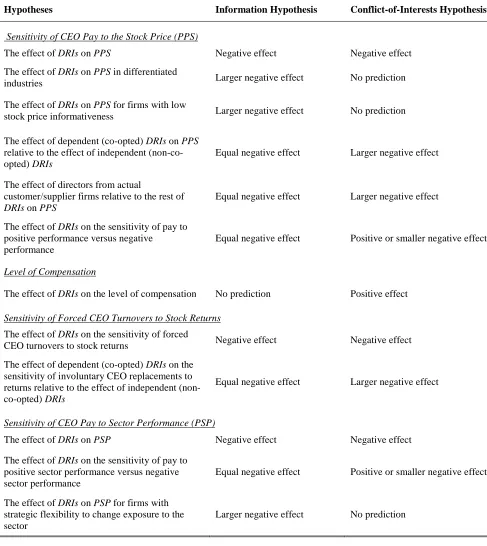
A crucial implication of the Information Hypothesis is that the information that DRIs can provide must be associated with their industry expertise. Hence, their impact on PPS is expected to be more negative for firms with greater dependence on information about customer and
supplier industries.4 Another important implication of the Information Hypothesis pertains to the
informativeness of the stock price. Firms whose stock prices are less informative about product markets are more likely to substitute its board members’ information for stock-based compensation. Under this scenario, then, DRIs are expected to have a more negative effect on
PPS when the firm’s stock price is less informative. As discussed earlier, the
Conflict-of-Interests Hypothesis also predicts lower PPS. Therefore, to understand the underlying
explanation for any effect of DRIs on PPS, I also derive and test a number of implications of the
Conflict-of-Interests Hypothesis.5 One implication, for example, is that dependent DRIs, i.e., those who are expected to be under CEO influence, are associated with a lower PPS than
independent DRIs.6
Pay for sector performance (PSP) is another type of stock-based incentive contracts that has received considerable attention. Standard models suggest that the agent should not be compensated for luck, i.e., factors that are beyond his control, as introducing luck into his compensation makes it riskier without providing additional incentives (e.g., Holmstrom, 1979). This prediction, however, is not supported by empirical studies which commonly use sector
performance as their measure of luck (e.g., Bertrand and Mullainathan, 2001).7 Subsequent
studies provide explanations consistent with the optimal contracting theory. Among others,8
Gopalan, Milbourn, and Song (2010) suggest that PSP gives the CEO incentive to choose the optimal level of exposure to the firm’s primary sector. Optimal sector exposure, on the other
4 For example, sales of firms that produce differentiated products are likely to be more sensitive to demand and
supply shocks. Thus, the information that DRIs can provide is more relevant for these firms.
5 A summary of all implications of the Information and the Conflict-of-Interests Hypotheses is presented in Table 1.
6 The other implications of the Conflict-of-Interests Hypothesis are as follows. The level of CEO pay is expected to
be significantly higher in the presence of DRIs. Furthermore, the conflict, if any, and thereby the negative impact on PPS is expected to be stronger with directors from active customers and suppliers of the firm than it is with DRIs from firms with no trading relationship with the firm. Finally, any asymmetry in the sensitivity of CEO pay to positive and negative stock returns is likely to be greater in the presence of DRIs.
7 Bertrand and Mullainathan’s other proxies for luck, that is, prices in the oil industry and exchange rates in traded
goods sectors are also related to product markets. 8
4
hand, clearly depends on developments in key input and output product markets. A permanent shock to these markets, for example, is expected to change conditions in the sector and the degree to which the firm should be exposed to that sector. Therefore, the information and advice that DRIs can offer may help the CEO identify optimal sector exposure with less effort. Correspondingly, the Information Hypothesis predicts the extent of PSP to be smaller for firms with DRIs. On the other hand, the Conflict-of-Interests Hypothesis suggests that boards with
DRIs will lower PSP only in the case of negative sector performance.
My empirical tests of these predictions use a large dataset on directors and officers drawn from Compact Disclosure. To identify directors with more than one position in related industries, I first match the SIC industry code(s) associated with one position of a director to SIC industry
codes of his other positions in the same year.9 I then identify the pairs of SIC codes that are
vertically related using benchmark input-output tables published every five years by the Bureau of Economic Analysis. More specifically, suppose that a given firm is in industry i and one of its directors is also an executive or director in industry j. To quantify the vertical relatedness of industry j to industry i, I compute the proportion of output products of industry i sold to industry
j and the proportion of input products of industry i bought from industry j. If the sum of these
proportions exceeds 1% (5%), then industry j is classified as vertically related to industry i at the 1% (5%) vertical-relatedness threshold and the corresponding director is considered to be from a related industry (DRI). As the main explanatory variable in PPS regressions, I use either a dummy variable that equals one if the firm has at least one DRI on its board or the proportion of
DRIs on the board. I refer to these variables as DRI Measures. Merging the data on compensation
from ExecuComp with the data on directors leads to a sample of 19,616 firm-year observations that span the period 1993 – 2005. About 56% (24%) of this sample involves at least one director from related industries where related industries are identified using the 1% (5%) vertical-relatedness threshold.
Overall, the results documented in this paper are largely consistent with the Information
Hypothesis. Univariate tests show that firms with DRIs have significantly higher stock-based
compensation. However, after controlling for other determinants of PPS such as firm size, DRIs
5
are found to have a negative effect on PPS. This implies that had those firms not appointed DRIs on their board, they would have used greater stock-based compensation. The negative effect of
DRIs on PPS holds with a variety of alternative measures of DRIs and PPS.10 More crucially, among the subsample of firms that produce differentiated products or have low stock price informativeness, those with DRIs are more likely to lower PPS, consistent with the Information
Hypothesis.11 These findings suggest that the information that DRIs can bring to the table is more likely to be employed by the board when it is more relevant and when the private information conveyed by the firm’s stock price is limited.
As discussed earlier, lower PPS in the presence of DRIs is also consistent with the
Conflict-of-Interests Hypothesis. Thus, I conduct several additional tests as an attempt to uncover
the main reason. First, using the IRRC (now RiskMetrics) database, DRIs are classified as
independent or dependent and as non-co-opted or co-opted (Coles, Daniel and Naveen, 2010).12 I
find that PPS is significantly lower largely for firms with independent or non-co-opted DRIs rather than dependent or co-opted DRIs, inconsistent with the Conflict-of-Interests Hypothesis,. Second, I examine the influence of DRIs on the level of CEO compensation. Under the
Conflict-of-Interests Hypothesis, CEO compensation is predicted to be higher in the presence of DRIs.
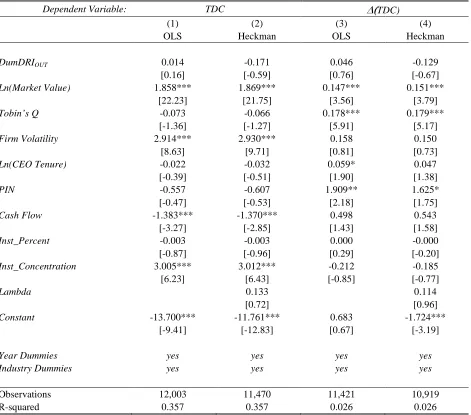
Inconsistent with this prediction, I find an insignificant relationship between the level of compensation and DRIs. Third, if DRIs have conflicted interests, they are expected to be associated with a lower PPS only when the stock price are heading downward. CEO pay is found to be equally less sensitive to the positive stock return with DRIs on the board. Last, but not the least, DRIs that represent the active suppliers or customers of the firm on the board are likely to face a more severe conflict with shareholders than DRIs from firms with no business ties to the firm. Hence, the effect of directors from customer and supplier firms on PPS should be more negative than otherwise. To test this possibility, I first identify directors that represent customer or supplier firms listed in Compustat segment tapes. I observe that 465 firm-year observations involve a director from either a supplier or a customer firm. These directors do not seem to have
10 I also find that serving on the compensation committee is not necessary for DRIs to communicate their information that has influence on the compensation contract.
11
In unreported regressions, it is also documented that, among firms with DRIs, those in differentiated industries and those with low stock price informativeness are more likely to reduce their use of stock-based pay.
6
a significant effect on PPS. Hence, the negative relationship between DRIs and PPS is, on average, not likely to be explained by a possible conflict between DRIs and shareholders.
The PPS measure described above captures the sensitivity of CEO compensation to the stock price but does not account for the possibility that the CEO is replaced. Therefore, I also test whether DRIs are related to the sensitivity of non-routine CEO turnovers to the stock price in a similar way that they are to PPS. The economic magnitude of the sensitivity of forced CEO turnovers to the recent stock performance is smaller especially for firms with independent or non-co-opted DRIs, consistent with earlier findings. However, this effect is statistically insignificant in many cases. This implies that boards with DRIs act more consistently with the stock market at the stage where the stock price signals the need for forcefully replacing the incumbent CEO. Finally, I investigate how directors from related industries affect pay for sector performance. Consistent with earlier studies, I confirm that CEOs are paid for sector performance. DRIs, on the other hand, are associated with lower pay for sector performance (PSP). Following Garvey and Milbourn (2006), I also look into the asymmetry of PSP. Consistent with the Information Hypothesis and inconsistent with the Conflict-of-Interests
Hypothesis, DRIs are associated with a lower sensitivity of pay to positive sector performance.
Further support for the Information Hypothesis is provided by the evidence that DRIs impact on
PSP is observed primarily in industries with more research and development (R&D) activities.
This implies that DRIs are effective particularly in environments with potentially greater
industry-related information challenges such as high-R&D industries.1314
In my empirical analysis, it is necessary to account for the possibility that there are factors leading to both the presence of DRIs on the board and lower PPS. To address this concern, I first use the Heckman treatment effects model, where in the first stage, a number of industry and firm characteristics are employed to control for selection of DRIs. Moreover, I employ instrumental variables that are both economically meaningful and also pass the validity
13 In unreported regressions, I also find that the DRIs are associated with lower pay for sector performance only for
firms producing differentiated products. 14
7
and the relevance tests.15 Finally, to control for potential simultaneity biases, PPS and DRI
regressions are estimated simultaneously. The main findings in the paper are robust to all these alternative estimation methods.
Given the arguments and findings in the paper, the question that arises is why all firms do not have DRIs on their board. There are a number of reasons why this might be the case. First of all, the board may fear leakage of strategic information from the firm to interested parties through DRIs. Secondly, there is always the risk of being subject to antitrust scrutiny and lawsuits for having directors from firms in related industries especially when two firms with
common directors are competitors at least in one line of business.16 Finally, assuming that there
is an optimal board size for every firm (e.g., Yermack, 1996; Coles, Daniel, and Naveen, 2008), boards are expected to be highly selective in appointing their members. Only firms with certain characteristics such as producers of differentiated products are likely to benefit from directors with expertise in related product markets more than they would from directors, say, with financial expertise or political connections.
This paper contributes particularly to the literature on incentive contracts: (i) pay-for-performance sensitivity (e.g., Jensen and Murphy, 1990; Yermack, 1995; Guay, 1999; Core and Guay, 1999; Aggarwal and Samwick, 1999a; Prendergast, 2000, 2002; Coles Daniel, and Naveen, 2006); (ii) CEO replacement decisions (e.g., Weisbach, 1988; Parrino, 1997; Huson, Parrino, and Starks, 2001; Kaplan and Minton, 2008; Jenter and Kanaan, 2010); (iii) pay for sector performance (e.g., Bertrand and Mullainathan, 2001; Garvey and Milbourn, 2006; Gopalan Milbourn, and Song, 2010). It introduces an important factor that affects the design of
15 Instrumental variables that I employ are the supply of DRIs within 100 miles of the county of the firm’s headquarters, the average pair-wise correlation of the firm’s industry returns with its supplier and customer industry returns, the number of supply chain industries and the industry median value of the respective DRI measure (calculation excludes the firm itself). There is no a priori reason for any of these variables to be related to stock-based compensation decisions of the firm.
16 The Clayton Antitrust Act of 1914 prohibits interlocking directorates between rival companies. A salient example
for concerns about antitrust scrutiny as well as leakage of information is the case of Google and Apple. Eric Schmidt, CEO of Google, and Arthur Levinson, former CEO of Genentech, were the common directors of the two companies in 2009 when the companies came under antitrust scrutiny. Besides, in response to critics of Mr. Schmidt’s directorship at Apple, Google noted that he recused himself from board meetings when Apple’s board discussed mobile phones – a business line for both companies. The following article on NY Times provides more
8
incentive contracts – presence of directors who can bring sector-related information.17 The
broader contribution is to the literature on the role of directors.18 The primary focus of theoretical
and empirical studies on boards has been on board structure and how it relates to firm value (e.g. Hermalin and Weisbach, 1998; Raheja, 2005; Boone, Field, Karpoff, and Raheja, 2007; Adams and Ferreira, 2007; Harris and Raviv, 2008; Coles, Daniel, and Naveen, 2008; Linck, Netter, and Yang, 2008; Duchin, Matsusaka, and Ozbas, 2010). This paper complements the work of Dass, Kini, Nanda, Onal, and Wang (2011) in that both studies emphasize a novel characteristic of boards—the presence of DRIs—which is driven by the economic needs of the firm. In addition to documenting that DRIs lead to higher firm value, they find that firms with DRIs do not experience a decline in value following a sales shock which implies that their management are better informed about these shocks. This result can be interpreted as a direct evidence of the information role of DRIs.
The board is, in general, assumed to serve a dual role: monitoring and advising. This study contributes to the literature on both fronts. The most related strand of literature studies the interaction between different governance mechanisms. Stock-based compensation can be viewed as a mechanism through which boards can delegate monitoring to investors (e.g. Holmstrom and Tirole, 1993; Garvey and Swan, 2002). Cai, Liu, and Qian (2009) show that firms facing a greater information asymmetry substitute incentive compensation and exposure to the market for corporate control for direct board monitoring. This paper suggests that firms can also appoint directors with informational advantages to allow for more internal monitoring. The analysis on the choice of sector exposure, on the other hand, is related more to the advisory role of
directors.19 Outside directors are commonly assumed to rely heavily on inside directors for
information (e.g., Raheja, 2005; Adams and Ferreira, 2007; Harris and Raviv, 2008). Inside directors, however, have incentive to conceal their private information if they are concerned
17
Edmans and Gabaix (2009) provide a review of recent theoretical papers that propose some real-life complexities as the reason for seemingly low pay-for-performance sensitivities. DRIs can be considered as an additional real-life factor that can explain a lower PPS than would otherwise be required, particularly for firms with certain characteristics such as producers of differentiated products.
18 Hermalin and Weisbach (2003), Becht, Bolton, and Roell (2003) and Adams, Hermalin, and Weisbach (2009)
provide surveys of this literature. 19
9
about retaining their positions in the firm. Hence, unless outside directors are “friendly” or there are other sources of information such as accurate analyst forecasts (Duchin, Matsusaka, and Ozbas, 2010); outside directors are not likely to advise effectively. This paper is an attempt to show that certain types of outside directors are less dependent on inside directors, analysts, or investors for information. Finally, this paper contributes to the literature that links product markets to corporate finance (e.g., Fee and Thomas, 2004; Kale and Shahrur, 2007; Shenoy, 2010). It suggests that greater access to information about product markets affects the design of incentive contracts significantly.
The rest of the paper is organized as follows. In section 2, I lay out the theoretical background and develop hypotheses to be tested. Section 3 describes the data and discusses some of the summary statistics. Empirical analyses and results are provided in Section 4. Finally, section 5 concludes the paper.
2. Theoretical Background and Hypothesis Development
Optimal contracting theory suggests that the agent’s compensation should be linked to an observable performance measure to induce the agent to choose the optimal set of actions from
the principal’s point of view.20 Furthermore, the strength of this link, coined
pay-for-performance sensitivity (PPS), should be based on the level uncertainty in the monitoring
environment faced by the principal (Prendergast, 2000; 2002).21 In certain environments, the
principal can acquire information readily and monitor actions at a low cost. This alleviates the need for performance-based compensation. In uncertain environments, on the other hand, the cost of monitoring (and advising) is likely to exceed the cost of introducing incentives into the agent’s compensation.
Extensions to these arguments can be built on possible information channels available to the board in the context where the board is the principal and the CEO is the agent. The increased amount and quality of information available to the board will enhance its ability to deal with uncertainties. Along these lines, Duchin, Matsusaka, and Ozbas, (2010) take analyst forecasts as a mechanism that expand the information set of directors, while Alam, Chen, Ciccotello, and
20
See e.g. Mirrlees (1976), Shavell (1979), Holmstrom (1979, 1982).
10
Ryan (2010) consider geographical proximity of directors to the firm headquarters as a proxy for having access to sources of soft information. Stock markets, on the other hand, can also constitute an important source of information not only for managers (e.g., Chen, Goldstein, and Jiang, 2007), but also for the board if stock-based compensation is thought of as a means for the board to utilize the information generated in stock markets. Consequently, the board’s reliance on stock-based compensation is expected to be stronger (weaker) when the stock price is more (less) informative (e.g. Holmstrom and Tirole, 1993; Garvey and Swan, 2002; Kang and Liu,
2008; Ferreira, Ferreira, and Raposo, 2011).22
In this study, I examine the impact on stock-based compensation of a mechanism that can lead to informational advantages for the board: having directors with greater involvement in the firm’s operating environment. Specifically, a director who at the same time holds another directorship or an executive position in a related industry, i.e., an upstream (supplier) or downstream (customer) industry, is argued to produce soft information that is useful in monitoring and advising activities of the board. Boards with directors from related industries (DRIs) can, then, substitute its information about product markets for that in stock prices. Hence,
DRIs are expected to be associated with lower stock-based incentives. Furthermore, information
about related industries is more relevant for firms with greater reliance on these industries and for firms with stock prices that contain too much noise. Thus, if there is a negative relationship between DRIs and PPS, it is more likely to be the case for such firms. These arguments lay the ground for the Information Hypothesis and its following implications.
Information Hypothesis:
1. DRIs are associated with a lower sensitivity of CEO pay to the stock price (PPS).
2. DRIs are more negatively related to PPS for firms with tighter economic link to
customer/supplier industries and for firms with lower stock price informativeness
than otherwise.
22
11
Lower PPS can also mean that DRIs are dependent on the incumbent CEO and help him reduce his exposure to stock markets. Some DRIs have trading relationships with the CEO and to protect such relationships, they may provide convincing arguments in support of lower PPS. Other DRIs may also act in the best interest of the CEO with the expectation of future business relationships. Another channel that the CEO can control a DRI is through his influence over that
DRI’s employment opportunities within the supply chain of the firm. Under these scenarios,
DRIs are expected to act as agents of the CEO rather than shareholders and, in particular, help
the CEO extract a compensation contract with a higher level of compensation and lower sensitivity to the stock price. The hypothesis based on these arguments is referred to as the
Conflict-of-Interests Hypothesis.
To test the Conflict-of-Interests Hypothesis, one can investigate the degree of a DRI’s dependence on the CEO and whether that is related to the level of PPS. More specifically, according to the Conflict-of-Interests Hypothesis, DRIs who are under greater CEO control are expected to reduce PPS more than otherwise. Secondly, the CEO can use the help of DRIs to justify a higher level of compensation. Hence, the related implication is that CEOs of firms with
DRIs receive a higher level of compensation. Furthermore, if the CEO, in collaboration with the
DRIs, is able to foresee the direction of the stock price, the Conflict-of-Interests Hypothesis
implies that DRIs should have a more negative effect on PPS when the stock price is heading downward. A final approach that I use to understand the relationship between DRIs and stock-based incentives focuses on DRIs from active customers and suppliers of the firm. This exercise is based on the assumption that directors from supplier or customer firms have stronger incentives to favor the CEO to maintain their business relationship with him. Hence, the
Conflict-of-Interests Hypothesis predicts that DRIs from active suppliers or customers are
associated with a lower PPS than DRIs from firms with no trading relationship with the firm. A summary of the implications of the Conflict-of-Interests Hypothesis that are based on the preceding arguments is as follows.
Conflict-of-Interests Hypothesis:
1. DRIs under CEO control are associated with a lower PPS than independent DRIs.
12
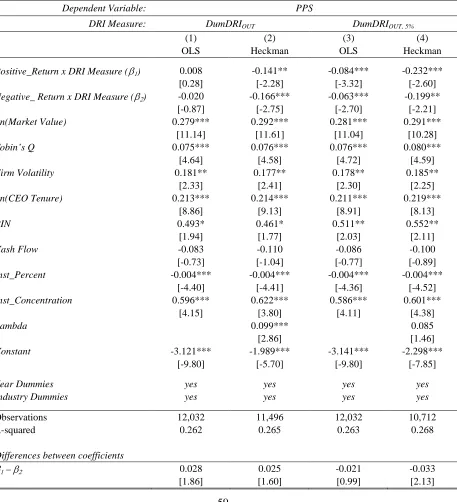
3. DRIs are associated with a higher sensitivity of CEO pay to positive stock returns and
lower sensitivity to negative stock returns.
4. DRIs from active customer or supplier firms of the firm are associated with a lower
PPS than the rest of the DRIs.
The Information Hypothesis, on the other hand, predicts an equally lower sensitivity to positive stock returns. It entails no heterogeneity with respect to PPS based on the independence of DRIs or their business ties with the firm. Finally, it has no implication regarding the level of compensation.
The analysis, thus far, has abstracted away from the possibility that the CEO is replaced by force. The board can, however, also choose to delegate CEO replacement decisions to stock markets to the extent it is uninformed about CEO actions. The empirical implications for the sensitivity of CEO turnovers to stock returns follow directly from the arguments on PPS. A lower sensitivity is expected for both the Information Hypothesis and the Conflict-of-Interests
Hypothesis. Thus, to explain the motivation behind lower sensitivity of CEO turnovers to stock
returns, I derive similar testable implications for each hypothesis. For example, the
Conflict-of-Interests Hypothesis predicts the effect of dependent DRIs on the sensitivity of CEO turnovers to
stock returns to be more negative than that of the independent ones.
13
sector performance. It is important to note that all of these exogenous factors are related to input or output product markets or both, which are argued to be the areas of expertise for DRIs.
Empirical studies on pay for sector performance that followed provide explanations that are consistent with optimal contracting theory. Gopalan, Milbourn, and Song (2010), among
others,23 point to another potential role that DRIs can play. They model and show that CEOs that
have the ability to select the degree of exposure to the firm’s sector are also those who are paid for sector performance. With her pay tied to sector performance, the CEO has the incentive to exert the effort to choose the optimal sector exposure from shareholder’s perspective. In this context, managers and directors can be said to face an information gap with the input and/or output product markets. Assuming that DRIs help bridge that information gap, boards with DRIs are likely to advise and evaluate more effectively the choice of sector exposure. Thus, the extent of pay for sector performance (PSP) is expected to be less with DRIs on the board. Under the
Uncertainty Hypothesis, it is also expected that the relationship between DRIs and PSP be
stronger when the firm’s primary sector involves greater information challenges about its product markets such as high-tech or differentiated industries.
Information Hypothesis:
3. DRIs are associated with less pay for sector performance and this effect is stronger
for firms facing greater information challenges about their primary sector.
Alternative explanations for pay for sector performance have also been suggested. Bertrand and Mullainathan (2001) show that the CEOs that control the board are paid for luck, consistent with the skimming model (Bertrand and Mullainathan, 2000) or the rent extraction hypothesis (Bebchuk, Fried, and Walker, 2002; Bebchuk and Fried, 2003). As pointed out by Garvey and Milbourn (2006), however, this evidence does not necessarily indicate that the CEO has captured the pay-setting process. The link between CEO pay and luck leads not only to a reward for the CEO in a period of sector growth, i.e., when “luck is up”, but also penalizes him
23 Himmelberg and Hubbard (2000), Oyer (2004) and Rajgopal, Shevlin and Zamora (2006) argue that the reason for
14
during sector downturns, i.e., when “luck is down”. Skimming/rent-extraction model is supported only if the CEO pay is at least partly immune to sector downturns, which is indeed what Garvey and Milbourn document.
Gopalan, Milbourn, and Song, on the other hand, reconcile asymmetric benchmarking as well with optimal contracting theory. They suggest that the reason for asymmetry is that CEOs have a greater incentive to avoid wealth losses during sector downturns than they do to gain from good times in the sector. Following Garvey and Milbourn (2006) and Gopalan Milbourn, and Song (2010), I also investigate the asymmetry in sensitivity of CEO pay to sector performance.
According to the Information Hypothesis, boards with DRIs reduce the sensitivity both for
positive and negative sector performance. On the contrary, the Conflict-of-Interests Hypothesis predicts that boards with DRIs reinforce asymmetric benchmarking in favor of the CEO.
Conflict-of-Interests Hypothesis:
5. Boards with DRIs are associated with a lower sensitivity to negative sector
performance and higher sensitivity to positive sector performance.
In general, the purpose of this paper is to investigate directors with more than one position in a given supply chain and whether they are associated with the type of incentive design that is more in line with their potential role to fill information gaps (i.e., the Information
Hypothesis) or with potential conflict of interests with shareholders due to these directors’
business ties with the incumbent CEO (i.e., the Conflict-of-Interests Hypothesis) or both. A summary of all the implications of these non-mutually exclusive hypotheses is presented in Table 1.
3. Data Description
The data on executives and directors are drawn from Compact Disclosure CDs for the period of 1993-2005. This dataset lists all the executives and directors who are employed by
publicly-traded companies identified by ticker symbols.Each executive or director is assigned a
15
Wang (2011). I obtain the primary SIC codes corresponding to each ticker by merging the data from Compact Disclosure with Compustat. Firms with non-positive sales or assets are excluded to eliminate potentially erratic data.
Matching a director’s appointments as an executive or a director with his all other appointments in a given year allows me to identify his industry affiliations that are in the same supply chain. Whenever four-digit SIC codes of a pair of firms that a director is associated with are vertical related, I identify that director as a director from related industries (DRI) for both firms. Vertical relationships between industries are measured using the benchmark input-output (I-O) tables published by the Bureau of Economic Analysis every five years. The board data from 1993 to 1996 are matched with the Use table from 1992 using the concordance table for SIC codes and I-O codes. The data for the periods of 1997-2001 and 2002-2005 are matched with the Use tables from 1997 and 2002 respectively, using the respective concordance tables for NAICS codes and I-O codes. A director is considered to be from related industries if at least one of the other industries that he is affiliated with either uses a significant amount of the output of the firm’s own industry and/or supplies a significant amount of the input of the firm’s own industry.
Formally, for a given pair of industries, industry i and j, suppose that the proportion of the output of industry i used by industry j is a% of the total output of industry i and the proportion of the use of industry j’s output by industry i is b% of the total use of industry i. If the sum of a% and b% is at least 1% (5%), then industry j is identified as vertically related to
industry i at the 1% (5%) threshold. After identifying industries in the same supply chain, I
16
directors of other firms in the firm’s supply chain.24 This measure is scaled by the number of
outside directors on the board. I also construct measures based on inside as well as outside directors from related industries and these measures are scaled by the board size. All measures are constructed for both the 1% and 5% vertical-relatedness thresholds.
The data on directors are matched with the data on CEO compensation from
ExecuComp,25 leading to a sample of 19,616 firm-year observations. Panel A in Table 2 presents descriptive statistics on dummy scores for directors from related industries. The mean gives the percent of firm-year observations with at least one director from related industries defined by the
respective criteria. DumDRIOUT, for example, equals one if the firm has at least one outside
director who is an executive or a director of another firm in its upstream or downstream industries based on the vertical-relatedness threshold of 1%. 56% of firm-year observations
involve directors from related industries fitting this category. DumDRIOUT, 5%, on the other hand,
is based on the vertical-relatedness threshold of 5%. About 24% of firm-year observations involve outside directors from related industries identified using the 5% vertical-relatedness threshold. As the definition of DRIs is broadened, the percent of firm-years with DRIs also increases.
I present statistics on proportional DRI Measures in Panel B. The mean for proportional scores is naturally small because a large number of firm-year observations have boards with no directors from related industries and thereby will have a score of zero for most of the definitions
of DRI. The mean for DRIOUT which is defined as the proportion of outside directors from related
industries based on the 1% vertical-relatedness threshold is 10.7%. For the sample that has
non-zero DRIOUT, however, the mean (median) is 19% (17%). This suggests that for the sample of
firms with DRIs, about two out of ten directors are from related industries. Not surprisingly, the figures for both dummy and proportional DRI Measures are larger than those in Dass, Kini, Nanda, Onal, and Wang (2011), as firms covered in ExecuComp are typically larger than the
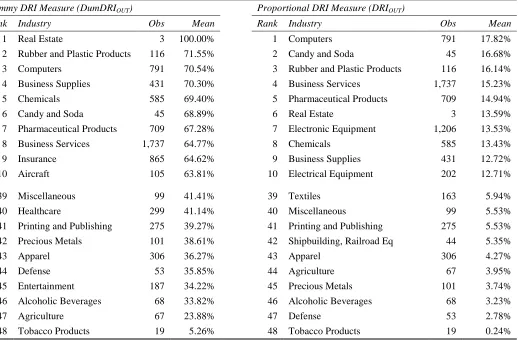
Compact Disclosure universe and, as such, are more likely to appoint DRIs. Table 3 presents the
24 Formally, each director seat in related industries is assigned a score of 0.5 whereas each executive position is assigned a score of 1 because the latter imply greater involvement in the corresponding related industry. These scores are then summed and limited to a maximum of 1 for each director. Finally, the measure for the firm is the sum of the scores assigned to its directors.
17
top and bottom ten industries in the distribution of the dummy and proportional scores for outside directors by 48 Fama-French industry categories (Fama and French, 1997).
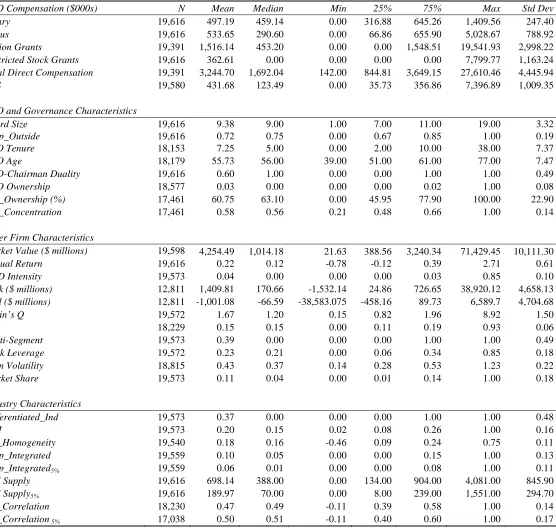
Table 4 lists the descriptive statistics for the variables that are used in the following
empirical analyses.26 All unbounded variables are winsorized at 1% and 99% and all dollar
values are converted into 1992 dollars. Panel A contains information on CEO compensation. Total direct compensation (TDC) and its components are drawn from ExecuComp. Mean (Median) TDC is $3.24 million ($1.69 million). The sensitivity of CEO pay to the stock price,
PPS is defined as the dollar change in CEO wealth for a 1% change in the stock price following
Guay (1999), Core and Guay (1999) and Coles, Daniel, and Naveen (2006).27 Option values are
based on the Black and Scholes (1973) formula modified to account for dividends (Merton, 1973). The sensitivity of previously granted option and share values to the stock price is computed using the approximation method detailed in Core and Guay (2002). The mean (median) PPS is $431,670 ($123,490). Furthermore, for firms with DRIs, both the mean ($458,850) and the median ($136,495) PPS are significantly higher than the mean ($396,812) and the median (107,400) PPS for firms without DRIs. However, to understand the direct relationship between PPS and DRIs, one needs to control for other factors that determine PPS.
Panel B provides summary statistics on a number of CEO and governance characteristics. Board size, proportion of outside directors and CEO-Chairman duality are drawn from Compact
Disclosure. The mean (median) board size is 9.4 (9). The mean (median) proportion of outside
directors is 72% (75%). Occurrences where CEO is also the Chairman constitute about 60% of the dataset. CEO tenure, age and ownership are drawn from ExecuComp. Mean (median) CEO tenure is 7.3 (5) years. CEO Age has a mean (median) of 55.7 (56). The mean (median) percent of shares owned by the CEO is 3.1% (0.4%). Finally, the data on institutional ownership are drawn from CDA/Spectrum. The mean (median) of percent of shares owned by institutions (Inst_Ownership) is 60.8% (63.1%). Finally, Inst_Concentration is the ratio of number of shares owned by top ten institutions to total number of shares owned by all institutions. The fewer the number of institutions that command all institutional ownership is, the more powerful each one
26 Definitions of all variables are provided in Appendix A.
27
18
of them is expected to be as suggested by Hartzell and Starks (2003). The mean (median)
Inst_Concentration is 0.58 (0.56). Other firm characteristics used as control variables are listed
in Panel C. Market Value, i.e., market value of equity, has a mean (median) of about $4.3 ($1) billion. Annual percentage return (after dividends reinvested) has a mean (median) of 22% (12%). R&D Intensity defined as the ratio of R&D expenditures to total assets captures the innovativeness of the firm and has a mean of 4%. Luck and Skill are estimated following Garvey and Milbourn (2006). Luck (Skill) is defined as the market value of the firm at the beginning of the year multiplied by the predicted value (residual) from the regression of firm stock returns on the equal-weighted and value-weighted industry returns and year effects. Luck has a mean (median) of about $1.4 ($0.17) billion, while Skill has a mean (median) of about $1 ($0.07) billion. Tobin’s Q is used as a proxy for growth opportunities and has a mean (median) of 1.67 (1.2). PIN is the yearly mean of the quarterly estimates of probability of informed trading used in Brown, Hillegeist, and Lo (2004) and estimated based on the market microstructure model of
Easley, Kiefer, and O’hara (1997).28 Both mean and median PIN is about 0.15. Multi-Segment is
a dummy variable that equals one if the firm is multi-divisional. Its mean is 0.39. Firm Volatility is the standard deviation of monthly stock returns over the past five years. The mean (median) firm volatility is 0.43 (0.37). Market share is based on sales and has a mean (median) of 11% (4%). Book leverage has a mean (median) of 23% (21%).
Among industry characteristics, differentiated industries (Differentiated_Ind) are
identified based on Rauch’s (1999) classification except that the four-digit SIC industries that are not included in his dataset are assigned the classification of their respective three-digit SIC industries. Three-digit SIC industries, on the other hand, are classified as differentiated (non-differentiated) if at least one (none) of the four-digit SIC industries with the same three-digit SIC code is differentiated. Based on this modified definition, 37% of the sample involves a differentiated industry. Industry concentration is captured by the sale-based Herfindahl-Hirshman Index (HHI). The mean (median) HHI is 20% (15%). Industry homogeneity is estimated following Parrino (1997). Specifically, the partial correlation of each firm’s stock returns with its four-digit SIC industry returns is calculated and averaged across all the firms in
28
19
that industry. The mean (median) industry homogeneity is 18% (16%). Proportion of vertically-integrated firms in the industry, Prop_Integrated has a mean (median) of 10% (5%) at the 1% relatedness threshold. Supply of potential DRIs is based on the sample of all directors and executives in Compact Disclosure. DRI Supply is the number of all directors and executives of firms that are in the firm’s supply chain and headquarters of which are located within a radius of 100 miles of the firm’s headquarter. It has a mean (median) of 698 (388) at the 1%
vertical-relatedness threshold and 190 (70) at the 5% vertical-relatedness threshold. Average pair-wise
correlation between a given industry and its related industries has a mean (median) of 47% (50%) at the 1% (5%) vertical-relatedness threshold.
4. Empirical Analysis
In this section, I provide a thorough empirical analysis of the relationship between directors from related industries and incentive contracts for CEOs. I study particularly three incentive mechanisms: sensitivity of CEO pay to the stock price (PPS), sensitivity of forced CEO turnovers to stock returns and sensitivity of CEO pay to sector performance (PSP). CEO pay is argued to be tied to the stock price to the extent the board lacks the information and ability to evaluate and guide CEO actions. The sensitivity of CEO replacements to stock returns is also likely to be designed in a similar fashion. Pay for sector performance, on the other hand, arises due to the need to give the CEO incentive to overcome the informational challenges or gaps in the choice of exposure to the primary sector of the firm.
If DRIs have advantage in acquiring information, they can help bridge the information gaps that the board and the CEO are facing. This, in turn, implies that PPS and PSP will be utilized to a lesser extent in the presence of DRIs. However, it is possible that common factors drive the need for DRIs as well as the degree of use of stock-based incentive mechanisms. I employ the Heckman treatment effects model to account for this endogeneity problem. Specifically, I use a model of the determinants of DRI appointments in the first stage and, how
DRIs affect stock-based compensation or replacements in the second stage. I also use the
20
a firm’s decision to have DRIs on its board. The following section discusses the determinants of
DRI appointments.
4.1. Determinants of Directors from Related Industries
Under what circumstances, do firms appoint a director from a related industry? In this
section, I address this question by drawing on the economic factors employed by Dass et al. (2011) that are likely to influence a firm’s decision to appoint a director from related industries.
DRIs are argued to help bridge the information gap with supplier and customer industries and the
gap for firms in innovative industries is expected to be deeper. Therefore, a positive relationship between the degree of innovativeness in the firm/industry and the likelihood of appointing DRIs is predicted. Innovativeness is a multidimensional concept and can be measured by a number of different variables. Investment in research and development (R&D Intensity) is perhaps the most obvious measure of innovativeness. In addition, the productivity of R&D activity that can be captured by the number of patents and citations received on those patents can also be considered as a dimension of innovativeness. Furthermore, it is crucial for firms in industries that produce differentiated products à la Rauch (1999) to anticipate industry conditions and take measures to ensure the success of their businesses. On the contrary, firms in homogeneous industries are less likely to experience significant changes in demand or supply conditions. Overall, I predict the
likelihood of having DRIs on board to be positively related to proxies for innovativeness – i.e.,
R&D intensity, the number of patents and citations, and being in differentiated industries, and
negatively related to Parrino’s (1997) measure of industry homogeneity (Ind_Homogeneity).
The need for DRIs is likely to be less if alternative sources of information such as informative stock prices are available. To test this possibility, I employ two measures of the quality of information contained in stock prices: probability of informed trading (PIN) (e.g., Brown, Hillegeist, and Lo, 2004) and price non-synchronicity (e.g., Chen, Goldstein, and Jiang, 2008). The information that DRIs can bring is expected to be more relevant when the firm’s own industry follows its supplier or customer industries closely in economic upturns and downturns. Thus, I construct the average pair-wise correlation between the firm’s own industry and its
supplier and customer industries (Ind_Correlation) and expect it to increase the likelihood of
21
expected to affect the appointments of DRIs. Larger and multidivisional firms, firms with higher market share and firms in concentrated industries (low HHI) are likely to be the firms that need and appoint DRIs. Managers of larger and multidivisional firms are expected to face greater information challenges and, thus, can benefit more from DRIs. Firms with lower leverage are less likely to experience financial distress and offer safer director seats to DRIs. Firms with higher market share and those in concentrated industries are more concerned about maintaining their market power. Therefore, they need to follow developments in their related product markets more closely and having DRIs on the board is one way to facilitate that.
Appointing a DRI is not the only way to have access to information about supplier or customer industries. Vertical integration is possibly a better but more costly way. The propensity of vertical integration in an industry can be viewed as an indicator of the need for bridging information gaps with supplier or customer industries in that industry. To account for this possibility, I include the proportion of integrated firms in the industry (Prop_Integrated) as a determinant of DRIs. Other variables that are expected to affect the likelihood of DRI appointments are the supply of potential directors from related industries, board characteristics such as board size, CEO-Chairman duality and the proportion of outside directors
(Prop_Outside). Putting all these explanatory variables for DRI appointments together leads to
the following specification:
DRI Measureit =β0 + β1 Innovativenessi(k)t + β2 PINit + β3 Ind_Corrkt +
β4 Ind_Homogeneitykt+β5 Market Shareit + β6 HHIkt + β7Prop_Integkt +
β8Ln(MarketValueit ) + β9Multi-Segmentit + β10 Book Leverageit +
β11CEO-Chairman Dualityit + β12 Ln(Board_Size)it + β13 Prop_Outsideit+
β14 Ln(DRI Supply)kt + Year Dummies + εit (1)
The subscripts in Specification (1) and those in the following sections refer to firm i,
industry k and year t.DRI Measure is either the dummy variable that equals one in the presence
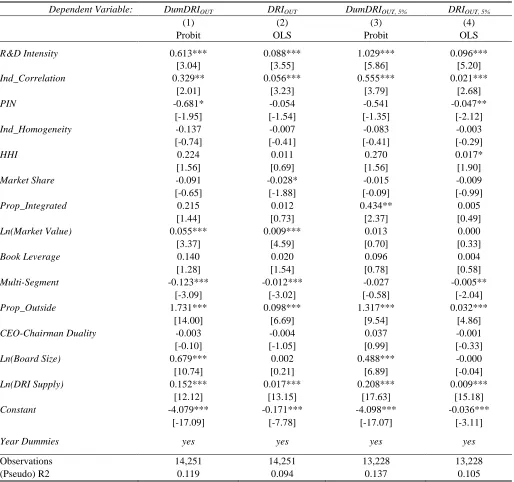
22
in Table 5. All columns use R&D Intensity as the measure of innovativeness but results are similar with the other measures such as number of patents granted to the firm. Most of the coefficient estimates have the predicted signs and several of them are statistically significant. The coefficients on R&D Intensity, Ind_Correlation, HHI and Ln(Market Value) are significantly positive, while the coefficient on PIN is significantly negative.
The impact of these variables on the DRI Measure is also economically significant. To describe a few, in Column (1), for a one standard deviation increase in R&D Intensity, Ln(Market
Value) and Ln(DRI Supply) around their mean, the probability of having a DRI increases by
about 2.57%, 3.36% and 9.66% respectively. A one standard deviation increase in PIN around its mean is associated with a 1.58% decrease in the probability of having a DRI. Only the coefficient on Multi-Segment does not have the predicted sign and is statistically significant. The possible explanation which follows from Gopalan, Milbourn, and Song (2010) is that multi-segment firms have more flexibility to move their investment out of the current primary industry. Hence, a multi-segment firm needs a DRI who is associated with its current primary industry less than a single-segment firm which does not have the flexibility to move out of its current industry at least in the short term. Consistent with this explanation, in unreported results, I observe that the DRI Measures based on all the segments of the firm are significantly positively related to being a multi-segment firm. Having described the conceptual model for DRI appointments, I now turn to the question of how DRIs influence the design of incentive contracts.
4.2. Sensitivity of CEO Pay to the Stock Price (PPS)
23
on the percentage change in the stock price is more relevant. Thus, the way PPS is measured is
chosen accordingly to account for the likelihood that DRIs’ role pertains to strategic decisions.29
The specification used to examine the relationship between PPS and directors from related industries (DRIs) is as follows:
PPSit = β0 +β1DRI Measureit + β2 Ln(Market Valueit ) + β3 Tobin’s Qit +
β4 Firm Volatilityit+β5 Ln(CEO Tenure)it + β6 Cash Flowit +
β7 PINit + β8 Inst_Holdingit + β9 Inst_Concentrationιt +
Year and Industry Dummies + εIt (2)
DRI Measure is the main explanatory variable and stands for either the dummy variable
that equals one if the firm has at least one DRI on its board or the proportion DRIs on the
board.30 The Information Hypothesis predicts that the coefficient of DRI Measure is negative and
significant. Sample selection criteria and control variables follow Core and Guay (1999) with additions of some variables that have been shown to affect PPS. Firm size has commonly been used as a control for CEO talent, difficulty of monitoring and CEO wealth (e.g., Demsetz and Lehn, 1985; Smith and Watts, 1992; Himmelberg, Hubbard, and Palia, 1999; Baker and Hall,
2004).31 Hence, it is predicted to be positively related to PPS. I use the natural logarithm of
market value of equity as a proxy for firm size.32 Tobin’s Q is employed to control for growth
opportunities which can be regarded as another proxy for the difficulty of monitoring actions (e.g., Smith and Watts, 1992). Firm Volatility is used as a proxy for the uncertainty in the environment and thus is expected to be positively related to PPS (e.g., Demsetz and Lehn, 1985; Core and Guay, 1999). CEO Tenure is used as a proxy for CEO wealth and risk aversion (e.g., Guay, 1999). It also controls for potential horizon problems (Dechow and Sloan, 1991), weaker career (Gibbons and Murphy, 1992) or reputational concerns (Milbourn, 2003) that arise as CEOs approach retirement. CEO tenure has also been used as a measure of CEO entrenchment (e.g., Harford and Li, 2007). I control for the need for higher incentives due to the free cash flow
29 Similar results are obtained using the alternative measure of PPS.
30 It is chosen to be contemporaneous with PPS to capture how incentives are set for the period that a DRI is on the
board. However, taking one-year lag of DRI Measures relative toPPS yields similar results.
31
CEO wealth captures CEO risk aversion. Wealthier CEOs are projected to be less risk averse. 32
24
problem (e.g., Jensen, 1986; Himmelberg, Hubbard, and Palia, 1999) by including Cash Flow which is measured as the sum of income before extraordinary items, depreciation and amortization scaled by total assets. Following Hartzell and Starks (2003) and Kang and Liu (2008), I control for the impact of institutional investors on PPS using two variables: percent of shares held by institutions and the concentration of institutional ownership. To the extent that it reduces liquidity, institutional ownership is likely to mitigate informativeness of stock prices and, as such, is expected to reduce PPS (Holmstrom and Tirole, 1993). Consistent with this prediction, Kang and Liu (2008) find a negative relationship between institutional ownership and
PPS. The concentration of institutional ownership, on the other hand, is expected to capture the
influence of institutions on incentive design. Kang and Liu also document a strong positive relationship between stock price informativeness and PPS. Therefore, I include PIN in all PPS regressions to control for stock price informativeness. In all specifications, I include year and
Fama-French industry dummies (Fama and French, 1997).33 I exclude finance and utility firms as
boards of these firms may not have full control over the pay-setting process. Reported t-statistics are robust and account for clusters at the firm level. Heckman t-statistics are based on 100 bootstrap replications.
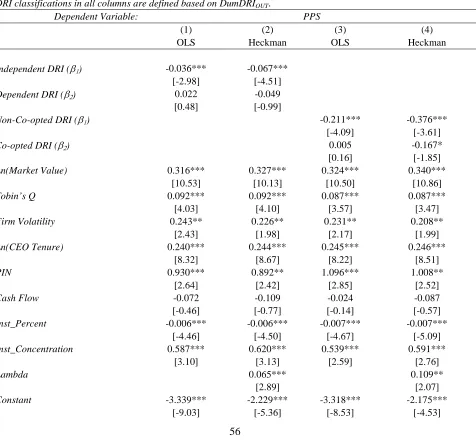
The results from the estimation of Specification (2) are presented in Table 6. In Panel A,
DRI Measures in Columns (1) – (4) are dummy variables that equal one if at least one of the
outside directors of the firm is from a related industry. The scores in Columns (5) – (8) are the respective proportional scores. In Columns (1), (2), (5) and (6), related industries are identified using the vertical-relatedness threshold of 1%, whereas in Columns (3), (4), (7) and (8) they are identified using the 5% vertical-relatedness threshold. Columns (1), (3), (5) and (7) contain the OLS results. Except for Column (1), the coefficient on DRI Measure is significantly related to
PPS in all columns. In Columns (2) and (4), I use the Heckman treatment effects model to
account for potential endogeneity problems. The coefficient of DRI Measure is negative and significant in both columns. Moreover, the effect of DRIs on PPS is economically more significant after controlling for endogeneity. In Columns (2) and (4), the change in CEO wealth for a 1% change in the firm’s stock price is smaller by $155,000 and $227,000, respectively, for