Enhancing Drug-Drug Interaction Classification with
Corpus-level Feature and Classifier Ensemble
Abstract
The study of drug-drug interaction (DDI) is important in the drug discovering. Both PubMed and DrugBank are rich re-sources to retrieve DDI information which is usually represented in plain text. Automatically extracting DDI pairs from text improves the quality of drug discov-ering. In this paper, we presented a study that focuses on the DDI classification. We normalized the drug names, and de-veloped both sentence-level and corpus-level features for DDI classification. A classifier ensemble approach is used for the unbalance DDI labels problem. Our approach achieved an F-score of 65.4% on SemEval 2013 DDI test set. The ex-perimental results also show the effects of proposed corpus-level features in the DDI task.
1
Introduction
Drug-drug interaction (DDI) is a situation that a drug modifies the effect of another drug, and the modified effect may be increased, decreased or new. For examples, if a patient takes two drugs and one increases the effect of another, an overdose may occur. In contrary, an under dosage may occur if the effect is decreased. Fur-thermore, the DDI may also cause the side ef-fects. Therefore, the survey of DDI studies is important for improving the quality of drug dis-covering. Many drug-drug interactions are pub-licly available through PubMed or DrugBank (Law, et al., 2014). However, only a fraction of them is in a structured format such as DrugBank (Law, et al., 2014). Most DDIs are represented in unstructured plane text. Therefore, automatically
* Corresponding author
extracting DDI form these texts is an important issue.
In 2013, SemEval (Segura-Bedmar, et al., 2013) sets this task as the one of its shared task challenge. Extracting DDI consists of two tasks: (1) drug name recognition (DNR) and (2) DDI classification. The named entity recognition (NER) is usually formulated as the sequence la-bel problem and resolved by the Conditional Random Fields model (Campos, et al., 2013; Leaman, et al., 2015). The most important thing is to design and select proper features which cap-ture the boundaries of the named entities. For DNR, several approaches (Björne, et al., 2013; Liu, et al., 2015; Rocktäschel, et al., 2013) have been proposed. For instance, Liu et.al (Liu, et al., 2015) considered selecting DNR features as a feature engineering problem, and their experi-ments combined several features. Their approach achieved an F-score of 79.36% in the DDIEx-traction 2013 dataset (Segura-Bedmar, et al., 2013).
The second task is to classify the drug-drug pair in the sentence into one of advice, effect, mechanism, int (interaction) or negative labels. The advice label indicates that the drug-drug pair is recommended or advised to have the interac-tion. The effect label indicates that the DDI ef-fect is described in the sentence. The mechanism label indicates that the DDI is described about Pharmacology which includes both pharmacody-namics and pharmacokinetics. The int label indi-cates that the physical interaction is stated with-out any other information. The negative label indicates that there is no interaction. For the sec-ond task, several Machine Learning (ML)-based approaches have been proposed. For an example, WBI-DDI (Thomas, et al., 2013) proposed a two-step strategy. They detect general drug-drug in-teractions regardless of subtype using the differ-ent machine-learning methods, and proposed an ensemble voting approach to ensemble these methods. Their approach achieved an F-score of
Jing-Cyun Tu
Yuan-Ze University, Taoyuan, Taiwan
Po-Ting Lai
National Tsing-Hua University, HsinChu, Taiwan [email protected]
Richard Tzong-Han Tsai*
National Central University, Taoyuan, Taiwan [email protected]
60.9%. The ML-based approaches usually suf-fered from bias number of the positive and nega-tive DDI pairs. Only few of them have true inter-actions. To resolve this problem, FBK-irst (Chowdhury and Lavelli, 2013) proposed a mul-ti-phase kernel-based approach. They consider the negative DDI sentence and pair as less in-formative sentence (LLS) and less inin-formative instance (LLI). They design the rules and classi-fier to discard LLS and LLI. They proposed a hybrid kernel approach and several syntactic de-pendent features for DDI detection and classifi-cation. Their approach achieves an F-score of 65% on SemEval DDI 2013 test set (Segura-Bedmar, et al., 2013).
Despise many DDI classification approach-es had been proposed, the approachapproach-es for DDI still can be further improved. For an example, since a drug can be represented in its branded name or generic name, the interaction describe in other sentence could not be directly used in other sentences without linking its different names. Therefore, the features used in current approach-es usually focus on sentence-level and the infor-mation above the target DDI sentences, such as corpus-level features, were not referred. Iyer et.al. (Iyer, et al., 2013) proposed an annotation-based approach to learn DDI from the electronic medical records (EMR). Since the EMR has rich temporal information such as section times, they annotate temporal relationship between the drugs and event and calculate the odds ratio (OR) of the drug-drug pair with events to only one drug with the event. Their experimental results show the effect of odds ratio in learning DDI pairs.
In this paper, we present a study that focus-es on the second task. First, we proposed a ML-based approach which includes the basic words, Part-of-speech, syntactic and template features as our baseline. Second, we deal with the drug vari-ous names and proposed the corpus-level fea-tures by calculating the odds ratios of the drugs matched our automatically generated DDI tem-plate which is inspired by Iyer et.al.’s approach (Iyer, et al., 2013). Third, to tackle the bias labels in DDI corpus, we used a classifier ensemble approach with voting strategy. The experiments are in the SemEval DDI 2013 dataset (Segura-Bedmar, et al., 2013). Our proposed approach achieved an F-score of 65.4%, which outper-forms both WBI-DDI and FBK-irst’s approaches.
2
Method
The proposed DDI classification approach
con-sists of four main steps. The first is Drug Name Normalization, which used RxNorm (Nelson, et al., 2011) to normalize drug synonyms in order calculate odds ratio more accurately. Following is the Odds Ratio step, in which we calculate the odds ratio of drug-drug pair matched DDI tem-plates to only one drug matched. Next, Features for Classification presents the DDI classification features. Lastly, the Classifier Ensemble divides positive and negative training data into equal size, and training five classifiers in the different sets, then used a voting strategy to ensemble classifi-cation results.
2.1
Drug Name NormalizationA drug might be represented as its generic name or branded name in the text. Here we refer them as drug synonyms. To normalize the synonyms can make the calculation of odds ratio more ac-curately. RxNorm is a tool developed by Nation-al Library of Medicine (NIH). It contains the normalized drug names and links them to many drug vocabularies which are commonly used in pharmacy management and drug interaction software. RxNorm can links the drug names be-tween different systems which do not use the same software and vocabulary. Before calculat-ing the odds ratio, we will use RxNorm to nor-malize the drug name d into its generic name g. If the d cannot be normalized to any generic name, then we will use d as its normalized name.
2.2
Odds RatioThe odds is the ratio r of the probability p1 that the event of interest occurs to the probability p2 that it does not occur. This is often estimated by the ratio of the number of times t1 that the event of interest occurs to the number of times t2 that it does not. In this paper, the odds ratio refers to the ratio or of the odds r1 that the drug d1 interacts with the drug d2 to the odds r2 that d1 or d2 interacts with the other drugs. For example, the odds r1 that a drug d1 interacts with the drug d2 is 4 and the odds r2 that d1 or d2 interacts with the other drugs is 2. The odds ratio or of d1 and d2 will be 4/2 = 2. The higher or indicates the higher odds that d1 and d2 have interaction than they interact with the other drugs. While calculating or, whether d1 interacts with d2 is obtained by the DDI templates which we will introduce in section 2.3.2.
2.3
Features for Classification
features. The basic and template features utilized the immediate context of the drugs pair as fea-tures, whereas odds ratio features used the cor-pus-level information.
2.3.1
Basic Features
The basic features comprised words, Part-of-speech (POS) and syntactic features. There are two sets of word features used in our system, each with a different feature label. Inter-Drugs n-grams set includes all word unin-grams and bi-grams located between drugs. If none is present, the feature is given a “NULL” value. Surround-ing Words set includes the two words before the first drug and the two after the second drug. If there are no words before or after both NEs, a “NULL” value is set. All words are treated as bag-of-words. That is, the order of these words is not considered. Similarly, the unigrams of POS tags between drugs are also used as POS fea-tures. We also parse each sentence with a full-sentence syntactic parser (Roark, et al., 2006) to generate its full parse tree. We use the syntactic path through the parse tree from the drug d1 to the drug d2 as a feature.
2.3.2
Template Features
Our template generation (TG) algorithm, which extracts word patterns for drugs pairs using Smith and Waterman's local alignment algorithm (Smith and Waterman, 1981). Firstly, we pair all sentences containing positive relations. The sen-tence pairs are then aligned word-by-word and a pattern satisfying the alignment result is created. Each slot in the template is given by the corre-sponding constraint information expressed in the form of a word (e.g. “associated”). If two aligned sentences have nothing in common for a given slot, the TG algorithm puts a wildcard in the position. The complete TG algorithm is de-scribed with pseudo code in the Algorithm. The similarity function used to compare the similarity of two tokens in local algorithm is defined as:
otherwise
0,
if
, x y y
x
Sim( , ) max 1
where x and y are tokens in sentences si and sj, respectively. The similarity of two sentences is calculated by the local algorithm on the basis of this token-level similarity function.
Template Generation Algorithm INPUT: A set of sentences S = {s1, …, sk}
1:T = {}; 2:forsi in s1 to sk-1
3: forsj in si+1 to sk
4: if the similarity of si and sj above the threshold
5: then generate template t from si and sj
6: T←t ; 7: end; 8:end; 9:returnT
OUTPUT: A set of templates T = {t1, …, tk}
2.3.3
Odds Ratio Features
The odds ratio is the ratio of one odds to
an-other, and it is larger than zero. In our
exper-iment, we use different thresholds as odd
ra-tio features include 1.0, 1.5, 2.0 and 2.5. The
real number of odds ratio is also used as one
of the odds ratio features.
2.4
Classifier Ensemble
The amount of negative DDI pairs is higher than the positive ones in both DDI corpus and real world. The support vector machine model (Chang and Lin, 2011) used in our experiment is suffered from this problem. To tackle this prob-lem, we proposed a classifier ensemble approach to training our classifiers. Firstly, we randomly divide the negative data into five unique subsets, since the ratio of the positive pairs to the nega-tive pairs is approximate 5 in the experimental training corpus. Secondly, we construct five training datasets that each contains all positive data and one negative subset. Thirdly, we train five base classifiers with SVM. Here we use the Gaussian kernel. Once the classifiers are con-structed, new DDI pairs are classified by the classifiers, and their results are aggregated to form the final ensemble decision output. The vote method is used in this paper. Given classifi-ers Ci, i = 1, 2, ... , NC, and DDI labels Lj , j = 1, 2, ... , NL, where NC is the ensemble size and NL is the number of DDI labels. The final aggregat-ed decision is the winning classifier that has the highest votes across all classifiers. If any tie situ-ation existed, the label with the highest predicted value will be assigned.
3
Experiments
training and test set. Here, we first compare the performance achieved by baseline features (basic + template features) to the baseline + odds ratio (OR) features. In Table 2, we can see that OR features improve the baseline’s performance by an F-score 11.9%. Our approach performs better than FBK-irst and WBI-DDI, because our OR features are effective. In Table 3, we list the F-score for each category of DDI. We observe that the F-scores for advice and mechanism are com-paratively high. This is possibly because they have some specific keywords in both categories. However, although effect is the second most fre-quent category, it does not have a high F-score. We think this discrepancy is due to the fact that the descriptions of DDI effects are commonly presented more flexible. Int's performance is comparatively higher than the other two systems since the OR features are effective while the training set is very small.
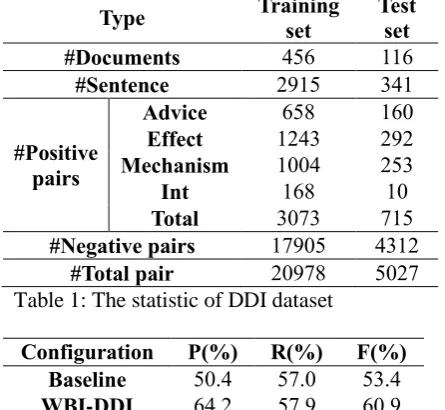
Type Training
set
Test set
#Documents 456 116
#Sentence 2915 341
#Positive pairs
Advice 658 160
Effect 1243 292
Mechanism 1004 253
Int 168 10
Total 3073 715
#Negative pairs 17905 4312
[image:4.595.64.287.341.546.2]#Total pair 20978 5027
Table 1: The statistic of DDI dataset
Configuration P(%) R(%) F(%)
Baseline 50.4 57.0 53.4
WBI-DDI 64.2 57.9 60.9
FBK-irst 65.0 66.0 65.0
Baseline + OR 64.0 66.7 65.3
Table 2: The DDI classification performances on the test set
Category Baseline
+ OR
FBK-irst
WBI-DDI
Advice 69.5 69.2 63.2
Effect 62.3 62.8 61.0
Mechanism 68.2 67.9 61.8
INT 60.0 54.7 51.0
Overall 65.3 65.0 60.9
Table 3. The F-scores of individual DDI catego-ries on the test set
4
Conclusion
In this paper, we present a classifier ensemble ap-proach for drug-drug interaction classification. We developed the sentence-level features for the clas-sification. To encode corpus-level odds ratio fea-tures, we used the RxNorm to normalize the drug names. Our ensemble classifier achieves an F-score of 65.4% on SemEval 2013 DDI test set. The results underscore the effect of corpus-level features in classifying the drug-drug interaction.
Reference
Björne, J., Kaewphan, S. and Salakoski, T. (2013) UTurku: Drug Named Entity Recognition and Drug-Drug Interaction Extraction Using SVM Classification and
Domain Knowledge. Second Joint
Conference on Lexical and Computational Semantics (*SEM), Volume 2: Proceedings of the Seventh International Workshop on Semantic Evaluation (SemEval 2013). Association for Computational Linguistics, pp. 651-659.
Campos, D., Matos, S. and Oliveira, J.L. (2013) Gimli: open source and high-performance
biomedical name recognition, BMC
Bioinformatics, 14, 54.
Chang, C.-C. and Lin, C.-J. (2011) LIBSVM: A library for support vector machines, ACM Trans. Intell. Syst. Technol., 2, 1-27.
Chowdhury, M.M.F. and Lavelli, A. (2013) FBK-irst : A Multi-Phase Kernel Based Approach for Drug-Drug Interaction Detection and Classification that Exploits Linguistic Information. Second Joint Conference on Lexical and Computational Semantics (*SEM), Volume 2: Proceedings of the Seventh International Workshop on Semantic Evaluation (SemEval 2013). Association for Computational Linguistics, pp. 351-355.
Iyer, S.V., et al. (2013) Learning Signals of Adverse Drug-Drug Interactions from the Unstructured Text of Electronic Health Records, AMIA Summits on Translational Science Proceedings, 2013, 98-98.
Acids Research, 42, D1091-D1097.
Leaman, R., Wei, C.-H. and Lu, Z. (2015) tmChem: a high performance approach for chemical named entity recognition and normalization, Journal of Cheminformatics, 7, S3.
Liu, S., et al. (2015) Feature Engineering for Drug Name Recognition in Biomedical Texts: Feature Conjunction and Feature Selection, Computational and Mathematical Methods in Medicine, 2015, 9.
Nelson, S.J., et al. (2011) Normalized names for clinical drugs: RxNorm at 6 years, Journal of the American Medical Informatics Association : JAMIA, 18, 441-448.
Roark, B., et al. (2006) SParseval: Evaluation metrics for parsing speech, Proc. LREC.
Rocktäschel, T., et al. (2013) WBI-NER: The impact of domain-specific features on the performance of identifying and classifying mentions of drugs. Second Joint Conference on Lexical and Computational Semantics (*SEM), Volume 2: Proceedings of the Seventh International Workshop on Semantic Evaluation (SemEval 2013). Association for Computational Linguistics, pp. 356-363.
Segura-Bedmar, I., Martínez, P. and Herrero Zazo, M. (2013) SemEval-2013 Task 9 : Extraction of Drug-Drug Interactions from Biomedical Texts (DDIExtraction 2013). Second Joint Conference on Lexical and Computational Semantics (*SEM), Volume 2: Proceedings of the Seventh International
Workshop on Semantic Evaluation
(SemEval 2013). Association for
Computational Linguistics, pp. 341-350.
Smith, T.F. and Waterman, M.S. (1981)
Identification of common molecular
subsequences, Journal of Molecular
Biology, 147, 195-197.
Thomas, P., et al. (2013) WBI-DDI: Drug-Drug Interaction Extraction using Majority Voting. Second Joint Conference on Lexical and Computational Semantics (*SEM), Volume 2: Proceedings of the Seventh International Workshop on Semantic