Scope, Time, and Predicate Restriction in Blackfoot using MC-STAG
Dennis Ryan Storoshenko
University of Calgary 2500 University Dr. NW Calgary, AB, Canada, T2R 1H4
Abstract
We use STAG to model the interaction between demonstratives and tense found in Blackfoot (Algonquian). In clauses with no tense or aspect marking, past tense can be encoded through a distal demonstrative on either the internal argu-ment (transitives, unaccusatives) or the ex-ternal argument (unergatives). A fourth class of predicate, semantically transi-tive but syntactically intransitransi-tive with a pseudo-incorporated object, does not al-low either argument to mark tense. Us-ing the scope mechanics described in
Frank and Storoshenko (2012), we first model the unique scope properties of pseudo-incorporation, following on the
Bliss (2013) claim that predicate satu-ration in these cases derives from the
Chung and Ladusaw (2004) operation of predicate restriction, not function appli-cation. Modelling the predicate restric-tion operarestric-tion within a STAG derivarestric-tion is shown to correctly predict the scope facts in a way such that the tense facts are also easily captured.
1 Tense and Demonstratives
In this section, we present the basic tense data, and discuss the challenges it presents for a GB/Minimalism-style analysis before moving on to STAG. Blackfoot is an Algonquian language of Southern Alberta and Montana with a largely polysynthetic morphology. While the language has a range of tense and aspect markers, clauses may appear untensed. As described in Lewis
(2014), untensed predicates may receive an oblig-atory temporal interpretation from a demonstrative
on one of their arguments:1
(1) amo ninaa ispii
DEM.PROXman dance
‘This man is dancing/danced.’ (either tense)
(2) oma ninaa ispii
DEM.DISTman dance
‘That man danced.’
(past only, Lewis 2014 ex19b)
As shown, while the proximal demonstrative does not fix the tense, a distal demonstrative fixes the interpretation in the past. The task of writing a function which could accomplish this is simply a matter of lambda gymnastics:
(3) JFK = λP λs′.P(s′) ∧ DIST(s′) →
s′ < s∗
F, a recursive function of type hhs,ti,hs,tii on the verbal projection inspects its complement for situation variables in the scope of a DIST func-tion (assuming demonstratives to also carry situa-tion variables, seeElbourne(2008)), dictating that such situations be interpreted as prior to the utter-ance times∗. The proposal is not that demonstra-tives themselves carry any temporal interpretation, rather that is built into the verbal projection (and therefore inherently part of the predicate) which interacts with demonstratives in its scope.
The same pattern of past tense following from distal demonstratives has been shown for unac-cusative predicates:
(4) amo ninaa o’too
DEM.PROXman arrive
‘This man arrives/arrived.’(either tense) 1In the interests of space, we will only give the mini-mal morphemic breakdown necessary to illustrate the facts salient to our discussion. Readers are encouraged to consult the sources cited in this paper to appreciate the complexity of the morphology.
(5) oma ninaa o’too
DEM.DISTman arrive
‘That man arrived.’ (past only)
However, in (syntactically) transitive construc-tions, only the internal argument fixes the tense:
(6) oma ninaa si’kataa amo
DEM.DIST man kick.TR DEM.PROX
ninaa man
‘That man kick/kicked this man’ (either tense, Lewis 2014 ex20a)
(7) amo ninaa si’kataa oma
DEM.PROXman kick.TR DEM.DIST
ninaa man
‘This man kicked that man.’ (past only, Lewis 2014 ex20c)
The fact that distal demonstratives do not always trigger a past interpretation is taken as evidence that the demonstratives themselves do not inher-ently carry tense, and that theF operator must be a part of the predicate, with a narrowly defined scope. The challenge therefore lies in locating the position of thisF function on the verbal spine. To account for the transitives and, by extension, unac-cusatives, the scope ofFmust exclude the external argument (specifier ofvP); however the unergative cases show that the specifier of vP can also be in the scope ofF. An additional complication arises when considering a fourth construction, known in the literature as the Animate Intransitive + Object (AI+O) construction:
(8) amo ninaa ooyi mamii
DEM.PROXman eat.INTRfish
‘This man is eating/ate fish.’
(9) oma ninaa ooyi mamii
DEM.DISTman eat.INTRfish
‘That man is eating/ate fish.’
In (8) and (9), the predicates are syntactically in-transitive, lacking the morphological marking of transitives, though they still take two arguments semantically. According to Bliss (2013), the ob-ject (mamii in this case) is pseudo-incorporated into the verbal predicate as an NP, not a full DP. As shown in our data, the subject of this type of intransitive does not fix the tense, while the object by definition has no ability to do so as a bare NP.
Assuming that the relevant function which in-spects demonstratives is contributed by some functional head on the verbal spine, it would need to be in a flexible position, sometimes above vP (unergatives) and sometimes below vP (all oth-ers). This would also imply that in the case of a transitive, the function would not even scope over a fully-saturated predicate, surely an unde-sirable state of affairs if we want to assume a sin-gle operator is responsible for this phenomenon. To solve this, one could adopt a Kratzer(1996 )-inspired deconstruction of predicates, in which ex-ternal arguments are introduced to a fully satu-rated predicate through event identification. Tak-ing this step, and then definTak-ing the position of F as the first opportunity to merge a function of the semantic type hhs,ti,hs,tii would again correctly capture the subjects of unaccusatives, objects of transitives, and correctly exclude the subject of the AI+O construction saturated by object incorpora-tion, but would miss the unergatives, as the neces-sary condition for applying theF function would be met before event identification ever took place. The only solution would be to then add a syntactic constraint in the form of some uninterpretable fea-ture requiring the functional head to have at least one nominal (NP or DP) in its scope. While such a move is possible, the necessary syntactic feature is not a natural one in the framework, and the notion of merging a functional head as soon as seman-tically possible in a derivation, regardless of the syntactic form of the object derived to that point, goes against most notions of functional cartogra-phies. However, the clear judgement particularly in the case of the intransitive subject of AI+O not triggering a past tense interpretation strongly sug-gests that there is some interplay with the mechan-ics of argument saturation underlying this phe-nomenon, and that it should not be downplayed as a spatial metaphor residing in the pragmatics. This paper argues that implementing an STAG analy-sis of the Blackfoot clause provides a more natural way to characterize the position ofF.
as independent motivation for the STAG account of these predicates which will in turn more easily capture the tense data.
2 Blackfoot Scope
Quantification in Blackfoot can be expressed via a verbal suffix, which is able to associate with either the subject or the object of a transitive predicate:
(10) nit-ohkana-ohpommatoop-innaan-1ST-all-buy.TR-1PL
-iaawa
PL.OBJ
‘We all bought them.’ or ‘We bought all of them.’
(Weber & Matthewson 2013 ex10)
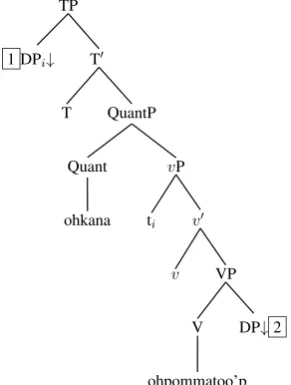
Following the Constraint on Elementary Tree Min-imality defined in Frank (2002), we treat these quantifiers as being part of the verb’s elementary tree. This is shown in Figure1. The only elements of the morphology we take to be part of the verb’s elementary tree here are the quantification and the verb root itself including morphological marking of valence. The argument positions are DP substi-tution sites, and the additional agreement affixes arise as a result of the arguments which substitute in, both ϕ-feature valued instances of pro in the case of (10). A discussion of how this agreement is manifested in an STAG context is orthogonal to the present discussion. However, it is worth noting that the universal quantification can also combine with full DPs:
(11) ´om-iksi aak´ı´ıkoan-iksi
DEM.DIST-PLgirl-PL
ik-ohkana-issta-yi-aawa...
DEG-all-want.INTR-3PL-PL.OBJ ...
‘Those girls all want...’
(Weber & Matthewson 2013 ex13)
So, while these argument positions may be oc-cupied by pro or by overt DPs with determiners, they take on a complex meaning incorporating the meaning of the quantifier that originates in the ver-bal predicate.
Extending further to theFrank and Storoshenko
(2012) treatment of scope, wherein the semantic form of a predicate in STAG is broken into a pred-icate part and a scope part, we place this quantifier in the scope part. Whereas traditional STAG anal-yses of scope ambiguity make use of an undeter-mined order of operations leading to two distinct
TP
1 DPi↓ T′
T QuantP
Quant
ohkana
vP
ti v′
v VP
V
[image:3.595.344.490.63.256.2]ohpommatoo’p DP↓2
Figure 1: Basic syntactic tree for the predicate in (10)
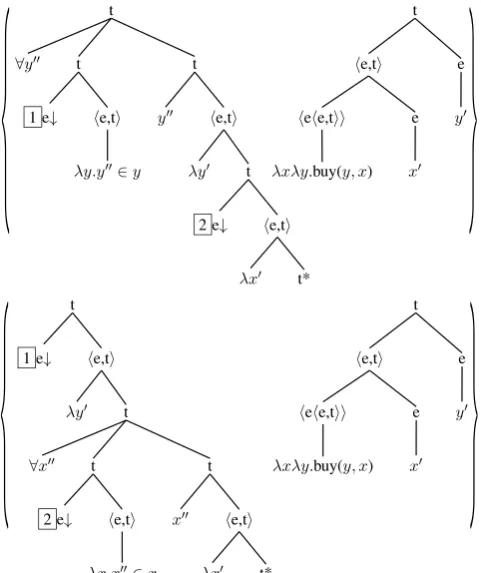
derivations (Schabes and Shieber,1994), here we claim that the Blackfoot facts must be captured by two different semantic elementary tree sets for the verbal predicate, shown in Figure22. Though
not strictly necessary for the example in (10) with pronominal arguments, the form presented here is robust enough to accommodate interaction be-tween predicate modifying affixes and DPs with determiners, yielding complex expressions such as
all the men. For the moment, we assume that
defi-nite and demonstrative DPs in this language are of typehei, consisting of definite descriptions closed
using the iota operator:
(12) Jthe manK=ιx.man(x)
We further assume that forms such as (12) are not specified for number; following Link(1983), the uniquexvariable here may also denote a plurality of entities. Following the quantification presented in Figure2, the semantic content of the argument DP substitutes into the restrictor of the quanti-fier, rather than directly into an argument position. This restrictor contains a simple set membership function, in this case defining all entities that be-long to the set defined by the plurality which sub-stitutes in.
Having established the basic mechanics of the verbal quantification, we move on to the
∀y′′ t
1 e↓ he,ti
λy.y′′∈y t
y′′ he,ti
λy′ t
2 e↓ he,ti
λx′ t*
t
he,ti
hehe,tii
λxλy.buy(y, x) e
x′ e
y′
t1 e↓ he,ti
λy′ t
∀x′′ t
2 e↓ he,ti
λx.x′′∈x t
x′′ he,ti
λx′ t*
t
he,ti
hehe,tii
λxλy.buy(y, x)
e
x′
e
y′
[image:4.595.179.420.60.347.2]Figure 2: Semantic tree sets for the predicate in (10)
tion with quantified DPs and the AI+O construc-tion. In the following examples, the verbal
pre-fix iihkana (a phonological variant of the prefix
in (10)) denotes universal quantification, now in-teracting with another quantified DP in the same clause:
(13) iihkana-inoyiiya anniskey piita all-see.TR one certain eagle
‘They all saw this one eagle’ 1>∀, *∀>1
(Weber & Matthewson 2013 ex21) (14) iihkana-yaapiiya piita
all-see.INTR eagle
‘They all saw a different eagle’ *1>∀,∀>1
(Weber & Matthewson 2013 ex26)
Weber and Matthewson (2013) note that in exam-ples such as (13), a transitive clause with a quanti-fied object DP, the DP quantifier obligatorily takes wide scope over the verbal prefix quantifier, which in turn associates with the subject. That the ob-jects obligatorily outscope the verb-affixed tifiers means that in such cases, the affixed quan-tifier must associate with the subject. In other words, only the upper MCS configuration in Fig-ure 2 is available. We propose that this may be the
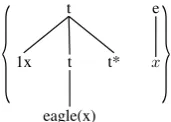
result of a semantic well-formedness constraint. While the affixal quantifiers may associate with DPs bearing simple determiners or demonstratives (i.e. objects of typehei), the available data show no examples of the affixal quantifier associating with an independently quantified DP. Such quan-tified DPs, we assume, combine using the typi-cal two-tree semantic multi-component set (MCS) consisting of a type hei variable substituting at
the argument site and a hti-recursive scope tree which must adjoin high enough to bind the vari-able. This would be the familiar type of quantifi-cational MCS as in Figure3. A constraint against “overloading” an argument with two quantifiers, essentially preventing a quantified DP from com-bining into an argument position already part of a verb’s quantifier, would block a derivation for (13) using the lower MCS in Figure 2 and creat-ing a clash between the verbal suffix universal and the DP’s specific numeral in this case. From here, we turn to the type-shifting operation defined in
Storoshenko and Frank (2012) and applying it to the scope tree in the upper MCS, targeting the root node as the adjoining site for the DP’s scope, al-lowing the specific ‘one’ to scope wide3The
eagle(x) t*
e
x
[image:5.595.138.224.61.122.2]Figure 3: Semantic tree set for DP quantifier as in (13)
ject, again a pronoun, associates with the verbal quantifier by way of set membership. Note this
is contra Weber and Matthewson who derive the
wide scope of the object through a choice func-tion.
In the AI+O case (14), they find that the in-corporated singular object obligatorily takes nar-row scope, yielding only an interpretation where each person sees a different eagle. Translated into STAG, this means that the object is not compos-ing with the scope tree of the predicate in the same way as a quantified object. Following Bliss (and Weber and Matthewson for this example), the semantic operation is Predicate Restriction (PR). As defined by Chung and Ladusaw(2004), PR is an alternative to Function Application (FA) as a means of saturating the argument position of a given predicate. PR is a two step process: first the argument is taken to be of type he,ti, and acts as
a restrictor on the targeted argument position in-side the predicate. Then, existential closure binds the argument position. In an STAG context, this will of course be a single operation, a compos-tion of the predicate’s MCS with the tree set of the incorporated argument. The key distinction will be that such pseudo-incorporated arguments will have unique tree sets, shown in Figure 4. Again, as with a standard GQ, there is a variable portion of typeheiwhich will substitute into the relevant
argument position of a predicate’s scope tree. The difference here is that the recursive “scope part” of the MCS is not recursive onhti, but rather onhe,ti.
The function from he,ti to he,ti within the auxil-iary tree accomplishes the operations of restriction and closure in one step. The type hei component
is associated with the restricted and existentially-closed variable by way of an identity function. Ad-joining the auxiliary tree into the lowesthe,tinode
of scope tree in the upper (subject universal quan-tifier) MCS in Figure 2, while substituting the type
heivariable into the 2 -linked argument position
2 node in the lower MCS from type shifting.
he,tihe,ti hhe,ti,he,tii
λP λx∃x′′.P(x′′)∧eagle(x′′)∧ID(x, x′′) e
x
[image:5.595.339.495.61.125.2]Figure 4: Semantic tree set for incorporated object (first attempt)
yields the form in (15), composed up to the hti
node immediately dominating 2 in the scope tree.
(15) ∃x′′.see(y′, x′′)∧eagle(x′′)∧ID(x, x′′)
Though inelegant, and leaving thexvariable free but identified with the existentially boundx′′, the method in Figure4allows us to retain the same ba-sic predicate tree sets regardless of the type of ar-gument (DP or incorporated object), and to easily derive the obligatory narrow scope of the object.
An alternative approach would be to take more seriously the syntactic differences between not just the objects in (13) and (14), but also the predicates, which do have different morphology, and assume that the predicate trees will be different as well. For (13), we assume the object to be a full DP, combining into predicate trees similar to those in Figures 1 and 2. However, a predicate taking a pseudo-incorporated object may have a distinct se-mantics, mirroring the fact that on the syntax side it combines with a bare NP rather than a DP. This is the scenario sketched in Figure 5. Here, the scope part of the predicate does not contain an ab-straction over the object position; instead, the ob-ject position 2 , which would be an NP substitu-tion site in the syntax, is now linked to thehe,he,tii
node in the lower predicate part of the semantic tree.
The gain from this method can be seen in Figure
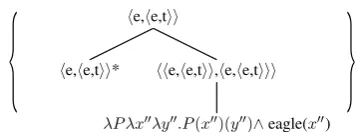
6, where we present the updated semantic trees for the incorporated argument. Here, the only contri-bution of the nominal is to act as a function over the semantically transitive predicate, and incorpo-rate the restriction on the object. The existential closure is already built into the root of the predi-cate’s lower tree, which will necessarily be under the scope of the subject combining into the scope tree for the same predicate. Simplification of the resulting expression yields (16) as the final deno-tation of the lower member of the predicate’s MCS after the incorporated object adjoins.
∀y′′ t
1 e↓ he,ti
λy.y′′∈y t
y′′ he,ti
λy′ t*
t
∃x′ t
he,ti
hehe,tii2
λxλy.see(y, x)
e
x′
e
y′
[image:6.595.179.421.59.178.2]Figure 5: Alternate Predicate for PR (including universal quantifier over subject)
he,he,tiihe,he,tii* hhe,he,tii,he,he,tiii
λP λx′′λy′′.P(x′′)(y′′)∧eagle(x′′)
Figure 6: Alternate semantic tree set for incorpo-rated argument
Avoiding the issue of the unbound variable makes this method preferable, and we will adopt it go-ing forward, but it comes at the apparent cost of proposing a different tree set for the predicate. In-cidentally, this approach also directly encodes the fact that incorporation is uniquely available for ob-jects but not subob-jects, which the prior attempt does not. With the basics of handling different types of arguments and quantification settled, we return to the matter of tense in the next section.
3 Accounting for Tense
To get back on track, recall the formula from (1), repeated below as (17):
(17) JFK = λP λs′.P(s′) ∧ DIST(s′) →
s′ < s∗
What we need to get the temporal interpretation correct is a function which inspects a predicate of typehs,tifrom situations to propositions (truth val-ues), and dictates that if the current situation has been taken as the argument of a DISTal function, then the current situation is in the past relative to the present speech time defined as s∗. As noted earlier, this calls upon a treatment of demonstra-tives described in Elbourne (2008) where situa-tion variables proliferate; one place predicates are of typehhs,ei,hs,tii, arguments normally taken to
be type hei are hs,ei, and so on. Essentially, all entities and propositions are interpreted with re-spect to situations. Having already motivated a
treatment of demonstratives and definite DPs as type hei, the lift to type hs,ei is no great stretch.
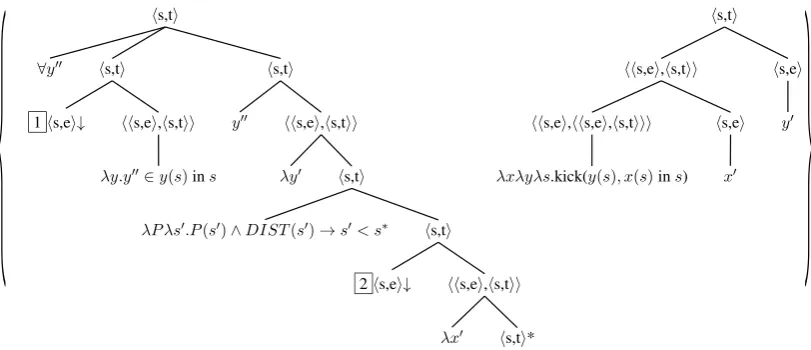
Revised trees, showing only one argument under the universal quantifier for the sake of brevity, are given in Figure7.
For a definite DP, the update is quite simple: (18) Jthe manK=λs.ιx.man(x) ins
Combining this form with our updated univer-sal quantification yields the following (abstracting away from tense and the object position for the time being):
(19) λs∀y′′[y′′ ∈ ιx.[man(x) in s] in s] [kick(y′′, x(s))]
While there is some redundancy, this gives ally′′ who, in the given situation, are part of the plurality defined as being men in the given situation.
The next ingredient of our account for tense will be a form for the distal demonstrative. Again, this is accomplished with a minor simplification of El-bourne’s form, here conflating temporal and world variables into the single typehsifor convenience:
(20) Joma ninaaK = λs.[[[ιx.x is a man in s] =z]∧DIST(z, a, s)]
Following Elbourne, the iota operator defines an x as a man, and then associates that x with an-other variable of the same type (z here). This second variable is passed along as an argument of a second function defined as DIST, here tak-ing three arguments. The first is the associated en-tity, while the third is the given situation in which x’s man-hood is defined. The middle variable a is a contextually-defined indexical, providing the frame of reference for distance. In essence, “z is distant with respect toain the situations”.
[image:6.595.90.271.218.284.2]1hs,ei↓ hhs,ei,hs,tii
λy.y′′∈y(s)ins
hs,ti
y′′ hhs,ei,hs,tii
λy′ hs,ti
λP λs′.P(s′)∧DIST(s′)→s′< s∗ hs,ti
2hs,ei↓ hhs,ei,hs,tii
λx′ hs,ti*
hs,ti
hhs,ei,hs,tii
hhs,ei,hhs,ei,hs,tiii
λxλyλs.kick(y(s), x(s)ins)
hs,ei
x′
hs,ei
y′
[image:7.595.96.502.59.234.2]Figure 7: Semantic tree set for the predicate in (10), updated to situations and including F. For (un-quantified) unergatives and unaccusatives,F appears at the root, still immediately above the lowesths,ei substitution site.
object of typehs,tiin its scope for any DIST func-tions taking the given situation as an argument. The presence of such a function triggers an im-plication that the given situation is in the past rela-tive to the present situation of utterance. Recalling the facts in Section 1, the relevant syntactic po-sitions triggering this implication were the inter-nal argument of transitives, and the sole argument of unergatives and unaccusatives. The latter two are simplest, as while their arguments may have different positions in the syntax, the semantic tree sets for both will have the same basic shape. For these, we need simply to posit that they will have a scope tree similar to that for the AI+O case in Fig-ure 5, and that this function from hs,ti tohs,ti is
generated at the root of the scope tree, being a part of the verb’s semantics. For the syntactically tran-sitive case, we must make an uncomfortable stipu-lation, placing the function immediately above the node marked 2 in Figure7. This will guarantee scope over the substitution position for the object but not the subject.
The crucial step in the derivation of (7), with the distal demonstrative triggering a past tense inter-pretation, comes at the stage whereF takes its ar-gument. Assuming the object ofkickto have been
oma ninaa, the expression would be as in (21):
(21) λs′.kick(y′(s′),ιx.xis a man ins′ =z∧ DIST(z, a, s′))∧DIST(s′) → s′ < s∗
Crucially, the material implication is calculated immediately, such that in this case the statement that the bounds′is temporally prior to the present
s∗is coordinated to the expression for the duration of the final computation. Ifs′ is not the argument of a DIST function at this stage, then F takes no action and is inert for the rest of the interpretation. Turning to the AI+O cases, we capitalize on the conclusion that the best solution to dealing with PR is to say that the semantic elementary trees of the predicates involved are substantially different. It is then not unreasonable to claim that another consequence of this is that the F function is not a part of the Figure 5tree set. This allows us to claim that for the rest, F is built into the pred-icate’s scope tree immediately above the lowest
hs,eisubstitution site during the generation of the
predicate’s elementary tree. Assuming F has a syntactic analogue, the separation of syntax and semantics provided by STAG allows us to define a consistent syntactic position forF which maps to an equally consistent semantic one.
4 Conclusion and Future Work
for this quantification are defined. A quantifier on a transitive predicate may bind either the subject or the object; our solution to this has been to stip-ulate there must be different elementary tree sets for each eventuality. This suggests that there is some room for variability in the mapping between syntax and semantics during the process of ele-mentary tree construction. More work in this area is called for, as the complicated interactions be-tween verbal morphology and argument structure in this language do suggest that a parallel deriva-tional process is also at work before the TAG com-binatory operations begin.
This is reinforced by the second issue, that of Predicate Restriction. The ideal solution seems to be to follow the lead of the verb morphology and again assume that there is a fundamentally differ-ent semantic tree set for what is essdiffer-entially the same predicate. Once this leap is made, the im-plementation of PR is relatively simple, with the two steps split between the two lexical items in-volved: the verb’s semantic MCS provides the ex-istential closure, while the incorporating argument provides the restriction over the argument position by way of a function over the predicate.
The issue of the positioning of the function which determines temporal interpretations from the presence of a demonstrative is where the ben-efits of the STAG approach to semantics shine though. As discussed above, the expanded scope trees adopted in this paper allow not only for the function to be divorced from a given syntactic position, but they allow for a consistent position above a saturated predicate in the scope trees to be defined. The position unifying the subject of unergatives and unaccusatives, along with the ob-ject of transitives is that they are all associated with the lowestλ-abstractor in the scope tree. No such generalization is possible in a mainstream framework. We also now have a principled rea-son for treating the AI+O cases as distinct. The STAG account may feel somewhatad hoc, but it still seems preferable to conceive of this as a func-tion of syntactic elementary tree building interfac-ing with a distinct semantic tree than tryinterfac-ing to read the semantics off the syntactic tree directly.
Lastly, we must point out that beyond the contri-butions of derivational morphology to elementary tree building in both the syntax and the semantics, there is a rather intricate agreement system at work in this language which we have made no effort to
capture. This remains for future work.
Acknowledgments
Thanks go first to the members of the Blackfoot community for sharing their language; unless oth-erwise cited, data in this paper are from fieldwork carried out at the University of Calgary with the support of a Faculty Start-Up Grant. This paper has been improved by the detailed comments of the TAG+ reviewers. All errors are my own.
References
Heather Bliss. 2013. The Blackfoot configurational-ity conspiracy: Parallels and differences in clausal and nominal structures. Ph.D. thesis, University of British Columbia.
Sandra Chung and William Ladusaw. 2004.Restriction and Saturation. Cambridge, MA: MIT Press. Paul Elbourne. 2008. Demonstratives as individual
concepts.Linguistics and Philosophy31:409–466. Robert Frank. 2002. Phrase Structure Composition
and Syntactic Dependencies. Cambridge, MA: MIT Press.
Robert Frank and Dennis Ryan Storoshenko. 2012. The shape of elementary trees and scope possibili-ties in STAG. InProceedings of the 11th Interna-tional Workshop on Tree Adjoining Grammars and Related Formalisms.
Angelika Kratzer. 1996. Severing the external argu-ment from its verb. In Johan Rooryck and Laurie Zaring, editors, Phrase Structure and the Lexicon, Dordrecht: Kluwer Academic Publishers, pages 109–138.
Blake Lewis. 2014. The syntax and semantics of demonstratives: A DP-external approach. In Laura Teddiman, editor, Proceedings of the 2014 An-nual Conference of the Canadian Linguistics Asso-ciation. http://cla-acl.ca/wp-content/uploads/Lewis-2014.pdf.
Godehard Link. 1983. Logical semantics for natural language.Erkenntnis19(1-3):261–283.
Yves Schabes and Stuart M. Shieber. 1994. An alterna-tive conception of tree-adjoining derivation. Com-putational Linguistics20(1):91–124.
Dennis Ryan Storoshenko and Robert Frank. 2012. Deriving syntax-semantics mappings: node linking, type shifting and scope ambiguity. InProceedings of the 11thInternational Workshop on Tree
Adjoin-ing Grammars and Related Formalisms.