Encoder-Decoder Shift-Reduce Syntactic Parsing
Jiangming Liu and Yue Zhang
Singapore University of Technology and Design, 8 Somapah Road, Singapore, 487372
[email protected], yue [email protected]
Abstract
Encoder-decoder neural networks have been used for many NLP tasks, such as neural machine translation. They have also been applied to constituent parsing by using bracketed tree structures as a tar-get language, translating input sentences into syntactic trees. A more commonly used method to linearize syntactic trees is the shift-reduce system, which uses a sequence of transition-actions to build trees. We empirically investigate the effec-tiveness of applying the encoder-decoder network to transition-based parsing. On standard benchmarks, our system gives comparable results to the stack LSTM parser for dependency parsing, and signifi-cantly better results compared to the afore-mentioned parser for constituent parsing, which uses bracketed tree formats.
1 Introduction
Neural networks have achieved the state-of-the-art for parsing under various grammar formalisms, including dependency grammar (Dozat and Man-ning, 2017), constituent grammar (Dyer et al.,
2016) and CCG (Xu et al.,2016). For transition-based parsing, Chen and Manning (2014) em-ployed a feed-forward neural network with cube activation functions for local action modeling, archiving better results compared to MaltParser (Nivre et al.,2007). Subsequent work extend this method by investigating more complex representa-tions of configurarepresenta-tions (Dyer et al.,2015; Balles-teros et al., 2015) and global training with beam search (Zhou et al.,2015;Andor et al.,2016).
Borrowing ideas from neural machine trans-lation (NMT) (Bahdanau et al., 2015), a line of work utilizes a bidirectional RNN to
en-code input sentences, using it for feature extrac-tion, and observing improved performances for both transition-based (Kiperwasser and Goldberg,
2016;Dyer et al.,2016) and graph-based ( Kiper-wasser and Goldberg,2016;Dozat and Manning,
2017) parsers. In particular, using such encoder structure, the graph-based parser of Dozat and Manning (2017) achieves the state-of-the-art re-sults for dependency parsing.
The success of the encoder structure can be attributed to the use of multilayer bidirectional LSTMs to induce non-local representations of sentences. Without manual feature engineering, such architecture automatically extracts complex features for syntactic representation. For neural machine translation, such encoder structure has been connected to a corresponding LSTM de-coder, giving the state-of-the-art for sequence-to-sequence learning. Compared to carefully de-signed feature representations, such as the parser ofChen and Manning(2014) and the stack-LSTM structure of Dyer et al. (2015), the encoder-decoder structure is conceptually simpler, and more general, which can be used across differ-ent grammar formalisms without redesigning the stack representation. Vinyals et al.(2015) applied the encoder-decoder structure to constituent pars-ing, generating the bracketed syntactic trees as the output token sequence without model combina-tion. However, their model achieves relatively low accuracies.
The advantage of using a decoder LSTM is that it leverages a recurrent structure for captur-ing full sequence information in the output. Un-like greedy or CRF decoders (Durrett and Klein,
2015), which capture only local label dependen-cies, LSTM decoder models global label sequence relations. Vinyals et al.(2015) use bracketed syn-tactic trees as the output token sequence, which re-quires strong constraints to ensure that the output
strings correspond to valid dependency trees. On the other hand, a more commonly used sequen-tial representation of syntactic structures is the transition-action sequences in shift reduce parsers. For both constituent (Sagae and Lavie, 2005;
Zhang and Clark, 2009) and dependency (
Ya-mada and Matsumoto, 2003; Nivre, 2003) pars-ing, output syntactic structures can be built using a sequence of inter-dependent shift-reduce actions, which convey incremental structural information.
Motivated by the above, we study the effective-ness of a highly simple encode-decoder structure for shift-reduce parsing. In particular, the encoder is used to represent the input sentence and the de-coder is used to generate a sequence of transi-tion actransi-tions for constructing the syntactic struc-ture. We additionally use the attention over the input sequence (Vinyals et al., 2015), but with a slight modification, taking separate attentions to represent the stack and queue, respectively.
On standard PTB evaluation, our final model achieves 93.1% UAS for dependency parsing, which is comparable to the model of Dyer et al. (2015), and 90.5% on constituent parsing, which is 2.2% higher compared to Vinyals
et al. (2015). We release our source code at
https://github.com/LeonCrashCode/ Encoder-Decoder-Parser.
2 Transition-based parsing
Transition-based parsers scan an input sentence from left to right, incrementally performing a se-quence of transition actions to predict its parse tree. Partially-constructed outputs are maintained using a stack, and the next incoming words are or-dered in a queue. The initial state consists of an empty stack and a queue containing the whole in-put sentence. At each step, a transition action is taken to consume the input and construct the out-put. The process repeats until the input queue is empty and the stack contains only one element, e.g. a ROOT for dependency parsing, and S for constituent parsing and CCG parsing.
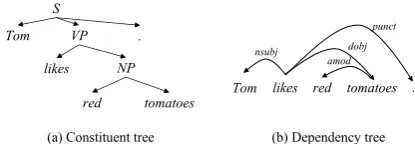
In this paper, we investigate both dependency parsing and constituent parsing, which are shown in Figure 1(a) and (b), respectively. As can be seen in the figure, the two formalisms render syn-tactic structures from different perspectives. Cor-respondingly, the stack structures for transition-based dependency parsing and constituent parsing are different. For dependency parsing, the stack
S VP
NP
red tomatoes likes
Tom
red tomatoes likes
Tom
(a) Constituent tree (b) Dependency tree
.
.
amod
nsubj dobj
punct
Figure 1: Constituent structure and dependency structure of the sentence “Tom likes red tomatoes.”
contains words directly, while for constituent pars-ing, the stack contains constituent nodes, which cover spans of words in a sentence. In addition, the set of transition actions for building dependency and constituent structures are highly different, as shown by the examples in sections 2.1 and 2.2, respectively. Traditional approaches, such as the stack LSTM ofDyer et al.(2015,2016), build dif-ferent representations of the stack for dependency and constituent parsing. In contrast, our method is agnostic to the stack structure, using an encoder-decoder structure to “translate” input sentences to output sequences of shift-reduce actions. To this term, each grammar formalism is reminiscent of a unique foreign language.
2.1 Dependency parsing
We employ the arc-standard transition system (Nivre et al., 2007). Formally, a parsing state is denoted as a tuple(S, Q, L), whereS is the stack
[..., s2, s1, s0], Qis the queue containing coming
words, andLis a set of dependency arcs that have been built. At each step, the parser chooses one of the following actions:
• SHIFT: pop the front word off the queue, and push it onto the stack.
• LEFT-ARC(l): add an arc with label l be-tween the top two trees on the stack (s1 ←
s0)and removes1from the stack.
• RIGHT-ARC(l): add an arc with label l be-tween the top two trees on the stack (s1 →
s0)and removes0from the stack.
The arc-standard parser can be summarized as the deductive system in Figure 2a. For a sentence with size n, parsing stops after performing ex-actly2n−1actions. Given a sentence of Figure
[image:2.595.318.526.65.137.2]Initial State (φ, Q, φ) Final State (s0, φ, L)
Induction Rules: SHIFT ((S,qS|q0|Q,L)
0,Q,L)
LEFT-ARC(L) (S|(sS|s1|s0,Q,L)
0,Q,L∪s1←s0)
RIGHT-ARC(L) (S|(sS|s1|s0,Q,L)
1,Q,L∪s1→s0)
(a) Arc-standard dependency parsing.
Initial State (φ, Q,0) Final State (s0, φ,0)
Induction Rules: SHIFT ((S,qS|q0|Q,n)
0,Q,n)
NT(X) (S|e((S,Q,nx),Q,n)+1)
REDUCE (S(S|e|(ex,s(x)|sj|...|s0,Q,n)
j,...,s0),Q,n−1)
(b) Top-down constituent parsing. Figure 2: Deduction systems
2.2 Constituent parsing
We employ the top-down transition system of
Dyer et al. (2016) for constituent parsing. For-mally, a parsing state is denoted as a tuple
(S, Q, n), where S is the stack [..., s2, s1, s0].
Each element in S can be a open nonterminal1, a completed constituent, or a terminal, Q is the queue, andnis the number of open nonterminals on the stack. At each step, the parser chooses one of the following actions:
• SHIFT: pop the front word off the queue, and push it onto the stack.
• NT(X): open a nonterminal with label X on top of the stack.
• REDUCE: repeatedly pop completed subtrees or terminal symbols from the stack until an open nonterminal is encountered, and then this open NT is popped and used as the la-bel of a new constituent that has the popped subtrees as its children. This new completed
1An open nonterminal in top-down parsing is a
nontermi-nal waiting to be completed
hs2 hs1 hs0
hq2 hq1 hq0
ha0
ha1
softmax a1
a1
xj
xj-1
xj-2
comp xi
a0
stack
queue
action
r
l head
dep
c0 c1 c2
comp
comp head dep e(r)
c0 c1 c2 e(l) dependency
constituent
(a)
(b)
(c)
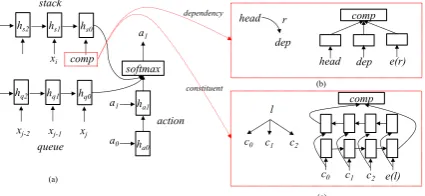
Figure 3: Structure of stack-LSTM with depen-dency and constituent composition, respectively.
constituent is pushed onto the stack as a sin-gle composite item.
The top-down parser can be summarized as the de-ductive system in Figure2b. Given the sentence in Figure1, the sequence of actions NT(S), SHIFT, NT(V P), SHIFT, NT(NP), SHIFT, SHIFT, RE -DUCE, REDUCE, SHIFT, REDUCE, can be used to construct its constituent tree.
2.3 Generalization
Both transition systems above can be treated as examples of a general sequence-to-sequence task. Formally, given a sentence x1, x2, ..., xn where
xi is the ith word in the sentence, the goal is
to generate a corresponding sequence of actions a1, a2, ..., am, which correspond to a syntactic
structure. Other shift-reduce parser systems, such as CCG (Zhang and Clark, 2011a), can be re-garded as instantiation of this.
3 Baseline
We take two baseline neural parsers, namely the parser ofDyer et al. (2015,2016) and the parser of Vinyals et al. (2015). The former is used to study the effect of our formalism-independent rep-resentation, while the latter is used to demon-strate the advantage of transition action sequences over bracketed tree structures for encoder-decoder parsing. We briefly describe the parsers of Dyer et al. (2015, 2016) in this section, and the struc-ture of Vinyals et al. (2015) in Sections 4.1 and 4.2.
[image:3.595.310.523.67.165.2]LSTM is implemented right to left, and the action history LSTM in the first-to-last order. The last hidden states of each LSTM is concatenated and fed to a softmax layer to determine the next action given the current state:
p(act) =softmax(W[hs;hq;ha] +b),
wherehs,hq andhadenote the last hidden states
of the stack LSTM, the queue LSTM and the ac-tion history LSTM, respectively.
The stack-LSTM parser represents states on the stack by task-specific composition functions. We give the composition by using task-specific com-position functions for dependency parsing (Dyer et al., 2015) and constituent parsing (Dyer et al.,
2016) respectively below.
Dependency parsing The composition func-tion models the dependency arc between a head and its dependent (i.e.,head→r dep), when a RE -DUCEaction is applied, as shown in Figure3(b):
comp=tanh(Wcomp[hshead;hsdep;e(r)]+bcomp),
wherehshis the value of the head,hsdis the value of the dependent ande(r) is the arc relation em-bedding. After a LEFT-ARC(r) action is taken, hsh and hsd are removed from the stack-LSTM, and thencompis push onto the stack-LSTM.
Constituent parsing The composition func-tion models the constituent spanning their children (i.e., (l(c2) (c1) (c0))), when a REDUCEaction is
applied, as shown in Figure3(c):
comp=BI-LSTMcomp([hsc2, hsc1, hsc0, e(l)]),
wherehsc2,hsc1 andhsc0 are the value of the
chil-dren on stack, ande(l)is the constituent label em-bedding. After a REDUCE action is taken, hsc2, hsc1 andhsc0 are removed from the stack-LSTM,
and thencompis push onto the stack-LSTM. It is worth noting that the stack contains over-lapping information with the action history. This is because the content of the stack can be inferred when the action history is given. As a result, the stack structure of the parser byDyer et al.(2015) can be regarded as redundant, serving to extract the same source of information as features from a different perspective, given the sequence of ac-tions that have been applied. Our parser models only the action sequence, relying on the model to infer necessary information about the stack auto-matically.
4 Model
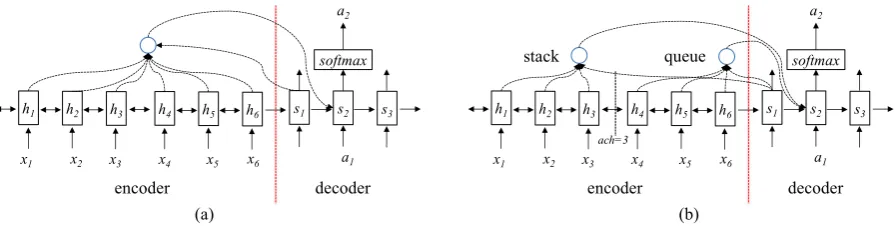
As shown in Figure 4, our model structure con-sists of two main components, namely encoder and decoder. The encoder is a bidirectional re-current neural network, representing information of the input sentence; the decoder is a different re-current neural network, used to output a sequence of transition actions. The encoder can be further divided into a stack and a queue, respectively, for transition-based parsing.
4.1 Encoder
We follow Dyer et al. (2015), representing each word using three different types of em-beddings including pretrained word embedding, ewi, which are not fine-tuned during training of the parser, randomly initialized embeddings ewi, which are fine-tuned, and randomly initialized part-of-speech embeddings epi, which are fine-tuned. The three embeddings are concatenated, and then fed to nonlinear layer to derive the final word embedding:
xi =f(Wenc[epi;ewi;ewi] +benc),
where Wenc and benc are model parameters, wi
andpidenote the form of the POS of theith input
word, respectively, andf is a nonlinear function. In this paper, we use ReLu forf.
The encoder is based on bidirectional peephole connected LSTM (Greff et al.,2016), which takes sequence of the word embeddingsxias input, and
output the sequence of hidden statehi. Bi-LSTM
is adopted in our models:
hi = [hli;hri] =BI-LSTM(xi).
The sequence ofhiis fed to the decoder.
4.2 Vanilla decoder
As shown in Figure4(a), the decoder structure is similar to that of the decoder of neural machine translation. It applies an LSTM to generate se-quences of actions:
sj =g(Wdec[sj−1;eaj−1;hattj] +bdec),
whereWdec andbdec are model parameters,aj−1
is previous action,eaj−1is the embedding ofaj−1,
h1 h2 h3 h4 h5 h6 s1 s2 s3
encoder decoder
stack queue softmax
a2
a1
x2 x5
x1 x3 x4 x6
ach=3 h1 h2 h3 h4 h5 h6 s1 s2 s3
encoder decoder
softmax a2
a1
x2 x5
x1 x3 x4 x6
[image:5.595.77.525.63.176.2](a) (b)
Figure 4: Encoder-decoder structure for parsing. (a) vanilla decoder; (b) Stack-queue decoder, where the stack and the queue are differentiated byach, which is initialized to the beginning of the sentence (ach= 0), meaning the stack is empty and queue contains the whole sentence.
is the current LSTM state, from whichaj is
pre-dicted. hattj is the result of attention over the en-coder statesh1...hnusing thejth decoder state:
hattj =attention(1, n) =
n X
i=1
αihi (1)
where
αi = Pnexp(βi)
k=1exp(βk),
and the weight scores β are calculated by using the previous hidden statesj−1 and corresponding
encoder hidden stateh:
βi =UTtanh(Watt·[hi;sj−1] +batt).
sjis used to predict the current actionaj:
p(aj|sj) =softmax(Wout∗sj+bout)).
HereWatt,batt,Wout,boutare model parameters,
g is a nonlinear activation function. We use the ReLU for g. For the encoder, the initial hidden states are randomly initialized model parameters; For the decoder, the initial LSTM state s0 is the
last the encoder hidden state[hln;hr1].
This vanilla encoder decoder structure is identi-cal to the method ofVinyals et al.(2015). The only difference is that we use shift-reduce action as the output, while Vinyals et al. (2015) use bracketed string of constituent trees as the output.
4.3 Stack-Queue decoder
We extend the vanilla decoder, using two sepa-rate attention models over encoder hidden state to represent the stack and the queue, respectively, as shown in Figure 4(b). In particular, for a given state, the encoder is divided into two segments,
with the left segment (i.e.stack segment) contain-ing words formx1to the word on top of the stack
xt, and the right segment (i.e.queue segment)
con-taining words from the front of the queuext+1 to
xn.
Attention is applied to the stack and the queue segments, respectively. In particular, the represen-tation of the stack segment is:
hlattj =attention(1, t) = t X
i=1
αihi,
and the representation of the queue segment is:
hrattj =attention(t+ 1, n) = n X
i=t+1
αihi,
where the function attention is the same with equation (1). Similar with the vanilla decoder, the hidden unitsjis calculated using:
sj =g(Wdec[sj−1;eaj−1;hlattj;hrattj] +bdec).
Where g is the same nonlinear function as in vanilla decoder.
4.4 Training
Our models are trained to minimize a cross-entropy loss objective with an l2 regularization
term, defined by
L(θ) =−X
i X
j
log paij+ λ
2||θ||2,
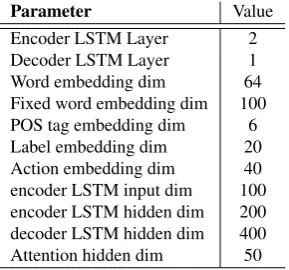
whereθis the set of parameters,paijis the proba-bility of thejth action in theith training example given by the model andλis a regularization hyper-parameter. λ= 10−6. We use stochastic gradient
Parameter Value Encoder LSTM Layer 2 Decoder LSTM Layer 1 Word embedding dim 64 Fixed word embedding dim 100 POS tag embedding dim 6 Label embedding dim 20 Action embedding dim 40 encoder LSTM input dim 100 encoder LSTM hidden dim 200 decoder LSTM hidden dim 400 Attention hidden dim 50
Table 1: Hyper-parameters.
5 Experiments
5.1 Data
We use the standard WSJ sections in PTB ( Mar-cus et al.,1993), where the sections 2-21 are taken for training data, section 22 for development data and section 23 for test for both dependency ing and constituent parsing. For dependency pars-ing, the constituent trees are converted to Stanford dependencies (v3.3.0) using the Stanford parser2. We adopt the pretrained word embeddings gener-ated on the AFP portion of English Gigaword.
5.2 Hyper-parameters
The hyper-parameter values are chosen according to the performance of the model on the develop-ment data for dependency parsing, and final val-ues are shown in Table1. For constituent parsing, we use the same hyper-parameters without further optimization.
5.3 Development experiments
Table2shows the development results on depen-dency parsing. To verify the effectiveness of at-tention, we build a baseline using average pooling instead (SQ decoder + average pooling). We ad-ditionally build a baseline (SQ decoder + treeL-STM) that is aware of stack structures, by using a tree-LSTM (Tai et al.,2015) to derive head node representations when dependency arcs are built. Attention on the stack sector are applied only on words on the stack, but not for their dependents. This representation is analogous to the stack rep-resentation ofDyer et al.(2015) andWatanabe and Sumita(2015).
Results show that the explicit construction of stack does not bring significant improvements
2https://nlp.stanford.edu/software/lex-parser.shtml
Model UAS (%)
Dyer et al.(2015) 92.3
Vanilla decoder 88.5
[image:6.595.110.255.62.197.2]SQ decoder + average pooling 91.9 SQ decoder + attention 92.4 SQ decoder + treeLSTM 92.4
Table 2: Dependency parsing dev results.
10 20 30 40 50 60
88 90 92 94
Sentence length
Dependenc
y
accurac
y
(%)
stack-LSTM SQ decoder
Figure 5: Accuracy against sentence length in bins of size 10, where 20 contains sentences with length [10, 20).
over our stack-agnostic attention model, which confirms our observation in Section 3 that the ac-tion history informaac-tion is sufficient for inferring the stack structure. Our model achieved this goal to some extent. The SQ decoder with average pooling achieves a 3.4% UAS improvement, com-pared to the vanilla decoder (Section 4.2). The SQ decoder with attention achieves a further 0.5% UAS improvement, reaching comparable results to the stack-LSTM parser.
5.4 Comparison to stack-LSTM
We take a range of different perspectives to an-alyze the errors distribution of our parser, com-paring them with stack-LSTM parser (Dyer et al.,
2015). The parsers show different empirical per-formances over these measures.
[image:6.595.310.527.172.295.2]NN IN NNP DT JJ NNS RB CD VBD VB CC TO VBZ VBN PRP 90
95
constituents
recall
(%) stack-LSTM
[image:7.595.83.521.62.153.2]SQ-decoder
Figure 6: Accuracy against part-of-the-speech tags.
2 4 6 8 10 12 14 16
80 85 90 95
Length
Precision
[image:7.595.308.536.203.325.2](%) stack-LSTMSQ-encdec
Figure 7: Arc precision against dependency length. The length is defined as the absolute differ-ence between the indices of the head and modifier.
With stack-queue sensitive attention, SQ decoder implicitly represent the structures.
Figures 6 and 7 show comparison on various POS and dependency lengths, respectively. While the error distributions of the two parsers on the fine-grained metrics are slightly different, with our model being stronger on arcs that take rela-tively more steps to build, the main trends of the two models are consistent, which shows that our model can learn similar information compared to the parser ofDyer et al.(2015), without explicitly modeling stack information. This verifies the use-fulness of the decoder on exploiting action history.
5.5 Contrast withVinyals et al.(2015)
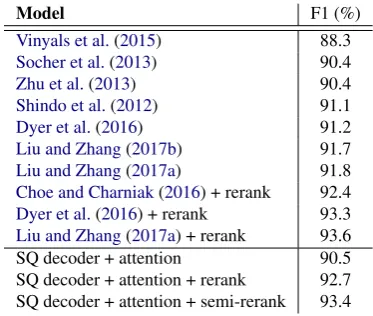
For constituent parsing, our models outperforms the parser ofVinyals et al.(2015) by differentiat-ing stack and queue and generatdifferentiat-ing transition ac-tions instead. This shows the advantage of shift-reduce actions over bracketed syntactic trees as decoder outputs. Using the settings tuned on the dependency development data directly, our model achieves a F1-score of 90.5, which is comparable to the models ofZhu et al.(2013) andSocher et al.
(2013). By using the rerankers ofChoe and Char-niak (2016) under the same settings, we obtain a 92.7 F1-score with fully-supervised reranking and a 93.4 F1-score with semi-supervised reranking.
Model UAS (%) LAS (%) Graph-based
Kiperwasser and Goldberg(2016) 93.0 90.9
Dozat and Manning(2017) 95.7 94.1
Transition-based
Chen and Manning(2014) 91.8 89.6
Dyer et al.(2015) 93.1 90.9
Kiperwasser and Goldberg(2016)† 93.9 91.9
Andor et al.(2016) 92.9 91.0
Andor et al.(2016)* 94.6 92.8
SQ decoder + attention 93.1 90.1
Table 3: Results for dependency parsing, where * use global training,†use dynamic oracle.
5.6 Attention visualization
We visualize the attention values during parsing, as shown in Figure 8. The parser can implicitly extract the structure features by assigning different attention value to the elements on stack. In Figure
8(a), “Jones” on the top of stack and “industrials” on the front of queue dominates the prediction of SHIFTaction. In Figure8(b), “The” on the top of stack and “closed” on the front of queue contribute more to the prediction of LEFT-ARC, which con-structs an left arc from “industrials” to “The” to complete dependency of the word “industrials”. In Figure8(c), “said” on the top of stack determines the prediction of NT(SBAR) for a clause. In Fig-ure 8(d), “of” on the front of queue suggests to complete the noun phrase of “most”. In Figure
8(e), “their major institutional” on top of the stack needs the word “investor” on the front of queue to complete a noun phrase.
Interestingly, these attention values capture in-formation not only from nodes on the stack, but also their dependents, achieving similar effects as the manually defined features of Chen and
Manning (2014) and Kiperwasser and Goldberg
stack
The Dow Jones industrials closed at 2569.26 . queue
Shift
Left-Arc The
Dow Jones
industrials closed at 2569.26 .
…
(a)
(b)
(c) NP
Traders
said most of their major (VP
(S institutional
NT(SBAR)
… said (SBAR (NP of their major institutional
… … most investors
, major institutional
(PP (NP
… of their investors
(d)
Reduce
on the …
Shift
[image:8.595.322.509.61.219.2](e)
Figure 8: Output examples to visualize attention values. The grey scale indicates the value of the attention. (a) (b) are for dependency parsing, and (c) (d) (e) are for constituent parsing.
bottom of the stack can sometimes influence the decision, as shown in Figure8(b). These are worth noting given that our model does not explicitly model the stack structure.
The decoder is used to model sequences of ac-tions globally, and is less influenced by error prop-agation.
5.7 Final results
We compare the final results with previous re-lated work under the fully-supervised setting (ex-cept for pretrained word embeddings), as shown in Table 3 for dependency parsing, and Table 4
for constituent parsing. For dependency parsing, our models achieve comparable UAS to the ma-jority of parsers (Dyer et al., 2015; Kiperwasser and Goldberg,2016;Andor et al.,2016).
6 Related work
LSTM encoder structures have been used in both transition-based and graph-based parsing. Among transition-based parsers, Kiperwasser and Gold-berg (2016) use two-layer encoder to encode in-put sentence, extracting 11 different features from a given state in order to predict the next transition action, showing that the encoder structure lead to significant accuracy improvements over the base-line parser ofChen and Manning(2014). Among graph-based parsers, Dozat and Manning (2017) exploit 4-layer LSTM encoder over the input, us-ing conceptually simple biaffine attention mecha-nism to model dependency arcs over the encoder, resulting in the stat-of-the-art accuracy in
depen-Model F1 (%)
Vinyals et al.(2015) 88.3
Socher et al.(2013) 90.4
Zhu et al.(2013) 90.4
Shindo et al.(2012) 91.1
Dyer et al.(2016) 91.2
Liu and Zhang(2017b) 91.7
Liu and Zhang(2017a) 91.8
Choe and Charniak(2016) + rerank 92.4
Dyer et al.(2016) + rerank 93.3
Liu and Zhang(2017a) + rerank 93.6
SQ decoder + attention 90.5 SQ decoder + attention + rerank 92.7 SQ decoder + attention + semi-rerank 93.4
Table 4: Results for constituent parsing.
dency parsing. Their success forms a strong moti-vation of our work.
Vinyals et al. (2015) can also be understood as building a language model over bracket con-stituent trees. A similar idea is proposed byChoe and Charniak(2016), who directly use LSTMs to model such output forms. The language model is used to rerank candidate trees from a baseline parser, and trained over large automatically pars-ing data uspars-ing tri-trainpars-ing, achievpars-ing a current best results for constituent parsing. Our work is simi-lar in that it can be regarded as a form of language model, over shift-reduce actions rather than brack-eted syntactic trees. Hence, our model can poten-tially be used for under tri-training settings also.
There has also been a strand of work apply-ing global optimization to neural network parsapply-ing.
Zhou et al. (2015) and Andor et al. (2016) ex-tend the parser ofZhang and Clark(2011b), using beam search and early update training. They set a max-likelihood training objective, using proba-bility mass in the beam to approximate partition function of CRF training. Watanabe and Sumita
(2015) study constituent parsing by using a large-margin objective, where the negative example is the expected score of all states in the beam for transition-based parsing. Xu et al. (2016) build CCG parsing models with a training objective of maximizing the expected F1 score of all items in the beam when parsing finishes, under a transition-based system. More relatedly,Wiseman and Rush
[image:8.595.80.294.66.217.2]7 Conclusion
We adopted a simple encoder-decoder neural net-work with slight modification for shift-reduce parsing, regarding the task as translating a sen-tence into a shift-reduce action sequence, achiev-ing comparable results to the current state-of-the-art neural parsers under the same settings. One advantage of our model is that NMT techniques, such as scheduled sampling (Bengio et al.,2015), residual networks (He et al., 2016) and ensemble mechanisms (Luong et al.,2015), can be directly applied.
Acknowledgments
We thank the anonymous reviewers for their de-tailed and constructive comments. Yue Zhang is the corresponding author.
References
Daniel Andor, Chris Alberti, David Weiss, Aliaksei Severyn, Alessandro Presta, Kuzman Ganchev, Slav Petrov, and Michael Collins. 2016. Globally nor-malized transition-based neural networks. InACL.
Dzmitry Bahdanau, Kyunghyun Cho, and Yoshua Ben-gio. 2015. Neural machine translation by jointly learning to align and translate. InICLR.
Miguel Ballesteros, Chris Dyer, and Noah A. Smith. 2015. Improved transition-based parsing by mod-eling characters instead of words with lstms. In
EMNLP.
Samy Bengio, Oriol Vinyals, Navdeep Jaitly, and Noam Shazeer. 2015. Scheduled sampling for se-quence prediction with recurrent neural networks. InAdvances in Neural Information Processing
Sys-tems. pages 1171–1179.
Danqi Chen and Christopher D. Manning. 2014. A fast and accurate de- pendency parser using neural
net-works. InEMNLP.
Do Kook Choe and Eugene Charniak. 2016. Parsing as
language modeling. InEMNLP.
Timothy Dozat and Christopher D. Manning. 2017. Deep biaffine attention for neural dependency
pars-ing. ICLR.
Greg Durrett and Dan Klein. 2015. Neural crf parsing. InACL.
Chris Dyer, Miguel Ballesteros, Wang Ling, Austin Matthews, and Noah A. Smith. 2015. Transition-based dependency parsing with stack long
short-term memory. InACL.
Chris Dyer, Adhiguna Kuncoro, Miguel Ballesteros, and Noah A. Smith. 2016. Recurrent neural network
grammars. InNAACL.
Klaus Greff, Rupesh K. Srivastava, Jan Koutn´ık, Bas R. Steunebrink, and J¨urgen Schmidhuber. 2016. Lstm:
A search space odyssey. IEEE transactions on
neu-ral networks and learning systems.
Kaiming He, Xiangyu Zhang, Shaoqing Ren, and Jian Sun. 2016. Deep residual learning for image
recog-nition. In Proceedings of the IEEE Conference
on Computer Vision and Pattern Recognition. pages 770–778.
Diederik Kingma and Jimmy Ba. 2015. Adam: A method for stochastic optimization. InICLR.
Eliyahu Kiperwasser and Yoav Goldberg. 2016. Sim-ple and accurate dependency parsing using bidirec-tional lstm feature representations. Transactions of the Association for Computational Linguistics.
Jiangming Liu and Yue Zhang. 2017a. In-order
transition-based constituent parsing. arXiv preprint arXiv:1707.05000.
Jiangming Liu and Yue Zhang. 2017b. Shift-Reduce Constituent Parsing with Neural Lookahead
Fea-tures. Transactions of the Association for
Compu-tational Linguistics5:45–58.
Thang Luong, Hieu Pham, and Christopher D. Man-ning. 2015. Effective approaches to attention-based
neural machine translation. InEMNLP.
Mitchell P. Marcus, Beatrice Santorini, and Mary Ann Marcinkiewicz. 1993. Building a Large Annotated
Corpus of English: The Penn Treebank.
Computa-tional Linguistics19(2):313–330.
Joakim Nivre. 2003. An efficient algorithm for projec-tive dependency parsing. InIWPT. Citeseer.
Joakim Nivre, Johan Hall, Jens Nilsson, Atanas Chanev, G¨ulsen Eryigit, Sandra K¨ubler, Svetoslav Marinov, and Erwin Marsi. 2007. Maltparser: A language-independent system for data-driven
de-pendency parsing. Natural Language Engineering
13(02):95–135.
Kenji Sagae and Alon Lavie. 2005. A classifier-based
parser with linear run-time complexity. In IWPT.
Association for Computational Linguistics, pages 125–132.
Hiroyuki Shindo, Yusuke Miyao, Akinori Fujino, and Masaaki Nagata. 2012. Bayesian symbol-refined tree substitution grammars for syntactic parsing. InACL. Association for Computational Linguistics, pages 440–448.
Richard Socher, John Bauer, Christopher D. Manning, and Andrew Y. Ng. 2013. Parsing with
Kai Sheng Tai, Richard Socher, and Christopher D. Manning. 2015. Improved semantic representations from tree-structured long short-term memory net-works. InACL.
Oriol Vinyals, Łukasz Kaiser, Terry Koo, Slav Petrov, Ilya Sutskever, and Geoffrey Hinton. 2015. Gram-mar as a foreign language. InICLR.
Taro Watanabe and Eiichiro Sumita. 2015.
Transition-based neural constituent parsing. In ACL. pages
1169–1179.
Sam Wiseman and Alexander M. Rush. 2016. Sequence-to-sequence learning as beam-search
op-timization. InEMNLP.
Wenduan Xu, Michael Auli, and Stephen Clark. 2016. Expected f-measure training for shift-reduce parsing
with recurrent neural networks. In NAACL. pages
210–220.
Hiroyasu Yamada and Yuji Matsumoto. 2003. Statis-tical dependency analysis with support vector
ma-chines. InIWPT. volume 3, pages 195–206.
Yue Zhang and Stephen Clark. 2009. Transition-based parsing of the chinese treebank using a global
dis-criminative model. InIWPT. Association for
Com-putational Linguistics, pages 162–171.
Yue Zhang and Stephen Clark. 2011a. Shift-reduce ccg parsing. InACL. Association for Computational Linguistics, pages 683–692.
Yue Zhang and Stephen Clark. 2011b. Syntactic pro-cessing using the generalized perceptron and beam
search. Computational linguistics37(1):105–151.
Hao Zhou, Yue Zhang, Shujian Huang, and Jiajun
Chen. 2015. A neural probabilistic
structured-prediction model for transition-based dependency
parsing. InACL. pages 1213–1222.