University of Warwick institutional repository: http://go.warwick.ac.uk/wrap
This paper is made available online in accordance with publisher policies. Please scroll down to view the document itself. Please refer to the repository record for this item and our policy information available from the repository home page for further information.
To see the final version of this paper please visit the publisher’s website. Access to the published version may require a subscription.
Author(s): Sarah R. Beck, Kerry L.T. McColgan, Elizabeth J. Robinson, Martin G. Rowley
Article Title: Imagining what might be: Why children underestimate uncertainty
Year of publication: 2011 Link to published article:
http;//dx.doi.org/10.1016/j.jecp.2011.06.010
Publisher statement: “NOTICE: this is the author’s version of a work that was accepted for publication in Journal of Experimental Child Psychology. Changes resulting from the publishing process, such as peer review, editing, corrections, structural formatting, and other quality control mechanisms may not be reflected in this document. Changes may have been made to this work since it was submitted for
Running Head: Imagining what might be.
Imagining What Might Be: Why Children Under-estimate Uncertainty.
Sarah R. Beck
University Of Birmingham, U.K.
Kerry L.T. McColgan and Elizabeth J. Robinson
University of Warwick, U.K.
Martin G. Rowley
Keele University, U.K.
Journal of Experimental Child Psychology, in press, June 2011
Author note: The research was supported by a grant from the Economic and Social
Research Council, U.K. (RES-062-23-0335).
Correspondence concerning this article should be addressed to Sarah Beck, School Of
Psychology, University Of Birmingham, Edgbaston, Birmingham, B15 2TT, UK.
Abstract
Children’s well-documented tendency to behave as if they know more than they do
about uncertain events is reduced under two conditions: When the outcome of a
chance event has yet to be determined, and when one unknown outcome has occurred
but is difficult to imagine. In Experiment 1, in line with published findings, 5- and
6-year-olds (N = 69) preferred to guess the unknown location of a known object when
the object was in place rather than before its location had been determined. There was
no such preference when the object’s identity was unknown. In Experiment 2, 29 5-
and 6-year-olds were more likely correctly to mark both possible locations when an
already hidden object’s identity was unknown rather than known. We conclude that
children’s vivid imaginations can lead them to under-estimate uncertainty, in a similar
Imagining What Might Be: Why Children Under-estimate Uncertainty.
Young children have more difficulty responding appropriately to uncertainty
than adults do. They make single interpretations based on insufficient information and
claim that they know what is intended when a message is ambiguous and has multiple
interpretations (e.g. Beck & Robinson, 2001; Ironsmith & Whitehurst, 1978; Taylor,
1988). This apparently overconfident behavior is seen even when implicit measures
(e.g. response latencies, eye movements) indicate that children are taking into account
the different possibilities (e.g. Plumert, 1996; Nilsen, Graham, Smith, & Chambers,
2008). The problem is not simply that children fail to notice the alternative
possibilities.
Until recently, studies had only examined children’s responses to uncertainty
in situations when there was a reality about which the participant was ignorant
(epistemic uncertainty). However, new studies showed that children’s difficulties
were reduced when uncertainty existed because the outcome had yet to be determined
(physical uncertainty. Robinson, Rowley, Beck, Carroll, & Apperly, 2006). In a game
where children had to catch an object that would fall from one of two doors, 5- and
6-year-olds were more likely to place two mats, thus ensuring that the object was
caught, when the object had yet to be hidden behind a door (physical uncertainty) than
when it was already in place (epistemic uncertainty). Further evidence comes from a
study in which children played a guessing game (Robinson, Pendle, Rowley, Beck, &
McColgan, 2009). The task was to guess what number would come up on a die that
was thrown under a cup, so that no one could see the outcome. Children chose to
guess before or after the outcome was determined (but remained unknown). 95% of 5-
expect if children find it more difficult to think about the multiple possibilities when
the uncertainty is epistemic rather than physical. Both epistemic and physical
uncertainty lead to subjective ignorance for the individual, but they result from
different states of the external world. That children treat events involving epistemic
and physical uncertainty differently suggests that the state of the external world
affects how children think about uncertainty. The evidence converges on the
possibility that children are more likely to represent only one outcome under
epistemic uncertainty: they tend to place only one mat to catch a block that could fall
from one of two places and they behave as if they can be confident in the outcome.
Despite now knowing that children are more likely to respond appropriately to
one type of uncertainty compared to another, we do not know why this difference
occurs. The possibility to be examined here is that once the object is behind the door
or the die has been thrown children might imagine one of the possible outcomes: The
object in a possible location or the number on the die under the cup. We know that
young children have rich imaginative abilities. They enjoy pretence and explore
sophisticated fictional worlds (e.g. Freidman & Leslie, 2007; Rakoczy, 2008;
Skolnick & Bloom, 2006). Being imaginative has broad positive consequences for
children’s cognition (Harris, 2000): Children with imaginary companions perform
better on various cognitive tasks compared to their peers without such friends (e.g.
Roby & Kidd, 2008; Taylor & Carlson, 1997). Several papers have shown that
although 4-year-olds find counterfactual syllogistic reasoning tasks very difficult,
their performance improves when they are encouraged to use their imagination (Dias
& Harris, 1988; 1990; Richards & Sanderson, 1999).
Could children, in imagining our scenarios, be drawn to imagine they know
come up on the hidden die)? Children’s sophisticated imagination may make it
particularly easy for them to imagine one of the possible outcomes of a chance event
once it has occurred. This act of vividly imagining one possible outcome may result in
children behaving as if this is this actual outcome. This imagination account suggests
that in the Doors game, for example, the ease with which children can generate a
vivid image of the object in place under epistemic uncertainty may lead them to
confuse this with knowledge about its location. Similar metacognitive errors based on
the ease with which one can bring something to mind, or fluency, are well known in
the adult literature (see Alter & Oppenheimer, 2009 and Schwartz, Benjamin, &
Bjork, 1997 for reviews). Physical uncertainty may not cause the same problems,
because the outcome has not yet occurred. So the child is not led to imagine a
completed outcome and imagine this to be the true outcome. Mistaking an imagined
outcome for the true one could also lead to the preference for guessing under
epistemic uncertainty observed in studies such as the Die game (Robinson et al.,
2009). During the practice trials in this game, children experienced guessing under
epistemic and physical uncertainty. If they vividly imagined the outcome under
epistemic uncertainty but not under physical uncertainty, they may feel greater
confidence than when they guessed under the former. This could plausibly have led to
the preference for guessing under epistemic uncertainty.
We tested whether the imaginability of the outcome affected children’s
handling of uncertainty using a version of the Doors game (Robinson et al., 2006).
We manipulated the ease of imagining the outcome: in one condition (Specified)
children knew what object was placed behind the door, in the new condition
identity of the object should make it more difficult to imagine the object in place.
Would this affect children’s handling of uncertainty?
Previous studies of children’s responses to physical and epistemic uncertainty
tested children from 4 to 8 years of age. Children at all ages prefer to guess under
epistemic uncertainty compared with physical (Harris, Rowley, Beck, Robinson &
McColgan, in press; Robinson et al., 2009), but children’s success marking multiple
possibilities improves with age (Robinson et al., 2006). Our aim in this experiment
was specifically to investigate why children behave more confidently under epistemic
uncertainty. We chose to test just one age group (5- to 6-year-olds) to prove the point
in principle. We return to discuss developmental implications of our findings in the
General Discussion.
Experiment 1
In Experiment 1, children indicated their preference to guess under epistemic
or physical uncertainty (see Robinson et al., 2009). The imagination account predicted
a preference for guessing under epistemic uncertainty rather than physical uncertainty
in the Specified condition, but no preference at all in the Unspecified condition, as
children should be less likely to imagine an unknown object in place in the epistemic
version.
Method
Participants. Sixty-one children (29 girls; mean age 6 years 1 month (6;1), range 5;6 – 6;6) participated. They were recruited from and tested at a school serving
a working and middle class population in the U.K..
Materials. Our apparatus was modeled on that used by Robinson et al. (2006). A large cardboard screen (approx. 40cm2) was divided into three vertical sections
squared), behind which there was a shelf. The shelf was cushioned so that auditory
cues would not reveal the location of the hidden items. We also used a purple mat
(approx. 12 cm2), a large die (approx. 2 cm cubed, with two sides colored each of red,
white, and green), orange blocks (approx. 1.5cm cubed), yellow pom poms (approx
1.5cm in diameter) in a transparent box (10cm cubed), and a collection of small
objects (e.g. ball, plastic cat) in an opaque box (10cm cubed). During the task we
referred to the die as a “dice” as this word is typically used by British children to
indicate the singular.
Procedure. Children were tested individually. Each played under both specified and unspecified conditions with the order alternated between children. The
experimenter began by demonstrating the game, using a type of object that would not
feature again in the procedure: She threw the die in view of the child, and explained
that the color shown on the top face determined which colored door the block would
be pushed through. The block was put in place behind the correct door and children
were directed to put out the mat to catch the block, which was then caught
successfully.
Experimental Trials. In each condition, Specified and Unspecified, there were
two practice trials (one epistemic and one physical) and one test trial. The order in
which the practice trials were played and the corresponding order in which these trials
were referred to in the test trial were counterbalanced between children.
In the Specified Condition, the experimenter put the transparent box
containing the pom poms on the table and told children that they would be playing
with “this box with pom poms in it”. On the physical practice trial the experimenter
took a pom pom from the box and said, “This time you’re going to guess before I’ve
mat under the door you think the pom pom is going to fall from”. Once children had
indicated their guess with the mat, the experimenter threw the die out of the child’s
view behind the screen and placed the pom pom behind one of the doors. On both
practice trials the experimenter ensured that the child’s guess was wrong so that
feedback on the epistemic and physical practice trials was consistent and could not
bias the child to prefer one version of the game. Having placed the pom pom behind a
door the experimenter reminded the child, “That time you guessed before I threw the
dice, didn’t you?”. The child was shown the die (which was manipulated to be
consistent with the location of the pom pom if necessary), and the pom pom was
pushed through the door. On epistemic practice trials children placed the mat after the
pom pom was behind the door. Children were told, “This time you’re going to guess
when the pom pom is behind the right door”. As on physical trials, if children guessed
correctly by chance, the pom pom was pushed through the adjacent door.
After children had experienced guessing under both physical and epistemic
uncertainty, on the subsequent test trial they chose when to guess, with the promise of
a sticker if they guessed correctly. They were told, “You can guess before I’ve thrown
the dice, or you can guess when the pom pom is behind its door. So which way do you
want to play the game? Before I’ve thrown the dice, or when the pom pom is behind
its door?”. The experimenter manipulated the die so that children ‘guessed’ correctly
and thus received a sticker, giving a pleasant end to the game for the child.
The Unspecified condition was the same except that we used the opaque box
containing the diverse collection of objects. Children were told, “This box has lots of
different things in it” and the experimenter referred to the object as “something”. The
experimenter emphasized that objects were not replaced in the opaque box and so
Results and discussion
Chi square tests confirmed that the order in which the conditions (specified or
unspecified first) and the practice trials (epistemic or physical first) were presented
had no effect on children’s performance (lowest p = .577).
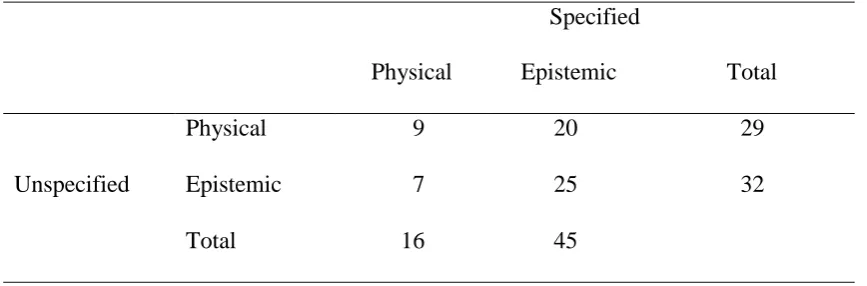
In the Specified condition, in which children knew the identity of the object,
children preferred to guess when the pom pom was behind the door (epistemic
uncertainty) rather than before the die was thrown (physical uncertainty), binomial
test p < .001, Cohen’s g = .24, see Table 1. In contrast in the Unspecified condition, in
which children did not know the identity of the object, there was no preference, p =
.798, g = .02.
There was a significant difference in children’s preferences between
conditions: McNemar test, p = .019, φ = .10. Children who preferred to guess under
epistemic uncertainty in only one condition were more likely to do this in the
Specified condition.
In summary, we replicated the preference to guess under epistemic rather than
physical uncertainty reported by Robinson et al. (2009), but only when the object
being hidden was known. When children did not know what object was being hidden,
the preference disappeared. This supports the imagination account.
Experiment 2
In Experiment 1, children did not prefer to guess under epistemic rather than
physical uncertainty when the object being hidden was unspecified. According to the
imagination account this is because it was difficult for them to imagine ‘something’ in
one of the possible locations: they were equally likely to choose to guess before or
Recall that Robinson et al. (2006) found that 59% of 4- to 6-year-olds in their sample
placed only one mat to catch the falling object in the epistemic uncertainty trials. The
imagination account predicts that if children are less likely to imagine the object in
place then they should be less likely to behave as if there is only one possible
outcome. Thus, under Unspecified conditions children should be able to mark
multiple possibilities even under epistemic uncertainty. We tested this prediction in
Experiment 2. We knew from Robinson et al. (2006) that 4- to 6-year-olds found it
relatively easy to mark multiple possibilities under physical uncertainty (Specified
conditions) and so the imagination account did not predict any change in performance
under Unspecified conditions. Thus, in Experiment 2 we focused only on epistemic
trials to test whether we could reduce the tendency for children to behave
overconfidently under this type of uncertainty.
Method
Participants. Twenty nine children (16 girls, mean age 5;7, range 5;0 – 6;1) participated. They were recruited from and tested at a school serving a working and
middle class population in the U.K..
Materials. We adapted the apparatus from Experiment 1 to have only two vertical sections colored green and orange. We used the pom poms, the collection of
objects, the transparent box and the opaque box from Experiment 1 and in addition:
blue blocks (approx. 1.5 cm cubed) and two gold mats (approx. 12 cm2) cushioned
with cotton wool.
Procedure. As in Experiment 1, children were tested individually. Each child played both the Specified and Unspecified conditions, with the order alternated
between children. Children were shown the ‘Doors’ apparatus and told that the
they were to put out the mats to catch it. In the warm up trials the experimenter took a
blue block from the table and placed it behind the green door. She told the child that
she had put it behind the green door and directed her to put a mat under the green
door. The experimenter then pushed the block through the door, where it landed on
the mat. On a second warm up trial the experimenter did not tell the child where the
block was. She placed the block behind the orange door and told the child to put out
two mats to make sure the block was caught. The block was then pushed through the
door and landed in one of the mats. The experimenter recapped that if the child knew
which door the thing was going to fall from the right thing to do was to put out one
cotton wool mat, and if she did not know which door the thing was going to fall from
the right thing to do was to put out two cotton wool mats. The experimenter then
removed the blocks from the table and told children that they were going to play the
game for real.
Experimental Trials. In the Specified Condition, using the transparent
container with the yellow pom poms , the experimenter placed a pom pom behind a
door, without the child seeing which door. Children were asked to, “put out cotton
wool to make sure you catch the pom pom” (as in Beck, Robinson, Carroll, &
Apperly (2006) we used cotton wool so that we could refer to the mats without having
to use a singular or plural instruction). When the mat or mats had been placed, the
experimenter pushed the pom pom through a door, ensuring that if children had
placed only one mat, they did not catch the pom pom. The experimenter then stated
either “You caught it that time” when the child had placed two mats or “You didn’t
catch it that time” when they had placed only one. Mat(s) were removed from the
doors and the game was repeated for two further Specified trials, making three
In the Unspecified Condition, as in Experiment 1, the game was played with
the opaque box with objects of unknown identity. Three trials followed the procedure
for the Specified Condition, except that the experimenter stated that she was putting
‘something’ behind the door, and asked children to put out cotton wool to make sure
they caught ‘the thing’.
Results and discussion.
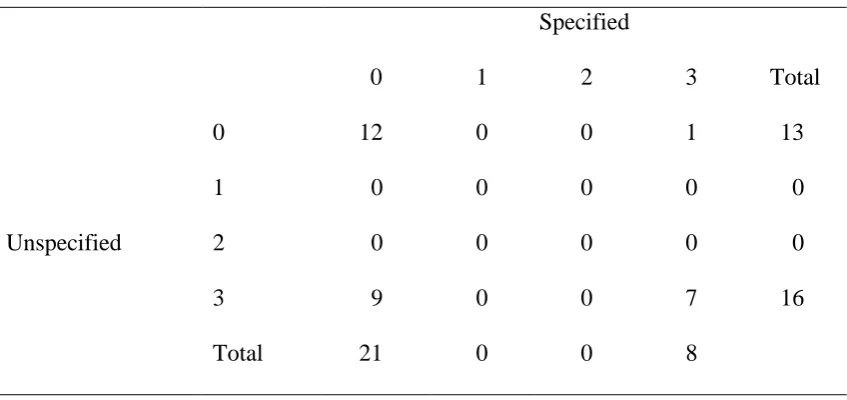
Children were given a score of 1 on each trial on which they placed two mats
(maximum 3). These data are shown in Table 2. Note that children were consistent in
the number of mats they placed across all three trials in each condition. Chi square
tests confirmed that the order in which the trials (specified or unspecified first) were
presented had no effect on children’s performance (lowest p = .474).
A Wilcoxon signed ranks test showed that scores were higher (i.e. children
were more likely to place two mats) in the Unspecified Condition (16 out of 29
children always placed two mats) than in the Specified Condition (8 out of 29), Z =
-2.53, p = .011, CL = .66. Nine children always placed two mats on the unspecified
trials and never did so on the specified and only one showed the reverse pattern (Sign
test p = .021). In line with the imagination account, children’s success acknowledging
possibilities was affected by whether they knew what the object was behind one of the
doors.
The manipulation in Experiment 2 did not entirely ameliorate children’s
difficulty handling uncertainty. Children were more likely to place two mats (i.e.
acknowledge uncertainty) in the Unspecified condition than in the Specified
condition, and they were more likely to place two mats than just one. To some extent,
5-year-olds remained somewhat overconfident: 45% of children consistently placed
However, experiments 1 and 2 suggest that one reason children have difficulties
responding appropriately to epistemic uncertainty is that they imagine the outcome
and experience a false sense of confidence.
General Discussion
Our results offer an explanation for the surprising results reported by
Robinson and colleagues (2006; 2009). Five- and six-year-olds, who typically behave
as if they are thinking about only one possible outcome when uncertainty is epistemic,
showed these behaviors less frequently when the object in the game was unspecified.
They preferred to guess under epistemic rather than physical uncertainty only when
they knew what the object in the hidden location was (Experiment 1) and they showed
the expected tendency to acknowledge just one possibility only when they knew the
object’s identity (Experiment 2). Our explanation for this is that under Specified
conditions they imagine one particular outcome. Under epistemic uncertainty they
imagine the object in one of the possible locations. Under physical uncertainty
children may be less inclined to imagine a single outcome as it has yet to happen.
Thus, under Unspecified conditions, children are less likely to imagine the object in
place and so are better able to acknowledge the multiple possible outcomes.
By what mechanism could imagining an object in place affect children’s
handling of uncertainty? It is unlikely to be due to the fact that it is easier for children
to handle uncertainty in the fantasy domain as there were none of the vocal or
behavioral cues that are typical when engaging children in pretense (Lillard &
Witherington, 2004). More likely is that the ease with which children can imagine the
object in place can lead to a metacognitive error, akin to fluency effects seen in adults
(Alter & Oppenheimer, 2009). Adults feel more confident that they have experienced
effects result from increased ease of processing as imagined events become more
familiar and source confusion (Sharman, Garry, & Hunt, 2005). It is plausible that
children, whose source monitoring is still developing (see e.g. Robinson &
Whitcombe, 2003), may be particularly susceptible to these effects and that this leads
them to ignore alternative possibilities under epistemic uncertainty (when the outcome
is easily imagined). If this is the case, then other factors that influence the ease with
which children can imagine something, such as familiarity, may also affect
performance.
Differentiation between physical and epistemic uncertainty has also been
reported by researchers studying adults, although they do not use the same terms (e.g.
Brun & Teigen, 1990; Chow & Sarin, 2002; Rothbart & Snyder, 1970). Adults predict
they will prefer to guess about a chance event (e.g. the throw of a die) before it has
happened. However, in reality they, like children, prefer to guess after the event
(Robinson et al., 2009). They appear to be over-confident about their ability to guess
under epistemic uncertainty compared to physical uncertainty. Perhaps the same
process that leads children to behave more confidently under epistemic compared to
physical uncertainty also influences adults. Adults might find it easier to imagine an
outcome once it has happened rather than before and, having imagined this outcome,
they may confuse this imagined outcome with a known outcome, or misinterpret the
ease with which they imagined it as evidence for knowledge (a fluency effect, see e.g.
Alter & Oppenheimer, 2009). If this is the case, we would also expect adults to be
susceptible to the specified manipulation. Adults should rate themselves as more
confident, or bet larger amounts, in tasks where they can easily imagine the outcome
(e.g. specified versions of tasks) than those where they cannot (e.g. unspecified
We limited our samples to 5- to 6-year-old children because we were
confident they would show the preference for guessing under epistemic uncertainty
and the difficulties in acknowledging possibilities arising from it and thus allow us to
test our imagination account. We demonstrated that our manipulation affected their
performance (removing the preference for guessing under uncertainty and facilitating
their acknowledgement of multiple possibilities) and gained support for this account.
Future research should pursue a developmental story detailing the role of imagination
in responses to uncertainty at different ages. For example, when children first
successfully mark multiple possibilities on physical uncertainty tasks (Beck et al.
(2006) suggests this may be around 3 to 4 years of age) are they also able to mark
multiple possibilities on epistemic uncertainty tasks if the object is difficult to
imagine? When older (7- to 8-year-old) children pass the epistemic trials, are they still
influenced by imaginability: if an outcome is made extremely easy for them to
imagine would they slip back to treating it as if it could be known?
In conclusion, children’s tendency to imagine outcomes leads to difficulty
responding appropriately to epistemic uncertainty. While we have demonstrated this
principle in one age group, research on epistemic and physical uncertainty should be
expanded to give a truly developmental account of this domain. Uncertainty is one
References
Acredolo, C. & Horobin, K. (1987). Development of relational reasoning and
avoidance of premature closure. Developmental Psychology, 23, 13-21.
doi:10.1037/0012-1649.23.1.13
Alter, A. L. & Oppenheimer, D. M. (2009). Uniting the tribes of fluency to form a
metacognitive nation. Personality and Social Psychology Review, 13, 219-235.
doi:10.1177/1088868309341564
Atance, C. M., & Meltzoff, A. N. (2005). My future self: Young children’s ability to
anticipate and explain future states. Cognitive Development, 20, 341-361.
doi:10.1016/j.cogdev.2005.05.001
Beck, S. R. & Robinson, E. J., (2001). Children’s ability to make tentative
interpretations of ambiguous messages. Journal of Experimental Child
Psychology 79, 95-114. doi:10.1006/jecp.2000.2583
Beck. S. R., Robinson, E. J., Carroll, D. J., & Apperly, I. A. (2006). Children’s
thinking about counterfactuals and future hypotheticals as possibilities. Child
Development, 77, 413-426. doi:10.1111/j.1467-8624.2006.00879.x
Brocki, K. C. & Bohlin, G. (2004). Executive functions in children aged 6 to 13: A
dimensional and developmental study. Developmental Neuropsychology, 26,
571-593. doi:10.1207/s15326942dn2602_3
Brun, W. & Teigen, K. H. (1990). Prediction and postdiction preferences in guessing.
Journal of Behavioral Decision Making, 3, 17-28. doi:10.1002/bdm.3960030103
Chow, C. C. & Sarin, R. K. (2002). Known, unknown and unknowable uncertainties.
Dias, M. G. & Harris, P. L. (1988). The effect of make-believe play on deductive
reasoning. British Journal of Developmental Psychology, 6, 207-221.
Dias, M. G. & Harris, P. L. (1990). The influence of the imagination on reasoning by
young-children. British Journal of Developmental Psychology, 8, 305-318.
Doherty, M. J. & Perner, J. (1998). Metalinguistic awareness and theory of mind: Just
two words for the same thing? Cognitive Development, 13, 279-305.
doi:10.1016/S0885-2014(98)90012-0
Doherty, M. J. & Wimmer, M.C. (2005). Children's understanding of ambiguous
figures: Which cognitive developments are necessary to experience reversal?
Cognitive Development, 20, 407-421. doi:10.1016/j.cogdev.2005.05.003 Friedman, O. & Leslie, A. M. (2007). The conceptual underpinnings of pretense:
Pretending is not ‘behaving-as-if’. Cognition, 105, 103-124.
doi:10.1016/j.cognition.2006.09.007
Garry, M. & Polaschek, D. L. L. (2000). Imagination and memory. Current
Directions in Psychological Science, 9, 6-10. doi:10.1111/1467-8721.00048 Harris, A. J. L., Rowley, M. G., Beck, S. R., Robinson, E. J., & McColgan, K. L. T.
(in press). Agency affects adults’, but not children’s, guessing preferences in a
game of chance. Quarterly Journal of Experimental Psychology.
Harris, P. L. (2000). The work of the imagination. Oxford, UK. Blackwell.
Ironsmith, M. & Whitehurst, G. J. (1978). The development of listener abilities in
communication: How children deal with ambiguous information. Child
Development, 49, 348–352. doi:10.2307/1128697
Lillard, A. S. & Witherington, D. C. (2004). Mothers’ behavior modifications during
pretense and their possible signal value for toddlers. Developmental
Rakoczy, H. (2008). Taking fiction seriously: Young children understand the
normative structure of joint pretend games. Developmental Psychology, 44,
1195-1201. doi:10.1037/0012-1649.44.4.1195
Richards, C. A. & Sanderson, J. A. (1999). The role of imagination in facilitating
deductive reasoning in 2-, 3- and 4-year olds. Cognition, 72, B1-B9.
doi:10.1016/S0010-0277(99)00037-2
Robinson, E. J., Pendle, J., Rowley, M. G., Beck, S. R., & McColgan, K. L. T. (2009).
Guessing imagined and live chance events: Adults behave like children with
live events. British Journal of Psychology, 100, 645 – 659.
doi:10.1348/000712608X386810
Robinson, E. J., Rowley, M. G., Beck, S. R., Carroll, D. J., & Apperly, I. A. (2006).
Children’s sensitivity to their own relative ignorance: handling of possibilities
under epistemic and physical uncertainty. Child Development, 77, 1642-1655.
doi:10.1111/j.1467-8624.2006.00964.x
Robinson, E. J. & Robinson, W. P. (1982). Knowing when you don’t know enough:
Children’s judgments about ambiguous information. Cognition, 12, 267–280.
doi:10.1016/0010-0277(82)90034-8
Robinson, E. J. & Whitcombe, E. L. (2003). Children's suggestibility in relation to
their understanding about sources of knowledge. Child Development, 74,
48-62. doi:10.1111/1467-8624.t01-1-00520
Rothbart, M. & Snyder M. (1970). Confidence in the prediction and postdiction of an
uncertain outcome. Canadian Journal of Behavioral Science, 2, 38-43.
Schwartz, B. L., Benjamin, A. S., & Bjork, R.A. (1997). The inferential and
experiential bases of metamemory. Current Directions in Psychological
Science, 6, 132 – 137. doi:10.1111/1467-8721.ep10772899
Sharman, S. J., Garry, M., & Hunt, M. (2005). Using source cues and familiarity cues
to resist imagination inflation. Acta Psychologica, 120, 227-242.
doi:10.1016/j.actpsy.2005.04.002
Skolnick, D. & Bloom, P. (2006). What does Batman think about SpongeBob?
Children’s understanding of the fantasy/fantasy distinction. Cognition, 101,
Table 1.
Children’s preferences for physical and epistemic versions of the game in Experiment
1.
Specified
Physical Epistemic Total
Unspecified
Physical 9 20 29
Epistemic 7 25 32
Table 2.
Number of times children placed two mats on Specified and Unspecified trials in Experiment 2.
Specified
0 1 2 3 Total
Unspecified
0 12 0 0 1 13
1 0 0 0 0 0
2 0 0 0 0 0
3 9 0 0 7 16