Proceedings of the Sixth Workshop on Computational Linguistics and Clinical Psychology, pages 1–11 1
Towards Augmenting Crisis Counselor Training by Improving Message
Retrieval
Orianna DeMasi
University of California Berkeley
Marti A. Hearst
University of California Berkeley
Benjamin Recht
University of California Berkeley
Abstract
A fundamental challenge when training coun-selors is presenting novices with the opportu-nity to practice counseling distressed individ-uals without exacerbating a situation. Rather than replacing human empathy with an auto-mated counselor, we propose simulating an in-dividual in crisis so that human counselors in training can practice crisis counseling in a low-risk environment. Towards this end, we collect a dataset of suicide prevention counselor role-play transcripts and make initial steps towards constructing a CRISISbot for humans to coun-sel while in training. In this data-constrained setting, we evaluate the potential for message retrieval to construct a coherent chat agent in light of recent advances with text ding methods. Our results show that embed-dings can considerably improve retrieval ap-proaches to make them competitive with gen-erative models. By coherently retrieving mes-sages, we can help counselors practice chat-ting in a low-risk environment.
1 Introduction
Suicide prevention hotlines can provide immedi-ate care in critical times of need (Gould et al.,
2012,2013;Ramchand et al., 2016). These hot-lines are expanding services to text to meet grow-ing demands and adapt to shifts in communication trends (Smith and Page, 2015). Crisis helplines rely on counselors who are trained in a variety of skills, such as empathy, active listening, assessing risk of suicide, de-escalation, and connecting in-dividuals to longer term solutions (Gould et al.,
2013;Paukert et al.,2004).
Properly training counselors is critical yet diffi-cult as, resource costs aside, counselors need to practice and develop expertise in realistic envi-ronments that are low-risk, i.e., they do not put distressed individuals in danger. Because novice
counselors are unable to assume full responsibil-ity for a crisis situation until they have some ex-perience, training often includes human-to-human role-playing (American Association of Suicidol-ogy, 2012; Suicide Prevention Resource Center,
2007). Role-playing has been shown to improve crisis intervention training (Cross et al., 2011). However, such training takes a lot of human time, which centers struggle to provide.
Instead of attempting to scale services by re-placing human counselors and trying to automate the generation of empathetic responses, we seek to build a training tool that can augment hotline train-ing and empower more counselors. As a first com-ponent, we develop a chat interface where novices can practice formulating responses by interacting with a simulated distressed individual.
To build such a system, we collect synthetic role-play transcripts that provide example scenar-ios and example messages.Because real transcripts may contain scenarios that cannot be fully de-identified, we hope that synthetic transcripts will enable the development of a training system with-out violating the confidentiality of anyone contact-ing a real hotline. Here, we consider the one-sided case of simulating the individual in distress with the intention of eventually providing a training en-vironment for novice counselors to practice coun-seling without putting anyone in danger.
RQ1 Do improved embedding methods retrieve coherent responses to a single turn of context more often than commonly-used TF-IDF or generative models?
RQ2 Can we extend retrieval baseline models to consider more than one turn of context when selecting a response?
Our results show that recent developments in embedding methods have considerably improved dialogue retrieval, which is promising for the use of these methods in data-limited applications. We also find that extending retrieval to consider ad-ditional messages of context does improve base-lines. This indicates the potential for retrieval methods to benefit data-limited dialogue systems and the need to re-evaluate baselines for genera-tive models. Within the setting that we study, our results provide promise for building a chat module that can enable crisis counselors to practice before interacting with individuals in need.
2 Related Work
Considerable potential for automating a counselor was shown with the initial rule-based Eliza sys-tem (Weizenbaum,1966) and recent developments have sought to target systems for delivering cogni-tive behavioral therapy (Fitzpatrick et al., 2017). Other studies have looked at the effect of sui-cide prevention counselor training (Gould et al.,
2013), identifying patterns of successful crisis hot-line counselors (Althoff et al.,2016), automating counselor evaluation (P´erez-Rosas et al., 2017), and building a dashboard for crisis counselors ( Di-nakar et al., 2015). There is additional work to identify supportive and distressed behaviors and language in online forums (Balani and De Choud-hury, 2015;De Choudhury and De, 2014; Wang and Jurgens,2018) and support forum moderators (Hussain et al.,2015). Most similar to our study, was one study that showed the potential for an avatar system to help train medical doctors to de-liver news to patients (Andrade et al.,2010). How-ever, this study did not target counselors or train conversation strategies. To our knowledge, there has been no work on automating the individual seeking help to improve counselor training.
2.1 Text Retrieval for Dialogue Systems
Previous systems have explored the use of retriev-ing messages from related contexts for continuretriev-ing
I did not know who to talk to
This is a safe place to talk. Tell me more about what is going on to make you feel sad and stressed
Well, my parents have been fighting a lot for the past few months and I got a C
on a test today
Visitor
Counselor
m
ic
ir
iFigure 1: A conversation snippet showing a visitor’s responserito a counselor’s messagemiwith preceding context, i.e., a visitor’s messageci.
dialogue. Some studies have looked at defining or learning scoring functions over IDF weights to construct retrieval scores (Krause et al.,2017; Rit-ter et al., 2011). Most similar to our work is a system that considered similarities of full histories of dialogues in addition to a previous turn of con-text (Banchs and Li,2012) and another study that hand-tuned weights in a scoring function on IDF weights to include additional messages of context (Sordoni et al.,2015). However, these works used similarities calculated over TF-IDF (Baeza-Yates et al.,2011) and bag-of-words of representations, instead of more recent embedding methods ( Bo-janowski et al.,2016;Conneau et al., 2017; Pen-nington et al.,2014;Peters et al.,2018; Subrama-nian et al.,2018), which we explore.
3 Dataset
Role-playing between experienced and novice counselors is a common tool for crisis counselor training, and is a task counselors are often ex-posed to before being approved to work on a hot-line (American Association of Suicidology,2012;
Kalafat et al., 2007). In addition to expecting role-playing to be a natural task for hotline coun-selors, prior work on short, unstructured social di-alogues between peers found that self-didi-alogues, i.e., where an individual would produce both sides of a two-person dialogue, generated high quality and creative example conversations (Krause et al.,
2017). We followed this work and asked experi-enced counselors to self-role-play scenarios of a counselor working with a hotline visitor. We col-lected transcripts in three phases: full role-plays, visitor-only role-plays, and counselor-paraphrase role-plays.
3.1 Collection
After consenting to participate in the study, coun-selors were invited to the first of three phases. In the first phase, counselors were asked to role-play both sides of a potential crisis text conversation. To be representative of common demographic of individuals who contact a helpline over text, coun-selors were prompted to role-play a youth expe-riencing trouble in school and with their parents. This persona was chosen to represent a common scenario that a counselor may encounter in a text-based conversation. The counselors were able to decide if the fictional youth was experiencing sui-cidal thoughts, specific issues they were having, and if they felt better by the end of the conversa-tion. Transcripts were required to be 20 turns for each counselor and visitor (40 turns total). How-ever, participants were able to extend the conver-sation to at most 60 turns total, if they chose. Mes-sages were unconstrained in length, but it was sug-gested that they resemble SMS messages.
Counselors who participated in a second phase of the study were given the counselor’s side of a transcript generated in the first phase of the study and asked to role-play only the youth experiencing trouble in a way that fit with the counselor’s mes-sages. Participants in the third phase of the study were given a full transcript generated in the first phase and asked to generate counselor paraphrases that reworded and possibly improved the original counselor messages. The second and third phases were designed to increase the variety of responses
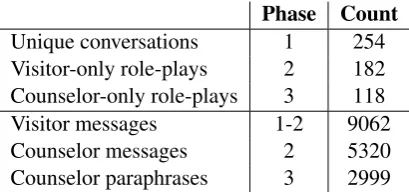
[image:3.595.314.519.62.158.2]Phase Count Unique conversations 1 254 Visitor-only role-plays 2 182 Counselor-only role-plays 3 118 Visitor messages 1-2 9062 Counselor messages 2 5320 Counselor paraphrases 3 2999
Table 1: Statistics on role-play transcripts. Phase in-dicates the study phase during which each set of data was collected. Each counselor paraphrase reworded a single counselor message.
that might be made.
Additional data were collected for evaluating models, as will be discussed below. All study methods were approved by the university’s Inter-nal Review Board.
3.2 Dataset Statistics
In total, 32 crisis counselors participated in the study and wrote example messages. In general, the transcripts represent a broad range of scenarios. Statistics on the resulting dataset are in Table1. In the following results, we do not include messages generated in the second phase of the study.
4 Methods
After preprocessing, we consider two tasks: how to return a visitor response to a single input coun-selor message and how to return a visitor response when considering a counselor input message and preceding conversation context. For responding to a single counselor input message, we consider two approaches: one based on cosine similarity of vector representations and the other based on likelihood. For responding to a counselor message when considering additional conversation context, we extend retrieval to consider additional mes-sages of context, i.e., an additional message pre-ceding the counselor’s last message. For gener-ating responses, we consider a popular Seq2Seq model (Sutskever et al., 2014; Vinyals and Le,
2015) and a hierarchical neural model (Park et al.,
2018).
4.1 Data Preprocessing
4.2 Response Retrieval Considering a Single Message
For the first retrieval approach we consider, let a message input to the system be mi. Let MN andRN be all theN messages and responses, re-spectively, in the training set and mj and rj in-dicate individual messages and responses in the training set. The first method considers all the messages in the training set and returns the re-sponserj0 to the messagemj0that shares the high-est cosine similarity with the input message, i.e.,
j0 = arg maxjsim(mi, mj)wherejindexes over the messages in the training set.
Similarity is commonly calculated as cosine similarity between TF-IDF vector representations of the input (i.e., counselor) messagemiand mes-sages in the training set. We compare the TF-IDF representation with additional vector repre-sentations of the counselor input. Exhaustive com-parison of embedding methods is not feasible, so we chose popular, successful, and diverse embed-dings: GloVe (Pennington et al., 2014), FastText (Bojanowski et al., 2016), Attract-Repel (Vuli´c et al.,2017), and ELMo (Peters et al.,2018; Gard-ner et al.,2018). We also consider two sentence embeddings: InferSent (Conneau et al.,2017) and GenSen (Subramanian et al.,2018). Messages are embedded by summing the embeddings of their el-ements, e.g., across words or sentences for appro-priate embeddings.
For the second retrieval approach, we select the response from the training data that is most prob-able, i.e, j0 = arg maxjP(rj|mi) where mi is again the input message andjindexes over train-ing examples. With this approach, which we will refer to as S2S-retrieve, the probability of a re-sponse is calculated by a Seq2Seq model trained on counselor-visitor message-response pairs. All Seq2Seq models were trained in the OpenNMT framework (Klein et al.,2017).
4.2.1 Response Retrieval Considering More than One Message of Context
When multiple messages of context are present, we propose including the additional context in the retrieval methods in three ways. For this work, we consider only one message in the conversation that precedes the counselor’s input message to be additional context, as indicated in Figure1.
First, we consider the response from the train-ing datarj0 that has the highest similarity
calcu-lated over the sum of the previous messages em-beddings, i.e., considering contextsci andcj that precede a test message mi and a training mes-sagemjrespectively, we chooserj0such thatj0 =
arg maxjsim(mi+ci, mj+cj).
As a second approach, we measure context sim-ilarity as the weighted sum of context and mes-sage similarities: j0 = arg maxjsim(mi, mj) + λsim(ci, cj).The weight parameterλis found via cross-validation to optimize the similarity of em-bedded responses returned with true responses on a development set.
Third, for the likelihood based model, we again consider the response from the training set that returns the highest likelihood, as calculated by a Seq2Seq model. To include an additional context message, we concatenate preceding messages be-fore encoding and decoding.
4.3 Response Generation
For generating a response to a single coun-selor message, we consider a Seq2Seq model (Sutskever et al.,2014).
When considering an additional message of context, we first use the Seq2Seq model with the preceding messages concatenated into a single in-put. Second, we use a Variational Hierarchical Conversation RNN (VHCR) that explicitly models prior conversation state with a hierarchical struc-ture of latent variables (Park et al., 2018). This model has been shown to improve on other models that adjust for context when there is more than one preceding utterance (Park et al., 2018). Seq2Seq and VHCR model embeddings are initialized with GloVe vectors (Pennington et al.,2014).
5 Experiments
Method Embedding unit
Selection metric
Percent that made sense
Avg. tokens in response
Avg. tokens in MS
Random – – 25.30 15.1 12.6
retrie
v
al
TF-IDF word cos-sim 60.34 13.1 12.4
Attract-Repel word cos-sim 58.50 18.3 16.2
ELMo word cos-sim 65.88 14.5 14.0
FastText word cos-sim 62.71 16.2 15.5
GloVe word cos-sim 58.63 15.9 15.1
GenSen sentence cos-sim 64.16 14.5 14.2
InferSent sentence cos-sim 61.79 14.9 14.0
S2S-retrieve – likelihood 67.46 8.8 8.2
gen. S2S-generate – – 64.16 11.7 10.8
[image:5.595.93.503.63.245.2]Ground truth – – 89.33 14.6 14.6
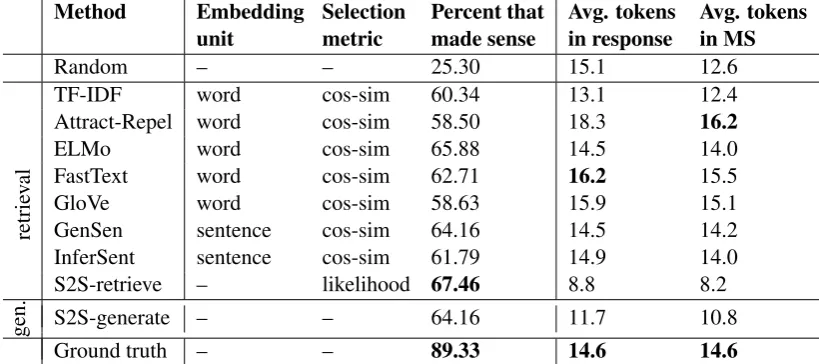
Table 2: Performance of methods used to return a response to a single input message. MS indicates the set of responses that crowdworkers judged as making sense in context, rather than all the responses that the method returned. Both the best performing method and ground truth results are in bold.
5.1 Evaluation
To evaluate the overall quality of responses that methods returned, we follow prior work that in-dicated there is currently no automatic equivalent and used human judges (Liu et al., 2016). These judges were crowdworkers on Amazon Mechani-cal Turk1who had been granted Masters status and were located in the United States. Crowdwork-ers were presented with instructions, labeled ex-amples, and batches of 10 cases where they were asked to judge responses to messages.
To evaluate methods for the first research ques-tion, crowdworkers were given a single message and a response and asked to judge the response. For the second research question, crowdworkers were given two messages of context and a high-lighted response and asked to judge the response.
In contrast to studies that rank on scales (Lowe et al.,2017), we directly asked the workers to de-cide if a response made sense or not. In addition to indicating that a response did or did not make sense, we allowed a third class for workers to in-dicate if they were unsure without additional con-text. We found these classes to be sufficiently de-scriptive to consistently label messages between researchers. In preliminary trials with crowdwork-ers, there was insufficient agreement on labels. This instability of labels could stem from a vari-ety of causes, including uncertainty about whether a change of topic should be considered a coherent response. To surmount this ambiguity, we asked
1https://www.mturk.com/
two crowdworkers to label each response and a third crowdworker to break any ties. All cases where crowdworkers indicated that they were un-sure were considered to be labeled as not coherent. With this voting approach, on a trial set of mes-sage and response pairs, crowdworker labels cor-responded with researcher determined labels with a Cohen’s Kappa of 0.69 (Cohen, 1968), indicat-ing considerable agreement.
5.2 Performance Metrics
Decision Subcategory Count
Makes sense
Answers the counselor’s question(s) 17
Logical response, fits the conversation 15
Not perfect, but conceivable someone could respond this way 7
Agrees/disagrees with counselor’s statement 2
Mismatched
Doesn’t answer or respond to the question 11
Messages are unrelated 9
Doesn’t fit, seem right, or make sense 4
Responses answers a different question 3
Response is a bad, incoherent message 3
Message is from a different part of the conversation 2
Unclear
Response is vague or confusing 4
Worker just didn’t know 3
Can’t tell without more context 2
Explanation of why worker is unsure 1
Other Researchers were unsure what rationale meant 13
[image:6.595.134.465.61.235.2]Description of message content 4
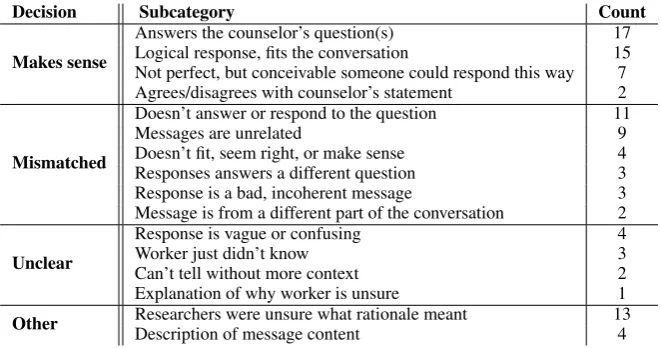
Table 3: Themes in crowdworker rationales for why a response made sense or not. The count is the number of rationales out of a subset of 100 pairs that shared the theme.
5.3 Random and Ground Truth Baselines
For the first research question, we included a method that randomly selected responses from the training set to messages in the test set. This method is intended as a baseline for how easy the task was for a method to guess responses.
For both the first and second research questions, we included a method that returned ground truth visitor responses from the test set as an indicator of how hard the task was for humans to determine response quality without additional context.
5.4 Assessing Why Responses Are Coherent
To understand how crowdworkers decided if a response was coherent, we asked crowdworkers to evaluate responses on a set of 100 message-response pairs and additionally provide a ratio-nale for their decision. For each of 50 test mes-sages, we made two pairs: one with a response randomly selected from the training messages and the other with the ground truth response from the test set. These two methods where chosen to gen-erate pairs that were not likely and likely to be co-herent. We directly asked whether the response was coherent and “Why did you choose that op-tion?” with an open text box for crowdworkers to enter a rationale. We read and grouped the ratio-nales into themes of why responses did or did not make sense.
6 Results
We present results on two tasks corresponding to our two research questions: retrieving a response to a counselor’s message and extending retrieval
to consider an additional message of context. We also consider rationales for why responses do or do not make sense.
6.1 Comparing Retrieval Methods for a Single Message of Context
Retrieval methods showed a clear benefit over ran-domly selecting responses, i.e., retrieval methods returned a higher percent of coherent messages, as judged by crowdworkers (Table2). ELMo embed-dings and three other embedembed-dings (FastText, In-ferSent, and GenSen) improved on the commonly used TF-IDF retrieval baseline. This suggests that retrieval methods with recent embeddings provide stronger baselines for generative methods and may continue to improve alongside better embedding methods. However, only the ELMo embeddings surpassed the Seq2Seq generative model in per-cent of coherent messages returned, indicating the potential of generative models even in this data-limited setting.
Retrieving responses with a Seq2Seq likelihood score returned the highest percent of coherent re-sponses, but the shortest messages on average. Short messages may indicate that, while coherent, the messages may be less engaging or interesting for an interactive environment.
re-Method Example 1 Example 2 Example 3
Message
Wow, not even 18 but al-ready paying the bills. How old are you?
Sounds like a great plan, take care Jessica... we’re here 24/7 in case you need to talk to us again
Hi, I’m Michael! What is your name? Location?
Responses
Random I took a small amount. (N) Sometimes I have to. They don’t really like hanging out with him. (N)
Yes, please. (N)
Tf-idf I’m 17. (Y) Thanks, it’s good to talk about this stuff. I have to go eat din-ner now (Y)
Hi Michael, this is Christo-pher. I’m in Daly City and I need help. (Y)
Attract-Repel I feel lonely (N) Maybe. Maybe next time. (N) I’m Jennifer (Y)
ELMo 14 (Y) ok thx (Y) i’d rather not say my name. is
this space confidential (Y)
FastText 14 (Y) ok thx (Y) i’d rather not say my name. is
this space confidential (Y)
GloVe Im 15, i have a twin but hes a boy. Im a girl. They let him get away with evvvverything at home and school (Y)
Maybe. Maybe next time. (N) i’d rather not say my name. is this space confidential (Y)
GenSen 14 (Y) Okay. I got it. Thank you.
You were really helpful. I was feeling really awful but I’m feeling better now. (Y)
i’d rather not say my name. is this space confidential (Y)
InferSent 14 (Y) Yes please. I’ll be right back.
(N)
i’d rather not say my name. is this space confidential (Y)
S2S-retrieve I’m 15 and I’m pretty sure. Life is lame and I can’t go on like this anymore. (Y)
Maybe (Y) i’d rather not say my name. is
this space confidential (Y)
S2S-generate I’m 15 and I’m pretty sure . Life is lame and I can’t go on like this anymore . (Y)
Okay, I will message you to-morrow. Thank you (Y)
i’d rather not say my name. is this space confidential (Y)
Ground truth Yea it’s awkward. Im 17, be 18 in 4mo (Y)
You too (Y) My name is Christopher and
[image:7.595.77.525.60.416.2]I’m in Golden Gate Park. (Y)
Table 4: Examples of three counselor messages and the corresponding visitor response output from each method. These examples are from the first research question, where only one preceding counselor message is considered. Whether crowdworkers thought a response made sense or not is indicated parentheses as ”Y” and ”N”, respectively.
turned for them are shown in Table4.
6.2 Extending Retrieval to Include Additional Messages of Context
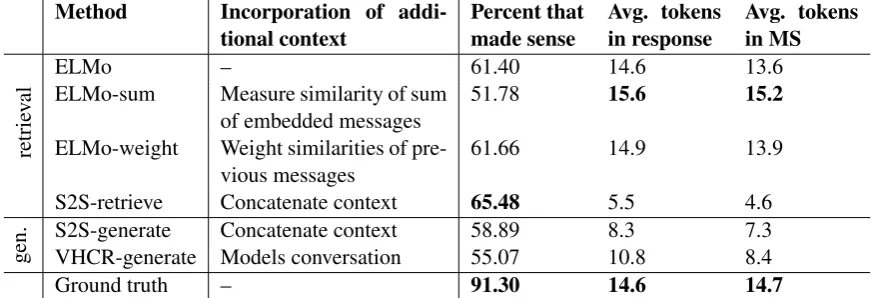
Providing crowdworkers with an additional mes-sage of context appeared to impact their impres-sion of whether responses made sense in context. When presented with an additional message of context, i.e, one visitor message and one coun-selor message, crowdworkers found a larger per-cent of the ground truth responses from the test set to make sense (Table 5). In contrast, when provided with an additional message of context to evaluate a response, crowdworkers judged a lower percent of responses returned by the ELMo-based retrieval method to be coherent (61.40%, Table5) than when they were only presented with a single message of context (65.88%, Table2). Incorporat-ing a previous message of context into a similarity score increased the percent of coherent messages returned, but by less than 1%. We only
consid-ered the ELMo embeddings, as they were found to perform best in the first research question. Three out of four retrieval methods returned a higher per-cent of coherent messages than both generative models, indicating that including more context for generative models is challenging. Again using the Seq2Seq likelihood to retrieve responses returned the highest percent of messages that made sense. However, these responses also had the fewest to-kens, implying generic, short messages that might score low on a qualitative scale of how engaging an interactive system is.
7 Discussion
Method Incorporation of addi-tional context
Percent that made sense
Avg. tokens in response
Avg. tokens in MS
retrie
v
al
ELMo – 61.40 14.6 13.6
ELMo-sum Measure similarity of sum of embedded messages
51.78 15.6 15.2
ELMo-weight Weight similarities of pre-vious messages
61.66 14.9 13.9
S2S-retrieve Concatenate context 65.48 5.5 4.6
gen.
S2S-generate Concatenate context 58.89 8.3 7.3 VHCR-generate Models conversation 55.07 10.8 8.4
[image:8.595.80.518.63.212.2]Ground truth – 91.30 14.6 14.7
Table 5: Performance of methods used to retrieve or generate responses when an additional message of context is considered, i.e., two total messages. MS denotes only responses that were considered to make sense in context. Both the best performing method and ground truth results are in bold.
youth, and related themes. We find retrieval to be a competitive approach with generative mod-els and return responses that make sense for more than 60% of input messages. We also find themes for how responses can seem to be coherent.
Giving crowdworkers an additional message of context to judge whether a response was coher-ent or not affected their decisions. It appeared that ground truth responses were easier to distin-guish as coherent and fewer retrieved messages were judged as coherent if an additional message of context was presented. This indicates the im-portance of context, especially during evaluation.
The results we present are on a specific, data-limited setting, but the implications of our results may be broader both for other important applica-tions, which commonly have data limitaapplica-tions, and for retrieval baselines that are used to assess gen-erative models. As embeddings have improved, so too have retrieval baselines, which need to be updated for appropriate evaluation of generative models in any language generation setting.
Our results are not without limitations. The data-limited setting presented a challenge to train-ing generative models, and perhaps extensive hyper-parameter tuning could influence results. However, limited data and non-exhaustive param-eter tuning are common limitations. Further, as datasets increase in size, so does the potential for relevant, related contexts to be present and thus the potential for successful retrieval increases as well. Thus, even on larger datasets, competitive retrieval models, such as those we have presented, should be considered for baseline comparisons.
Another limitation of our approach is the extent
to which we have considered context so far. Be-cause the conversations we collected are long rel-ative to some other datasets it is likely more con-text will be necessary to produce a coherent sim-ulation. We have begun to methodically look at the effects of incrementally including more con-text and extending retrieval models beyond a sin-gle message. These initial steps indicate the im-pact context has and provide important baselines for comparing future, more general models.
8 Conclusion
Our work shows promise that data-limited applica-tions may build initial systems with retrieval meth-ods powered by recently developed embeddings. By collecting role-play transcripts and showing re-sults in a data-limited context, we have demon-strated the potential to develop a successful sim-ulation of a hotline visitor that novice counselors can practice with during training. We found that retrieval methods became more competitive with improved embedding methods and surpassed gen-erative methods when more context was consid-ered. We also found that context had impact on how difficult it was for crowdworkers to evaluate responses.
References
Tim Althoff, Kevin Clark, and Jure Leskovec. 2016. Large-scale Analysis of Counseling Conversations: An Application of Natural Language Processing to Mental Health. Transactions of the Association for Computational Linguistics.
American Association of Suicidology. 2012. Organi-zation Accreditation Standards Manual.
Allen D Andrade, Anita Bagri, Khin Zaw, Bernard A Roos, and Jorge G Ruiz. 2010. Avatar-mediated training in the delivery of bad news in a virtual world. Journal of palliative medicine, 13(12):1415– 1419.
Ricardo Baeza-Yates, Berthier de Ara´ujo Neto Ribeiro, et al. 2011. Modern information retrieval. New York: ACM Press; Harlow, England: Addison-Wesley,.
Sairam Balani and Munmun De Choudhury. 2015. De-tecting and characterizing mental health related self-disclosure in social media. In Proceedings of the 33rd Annual ACM Conference Extended Abstracts
on Human Factors in Computing Systems, pages
1373–1378. ACM.
Rafael E Banchs and Haizhou Li. 2012. Iris: a chat-oriented dialogue system based on the vector space model. In Proceedings of the ACL 2012 System
Demonstrations, pages 37–42. Association for
Com-putational Linguistics.
Piotr Bojanowski, Edouard Grave, Armand Joulin, and Tomas Mikolov. 2016. Enriching word vec-tors with subword information. arXiv preprint
arXiv:1607.04606.
Jacob Cohen. 1968. Weighted kappa: Nominal scale agreement provision for scaled disagreement or par-tial credit.Psychological bulletin, 70(4):213. Alexis Conneau, Douwe Kiela, Holger Schwenk, Lo¨ıc
Barrault, and Antoine Bordes. 2017. Supervised learning of universal sentence representations from natural language inference data. InProceedings of the 2017 Conference on Empirical Methods in Nat-ural Language Processing.
Wendi F Cross, David Seaburn, Danette Gibbs, Karen Schmeelk-Cone, Ann Marie White, and Eric D Caine. 2011. Does practice make perfect? a ran-domized control trial of behavioral rehearsal on sui-cide prevention gatekeeper skills. The journal of primary prevention, 32(3-4):195.
Munmun De Choudhury and Sushovan De. 2014. Mental health discourse on reddit: Self-disclosure, social support, and anonymity. InICWSM.
Karthik Dinakar, Jackie Chen, Henry Lieberman, Ros-alind Picard, and Robert Filbin. 2015. Mixed-initiative real-time topic modeling & visualization
for crisis counseling. InProceedings of the 20th in-ternational conference on intelligent user interfaces, pages 417–426. ACM.
Kathleen Kara Fitzpatrick, Alison Darcy, and Molly Vierhile. 2017. Delivering cognitive behavior ther-apy to young adults with symptoms of depression and anxiety using a fully automated conversational agent (woebot): a randomized controlled trial. JMIR mental health, 4(2).
Matt Gardner, Joel Grus, Mark Neumann, Oyvind Tafjord, Pradeep Dasigi, Nelson F. Liu, Matthew Peters, Michael Schmitz, and Luke S. Zettlemoyer. 2018. AllenNLP: A deep semantic natural language processing platform. In ACL workshop for NLP
Open Source Software.
Madelyn S Gould, Wendi Cross, Anthony R Pisani, Jimmie Lou Munfakh, and Marjorie Kleinman. 2013. Impact of applied suicide intervention skills training on the national suicide prevention lifeline.
Suicide and Life-Threatening Behavior, 43(6):676–
691.
Madelyn S Gould, Jimmie LH Munfakh, Marjorie Kleinman, and Alison M Lake. 2012. National sui-cide prevention lifeline: enhancing mental health care for suicidal individuals and other people in crisis. Suicide and Life-Threatening Behavior, 42(1):22–35.
M Sazzad Hussain, Juchen Li, Louise A Ellis, Laura Ospina-Pinillos, Tracey A Davenport, Rafael A Calvo, and Ian B Hickie. 2015. Moderator assistant: A natural language generation-based intervention to support mental health via social media. Journal of
Technology in Human Services, 33(4):304–329.
John Kalafat, Madelyn S Gould, Jimmie Lou Harris Munfakh, and Marjorie Kleinman. 2007. An evalu-ation of crisis hotline outcomes. part 1: Nonsuicidal crisis callers. Suicide and Life-threatening behav-ior, 37(3):322–337.
Guillaume Klein, Yoon Kim, Yuntian Deng, Jean Senellart, and Alexander M. Rush. 2017. Open-NMT: Open-source toolkit for neural machine trans-lation. InProceedings of ACL.
Ben Krause, Marco Damonte, Mihai Dobre, Daniel Duma, Joachim Fainberg, Federico Fancellu, Em-manuel Kahembwe, Jianpeng Cheng, and Bon-nie Webber. 2017. Edina: Building an open do-main socialbot with self-dialogues. arXiv preprint
arXiv:1709.09816.
Juncen Li, Robin Jia, He He, and Percy Liang. 2018. Delete, retrieve, generate: a simple approach to sen-timent and style transfer. InProceedings of the 2018 Conference of the North American Chapter of the Association for Computational Linguistics: Human
Chia-Wei Liu, Ryan Lowe, Iulian Serban, Mike Nose-worthy, Laurent Charlin, and Joelle Pineau. 2016. How not to evaluate your dialogue system: An em-pirical study of unsupervised evaluation metrics for dialogue response generation. InProceedings of the 2016 Conference on Empirical Methods in Natural
Language Processing, pages 2122–2132.
Associa-tion for ComputaAssocia-tional Linguistics.
Ryan Lowe, Michael Noseworthy, Iulian Vlad Ser-ban, Nicolas Angelard-Gontier, Yoshua Bengio, and Joelle Pineau. 2017. Towards an automatic turing test: Learning to evaluate dialogue responses. In
Proceedings of the 55th Annual Meeting of the Asso-ciation for Computational Linguistics, pages 1116– 1126.
Yookoon Park, Jaemin Cho, and Gunhee Kim. 2018. A hierarchical latent structure for variational conversa-tion modeling. InProceedings of the 2018 Confer-ence of the North American Chapter of the Associ-ation for ComputAssoci-ational Linguistics: Human
Lan-guage Technologies, pages 1792–1801.
Amber Paukert, Brian Stagner, and Kerry Hope. 2004. The assessment of active listening skills in helpline volunteers.Stress, Trauma, and Crisis, 7(1):61–76. Jeffrey Pennington, Richard Socher, and
Christo-pher D. Manning. 2014. Glove: Global vectors for word representation. InEmpirical Methods in
Nat-ural Language Processing (EMNLP), pages 1532–
1543.
Ver´onica P´erez-Rosas, Rada Mihalcea, Kenneth Resni-cow, Satinder Singh, Lawrence Ann, Kathy J Gog-gin, and Delwyn Catley. 2017. Predicting coun-selor behaviors in motivational interviewing encoun-ters. In Proceedings of the 15th Conference of the European Chapter of the Association for
Compu-tational Linguistics: Volume 1, Long Papers,
vol-ume 1, pages 1128–1137.
Matthew E. Peters, Mark Neumann, Mohit Iyyer, Matt Gardner, Christopher Clark, Kenton Lee, and Luke Zettlemoyer. 2018. Deep contextualized word rep-resentations. InProc. of NAACL.
Rajeev Ramchand, Lisa Jaycox, Pat Ebener, Mary Lou Gilbert, Dionne Barnes-Proby, and Prodyumna Goutam. 2016. Characteristics and proximal out-comes of calls made to suicide crisis hotlines in cal-ifornia.Crisis.
Alan Ritter, Colin Cherry, and William B Dolan. 2011. Data-driven response generation in social media. In
Proceedings of the conference on empirical methods in natural language processing, pages 583–593. As-sociation for Computational Linguistics.
Iulian Vlad Serban, Ryan Lowe, Peter Henderson, Lau-rent Charlin, and Joelle Pineau. 2015. A survey of available corpora for building data-driven dialogue systems. arXiv preprint arXiv:1512.05742.
Aaron Smith and Dana Page. 2015. Us smartphone use in 2015. Pew Research Center, 1.
Alessandro Sordoni, Michel Galley, Michael Auli, Chris Brockett, Yangfeng Ji, Margaret Mitchell, Jian-Yun Nie, Jianfeng Gao, and Bill Dolan. 2015. A neural network approach to context-sensitive gen-eration of conversational responses. In Proceed-ings of the 2015 Conference of the North Ameri-can Chapter of the Association for Computational
Linguistics: Human Language Technologies, pages
196–205.
Sandeep Subramanian, Adam Trischler, Yoshua Ben-gio, and Christopher J Pal. 2018. Learning gen-eral purpose distributed sentence representations via large scale multi-task learning. InICLR.
Suicide Prevention Resource Center. 2007. Applied suicide intervention skills training (ASIST). Ilya Sutskever, Oriol Vinyals, and Quoc V Le. 2014.
Sequence to sequence learning with neural net-works. InAdvances in neural information process-ing systems, pages 3104–3112.
Oriol Vinyals and Quoc Le. 2015. A neural conversa-tional model. arXiv preprint arXiv:1506.05869. Ivan Vuli´c, Nikola Mrkˇsi´c, Roi Reichart, Diarmuid ´O
S´eaghdha, Steve Young, and Anna Korhonen. 2017. Morph-fitting: Fine-tuning word vector spaces with simple language-specific rules. In Proceedings of ACL, pages 56–68.
Zijian Wang and David Jurgens. 2018. Its going to be okay: Measuring access to support in online com-munities. InProceedings of the 2018 Conference on Empirical Methods in Natural Language Process-ing, pages 33–45.
Joseph Weizenbaum. 1966. Elizaa computer program for the study of natural language communication be-tween man and machine. Communications of the ACM, 9(1):36–45.
Jason Weston, Emily Dinan, and Alexander H Miller. 2018. Retrieve and refine: Improved sequence generation models for dialogue. arXiv preprint
arXiv:1808.04776.
A Appendices
Modified model parameters are shared below for reproducibility.
A.1 Seq2Seq Model Parameters
More information on model parameters can be found in the OpenNMT-py online documentation2.
-dynamic dict on
2http://opennmt.net/OpenNMT-py/index.
-share vocab on
-src seq length = 200
-tgt seq length = 200
-rnn size = 500
-src word vec size = 300
-tgt word vec size = 300
-share embeddings on
-encoder type = brnn
-decoder type = rnn
-rnn type = LSTM
-layers = 2
-global attention = general
-optim = adam
-learning rate = 0.001
-batch size = 4
pre-trained embedding glove.840B.300d.txt
A.2 VHCR Model Parameters
More info can be found about model parameters in the online repository3.
-model = VHCR
-batch size = 4
-embedding size = 300
-encoder hidden size = 500
-decoder hidden size = 500
-context size = 500
-z sent size = 50
-z conv size = 50
pre-trained embedding glove.840B.300d.txt
-max sentence length = 60
-max conversation length = 5
-min vocab frequency = 3
3https://github.com/ctr4si/