Proceedings of the 7th Joint Conference on Lexical and Computational Semantics (*SEM), pages 54–64
Graph Algebraic Combinatory Categorial Grammar
Sebastian Beschke Wolfgang Menzel Department of Informatics
University of Hamburg
Vogt-Kölln-Straße 30, 22527 Hamburg, Germany {beschke,menzel}@informatik.uni-hamburg.de
Abstract
This paper describes CCG/AMR, a novel grammar for semantic parsing of Abstract Meaning Representations. CCG/AMR equips Combinatory Categorial Grammar derivations with graph semantics by assigning each CCG combinator an interpretation in terms of a graph algebra.
We provide an algorithm that induces a CCG/AMR from a corpus and show that it cre-ates a compact lexicon with low ambiguity and achieves a robust coverage of 78% of the ex-amined sentences under ideal conditions. We also identify several phenomena that affect any approach relying either on CCG or graph algebraic approaches for AMR parsing. This includes differences of representation between CCG and AMR, as well as non-compositional constructions that are not expressible through a monotonic construction process. To our knowledge, this paper provides the first anal-ysis of these corpus issues.
1 Introduction
With the release of the Abstract Meaning Rep-resentation (AMR) corpus (Knight et al., 2014), graph representations of meaning have taken cen-tre stage in research on semantic parsing. Se-mantic parsing systems have to address the prob-lem oflexicon induction: extracting reusable lexi-cal items from the sentential meaning representa-tions annotated in the AMR corpus. Since the cor-pus contains sentential meaning representations, but no indication of their compositional structure, derivations of the meaning representation cannot be observed. Common approaches enumerate all conceivable lexical items that may have con-tributed to the derivation of the meaning represen-tation at hand (Artzi et al.,2015;Groschwitz et al.,
2017). This may produce very large lexicons with high degrees of ambiguity, and therefore require
large amounts of computational resources during parsing. One central contribution of this paper is a lexicon induction algorithm that produces a rel-atively compact lexicon.
Combinatory Categorial Grammar (CCG) uses a transparent syntax-semantic interface that con-structs meaning representations using λ-calculus. This makes lexicon induction challenging, as in-ducingλ-calculus terms essentially requires solv-ing higher-order unification (Kwiatkowski et al.,
2010). In practice, heuristics are employed to manage the search space, but it would be prefer-able to make use of a less powerful mechanism which better fits the problem domain. Graph alge-bras such as the HR algebra (Courcelle and Engel-friet, 2012) constitute such a constrained mecha-nism. By combining CCG with the HR algebra, we are able to leverage the availability of syntac-tic parsers for CCG while making use of tailored semantic construction operations.
1.1 Related Work
There is an extensive body of work on seman-tic parsing of AMRs, using a range of techniques including maximum spanning tree-based parsing (Flanigan et al., 2014), transition-based parsing (Wang et al., 2015; Ballesteros and Al-Onaizan,
2017;Peng et al.,2018), machine translation (van Noord and Bos, 2017), graph grammars (Peng et al., 2015; Groschwitz et al., 2017), and CCG parsing (Artzi et al.,2015;Misra and Artzi,2016). The system ofArtzi et al. (2015) is most sim-ilar to the present work. They induce a semantic CCG using a translation of AMR intoλ-calculus. A key difference is that their training algorithm combines lexicon induction and parameter train-ing into a strain-ingle phase. New lexical items are generated during each training step and then fil-tered based upon the model’s current parameters. In contrast, in this work we focus on lexicon
duction, with parameter training to be performed in a subsequent step.
Another related system is presented in Lewis et al. (2015), where a CCG parser is adapted to produce shallow semantic dependency graphs. In contrast, the meaning representations employed here are abstract and do not directly refer to the sentence under analysis.
Word-to-node alignments on the AMR corpus play an important role in this work. We exper-iment with JAMR’s rule-based aligner (Flanigan et al., 2014) and the statistical ISI aligner ( Pour-damghani et al.,2014).
Graph algebras have recently been applied to AMR parsing (Koller, 2015; Groschwitz et al.,
2017), but not in combination with CCG. In trast, we use syntactic CCG derivations to con-strain the space of possible derivations. However, the idea of using a constrained version of the HR algebra, introduced by Groschwitz et al. (2017), is also used here, and ourApplicationoperator ef-fectively subsumes theirApplyandModify opera-tions.
1.2 Tools
Syntax parser We use EasyCCG (Lewis and Steedman,2014) to obtain syntax derivations. For robustness, we extract the ten best derivations produced by EasyCCG based on the CCGBank-rebanked model (Honnibal et al.,2010).
Word-to-node alignments During lexicon induction, we make use of alignments between to-kens in the sentence and nodes in the meaning rep-resentation. We experiment with JAMR’s aligner (Flanigan et al., 2014) and the ISI aligner ( Pour-damghani et al.,2014).
Other tools We use Stanford CoreNLP ( Man-ning et al.,2014) for tokenisation.
2 Background
The task of semantic parsing is concerned with building formal meaning representations for natu-ral language text. While meaning representations can be elements of any formal language, in this pa-per we are concerned with Abstract Meaning Rep-resentations (AMRs). We use Combinatory Cat-egorial Grammar (CCG) as an underlying frame-work to explain how AMRs may be derived from the surface form words. To do so, we equip CCG with graph construction operators drawn from the HR algebra. These concepts are introduced below.
2.1 Combinatory Categorial Grammar
CCG is a grammar formalism centered around a transparent syntax-semantics interface (Steedman,
2000). A CCG consists of a small set of combina-tory rules, along with a lexicon of entries defining each word’s syntactic and semantic interpretation. A CCG lexical item, as used in this paper, con-tains one or several tokens, a syntactic category, and a semantic category. The syntactic category is a functional type defining the types of arguments expected by the words and whether they are ex-pected to the left or right. E.g., NP/N expects a noun (N) to the right (because of the rightward-facing slash) and returns anNP– it is the type of determiners. (S\NP) / NPis the category of tran-sitive verbs, consuming first anNPfrom the right and then from the left, and returning a sentence. See Figure1afor an example.
CCG derivations are created by recursively ap-plying combinators to the lexical syntactic cate-gories, thus combining them into constituents. Be-sides Application, implementations of CCG also use other combinators such as Composition, as well as specialized combinators for conjunctions and punctuation.
Semantic categories are represented as λ -calculus terms. A combinator is always applied to two constituents’ syntactic and semantic cate-gories at the same time, allowing semantic con-struction to be fully syntax-driven.
2.2 Abstract Meaning Representation
The Abstract Meaning Representation (AMR) is a semantic meaning representation language that is purposefully syntax-agnostic (Banarescu et al.,
2013). The data set used in this paper, the AMR 1.0 release (Knight et al., 2014), consists of En-glish sentences which have been directly anno-tated with meaning representations by human an-notators.
AMR represents meaning as labeled, directed graphs. Nodes are labeled with concepts, while edges represent roles. Predicates and core roles are drawn from PropBank (Kingsbury and Palmer,
2002). In addition, a set of non-core roles has been defined, such asmod,poss,time, etc.
The boy wants to sleep NP (S\NP)/(S\NP) S\NP
boyhrooti
wanthrooti
h0i h1i
ARG0 ARG1
sleephrooti
h0i
ARG0
> S\NP
wanthrooti
h0i sleep
ARG0 ARG1 ARG0
< S
wanthrooti
boy sleep
ARG0 ARG1 ARG0
(a) Example for a derivation making use of two Applicationoperations.
Step 1: Application. Insert sleep node into placeholderh1i; mergeh0iplaceholders. Step 2: Application. Insertboyinto placeholder h0i.
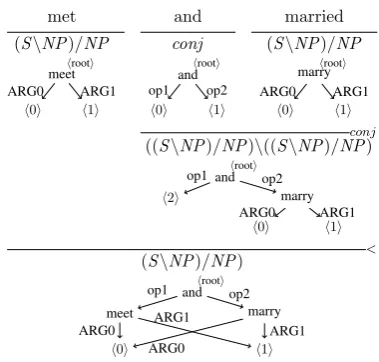
met and married (S\NP)/NP conj (S\NP)/NP
meethrooti
h0i h1i
ARG0 ARG1 and
hrooti
h0i h1i
op1 op2
marryhrooti
h0i h1i
ARG0 ARG1
conj ((S\NP)/NP)\((S\NP)/NP)
andhrooti
h2i marry
h0i h1i
op1 op2
ARG0 ARG1
< (S\NP)/NP)
andhrooti
meet marry
h0i h1i
op1 op2
ARG0 ARG1
ARG0 ARG1
(b) Example for a derivation containing oneConjunction and oneApplicationoperation.
Step 1: Conjunction. Insertmarrynode into placeholder h1iofand; shift placeholderh0iofandtoh2i.
[image:3.595.298.488.58.239.2]Step 2: Application of the phraseand marriedtomet; the operands’ same-numbered placeholders are merged. Figure 1: Examples for the semantic operationsApplicationandConjunction.
2.3 The HR Algebra
During semantic parsing, a complete meaning rep-resentation needs to be built out of smaller compo-nents. To formalise this process, known as seman-tic construction, an algebra may be defined that de-scribes the permitted operations on meaning repre-sentations. The HR algebra has first been defined in the context of graph grammars (Courcelle and Engelfriet, 2012) and has been applied to seman-tic construction of AMR graphs (Koller,2015).
The HR algebra operates on graphs with sources, or s-graphs. Given a set of labelsA, an
s-graph is a pair(G,slabG)whereG= (VG, EG)
is a graph andslabG : VG → A is a partial
in-jective function. The nodes contained within the domain ofslabGare called thesourcesofG, and
the elements ofAare calledsource labels. The HR algebra defines three basic operations over s-graphs:
• Parallel composition creates the union of two disjoint s-graphs and fuses nodes that share a source label. slabG is defined to
re-tain all source labels.
• Forgetting removes a source from the do-main ofslabG, effectively deleting its label.
• Renamingmodifies slabG to change source
labels according to a specified mapping. The HR algebra provides the building blocks for the manipulation of s-graphs. In the following sec-tion, we apply these basic operations to CCG.
3 Graph Semantics for CCG
In CCG, semantic construction is syntax-driven in that the construction operations that are applied to lexical units of meaning are determined by the combinatory operations that make up a CCG syn-tax tree. To define CCG derivations over graph semantics, we must therefore define the semantic construction operators invoked by each CCG com-binator.
We will use a restricted version of the HR alge-bra, where we only consider a subset of possible s-graphs, and only some of the possible operations. To represent incomplete meaning representations, we defineCCG/AMR s-graphs.
3.1 CCG/AMR S-Graphs
As an extension of AMR graphs, CCG/AMR s-graphs may contain unlabeled nodes called
place-holders. In addition to the AMR labels, a source
labelling function is employed, as defined in Sec-tion 2.3. Source labels used in CCG/AMR s-graphs take one of two forms:
• hr, ii with r ∈ {root,∅} and i ∈ N∪ {∅}, which marks a node as root ifr = root, and assigns it an indexiifi ∈ N. However, we
disallowh∅,∅ias a source label.
• hsi, used temporarily to label a placeholder-argument pair.
CCG combinator Semantic operator
(F/B) Application (F/B) Application (F/B) [Gen.] [Cr.] Comp. (F/B) Application Conjunction F Conjunction (Left/Right) Punctuation (F/B) Identity
Table 1: The mapping from CCG combinators to semantic operators. F and B stand for Forward
andBackward, Gen. stands for Generalised, Cr.
stands forCrossed, andComp. stands for compo-sition. All variants of Composition are mapped to the Application operation.
simplicity, we abbreviate hroot,∅i to hrooti and h∅, iitohiifori∈N.
The following constraints apply:
• A CCG/AMR s-graph must have exactly one
root-source.
• For everyi ∈ N, there may be at most one
i-source, and for everyi-source withi > 0,
there must also be an(i−1)-source.
• Thei-sources of a CCG/AMR s-graph must
be exactly its placeholders.
The outermost placeholder of a CCG/AMR
s-graph is defined to be the placeholder with the highest indexi.
3.2 Semantic Operators
We now define three semantic operators based on the building blocks of the HR algebra. They are bi-nary operators, with a left and a right operand. If the operator is used inforward direction, we call the left operand thefunction graph and the right operand theargument graph. Inbackward direc-tion, these roles are reversed.
• Application Relabels both the outermost
placeholder of the function graph and the root of the argument graph tohsi. Then performs parallel composition of both graphs. Finally, forgets hsi. Requires the function graph to
have at least one placeholder.
• Conjunction The function graph of a con-junction operator is required to have exactly two placeholders. Placeholder h1i and the root of the function graph are both renamed tohsi. Placeholderh0iof the function graph is relabelled tohi+ 1i, whereiis the index of
the argument graph’s outermost placeholder. Then, parallel composition is applied to the
relabelled graphs andhsiforgotten.
• Identity A special case of Application where the function graph must consist of a single placeholder and the argument graph is therefore always returned unchanged. Examples for the Application and Conjunction operators are given in Figure1.
For our definition of CCG/AMR, we use the combinator set of the EasyCCG parser (Lewis and Steedman, 2014), which is small and achieves good coverage. The Application operator is suffi-cient to cover almost all CCG combinators, with the exception of conjunctions. The mapping of CCG combinators to semantic operators used in this paper is summarised in Table1.
All unary combinators, including type raising and the various type-changing rules used by Easy-CCG, are defined to have no effect on the semantic representation.
We add a single rule that is non-compositional in terms of the semantic operators. Since n-ary conjunctions are frequent in the AMR corpus, this rule combines two nested conjunction nodes, merging their operands into a single contiguous operand list.
3.3 Induction of CCG/AMR Lexicons
To induce a CCG/AMR lexicon, we propose a simple recursive algorithm, described in Algo-rithm 1. It starts with a full-sentence meaning representation, a syntax tree, and a set of word-to-node alignments. Starting from the root, it re-curses down the syntax tree and splits the meaning representation into smaller parts by applying the inverse of one of the semantic operators at each node.
Constraints We impose two constraints on the generated lexical items:
1. The alignments must not be violated.
2. The number of placeholders must not exceed the arity of the lexical item’s syntactic cat-egory. E. g., the meaning representation for the syntactic category(S\NP)/NPmust not
have more than two placeholders.
Soundness Algorithm 1 requires finding
z1, z2 with o(z1, z2) = z. This equation states
that a parser would be able to produce the parse observed in the data based on the induced the lexical items, thus ensuring the soundness of the induction algorithm.
par-titioning the meaning representation into a func-tion subgraph and an argument subgraph, provided that no alignments are violated. Nodes that sit at the boundary between both subgraphs – belonging to the argument subgraph but connected by edges to the function subgraph – areunmerged, meaning that a placeholder is created in the function sub-graph to which those edges are moved.
Phrasal items Intermediate items are emitted by the algorithm even if they can be further de-composed. The rationale behind this behaviour is that some lexical entries legitimately span multiple tokens. E.g., one could argue that a named entity such asNew Yorkshould be kept as a lexical item.
Coreferences Since there are many cases where graphs are connected more densely than al-lowed by the arity constraint, we allow <coref> nodes to be created by unmerging additional nodes. They are treated just like regular nodes. In particular, they are not sources and do not count towards the function graph’s placeholder count. In the experiments in this paper, we only allow cre-ation of a single <coref> node per splitting step.
Splitting failures The algorithm may en-counter situations where splitting cannot continue because it is impossible to further decompose the meaning representation without violating one of the constraints. In such cases, its output is incom-plete, emitting a lexical item only for the deriva-tion node at which the problem was encountered – which may span a long constituent of the sentence – but not for any of its sub-nodes.
4 Analysis of Lexicon Induction
We begin by analysing the statistical properties of large-scale grammar induction on the 6,603 sen-tences of theproxy-trainsubset of the AMR corpus, which consists of newswire texts. We also examine the influence that different alignment strategies have on the produced lexicon.
We then turn to the consensus-dev sub-set, which consists of 100 sentences taken from the Wall Street Journal corpus. Therefore, gold standard syntax parses for these sentences can be obtained from CCGBank (Hockenmaier and Steedman, 2007). In addition, Pourdamghani et al.(2014) have released gold-standard word-to-meaning alignments for these sentences. This al-lows us to examine the effect of tool-derived align-ments and syntax parses on the induction algo-rithm’s behaviour.
Algorithm 1Recursive Splitting
Input: syntax derivation node y, CCG/AMR
s-graphz
Definitions: OPERATOR returns the semantic op-erator matching a derivation node’s combina-tor.CHILDRENreturns the sub-nodes of a syn-tax derivation node. VALID tests whether a pair of a derivation node and a meaning repre-sentation fulfill the constraints of Section3.3. EMIT adds an item to the lexicon. EMITTED tests whether an equivalent item is already in the lexicon.
1: functionSPLITREC(y, z)
2: if¬EMITTED(y, z)∧VALID(y, z)then 3: EMIT(y, z)
4: y1, y2 ←CHILDREN(y)
5: o← OPERATOR(y)
6: forz1, z2such thato(z1, z2) =zdo
7: SPLITREC(y1, z1)
8: SPLITREC(y2, z2)
9: end for
10: end if 11: end function
4.1 Quantitative Analysis
We run lexicon induction on the full
proxy-train subcorpus. To limit the
computational effort and reduce the extraction of poorly generalisable lexical items, we apply the following limitations:1
1. If more than 1,000 lexical items are extracted from a derivation, it is skipped entirely. 2. Sentences with more than ten unaligned
nodes are skipped.
3. If at any derivation node, more than ten lexi-cal items are generated, none of them are in-cluded in the lexicon (but induction may still proceed recursively from these nodes). We measure results by examining the distribu-tion of maximum span lengths over the corpus. The maximum span length of a sentence is de-fined as the length of its longest subspan which the induction algorithm was not able to split any further. Ideally, we would like to achieve a maxi-mum span length of 1 for every sentence, meaning that each individual token is assigned at least one lexical item.
10 20 30 40 50 maximum span length
60 65 70 75 80 85 90 95 100
% sentences covered
jamr isi union intersect combine
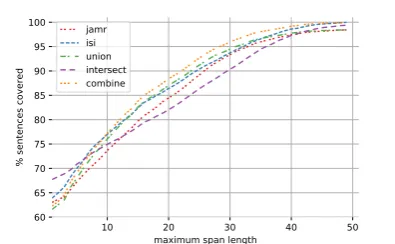
(a) Lexical induction coverage. For each alignment strat-egy, the plot shows the percentage of sentences having at most a given maximum span length.
Alignments Lexicon Size Skipped
jamr 314,299 104
isi 387,932 2
union 275,418 103
intersect 429,278 41
combine 286,129 3
[image:6.595.82.280.70.192.2](b) Lexicon sizes and skipped sentences by alignment strategy. Sentences were skipped if they produced more than 1,000 lexical items.
Figure 2: Comparison of alignment strategies for lexical induction on theproxy-trainset.
4.1.1 Alignment Strategies
We first examine the impact of several alignment strategies. The two alignment tools investigated here, the JAMR aligner (Flanigan et al.,2014) and the ISI aligner (Pourdamghani et al., 2014), use different approaches and thus produce alignments with different characteristics. We therefore ex-plore different strategies of combining the align-ments produced by the two tools:
• jamr/isi:Use only the output from one of the tools. In the case of the ISI aligner, align-ments to edges are dropped.
• union/intersect: Take the union / intersec-tion of both aligners’ outputs.
• combine: Take the union of both aligners’
outputs. However, if a node has been aligned to different tokens by the two aligners, drop alignments for this node altogether.
Two strategies exhibit the most interesting prop-erties (Figure2). Theintersectstrategy achieves a maximum span length of 1 on the most sentences, but its produced alignments are too sparse, causing many lexical items to be dropped due to ambiguity. From a maximum span length of 8, the combine
strategy is more successful, while still maintaining a small lexicon size and a low number of skipped sentences. Intuitively, it increases the node cover-age of either method, while also allowing the cor-rection of errors made by one of the tools.
4.1.2 Lexicon Statistics
The lexicon resulting from the combine strategy has 286,129 entries. In comparison, this is less than a fifth the lexicon size of 1.6 million entries reported byArtzi et al.(2015).
Of the 6,603 sentences, the algorithm skipped three because they would have produced more than 1,000 lexical items. Each of the remain-ing sentences contributes on average 3.29 lexical items per token (median 2.91).
The lexicon is essentially a non-unique map-ping from sequences of tokens to pairs of syntactic and semantic categories. By counting the number of distinct entries for each token sequence, we can assess the ambiguity of the lexicon. For the to-ken sequences represented in the lexicon, the mean ambiguity is 10.6 (median: 4). There is a small number of entries with very high ambiguities: 73 tokens have an ambiguity of more than 100, the most ambiguous one beingin with 1,798 lexical items. In general, prepositions dominate among the most ambiguous items, because they occur fre-quently, tend not to have any alignments, and also have a high degree of legitimate polysemy. How-ever, high-frequency words specific to the corpus also appear, such asgovernmentorsecurity.
Of the 10,600 unique tokens in the training cor-pus, 23% (2,458) are not assigned a lexical item at all because the induction algorithm was not able to fully decompose the meaning representation, or because more than ten candidates resulted from every occurrence. They are covered by multi-token items.
4.2 Impact of Tool-Derived Annotations
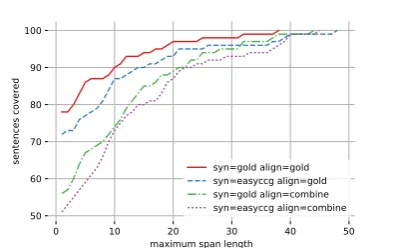
To examine the induction algorithm’s sensitivity to errors propagated from external tools, we compare them with the gold standard annotations available for the consensus-dev set. The results are shown in Figure3.
annota-0 10 20 30 40 50 maximum span length
50 60 70 80 90 100
sentences covered syn=gold align=gold syn=easyccg align=gold syn=gold align=combine syn=easyccg align=combine
(a) Lexical induction coverage with either gold-standard or tool-derived annotations. Tool-derived syntax is from EasyCCG, tool-derived annotations are JAMR/ISI align-ments processed using thecombinestrategy.
Syntax Alignments Lexicon Size
gold gold 7,908
easyccg gold 11,123
gold combine 4,435
easyccg combine 5,401
[image:7.595.84.282.68.192.2] [image:7.595.316.515.102.183.2](b) Sizes of the lexicons induced with different an-notation sources.
Figure 3: Analysis of lexicon induction perfor-mance using gold-standard or tool-derived anno-tations.
tions. Table3bshows an increase in lexicon size when EasyCCG syntax is used, which is likely due to added noise because the ten best derivations are considered instead of a single one. Tool-derived alignments, on the other hand, reduce the lexicon size, because alignment errors force induction to stop early on some sentences.
5 Problematic Phenomena in AMR Is the proposed framework a good fit for analysing the AMR corpus? Figure 3 shows that even if errors from external tools are ruled out, there re-mains a gap of 22% of sentences that are not fully split by the lexical induction algorithm.
To assess the nature of these failures, we group them into error classes. Table 2 provides an overview of the error counts.
Broadly speaking, we identify three types of er-rors: Algorithmic limitations, where parameters of the algorithm prohibit the desired decomposition; mismatches where the CCG and AMR annota-tions choose to represent phenomena in incompat-ible ways; and non-compositional constructions,
where certain AMRs cannot be expressed in our graph algebra.
Error Class Label Count
dependency mismatch dep 15 coreference restriction coref 3
negation neg 2
node duplication dup 2
Table 2: Classification of causes for lexical induction failures, using gold-standard syntax parses and word-to-node alignments, based on the
consensus-devdata set (100 sentences). The remaining 78 sentences were split perfectly. La-bels refer to the paragraphs in Section5.
5.1 Algorithmic Limitations
Restriction of coreference node extraction (coref) In three cases, we observed more than one <coref> node to be required, as exemplified in Figure4c.
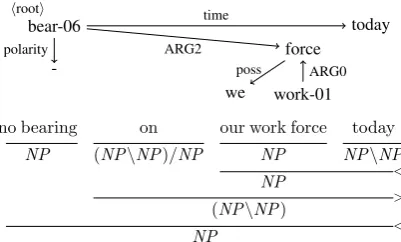
5.2 Mismatches Between CCG and AMR Mismatch of syntactic and semantic dependen-cies (dep) Since the induction algorithm walks the syntax tree and relies strongly on the existence of a parallel structure between syntax and seman-tics, it fails in cases where different dependency structures are present in the syntactic and the se-mantic annotations.
Of the 15 errors in this class, we judged 11 to be “fixable” in that an acceptable CCG derivation could be constructed matching the dependencies on the semantic level. Typically, these are re-lated to ambiguities or annotation errors. Figure
4ashows a typical example.
Treatment of negation (neg) Syntactically, the negatornocan attach to a noun in cases where it semantically modifies the verb, as shown in Fig-ure4b. In AMR, the choice is made to attach po-larity edges to the verb, which prohibits syntactic analysis of such constructions. This is a system-atic difference between CCG and AMR.
[image:7.595.90.273.255.332.2]bear-06 hrooti
force
work-01 today
-we
ARG2
ARG0 time
polarity
poss
no bearing on our work force today
NP (NP\NP)/NP NP NP\NP
< NP
> (NP\NP)
< NP
(a) Example for mismatching syntactic / semantic dependen-cies. Syntactically, a dependency between work forceand todayis annotated, but semantically,todayis dependent on bearing. While a syntax derivation matching the semantic dependencies could be constructed, it has not been annotated in CCGbank. Fromwsj_0003.30.
have-03 hrooti
we
information
useful
-ARG0
ARG1
mod polarity
We have no useful information NP (S[dcl]\NP)/NP NP[nb]/N N
> NP
> S[dcl]\NP
< S[dcl]
(b) Example for the incompatible treatment of negation. The polarity edge ofhave-03does not match the dependency be-tweennoandinformation. Simplified fromwsj_0003.9
settle-01 hrooti
h0i
Indianapolis
meet-03 board
ARG1
ARG0 part ARG0
location
settled on Indianapolis for its board meeting (S[dcl]\NP)/PP PP (S\NP)\(S\NP)
> S[dcl]\NP
< S[dcl]\NP
(c) Example for a phrase with more than one coreference. The phraseits board meetingcontains coreferences both via thelocationandpartedges. TheIndianapolisnode is an ab-breviation for a multi-node named entity subgraph. Simpli-fied fromwsj_0010.3.
and hrooti
operation
sell-01
operation
service-01
operation part
operation
market-01
op1 op2 op3 op4
mod mod mod mod
(d) Example for the duplication of nodes due to coordination. The phrase issales, service, parts and marketing operations. Even though the tokenoperationsoccurs only once, a sepa-rateoperationnode is introduced for each operand of theand conjunction. Fromwsj_0009.2.
chef hrooti
include-91 chef town
hot most
ARG1 ARG2 location
mod degree
[image:8.595.84.285.65.186.2](e) Example for the duplication of nodes due to a partitive. The phrase issome of the hottest chefs in town. The ex-ample illustrate how quantification can lead to nodes be-ing duplicated, such as thechef nodes in this AMR. From wsj_0010.17
Figure 4: Corpus examples for the phenomena described in Section5: mismatching dependencies, treat-ment of negations, number of coreferences, duplication of nodes due to coordination and partitives. Syntax annotations are taken from CCGbank, and semantic annotations are taken from the AMR corpus.
hrooti tell-01
h0i
boy
sleep
ARG0 ARG2
ARG1 ARG0
(a) Meaning representation for told the boy to sleep.
hrooti tell-01
h0i
boy
h1i
ARG0 ARG2
ARG1 ARG0
(b) Induced meaning represen-tation fortold the boy.
hrooti tell-01
h0i
h2i
h1i
ARG0 ARG2
ARG1 ARG0
boy hrooti
sleep hrooti
[image:8.595.315.525.77.188.2](c) Induced meaning representations for told,boy, andsleep.
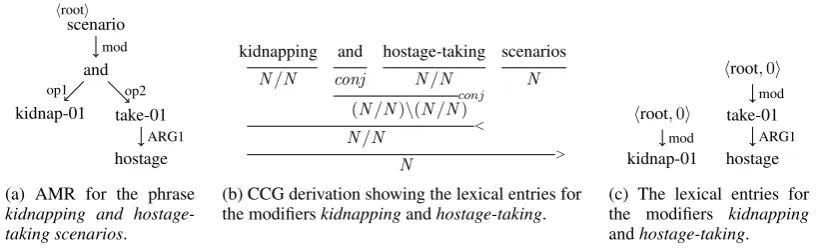
scenario hrooti
and kidnap-01 take-01
hostage
mod
op1 op2
ARG1
(a) AMR for the phrase kidnapping and hostage-taking scenarios.
kidnapping and hostage-taking scenarios
N/N conj N/N N
conj (N/N)\(N/N)
< N/N
> N
(b) CCG derivation showing the lexical entries for the modifierskidnappingandhostage-taking.
hroot,0i
kidnap-01
mod
hroot,0i
take-01 hostage
mod
ARG1
[image:9.595.95.509.64.190.2](c) The lexical entries for the modifiers kidnapping andhostage-taking.
Figure 6: Corpus example for conjunctions of modifiers. The AMR in Figure 6a cannot be com-positionally constructed from the modifier interpretations of kidnapping and hostage-taking because the mod edges present in the lexical entries would have to be destructively modified. Example from
PROXY_AFP_ENG_20020105_0162.12.
are introduced only once lexically, and then copied based on the syntactic context.
Coordination of modifiers2 When modifiers
are the arguments of a conjunction, the conjunc-tion node itself is connected to the modifiee via a
modedge, as shown in Figure6. Given that each of the conjoined modifiers itself has a modedge, these edges need to be merged, moved, or deleted somehow.
6 Conclusion
We have presented a new variant of CCG which performs semantic construction using the opera-tions of a graph algebra instead of combinatory operations on λ-calculus terms. This allows the grammar to construct graph representations di-rectly without going through intermediate repre-sentations. It also restricts the set of possible operations, leading to a compact lexicon. We have demonstrated that under ideal conditions, our grammar achieves a robust coverage of 78% on WSJ sentences.
Our experiments suggest that CCG/AMR is a good overall match for representing the derivation of AMRs. There remain several possibilities for improvement which we leave for future work:
• Allowing the induction algorithm to search over possible derivations and alignments would reduce the influence of both tool er-rors and mismatching annotations. To keep the lexicon manageable, an optimizing induc-tion algorithm would be needed, e.g. using EM.
2This phenomenon has not been observed in the
consensusdata set and is therefore not represented in Ta-ble2.
• An attempt could me made to more strongly
identify placeholders with the argument po-sitions of the corresponding syntactic cate-gories. Among others, this would allow for a more canonical treatment of object con-trol verbs, which is somewhat ad hoc, requir-ing an interpretation of verbs as 0-ary lexical items (see Figure5for an example).
• Additional rules could be introduced to deal with non-compositional phenomena such as the conjunction of modifiers. Statistically, such phenomena appear to be rare, affecting only 2% of the examined corpus.
• Other differences in representation might be resolved statistically or using heuristics. E.g., the fact that negators that attach to a noun syntactically attach to the verb in AMR could be mitigated by a rule that allows for the movement of polarity edges.
Our results represent a promising step towards a more complete grammatical treatment of AMR. Although AMR has not been designed with com-positionality in mind, we have shown that it is pos-sible to construct linguistically motivated compo-sitional derivations.
7 Acknowledgements
We thank Alexander Koller and his group, Chris-tine and Arne Köhn, and the anonymous reviewers for their helpful comments. Part of this work was supported by the DFG (IGK 1247).
References
Yoav Artzi, Kenton Lee, and Luke Zettlemoyer. 2015.
In Proceedings of the 2015 Conference on Empiri-cal Methods in Natural Language Processing, pages 1699–1710, Lisbon, Portugal. Association for Com-putational Linguistics.
Miguel Ballesteros and Yaser Al-Onaizan. 2017.AMR Parsing using Stack-LSTMs. InProceedings of the 2017 Conference on Empirical Methods in Natu-ral Language Processing, pages 1269–1275, Copen-hagen, Denmark. Association for Computational Linguistics.
Laura Banarescu, Claire Bonial, Shu Cai, Madalina Georgescu, Kira Griffitt, Ulf Hermjakob, Kevin Knight, Philipp Koehn, Martha Palmer, and Nathan Schneider. 2013. Abstract Meaning Representation for Sembanking. InProceedings of the 7th Linguis-tic Annotation Workshop and Interoperability with Discourse, pages 178–186, Sofia, Bulgaria. Associ-ation for ComputAssoci-ational Linguistics.
Emily M. Bender, Dan Flickinger, Stephan Oepen, Woodley Packard, and Ann Copestake. 2015. Lay-ers of Interpretation: On Grammar and Compo-sitionality. In Proceedings of the 11th Inter-national Conference on Computational Semantics, pages 239–249, London, UK. Association for Com-putational Linguistics.
Bruno Courcelle and Joost Engelfriet. 2012. Graph Structure and Monadic Second-Order Logic: A Language-Theoretic Approach, 1st edition. Cam-bridge University Press, New York, NY, USA. Jeffrey Flanigan, Sam Thomson, Jaime Carbonell,
Chris Dyer, and Noah A. Smith. 2014. A Discrimi-native Graph-Based Parser for the Abstract Meaning Representation. InProceedings of the 52nd Annual Meeting of the Association for Computational Lin-guistics, pages 1426–1436, Baltimore, Maryland. Association for Computational Linguistics.
Jonas Groschwitz, Meaghan Fowlie, Mark Johnson, and Alexander Koller. 2017. A constrained graph al-gebra for semantic parsing with AMRs. In Proceed-ings of the 12th International Conference on Com-putational Semantics, Montpellier, France. Associa-tion for ComputaAssocia-tional Linguistics.
Julia Hockenmaier and Mark Steedman. 2007. CCG-bank: a corpus of CCG derivations and dependency structures extracted from the Penn Treebank. Com-putational Linguistics, 33(3):355–396.
Matthew Honnibal, James R. Curran, and Johan Bos. 2010. Rebanking CCGbank for Improved NP Inter-pretation. InProceedings of the 48th Annual Meet-ing of the Association for Computational LMeet-inguis- Linguis-tics, pages 207–215, Uppsala, Sweden. Association for Computational Linguistics.
Paul Kingsbury and Martha Palmer. 2002. From Tree-Bank to PropTree-Bank. InProceedings of the Third In-ternational Conference on Language Resources and Evaluation, pages 1989–1993, Las Palmas, Spain. European Language Resources Association.
Kevin Knight, Laura Baranescu, Claire Bonial, Madalina Georgescu, Kira Griffitt, Ulf Hermjakob, Daniel Marcu, Martha Palmer, and Nathan Schnei-der. 2014. Abstract Meaning Representation (AMR) Annotation Release 1.0 LDC2014T12. Linguistic Data Consortium, Philadelphia.
Alexander Koller. 2015. Semantic construction with graph grammars. InProceedings of the 11th Inter-national Conference on Computational Semantics, pages 228–238, London, UK. Association for Com-putational Linguistics.
Tom Kwiatkowski, Luke Zettlemoyer, Sharon Goldwa-ter, and Mark Steedman. 2010. Inducing Probabilis-tic CCG Grammars from Logical Form with Higher-Order Unification. InProceedings of the 2010 Con-ference on Empirical Methods in Natural Language Processing, pages 1223–1233, Cambridge, MA. As-sociation for Computational Linguistics.
Mike Lewis, Luheng He, and Luke Zettlemoyer. 2015.
Joint A* CCG Parsing and Semantic Role Labelling. In Proceedings of the 2015 Conference on Empiri-cal Methods in Natural Language Processing, pages 1444–1454, Lisbon, Portugal. Association for Com-putational Linguistics.
Mike Lewis and Mark Steedman. 2014. A* CCG Pars-ing with a Supertag-factored Model. In Proceed-ings of the 2014 Conference on Empirical Methods in Natural Language Processing (EMNLP), pages 990–1000, Doha, Qatar. Association for Computa-tional Linguistics.
Christopher D. Manning, Mihai Surdeanu, John Bauer, Jenny Finkel, Steven J. Bethard, and David Mc-Closky. 2014. The Stanford CoreNLP Natural Lan-guage Processing Toolkit. InAssociation for Com-putational Linguistics (ACL) System Demonstra-tions, pages 55–60.
Kumar Dipendra Misra and Yoav Artzi. 2016. Neural Shift-Reduce CCG Semantic Parsing. In Proceed-ings of the 2016 Conference on Empirical Methods in Natural Language Processing, pages 1775–1786, Austin, Texas. Association for Computational Lin-guistics.
Rik van Noord and Johan Bos. 2017. Neural Se-mantic Parsing by Character-based Translation: Ex-periments with Abstract Meaning Representations. Computational Linguistics in the Netherlands Jour-nal, 7:93–108.
Xiaochang Peng, Daniel Gildea, and Giorgio Satta. 2018.AMR Parsing with Cache Transition Systems. In Proceedings of the Thirty-Second AAAI Confer-ence on Artificial IntelligConfer-ence, New Orleans, USA. Association for the Advancement of Artificial Intel-ligence.
Grammar based approach for AMR parsing. In Pro-ceedings of the Nineteenth Conference on Compu-tational Natural Language Learning, pages 32–41, Beijing, China. Association for Computational Lin-guistics.
Nima Pourdamghani, Yang Gao, Ulf Hermjakob, and Kevin Knight. 2014. Aligning English Strings with Abstract Meaning Representation Graphs. In Pro-ceedings of the 2014 Conference on Empirical Meth-ods in Natural Language Processing (EMNLP), pages 425–429, Doha, Qatar. Association for Com-putational Linguistics.
Mark Steedman. 2000. The Syntactic Process. MIT Press, Cambridge, MA, USA.