152
Automatic Opinion Question Generation
Yllias Chali University of Lethbridge
4401 University Drive Lethbridge, Alberta, T1K 3M4
Tina Baghaee University of Lethbridge
4401 University Drive Lethbridge, Alberta, T1K 3M4 [email protected]
Abstract
We study the problem of opinion question generation from sentences with the help of community-based question answering systems. For this purpose, we use a se-quence to sese-quence attentional model, and we adopt coverage mechanism to prevent sentences from repeating themselves. Ex-perimental results on the Amazon ques-tion/answer dataset show an improvement in automatic evaluation metrics as well as human evaluations from the state-of-the-art question generation systems.
1 Introduction
Question generation (QG) can be considered as a task which affects many aspects of people’s lives. One of the main significance of the question gen-eration is its capability to improve one’s learning ability. Studies have shown that asking questions can help students realize their knowledge deficits and encourages them to look for information to compensate for those deficits (Graesser and Per-son,1994). Additionally, QG can be used as an aid to search engines by providing suggestions regard-ing the users’ queries (Chali and Hasan, 2015). This way, the users can either choose one of those suggestions or obtain a better idea on how to mod-ify their query to get better results. Moreover, QG can assist the reading comprehension task and the question answering community by providing a ro-bust input for their systems (Serban et al., 2016;
Rajpurkar et al.,2016;Yang et al.,2017).
In this work, we propose a sequence to sequence model that uses attention and coverage mecha-nisms for addressing the question generation prob-lem at the sentence level. The attention and cover-age mechanisms prevent langucover-age generation sys-tems from generating the same word over and over
again, and have been shown to improve a system’s output (See et al.,2017).
We benefit from the community-based question answering systems. Specifically, we use the Ama-zon question/answer dataset (McAuley and Yang,
2016). The sentences are mostly informal and sometimes do not follow the correct grammatical structure. We utilize the answers that people post on the community question answering system as inputs to our model; hence, proposing anopinion question generationsystem which could be used as an interface to online forums helping users in browsing and querying them by making questions as suggestions.
In the subsequent section, we describe the re-lated works to QG. The next section is on the task definition, followed by the demonstration of the model structure. After that, we discuss the exper-imental settings and at the end provide a thorough discussion of our results.
2 Related Work
advantage of semantic information to generate nat-ural language questions for on-line learning sup-port. Chali and Hasan (2015) consider the auto-matic generation of all possible questions from a topic of interest by exploiting the named entity in-formation and the predicate argument structures of the sentences.
Lately, more approaches have been presented that utilize the neural encoder-decoder architec-ture. Serban et al.(2016) address the problem by transducing knowledge graph facts into questions. They created a factoid question and answer corpus by using the Recurrent Neural Network architec-ture.
QG can also be combined with its complemen-tary task, Question Answering (QA) for further improvement.Tang et al.(2017) consider QG and QA as dual tasks and train their relative models simultaneously. Their training framework takes advantage of the probabilistic correlation between the two tasks. QG has also entered other com-munities such as computer vision. Mostafazadeh et al.(2016) introduced the visual question gener-ation task where the goal of the system is to create a question given an image.
One of the latest studies on the QG task has been conducted byDu et al.(2017). Their task is a QG on both sentences and paragraphs for the reading comprehension task, and they adopt an attention-based sequence learning model. Another recent work is byYuan et al.(2017), they generate ques-tions from documents using supervised and rein-forcement learning.
In our work, we generate questions using com-munity questions and answers and apply the encoder-decoder structure. To boost the perfor-mance of our system, we use attention and cover-age mechanisms as suggested inSee et al.(2017).
3 Task Formulation
Given an answerA= (a1, a2, ..., aN), we are go-ing to generate a natural language question Q = (q1, q2, ..., qM), where its answer is embedded in A. Our goal is to find Q such that the con-ditional probability p(Q|A) is maximized. We modelp(Q|A)as a product of word predictions:
p(Q|A) =
M Y
1
p(qt|q1:t−1, A)
This indicates that the probability of eachqt re-lies on the previously generated words and the
in-put sentence A.
4 Model Structure
For modeling p(Q|A), we use the simple RNN encoder-decoder architecture (Cho et al., 2014) with the global attentional model (Luong et al.,
2015), which lets the decoder learn to focus on a particular range of the input sequence during the generation task. To improve upon this model, we apply coverage mechanism (See et al.,2017), which prevents the word repetition problem.
4.1 Encoder
An encoder network maps an input sequence into word vectors and then converts them into hidden statesb1, ..., bN. In our case, the encoder is a two layer bidirectional LSTM network (Hochreiter and Schmidhuber, 1997). We concatenate the output of the forward hidden states−→bj and the backward hidden states ←b−j, namely, bj = [
− →
bj;
←−
bj]for input token j. This bj is used later by the decoder to calculate the context vector ct, which stores the relevant source-side information and simplifies the prediction of the next target word. ctis computed as a weighted sum ofbi:
ct= N X
i=1
at(i)bi (1)
whereatis an alignment vector and is calculated according to the general attention model:
at(i) =
exp(hTtWabi) P
jexp(hTtWabj))
(2)
To initialize the decoder’s hidden state, we con-catenate the hidden states of the forward and the backward pass of the encoder.
4.2 Decoder
The decoder is a two layer unidirectional LSTM. It keeps a coverage vectors, which is the sum of the previous alignment vectors:
st= t−1
X
t0=0
at0
has been covered on the first time step. This cov-erage vector will be added to the source hidden statesbi:
bi = tanh(bi+wsst(i))
Thisbi will be substituted in equations (1) and (2) where ws is a parameter to be learned. This way, with the help ofst, the attention mechanism always has a memory of its past decisions.
The decoder predicts the next wordqtgiven the context vectorct and all the previously predicted words {q1, ..., qt−1}. We use a softmax layer to
produce the predictive distribution:
p(qt|q1:t−1, A) =sof tmax(Wseht)
e
ht is the attentional hidden state which is cal-culated given the target hidden state ht and the source context vectorct:
e
ht= tanh(Wc[ct;ht])
where Ws and Wc are learnable parameters. The hidden state at time step t of the decoder is generated by:
ht=LST M(qt−1, ht−1)
whereqt−1 is the previously generated word and
ht−1is the former hidden state.
Moreover, we use the input feeding approach (Luong et al., 2015), which informs the decoder which words were considered for the past align-ments. We do this by concatenating the attentional hidden state eht with the inputs at the next time steps.
4.3 Training and Generation
The training objective is to minimize the negative log-likelihood of the training corpus. Considering S = {(ai, qi)}
|S|
1 as our whole training data, we
define the objective as:
Jt=
|S|
X
i=1
−logp(qi|ai) (3)
In addition to this primary loss function, it is re-quired to introduce a coverage loss to penalize an overlap between the coverage vector and the at-tention distribution, which means attending to the same location multiple times.
covlosst= X
i
min(at(i), st(i))
After being reweigted by some hyperparame-terλ, this amount is added to equation (3):
Jt=
|S|
X
i=1
−logp(qi|ai) +λcovlosst
In the generation step, we utilize the beam search for the inference to maximize the condi-tional probability.
Since the size of our vocabulary is limited to a small number, many unknown words (UNK) will be generated during the inference. We substitute the (UNK) tokens with the words with the highest attention weight from the source sentence.
5 Experiments
5.1 Dataset
We use the Amazon question/answer dataset (McAuley and Yang,2016). We set the minimum length of the questions to 4 tokens, including the question mark to filter out poorly structured sen-tences. The answers must be at least 10 tokens long. Moreover, we set the maximum length of the questions and the answers to 20 and 35 to-kens, respectively. As there are many URLs in the dataset, we replace them with aURLtoken to re-duce the vocabulary size. We lower-case the entire dataset and use the NLTK toolkit 1 for sentence tokenization. There can be many examples where the questions are not grammatically correct. Peo-ple may just ask: “Waterproof ?”. The same prob-lem occurs with the answers: the answer might be a single “Yes”. We use 80% of the dataset as the training set, and the rest is divided between the validation set and the test set. Table1 shows the total number of examples in each dataset after re-moving very long or very short sentences from the training and the validation datasets.
Train Validation Test # pairs 233729 28969 70648
Table 1: Statistics of the dataset
5.2 Experimental Setting
Our base model is from OpenNMT system (Klein et al.,2017), and we use the PyTorch2 library, a deep learning framework that provides maximum flexibility and speed. It accelerates the computa-tion on both CPU and GPU by a great amount, and the memory usage is extremely efficient in PyTorch compared to other options. We fix the size of the answer and the question vocabularies to 50k. Only the most frequent words are kept, and the rest are replaced with theUNKtoken. We set the word embedding dimension to 300 and we use glove.840B.300d (Pennington et al., 2014) as the pre-trained word embedding on both the encoder and the decoder sides. These embeddings are up-dated during training. The LSTM hidden unit size is set to 600 and we set the number of layers to 2. We employ the stochastic gradient descent (SGD) as the optimization method with an initial learn-ing rate of 1.0 and halve the learnlearn-ing rate after 10 epochs. The training continues for 20 epochs with the batch size of 64 and dropout probability of 0.3. The hyperparameterλ that is used for weighting the coverage loss is set to 13. The decoding is done using the beam search with the beam size of 5, and the generation is stopped when we reach theEOS token. In the end, we choose the model with the lowest perplexity on the validation set.
5.3 Baseline
We compare our model4 to that of Du et al.
(2017). We only experiment with their sentence-level model and run the same Amazon question and answer dataset on the system provided by the first author. We keep the source and target vocab-ulary size the same as ours, (i.e., 50k) and set the maximum and the minimum length of the ques-tions and answers the same as our model. Every-thing else is left to the default values.
5.4 Automatic Evaluation Metrics
For evaluating our system automatically, we use three different evaluation metrics. The first one is BLEU (Papineni et al., 2002) that uses the n-gram similarity between a prediction and a set of references. We calculate BLEU score for un-igrams and bun-igrams. The next one is METEOR
2
http://pytorch.org
3
We also experimented withλ= 2but did not find it to be helpful.
4https://github.com/Tina-19/Question-Generation
(Denkowski and Lavie, 2014), which scores pre-dictions by aligning them to ground truth sen-tences with the help of stemming, synonyms and paraphrases. The last evaluation metric is Rouge (Lin,2004). It compares the generated sentences with the references based on n-gram. For this task, we use ROUGEL, which reports the results based
on the longest common subsequence. We use the evaluation package byChen et al.(2015).
6 Results and Discussion
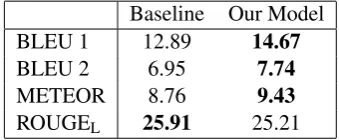
Table 2 shows the results of our system and the baseline. Our model improves the BLEU 1 score by at least 1.5 points. It also achieves a bet-ter result regarding the BLEU 2 and the ME-TEOR whereas the ROUGE is lower than the base-line. If we consider the results reported in Du et al. (2017), we notice that the BLEU scores are much higher compared to our work. The reason is that they use the SQuAD dataset ( Ra-jpurkar et al.,2016), which is a human-generated corpus. The sentences are well-structured, gram-matically correct with fewer unnecessary punctu-ation and colloquialism. However, when work-ing with the community-based question answer-ing systems, the structure of sentences do not al-ways follow the correct path. These sentences of-ten contain useless information and symbols.
Baseline Our Model BLEU 1 12.89 14.67
BLEU 2 6.95 7.74
METEOR 8.76 9.43
ROUGEL 25.91 25.21
Table 2: BLEU 1-2, METEOR and ROUGEL
scores on the test set. Bold numbers demonstrate the best performing system for each evaluation metric.
Another problem is that multiple questions can be generated from a single sentence. The system may generate a question which is correct both se-mantically and grammatically and also asks about accurate information in the sentence. However, if it is not the same as the ground-truth, the results will be affected.
[image:4.595.331.501.461.531.2]Answer 1: I really don’t know, I did full size cupcakes, mini ones it would hold a ton!
GT Question: How many mini-cupcakes will this hold?
DSC:what size is it?
Ours:how many cupcakes will it hold?
Answer 2: Nothing out of the ordinary. just a simple screw driver. if I recall correctly, I think it may have came with the tools needed to assem-ble. good luck and congratulations
GT Question:What tools are required to assem-ble unit?
DSC:What is the assembly required?
Ours:what tools do I need to assemble this?
Answer 3: You can definitely still do pushups with the wraps on. The wraps just give extra sup-port, they really don’t impact your range of mo-tion at all.
GT Question: Can I do pushups while wearing these wraps, or is the material too stiff?
DSC:Can you still use the material while wear-ing the material?
Ours: Can I do pushups while wearing these wraps?
Answer 4: I would go with a medium it fits well and when you adjust it with the helmet it’s tight to the chin.
GT Question: What size to buy for 14 yr old 125lb and 5’5?
DSC:I’m a woman with a small head, what size should I get?
Ours: What size should I get for a child who is 5’6”?
Answer 5: There’s the ability to forward the bp measurement information via email to friends, family and doctors so I assume that once it’s been sent an email you can print - it however I haven’t tested this functionality yet. At the very least when you bring up the bp readings on your screen you can do a screen capture and then print that screen capture.
GT Question:Is it possible to print the BP read-ings?
DSC:What is the difference between the BP and the BP?
Ours:How do you print from the BP?
Figure 1: Examples of generated questions: ground truth (GT),Du et al.(2017) (DSC) and our model, with their answers.
7 Human Evaluations
To further assess the performance of our system, we performed human evaluations on the results. Three English-speaker students were asked to give a score from 1 (very poor) to 5 (very good) to the questions generated from both systems according to two criteria: syntactic correctness and rele-vance. Syntactic correctness indicates the gram-maticality and the fluency and relevance demon-strates whether the question is meaningful and re-lated to the sentence it is generated from. The three assessors performed the evaluations on 100 randomly selected question and answer pairs from the results. The comparison of human evaluations between our system and theDu et al.(2017) model is shown in Table 3. Bold numbers demonstrate the best performing system for each evaluation cri-teria, and we see that our system outperforms the
Du et al.(2017) model on both criteria.
Baseline Our Model Syntactic correctness 4.4 4.52
Relevance 2.93 3.37
Table 3: Human evaluation results for the syntac-tic correctness and relevance between our model andDu et al.(2017).
8 Conclusion
In this work, we presented a sequence to sequence learning model to address the opinion question generation task. We showed the training process using the global attention and applied the cover-age mechanism to improve the model. We took advantage of community-based question answer-ing systems which contain informal speech and its sentences do not always follow grammatical rules. Experimental results show an improvement in the automatic evaluation metrics as well as the human evaluations compared to the baseline system.
Acknowledgements
References
Yllias Chali and Sadid A. Hasan. 2015. Towards topic-to-question generation. Computational Linguistics, 41(1):1–20.
Xinlei Chen, Hao Fang, Tsung-Yi Lin, Ramakr-ishna Vedantam, Saurabh Gupta, Piotr Doll´ar, and C. Lawrence Zitnick. 2015. Microsoft COCO cap-tions: Data collection and evaluation server. arXiv preprint, arXiv:1504.00325.
Kyunghyun Cho, Bart van Merrienboer, Caglar Gulcehre, Dzmitry nau, Fethi Bougares, Holger Schwenk, and Yoshua Bengio. 2014. Learning phrase representations using rnn encoder–decoder for statistical machine translation. InProceedings of the 2014 Conference on Empirical Methods in Nat-ural Language Processing, pages 1724–1734. Asso-ciation for Computational Linguistics.
Michael Denkowski and Alon Lavie. 2014. Meteor universal: Language specific translation evaluation for any target language. In Proceedings of the Ninth Workshop on Statistical Machine Translation, pages 376–380, Baltimore, Maryland. Association for Computational Linguistics.
Xinya Du, Junru Shao, and Claire Cardie. 2017. Learn-ing to ask: Neural question generation for readLearn-ing comprehension. In Proceedings of the 55th An-nual Meeting of the Association for Computational Linguistics (Volume 1: Long Papers), pages 1342– 1352, Vancouver, Canada. Association for Compu-tational Linguistics.
Arthur C. Graesser and Natalie K. Person. 1994. Ques-tion asking during tutoring. American Educational Research Journal, 31(1):104–137.
Michael Heilman and Noah A. Smith. 2010. Good question! statistical ranking for question genera-tion. InHuman Language Technologies: The 2010 Annual Conference of the North American Chap-ter of the Association for Computational Linguistics, pages 609–617.
Sepp Hochreiter and J¨urgen Schmidhuber. 1997. Long short-term memory. Neural Computation, 9:1735– 1780.
G. Klein, Y. Kim, Y. Deng, J. Senellart, and A. M. Rush. 2017. OpenNMT: Open-Source Toolkit for Neural Machine Translation.ArXiv e-prints.
Igor Labutov, Sumit Basu, and Lucy Vanderwende. 2015. Deep questions without deep understanding. In Proceedings of the 53rd Annual Meeting of the Association for Computational Linguistics and the 7th International Joint Conference on Natural Lan-guage Processing, pages 889–898, Beijing, China. Association for Computational Linguistics.
Chin-Yew Lin. 2004. Rouge: a package for automatic evaluation of summaries. In Text Summarization
Branches Out: Proceedings of the ACL-04 Work-shop, pages 74–81, Barcelona, Spain. Association for Computational Linguistics.
David Lindberg, Fred Popowich, John C. Nesbit, and Philip H. Winne. 2013. Generating natural language questions to support learning on-line. In Proceed-ings of the 14th European Workshop on Natural Lan-guage Generation, pages 105–114, Sofia, Bulgaria. Association for Computational Linguistics.
Thang Luong, Hieu Pham, and Christopher D. Man-ning. 2015. Effective approaches to attention-based neural machine translation. InProceedings of the 2015 Conference on Empirical Methods in Natural Language Processing, pages 1412–1421. Associa-tion for ComputaAssocia-tional Linguistics.
Julian McAuley and Alex Yang. 2016. Addressing complex and subjective product-related queries with customer reviews. In Proceedings of the 25th In-ternational Conference on World Wide Web, pages 625–635.
Nasrin Mostafazadeh, Ishan Misra, Jacob Devlin, Mar-garet Mitchell, Xiaodong He, and Lucy Vander-wende. 2016. Generating natural questions about an image. InProceedings of the 54th Annual Meet-ing of the Association for Computational LMeet-inguistics (Volume 1: Long Papers), pages 1802–1813. Asso-ciation for Computational Linguistics.
Kishore Papineni, Salim Roukos, Todd Ward, and Wei-Jing Zhu. 2002. Bleu: a method for automatic eval-uation of machine translation. InProceedings of the 40th Annual Meeting of the Association for Compu-tational Linguistics.
Jeffrey Pennington, Richard Socher, and Christopher Manning. 2014. Glove: Global vectors for word representation. In Proceedings of the 2014 Con-ference on Empirical Methods in Natural Language Processing (EMNLP), pages 1532–1543. Associa-tion for ComputaAssocia-tional Linguistics.
Pranav Rajpurkar, Jian Zhang, Konstantin Lopyrev, and Percy Liang. 2016. Squad: 100,000+ questions for machine comprehension of text. InProceedings of the 2016 Conference on Empirical Methods in Nat-ural Language Processing, pages 2383–2392. Asso-ciation for Computational Linguistics.
Vasile Rus, Brendan Wyse, Paul Piwek, Mihai Lin-tean, Svetlana Stoyanchev, and Cristian Moldovan. 2010. The first question generation shared task eval-uation challenge. In Proceedings of the 6th Inter-national Natural Language Generation Conference, pages 251–257. Association for Computational Lin-guistics.
Iulian V. Serban, Alberto Garc´ıa-Dur´an, C¸ alar G¨ulc¸ehre, Sungjin Ahn, Sarath Chandar, Aaron Courville, and Yoshua Bengio. 2016. Generating factoid questions with recurrent neural networks: The 30m factoid question-answer corpus. In Pro-ceedings of the 54th Annual Meeting of the Associa-tion for ComputaAssocia-tional Linguistics, pages 588–598, Berlin, Germany.
Duyu Tang, Nan Duan, Tao Qin, and Ming Zhou. 2017. Question answering and question generation as dual tasks.arXiv preprint, arXiv:1706.02027.
Zhilin Yang, Junjie Hu, Ruslan Salakhutdinov, and William Cohen. 2017. Semi-supervised qa with generative domain-adaptive nets. InProceedings of the 55th Annual Meeting of the Association for Com-putational Linguistics (Volume 1: Long Papers), pages 1040–1050, Vancouver, Canada. Association for Computational Linguistics.