Proceedings of NAACL-HLT 2018, pages 654–660
Objective Function Learning to Match Human Judgements for
Optimization-Based Summarization
Maxime Peyrard and Iryna Gurevych
Research Training Group AIPHES and UKP Lab
Computer Science Department, Technische Universit¨at Darmstadt www.aiphes.tu-darmstadt.de, www.ukp.tu-darmstadt.de
Abstract
Supervised summarization systems usually rely on supervision at the sentence or n-gram level provided by automatic metrics like ROUGE, which act as noisy proxies for human judgments. In this work, we learn a summary-level scoring functionθincluding human judg-ments as supervision and automatically gener-ated data as regularization. We extract sum-maries with a genetic algorithm usingθas a fit-ness function. We observe strong and promis-ing performances across datasets in both auto-matic and manual evaluation.
1 Introduction
The task of extractive summarization can naturally be cast as a discrete optimization problem where the text source is considered as a set of sentences and the summary is created by selecting an opti-mal subset of the sentences under a length con-straint (McDonald,2007). This view entails defin-ing an objective function which is to be maximized by some optimization technique. In the ideal case, this objective function would encode all the rel-evant quality aspects of a summary, such that by maximizing all these quality aspects we would ob-tain the best possible summary.
However, we find several issues with the ob-jective function in previous work on optimization-based summarization. First, the choice of the ob-jective function is based on ad-hoc assumptions about which quality aspects of a summary are rel-evant (Kupiec et al.,1995). This bias can be miti-gated via supervised techniques guided by data. In practice, these approaches use signals at the sen-tence (Conroy and O’leary,2001;Cao et al.,2015) or n-gram (Hong and Nenkova, 2014; Li et al.,
2013) level and then define a combination func-tion to estimate the quality of the whole summary (Carbonell and Goldstein,1998;Ren et al.,2016).
This combination θ determines the trade-off
be-tween conflicting quality aspects (importance vs redundancy) encoded in the objective function by making simplistic assumptions to ensure conve-nient mathematical properties of θ like linearity
or submodularity (Lin and Bilmes, 2011). This restriction comes from computational considera-tions without conceptual justificaconsidera-tions. More im-portantly, the supervision signal comes from au-tomatic metrics like ROUGE (Lin, 2004) which are convenient but noisy approximations for hu-man judgment.
In this work, we propose to learn the objec-tive functionθ at the summary-level from a pool
of manually annotated system summaries to en-sure the extraction of summaries consideredgood by humans. This explicitly targets the extraction of high-quality summaries as measured by hu-mans and limits undesired gaming of the target evaluation metric. However, the number of data points is relatively low and the learned θ might
not be well-behaved (high θscores for bad
sum-maries) pushing the optimizer to explore regions of the feature space unseen during training where
θ wrongly assumes high scores. To prevent this
scenario, we rely on a large amount of noisy but automatic training data providing supervision on a larger span of the feature space. Intuitively, it can be viewed as a kind of regularization.
By definingθdirectly at the summary-level, one
has access to features like redundancy or global information content without the need to define a combination function from individual sentence scores. Any feature available at the sentence or n-gram level can be transferred to the summary-level (by summation), while the summary-summary-level perspective provides access to new features cap-turing the interactions between sentences. Further-more, recent works have demonstrated that global optimization using genetic algorithms without
posing any mathematical restrictions onθis feasi-ble (Peyrard and Eckle-Kohler,2016).
In summary, our contributions are: (1) We pro-pose to learn a summary-level scoring function
θ and use human judgments as supervision. (2)
We demonstrate a simple regularization strategy based on automatic data generation to improve the behavior of θ under optimization. (3) We
per-form both automatic and manual evaluation of the extracted summaries, which indicate competitive performances.
2 Approach
2.1 Learning setup
Letθ∗ be the observed human judgments. θ∗ can
be manual Pyramid (Nenkova et al.,2007) or over-all responsiveness on a0to5LIKERT scale. We learn a functionθwwith parametersw approximat-ingθ∗ based on a feature setΦ.Φ(S)∈Rdis the
feature representation of a summaryS.
LetT be the set of topics in the training set, and
ST the set of scored summaries for the topicT. The learning problem consists in minimizing the following loss function:
Lω= X
T∈T
X
s∈ST
kθω(Φ(S))−θ∗(S)k2 (1)
While any regression algorithm could be ap-plied, we observed strong performances for the simple linear regression. It is particularly simple and not prone to overfitting.
2.2 Automatic data generation
Few annotated summaries are available (50 per topic) and they cover a small region of the feature space (low variability). θ may wrongly assume
high scores in some parts of the feature space de-spite lack of evidence. The optimizer will explore these regions and output low-quality summaries.
To address this issue, we generate summaries distributed across the feature space. For each feature x, we sample a set of k = 100
sum-maries covering the range of possible values of
x. For sampling, we use the genetic algorithm
recently introduced byPeyrard and Eckle-Kohler
(2016).1Their solver implements a Genetic Algo-rithm (GA) to create and iteratively optimize sum-maries over time. We use default values for the
1https://github.com/UKPLab/
coling2016-genetic-swarm-MDS
reproduction and mutation rate and set the popu-lation size to50. With x as fitness function, the
resulting population is a set of summaries ranging from random to (close to) maximal value. After both maximization and minimization, we obtain
100summaries covering the full range ofx.
In total, we samplem·ksummaries per topic,
wheremis the number of features. We score these
summaries with ROUGE-2 recall (R2), which is a noisy approximation of human judgments but pro-vides indications preventing bad regions from get-ting high scores.
2.3 Summary Extraction
We trained3different scoring functions:θpyrwith manual pyramid annotations; θresp with respon-siveness annotations; and θR2 with our automat-ically generated data.2 The final scoring function is a linear combination:
θ(S) =α1·θpyr(S) +α2·θresp(S) +α3·θR2(S)
Therefore θR2 acts as a regularizer for the θ’s learned with human judgments. 3 It is a simple form of model averaging which combine the dif-ferent information of the 3 difdif-ferent models.
We didn’t constrain θ to have specific
proper-ties like linearity with respect to sentence scores, thus extracting high scoring summaries cannot be done with Integer Linear Programming. Instead, we search an approximate solution by employing the same meta-heuristic solver we used for sam-pling withθas the fitness function.
2.4 Features
Learning a scoring function at the summary-level gives us access to both n-gram/sentence-level fea-tures and summary-level feafea-tures. Sentence-level features can be transferred to the summary-level, while new features capturing the interactions be-tween sentences in the summary become available. As sentence-level features, we used the stan-dard: TF*IDF, n-gram frequency and overlap with the title. As new summary-level features, we used: number of sentences, summary-level redundancy and summary-level n-gram distributions: Jensen-Shannon (JS) divergence with n-gram distribution in the source (Louis and Nenkova,2013).
2We train these models separately because the different
annotations do not lie on the same scale
3We didn’t automatically tune the different values ofα
N-gram Coverage. Each n-gram gi in the doc-uments has a frequencytf(gi), the summarySis scored by:
Covn(S) = X
g∈Sn
tf(gi)
Here Sn is the multiset of n-grams (with repeti-tions) composing S. Also, the frequency can be
computed either by counting the number of occur-rence of the n-gram or by counting the number of documents in which the n-gram appears. For both frequency computations, we extract features for unigrams, bigrams and trigrams.
TF*IDF. Each n-gram gi is also associated its Inverse Document Frequence: idf(gi). The sum-marySis scored by:
T F ∗IDFn(S) = X
g∈Sn
tf(gi)∗idf(gi)
Here Sn is the multiset of n-grams (with repeti-tions) composing the summaryS. We also extract
features for both frequency computations for uni-grams, bigrams and trigrams.
Overlap with title. We measure the proportion of n-grams from the title that appear in the sum-mary:
Overlapn(S) = |
Tn∩Sn|
Tn
WhereTn is the multiset of n-grams in the title, and Sn is the multiset of n-grams in the sum-mary. We compute it for unigrams, bigrams and trigrams.
Number of sentences. We also use the number of sentences inS as a feature because summaries
with a lot of sentences tend to have very short and meaningless sentences.
Redundancy. Previous features were at the sentence-level, we obtained features for the whole summary by summation over sentences. How-ever, the redundancy ofS cannot be computed at the sentence-level. This is an example of features available at the summary-level but not available at the sentence-level. We define it as the number of unique n-gram types (|Un|) in the summary di-vided by the total number of n-gram tokens (the length ofS)
Redn(S) = |
Un| |Sn|
Where Un is the set of n-grams (without repeti-tions) composing S and Sn is the multiset of n-grams (with repetitions).
Divergences. This is another feature that can only be computed at the summary-level inspired byHaghighi and Vanderwende(2009) andPeyrard and Eckle-Kohler(2016). We compute the KL di-vergence and JS didi-vergence between n-gram prob-ability distributions of the summaries and of the documents. The probability distributions are built from the two kinds of frequency distributions and for unigrams, bigrams and trigrams.
3 Experiments
Dataset We use two multi-document summa-rization datasets from the Text Analysis Confer-ence (TAC) shared tasks: 2008 and TAC-2009.4 TAC-2008 and TAC-2009 contain 48 and 44 topics, respectively. Each topic consists of 10 news articles to be summarized in a maximum of 100 words. We use only the so-called initial sum-maries (A sumsum-maries), but not the update part.
We used these datasets because all system sum-maries and the 4 reference sumsum-maries were man-ually evaluated by NIST assessors for content se-lection (with Pyramid) and overall responsiveness. At the time of the shared tasks, 57 systems were submitted to TAC-2008 and 55 to TAC-2009. For our experiments, we use the Pyramid and the re-sponsiveness annotations.
With our notations, for example with TAC-2009, we haven = 55scored system summaries,
m = 44topics,Di contains 10 documents andθi contains 4 reference summaries.
We also use the recently created German dataset DBS (Benikova et al., 2016) which contains 10 heterogeneous topics. For each topic, 5 summaries were evaluated by trained human annotators but only for content selection with Pyramid. The sum-maries have variable sizes and are about 500 words long.
Baselines (1) ICSI (Gillick and Favre, 2009) is a global linear optimization approach that ex-tracts a summary by solving a maximum coverage problem considering the most frequent bigrams in the source documents. ICSI has been among the best systems in a standard ROUGE evalua-tion (Hong et al., 2014). (2) LexRank (Erkan
4http://tac.nist.gov/2009/
ρ NDCG Best-Baseline-R .594 .505
θR2 .663 .536
Best-Baseline-Pyr .492 .715
θpyr .554 .780
Best-Baseline-Resp .367 .710
[image:4.595.105.256.63.156.2]θresp .391 .741
Table 1: Performance of learned θ’s compared to the best baselines for each type annotation types.
and Radev,2004) is a graph-based approach com-puting sentence centrality based on the PageRank algorithm. (3) KL-Greedy (Haghighi and Van-derwende,2009) minimizes the Kullback-Leibler (KL) divergence between the word distributions in the summary and the documents. (3)Peyrard and Eckle-Kohler(2016) optimize JS divergence with a genetic algorithm. (4) Finally, SFOUR is a su-pervised structured prediction approach that trains an end-to-end on a convex relaxation of ROUGE (Sipos et al.,2012).
Objective function learning In this section, we measure how well our models can predict human judgments. We train each θ in a leave-one-out cross-validation setup for each dataset and com-pare their performance to the summary scoring function of baselines like it was done previously (Peyrard and Eckle-Kohler,2017). Each individ-ual feature is also included in the baselines.
Correlations are measured with two comple-mentary metrics: Spearman’s ρ and Normalized
Discounted Cumulative Gain (NDCG). Spear-man’sρ is a rank correlation metric, which
com-pares the ordering of systems induced byθand the
ordering of systems induced by human judgments. NDCG is a metric that compares ranked lists and puts more emphasis on the top elements with log-arithmic decay weighting. Intuitively, it captures how wellθcan recognize the best summaries. The
optimization scenario benefits from high NDCG scores because only summaries with highθscores
are extracted.
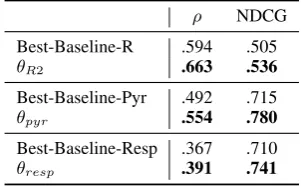
The results are presented in Table 1. For sim-plicity, we report the average over the 3 datasets. Each θ is compared against the best performing
baseline for the data annotation type it was trained on (R2, responsiveness or pyramid).5 The trained models perform substantially and consistently bet-5Best baseline for R2 and Responsiveness is: KL
diver-gence on bigrams; for Pyramid: KL diverdiver-gence on unigrams
ter than the best baselines. They have a high cor-relation with human judgments and are capable of identifyinggoodsummaries.
However, we need to test whether the combi-nation of the threeθ’s is well behaved under
op-timization. For this, we perform an evaluation of the summaries extracted by the genetic optimizer.
Summaries Evaluation Now, we evaluate the summaries extracted by the genetic optimizer with
θas fitness function (noted (θ, Gen)). We still train θwith leave-one-out cross-validation.
To evaluate summaries, we report the ROUGE variant identified by Owczarzak et al. (2012) as strongly correlating with human evaluation meth-ods: ROUGE-2 (R2) recall with stemming and stopwords not removed. We also report JS2, the Jensen-Shannon divergence between bigrams in the reference summaries and the candidate system summary (Lin et al.,2006). The last metric is S3 (Peyrard et al., 2017), a combination of several existing metrics trained explicitly to maximize its correlation with human judgments.
Finally, our approach aims at improving sum-marization systems based on human judgments, therefore we also set up a manual evaluation for the two English datasets. Two annotators were given the summaries of every system for 10 ran-domly selected topic of both 2008 and TAC-2009. They annotated (with a Cohen’s kappa of 0.73) summaries on a LIKERT scale following the responsiveness guidelines.
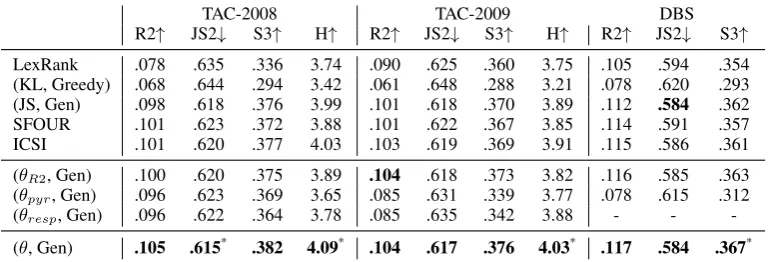
The results are reported in Table 2. We per-form significance testing with Approximate Ran-dom Testing to compare differences between two means in cross-validation6.
While θ’s trained on human judgments have a
high correlation with human judgments, they be-have badly under optimization. This effect is much less visible for θR2 because the data points have been sampled to cover the feature space. We ob-serve the effectiveness of the regularization be-cause eachθR2/pyr/resp performs much worse
in-dividually than the combinedθ. We also note that (θR2, Gen) performs on par with the other super-vised baseline SFOUR but both are outperformed by exploiting human judgments. (θ, Gen) is
con-sistently and often significantly better than base-lines across datasets and metrics. In particular, humans tend to prefer the summaries extracted by 6The symbol * indicates that the difference compared to
TAC-2008 TAC-2009 DBS R2↑ JS2↓ S3↑ H↑ R2↑ JS2↓ S3↑ H↑ R2↑ JS2↓ S3↑ LexRank .078 .635 .336 3.74 .090 .625 .360 3.75 .105 .594 .354 (KL, Greedy) .068 .644 .294 3.42 .061 .648 .288 3.21 .078 .620 .293 (JS, Gen) .098 .618 .376 3.99 .101 .618 .370 3.89 .112 .584 .362 SFOUR .101 .623 .372 3.88 .101 .622 .367 3.85 .114 .591 .357 ICSI .101 .620 .377 4.03 .103 .619 .369 3.91 .115 .586 .361 (θR2, Gen) .100 .620 .375 3.89 .104 .618 .373 3.82 .116 .585 .363
(θpyr, Gen) .096 .623 .369 3.65 .085 .631 .339 3.77 .078 .615 .312
(θresp, Gen) .096 .622 .364 3.78 .085 .635 .342 3.88 - -
[image:5.595.107.492.64.195.2]-(θ, Gen) .105 .615* .382 4.09* .104 .617 .376 4.03* .117 .584 .367*
Table 2: Comparison of systems across 3 datasets evaluated with ROUGE-2 recall; JS divergence on
bigrams; S3 and Human annotations.
(θ, Gen). Manual inspection of summaries reveals
that (θ, Gen) has lower redundancy than previous
baselines thanks to summary-level features.
Important Features Since we used a linear re-gression, we can estimate the contribution of a feature by the amplitude of its associated weight. The two best features (n-gram distributions and redundancy) are summary-level features, which confirms the advantage of using a summary-level scoring function.
4 Related Work and Discussion
Supervised summarization started with Kupiec et al.(1995) who observed that there is no prin-cipled method to select and weight relevant fea-tures. Previous work focused on predicting sen-tence (Conroy and O’leary,2001;Cao et al.,2015) or n-gram (Hong and Nenkova, 2014; Li et al.,
2013) scores and then defining a composition function to get a score for the summary. This combination usually accounts for redundancy or coherence (Nishikawa et al., 2014) in an ad-hoc fashion (Carbonell and Goldstein,1998;Ren et al.,
2016). Structure prediction has been investigated to learn the composition function as well (Sipos et al.,2012;Takamura and Okumura,2010). The supervision is always provided by automatic met-rics, whereas we incorporate human judgments as supervision and learn from it directly at the summary-level. We note thatHe et al.(2006) and
Peyrard and Eckle-Kohler(2016) have used a scor-ing function at the summary-level but these ap-proaches are unsupervised.
One of the challenges we face is the lack of data with human judgments. We hope that this work will encourage efforts to create new and large datasets as they will be decisive for the progress
of summarization. Indeed, systems trained only with automatic metrics can only be as good as the metrics are as a proxy for humans.
We used simple features but using more com-plex and semantic features is promising. Indeed, two syntactically similar but semantically different summaries cannot be distinguished by ROUGE, which diminishes the usefulness of semantic fea-tures. However, humans can distinguish them, thus inducing better usage of such features.
Another promising direction is to investigate more sophisticated ways of combining the human judgments with the automatically generated data. For example, by exploiting techniques from semi-supervised learning (Zhu et al., 2009) or by dy-namically sampling unseen regions of the feature space with active learning (Settles,2009).
5 Conclusion
We proposed an approach to learn a summary-level scoring functionθwith human judgments as
supervision and automatically generated data as regularization. The summaries subsequently ex-tracted with a genetic algorithm are of high qual-ity according to both automatic and manual evalu-ation. We hope this work will encourage more re-search directed towards the generation and usage of human judgment datasets.
Acknowledgements
References
Darina Benikova, Margot Mieskes, Christian M. Meyer, and Iryna Gurevych. 2016. Bridging the Gap Between Extractive and Abstractive Summaries: Creation and Evaluation of Coherent Extracts from Heterogeneous Sources. InProceedings of the 26th International Conference on Computational Lin-guistics (COLING), pages 1039 – 1050.
Ziqiang Cao, Furu Wei, Sujian Li, Wenjie Li, Ming Zhou, and Houfeng Wang. 2015. Learning sum-mary prior representation for extractive summariza-tion. InProceedings of the 53rd Annual Meeting of the Association for Computational Linguistics and the 7th International Joint Conference on Natural Language Processing (IJCNLP), pages 829–833.
Jaime Carbonell and Jade Goldstein. 1998. The Use of MMR, Diversity-based Reranking for Reordering Documents and Producing Summaries. In Proceed-ings of the 21st Annual International ACM SIGIR Conference on Research and Development in Infor-mation Retrieval, pages 335–336.
John M. Conroy and Dianne P. O’leary. 2001. Text summarization via hidden markov models. In Pro-ceedings of the 24th Annual International ACM SI-GIR Conference on Research and Development in Information Retrieval, pages 406–407.
G¨unes Erkan and Dragomir R. Radev. 2004. LexRank: Graph-based Lexical Centrality As Salience in Text Summarization. Journal of Artificial Intelligence Research, pages 457–479.
Dan Gillick and Benoit Favre. 2009.A Scalable Global Model for Summarization. In Proceedings of the Workshop on Integer Linear Programming for Natu-ral Language Processing (ILP’09), pages 10–18.
Aria Haghighi and Lucy Vanderwende. 2009. Explor-ing Content Models for Multi-document Summa-rization. InProceedings of Human Language Tech-nologies: The 2009 Annual Conference of the North American Chapter of the Association for Computa-tional Linguistics, pages 362–370.
Yan-xiang He, De-xi Liu, Dong-hong Ji, Hua Yang, and Chong Teng. 2006. MSBGA: A Multi-Document Summarization System Based on Genetic Algorithm. In 2006 International Conference on Machine Learning and Cybernetics, pages 2659– 2664.
Kai Hong, John Conroy, benoit Favre, Alex Kulesza, Hui Lin, and Ani Nenkova. 2014. A Repository of State of the Art and Competitive Baseline Sum-maries for Generic News Summarization. In Pro-ceedings of the Ninth International Conference on Language Resources and Evaluation (LREC’14), pages 1608–1616.
Kai Hong and Ani Nenkova. 2014. Improving the Estimation of Word Importance for News Multi-Document Summarization. In Proceedings of the
14th Conference of the European Chapter of the Association for Computational Linguistics (EACL), pages 712–721.
Julian Kupiec, Jan Pedersen, and Francine Chen. 1995.
A Trainable Document Summarizer. InProceedings of the 18th Annual International ACM SIGIR Con-ference on Research and Development in Informa-tion Retrieval, pages 68–73.
Chen Li, Xian Qian, and Yang Liu. 2013. Using Su-pervised Bigram-based ILP for Extractive Summa-rization. InProceedings of the 51st Annual Meet-ing of the Association for Computational LMeet-inguistics (ACL), pages 1004–1013.
Chin-Yew Lin. 2004. ROUGE: A Package for Au-tomatic Evaluation of summaries. In Proceedings of ACL workshop on Text Summarization Branches Out, pages 74–81, Barcelona, Spain.
Chin-Yew Lin, Guihong Cao, Jianfeng Gao, and Jian-Yun Nie. 2006. An Information-Theoretic Approach to Automatic Evaluation of Summaries. In Pro-ceedings of the Human Language Technology Con-ference at NAACL, pages 463–470, New York City, USA.
Hui Lin and Jeff A. Bilmes. 2011. A Class of Submod-ular Functions for Document Summarization. In
Proceedings of the 49th Annual Meeting of the Asso-ciation for Computational Linguistics (ACL), pages 510–520, Portland, Oregon.
Annie Louis and Ani Nenkova. 2013. Automati-cally Assessing Machine Summary Content With-out a Gold Standard. Computational Linguistics, 39(2):267–300.
Ryan McDonald. 2007. A Study of Global Inference Algorithms in Multi-document Summarization. In
Proceedings of the 29th European Conference on In-formation Retrieval Research, pages 557–564.
Ani Nenkova, Rebecca Passonneau, and Kathleen McKeown. 2007. The Pyramid Method: Incorpo-rating Human Content Selection Variation in Sum-marization Evaluation.ACM Transaction on Speech and Language Processing, 4.
Hitoshi Nishikawa, Kazuho Arita, Katsumi Tanaka, Tsutomu Hirao, Toshiro Makino, and Yoshihiro Matsuo. 2014. Learning to generate coherent summary with discriminative hidden semi-markov model. In Proceedings of the 25th International Conference on Computational Linguistics (COL-ING), pages 1648–1659.
Maxime Peyrard, Teresa Botschen, and Iryna Gurevych. 2017. Learning to Score System Summaries for Better Content Selection Evaluation. In Proceedings of the EMNLP workshop New Frontiers in Summarization, pages 74–84.
Maxime Peyrard and Judith Eckle-Kohler. 2016.
A General Optimization Framework for Multi-Document Summarization Using Genetic Algo-rithms and Swarm Intelligence. InProceedings of the 26th International Conference on Computational Linguistics (COLING), pages 247 – 257.
Maxime Peyrard and Judith Eckle-Kohler. 2017. A Principled Framework for Evaluating Summarizers: Comparing Models of Summary Quality against Hu-man Judgments. InProceedings of the 55th Annual Meeting of the Association for Computational Lin-guistics (ACL 2017), volume Volume 2: Short Pa-pers. Association for Computational Linguistics.
Pengjie Ren, Furu Wei, Zhumin Chen, Jun Ma, and Ming Zhou. 2016. A redundancy-aware sentence regression framework for extractive summarization. In26th International Conference on Computational Linguistics, Proceedings of the Conference, pages 33–43.
Burr Settles. 2009. Active Learning Literature Survey. Computer Sciences Technical Report 1648, Univer-sity of Wisconsin–Madison.
Ruben Sipos, Pannaga Shivaswamy, and Thorsten Joachims. 2012. Large-margin Learning of Sub-modular Summarization Models. InProceedings of the 13th Conference of the European Chapter of the Association for Computational Linguistics (EACL), pages 224–233.
Hiroya Takamura and Manabu Okumura. 2010. Learn-ing to Generate Summary as Structured Output. In
Proceedings of the 19th ACM international Confer-ence on Information and Knowledge Management, pages 1437–1440.