Proceedings of NAACL-HLT 2018, pages 764–769
Learning to Color from Language
Varun ManjunathaF♠ Mohit IyyerF†‡ Jordan Boyd-Graber♠♣♦ Larry Davis♠
University of Maryland : Computer Science♠, Language Science♦, iSchool♣, UMIACS Allen Institute of Artificial Intelligence† University of Massachusetts, Amherst‡ {varunm@cs, jbg@umiacs, lsd@umiacs}.umd.edu [email protected]
Abstract
Automatic colorization is the process of adding color to greyscale images. We condi-tion this process on language, allowing end users to manipulate a colorized image by feed-ing in different captions. We present two dif-ferent architectures for language-conditioned colorization, both of which produce more accurate and plausible colorizations than a language-agnostic version. Through this language-based framework, we can dramati-cally alter colorizations by manipulating de-scriptive color words in captions.
1 Introduction
Automatic image colorization (Cheng et al.,2015;
Larsson et al., 2016; Zhang et al., 2016; Iizuka et al.,2016;Deshpande et al.,2017)—the process of adding color to a greyscale image—is inherently underspecified. Unlike background scenery such as sky or grass, many common foreground objects could plausibly be of any color, such as a person’s clothing, a bird’s feathers, or the exterior of a car. Interactive colorization seeks human input, usually in the form of clicks or strokes on the image with a selected color, to reduce these ambiguities (Levin et al.,2004;Huang et al.,2005;Endo et al.,2016;
Zhang et al.,2017). We introduce the task of col-orization from natural language, a previously unex-plored source of color specifications.
Many use cases for automatic colorization in-volve images paired with language. For example, comic book artwork is normally first sketched in black-and-white by a penciller; afterwards, a col-orist selects a palette that thematically reinforces the written script to produce the final colorized art. Similarly, older black-and-white films are often col-orized for modern audiences based on cues from dialogue and narration (Van Camp,1995).
FAuthors contributed equally
Language is a weaker source of supervision for colorization than user clicks. In particular, lan-guage lacks ground-truth information about the colored image (e.g., the exact color of a pixel or region). Given a description likea blue motorcy-cle parked next to a fleet of sedans, an automatic colorization system must first localize the motorcy-cle within the image before deciding on a context-appropriate shade of blue to color it with. The chal-lenge grows with abstract language: a red color palette likely suits an artistic rendering ofthe boy threw down his toy in a ragebetter than it doesthe boy lovingly hugged his toy.
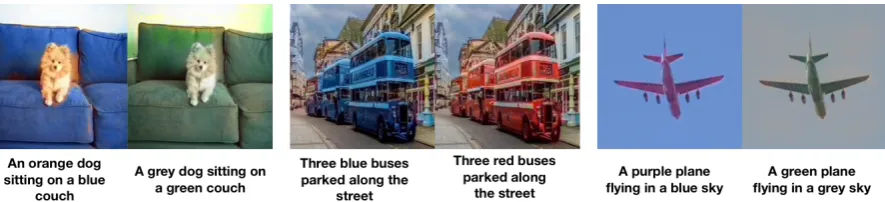
We present two neural architectures for language-based colorization that augment an exist-ing fully-convolutional model (Zhang et al.,2016) with representations learned from image captions. As a sanity check, both architectures outperform a language-agnostic model on an accuracy-based col-orization metric. However, we are more interested in whether modifications to the caption properly manifest themselves in output colorizations (e.g., switching one color with another); crowdsourced evaluations confirm that our models properly local-ize and color objects based on captions (Figure1).
2 Model
This section provides a quick introduction to color spaces (Sec.2.1) and then describes our baseline colorization network (Sec.2.2) alongside two mod-els (Sec.2.3) that colorize their output on represen-tations learned from language.
2.1 Images and color spaces
An image is usually represented as a three dimen-sional tensor with red, green and blue (RGB)
chan-nels. Each pixel’s color and intensity (i.e., light-ness) arejointlyrepresented by the values of these three channels. However, in applications such as
Figure 1: Three pairs of images whose colorizations are conditioned on corresponding captions by our FILM architecture. Our model can localize objects mentioned by the captions and properly color them.
colorization, it is more convenient to use represen-tations that separately encode lightness and color. Thesecolor spacescan be obtained through mathe-matical transformations of the RGB color space; in this work, following Zhang et al.(2016), we use theCIELabspace (Smith and Guild,1931). Here,
the first channel (L) encodes only lightness (i.e., black-and-white). The two color channelsaand brepresent color values between green to red and
blue to yellow, respectively. In this formulation, the task of colorization is equivalent to taking the light-ness channel of an image as input and predicting the two missing color channels.
2.2 Fully-convolutional networks for colorization
FollowingZhang et al.(2016), we treat coloriza-tion as a classificacoloriza-tion problem inCIELabspace:
given only the lightness channelLof an image (i.e., a greyscale version), a fully-convolutional network predicts values for the two color channelsaandb. For efficiency, we deviate fromZhang et al.(2016) by quantizing the color channels into a 25×25 grid, which results in 625 labels for classification. To further speed up training, we use a one-hot encod-ing for theabchannels instead of soft targets as in Zhang et al. (2016); preliminary experiments showed no qualitative difference in colorization quality with one-hot targets. The contribution of each label to the loss is downweighted by a factor inversely proportional to its frequency in the train-ing set, which prevents desaturatedabvalues. Our baseline network architecture (FCNN) consists of eight convolutional blocks, each of which contains multiple convolutional layers followed by batch normalization (Ioffe and Szegedy,2015).1 Next,
we propose two ways to integrate additional text
1SeeZhang et al.(2016) for complete architectural de-tails. Code and pretrained models are available athttps: //github.com/superhans/colorfromlanguage.
abAccuracy Human Experiments Model acc@1 acc@5 plaus. qual. manip.
[image:2.595.81.524.61.162.2]FCNN 15.4 45.8 20.4 32.6 N/A CONCAT 17.9 50.3 39.0 34.1 77.4 FILM 23.7 60.5 40.6 32.1 81.2
Table 1: WhileFILMis the most accurate model inab space, its outputs are about as contextually plausible asCONCAT’s according to ourplausibilitytask, which asks workers to choose which model’s output best de-picts a given caption (however, both models signifi-cantly outperform the language-agnosticFCNN). This additional plausibility does not degrade the output, as shown by ourqualitytask, which asks workers to distin-guish an automatically-colorized image from a real one. Finally, our captionmanipulationexperiment, in which workers are guided by a caption to select one of three outputs generated with varying color words, shows that modifying the caption significantly affects the outputs ofCONCATandFILM.
input intoFCNN.
2.3 Colorization conditioned on language Given an imageIpaired with a unit of textT, we first encode T into a continuous representation h using the last hidden state of a bi-directional
LSTM (Hochreiter and Schmidhuber,1997). We
integratehinto every convolutional block of the FCNN, allowing language to influence the compu-tation of all intermediate feature maps.
Specifically, say Zn is the feature map of the nth convolutional block. A conceptually simple
way to incorporate language into this feature map is to concatenatehto the channels at each spatial locationi, jinZn, forming a new feature map
Z0
ni,j = [Zni,j;h]. (1)
a green pickup truck next to trees
x8 + CONV
batch norm
[image:3.595.77.282.67.191.2]FiLM
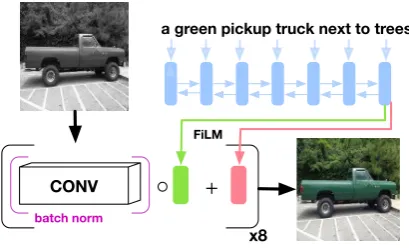
Figure 2: FILMapplies feature-wise affine transforma-tions (conditioned on language) to the output of each convolutional block in our architecture.
Feichtenhofer et al., 2016), it requires consider-ably more parameters than the FCNN due to the additional language channels.
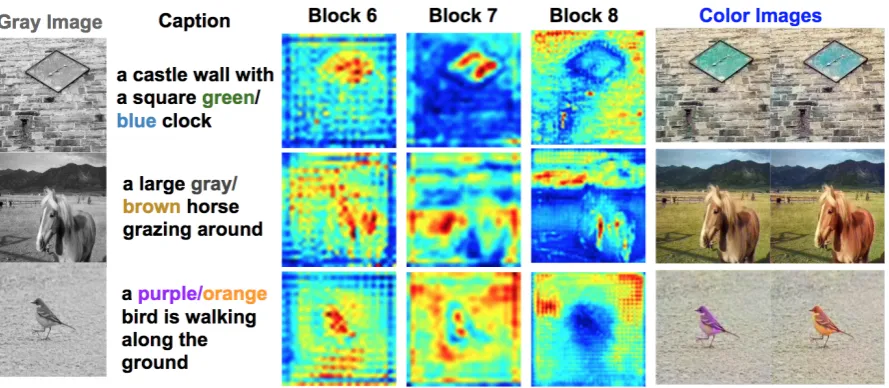
Inspired by recent work on visual question an-swering, we also experiment with a less parameter-hungry approach, feature-wise linear modula-tion (Perez et al.,2018,FILM), to fuse the language and visual representations. Since the activations ofFILMlayers have attention-like properties when trained on VQA, we also might expect FILM to be better at localizing objects from language than CONCATon colorization (see Figure4for heatmap visualizations).
FILMapplies a feature-wise affine transforma-tion to the output of each convolutransforma-tional block, where the transformation weights are conditioned on language (Figure2). GivenZnandh, we first
compute two vectors γn and βn through linear projection,
γn=Wnγh βn=Wnβh, (2)
whereWnγ andWnβ are learned weight matrices. The modulated feature map then becomes
Z0
ni,j = (1 +γn)◦Zni,j+βn, (3)
where◦denotes the element-wise product. Com-pared toCONCAT,FILMis parameter-efficient, re-quiring just two additional weight matrices per fea-ture map.
3 Experiments
We evaluateFCNN,CONCAT, andFILMusing ac-curacy inabspace (shown byZhang et al.(2016) to be a poor substitute for plausibility) and with crowdsourced experiments that ask workers to judge colorization plausibility, quality, and the
colorization flexibly reflects language manipula-tions. Table1summarizes our results; while there is no clear winner between FILM and CONCAT, both rely on language to produce higher-quality colorizations than those generated byFCNN.
3.1 Experimental setup
We train all of our models on the 82,783 images in theMSCOCO(Lin et al.,2014) training set, each
of which is paired with five crowdsourced cap-tions. Training from scratch onMSCOCOresults in
poor quality colorizations due to a combination of not enough data and increased image complexity compared to ImageNet (Russakovsky et al.,2015). Thus, for our final models, we initialize all convolu-tional layers with aFCNNpretrained on ImageNet; we finetune both FILM and CONCAT’s convolu-tional weights during training. To automatically evaluate the models, we compute 1 and top-5 accuracy in our quantizedaboutput space2 on
theMSCOCOvalidation set. WhileFILMachieves the highestab accuracy, FILM and CONCAT do not significantly differ on crowdsourced evaluation metrics.
3.2 Human experiments
We run three human evaluations of our models on the Crowdflower platform to evaluate their plausi-bility, overall quality, and how well they condition their output on language. Each evaluation is run using a random subset of 100 caption/image pairs from theMSCOCOvalidation set,3 and we obtain
five judgments per pair.
Plausibility given caption: We show workers a caption along with three images generated by FCNN, CONCAT, andFILM. They choose the age that best depicts the caption; if multiple im-ages accurately depict the caption, we ask them to choose the most realistic. FCNNdoes not receive the caption as input, so it makes sense that its out-put is only chosen 20% of the time; there is no significant difference betweenCONCATandFILM in plausibility given the caption.
Colorizationquality: Workers receive a pair of images, a ground-truthMSCOCOimage and a
gen-erated output from one of our three architectures, 2We evaluate accuracy at the downsampled 56
×56 resolu-tion at which our network predicts colorizaresolu-tions. For human experiments, the prediction is upsampled to 224×224.
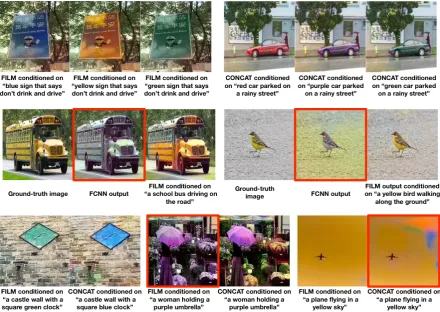
Figure 3: The top row contains successes from our caption manipulation task generated byFILMandCONCAT, respectively. The second row shows examples of how captions guideFILMto produce more accurate colorizations thanFCNN (failure cases outlined inred). The final row contains, from left to right, particularly eye-catching colorizations from bothCONCAT andFILM, a case whereFILMfails to localize properly, and an image whose unnatural caption causes artifacts inCONCAT.
and are asked to choose the image that was not
colored by a computer. The goal is to fool workers into selecting the generated images; the “fooling rates” for all three architectures are comparable, which indicates that we do not reduce colorization quality by conditioning on language.
Captionmanipulation: Our last evaluation mea-sures how much influence the caption has on the CONCATandFILMmodels. We generate three dif-ferent colorizations of a single image by swapping out different colors in the caption (e.g.,blue car,
red car,green car). Then, we provide workers with a single caption (e.g.,green car) and ask them to choose which image best depicts the caption. If our models cannot localize and color the appropriate object, workers will be unable to select an appro-priate image. Fortunately,CONCATandFILMare both robust to caption manipulations (Table1).
4 Discussion
Both CONCAT and FILM can manipulate image color from captions (further supported by the top row of Figure3). Here, we qualitatively examine model outputs and identify potential directions for improvement.
Language-conditioned colorization depends on correspondences between language and color statis-tics (stop signsare always red, andschool buses
are always yellow). While this extra information helps us produce more plausible colorizations com-pared to language-agnostic models (second row of Figure3), it biases models trained on natural images against unnatural colorizations. For exam-ple, the yellow sky produced by CONCATin the bottom right of Figure3contains blue artifacts be-cause skies are usually blue inMSCOCO.
Figure 4: Examples of intermediate layer activations while generating colorized images using theFILMnetwork. These activation maps correspond to the mean activation immediately after theFILMlayers of the sixth, seventh, and eighth blocks. Interestingly, the activations after theFILMlayer of Block 6 always seems to focus on the object that is to be colorized, while those of Block 8 focus almost exclusively on the background. The activation maps do not significantly differ when color words in the caption are manipulated; therefore, we show maps only for the first color word in these examples.
into smaller objects from larger ones, as shown byFILM’s colorizations of purple plants (Figure3, bottom-middle) and yellow tires (middle-left).
Figure4 shows activation maps from interme-diate layers generated while colorizing images us-ing theFILMnetwork. Each intermediate layer is captured immediately after theFILMlayer and is of dimension h×w×c (e.g., 112×112×64, 28×28×512, etc.), wherehis the height of the
feature map,w is its width, andc is the number
of channels.4 On inspection, the first few
activa-tion maps correspond to edges and are not visually interesting. However, we notice that the sixth acti-vation map usually focuses on the principal subject of the image (such as a car or a horse), while the eighth activation map focused everywhere but on that subject (i.e., entirely on the background). This analysis demonstrates that theFILMlayer emulates visual attention, reinforcing similar observations on visual QA datasets byPerez et al.(2018).
5 Future Work
While these experiments are promising, that there are many avenues to improve language-conditioned colorization. From a vision perspective, we would like to more accurately colorize parts of objects (e.g., a person’s shoes); moving to more complex
ar-4We compute the mean across thecdimension and scale the resultingh×wfeature map between the limits [0, 255].
chitectures such as variational autoencoders ( Desh-pande et al., 2017) or PixelCNNs (Guadarrama et al.,2017) might help here, as could increasing training image resolution. We also plan on using refinement networks (Shrivastava et al.,2017) to correct for artifacts in the colorized output image. On the language side, moving from explicitly spec-ified colors to abstract or emotional language is a particularly interesting. We plan to train our models on dialogue/image pairs from datasets such as COMICS (Iyyer et al.,2017) and visual
story-telling (Huang et al., 2016); these models could also help learn powerful joint representations of vision and language to improve performance on downstream prediction tasks.
Acknowledgement
Manjunatha and Davis are partially supported by the Office of Naval Research under Grant N000141612713: Visual Common Sense Reason-ing. Boyd-Graber is supported byNSFGrantIIS
References
Zezhou Cheng, Qingxiong Yang, and Bin Sheng. 2015. Deep colorization. InInternational Conference on Computer Vision.
Aditya Deshpande, Jiajun Lu, Mao-Chuang Yeh, Min Jin Chong, and David Forsyth. 2017. Learning di-verse image colorization. In Computer Vision and Pattern Recognition.
Yuki Endo, Satoshi Iizuka, Yoshihiro Kanamori, and Jun Mitani. 2016. Deepprop: Extracting deep fea-tures from a single image for edit propagation. In Eurographics.
Christoph Feichtenhofer, Axel Pinz, and Andrew Zis-serman. 2016. Convolutional two-stream network fusion for video action recognition. InComputer Vi-sion and Pattern Recognition.
Sergio Guadarrama, Ryan Dahl, David Bieber, Moham-mad Norouzi, Jonathon Shlens, and Kevin Murphy. 2017. Pixcolor: Pixel recursive colorization. arXiv preprint arXiv:1705.07208.
Sepp Hochreiter and Jürgen Schmidhuber. 1997. Long short-term memory. Neural computation 9:1735– 1780.
Ting-Hao Kenneth Huang, Francis Ferraro, Nasrin Mostafazadeh, Ishan Misra, Aishwarya Agrawal, Ja-cob Devlin, Ross Girshick, Xiaodong He, Pushmeet Kohli, Dhruv Batra, et al. 2016. Visual storytelling. InConference of the North American Chapter of the Association for Computational Linguistics.
Yi-Chin Huang, Yi-Shin Tung, Jun-Cheng Chen, Sung-Wen Wang, and Ja-Ling Wu. 2005. An adaptive edge detection based colorization algorithm and its applications. InProceedings Annual ACM Interna-tional Conference on Multimedia.
Satoshi Iizuka, Edgar Simo-Serra, and Hiroshi Ishikawa. 2016. Let there be Color!: Joint End-to-end Learning of Global and Local Image Priors for Automatic Image Colorization with Simultane-ous Classification. InACM Transactions on Graph-ics.
Sergey Ioffe and Christian Szegedy. 2015. Batch nor-malization: Accelerating deep network training by reducing internal covariate shift. InProceedings of the International Conference of Machine Learning.
Mohit Iyyer, Varun Manjunatha, Anupam Guha, Yoga-rshi Vyas, Jordan Boyd-Graber, Hal Daumé III, and Larry Davis. 2017. The amazing mysteries of the gutter: Drawing inferences between panels in comic book narratives. In Computer Vision and Pattern Recognition.
Gustav Larsson, Michael Maire, and Gregory Shakhnarovich. 2016. Learning representations for automatic colorization. In Proceedings of the European Conference on Computer Vision.
Anat Levin, Dani Lischinski, and Yair Weiss. 2004. Colorization using optimization. In ACM Transac-tions on Graphics.
Tsung-Yi Lin, Michael Maire, Serge J. Belongie, Lubomir D. Bourdev, Ross B. Girshick, James Hays, Pietro Perona, Deva Ramanan, Piotr Dollár, and C. Lawrence Zitnick. 2014. Microsoft COCO: Com-mon objects in context. InProceedings of the Euro-pean Conference on Computer Vision.
Ethan Perez, Florian Strub, Harm de Vries, Vincent Du-moulin, and Aaron C. Courville. 2018. FiLM: Vi-sual reasoning with a general conditioning layer. In Association for the Advancement of Artificial Intelli-gence.
Scott E Reed, Zeynep Akata, Santosh Mohan, Samuel Tenka, Bernt Schiele, and Honglak Lee. 2016. Learning what and where to draw. InAdvances in Neural Information Processing Systems.
Olga Russakovsky, Jia Deng, Hao Su, Jonathan Krause, Sanjeev Satheesh, Sean Ma, Zhiheng Huang, An-drej Karpathy, Aditya Khosla, Michael Bernstein, Alexander C. Berg, and Li Fei-Fei. 2015. Imagenet large scale visual recognition challenge. Interna-tional Journal of Computer Vision.
Ashish Shrivastava, Tomas Pfister, Oncel Tuzel, Joshua Susskind, Wenda Wang, and Russell Webb. 2017. Learning from simulated and unsupervised images through adversarial training. In Computer Vision and Pattern Recognition.
Thomas Smith and John Guild. 1931. The C.I.E. col-orimetric standards and their use. Transactions of the Optical Society33(3):73.
Julie Van Camp. 1995. The colorization controversy. The Journal of Value Inquiry29(4).
Richard Zhang, Phillip Isola, and Alexei A Efros. 2016. Colorful image colorization. InProceedings of the European Conference on Computer Vision.