Creating Interactive Macaronic Interfaces for Language Learning
Adithya Renduchintala and Rebecca Knowles and Philipp Koehn and Jason Eisner Department of Computer Science
Johns Hopkins University
{adi.r,rknowles,phi,eisner}@jhu.edu
Abstract
We present a prototype of a novel tech-nology for second language instruction. Our learn-by-reading approach lets a hu-man learner acquire new words and structions by encountering them in con-text. To facilitate reading comprehen-sion, our technology presents mixed na-tive language (L1) and second language (L2) sentences to a learner and allows them to interact with the sentences to make the sentences easier (more L1-like) or harder (more L2-like) to read. Eventu-ally, our system should continuously track a learner’s knowledge and learning style by modeling their interactions, including performance on a pop quiz feature. This will allow our system to generate person-alized mixed-language texts for learners.
1 Introduction
Growing interest in self-directed language learn-ing methods like Duollearn-ingo (von Ahn, 2013), along with recent advances in machine translation and the widespread ease of access to a variety of texts in a large number of languages, has given rise to a number of web-based tools related to language learning (ranging from dictionary apps to more interactive tools like Alpheios (Nelson, 2007) or Lingua.ly (2013)). Most of these either focus on vocabulary learning or require hand-curated les-son plans. We present a prototype of a system for learning to read in a foreign language, which presents learners with text consisting of a mix of their native language (L1) and the language they are interested in learning (L2). We refer to sen-tences containing a mix of L1 and L2 text as mac-aronic1 sentences. Along the continuum from 1The term “macaronic” traditionally refers to a mash-up of languages, often intended to be humorous. We use this term, rather than “code-switching,” since code-switching
fully L1 to fully L2 text are sentences with any combination of L1 and L2 vocabulary, syntax, and (potentially) morphology.
Proponents of language acquisition through ex-tensive reading, such as Krashen (1989), argue that much of language acquisition takes place through incidental learning—when a learner is ex-posed to novel vocabulary or structures and must find a way to understand them in order to compre-hend the text. The trouble is that learning by read-ing already requires considerable L2 fluency. To bootstrap, we propose making L2 sentences more accessible to early learners by shifting these sen-tences along the macaronic spectrum towards L1, stopping at the “zone of proximal development” (Vygotski˘ı, 2012) where the learner is able to com-prehend the text but only by stretching their L2 capacity. We aim in the future to customize maca-ronic sentences to each individual learner.
A reasonable concern is whether exposure to macaronic language might actually harm acquisi-tion of correct L2 (even though our interface uses color and font to mark the L1 “intrusions” into the L2 sentence). As some reassurance, our approach is analogous to the well-established paradigm of inventive spelling (or “invented spelling”),2 in which early writers are encouraged to write in their native language without concern for cor-rect spelling, in part so they can more fully and happily engage with the writing challenge of composing longer and more authentic texts (Clarke, 1988). We also observe that simulta-neous dual language acquisition—from multilin-gual and code-switched language—is common for young children in many countries, who employ code-switching in a socially appropriate way and as “a resource . . . to fill gaps in their developing requires the speaker/writer to be fluent in both languages. Code-switching is governed by syntactic and pragmatic con-siderations, rather than by pedagogical or humorous ones.
2Spelling, like L2, is a type of linguistic knowledge that is acquired after L1 fluency and largely through incidental learning (Krashen, 1993).
languages” (Genesee, 2009). Still, it remains an open question whether older students can success-fully unlearn initial habits and move toward an in-creasingly complete and correct L2 model.
We envision our technology being used along-side traditional classroom L2 instruction—the same instructional mix that leads parents to ac-cept inventive spelling (Gentry, 2000). Traditional grammar-based instruction and assessment, which use “toy” sentences in pure L2, should provide fur-ther scaffolding for our users to acquire language by reading more advanced (but macaronic) text.
We provide details of the current user interface and discuss how content for our system can be au-tomatically generated using existing statistical ma-chine translation (SMT) methods, enabling learn-ers or teachlearn-ers to choose their own texts to read. Our prototype is currently running on http: //www.clsp.jhu.edu:3030/ with sample content. Our interface lets the user navigate through the spectrum from L2 to L1, going beyond the single-word or single-phrase translations of-fered by other online tools such as Swych (2015), or dictionary-like browser plugins.
Finally, we discuss plans to extend this proto-type and to integrate it with a continuously adapt-ing user model. To this end, our companion pa-per (Renduchintala et al., 2016) develops an initial model of macaronic sentence comprehension by novice L2 learners, using data collected from hu-man subjects via Amazon’s Mechanical Turk ser-vice. In another paper (Knowles et al., 2016), we carry out a controlled study of comprehension of individual L2 words in isolation and in L1 context.
2 Macaronic Interface
For the purposes of this demo we assume a na-tive English speaker (L1=English) who is learn-ing German (L2=German). However, our exist-ing interface can accommodate any pair of lan-guages whose writing systems share directional-ity.3 The primary goal of the interface is to em-power a learner to translate and reorder parts of a confusing foreign language sentence. These trans-lations and reorderings serve to make the German sentence more English-like. The interface also permits reverse transformations, letting the curi-ous learner “peek ahead” at how specific English words and constructions would surface in German.
3We also assume that the text is segmented into words.
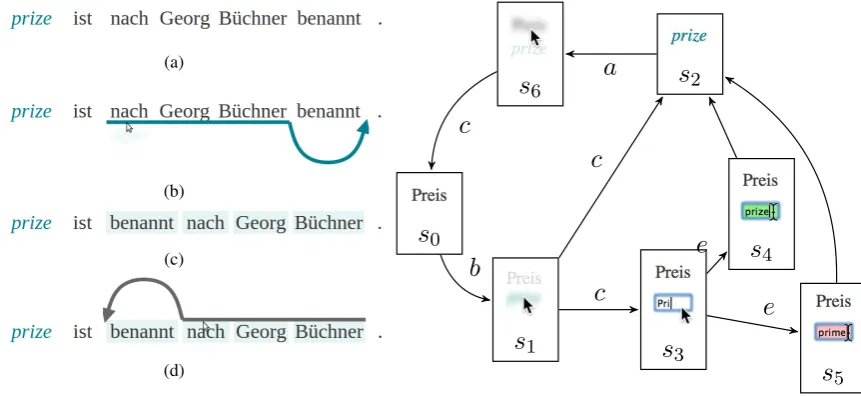
(a) Initial sentence state.
(b) Mouse hovered underPreis.
(c)Preistranslated toprize.
(d) Mouse hovered aboveprize. Clicking above will revert the sentence back to the initial state 1a.
(e) Sentence with 2 different words translated into English Figure 1: Actions that translate words.
Using these fundamental interactions as build-ing blocks, we create an interactive framework for a language learner to explore this continuum of “English-like” to “foreign-like” sentences. By re-peated interaction with new content and exposure to recurring vocabulary items and linguistic pat-terns, we believe a learner can pick up vocabulary and other linguistic rules of the foreign language. 2.1 Translation
The basic interface idea is that a line of macaronic text is equipped with hidden interlinear annota-tions. Notionally, English translations lurk below the macaronic text, and German ones above.
The Translation interaction allows the learner to change the text in the macaronic sentence from one language to another. Consider a macaronic sentence that is completely in the foreign state (i.e.,, entirely in German), as shown in Fig. 1a. Hovering on or under a German word shows a pre-view of a translation (Fig. 1b). Clicking on the preview will cause the translation to “rise up” and replace the German word (Fig. 1c).
To translate in the reverse direction, the user can hover and click above an English word (Fig. 1d).
Since the same mechanism applies to all the words in the sentence, a learner can manipulate translations for each word independently. For ex-ample, Fig. 1e shows two words in English.
(a)
(b)
(c)
(d)
Figure 2: Actions that reorder phrases.
gives the learner a chance to think about what the translation might be, based on visual clues such as length and shape of the blurred text.
2.2 Reordering
When the learner hovers slightlybelowthe words
nach Georg B¨uchneraReordering arrow is displayed (as shown in Figure 2). The arrow is an indicator of reordering. In this example, the Ger-man past participlebenanntappears at the end of the sentence (the conjugated form of the verb is
ist benannt, oris named); this is the gram-matically correct location for the participle in Ger-man, while the English form should appear earlier in the equivalent English sentence.
Similar to the translation actions, reordering actions also have a directional attribute. Figure 2b shows a German-to-English direction arrow. When the learner clicks the arrow, the interface re-arranges all the words involved in the reordering. The new word positions are shown in 2c. Once again, the user can undo: hovering just above
nach Georg B¨uchnernow shows a gray ar-row, which if clicked returns the phrase to its Ger-man word order (shown in 2d).
German phrases that are not in original German order are highlighted as a warning (Figure 2c). 2.3 “Pop Quiz” Feature
So far, we have described the system’s standard responses to a learner’s actions. We now add oc-casional “pop quizzes.” When a learner hovers be-low a German word (s0in Figure 3) and clicks the blurry English text, the system can either reveal the translation of the German word (states2) as
de-s
0s
1s
3s
4s
5s
2s
6b
c
c
e
e
a
[image:3.595.94.525.62.260.2]c
Figure 3: State diagram of learner interaction (edges) and system’s response(vertices). Edges can be traversed by click-ing (c), hovering above (a), hovering below (b) or the enter (e) key. Unmarked edges indicate an automatic transition.
scribed in section 2.1 or quiz the learner (states3). We implement the quiz by presenting a text input box to the learner: here the learner is expected to type what they believe the German word means. Once a guess is typed, the system indicates if the guess is correct (s4) or incorrect(s5) by flashing green or red highlights in the text box. The box then disappears (after 700ms) and the system au-tomatically proceeds to the reveal states2. As this imposes a high cognitive load and increases the teraction complexity (typing vs. clicking), we in-tend to use the pop quiz infrequently.
The pop quiz serves two vital functions. First, it further incentivizes the user to retain learned vo-cabulary. Second, it allows the system to update its model of the user’s current L2 lexicon, macaronic comprehension, and learning style; this is work in progress (see section 4.2).
2.4 Interaction Consistency
Again, we regard the macaronic sentence as a kind of interlinear text, written between two mostly in-visible sentences: German above and English be-low. In general, hovering above the macaronic sentence will reveal German words or word or-ders, which fall down into the macaronic sentence upon clicking. Hovering below will reveal English translations, which rise up upon clicking.
de-Action Direction Trigger Preview Preview Color Confirm Result Translation E-to-G Hover above English Blurry Germantranslation above Gray Blur Click onBlurry Text translation replacesEnglish word(s)
G-to-E Hover under Germantoken Blurry Englishtranslation below Blue Blur Click onBlurry Text translation replacesGerman word(s)
[image:4.595.73.526.63.160.2]Reordering E-to-G Hover above token Arrow abovereordering tokens Gray Arrow Click on Arrow tokens reorder G-to-E Hover under token Arrow belowreordering tokens Blue Arrow Click on Arrow tokens reorder
Table 1: Summary of learner triggered interactions in the Macaronic Interface.
fault, while the English words use a marked color and font (italic blue). Reordering arrows also fol-low the same color scheme: arrows that will make the macaronic sentence more “German-like” are gray, while arrows that make the sentence more “English-like” are blue. The summary of interac-tions is shown in Table 1.
3 Constructing Macaronic Translations
In this section, we describe the details of the un-derlying data structures needed to allow all the in-teractions mentioned in the previous section. A key requirement in the design of the data struc-ture was to support orthogonal actions in each sen-tence. Making all translation and reordering ac-tions independent of one another creates a large space of macaronic states for a learner to explore. At present, the input to our macaronic inter-face is bitext with word-to-word alignments pro-vided by a phrase-based SMT system (or, if de-sired, by hand). We employ Moses (Koehn et al., 2007) to translate German sentences and gener-ate phrase alignments. News articles written in
simple German from nachrichtenleicht.
de(Deutschlandfunk, 2016) were translated after training the SMT system on the WMT15 German-English corpus (Bojar et al., 2015).
We convert the word alignments into “mini-mal alignments” that are either to-one, one-to-many or many-to-one.4 This step ensures con-sistent reversibility of actions and prevents large phrases from being translated with a single click.5 The resulting bipartite graph can be regarded as 4For each many-to-many alignment returned by the SMT system, we remove alignment edges (lowest probability first) until the alignment is no longer many-to-many. Then we greedily add edges from unaligned tokens (highest probabil-ity first), subject to not creating many-to-many alignments and subject to minimizing the number of crossing edges, un-til all tokens are aligned.
[image:4.595.308.525.203.286.2]5Preliminary experiments showed that allowing large phrases to translate with one click resulted in abrupt jumps in the visualization, which users found hard to follow.
Figure 4: The dotted lines show word-to-word alignments between the German sentencef0, f1, . . . , f7and its English
translatione0, e1, . . . , e6. The figure highlights 3 of the 7
units:u2, u3, u4.
Figure 5: A possible state of the sentence, which renders a subset of the tokens (shown in black). The rendering order (section 3.2) is not shown but is also part of the state. The string displayed in this case is ”Und danach they run
noch einen Marathon.” (assuming no reordering).
a collection of connected components, or units
(Fig. 4).6
3.1 Translation Mechanism
In a given state of the macaronic sentence, each unit is displayed in either English or German. A translation action toggles the display language of the unit, leaving it in place. For example, in Fig-ure 5, where the macaronic sentence is currently displaying f4f5 = noch einen, a translation action will replace this withe4 =a.
3.2 Reordering Mechanism
[image:4.595.308.526.349.425.2]put string “Und danach they run noch einen Marathon.” is obtained from Figure 5 only if unit u2 (as labeled in Figure 4) is ren-dered (in its current language) to the left of unit
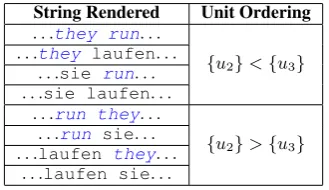
u3, which we write as u2 < u3. In this case, it is possible for the user to change the order of these units, becauseu3 < u2in German. Table 2 shows the 8 possible combinations of ordering and trans-lation choices for this pair of units.
String Rendered Unit Ordering
. . .they run. . .
{u2}<{u3}
. . .they laufen. . . . . .sie run. . . . . .sie laufen. . .
. . .run they. . .
{u2}>{u3}
. . .run sie. . . . . .laufen they. . .
[image:5.595.98.263.196.291.2]. . .laufen sie. . .
Table 2: Generating reordered strings using units.
The space of possible orderings for a sentence pair is defined by a bracketing ITG tree (Wu, 1997), which transforms the German ordering of the units into the English ordering by a collec-tion of nested binary swaps of subsequences.7 The ordering state of the macaronic sentence is given by the subset of these swaps that have been per-formed. A reordering action toggles one of the swaps in this collection.
Since we have a parser for German (Rafferty and Manning, 2008), we take care to select an ITG tree that is “compatible” with the German sentence’s dependency structure, in the following sense: if the ITG tree combines two spansAand
B, then there are not dependencies from words in
Ato words inBandvice-versa.
4 Discussion and Future Work
4.1 Machine Translation Challenges
When the English version of the sentence is pro-duced by an MT system, it may suffer from MT errors and/or poor alignments.
Even with correct MT, a given syntactic con-struction may be handled inconsistently on differ-ent occasions, depending on the particular words involved (as these affect what phrasal alignment is found and how we convert it to a minimal align-ment). Syntax-based MT could be used to design a more consistent interface that is also more closely tied to classroom L2 lessons.
7Occasionally no such ITG tree exists, in which case we fuse units as needed until one does.
Cross-linguistic divergences in the expression of information (Dorr, 1994) could be confusing. For example, when moving through macaronic
space from Kaffee gef¨allt Menschen
(coffee pleases humans) to its translationhumans like coffee, it may not be clear to the learner that the reordering is triggered by the fact that like is not a literal translation of
gef¨allt. One way to improve this might be to have the system pass smoothly through a range of intermediate translations from word-by-word glosses to idiomatic phrasal translations, rather than always directly translating idioms. We might also see benefit in guiding our gradual translations with cognates (for example, rather than translate directly from the German M¨ohre to the English carrot, we might offer the cognate Karotte
as an intermediate step).
We also plan to transition through words that are macaronic at the sub-word level. For example, hovering over the unfamiliar Ger-man word gesprochen might decompose it into ge-sprochen; then clicking on one of those morphemes might yield ge-talk or
sprech-ed before reaching talked. This could guide learners towards an understanding of German tense marking and stem changes.
4.2 User Adaptation and Evaluation
We would prefer to show the learner a macaronic sentence that provides just enough clues for the learner to be able to comprehend it, while still pushing them to figure out new vocabulary or new structures. Thus, we plan to situate this interface in a framework that continuously adapts as the user progresses. As the user learns new vocabu-lary, the system will automatically present them with more challenging sentences (containing less L1). In (Renduchintala et al., 2016) we show that we can predict a novice learner’s guesses of L2 word meanings in macaronic sentences using a few simple features. We will subsequently track the user’s learning by observing their mouse ac-tions and “pop quiz” responses (section 2).
5 Conclusion
In this work we present a prototype of an inter-active interface for learning to read in a foreign language. We expose the learner to L2 vocabulary and constructions in contexts that are comprehen-sible because they have beenpartially translated into the learner’s native language, using statistical MT. Using MT affords flexibility: learners or in-structors can choose which texts to read, and learn-ers or the system can control which parts of a sen-tence are translated.
We are working towards integrating models of learner understanding (Renduchintala et al., 2016; Knowles et al., 2016) to produce personalized macaronic texts that give each learner just the right amount of challenge and support. In the long term, we would like to extend the approach to allow users also to producemacaronic language, draw-ing on techniques from grammatical error correc-tion or computer-aided translacorrec-tion to help them gradually remove L1 features from their writing (or speech) and make it more L2-like.
Acknowledgments
This material is based upon work supported by a seed grant from the Science of Learning Institute at Johns Hopkins University, and also by a Na-tional Science Foundation Graduate Research Fel-lowship (Grant No. DGE-1232825) to the second author. We would like to thank Chadia Abras for useful discussions.
Supplemental Material
• A video demonstration can be found here:
https://youtu.be/d5lxyeHIDWI
• A live sample version is here: http:// www.clsp.jhu.edu:3030/signin
References
Ondˇrej Bojar, Rajen Chatterjee, Christian Federmann, Barry Haddow, Matthias Huck, Chris Hokamp, Philipp Koehn, Varvara Logacheva, Christof Monz, Matteo Negri, Matt Post, Carolina Scarton, Lucia Specia, and Marco Turchi. 2015. Findings of the 2015 Workshop on Statistical Machine Translation. InProceedings of the Tenth Workshop on Statistical Machine Translation, pages 1–46.
Linda K. Clarke. 1988. Invented versus traditional spelling in first graders’ writings: Effects on learn-ing to spell and read. Research in the Teaching of English, pages 281–309, October.
Deutschlandfunk. 2016. nachrichtenleicht. http:// www.nachrichtenleicht.de/. Accessed: 2015-09-30.
Bonnie J. Dorr. 1994. Machine translation diver-gences: A formal description and proposed solution. Computational Linguistics, 20(4):597–633, Decem-ber.
Fred H. Genesee. 2009. Early childhood bilingualism: Perils and possibilities. Journal of Applied Research on Learning, 2(Article 2):1–21, April.
J. Richard Gentry. 2000. A retrospective on invented spelling and a look forward. The Reading Teacher, 54(3):318–332, November.
Rebecca Knowles, Adithya Renduchintala, Philipp Koehn, and Jason Eisner. 2016. Analyzing learner understanding of novel L2 vocabulary. To appear. Philipp Koehn, Hieu Hoang, Alexandra Birch, Chris
Callison-Burch, Marcello Federico, Nicola Bertoldi, Brooke Cowan, Wade Shen, Christine Moran, Richard Zens, et al. 2007. Moses: Open source toolkit for statistical machine translation. In Pro-ceedings of ACL: Interactive Poster and Demonstra-tion Sessions, pages 177–180.
Stephen Krashen. 1989. We acquire vocabulary and spelling by reading: Additional evidence for the input hypothesis. The Modern Language Journal, 73(4):440–464.
S. Krashen. 1993. How well do people spell? Reading Improvement, 30(1).
Lingua.ly. 2013. Lingua.ly. https://lingua. ly/. Accessed: 2016-04-04.
Mark Nelson. 2007. The Alpheios project. http: //alpheios.net/. Accessed: 2016-04-05. Anna N Rafferty and Christopher D Manning. 2008.
Parsing three German treebanks: Lexicalized and unlexicalized baselines. InProceedings of the Work-shop on Parsing German, pages 40–46. Association for Computational Linguistics.
Adithya Renduchintala, Rebecca Knowles, Philipp Koehn, and Jason Eisner. 2016. User modeling in language learning with macaronic texts. In Proceed-ings of ACL.
Swych. 2015. Swych. http://swych.it/. Ac-cessed: 2016-04-05.
Luis von Ahn. 2013. Duolingo: Learn a language for free while helping to translate the web. In Proceed-ings of the 2013 International Conference on Intel-ligent User Interfaces, pages 1–2.
Lev Vygotski˘ı. 2012. Thought and Language (Revised and Expanded Edition). MIT press.