Data Selection for IT Texts using Paragraph Vector
Mirela-Stefania Duma and Wolfgang Menzel
University of Hamburg Natural Language Systems Division
{mduma, menzel}@informatik.uni-hamburg.de
Abstract
This paper presents an overview of the sys-tem submitted by the University of Ham-burg to the IT domain shared translation task as part of the ACL 2016 First Con-ference of Machine Translation (WMT 2016). We have chosen data selection as a domain adaptation method. The filtering of the general domain data makes use of paragraph vectors as a novel approach for scoring the sentences. Experiments were conducted for English-German under the constrained condition.
1 Introduction
The WMT 2016 shared task of translating IT doc-uments focuses on translation of answers in a cross-lingual help-desk service. This paper de-scribes the system submitted by the University of Hamburg to this task. We took part in the English-German translation track in which twelve systems (seven constrained and five unconstrained ones) from four different organizations participated. The challenges for this task came from the fact that the available in-domain data for the constrained con-dition is very small. Moreover, the in-domain dif-fers considerably from any of the domains of the given general domain data.
We propose a method of data selection by filter-ing the general domain data applyfilter-ing a threshold on the similarity between vector representations for the sentences from the general domain and the in-domain. Sentences are described by paragraph vectors which are trained together with word vec-tors in order to predict the upcoming words within that paragraph (Le and Mikolov, 2014). Given a sentence from the general domain, our procedure identifies a set of candidate sentences that are most similar to the reference. If at least one of the
re-trieved sentences comes from the in-domain then the general domain sentence is considered sim-ilar to the in-domain, otherwise it is discarded. This binary decision has the advantage that only one MT system needs to be trained and the disad-vantage that it gives only a fixed ratio of general domain data to be kept depending on the chosen threshold.
In order to overcome the disadvantage that the paragraph vector method has, we extend it from using a binary decision filtering to scoring and ranking all the sentences from the general domain from which a certain amount of training sentences can be selected. This extended version is a prereq-uisite for being able to train and compare multi-ple MT systems using different ratios of data to be kept.
We first summarize related work in data selec-tion for Statistical Machine Translaselec-tion (SMT) in Section 2, then describe Paragraph Vector that we used for our data selection method in Section 3. Section 4 presents the experimental settings of the submitted systems and section 5 contains an overview of their performance in the shared IT task.
2 Related work
A range of different methods for domain adapta-tion of models for statistical machine translaadapta-tion have been developed including mixture modeling, instance weighting, transductive learning, or data selection (Chen et al., 2013).
The data selection approach is the focus of this paper. In the state of the art, data selection is used at the corpus-level, where the selected data is joined together, or at the model-level, where sev-eral models are combined together in the transla-tion phase (Wang et al., 2013a). The main work-flow of the data selection method consists of the
following steps:
• scoring: a measure is used to determine how similar the sentences from the general do-main are to the in-dodo-main
• filtering: sentences from the general domain are selected, if their similarity score is greater than a predefined threshold.
• training: the selected sentences are used as additional training data to develop the lan-guage model, to weight the phrase pairs or for tuning purposes.
To compute the similarity score three ap-proaches are commonly used: information re-trieval inspired, perplexity-based and edit distance similarity inspired.
TF-IDF1 term weighing as used in informa-tion retrieval was adopted by (Hildebrand et al., 2005) where each sentence from the source side of the bilingual training data constitutes one doc-ument (represented usingTF-IDF) and each sen-tence from the test data is used as a query. The cosine distance similarity is used to compute the relevance of the queries to the documents. L¨u et al. (2007) also uses the cosine to select sentences for offline and online training data optimization. Tamchyna et al. (2012) presents a method where sentences are extracted from the general domain by translating the source side of a test set and using it in computing the cosine similarity to the general domain.
In Mandal et al. (2008) and in Axelrod et al. (2011) language model perplexity was used to score sentences. Foster et al. (2010) used phrase pairs instead of sentences and learned weights for them using in-domain features based on word frequencies and perplexities. In Mansour et al. (2011), the cross-entropy score is used for lan-guage model filtering together with a translation model score that estimates the likelihood that a source and a target sentence are a translation of each other. Toral et al. (2015) introduced lin-guistic information such as lemmas, named enti-ties and part-of-speech tags into the preprocessing of the data and then ranked the sentences by per-plexity.
The edit distance which computes the minimum number of edits needed to transform a sentence from the general domain into a sentence from the
1Term frequency - Inverse document frequency
in-domain was used in Wang et al. (2013b). A combination of the three data selection approaches is presented in Wang et al. (2013a, 2013c).
We propose a new approach of filtering general domain sentences using paragraph vectors (Le and Mikolov, 2014) to determine sentence similarity in a high-dimensional vector space. To the knowl-edge of the authors, this is the first time Paragraph vector is applied to data selection for SMT.
3 Paragraph vector
In this section we describe Paragraph vector (Le and Mikolov, 2014) which stands at the core of the proposed data selection method. It has been suc-cessfully employed in sentiment detection and in-formation retrieval tasks. Le and Mikolov (2014) propose an unsupervised framework that learns continuous distributed vector representations for phrases, sentences or documents.
The idea of learning paragraph vectors is simi-lar to the approach used in learning word vectors (Mikolov et al., 2013): word vectors are used in predicting a word given its sentential context and paragraph vectors adopt the same idea to contexts sampled from a paragraph.
The model maps context words and a paragraph identifier to the word that is going to be predicted. The contexts have a fixed length and are sampled from a sliding window over the paragraph. The mapping is established by means of two matrices: one consisting of the trained paragraph vectors and the other consisting of word vectors. The para-graph vector is shared among all the contexts sam-pled from the same paragraph (but not among all paragraphs). The word vectors are shared between all the paragraphs. Paragraph and word vectors are combined during training and inference either by concatenation or by averaging. The paragraph and word vectors are trained on pairs consisting of the word to be predicted and a sampled context tagged by a paragraph identifier. (Le and Mikolov, 2014)
We use single sentences as paragraphs. The rea-son why we adopted Paragraph vector is because they reflect semantic relatedness, similar to word vectors. Moreover, we have chosen paragraph vec-tors for representing sentences as vecvec-tors because the approach does not require tuning, parsing or availability of labeled data. The implementation of paragraph vectors we used is Doc2vec from the gensimtoolkit2( ˇReh˚uˇrek and Sojka, 2010).
4 Experiments
For all the submitted systems, we used only the data distributed for the shared IT task. For the general domain training data we chose Common-crawl3 (made available by WMT) because it is a relatively large corpus and contains crawled data from a variety of domains including the IT do-main. As in-domain training data we concatenated the corpora provided by the task. We tuned the systems with 2000 sentences from Batch1a and Batch2a provided by the shared task and evaluated them on Batch3a.
Our systems have been developed using the Moses phrase-based MT toolkit (Koehn et al., 2007) and the Experiment Management System (Koehn, 2010) that facilitates the preparation of scripts for experiments.
4.1 Data preprocessing
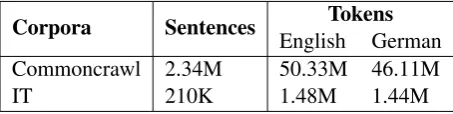
All the available data were tokenized, cleaned (i.e. restricted to a maximum sentence length of 80 words) and lowercased. The general domain data was filtered by removing the sentence pairs that do not pertain to the English-German language pair as well as sentences that contain non-alpha characters. In addition to that, punctuation was normalized using the normalize-punctuation.perl script. Approximately 25K sentences were re-moved because they were not considered English-German sentence pairs by the jlangdetect library4 and further 650 sentences have been discharged because they contained non-alpha characters. Ta-ble 1 presents some data statistics for both do-mains after preprocessing:
Corpora Sentences English GermanTokens
Commoncrawl 2.34M 50.33M 46.11M
[image:3.595.72.299.547.604.2]IT 210K 1.48M 1.44M
Table 1: Corpora statistics after preprocessing
4.2 Experimental settings
We performed word alignment using GIZA++ (Och and Ney, 2003) with the default grow-diag-final-and alignment symmetrization method. For the language model (LM) estimation we trained
models/doc2vec.html
3http://commoncrawl.org/
4https://github.com/melix/jlangdetect
5-gram LMs using the SRILM toolkit (Stolcke, 2002) with Kneser-Ney discounting (Kneser and Ney, 1995) on the target side of the Common-crawl and IT corpora. When LM interpolation was needed, the in-domain LM and the general domain LM were interpolated using weights tuned to min-imize the perplexity on the tuning set. The same data was used for tuning the systems with MERT (Och, 2003).
For the BLEU-cased scores training recasing was performed using the default configuration from the EMS script: language model trained us-ing KenLM (Heafield, 2011) and order 3. Due to time limitations, we did not try to further improve the recaser model.
4.3 Baselines
The baseline systemU HBS simplewas trained on the concatenation of the in-domain data and the complete general domain data. The sec-ond baseline, U HBS lmi, only differed from U HBS simple in its language model that was created by LM interpolation. The motivation for training a second, i.e. stronger baseline, is that we intended to compare the translation re-sults of the system submitted to the competition (U HDS doc2vec) with the one produced by a competitive approach.
4.4 Data selection using Doc2vec
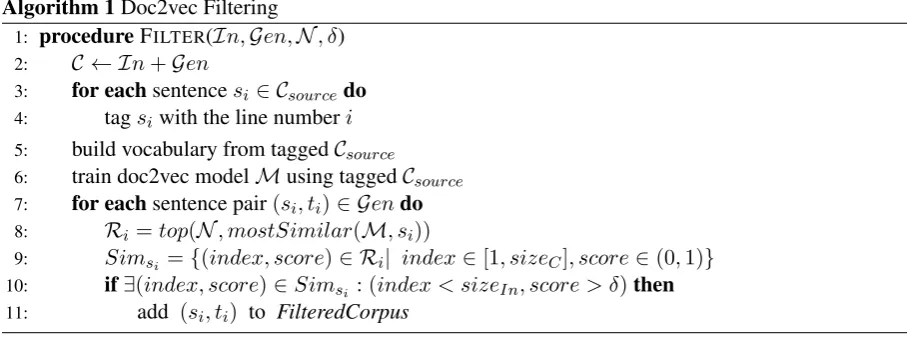
In this section the submitted system U HDS doc2vec is described. The filtering procedure receives as input the bilingual in-domain corpusIn, the bilingual general domain
Gen, the number of most similar sentencesN that should be retrieved given a thresholdδthat will be described later. Our approach is monolingual as we used only the source side of the corpus data to select sentences from the general domain corpus. To train the paragraph vectors we concatenatedIn andGenresulting in the data setC. Training the doc2vec model required tagging every sentence from the source side of the concatenated corpus
Csourcewith its corresponding line number in the
corpus and building a vocabulary from the tagged
C. Therefore, a sentence that came from Inwas tagged with a number from [1, sizeIn] and a
sentence that came from Gen was tagged with a number from[sizeIn+ 1, sizeIn+sizeGen].
The doc2vec model was trained on the tagged Csource. After obtaining the doc2vec model M,
Algorithm 1Doc2vec Filtering 1: procedureFILTER(In,Gen,N, δ)
2: C ← In+Gen
3: for eachsentencesi ∈ Csourcedo
4: tagsiwith the line numberi
5: build vocabulary from taggedCsource
6: train doc2vec modelMusing taggedCsource
7: for eachsentence pair(si, ti)∈ Gendo
8: Ri=top(N, mostSimilar(M, si))
9: Simsi ={(index, score)∈ Ri| index∈[1, sizeC], score∈(0,1)}
10: if∃(index, score)∈Simsi : (index < sizeIn, score > δ)then
[image:4.595.71.525.78.248.2]11: add (si, ti) to FilteredCorpus
Figure 1: Doc2vec filtering algorithm
fromGen. Given a sentence pair(si, ti) ∈ Gen,
the topN most similar vectors to si are retrieved
in the form of a pair(index, score)whereindex gives the tag (i.e. the line number) of the selected similar sentence tosiandscorespecifies the
sim-ilarity between si and sindex. The similarity is
computed as the cosine between the two vectors. The list of top N most similar sentences for
each sentence from Genis now filtered by com-paring them to a prespecified thresholdδ creating a reduced data setF ilteredCorpus. A sentence pair(si, ti)is included intoF ilteredCorpusif at
least one pair (index, score) originates from the
in-domain (index < sizeIn) and has a score >
δ. With a value setting of δ = 0.5 we selected 47% of the sentences ofGen. Systematic exper-iments with other values ofδ are planned for fu-ture work. Eventually, we trained the final sys-tem U HDS doc2vec on a concatenation of the reduced general domain corpusF ilteredCorpus and the in-domain dataIn. Two separate language models were trained with the in-domain data In and the full general domain corpus Gen. They have been interpolated and the interpolated model has been used in bothU HBS lmi (strong base-line) andU HDS doc2vec(the submission to the competition). In Figure 1 the pseudocode for fil-tering the general domain corpus is presented.
Doc2vec filtering selects in one step all the gen-eral domain sentences similar to the in-domain producing oneF ilteredCorpus. Eventually, each sentence fromGenis either discarded or added to F ilteredCorpus).
In order to be able to compare our method with
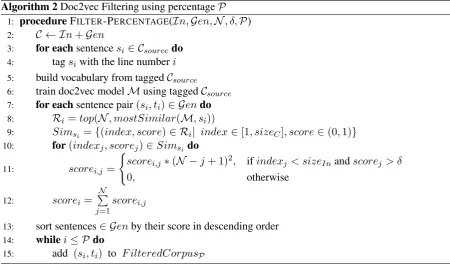
other data selection approaches, we modified the binary decision from step 10 of the algorithm with a step that produces a score for each sentence si ∈ Gen (Figure 2). Therefore, in addition to
the submitted systems to the WMT competition, we also conducted experiments with the extended Doc2vec algorithm and with a perplexity-based metric which defines the state-of-the-art for data selection for MT (Axelrod et. al, 2011). We name SEF (Sentence Embedding Filtering) the method presented in Figure 2 and P P L (Perplexity) the state-of-the-art method.
In addition to the input parameters that the al-gorithm presented in Figure 1 uses, the adapted algorithm receives as input also a percentage P
which gives the number of sentences to be selected fromGen. Given a sentencesi ∈ Gen, theSEF
method uses the similarity score between si and
itsN most similar sentences for producing a final score. Moreover, since the position inSimsi
mat-ters, we multiply each intermediary score with the inverse position(N −j+ 1). For example, if the most similar sentence tosiissjplaced on the first
position inSimsi, then theirscoreij is multiplied
with the highest possible valueN. After scoring all the sentences fromGen, they are sorted by their score in descending order.
The comparison between SEF andP P Lwas evaluated on a range of percentages from 10 till 90, incrementing the ratio in steps of 10.
5 Results
sub-Algorithm 2Doc2vec Filtering using percentageP 1: procedureFILTER-PERCENTAGE(In,Gen,N, δ,P) 2: C ← In+Gen
3: for eachsentencesi ∈ Csourcedo
4: tagsiwith the line numberi
5: build vocabulary from taggedCsource
6: train doc2vec modelMusing taggedCsource
7: for eachsentence pair(si, ti)∈ Gendo
8: Ri=top(N, mostSimilar(M, si))
9: Simsi ={(index, score)∈ Ri| index∈[1, sizeC], score∈(0,1)}
10: for(indexj, scorej)∈Simsido
11: scorei,j = (
scorei,j∗(N −j+ 1)2, ifindexj < sizeInandscorej > δ
0, otherwise
12: scorei =
N
P j=1
scorei,j
13: sort sentences∈ Genby their score in descending order 14: whilei≤ Pdo
[image:5.595.71.522.75.345.2]15: add (si, ti) to F ilteredCorpusP
Figure 2: Doc2vec filtering algorithm adapted to select a given percentageP of sentences
mitted systems. Moreover, we present the evalua-tion scores for theSEF andP P L methods and discuss the results. Table 2 presents the BLEU (Papineni et al., 2002), the BLEU-cased and the TER (Snover et al., 2006) scores for the submitted systems to WMT:
System BLEU BLEU-c TER
U HBS lmi 37.21 35.29 0.545 U HDS doc2vec 37.14 35.04 0.528 U HBS simple 36.02 34.17 0.546
Table 2: Submitted systems results
According to their BLEU scores, the strong baseline, U HBS lmi, performs almost on a par with the filtered general domain system, U HDS doc2vec, but with respect to TER U HDS doc2vec clearly outperforms the baline. The results are encouraging, since our se-lection method filtered out more than 50% of the general domain data without a substantial loss of translation quality compared to the strong base-line.
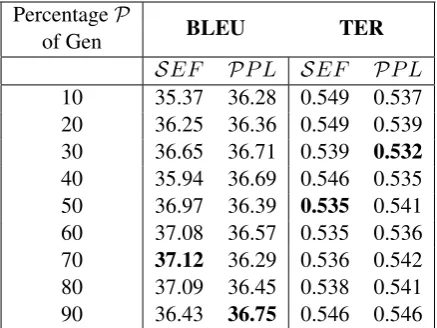
The BLEU and TER scores for the SEF and P P L methods are given in Table 3. The max-imum BLEU score has been achieved by SEF
(37.12) selecting 70% ofGen. TheP P Lmethod achieved its maximum BLEU score at a 90% ra-tio of Gen with a score of 36.75 that is close to the score already achieved at 30% filtering (36.71). With respect to that, the SEF method also has a close score to it at 30% filtering (36.65). The TER scores are all very close for most of the steps, with the lowest score achieved by theP P Lmethod at 30% filtering (0.532). A very similar score has been gained by theSEF method when filtering to 50% (0.535). In comparison to the systems sub-mitted to WMT, the best BLEU and TER scores have still been achieved byU HDS doc2vec and U HBS lmi.
6 Conclusions
[image:5.595.75.291.492.549.2]PercentageP
of Gen BLEU TER
SEF PP L SEF PP L 10 35.37 36.28 0.549 0.537 20 36.25 36.36 0.549 0.539 30 36.65 36.71 0.539 0.532
[image:6.595.72.291.62.226.2]40 35.94 36.69 0.546 0.535 50 36.97 36.39 0.535 0.541 60 37.08 36.57 0.535 0.536 70 37.12 36.29 0.536 0.542 80 37.09 36.45 0.538 0.541 90 36.43 36.75 0.546 0.546
Table 3: Evaluation results forSEF andP P L
as the strong baseline in terms of BLEU.
We also presented an adaptation of the para-graph vector filtering method that is able to se-lect any required percentage of the general do-main data and we conducted experiments using a range of ratios for this method and a state-of-the-art method. The BLEU results indicated that the adapted paragraph vector method outperforms the state-of-the-art method.
These results make filtering using paragraph vector for scoring sentences particularly attractive for scenarios where a large pool of general domain data is available, but only a very small amount of in-domain data.
References
Amittai Axelrod, Xiaodong He and Jianfeng Gao. 2011. Domain Adaptation via Pseudo In-Domain Data Selection. Proceedings of EMNLP 2011.
Boxing Chen, Roland Kuhn and George Foster. 2013. Vector Space Model for Adaptation in Statistical Machine Translation Proceedings of the 51st An-nual Meeting of the Association for Computational Linguistics, pages 1285-1293, Sofia, Bulgaria, Au-gust 4-9 2013.
George Foster, Cyril Goutte and Roland Kuhn. 2010. Discriminative instance weighting fordomain adap-tation in statistical machine translation. Proceed-ings of the 2010 Conference on Empirical Methods in Natural Language Processing. Association for Computational Linguistics, Stroudsburg, PA,USA, pages 451-459.
Kenneth Heafield. 2011. KenLM: Faster and Smaller Language Model Queries. Proceedings of Proceed-ings of the Sixth Workshop on Statistical Machine Translation, Edinburgh, UK.
Almut Silja Hildebrand, Matthias Eck, Stephan Vogel, and Alex Waibel. 2005. Adaptation of the Transla-tion Model for Statistical Machine TranslaTransla-tion based on Information Retrieval. Proceedings of EAMT 2005.
Reinhard Kneser and Hermann Ney. 1995. Improved backing-off for N-gram language modeling. Pro-ceedings ICASSP, pages 181-184.
Philipp Koehn, Hieu Hoang, Alexandra Birch, Chris Callison-Burch, Marcello Federico, Nicola Bertoldi, Brooke Cowan, Wade Shen, Christine Moran, Richard Zens, Chris Dyer, Ondˇrej Bojar, Alexan-dra Constantin and Evan Herbst. 2007. Moses: open source toolkit for statistical machine transla-tion. Proceedings of the 45th Annual Meeting of the ACL on Interactive Poster and Demonstration Ses-sions. June 25-27, 2007, Prague, Czech Republic.
Philipp Koehn. 2010. An experimental management system. The Prague Bulletin of Mathematical Lin-guistics, 94.
Quoc Le and Tomas Mikolov. 2014. Distributed Rep-resentations of Sentences and Documents. Proceed-ings of the 31st International Conference on Ma-chine Learning, volume 32, Beijing, China. JMLR: W&CP.
Yajuan L¨u, Jin Huang and Qun Liu. 2007. Improv-ing Statistical Machine Translation Performance by Training Data Selection and Optimization. Prooced-ings of EMNLP-CoNLL 2007.
A. Mandal, D. Vergyri, W. Wang, J. Zheng, A. Stol-cke, G. Tur, D. Hakkani-T¨ur, and N. F. Ayan. 2008. Efficient data selection for machine translation. Pro-ceedings IEEE Workshop on Spoken Language Tech-nology.
Saab Mansour, Joern Wuebker and Hermann Ney. 2011. Combining Translation and Language Model Scoring for Domain-Specific Data Filtering. Pro-ceedings of IWSLT.
Tomas Mikolov, Kai Chen, Greg Corrado and Jef-frey Dean. 2013. Efficient Estimation of Word Representations in Vector Space. arXiv preprint arXiv:1301.3781.
Franz Josef Och. 2003. Minimum error rate training in statistical machine translation. Proceedings of the 41st Annual Meeting on Association for Computa-tional Linguistics, pages 160-167, July 07-12, 2003, Sapporo, Japan.
Franz Josef Och and Hermann Ney. 2003. A Sys-tematic Comparison of Various Statistical Align-ment Models. Computational Linguistics, volume 29, number 1, pages 19-51.
the 40th Annual Meeting on Association for Compu-tational Linguistics, July 07-12, 2002, Philadelphia, Pennsylvania.
Radim ˇReh˚uˇrek and Petr Sojka. 2010. Software Framework for Topic Modelling with Large Cor-pora. Proceedings of the LREC 2010 Workshop on New Challenges for NLP Frameworks, pages 45-50.
Matthew Snover, Bonnie Dorr, Richard Schwartz, Lin-nea Micciulla, and John Makhoul. 2006. A study of translation edit rate with targeted human annotation. Proceedings of the 7th Biennial Conference of the Association for Machine Translation in the Ameri-cas, Cambridge, Massachusetts.
Andreas Stolcke. 2002. SRILM - an Extensible Lan-guage Modeling Toolkit. International Conference on Spoken Language Processing.
Aleˇs Tamchyna, Galuˇsˇc´akov´a Petra, Kamran Amir, Stanojevi´c Miloˇs and Bojar Ondˇrej. 2012. Select-ing Data for English-to-Czech Machine Translation. Proceedings of the Seventh Workshop on Statistical Machine Translation.
Antonio Toral, Pavel Pecina, Longyue Wang and Josef van Genabith. 2015. Linguistically-augmented perplexity-based data selection for language models. Computer Speech & Language, Volume 32, Issue 1, July 2015, pages 11-26.
Longyue Wang, Derek F. Wong, Lidia S. Chao, Yi Lu, and Junwen Xing. 2013a. A Systematic Compar-ison of Data Selection Criteria for SMT Domain Adaptation. The Scientific World Journal, vol. 2014.
Longyue Wang, Derek F. Wong, Lidia S. Chao, Jun-wen Xing and Yi Lu. 2013b. Edit Distance: A New Data Selection Criterion for Domain Adaptation in SMT. Proceedings of Recent Advances in Natural Language Processing.