Proceedings of NAACL-HLT 2018, pages 1865–1874
Delete, Retrieve, Generate:
A Simple Approach to Sentiment and Style Transfer
Juncen Li∗1 Robin Jia2 He He2 Percy Liang2 1 WeChat Search Application Department, Tencent 2 Computer Science Department, Stanford University
{robinjia,hehe,pliang}@cs.stanford.edu
Abstract
We consider the task of text attribute transfer: transforming a sentence to alter a specific at-tribute (e.g., sentiment) while preserving its attribute-independent content (e.g., changing
“screen is just the right size”to“screen is too small”). Our training data includes only sen-tences labeled with their attribute (e.g., pos-itive or negative), but not pairs of sentences that differ only in their attributes, so we must learn to disentangle attributes from attribute-independent content in an unsupervised way. Previous work using adversarial methods has struggled to produce high-quality outputs. In this paper, we propose simpler methods mo-tivated by the observation that text attributes are often marked by distinctive phrases (e.g.,
“too small”). Our strongest method extracts content words by deleting phrases associated with the sentence’s original attribute value, re-trieves new phrases associated with the target attribute, and uses a neural model to fluently combine these into a final output. On human evaluation, our best method generates gram-matical and appropriate responses on 22%
more inputs than the best previous system, av-eraged over three attribute transfer datasets: altering sentiment of reviews on Yelp, altering sentiment of reviews on Amazon, and altering image captions to be more romantic or humor-ous.
1 Introduction
The success of natural language generation (NLG) systems depends on their ability to carefully con-trol not only the topic of produced utterances, but also attributes such as sentiment and style. The de-sire for more sophisticated, controllable NLG has led to increased interest in text attribute transfer— the task of editing a sentence to alter specific at-tributes, such as style, sentiment, and tense (Hu
∗Work done while the author was a visiting researcher at
Stanford University.
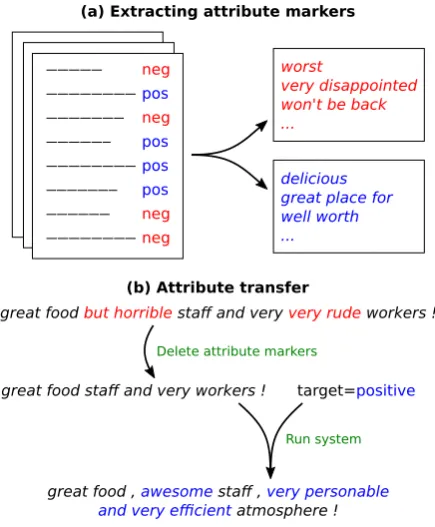
great food but horrible staff and very very rude workers !
target=positive great food staff and very workers !
great food , awesome staff , very personable and very efficient atmosphere !
Delete attribute markers
Run system
(b) Attribute transfer neg
pos
pos pos pos
neg
neg neg
worst
very disappointed won't be back ...
[image:1.595.307.525.220.484.2]delicious great place for well worth ... (a) Extracting attribute markers
Figure 1: An overview of our approach. (a) We identify attribute markers from an unaligned corpus. (b) We transfer attributes by removing markers of the original attribute, then generating a new sentence conditioned on the remaining words and the target attribute.
et al.,2017;Shen et al.,2017;Fu et al.,2018). In each of these cases, the goal is to convert a sen-tence with one attribute (e.g., negative sentiment) to one with a different attribute (e.g., positive sen-timent), while preserving all attribute-independent content1 (e.g., what properties of a restaurant are
being discussed). Typically, aligned sentences with the same content but different attributes are not available; systems must learn to disentangle attributes and content given only unaligned sen-tences labeled with attributes.
Previous work has attempted to use adversarial
1Henceforth, we refer to attribute-independent content as
networks (Shen et al., 2017;Fu et al., 2018) for this task, but—as we demonstrate—their outputs tend to be low-quality, as judged by human raters. These models are also difficult to train (Salimans
et al., 2016; Arjovsky and Bottou, 2017;
Bous-malis et al.,2017).
In this work, we propose a set of simpler, easier-to-train systems that leverage an important ob-servation: attribute transfer can often be accom-plished by changing a few attribute markers— words or phrases in the sentence that are indicative of a particular attribute—while leaving the rest of the sentence largely unchanged. Figure1shows an example in which the sentiment of a sentence can be altered by changing a few sentiment-specific phrases but keeping other words fixed.
With this intuition, we first propose a simple baseline that already outperforms prior adversarial approaches. Consider a sentiment transfer (nega-tive to posi(nega-tive) task. First, from unaligned cor-pora of positive and negative sentences, we iden-tify attribute markers by finding phrases that oc-cur much more often within sentences of one at-tribute than the other (e.g., “worst” and “very disppointed”are negative markers). Second, given a sentence, we delete any negative markers in it, and regard the remaining words as its content. Third, we retrieve a sentence with similar content from the positive corpus.
We further improve upon this baseline by in-corporating a neural generative model, as shown in Figure 1. Our neural system extracts content words in the same way as our baseline, then gen-erates the final output with an RNN decoder that conditions on the extracted content and the target attribute. This approach has significant benefits at training time, compared to adversarial networks: having already separated content and attribute, we simply train our neural model to reconstruct sen-tences in the training data as an auto-encoder.
We test our methods on three text attribute transfer datasets: altering sentiment of Yelp reviews, altering sentiment of Amazon reviews, and altering image captions to be more roman-tic or humorous. Averaged across these three datasets, our simple baseline generated gram-matical sentences with appropriate content and attribute 23% of the time, according to human
raters; in contrast, the best adversarial method achieved only12%. Our best neural system in turn
outperformed our baseline, achieving an average
success rate of34%. Our code and data, including newly collected human reference outputs for the Yelp and Amazon domains, can be found at https://github.com/lijuncen/ Sentiment-and-Style-Transfer.
2 Problem Statement
We assume access to a corpus of labeled sen-tences D = {(x1, v1), . . . ,(xm, vm)}, where
xi is a sentence and vi ∈ V, the set of possible attributes (e.g., for sentiment, V =
{“positive”,“negative”}). We define Dv = {x : (x, v) ∈ D}, the set of sentences in the corpus
with attributev. Crucially, we do not assume
ac-cess to a parallel corpus that pairs sentences with different attributes and the same content.
Our goal is to learn a model that takes as input
(x, vtgt) where x is a sentence exhibiting source
(original) attribute vsrc, and vtgt is the target
at-tribute, and outputs a sentencey that retains the
content ofxwhile exhibitingvtgt.
3 Approach
As a motivating example, suppose we wanted to change the sentiment of “The chicken was deli-cious.” from positive to negative. Here the word “delicious”is the only sentiment-bearing word, so we just need to replace it with an appropriate neg-ative sentiment word. More generally, we find that the attribute is oftenlocalizedto a small fraction of the words, an inductive bias not captured by pre-vious work.
How do we know which negative sentiment word to insert? The key observation is that the re-maining content words provide strong cues: given “The chicken was . . . ”, one can infer that a taste-related word like “bland” fits, but a word like “rude”does not, even though both have negative sentiment. In other words, while the deleted senti-ment words do contain non-sentisenti-ment information too, this information can often be recovered using the other content words.
In the rest of this section, we describe our four systems: two baselines (RETRIEVEONLY and TEMPLATEBASED) and two neural mod-els (DELETEONLYand DELETEANDRETRIEVE). An overview of all four systems is shown in Fig-ure 2. Formally, the main components of these systems are as follows:
(3) Generate output sentence
Inputs
(2) Retrieve similar sentence with target attribute
RetrieveOnly i have had it for a while
but barely used it . TemplateBased i have had this mount for about a year and it barely used .
DeleteAndRetrieve i have had this mount for about a year and barely used it .
DeleteOnly i have had this mount for about a year and it still works .
Extract target attribute markers
RNN
RNN : negative
: positive
: i have had this mount for about a year and it works great .
: i have had this mount for about a year and it .
: i have had it for a while but barely used it .
: barely used (1) Delete
[image:3.595.73.528.62.248.2]attribute markers
Figure 2: Our four proposed methods on the same sentence, taken from the AMAZONdataset. Every method uses
the same procedure (1) to separate attribute and content by deleting attribute markers; they differ in the construction of the target sentence. RETRIEVEONLYdirectly returns the sentence retrieved in (2). TEMPLATEBASEDcombines
the content with the target attribute markers in the retrieved sentence by slot filling. DELETEANDRETRIEVE
generates the output from the content and the retrieved target attribute markers with an RNN. DELETEONLY
generates the output from the content and the target attribute with an RNN.
attribute markersa(x, vsrc)and a sequence of
content wordsc(x, vsrc).
2. Retrieve: 3 of the 4 systems look through the corpus and retrieve a sentence xtgt that has
the target attributevtgt and whose content is
similar to that ofx.
3. Generate: Given the contentc(x, vsrc), target
attribute vtgt, and (optionally) the retrieved
sentence xtgt, each system generates y,
ei-ther in a rule-based fashion or with a neural sequence-to-sequence model.
We describe each component in detail below.
3.1 Delete
We propose a simple method to delete attribute markers (n-grams) that have the most
discrimina-tive power. Formally, for anyv∈ V, we define the salienceof an n-gram u with respect tov by its
(smoothed) relative frequency inDv:
s(u, v) = P count(u,Dv) +λ
v0∈V,v06=vcount(u,Dv0)
+λ
,
(1) wherecount(u,Dv) denotes the number of times
ann-gramuappears inDv, andλis the smoothing
parameter. We declareuto be an attribute marker
forvifs(u, v)is larger than a specified threshold γ. The attributed markers can be viewed as
dis-criminative features for a Naive Bayes classifier.
We define a(x, vsrc) to be the set of all source
attribute markers inx, and definec(x, vsrc)as the
sequence of words after deleting all markers in
a(x, vsrc)fromx. For example, for “The chicken
was delicious,”we would delete“delicious” and consider“The chicken was. . . ” to be the content (Figure2, Step 1).
3.2 Retrieve
To decide what words to insert intoc(x, vsrc), one
useful strategy is to look at similar sentences with the target attribute. For example, negative sen-tences that use phrases similar to “The chicken was. . . ” are more likely to contain“bland”than “rude.” Therefore, we retrieve sentences of simi-lar content and use target attribute markers in them for insertion.
Formally, we retrievextgtaccording to:
xtgt= argmin
x0∈Dvtgt d(c(x, v
src), c(x0, vtgt)), (2)
where d may be any distance metric comparing two sequences of words. We experiment with two options: (i) TF-IDF weighted word overlap and (ii) Euclidean distance using the content embed-dings in Section3.3(Figure2, Step 2).
3.3 Generate
Finally, we describe how each system generatesy
RETRIEVEONLY returns the retrieved sen-tencextgtverbatim. This is guaranteed to produce
a grammatical sentence with the target attribute, but its content might not be similar tox.
TEMPLATEBASEDreplaces the attribute mark-ers deleted from the source sentence a(x, vsrc)
with those of the target sentencea(xtgt, vtgt).2This
strategy relies on the assumption that if two at-tribute markers appear in similar contexts , they are roughly syntactically exchangeable. For ex-ample, “love”and“don’t like”appear in similar contexts (e.g.,“ilovethis place.”and“idon’t like
this place.”), and exchanging them is syntactically valid. However, this naive swapping of attribute markers can result in ungrammatical outputs.
DELETEONLY first embeds the content
c(x, vsrc) into a vector using an RNN. It then
concatenates the final hidden state with a learned embedding for vtgt, and feeds this into an RNN
decoder to generate y. The decoder attempts to
produce words indicative of the source content and target attribute, while remaining fluent.
DELETEANDRETRIEVE is similar to DELE -TEONLY, but uses the attribute markers of the re-trieved sentencextgtrather than the target attribute vtgt. Like DELETEONLY, it encodes c(x, vsrc)
with an RNN. It then encodes the sequence of attribute markers a(xtgt, vtgt) with another RNN.
The RNN decoder uses the concatenation of this vector and the content embedding to generatey.
DELETEANDRETRIEVE combines the ad-vantages of TEMPLATEBASED and DELE -TEONLY. Unlike TEMPLATEBASED, DELETE -ANDRETRIEVE can pick a better place to insert the given attribute markers, and can add or remove function words to ensure grammaticality. Com-pared to DELETEONLY, DELETEANDRETRIEVE has a stronger inductive bias towards using target attribute markers that are likely to fit in the current context. Guu et al. (2018) showed that retrieval strategies like ours can help neural generative models. Finally, DELETEANDRETRIEVE gives us finer control over the output; for example, we can control the degree of sentiment by deciding whether to add “good” or “fantastic” based on the retrieved sentencextgt.
2Markers are replaced from left to right, in order. If there
are not enough markers inxtgt, we use an empty string.
3.4 Training
We now describe how to train DELETEAN -DRETRIEVE and DELETEONLY. Recall that at training time, we do not have access to ground truth outputs that express the target attribute. In-stead, we train DELETEONLY to reconstruct the sentences in the training corpus given their con-tent andoriginalattribute value by maximizing:
L(θ) = X
(x,vsrc)∈D
logp(x|c(x, vsrc), vsrc);θ).
(3) For DELETEANDRETRIEVE, we could simi-larly learn an auto-encoder that reconstructs x
from c(x, vsrc) and a(x, vsrc). However, this
re-sults in a trivial solution: becausea(x, vsrc) and c(x, vsrc)were known to come from the same
sen-tence, the model merely learns to stitch the two sequences together without any smoothing. Such a model would fare poorly at test time, when we may need to alter some words to fluently com-bine a(xtgt, vtgt) with c(x, vsrc). To address this
train/test mismatch, we adopt a denoising method similar to the denoising auto-encoder (Vincent
et al., 2008). During training, we apply some
noise to a(x, vsrc) by randomly altering each
at-tribute marker in it independently with probability
0.1. Specifically, we replace an attribute marker
with another randomly selected attribute marker of the same attribute and word-level edit distance
1if such a noising marker exists, e.g., “was very
rude”to“very rude”, which producesa0(x, vsrc).
Therefore, the training objective for DELETE -ANDRETRIEVEis to maximize:
L(θ) = X
(x,vsrc)∈D
logp(x|c(x, vsrc), a0(x, vsrc);θ).
(4)
4 Experiments
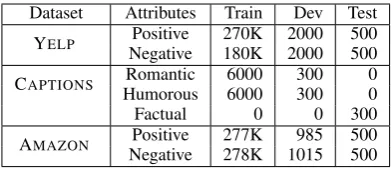
Dataset Attributes Train Dev Test YELP NegativePositive 270K180K 20002000 500500
CAPTIONS HumorousRomantic 60006000 300300 00
Factual 0 0 300
[image:5.595.83.279.61.147.2]AMAZON NegativePositive 277K278K 1015985 500500
Table 1: Dataset statistics.
4.1 Datasets
First, we describe the three datasets we use, which are commonly used in prior works too. All datasets are randomly split into train, develop-ment, and test sets (Table1).
YELP Each example is a sentence from a busi-ness review on Yelp, and is labeled as having ei-ther positive or negative sentiment.
AMAZON Similar to YELP, each example is a sentence from a product review on Amazon, and is labeled as having either positive or negative senti-ment (He and McAuley,2016).
CAPTIONS In the CAPTIONS dataset (Gan
et al.,2017), each example is a sentence that
de-scribes an image, and is labeled as either factual, romantic, or humorous. We focus on the task of converting factual sentences into romantic and hu-morous ones. Unlike YELP and AMAZON, CAP -TIONS is actually an aligned corpus—it contains captions for the same image in different styles. Our systems do not use these alignments, but we use them as gold references for evaluation.
CAPTIONSis also unique in that we reconstruct romantic and humorous sentences during training, whereas at test time we are given factual captions. We assume these factual captions carry only con-tent, and therefore do not look for and delete fac-tual attribute markers; The model essentially only inserts romantic or humorous attribute markers as appropriate.
4.2 Human References
To supply human reference outputs to which we could compare the system outputs for YELP and AMAZON, we hired crowdworkers on Amazon Mechanical Turk to write gold outputs for all test sentences. Workers were instructed to edit a sen-tence to flip its sentiment while preserving its con-tent.
Our delete-retrieve-generate approach relies on the prior knowledge that to accomplish attribute
transfer, a small number of attribute markers should be changed, and most other words should be kept the same. We analyzed our human ref-erence data to understand the extent to which hu-mans follow this pattern. We measured whether humans preserved words our system marks as content, and changed words our system marks as attribute-related (Section 3.1). We define the content word preservation rateSc as the average fraction of words our system marks as content that were preserved by humans, and the attribute-related word change rateSa as the average frac-tion of words our system marks as attribute-related that were changed by humans:
Sc=
1
|Dtest|
X
(x,vsrc,y∗)∈Dtest
|c(x, vsrc)∩y∗|
|c(x, vsrc)|
Sa= 1−
1
|Dtest|
X
(x,vsrc,y∗)∈Dtest
|a(x, vsrc)∩y∗|
|a(x, vsrc)| ,
(5) whereDtest is the test set, y∗ is the human
refer-ence sentrefer-ence, and| · |denotes the number of non-stopwords. Higher values of Sc and Sa indicate that humans preserve content words and change attribute-related words, in line with the inductive bias of our model. Sc is 0.61, 0.71, and 0.50 on YELP, AMAZON, and CAPTIONS, respectively;
Sais0.72on YELPand0.54on AMAZON(not ap-plicable on CAPTIONS).
To understand why humans sometimes deviated from the inductive bias of our model, we ran-domly sampled 50 cases from YELP where hu-mans changed a content word or preserved an attribute-related word. 70% of changed content
words were unimportant words (e.g., “whole” was deleted from “whole experience”), and an-other 18% were paraphrases (e.g., “charge”
be-came “price”); the remaining 12% were errors
where the system mislabeled an attribute-related word as a content word (e.g., “old” became “new”).84%of preserved attribute-related words
did pertain to sentiment but remained fixed due to changes in the surrounding context (e.g., “don’t
like” became “like”, and “below average” be-came“aboveaverage”); the remaining16%were
mistagged by our system as being attribute-related (e.g.,“walked out”).
4.3 Previous Methods
-YELP AMAZON CAPTIONS
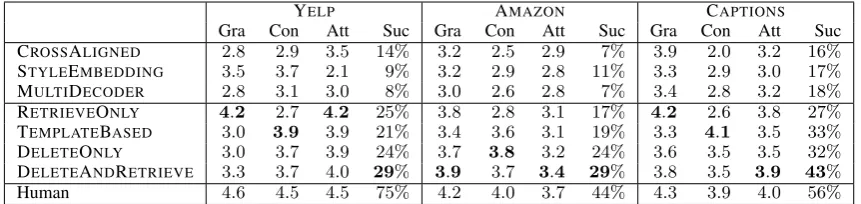
Gra Con Att Suc Gra Con Att Suc Gra Con Att Suc
CROSSALIGNED 2.8 2.9 3.5 14% 3.2 2.5 2.9 7% 3.9 2.0 3.2 16%
STYLEEMBEDDING 3.5 3.7 2.1 9% 3.2 2.9 2.8 11% 3.3 2.9 3.0 17%
MULTIDECODER 2.8 3.1 3.0 8% 3.0 2.6 2.8 7% 3.4 2.8 3.2 18%
RETRIEVEONLY 4.2 2.7 4.2 25% 3.8 2.8 3.1 17% 4.2 2.6 3.8 27%
TEMPLATEBASED 3.0 3.9 3.9 21% 3.4 3.6 3.1 19% 3.3 4.1 3.5 33%
DELETEONLY 3.0 3.7 3.9 24% 3.7 3.8 3.2 24% 3.6 3.5 3.5 32%
DELETEANDRETRIEVE 3.3 3.7 4.0 29% 3.9 3.7 3.4 29% 3.8 3.5 3.9 43%
[image:6.595.84.515.62.164.2]Human 4.6 4.5 4.5 75% 4.2 4.0 3.7 44% 4.3 3.9 4.0 56%
Table 2: Human evaluation results on all three datasets. We show average human ratings for grammaticality (Gra), content preservation (Con), and target attribute match (Att) on a1 to5Likert scale, as well as overall success
rate (Suc). On all three datasets, DELETEANDRETRIEVEis the best overall system, and all four of our methods
outperform previous work.
DING (Fu et al.,2018) learns an vector encoding
of the source sentence such that a decoder can use it to reconstruct the sentence, but a discrimi-nator, which tries to identify the source attribute using this encoding, fails. They use a basic MLP discriminator and an LSTM decoder. MULTIDE -CODER(Fu et al.,2018) is similar to STYLEEM -BEDDING, except that it uses a different decoder for each attribute value. CROSSALIGNED(Shen et al.,2017) also encodes the source sentence into a vector, but the discriminator looks at the hidden states of the RNN decoder instead. The system is trained so that the discriminator cannot distinguish these hidden states from those obtained by forcing the decoder to output real sentences from the tar-get domain; this objective encourages the real and generated target sentences to look similar at a pop-ulation level.
4.4 Experimental Details
For our methods, we use 128-dimensional word vectors and a single-layer GRU with 512hidden
units for both encoders and the decoder. We use the maxout activation function (Goodfellow et al.,
2013). All parameters are initialized by sampling from a uniform distribution between−0.1and0.1.
For optimization, we use Adadelta (Zeiler,2012) with a minibatch size of256.
For attribute marker extraction, we consider spans up to4words, and the smoothing parameter λis set to1. We set the attribute marker
thresh-old γ, which controls the precision and recall of
our attribute markers, to15,5.5 and5 for YELP, AMAZON, and CAPTIONS. These values were set by manual inspection of the resulting markers and tuning slightly on the dev set. For retrieval, we used the TF-IDF weighted word overlap score for DELETEANDRETRIEVE and TEMPLATEBASED,
and the Euclidean distance of content embeddings for RETRIEVEONLY. We find the two scoring functions give similar results.
For all neural models, we do beam search with a beam size of 10. For DELETEANDRETRIEVE, similar toGuu et al. (2018), we retrieve the
top-10 sentences and generate results using markers
from each sentence. We then select the output with the lowest perplexity given by a separately-trained neural language model on the target-domain train-ing data.
4.5 Human Evaluation
We hired workers on Amazon Mechanical Turk to rate the outputs of all systems. For each source sentence and target attribute, the same worker was shown the output of each tested system. Workers were asked to rate each output on three criteria on a Likert scale from 1 to 5: grammaticality, sim-ilarity to the target attribute, and preservation of the source content. Finally, we consider a gener-ated output “successful” if it is rgener-ated4or5on all
three criteria. For each dataset, we evaluated400
randomly sampled examples (200for each target
attribute).
Table2shows the human evaluation results. On all three datasets, both of our baselines have a higher success rate than the previously published models, and DELETEANDRETRIEVEachieves the best performance among all systems. Addition-ally, we see that human raters strongly preferred the human references to all systems, suggesting there is still significant room for improvement on this task.
There-fore, evaluating all system outputs in one batch is important and results on different datasets are not directly comparable.
4.6 Analysis
We analyze the strengths and weaknesses of the different systems. Table3show typical outputs of each system on the YELPand CAPTIONSdataset. We first analyze the adversarial methods. CROSSALIGNED and MULTIDECODER tend to lose the content of the source sentence, as seen in both the example outputs and the overall hu-man ratings. The decoder tends to generate a fre-quent but only weakly related sentence with the target attribute. On the other hand, STYLEEM -BEDDINGalmost always generates a paraphrase of the input sentence, implying that the encoder pre-serves some attribute information. We conclude that there is a delicate balance between preserv-ing the original content and dropppreserv-ing the original attribute, and existing adversarial models tend to sacrifice one or the other.
Next, we analyze our baselines. RE -TRIEVEONLY scores well on grammaticality and having the target attribute, since it retrieves sen-tences with the desired attribute directly from the corpus. However, it is likely to change the con-tent when there is no perfectly aligned sentence in the target domain. In contrast, TEMPLATE -BASEDis good at preserving the content because the content words are guaranteed to be kept. How-ever, it makes grammatical mistakes due to the unsmoothed combination of content and attribute words.
DELETEANDRETRIEVE and DELETEONLY achieve a good balance among grammaticality, preserving content, and changing the attribute. Both have strong inductive bias on what words should be changed, but still have the flexibility to smooth out the sentence. The main difference is that DELETEONLY fills in attribute words based on only the target attribute, whereas DELETE -ANDRETRIEVE conditions on retrieved attribute words. When there is a diverse set of phrases to fill in—for example in CAPTIONS— condition-ing on retrieved attribute words helps generate longer sentences with more specific attribute de-scriptions.
4.7 Automatic Evaluation
Following previous work (Hu et al., 2017; Shen
et al., 2017), we also compute automatic
evalua-tion metrics, and compare these numbers to our human evaluation results.
We use an attribute classifier to assess whether outputs have the desired attribute (Hu et al.,2017;
Shen et al.,2017). We define theclassifier scoreas the fraction of outputs classified as having the tar-get attribute. For each dataset, we train an attribute classifier on the same training data. Specifically, we encode the sentence into a vector by a bidirec-tional LSTM with an average pooling layer over the outputs, and train the classifier by minimizing the logistic loss.
We also compute BLEU between the output and the human references, similar toGan et al.(2017). A high BLEU score primarily indicates that the system can correctly preserve content by retain-ing the same words from the source sentence as the reference. One might also hope that it has some correlation with fluency, though we expect this correlation to be much weaker.
Table4 shows the classifier and BLEU scores. In Table 5, we compute the system-level corre-lation between classifier score and human judg-ments of attribute transfer, and between BLEU and human judgments of content preservation and grammaticality. We also plot scores given by the automatic metrics and humans in Figure 4. While the scores are sometimes well-correlated, the results vary significantly between datasets; on AMAZON, there is no correlation between the clas-sifier score and the human evaluation. Manual in-spection shows that on AMAZON, some product genres are associated with either mostly positive or mostly negative reviews. However, our sys-tems produce, for example, negative reviews about products that are mostly discussed positively in the training set. Therefore, the classifier often gives unreliable predictions on system outputs. As expected, BLEU does not correlate well with hu-man grammaticality ratings. The lack of automatic fluency evaluation artificially favors systems like TEMPLATEBASED, which make more grammati-cal mistakes. We conclude that while these auto-matic evaluation methods are useful for model de-velopment, they cannot replace human evaluation.
4.8 Trading off Content versus Attribute
Fromnegativetopositive(YELP)
SOURCE we sit down and we got some reallyslowandlazyservice .
CROSSALIGNED wewentdown and wewere agood , friendlyfood. STYLEEMBEDDING we sit down and we got some reallyslowandprices suck. MULTIDECODER we sit down and we got some really andfastfood.
TEMPLATEBASED we sit down and we got somethe service is alwaysgreatandeven betterservice . RETRIEVEONLY igota veggie hoagie that wasmassiveand somegrade a customerservice . DELETEONLY we sit down and we got somegreatandquickservice .
DELETEANDRETRIEVE we gotvery niceplace tosit down and we got some service . From factual toromantic(CAPTIONS)
SOURCE two dogs play by a tree .
CROSSALIGNED a dog is running through the grass.
STYLEEMBEDDING two dogs playagainsta tree .
MULTIDECODER two dogs play by a tree .
TEMPLATEBASED two dogs play by a treeloving.
RETRIEVEONLY two dogsare playing in a poolas best friends.
DELETEANDRETRIEVE two dogs play by a tree,enjoying the happiness of childhood.
DELETEONLY two dogsin loveplayhappilyby a tree .
Fromnegativetopositive(AMAZON)
SOURCE this is theworstgame i have come across in a long time .
CROSSALIGNED this is thebestthingive had for a few years.
STYLEEMBEDDING this is theworstgame i have come across in a long time .
MULTIDECODER this is thebestknifei haveno room witha long time .
TEMPLATEBASED this is thebestcome across in a long time .
RETRIEVEONLY the customer support is some of thebesti have come across in a long time .
DELETEONLY this is thebestgame i have come across in a long time .
[image:8.595.94.504.62.337.2]DELETEANDRETRIEVE this is thebestgame i have come across in a long time .
Table 3: Example outputs on YELP, CAPTIONS, and AMAZON. Additional examples for transfer from opposite
directions are given in Table6. Added or changed words are initalic. Attribute markers are colored.
YELP CAPTIONS AMAZON
Classifier BLEU Classifier BLEU Classifier BLEU
CROSSALIGNED 73.7% 3.1 74.3% 0.1 74.1% 0.4
STYLEEMBEDDING 8.7% 11.8 54.7% 6.7 43.3% 10.0
MULTIDECODER 47.6% 7.1 68.5% 4.6 68.3% 5.0
TEMPLATEBASED 81.7% 11.8 92.5% 17.1 68.7% 27.1
RETRIEVEONLY 95.4% 0.4 95.5% 0.7 70.3% 0.9
DELETEONLY 85.7% 7.5 83.0% 9.0 45.6% 24.6
[image:8.595.125.472.378.473.2]DELETEANDRETRIEVE 88.7% 8.4 96.8% 7.3 48.0% 22.8
Table 4: Automatic evaluation results. “Classifier” shows the percentage of sentences labeled as the target attribute by the classifier. BLEU measures content similarity between the output and the human reference.
we simply vary the threshold γ (Section 3.1) at
test time to control how many attribute markers we delete from the source sentence. In contrast, other methods (Shen et al.,2017;Fu et al.,2018) would require retraining the model with different hyperparameters to achieve this effect.
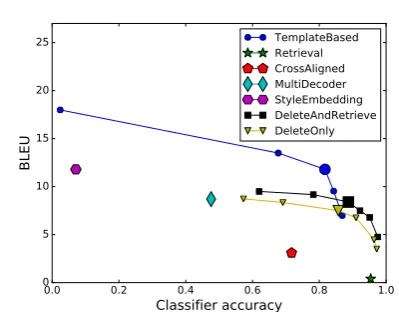
Figure 3 shows this trade-off curve for DELETEANDRETRIEVE, DELETEONLY, and TEMPLATEBASED on YELP, where target at-tribute match is measured by the classifier score and content preservation is measured by BLEU.3
We see a clear trade-off between changing the attribute and retaining the content.
3RETRIEVEONLYis less affected by what content words
are preserved, especially when no good output sentence ex-ists in the target corpus. Therefore, we found that it did not exhibit a clear content-attribute trade-off.
5 Related Work and Discussion
Our work is closely related to the recent body of work on text attribute transfer withunaligneddata, where the key challenge to disentangle attribute and content in an unsupervised way. Most existing work (Shen et al.,2017;Zhao et al.,2018;Fu et al.,
2018;Melnyk et al.,2017) uses adversarial train-ing to separate attribute and content: the content encoder aims to fool the attribute discriminator by removing attribute information from the content embedding. However, we find that empirically it is often easy to fool the discriminator without ac-tually removing the attribute information. There-fore, we explicitly separate attribute and content by taking advantage of the prior knowledge that the attribute is localized to parts of the sentence.
Classifier BLEU
Attribute Content Grammaticality All data 0.810 (p <0.01) 0.876 (p <0.01) −0.127 (p= 0.58)
YELP 0.991 (p <0.01) 0.935 (p <0.01) 0.119 (p= 0.80)
CAPTIONS 0.982 (p <0.01) 0.991 (p <0.01) −0.631 (p= 0.13)
[image:9.595.149.449.61.125.2]AMAZON −0.036 (p= 0.94) 0.857 (p <0.01) 0.306 (p= 0.50)
Table 5: Spearman correlation between two automatic evaluation metrics and related human evaluation scores. While some correlations are strong, the classifier exhibits poor correlation on AMAZON, and BLEU only measures
content, not grammaticality.
0.0 0.2 0.4 0.6 0.8 1.0
Classifier accuracy
0 5 10 15 20 25
BLEU
TemplateBased Retrieval CrossAligned MultiDecoder StyleEmbedding DeleteAndRetrieve DeleteOnly
Figure 3: Trade-off curves between matching the target attribute (measured by classifier scores) and preserving the content (measured by BLEU). Bigger points on the curve correspond to settings used for both training and our official evaluation.
et al. (2017) relies on an attribute classifier to
guide the generator to produce sentences with a desired attribute (e.g. sentiment, tense) in the Variational Autoencoder (VAE) framework. Sim-ilarly, Zhao et al. (2018) used a regularized au-toencoder in the adversarial training framework; however, they also find that these models require extensive hyperparameter tuning and the content tends to be changed during the transfer. Shen
et al. (2017) used a discriminator to align target
sentences and sentences transfered to the target domain from the source domain. More recently, unsupervised machine translation models (Artetxe
et al., 2017; Lample et al., 2017) used a cycle
loss similar toJun-Yan et al.(2017) to ensure that the content is preserved during the transformation. These methods often rely on bilinguial word vec-tors to provide word-for-word translations, which are then finetune by back-translation. Thus they can be used to further improve our results.
Our method of detecting attribute markers is reminiscent of Naive Bayes, which is a strong baseline for tasks like sentiment classification
(Wang and Manning, 2012). Deleting these
at-tribute markers can be viewed as attacking a Naive Bayes classifier by deleting the most informative features (Globerson and Roweis,2006), similarly to how adversarial methods are trained to fool an attribute classifier. One difference is that our clas-sifier is fixed, not jointly trained with the model.
To conclude, we have described a simple method for text attribute transfer that outperforms previous models based on adversarial training. The main leverage comes from the inductive bias that attributes are usually manifested in localized discriminative phrases. While many prior works on linguistic style analysis confirm our observa-tion that attributes often manifest in idiosyncratic phrases (Recasens et al., 2013; Schwartz et al.,
2017;Newman et al.,2003), we recognize the fact
that in some problems (e.g.,Pavlick and Tetreault
(2017)), content and attribute cannot be so cleanly separated along phrase boundaries. Looking for-ward, a fruitful direction is to develop a notion of attributes more general thann-grams, but with
more inductive bias than arbitrary latent vectors.
Reproducibility. All code, data, and ex-periments for this paper are available on the CodaLab platform athttps://worksheets. codalab.org/worksheets/
0xe3eb416773ed4883bb737662b31b4948/.
Acknowledgements. This work is supported by the DARPA Communicating with Computers (CwC) program under ARO prime contract no. W911NF- 15-1-0462. J.L. is supported by Ten-cent. R.J. is supported by an NSF Graduate Re-search Fellowship under Grant No. DGE-114747.
References
M. Arjovsky and L. Bottou. 2017. Towards princi-pled methods for training generative adversarial net-works. In International Conference on Learning Representations (ICLR).
[image:9.595.74.274.188.344.2]Unsupervised neural machine translation. arXiv preprint arXiv:1710.11041.
K. Bousmalis, N. Silberman, D. Dohan, D. Erhan, and D. Krishnan. 2017. Unsupervised pixel-level domain adaptation with generative adversarial net-works. InComputer Vision and Pattern Recognition (CVPR).
Z. Fu, X. Tan, N. Peng, D. Zhao, and R. Yan. 2018. Style transfer in text: Exploration and evaluation. In
Association for the Advancement of Artificial Intel-ligence (AAAI).
C. Gan, Z. Gan, X. He, J. Gao, and L. Deng. 2017. Stylenet: Generating attractive visual captions with styles. InComputer Vision and Pattern Recognition (CVPR).
A. Globerson and S. Roweis. 2006. Nightmare at test time: robust learning by feature deletion. In Inter-national Conference on Machine Learning (ICML). pages 353–360.
I. Goodfellow, D. Warde-farley, M. Mirza, A. Courville, and Y. Bengio. 2013. Maxout networks. InInternational Conference on Machine Learning (ICML). pages 1319–1327.
K. Guu, T. B. Hashimoto, Y. Oren, and P. Liang. 2018. Generating sentences by editing prototypes. Trans-actions of the Association for Computational Lin-guistics (TACL)0.
R. He and J. McAuley. 2016. Ups and downs: Model-ing the visual evolution of fashion trends with one-class collaborative filtering. In World Wide Web (WWW).
Z. Hu, Z. Yang, X. Liang, R. Salakhutdinov, and E. P. Xing. 2017. Toward controlled generation of text. In International Conference on Machine Learning (ICML).
Z. Jun-Yan, P. Taesung, I. Phillip, and E. A. A. 2017. Unpaired image-to-image translation using cycle-consistent adversarial networks. In International Conference on Computer Vision (ICCV).
G. Lample, L. Denoyer, and M. Ranzato. 2017. Unsu-pervised machine translation using monolingual cor-pora only.arXiv preprint arXiv:1711.00043. I. Melnyk, C. N. dos Santos, K. Wadhawan, I. Padhi,
and A. Kumar. 2017. Improved neural text attribute transfer with non-parallel data. arXiv preprint arXiv:1711.09395.
M. L. Newman, J. W. Pennebaker, D. S. Berry, and J. M. Richards. 2003. Lying words: Predicting de-ception from linguistic styles. Personality and So-cial Psychology Bulletin29.
E. Pavlick and J. Tetreault. 2017. An empirical analy-sis of formality in online communication. Transac-tions of the Association for Computational Linguis-tics (TACL)4.
M. Recasens, C. Danescu-Niculescu-Mizil, and D. Ju-rafsky. 2013. Linguistic models for analyzing and detecting biased language. InAssociation for Com-putational Linguistics (ACL).
T. Salimans, I. Goodfellow, W. Zaremba, V. Cheung, A. Radford, and X. Chen. 2016. Improved tech-niques for training gans. InAdvances in Neural In-formation Processing Systems (NIPS).
R. Schwartz, M. Sap, Y. Konstas, L. Zilles, Y. Choi, and N. A. Smith. 2017. The effect of different writ-ing tasks on lwrit-inguistic style: A case study of the ROC story cloze task. In Computational Natural Language Learning (CoNLL).
T. Shen, T. Lei, R. Barzilay, and T. Jaakkola. 2017. Style transfer from non-parallel text by cross-alignment. InAdvances in Neural Information Pro-cessing Systems (NIPS).
P. Vincent, H. Larochelle, Y. Bengio, , and P. Man-zagol. 2008. Extracting and composing robust fea-tures with denoising autoencoders. InInternational Conference on Machine Learning (ICML).
S. Wang and C. D. Manning. 2012. Baselines and bi-grams: Simple, good sentiment and topic classifica-tion. InAssociation for Computational Linguistics (ACL).
M. D. Zeiler. 2012. ADADELTA: an adaptive learning rate method.arXiv preprint arXiv:1212.5701.