Proceedings of NAACL-HLT 2018, pages 327–333
A Novel Embedding Model for Knowledge Base Completion
Based on Convolutional Neural Network
Dai Quoc Nguyen1, Tu Dinh Nguyen1, Dat Quoc Nguyen2, Dinh Phung1
1Deakin University, Geelong, Australia, Centre for Pattern Recognition and Data Analytics
{dai.nguyen,tu.nguyen,dinh.phung}@deakin.edu.au
2 The University of Melbourne, Australia
Abstract
In this paper, we propose a novel embedding model, named ConvKB, for knowledge base completion. Our model ConvKB advances state-of-the-art models by employing a convo-lutional neural network, so that it can capture global relationships and transitional character-istics between entities and relations in knowl-edge bases. In ConvKB, each triple(head en-tity, relation, tail entity)is represented as a 3-column matrix where each 3-column vector rep-resents a triple element. This 3-column matrix is then fed to a convolution layer where multi-ple filters are operated on the matrix to gener-ate different feature maps. These feature maps are then concatenated into a single feature vec-tor representing the input triple. The feature vector is multiplied with a weight vector via a dot product to return a score. This score is then used to predict whether the triple is valid or not. Experiments show that ConvKB achieves better link prediction performance than previous state-of-the-art embedding mod-els on two benchmark datasets WN18RR and FB15k-237.
1 Introduction
Large-scale knowledge bases (KBs), such as YAGO (Suchanek et al., 2007), Freebase ( Bol-lacker et al.,2008) and DBpedia (Lehmann et al.,
2015), are usually databases of triples represent-ing the relationships between entities in the form of fact(head entity, relation, tail entity)denoted as
(h, r, t), e.g.,(Melbourne, cityOf, Australia). These KBs are useful resources in many applications such as semantic searching and ranking (Kasneci et al., 2008; Schuhmacher and Ponzetto, 2014;
Xiong et al., 2017), question answering (Zhang et al.,2016;Hao et al.,2017) and machine reading (Yang and Mitchell,2017). However, the KBs are
still incomplete, i.e., missing a lot of valid triples (Socher et al., 2013; West et al., 2014). There-fore, much research work has been devoted to-wardsknowledge base completionorlink predic-tionto predict whether a triple(h, r, t)is valid or not (Bordes et al.,2011).
Many embedding models have proposed to learn vector or matrix representations for entities and relations, obtaining state-of-the-art (SOTA) link prediction results (Nickel et al., 2016a). In these embedding models, valid triples obtain lower implausibility scores than invalid triples. Let us take the well-known embedding model TransE (Bordes et al., 2013) as an example. In TransE, entities and relations are represented byk
-dimensional vector embeddings. TransE employs a transitional characteristic to model relationships between entities, in which it assumes that if(h, r, t)
is a valid fact, the embedding of head entityhplus
the embedding of relationrshould be close to the
embedding of tail entityt, i.e.vh+vr≈vt(here, vh,vrandvtare embeddings ofh,randt
respec-tively). That is, a TransE scorekvh+vr−vtkp
of the valid triple(h, r, t)should be close to0and
smaller than a scorekvh0 +vr0 −vt0kp of an
in-valid triple(h’, r’, t’). The transitional characteris-tic in TransE also implies the global relationships among same dimensional entries ofvh,vrandvt.
Other transition-based models extend TransE to additionally use projection vectors or matrices to translate head and tail embeddings into the rela-tion vector space, such as: TransH (Wang et al.,
2014), TransR (Lin et al., 2015b), TransD (Ji et al.,2015), STransE (Nguyen et al.,2016b) and TranSparse (Ji et al., 2016). Furthermore, DIST-MULT (Yang et al.,2015) and ComplEx ( Trouil-lon et al.,2016) use a tri-linear dot product to com-pute the score for each triple. Recent research
has shown that using relation paths between en-tities in the KBs could help to get contextual in-formation for improving KB completion perfor-mance (Lin et al., 2015a; Luo et al., 2015; Guu et al.,2015;Toutanova et al.,2016;Nguyen et al.,
2016a). See other embedding models for KB com-pletion inNguyen(2017).
Recently, convolutional neural networks (CNNs), originally designed for computer vision (LeCun et al., 1998), have significantly received research attention in natural language processing (Collobert et al.,2011;Kim, 2014). CNN learns non-linear features to capture complex relation-ships with a remarkably less number of parameters compared to fully connected neural networks. Inspired from the success in computer vision,
Dettmers et al.(2018) proposed ConvE—the first model applying CNN for the KB completion task. In ConvE, onlyvh andvr are reshaped and then
concatenated into an input matrix which is fed to the convolution layer. Different filters of the same
3 ×3 shape are operated over the input matrix
to output feature map tensors. These feature map tensors are then vectorized and mapped into a vector via a linear transformation. Then this vector is computed with vt via a dot product to
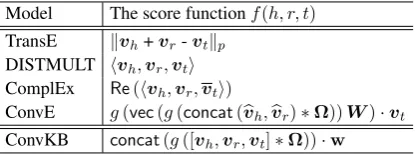
return a score for(h, r, t). See a formal definition of the ConvE score function in Table 1. It is worth noting that ConvE focuses on the local relationships among different dimensional entries in each ofvh orvr, i.e.,ConvE does not observe
the global relationships among same dimensional entries of an embedding triple (vh,vr,vt), so that
ConvE ignores the transitional characteristic in transition-based models, which is one of the most useful intuitions for the task.
In this paper, we present ConvKB—an embed-ding model which proposes a novel use of CNN for the KB completion task. In ConvKB, each entity or relation is associated with an unique k
-dimensional embedding. Letvh,vrandvtdenote k-dimensional embeddings ofh,r andt,
respec-tively. For each triple(h, r, t), the corresponding triple of k-dimensional embeddings (vh, vr, vt)
is represented as a k×3 input matrix. This
in-put matrix is fed to the convolution layer where different filters of the same 1×3 shape are used
to extract the global relationships among same di-mensional entries of the embedding triple. That is, these filters are repeatedly operated over ev-ery row of the input matrix to produce different
Model The score functionf(h, r, t) TransE kvh+vr-vtkp
DISTMULT hvh,vr,vti ComplEx Re(hvh,vr,vti)
[image:2.595.312.520.62.139.2]ConvE g(vec(g(concat(bvh,bvr)∗Ω))W)·vt ConvKB concat(g([vh,vr,vt]∗Ω))·w
Table 1: The score functions in previous SOTA models and in our ConvKB model. kvkp denotes thep-norm ofv. hvh,vr,vti=Pivhivrivti denotes a tri-linear dot product.gdenotes a non-linear function.∗denotes a convolution operator.·denotes a dot product.concat denotes a concatenation operator. vbdenotes a 2D
re-shaping ofv.Ωdenotes a set of filters.
feature maps. The feature maps are concatenated into a single feature vector which is then computed with a weight vector via a dot product to produce a score for the triple(h, r, t). This score is used to infer whether the triple(h, r, t)is valid or not.
Our contributions in this paper are as follows:
• We introduce ConvKB—a novel embedding
model of entities and relationships for knowl-edge base completion. ConvKB models the relationships among same dimensional en-tries of the embeddings. This implies that ConvKB generalizes transitional characteris-tics in transition-based embedding models.
• We evaluate ConvKB on two benchmark datasets: WN18RR (Dettmers et al., 2018) and FB15k-237 (Toutanova and Chen,2015). Experimental results show that ConvKB ob-tains better link prediction performance than previous SOTA embedding models. In partic-ular, ConvKB obtains the best mean rank and the highest Hits@10 on WN18RR, and pro-duces the highest mean reciprocal rank and highest Hits@10 on FB15k-237.
2 Proposed ConvKB model
A knowledge base G is a collection of valid
fac-tual triples in the form of (head entity, relation, tail entity)denoted as(h, r, t) such thath, t ∈ E
andr ∈ RwhereE is a set of entities andRis a set of relations. Embedding models aim to define a
score functionf giving an implausibility score for
each triple (h, r, t) such that valid triples receive
lower scores than invalid triples. Table1presents score functions in previous SOTA models.
We denote the dimensionality of embeddings by
h r t
k = 4
matrix 4×3 3 filters 1×3 convolution
3 feature maps are concatenated
score ReLU
[image:3.595.79.287.57.305.2]dot product
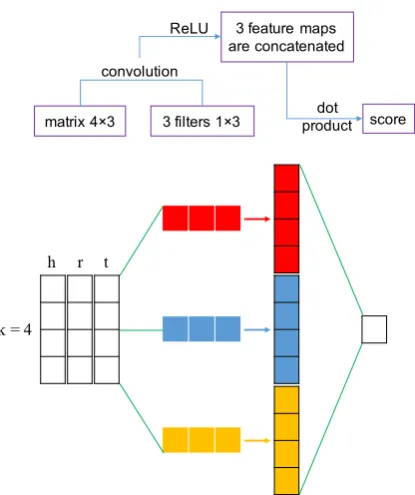
Figure 1: Process involved in ConvKB (with the em-bedding sizek= 4, the number of filtersτ= 3and the activation functiong=ReLU for illustration purpose).
viewed as a matrixA= [vh,vr,vt]∈Rk×3. And Ai,: ∈ R1×3 denotes thei-th row ofA. Suppose
that we use a filter ω ∈ R1×3 operated on the
convolution layer. ω is not only aimed to exam-ine the global relationships between same dimen-sional entries of the embedding triple (vh,vr,vt),
but also to generalize the transitional characteris-tics in the transition-based models.ωis repeatedly
operated over every row ofAto finally generate a
feature mapv= [v1, v2, ..., vk]∈Rkas:
vi=g(ω·Ai,:+b)
whereb∈Ris a bias term andgis some activation
function such as ReLU.
Our ConvKB uses different filters ∈ R1×3 to
generate different feature maps. LetΩandτ
de-note the set of filters and the number of filters, respectively, i.e. τ = |Ω|, resulting inτ feature
maps. Theseτ feature maps are concatenated into
a single vector ∈ Rτ k×1 which is then computed
with a weight vectorw ∈ Rτ k×1 via a dot
prod-uct to give a score for the triple(h, r, t). Figure1
illustrates the computation process in ConvKB. Formally, we define the ConvKB score function
f as follows:
f(h, r, t) =concat(g([vh,vr,vt]∗Ω))·w
where Ωandw are shared parameters,
indepen-Dataset | E | | R | #Triples in train/valid/test WN18RR 40,943 11 86,835 3,034 3,134 FB15k-237 14,541 237 272,115 17,535 20,466
Table 2: Statistics of the experimental datasets.
dent ofh,randt;∗denotes a convolution
opera-tor; andconcatdenotes a concatenation operator. If we only use one filterω (i.e. using τ = 1)
with a fixed bias term b = 0 and the
activa-tion funcactiva-tion g(x) = |x|or g(x) = x2, and fix ω = [1,1,−1]andw = 1during training,
Con-vKB reduces to the plain TransE model (Bordes et al.,2013). So our ConvKB model can be viewed as an extension of TransE to further model global relationships.
We use the Adam optimizer (Kingma and Ba,
2014) to train ConvKB by minimizing the loss functionL (Trouillon et al.,2016) withL2
regu-larization on the weight vectorwof the model:
L= X
(h,r,t)∈{G∪G0}
log 1 + exp l(h,r,t)·f(h, r, t)
+ λ 2kwk
2 2
in which,l(h,r,t) =
1for(h, r, t)∈ G −1for(h, r, t)∈ G0
hereG0 is a collection of invalid triples generated
by corrupting valid triples inG.
3 Experiments 3.1 Datasets
We evaluate ConvKB on two benchmark datasets: WN18RR (Dettmers et al., 2018) and FB15k-237 (Toutanova and Chen, 2015). WN18RR and FB15k-237 are correspondingly subsets of two common datasets WN18 and FB15k (Bordes et al.,
[image:3.595.307.535.339.436.2]Method MR WN18RRMRR H@10 MR MRR H@10FB15k-237
IRN (Shen et al.,2017) – – – 211 – 46.4 KBGAN (Cai and Wang,2018) – 0.213 48.1 – 0.278 45.8 DISTMULT (Yang et al.,2015) [?] 5110 0.43 49 254 0.241 41.9
ComplEx (Trouillon et al.,2016) [?] 5261 0.44 51 339 0.247 42.8
ConvE (Dettmers et al.,2018) 5277 0.46 48 246 0.316 49.1 TransE (Bordes et al.,2013) (our results) 3384 0.226 50.1 347 0.294 46.5 Our ConvKB model 2554 0.248 52.5 257 0.396 51.7
KBLRN (Garc´ıa-Dur´an and Niepert,2017) – – – 209 0.309 49.3
[image:4.595.84.512.63.239.2]R-GCN+ (Schlichtkrull et al.,2017) – – – – 0.249 41.7 Neural LP (Yang et al.,2017) – – – – 0.240 36.2 Node+LinkFeat (Toutanova and Chen,2015) – – – – 0.293 46.2
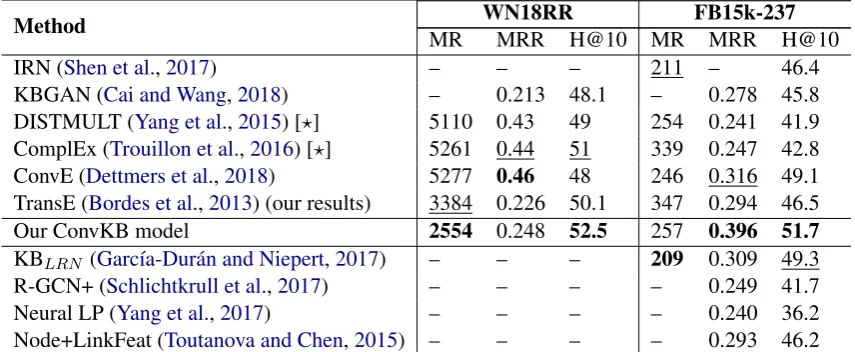
Table 3: Experimental results on WN18RR and FB15k-237 test sets. MRR and H@10 denote the mean reciprocal rank and Hits@10 (in %), respectively. [?]: Results are taken fromDettmers et al.(2018) where Hits@10 and MRR are rounded to 2 decimal places on WN18RR. The last 4 rows report results of models that exploit information about relation paths (KBLRN, R-GCN+ and Neural LP) or textual mentions derived from a large external corpus (Node+LinkFeat). The best score is inbold, while the second best score is in underline.
3.2 Evaluation protocol
In the KB completion or link prediction task ( Bor-des et al.,2013), the purpose is to predict a missing entity given a relation and another entity, i.e, infer-ringhgiven(r, t)or inferringtgiven(h, r). The
results are calculated based on ranking the scores produced by the score functionf on test triples.
Following Bordes et al.(2013), for each valid test triple (h, r, t), we replace either h or t by
each of other entities in E to create a set of
cor-rupted triples. We use the “Filtered” setting pro-tocol (Bordes et al., 2013), i.e., not taking any corrupted triples that appear in the KB into ac-counts. We rank the valid test triple and corrupted triples in ascending order of their scores. We em-ploy three common evaluation metrics: mean rank (MR), mean reciprocal rank (MRR), and Hits@10 (i.e., the proportion of the valid test triples ranking in top 10 predictions). Lower MR, higher MRR or higher Hits@10 indicate better performance.
3.3 Training protocol
We use the common Bernoulli trick (Wang et al.,
2014; Lin et al., 2015b) to generate the head or tail entities when sampling invalid triples. We also use entity and relation embeddings produced by TransE toinitializeentity and relation embeddings in ConvKB. We employ a TransE implementation available at: https://github.com/datquocnguyen/ STransE. We train TransE using a grid search of hyper-parameters: the dimensionality of em-beddings k ∈ {50,100}, SGD learning rate
∈ {1e−4,5e−4,1e−3,5e−3}, l1-norm orl2-norm,
and marginγ ∈ {1,3,5,7}. The highest Hits@10
scores on the validation set are when using l1
-norm, learning rate at 5e−4, γ = 5 and k = 50
for WN18RR, and usingl1-norm, learning rate at 5e−4,γ= 1 and k = 100 for FB15k-237.
To learn our model parameters including en-tity and relation embeddings, filters ω and the
weight vector w, we use Adam (Kingma and
Ba, 2014) and select its initial learning rate ∈ {5e−6,1e−5,5e−5,1e−4,5e−4}. We use ReLU
as the activation function g. We fix the batch
size at 256 and set the L2-regularizer λat 0.001
in our objective function. The filters ω are
ini-tialized by a truncated normal distribution or by
[0.1,0.1,−0.1]. We select the number of filters
τ ∈ {50,100,200,400,500}. We run ConvKB
up to 200 epochs and use outputs from the last epoch for evaluation. The highest Hits@10 scores on the validation set are obtained when using k
= 50, τ = 500, the truncated normal distribu-tion for filter initializadistribu-tion, and the initial learning rate at1e−4 on WN18RR; and k = 100,τ = 50, [0.1,0.1,−0.1]for filter initialization, and the ini-tial learning rate at5e−6on FB15k-237.
3.4 Main experimental results
MRR and Hits@10 scores on FB15k-237.
ConvKB does better than the closely related model TransE on both experimental datasets, es-pecially on FB15k-237 where ConvKB gains sig-nificant improvements of 347 − 257 = 90 in
MR (which is about 26% relative improvement) and 0.396 − 0.294 = 0.102 in MRR (which
is 34+% relative improvement), and also ob-tains 51.7 − 46.5 = 5.2% absolute
improve-ment in Hits@10. Previous work shows that TransE obtains very competitive results (Lin et al.,
2015a;Nickel et al.,2016b;Trouillon et al.,2016;
Nguyen et al., 2016a). However, when compar-ing the CNN-based embeddcompar-ing model ConvE with other models,Dettmers et al.(2018) did not exper-iment with TransE. We reconfirm previous find-ings that TransE in fact is a strong baseline model, e.g., TransE obtains better MR and Hits@10 than ConvE on WN18RR.
ConvKB obtains better scores than ConvE on both datasets (except MRR on WN18RR and MR on FB15k-237), thus showing the usefulness of taking transitional characteristics into accounts. In particular, on FB15k-237, ConvKB achieves im-provements of 0.394−0.316 = 0.078 in MRR
(which is about 25% relative improvement) and
51.7 − 49.1 = 2.6% in Hits@10, while both ConvKB and ConvE produce similar MR scores. ConvKB also obtains 25% relatively higher MRR score than the relation path-based model KBLRN
on FB15k-237. In addition, ConvKB gives bet-ter Hits@10 than KBLRN, however, KBLRN gives
better MR than ConvKB. We plan to extend Con-vKB with relation path information to obtain bet-ter link prediction performance in future work.
4 Conclusion
In this paper, we propose a novel embedding model ConvKB for the knowledge base comple-tion task. ConvKB applies the convolucomple-tional neu-ral network to explore the global relationships among same dimensional entries of the entity and relation embeddings, so that ConvKB generalizes the transitional characteristics in the transition-based embedding models. Experimental results show that our model ConvKB outperforms other state-of-the-art models on two benchmark datasets WN18RR and FB15k-237. Our code is available at:https://github.com/daiquocnguyen/ConvKB.
We also plan to extend ConvKB for a new appli-cation where we could formulate data in the form
of triples. For example, inspired from the work byVu et al.(2017) for search personalization, we can also apply ConvKB to modeluser-oriented re-lationships between submitted queries and docu-ments returned by search engines, i.e. modeling triple representations (query, user, document).
Acknowledgments
This research was partially supported by the Aus-tralian Research Council (ARC) Discovery Grant Project DP160103934.
References
Kurt Bollacker, Colin Evans, Praveen Paritosh, Tim Sturge, and Jamie Taylor. 2008. Freebase: A collab-oratively created graph database for structuring hu-man knowledge. In Proceedings of the 2008 ACM SIGMOD International Conference on Management of Data, pages 1247–1250.
Antoine Bordes, Nicolas Usunier, Alberto Garc´ıa-Dur´an, Jason Weston, and Oksana Yakhnenko. 2013. Translating Embeddings for Modeling Multi-relational Data. InAdvances in Neural Information Processing Systems 26, pages 2787–2795.
Antoine Bordes, Jason Weston, Ronan Collobert, and Yoshua Bengio. 2011. Learning Structured Embed-dings of Knowledge Bases. In Proceedings of the Twenty-Fifth AAAI Conference on Artificial Intelli-gence, pages 301–306.
Liwei Cai and William Yang Wang. 2018. KBGAN: Adversarial Learning for Knowledge Graph Embed-dings. InProceedings of The 16th Annual Confer-ence of the North American Chapter of the Associ-ation for ComputAssoci-ational Linguistics: Human Lan-guage Technologies, page to appear.
Ronan Collobert, Jason Weston, L´eon Bottou, Michael Karlen, Koray Kavukcuoglu, and Pavel Kuksa. 2011. Natural language processing (almost) from scratch. Journal of Machine Learning Research, 12:2493–2537.
Tim Dettmers, Pasquale Minervini, Pontus Stenetorp, and Sebastian Riedel. 2018. Convolutional 2D Knowledge Graph Embeddings. InProceedings of the 32nd AAAI Conference on Artificial Intelligence, page to appear.
Alberto Garc´ıa-Dur´an and Mathias Niepert. 2017. KBLRN: End-to-end learning of knowledge base representations with latent, relational, and numeri-cal features. arXiv preprint abs/1709.04676. Kelvin Guu, John Miller, and Percy Liang. 2015.
Yanchao Hao, Yuanzhe Zhang, Kang Liu, Shizhu He, Zhanyi Liu, Hua Wu, and Jun Zhao. 2017. An end-to-end model for question answering over knowl-edge base with cross-attention combining global knowledge. In Proceedings of the 55th Annual Meeting of the Association for Computational Lin-guistics (Volume 1: Long Papers), pages 221–231.
Guoliang Ji, Shizhu He, Liheng Xu, Kang Liu, and Jun Zhao. 2015. Knowledge Graph Embedding via Dynamic Mapping Matrix. In Proceedings of the 53rd Annual Meeting of the Association for Compu-tational Linguistics and the 7th International Joint Conference on Natural Language Processing (Vol-ume 1: Long Papers), pages 687–696.
Guoliang Ji, Kang Liu, Shizhu He, and Jun Zhao. 2016. Knowledge Graph Completion with Adap-tive Sparse Transfer Matrix. In Proceedings of the Thirtieth Conference on Artificial Intelligence, pages 985–991.
Gjergji Kasneci, Fabian M Suchanek, Georgiana Ifrim, Maya Ramanath, and Gerhard Weikum. 2008. Naga: Searching and ranking knowledge. In Pro-ceedings of the 24th IEEE International Conference on Data Engineering, pages 953–962.
Yoon Kim. 2014. Convolutional Neural Networks for Sentence Classification. InProceedings of the 2014 Conference on Empirical Methods in Natural Lan-guage Processing, pages 1746–1751.
Diederik Kingma and Jimmy Ba. 2014. Adam: A method for stochastic optimization. arXiv preprint arXiv:1412.6980.
Yann LeCun, L´eon Bottou, Yoshua Bengio, and Patrick Haffner. 1998. Gradient-based learning applied to document recognition. Proceedings of the IEEE, 86:2278–2324.
Jens Lehmann, Robert Isele, Max Jakob, Anja Jentzsch, Dimitris Kontokostas, Pablo N Mendes, Sebastian Hellmann, Mohamed Morsey, Patrick Van Kleef, S¨oren Auer, et al. 2015. DBpedia–a large-scale, multilingual knowledge base extracted from Wikipedia. Semantic Web, 6:167–195.
Yankai Lin, Zhiyuan Liu, Huanbo Luan, Maosong Sun, Siwei Rao, and Song Liu. 2015a. Modeling Rela-tion Paths for RepresentaRela-tion Learning of Knowl-edge Bases. In Proceedings of the 2015 Confer-ence on Empirical Methods in Natural Language Processing, pages 705–714.
Yankai Lin, Zhiyuan Liu, Maosong Sun, Yang Liu, and Xuan Zhu. 2015b. Learning Entity and Re-lation Embeddings for Knowledge Graph Comple-tion. InProceedings of the Twenty-Ninth AAAI Con-ference on Artificial Intelligence Learning, pages 2181–2187.
Yuanfei Luo, Quan Wang, Bin Wang, and Li Guo. 2015. Context-Dependent Knowledge Graph Em-bedding. InProceedings of the 2015 Conference on
Empirical Methods in Natural Language Process-ing, pages 1656–1661.
Dat Quoc Nguyen. 2017. An overview of embedding models of entities and relationships for knowledge base completion. arXiv preprint, arXiv:1703.08098.
Dat Quoc Nguyen, Kairit Sirts, Lizhen Qu, and Mark Johnson. 2016a. Neighborhood Mixture Model for Knowledge Base Completion. In Proceedings of The 20th SIGNLL Conference on Computational Natural Language Learning, pages 40–50.
Dat Quoc Nguyen, Kairit Sirts, Lizhen Qu, and Mark Johnson. 2016b. STransE: a novel embedding model of entities and relationships in knowledge bases. In Proceedings of the 2016 Conference of the North American Chapter of the Association for Computational Linguistics: Human Language Tech-nologies, pages 460–466.
Maximilian Nickel, Kevin Murphy, Volker Tresp, and Evgeniy Gabrilovich. 2016a. A Review of Rela-tional Machine Learning for Knowledge Graphs. Proceedings of the IEEE, 104(1):11–33.
Maximilian Nickel, Lorenzo Rosasco, and Tomaso Poggio. 2016b. Holographic Embeddings of Knowledge Graphs. InProceedings of the Thirtieth AAAI Conference on Artificial Intelligence, pages 1955–1961.
Michael Schlichtkrull, Thomas Kipf, Peter Bloem, Ri-anne van den Berg, Ivan Titov, and Max Welling. 2017. Modeling relational data with graph convolu-tional networks. arXiv preprint arXiv:1703.06103.
Michael Schuhmacher and Simone Paolo Ponzetto. 2014. Knowledge-based graph document modeling. In Proceedings of the 7th ACM International Con-ference on Web Search and Data Mining, pages 543– 552.
Yelong Shen, Po-Sen Huang, Ming-Wei Chang, and Jianfeng Gao. 2017. Traversing knowledge graph in vector space without symbolic space guidance. arXiv preprint arXiv:1611.04642v4.
Richard Socher, Danqi Chen, Christopher D Manning, and Andrew Ng. 2013. Reasoning With Neural Ten-sor Networks for Knowledge Base Completion. In Advances in Neural Information Processing Systems 26, pages 926–934.
Fabian M. Suchanek, Gjergji Kasneci, and Gerhard Weikum. 2007. Yago: A core of semantic knowl-edge. InProceedings of the 16th International Con-ference on World Wide Web, pages 697–706.
Kristina Toutanova, Xi Victoria Lin, Wen tau Yih, Hoifung Poon, and Chris Quirk. 2016. Composi-tional Learning of Embeddings for Relation Paths in Knowledge Bases and Text. InProceedings of the 54th Annual Meeting of the Association for Compu-tational Linguistics, pages 1434–1444.
Th´eo Trouillon, Johannes Welbl, Sebastian Riedel, ´Eric Gaussier, and Guillaume Bouchard. 2016. Complex Embeddings for Simple Link Prediction. In Pro-ceedings of the 33nd International Conference on Machine Learning, pages 2071–2080.
Thanh Vu, Dat Quoc Nguyen, Mark Johnson, Dawei Song, and Alistair Willis. 2017. Search Person-alization with Embeddings. In Proceedings of the 39th European Conference on Information Re-trieval, pages 598–604.
Zhen Wang, Jianwen Zhang, Jianlin Feng, and Zheng Chen. 2014. Knowledge Graph Embedding by Translating on Hyperplanes. InProceedings of the Twenty-Eighth AAAI Conference on Artificial Intel-ligence, pages 1112–1119.
Robert West, Evgeniy Gabrilovich, Kevin Murphy, Shaohua Sun, Rahul Gupta, and Dekang Lin. 2014. Knowledge Base Completion via Search-based Question Answering. In Proceedings of the 23rd International Conference on World Wide Web, pages 515–526.
Chenyan Xiong, Russell Power, and Jamie Callan. 2017. Explicit semantic ranking for academic search via knowledge graph embedding. In Pro-ceedings of the 26th International Conference on World Wide Web, pages 1271–1279.
Bishan Yang and Tom Mitchell. 2017. Leveraging knowledge bases in lstms for improving machine reading. In Proceedings of the 55th Annual Meet-ing of the Association for Computational LMeet-inguistics (Volume 1: Long Papers), pages 1436–1446.
Bishan Yang, Wen-tau Yih, Xiaodong He, Jianfeng Gao, and Li Deng. 2015. Embedding Entities and Relations for Learning and Inference in Knowledge Bases. InProceedings of the International Confer-ence on Learning Representations.
Fan Yang, Zhilin Yang, and William W Cohen. 2017. Differentiable Learning of Logical Rules for Knowl-edge Base Reasoning. pages 2316–2325.