Large-Scale Discriminative Training for Statistical Machine Translation
Using Held-Out Line Search
Jeffrey Flanigan Chris Dyer Jaime Carbonell Language Technologies Institute
Carnegie Mellon University Pittsburgh, PA 15213, USA
{jflanigan,cdyer,jgc}@cs.cmu.edu
Abstract
We introduce a new large-scale discrimina-tive learning algorithm for machine translation that is capable of learning parameters in mod-els with extremely sparse features. To ensure their reliable estimation and to prevent over-fitting, we use a two-phase learning algorithm. First, the contribution of individual sparse fea-tures is estimated using large amounts of par-allel data. Second, a small development cor-pus is used to determine the relative contri-butions of the sparse features and standard dense features. Not only does this two-phase learning approach prevent overfitting, the sec-ond pass optimizes corpus-level BLEU of the Viterbi translation of the decoder. We demon-strate significant improvements using sparse rule indicator features in three different trans-lation tasks. To our knowledge, this is the first large-scale discriminative training algo-rithm capable of showing improvements over the MERT baseline with only rule indicator features in addition to the standardMERT fea-tures.
1 Introduction
This paper is about large scale discriminative training of machine translation systems. Like
MERT(Och, 2003), our procedure directly optimizes the cost of the Viterbi output on corpus-level met-rics, but does so while scaling to millions of features. The training procedure, which we call theHeld-Out Line Searchalgorithm (HOLS), is a two-phase
iter-ative batch optimization procedure consisting of (1) a gradient calculation on a differentiable approxima-tion to the loss on a large amount of parallel training
data and (2) a line search (using the standardMERT
algorithm) to search in a subspace defined by the gradient for the weights that minimize the true cost. While sparse features are successfully used in many NLP systems, such parameterizations pose a number of learning challenges. First, since any one feature is likely to occur infrequently, a large amount of training data is necessary to reliably estimate their weights. Therefore, we use the full parallel train-ing data (rather than a small development set) to estimate the contribution of the sparse features in phase 1. Second, sparse features can lead to overfit-ting. To prevent this from hurting our model’s ability to generalize to new data, we do two things. First, we use “grammar and language model folds” (trans-lation grammars and language models built from other portions of the training data than are being used for discriminative training), and second, we run the phase 2 line search on a held-out develop-ment set. Finally, since our algorithm requires de-coding the entire training corpus, it is desirable (on computational grounds) to only require one or two passes through the training data. To get the most out of these passes, we rescale features by their inverse frequency which improves the scaling of the opti-mization problem. In addition to learning with few passes through the training data, theHOLSalgorithm has the advantage that it is easily parallelizable.
After reviewing related work in the next section, we analyze two obstacles to effective discriminative learning for machine translation: overfitting (since both rules and their weights must be learned, if they are learned together degenerate solutions that fail to generalize are possible) and poor scaling (since MT
decoding is so expensive, it is not feasible to make many passes through large amounts of training data, so optimization must be efficient). We then present the details of our algorithm that addresses these is-sues, give results on three language pairs, and con-clude.
2 Related Work
Discriminative training of machine translation sys-tems has been a widely studied problem for the last ten years. The pattern of using small, high-quality development sets to tune a relatively small number of weights was established early (Och and Ney, 2002; Och, 2003). More recently, standard structured prediction algorithms that target linearly decomposable approximations of translation qual-ity metrics have been thoroughly explored (Liang et al., 2006; Smith and Eisner, 2006; Watanabe et al., 2007; Rosti et al., 2010; Hopkins and May, 2011; Chiang, 2012; Gimpel and Smith, 2012; Cherry and Foster, 2012; Saluja et al., 2012). These have with-out exception used sentence-level approximations of
BLEUto determine oracles and update weights using a variety of criteria and with a variety of different theoretical justifications.
Despite advancements in discriminative training for machine translation, large-scale discriminative training with rule indicator features has remained notoriously difficult.Rule indicator featuresare an extremely sparse and expressive parameterization of the translation model: every rule has a feature, each of which has its own separately tuned weight, which count how often a specific rule is used in a trans-lation. Early experiments (Liang et al., 2006) used the structured perceptron to tune a phrase-based sys-tem on a large subset of the training data, show-ing improvements when usshow-ing rule indicator tures, word alignment features, and POS tag fea-tures. Another early attempt (Tillmann and Zhang, 2006) used phrase pair and word features in a block SMT system trained using stochastic gradient de-scent for a convex loss function, but did not compare to MERT. Problems of overfitting and degenerate derivations were tackled with a probabilistic latent variable model (Blunsom et al., 2008) which used rule indicator features yet failed to improve upon the MERT baseline for the standard Hiero features.
Techniques for distributed learning and feature se-lection for the perceptron loss using rule indicator, rule shape, and source side-bigram features have re-cently been proposed (Simianer et al., 2012), but no comparison toMERTwas made.
3 Difficulties in Large-Scale Training
Discriminative training for machine translation is complicated by several factors. First, both transla-tion rules and feature weights are learned from par-allel data. If the same data is used for both tasks, overfitting of the weights is very possible.1 Second, the standard MT cost function, BLEU (Papineni et al., 2002), does not decompose additively over train-ing instances (because of the “brevity penalty”) and so approximations are used—these often have prob-lems with the length (Nakov et al., 2012). Finally, state-of-the-art MT systems make extensive good use of “dense” features, such as the log probabil-ity of translation decisions under a simpler gener-ative translation model. Our goal is to begin to use much sparser features without abandoning the proven dense features; however, extremely sparse features leads to problems of scaling in the optimiza-tion problem as we will show.
3.1 Training Data and Overfitting
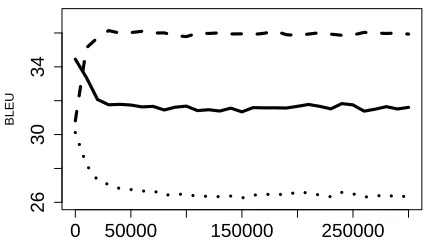
One of the big questions in discriminative train-ing of machine translation systems is why standard machine learning techniques can perform so poorly when applied to large-scale learning on the train-ing data. Figure 1 shows a good example of this. The structured SVM (Tsochantaridis et al., 2004; Cherry and Foster, 2012) was used to learn the weights for a Chinese-English Hiero system (Chi-ang, 2005) with just eight features, using stochastic gradient descent (SGD) for online learning (Bottou, 1998; Bottou, 2010). The weights were initialized from MERT values tuned on a2k-sentence dev set
(MT06), and the figure shows the progress of the on-line method during a single pass through the300 k-sentence Chinese-English FBIS training set.
As the training progresses in Figure 1, BLEU scores on the training data go up, but scores on the
0 50000 150000 250000
26
30
34
BLEU
Figure 1: Progress of the online SVM training method after each training instance on FBIS dataset. The solid line is BLEU on the test set, training set is the dashed line, and the dev set is dotted.
dev and test sets go down. If we hope to apply dis-criminative training techniques for not eight but mil-lions of features on the training data, we must find a way to prevent this overfitting.
We suggest that an important reason why overfit-ting occurs is that the training data is used not only to tune the system but also to extract the grammar, and the target side is included in the data used to build the language model. To test this hypothesis, we compare tuning using three different dev sets: 1000 sentences from the standard 4-reference MT06 dev set (Dev1000), a random selection of 1000 sentences that overlap with the corpus used to extract transla-tion rules (In1000), and 1000 sentences that came from the training data but were then excluded from rule extraction (Out1000). We runMERTon each of these and evaluate. For evaluation we compare three different sets: a random 1000 sentences from the training corpus that was used to create the grammars but which do not overlap with In1000 (Train1000), the1000sentence dev set (Dev1000), and the stan-dard 4-reference MT02-03 test set (Test). The en-tire experiment (including selection of the 1000 sen-tences) was replicated 5 times.
Table 1 shows the results, averaging over repli-cations. Out1000 gives much higher scores on the testing data, validating our hypothesis that tuning on data used to build the LM and grammar can lead to overfitting. However, the results also show that tun-ing on the traintun-ing data, even when it is held-out, can still lead to a small reduction in translation quality. One possible reason is that, unlike the training data
[image:3.612.72.286.59.182.2]which may come from various domains, the dev data is in the same domain as the test data and is typically of higher quality (e.g., it has multiple references).
Table 1:MERTon Zh-En FBIS
Tuning Set Train1000 Dev1000 Test Dev1000 32.2±1.1 30.2±.1 34.1±.3
In1000 37.0±1.2 25.7±.7 30.1±.6
Out1000 34.9±.8 29.0±.4 33.6±.5
3.2 Poor Scaling
When features occur with different frequencies, changing the weights of more frequent features has a larger effect than changing the weights of less fre-quent features.2 An example of frequent features that have a large impact on the translation quality are the language model and translation model features. These features are non-zero for every sentence, and changing their weights slightly has a large impact on translation output. In contrast, changing the weight drastically for a feature that is non-zero for only one out of a million sentences has very little effect on translation metrics. The sensitivity of the translation output to some feature weights over others was also pointed out in a recent paper (Chiang, 2012).
When the objective function is more sensitive in some dimensions than others, the optimization problem is said to be poorly scaled (Nocedal and Wright, 2000), and can slow down the convergence rate for some optimizers. A typical fix is to rescale the dimensions, as we will do in Section 5.2.
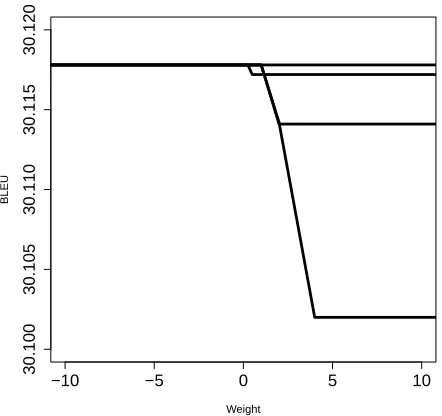
To verify that BLEU is poorly scaled with respect to weights of rule indicator features, we look at the effect of changing the weights for individual rules. We vary the feature weights for four randomly cho-sen frequent rules and four randomly chocho-sen infre-quent rules on our FBIS dev set (Figure 2). One can think of this plot as a “cross-section” of the BLEU score in the direction of the feature weight. The dense features are set to MERT-tuned values which are normalized to one. All other rule indi-cator features are set to zero, except the rule fea-ture weight that is varied. The frequent features
[image:3.612.321.536.130.187.2]were selected randomly from the 20 most common rule indictor features in the n-best lists on the dev set, and the infrequent features were selected from the features that only occurred once in these n-best lists. The plots indicate that the BLEU score is
−2 −1 0 1 2
27.0
28.0
29.0
30.0
Weight
BLEU
(a) Four representativefrequentsparse features.
−10 −5 0 5 10
30.100
30.105
30.110
30.115
30.120
Weight
BLEU
[image:4.612.74.295.423.631.2](b) Four representativeinfrequentsparse features
Figure 2:The effect of varying weights for rule indicator features on the BLEU score. Note the difference of scale on theyaxis.
poorly scaled for rule feature weights. Changing the weights for one of the common features changes the BLEU score by almost2.5BLEU points, while for the infrequent features the BLEU score changes by at most.02BLEU points. We take this as a sign that gradient descent based optimizers for machine trans-lation with rule features could be slow to converge due to poor scaling, and that rescaling will improve convergence.
3.3 Sentence Level Approximations to BLEU
Finally, we note that discriminative training methods often use a sentence level approximation to BLEU. It has been shown that optimizing corpus level BLEU versus sentence level BLEU can lead to improve-ments of up to nearly .4 BLEU points on the test set (Nakov et al., 2012). Possible fixes to this prob-lem include using a proper sentence level metric such a METEOR (Denkowski and Lavie, 2011) or a pseudo-corpus from the last few updates (Chiang et al., 2008). However, in light of the result from sec-tion 3.1 that tuning on the dev set is still better than tuning on a held-out portion of the training data, we observe that tuning a corpus level metric on a high-quality dev set from the same domain as the test set probably leads to the best translation quality. At-tempts to improve upon this strong baseline lead us to the development of theHOLSalgorithm which we
describe next.
4 Held-Out Line Search Algorithm
In this section we give the details of the learning al-gorithm that we developed for use in large-scale dis-criminative training for machine translation, which we call the Held-Out Line Search algorithm (abbre-viatedHOLS). It optimizes millions of features using evidence from the full set of parallel training data to obtain optimal predictive performance on a sec-ondary development set.
opti-mize the evaluation score of the one-best prediction of a translation system on a secondary development set.3 The secondary dev set is a crucial aspect of
the algorithm that helps reduce overfitting (we will demonstrate this in the experiments section).
During the line search phase we allow some of the feature weights to be adjusted independently of the line search. We will call the features we opti-mize independently the dense features, and the tures we include in the line search the sparse fea-tures.4 The feature vector spaceV is the direct sum
V = Vd ⊕ Vs, where Vd is the vector space of
the dense features andVs is the vector space of the
sparse features. The feature and weight vectors de-compose asf~=f~d+f~sandw~ =w~d+w~s. f~dand
~
wdare in the dense vector space, and thef~sandw~s
are in the sparse vector space.
In the gradient phase, we calculate a gradient of the surrogate loss function and project it onto the subspace of the sparse features. Let Psbe the
pro-jection operator ontoVs. Then the gradient projected
onto the sparse feature space is
~g= Ps∇w~L˜(w,~ Dg)
whereDg is the subset of the training data used to calculate this gradient, and L˜ is the surrogate loss function. This just sets the dense components of the gradient ofL˜ to zero.
In the line search phase, we use a separate opti-mizer to optimize the weights for the dense features and the stepsize α. Let L be the loss function we wish to minimize, then
(w~∗d, α∗) = arg min ~ wd,α
L(w~d+w~s+α~g,Dl)
Notew~sis held fixed from the previous iteration.Dl
is the portion of the training data which is used in the line search phase, and must not overlap withDg
used in the gradient calculation phase.5
After the line search, the dense weights are up-dated tow~d∗, and the sparse weights are updated with
~
ws ← w~s+α∗~g. The process repeats for another
iteration as desired (or until convergence).
3
While we use BLEU any loss function whose sufficient statistics decompose over training instances could be used.
4
The split over the features does not have to be done this way in practice.
5 L(w~∗d, α
∗
,Dl)can be thought of as unbiased or more accu-rately less biased estimator of expected loss whenDl∩ Dg=∅.
5 Procedure for Large-Scale Training
Now that we have described theHOLSalgorithm in
general, we next describe how to apply it to large-scale training of machine translation systems with millions of features. We find that it is necessary to use disjoint sets of training instances for grammar extraction and gradient estimation (§5.1) and to deal with the poor scaling of the optimization problem (§5.2).
5.1 Grammar and Language Model Folds
To address the problem of overfitting on the train-ing data, we split the traintrain-ing data inton-folds, and extract grammars for each fold using the data from the othern−1folds. Similarly, we build a language model for each fold using a target language mono-lingual corpus and the target side of the training data from the othern−1folds. Whenever we decode a sentence from the training data, we use the gram-mar and language model for the appropriate fold. This ensures that a sentence is never decoded using a grammar or language model it helped build, thereby reducing the overfitting effect demonstrated in§3.1. To perform the training, the HOLS algorithm is used on the training data. In our experiments, only 1-2 passes over the training data are necessary for significant gains. Data from one of the grammar folds is used for the line search, and the rest of the training data is used to calculate the gradient.
The procedure is iterative, first decoding training data to obtain a gradient, and then performing a line search with data from a held-out grammar fold. In-stead of decoding the whole set of sentences used for the gradient updates at once, one can also decode a portion of the data, do a gradient update, and then continue the next iteration of HOLSon the remain-ing data before repeatremain-ing.
The last line search of theHOLSalgorithm is done using dev data, rather than training data. This is be-cause the dev data is higher quality, and from Table 1 we can see that tuning on dev data produces bet-ter results than tuning on training data (even if the training data has been held out from the grammar process). The initial weights are obtained by run-ning MERT on a subset of the one of the grammar folds.
op-timizer for the loss function used during the line search (in our caseMERT), it can be used to perform the line search. This is done simply by callingMERT
with two extra features in addition to the dense fea-tures and omitting the sparse feafea-tures.
To see how, notice that the feature weights during the line search are decomposed as w~ =
~
wdense + wsparse~ + α~g where ~g is in the sparse
feature subspace, so the model score decomposes as score(x, y) = w~d·f~d(x, y) +w~s ·f~s(x, y) + α~g·fs~(x, y) where x is the input translation, y is the output translation and derivation. If we cre-ate two new features f1(x, y) = w~s ·f~s(x, y) and f2(x, y) =~g·fs~(x, y)then the score can be written
score(x, y) =w~d·f~d(x, y)
+f1(x, y) +αf2(x, y)
= (w~d,1, α)·(f~d, f1, f2)
Thus we can do the line search simply by calling
MERTwith the features(f~d, f1, f2).6
In summary our training algorithm is as follows: 1) split the training data inton-folds (we usen= 5), 2) initialize the dense weights to MERT values, 3) decode some or all the data in 4 of the 5 folds to get a gradient, 4) condition as in§5.2 (see below), 5) run
MERTon a 10k subset of the remaining fold to do the line search, 6) repeat steps 3-4 until convergence or stop as desired, and 7) runMERTon the normal dev set as a final step. We only runMERTon a 10k subset of one of the folds so it does not require running
MERTon an entire fold.
In the special case where just one iteration of
HOLS is performed, the procedure is very simple:
decode the training data to get a gradient, include the components of the gradient as an extra feature
f2 in addition to the dense features, and tune on a
dev set usingMERT.
5.2 Conditioning
To address the problem of poor scaling, we use a simple strategy of rescaling each component of the gradient based on how frequent the feature is. We call this process “conditioning.” For each feature, we simply divide the corresponding dimension of
6We could constrain the weight forf
1to be 1, but this is not necessary since sinceMERTis invariant to the overall scale of the weights.
the gradient by the number of n-best lists in which the feature was non-zero in.
The necessity for conditioning is evident when we run the HOLS algorithm as detailed so far on the training data without conditioning. On subsequent iterations, we observe that the features with the high-est component of the gradient oscillate between iter-ations, but the rest of the feature gradients stay the same.
Based on our knowledge that the optimization problem was poorly scaled, we divided by the fre-quency of the feature. We can give the following heuristic justification for our method of condition-ing. For theith feature weight, we will take a step
∆wi. Assume that we want to take the step∆wi
pro-portional to the average gradientgˆi calculated from n-best lists in which the feature is non-zero. In other words, we want ∆wi = αˆgi. Let gi be the total
gradient calculated by adding the gradients over all n-best lists (i.e. summing over training examples in the corpus). For a feature that is nonzero in ex-actlyni n-best lists, the gradient from each example
will have been added up ni times, so the total gra-dientgi = nigiˆ. Therefore we should take the step
∆wi = αgi/ni. In other words, we rescale each
componentgi of the gradient by1/ni before taking the gradient step.
We can relate this argument back to the oscillation we observed of the rule feature weights. For rules that are used a thousand times more often than the average rule, the corresponding component of the gradient is roughly a thousand times larger. But that does not indicate that the adjustment∆wito the rule
weight should be a thousand times larger in each it-eration.
6 Experiments
We evaluate and analyze the performance of our training method with three sets of experiments. The first set of experiments compares HOLS to other tuning algorithms used in machine translation in a medium-scale discriminative setting. The second set looks in detail atHOLSfor large scale discriminative training for a Chinese-English task. The third set looks at two other languages.
Table 2: Corpora
Language Corpus Sentences Tokens Source Target
En Gigaword 24M 594M
Ar-En Train 1M 7M 31M
Dev (MT06) 1797 13K 236K
MT05 1,056 7K 144K
MT08nw 813 5K 116K
MT05wb 547 5K 89K
Mg-En Train 89K 2.1M 1.7M
Dev 1,359 34K 28K
Test 1,133 29K 24K
Zh-En Train (FBIS) 302K 1M 9.3M
Dev (MT06) 1,664 4K 192K
Test (MT02-03) 1,797 5K 223K
MT08 1,357 4K 167K
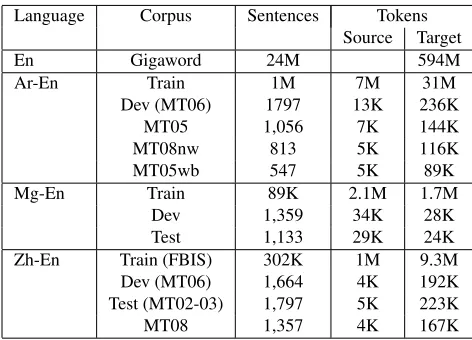
following 8 dense features: LM, phrasal and lexi-cal p(e|f) and p(f|e), phrase and word penalties, and glue rule. The total number of features is 2.2M (Mg-En), 28.8M (Ar-En), and 10.8M (Zh-En). The same features are used for all tuning methods, ex-ceptMERTbaseline which uses only dense features. Although we extract different grammars from vari-ous subsets of the training corpus, word alignments were done using the entire training corpus. We use GIZA++ for word alignments (Och and Ney, 2003), Thrax (Weese et al., 2011) to extract the grammars, our decoder is cdec (Dyer et al., 2010) which uses KenLM (Heafield, 2011), and we used a 4-gram LM built using SRILM (Stolcke, 2002). Our optimizer uses code implemented in the pycdec python inter-face to cdec (Chahuneau et al., 2012). To speed up decoding, for each source RHS we filtered the gram-mars to the top 15 rules ranked byp(e|f). Statistics about the datasets we used are listed in Table 2.
We use the “soft ramp 3” loss function (Gimpel, 2012; Gimpel and Smith, 2012) as the surrogate loss function for calculating the gradient in HOLS. It is
defined as
˜ L=
n
X
i=1
−log X
y∈Gen(xi)
ew~·f~(xi,y)−cost(yi,y)
+ log X y∈Gen(xi)
ew~·f~(xi,y)+cost(yi,y)
where the sum over i ranges over training exam-ples, Gen(x) is the space of possible outputs and
derivations for the inputx, andcost(yi, y)is add one smoothing sentence level BLEU.7
Except where noted, all experiments are repeated
5times and results are averaged, initial weights for the dense features are drawn from a standard nor-mal, and initial weights for the sparse features are set to zero. We evaluate using MultEval (Clark et al., 2011) and report standard deviations across opti-mizer runs and significance atp=.05using MultE-val’s built-in permutation test. In the large-scale ex-periments forHOLS, we only run the full optimizer
once, and report standard deviations using multiple runs of the lastMERTrun (i.e. the last line search on the dev data).
6.1 Comparison Experiments for ZH-EN
Our first set of experiments compares the perfor-mance of the proposed HOLS algorithm to learn-ing algorithms popularly used in machine transla-tion on a Chinese-English task. We also compare to a close relative of the HOLSalgorithm: optimizing the soft ramp 3 loss directly with online stochastic gradient descent and with conditioning. As we will see, SGDSOFTRAMP3 performs significantly worse thanHOLS, despite both algorithms optimizing sim-ilar loss functions.
In the experiments in this section, we do not use the full version of the training setup described in
§5 since we wish to compare to algorithms that do not necessarily scale to large amounts of training data. We therefore use only one fifth of the train-ing data for learntrain-ing the weights for both the dense and sparse features.
In this section we refer to the subset of the train-ing data used to learn the weights as thetuning set
(Tune). The grammar and LM are built using the training data that is not in the tuning set (the LM also includes the English monolingual corpus), and the weights for the features are tuned using the tuning set. This is similar to the typical train-dev-test split commonly used to tune machine translation systems, except that the tuning set is much larger (60k sen-tence pairs versus the usual 1k-2k) and comes from a random subset of the training data rather than a
7
Table 3: Comparison Experiments for Zh-En
Algorithm Tune MT08 Runtime
MERT 22.1±.1 23.1±.1 6hours
PRO 23.8±.05 23.6±.1 2weeks MIRA 21.7±.1 22.5±.1 19hours
SOFTRAMP3 21.5±.3 22.3±.3 29hours HOLS 22.3±.1 23.4±.1 10hours HILS 24.3±.2 22.4±.1 10hours
specialized development set.
We compare MERT, PRO (Hopkins and May, 2011), MIRA (Chiang, 2012), SOFTRAMP3, HOLS,
and a variant ofHOLSwhich we callHILS(discussed below). For HOLS, we used 10k of the 60k ing set for the line search, and the rest of the tun-ing set was used for calculattun-ing the gradient. For
HILS (“Held-In” Line Search), the full 60k tuning set was used to calculate the gradient, but the line search was on a 10k subset of that set. For MERT, we used a 10k subset of the tuning data because it takes a long time to run on large datasets, and it only has the eight dense features and so does not need the entire 60k tuning set. All the subsets are drawn ran-domly. Conditioning was performed only forHOLS,
HILS, andSOFTRAMP3 because conditioning would affect the regularizer forPROand require modifica-tions to the MIRA algorithm. To do the condition-ing for SOFTRAMP3 we used rule count during ex-traction of the grammar and not the frequency in the n-best lists because the online nature of SOFT
-RAMP3 prevents us from knowing how frequent a rule will be (and the dense features are conditioned using the corpus size). We choseMIRA’s best learn-ing rate (η = .001) from{.1, .01, .001}, used de-fault settings forPROin cdec, and forSOFTRAMP3 we used the same loss function asHOLSbut included an L2 regularizer of strength.001and used a
step-size of 1 (which was scaled because of condition-ing). To remedy problems of length bias for sentence level BLEU, we used brevity penalty smoothed and grounded BLEU+1 for sentence level scores (Nakov et al., 2012). Tuning was repeated four times with different initial weights, except for PRO which we
only ran three times (due to training costs). The ini-tial weights for MERTwere drawn from a standard normal distribution, and final MERT weights were
used as the initial weights for the dense features for the other algorithms. Initial weights for the sparse features were set to zero. ForHOLS, andHILS,
tun-ing set BLEU scores were evaluated on the set that the line search was run on. We also report run times for 8 threads on an Opteron 6220 processor.8
The results are shown in Table 3. PROandHOLS
are a statistically significant improvement upon the
MERT baseline on the MT08 test data, but MIRA,
SOFTRAMP3, andHILSare not.
HILS dramatically overfits the tuning set, while
HOLS does not, justifying the use of a held-out dataset for the line search. SOFTRAMP3 performs significantly worse thanHOLSon the test set.PROis a promising training algorithm, but does not scale to the full FBIS corpus because it requires many itera-tions.
6.2 FullZH-ENand Ablation Experiments
This set of experiments evaluates the performance of the full HOLS algorithm described in §5 for
large-scale discriminative training on the full FBIS Chinese-English dataset. Since this is a relatively small and widely studied dataset, we also investigate what happens if different aspects of the procedure are omitted.
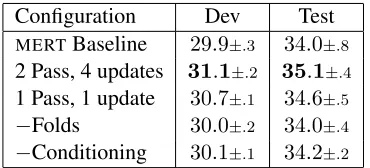
Table 4 gives the results. The number of updates is the number of times the HOLS line search opti-mizer is run (gradient updates). For2passes,4 up-dates, a line search is performed after a half pass through the training data, which is repeated four times for a total of two passes.
Using just one pass through the training data and
8
[image:8.612.335.520.614.698.2]StandardMIRAand SGDSOFTRAMP3 are not paralleliz-able and only use a single thread. All of these algorithms were run for one iteration, except forMERT which ran for at least seven iterations, andPROwhich we stopped after 20 iterations.
Table 4: Full-scale Chinese-English and Ablation Experiments
Configuration Dev Test
MERTBaseline 29.9±.3 34.0±.8
2 Pass, 4 updates 31.1±.2 35.1±.4
Table 5: Arabic-English
System Dev (MT06) MT05 MT08(nw) MT08(wb)
MERTBaseline 39.2±.4 50.3±.4 45.2±.2 29.4±.14 HOLS1 Pass, 2 updates 39.9±.9 51.2±.4 45.8±.4 30.0±.4
∆BLEU +.7 +.9 +.6 +.6
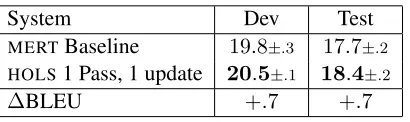
Table 6: Malagasy-English
System Dev Test
MERTBaseline 19.8±.3 17.7±.2 HOLS1 Pass, 1 update 20.5±.1 18.4±.2
∆BLEU +.7 +.7
one gradient update,HOLSimproves upon theMERT
baseline by.6BLEU points, which is a statistically significant improvement. With2passes through the training data and4gradient updates,HOLSperforms even better, obtaining a 1.1 BLEU point improve-ment over the baseline and is also statistically signif-icant. With 16 threads, 1 pass, 1 update completed in 9 hours, and 2 pass, 4 updates, completed in 40 hours. The medium-scalePROsetup in§6.1 obtains a result of34.4±.1on this test set, which is a statis-tically significant improvement of .4 BLEU points over theMERT baseline but does not beat the large-scaleHOLSresults.
Is folding and conditioning necessary? We ex-periment with what happens if grammar and LM folds are not used and if conditioning is not done.
−Folds denotes 1 pass 1 update without folds, and
−Conditioning denotes 1 pass 1 update without con-ditioning. We can see that both these steps are im-portant for the training procedure to work well.
The decrease in performance of the training pro-cedure without folds or conditioning is dramatic but not too surprising. With just one gradient update, one would expect conditioning to be very important. And from the lessons learned in section 3.1, one would also expect the procedure to perform poorly or even worse than theMERTbaseline without gram-mar or LM folds. But becauseHOLSrunsMERTon the dev data for the last line search, it is almost im-possible forHOLSto be worse than theMERT base-line. (This, in fact, was part of our motivation when we originally attempted theHOLSalgorithm.)
6.3 Other Language Pairs
The last set of experiments looks at the performance of the learning algorithm for two other languages and data scenarios for one pass through the training data. Using the same setup for large-scale discrimi-native training as before, we apply the training pro-cedure to a large data scenario Arabic-English task and a small data scenario Malagasy-English task (Tables 5 and 6). The training procedure gives statis-tically significant improvements over the baseline by
.6to.9BLEU for Arabic, and a statistically signif-icant improvement of.7BLEU for Malagasy. With 16 threads, the runtime was44hours for Arabic and
5hours for Malagasy.
7 Conclusion
We have explored the difficulties encountered in large-scale discriminative training for machine translation, and introduced a learning procedure de-signed to overcome them and scale to large corpora. We leave to future work to experiment with feature sets designed for the large-scale discriminative set-ting. In particular, we hope this framework will fa-cilitate incorporation of richer linguistic knowledge into machine translation.
Acknowledgments
This work was sponsored by the U. S. Army Research Laboratory and the U. S. Army Research Office un-der contract/grant number W911NF-10-1-0533. Jeffrey Flanigan would like to thank his co-advisor Lori Levin for support and encouragement during this work.
References
Phil Blunsom, Trevor Cohn, and Miles Osborne. 2008. A discriminative latent variable model for statistical machine translation. InProc. ACL-HLT.
[image:9.612.86.291.180.241.2]and Neural Networks. Cambridge University Press, Cambridge, UK. revised, oct 2012.
L´eon Bottou. 2010. Large-scale machine learning with stochastic gradient descent. In Yves Lechevallier and Gilbert Saporta, editors, Proceedings of the 19th In-ternational Conference on Computational Statistics
(COMPSTAT’2010), pages 177–187, Paris, France,
August. Springer.
V. Chahuneau, N. A. Smith, and C. Dyer. 2012. pycdec: A python interface to cdec. The Prague Bulletin of Mathematical Linguistics, 98:51–61.
Colin Cherry and George Foster. 2012. Batch tuning strategies for statistical machine translation. InProc.
of NAACL.
David Chiang, Yuval Marton, and Philip Resnik. 2008. Online large-margin training of syntactic and struc-tural translation features. InProceedings of the Con-ference on Empirical Methods in Natural Language
Processing, EMNLP ’08, pages 224–233,
Strouds-burg, PA, USA. Association for Computational Lin-guistics.
David Chiang. 2005. A hierarchical phrase-based model for statistical machine translation. InIn ACL, pages 263–270.
David Chiang. 2012. Hope and fear for discriminative training of statistical translation models. Journal of
Machine Learning Research, pages 1159–1187.
Jonathan H. Clark, Chris Dyer, Alon Lavie, and Noah A. Smith. 2011. Better hypothesis testing for statisti-cal machine translation: controlling for optimizer in-stability. InProceedings of the 49th Annual Meeting of the Association for Computational Linguistics: Hu-man Language Technologies: short papers - Volume 2, HLT ’11, pages 176–181, Stroudsburg, PA, USA. Association for Computational Linguistics.
Michael Denkowski and Alon Lavie. 2011. Meteor 1.3: Automatic Metric for Reliable Optimization and Eval-uation of Machine Translation Systems. In Proceed-ings of the EMNLP 2011 Workshop on Statistical Ma-chine Translation.
Chris Dyer, Adam Lopez, Juri Ganitkevitch, Johnathan Weese, Ferhan Ture, Phil Blunsom, Hendra Setiawan, Vladimir Eidelman, and Philip Resnik. 2010. cdec: A decoder, alignment, and learning framework for finite-state and context-free translation models. In Proceed-ings of ACL.
Kevin Gimpel and Noah A. Smith. 2012. Structured ramp loss minimization for machine translation. In
Proc. of NAACL.
K. Gimpel. 2012. Discriminative Feature-Rich Modeling
for Syntax-Based Machine Translation. Ph.D. thesis,
Carnegie Mellon University.
Kenneth Heafield. 2011. KenLM: Faster and smaller language model queries. InProceedings of the Sixth
Workshop on Statistical Machine Translation,
Edin-burgh, UK, July. Association for Computational Lin-guistics.
Mark Hopkins and Jonathan May. 2011. Tuning as rank-ing. InProc. of EMNLP.
Percy Liang, Alexandre Bouchard-cˆot´e, Dan Klein, and Ben Taskar. 2006. An end-to-end discriminative ap-proach to machine translation. In In Proceedings of the Joint International Conference on Computational Linguistics and Association of Computational
Linguis-tics (COLING/ACL, pages 761–768.
Preslav Nakov, Francisco Guzm´an, and Stephan Vogel. 2012. Optimizing for sentence-level bleu+1 yields short translations. In Martin Kay and Christian Boitet, editors, COLING, pages 1979–1994. Indian Institute of Technology Bombay.
Jorge Nocedal and Stephen J. Wright. 2000. Numerical Optimization. Springer.
Franz Josef Och and Hermann Ney. 2002. Discrimina-tive training and maximum entropy models for statis-tical machine translation. InProc. of ACL.
Franz Josef Och and Hermann Ney. 2003. A system-atic comparison of various statistical alignment mod-els. Comput. Linguist., 29(1):19–51, March.
Franz Josef Och. 2003. Minimum error rate training in statistical machine translation. InProc. of ACL. Kishore Papineni, Salim Roukos, Todd Ward, and
Wei-Jing Zhu. 2002. Bleu: a method for automatic eval-uation of machine translation. InProceedings of the 40th Annual Meeting on Association for Computa-tional Linguistics, ACL ’02, pages 311–318, Strouds-burg, PA, USA. Association for Computational Lin-guistics.
Antti-Veiko Rosti, Bing Zhang, Spyros Matsoukas, and Richard Schwartz. 2010. BBN system description for WMT10 system combination task. InProc. WMT. Avneesh Saluja, Ian Lane, and Joy Zhang. 2012.
Ma-chine Translation with Binary Feedback: a large-margin approach. InProceedings of The Tenth Bien-nial Conference of the Association for Machine Trans-lation in the Americas, San Diego, CA, July.
Patrick Simianer, Chris Dyer, and Stefan Riezler. 2012. Joint feature selection in distributed stochastic learn-ing for large-scale discriminative trainlearn-ing in SMT. In
Proc. ACL.
David A. Smith and Jason Eisner. 2006. Minimum risk annealing for training log-linear models. InProc. of ACL.
Andreas Stolcke. 2002. Srilm - an extensible language modeling toolkit. pages 901–904.
Christoph Tillmann and Tong Zhang. 2006. A discrim-inative global training algorithm for statistical mt. In
Computational Linguistics and the 44th annual meet-ing of the Association for Computational Lmeet-inguistics, ACL-44, pages 721–728, Stroudsburg, PA, USA. As-sociation for Computational Linguistics.
Ioannis Tsochantaridis, Thomas Hofmann, Thorsten Joachims, and Yasemin Altun. 2004. Support vec-tor machine learning for interdependent and structured output spaces. InProceedings of the twenty-first
inter-national conference on Machine learning, ICML ’04,
pages 104–, New York, NY, USA. ACM.
Taro Watanabe, Jun Suzuki, Hajime Tsukada, and Hideki Isozaki. 2007. Online large-margin training for statis-tical machine translation. InProc. EMNLP-CoNLL. Jonathan Weese, Juri Ganitkevitch, Chris
Callison-Burch, Matt Post, and Adam Lopez. 2011. Joshua 3.0: syntax-based machine translation with the thrax grammar extractor. InProceedings of the Sixth
Work-shop on Statistical Machine Translation, WMT ’11,