6185
MC
2: Multi-perspective Convolutional Cube
for Conversational Machine Reading Comprehension
Xuanyu Zhang
College of Information Science and Technology Beijing Normal University, Beijing, 100875, China
Abstract
Conversational machine reading comprehen-sion (CMRC) extends traditional single-turn machine reading comprehension (MRC) by multi-turn interactions, which requires ma-chines to consider the history of conversa-tion. Most of models simply combine pre-vious questions for conversation understand-ing and only employ recurrent neural networks (RNN) for reasoning. To comprehend con-text profoundly and efficiently from different perspectives, we propose a novel neural net-work model, Multi-perspective Convolutional Cube (MC2). We regard each conversation as a cube. 1D and 2D convolutions are integrated with RNN in our model. To avoid models pre-viewing the next turn of conversation, we also extend causal convolution partially to 2D. Ex-periments on the Conversational Question An-swering (CoQA) dataset show that our model achieves state-of-the-art results.
1 Introduction
Conversation is one of the most important ap-proaches for humans to acquire information. Dif-ferent from traditional machine reading compre-hension (MRC), conversational machine reading comprehension (CMRC) requires machines to an-swer multiple follow-up questions according to a passage and dialogue history. However, these questions usually have complicated linguistic phe-nomena, such as co-reference, ellipsis and so on. Only considering conversation context profoundly can we answer the current question correctly.
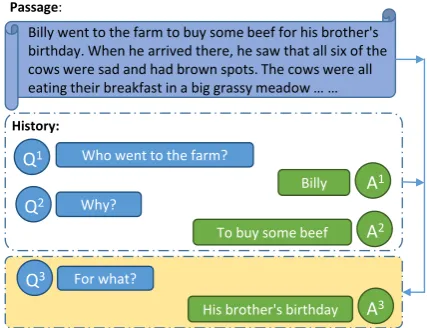
Recently, many CMRC datasets, such as CoQA (Reddy et al.,2019) and QuAC (Choi et al.,2018), are proposed to enable models to understand pas-sages and answer questions in dialogue. Here is an example from the CoQA dataset in Figure 1. We can observe that the second and third questions omit key information. It is impossible for both
hu-Billy went to the farm to buy some beef for his brother's birthday. When he arrived there, he saw that all six of the cows were sad and had brown spots. The cows were all
eating their breakfast in a big grassy meadow … …
History:
Who went to the farm?
Billy Why?
To buy some beef
Q1
Q2
A1
A2
For what?
His brother's birthday
Q3
[image:1.595.308.522.223.387.2]A3 Passage:
Figure 1: An example in the CoQA dataset.
mans and machines to understand such questions without dialogue history.
Most of existing methods consider conversation history by prepending previous questions and an-swers to the current question, such as BiDAF++ (Yatskar, 2019), DrQA+PGNet (Reddy et al.,
2019), SDNet (Zhu et al.,2018) and so on. How-ever, the latent semantic information of dialogue history is neglected. And the model may confuse some unrelated questions and answers in a sen-tence. Although FlowQA (Huang et al., 2019) utilizes intermediate representations of previous conversation, the flow mechanism can not synthe-size the information of different words in different turns of conversation simultaneously. Moreover, previous models only use recurrent neural network (RNN) as their main skeleton, which is not parallel due to recurrent nature. And RNN can only grasp information from two directions, either forward or backward. But for conversation, humans usually consider history from different perspectives and answer questions comprehensively.
Interaction Reasoning Layer Answer Prediction Layer
Passage Question(t-th)
Embedding Embedding
RNN Contextual
Encoding Layer
Perspective Ⅰ
Perspective Ⅱ
Perspective Ⅰ
Perspective Ⅲ-1
Perspective Ⅰ
Perspective Ⅲ-1
Attention Attention Attention
start end
① ② ③ ④ ⑤ ⑥
RNN
Perspective Ⅰ
[image:2.595.75.288.65.324.2]Attention
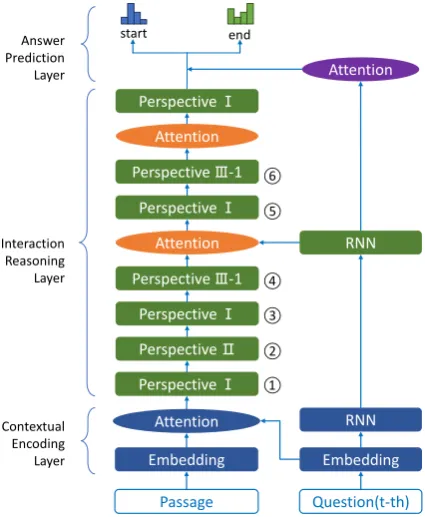
Figure 2: MC2structure overview.
cube, three dimensions of which are question an-swering (QA) turns, passage words and hidden states of words, separately. For one thing, convo-lutional neural networks (CNN) can extract local information effectively across dimensions in par-allel. Introducing CNN to RNN allows the model to take into account local and global features effi-ciently. For another thing, machines can compre-hend conversation history more deeply from dif-ferent perspectives by fusing 1D and 2D convo-lutions in our model. In addition, to avoid infor-mation leakage of the next turn of dialogue, we extend causal convolution to 2D. Experiments on the Conversational Question Answering (CoQA) dataset show that our model improves the result of the published state-of-the-art model by 3.2%.
2 Approaches
In this section, we propose our novel model, MC2, for the task of conversational machine reading comprehension, which can be formulated as fol-lows. For one conversation, given a passage with
ntokensP ={pi}ni=1and multiple questions with cturnsQ = {Qt}c
t=1, machines need to give the
corresponding answers A = {At}c
t=1. The t-th
question with m tokens is Qt = {qjt}m
j=1. The
neural network is required to model the probabil-ity distributionp(At|Q≤t, P)for thet-th QA turn in the conversation. As shown in Figure 2, there
are three main layers in our model, i.e., contextual encoding layer, interaction reasoning layer and an-swer prediction layer. Our proposed cube is used in the middle layer. For convenience, we will il-lustrate our model from bottom to top.
2.1 Contextual Encoding Layer
The purpose of this layer is to extract useful infor-mation for upper layers. We embed questions and passages into a sequence of vectors with the latest contextualized model, BERT (Devlin et al.,2019), separately. Instead of fine-tuning BERT with ex-tra scoring layers, we fix the weights of BERT like SDNet (Zhu et al.,2018) and aggregateLhidden layers generated by BERT as contextualized em-bedding for all BPE (Sennrich et al.,2016) tokens. To introduce other linguistic features token by words and facilitate answer selection, we choose the first token of a word in BPE to represent the word. Generally, the first token is often the root of the word and can represent main meaning of the whole word. And it also contains information of rest tokens in the word with the bidirectional structure of BERT. Besides, we split the long sen-tence by shorter windows and combine them again when the sentence exceeds the maximum length of pre-trained BERT.
In detail, suppose hli ∈ Rd is the l-th hidden layer of the first BPE token in thei-th word. We collapse all hidden layers generated by BERT into a single vector for each word following ELMo (Peters et al., 2018). The contextualized em-bedding for the i-th word is ei = γPLl=0αlhli, where γ is designed to scale the vector and αl is softmax-normalized weight for the l-th layer. These weights are all trainable. To be consis-tent with the number of turns of question EQ =
{eQt,j}m
j=1ct=1 ∈ Rc×m×d, the passage ePi is ex-pandedctimes toEP ={ePt,i}n
i=1ct=1 ∈Rc×n×d.
To incorporate other linguistic information, three additional features are utilized for each word
piin the passage followingChen et al. (2017), i.e. part-of-speech (POS) tags, named entity recog-nition (NER) tags and aligned question embed-dings. The embeddings of POS eposi and NER
ener
i are learned for different tags, separately. And aligned question embeddings can be obtained in Eq. 1. Following Huang et al. (2018), we use
f(x, y) = ReLU(U x)TDReLU(U y) as the
Passag
e
W
or
d
s
QA
Tu
rn
s
Perspective Ⅰ Perspective Ⅱ Perspective Ⅲ-1 Perspective Ⅲ-2
QA
Tu
rn
s
QA
Tu
rn
[image:3.595.97.515.67.156.2]s
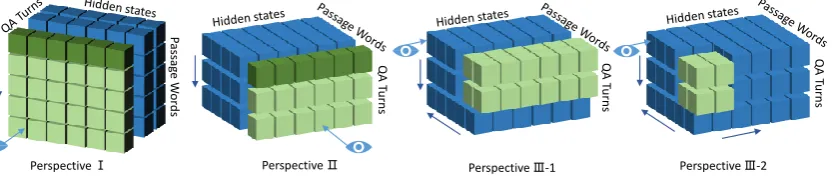
Figure 3: Different perspectives of the cube.
sij =f(ePt,i, eQt,j)
aij =exp(sij)/Xm
k=1exp(s
i k)
eattnt,i =Xm j=1a
i je
Q t,j
(1)
We then concatenate these features and embed-dings tort,iP for passages and employ bidirectional RNN to refine the question torQt,j.
rPt,i = [ePt,i;et,ipos;enert,i ;eattnt,i ]
rQt,j = BiRNN(rQt,j−1, eQt,j) (2)
2.2 Interaction Reasoning Layer
This layer plays an important role in our model, which aims to incorporate question information into passage representation further and reason from different perspectives by our proposed con-volutional cube. The cube represents the hidden states of passages in a conversation. We will de-scribe these perspectives in Figure3in the order of ¬to±in Figure2. To consider global context of each turn besides local information across differ-ent dimensions,Perspective Iequipped with RNN is inserted before other CNN perspectives.
We first observe the cube from Perspective I
and feed the hidden states of the cube rPt,i to bi-directional RNN for each turn of conversation
cPt,i = BiRNN(cPt,i−1, rt,iP). Then the cube is viewed fromPerspective IIalong QA turns for dif-ferent words, separately. Since the (t+1)-th turn of information can not be used when processing the
t-th turn, we employ 1D causal convolution (Oord et al., 2016) to the cube by moving the padding at the end to the beginning. And the representa-tion of the cube can be updated fromcPt,i into¯cPt,i. After viewed from these two perspectives (¬ in Figure2), the hidden states of every word in pas-sages grasp information from two dimensions of the cube.
Next, we observe the cube from Perspective I
again to fuse previous hidden states and generate
global context ˆcPt,i for each turn of conversation. To reason from more dimensions simultaneously, 2D CNN is utilized to generate hidden states of the cubehPt,ialong the dimension of both QA turns and passage words fromPerspective III-1. Differ-ent from other models, three kinds of information can be considered comprehensively by this pro-cess: the same word in different QA turns, differ-ent words in the same QA turn and differdiffer-ent words in different QA turns. Similar to 1D CNN above, the 2D CNN also requires to be unidirectional on the dimension of QA turns to avoid information leakage. But it is more reasonable to capture bidi-rectional information on the dimension of passage words. We thus extend traditional causal convolu-tion partially to 2D CNN by moving padding only on one dimension. These two perspectives (® ¯ in Figure 2) strengthen the representation of our cube further.
For questions in this layer, we pass them as the input to another RNN for reasoning hQt,j = BiRNN(hQt,j−1, rQt,j). Then we employ the atten-tion score funcatten-tion menatten-tioned above to integrate new information of questions to passages.
sij =f([ePt,i;cPt,i; ˆct,iP],[eQt,j;rt,jQ;hQt,j])
aij =exp(sij)/Xm
k=1exp(s
i k)
hattnt,i =Xm j=1a
i jh
Q t,j
(3)
As shown in Figure2, we repeat the process of ® ¯ in ° ± for deeper understanding and rea-soning. RNN takes[hPt,i;hattnt,i ]and generates¯hPt,i
fromPerspective I. Then 2D CNN generates ˜hPt,i
from Perspective III-1. We use self-attention to enhance the current passage representation as fol-lows:
sij =f([cPt,i; ˆcPt,i; ¯ht,iP],[cPt,j; ˆcPt,j; ¯hPt,j])
aij =exp(sij)/Xn
k=1exp(s
i k)
hselft,i =Xn j=1a
i j¯hPt,j
Model In-domain Out-of-domain Overall Child. Liter Mid-High. News Wiki Reddit Science
PGNet 49.0 43.3 47.5 47.5 45.1 38.6 38.1 44.1
DrQA 46.7 53.9 54.1 57.8 59.4 45.0 51.0 52.6
DrQA+PGNet 64.2 63.7 67.1 68.3 71.4 57.8 63.1 65.1 Augmt. DrQA 66.0 63.3 66.2 71.0 71.3 57.7 63.0 65.4 BiDAF++ 66.5 65.7 70.2 71.6 72.6 60.8 67.1 67.8
FlowQA 73.7 71.6 76.8 79.0 80.2 67.8 76.1 75.0
SDNet 75.4 73.9 77.1 80.3 83.1 69.8 76.8 76.6
MC2 78.4 76.7 81.1 83.0 84.8 73.8 80.6 79.8
[image:4.595.94.503.61.218.2]Human 90.2 88.4 89.8 88.6 89.9 86.7 88.1 88.8
Table 1: Model and human performance (% in F1 score) on the CoQA test set.
0 10 20 30 40 50 60 70 80 90
DrQA BiDAF++ FlowQA SDNet MC²
(ours)
Out 47.9 63.8 71.8 73.1 77.1
△F1 6.6 5.6 4.5 4.9 3.8
In
-d
o
main
F1
sc
o
re 54.5
69.4
76.3 78.0
80.9
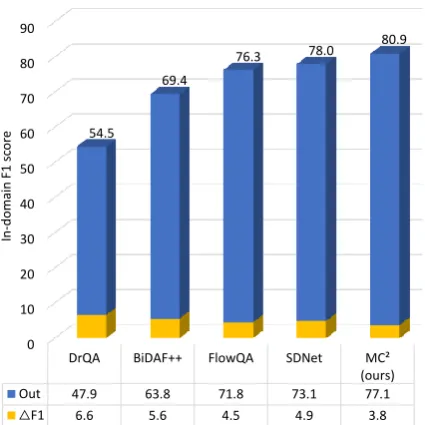
Figure 4: F1 score of models on in-domain and out-of-domain parts of the CoQA test set.
At last, we view the cube from Perspective I
again to synthesize the global information ˆhP t,i = BiRNN(ˆhPt,i−1,[¯hPt,i; ˜hPt,i;hselft,i ]).
2.3 Answer Prediction Layer
This layer is the top one of our model. We use similar methods (Chen et al.,2017;Huang et al.,
2019;Zhu et al.,2018) to predict the position of the answer in the passage. We project the ques-tion representaques-tion into one vector for each turn of dialogue ˆhQt = Pm
j=1at,jh
Q
t,j, where at,j =
exp(W hQt,j)/Pm
k=1exp(W h
Q
t,k) andW is train-able. Then two different bilinear attention func-tions are used to estimate the probability of the start and end according toˆhP
t,i andˆh Q
t. We choose the position of the maximum product of these two probabilities as the best span. For other answer
types, such asyes,noandunknown, we condense the passage representationˆhPt,itoˆhPt like questions and classify the answer according to[ˆhPt; ˆhQt ].
To train the cube, we minimize the sum of the negative log probabilities of the ground truth start position, end position and answer type by the pre-dicted distributions.
3 Experiments
3.1 Data and Metric
We conduct our experiments on the CoQA (Reddy et al., 2019), a large-scale CMRC dataset anno-tated by human. It consists of 127k questions with answers collected from 8k conversations over text passages. As shown in Table 1, it covers seven diverse domains (five of them are in-domain and two are out-of-domain). The out-of-domain pas-sages only appear in the test set. Aligned with the official evaluation, F1 score is used as the metric, which measures the overlap between the predic-tion and the ground truth at word level.
3.2 Implementation Details
We use pre-trained BERTLARGE model for
[image:4.595.75.288.257.470.2]51 53 55 57 59 61 63 65 67 69 71 73 75 77 79 81
1 3 5 7 9 11 13 15 17 19 21 23 25 27 29
F1
S
co
re
Epoch
MC² (ours) SDNet SDNet ⃰
[image:5.595.74.288.61.244.2]FlowQA BiDAF++ DrQA+PGNet
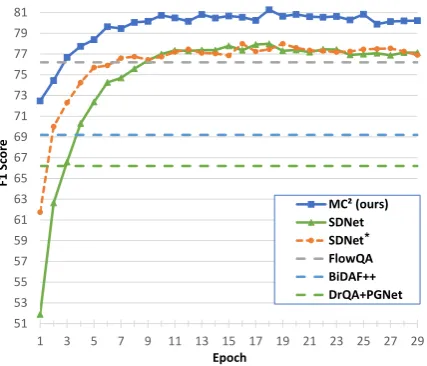
Figure 5: F1 score on the CoQA dev set under different training epochs.1
Configuration F1 ∆F1
MC2 81.266
-w/o ¯ ± 77.363 -3.903
w/o 80.718 -0.548
w/o¯ 80.867 -0.399
w/o± 80.849 -0.417
[image:5.595.90.272.291.433.2]replacewith¯ 80.932 -0.334 replace¯with 80.473 -0.793 replace±with III-2 81.087 -0.179 exchangewith¯ 81.102 -0.164
Table 2: Ablation study on the CoQA dev set. ( ¯ ±come from Fig.2. III-2 comes from Fig.3.)
3.3 Result
We compare our MC2with other baseline models2 in Table1: PGNet (See et al.,2017), DrQA (Chen et al.,2017), DrQA+PGNet (Reddy et al.,2019), Augmented DrQA (Reddy et al.,2019), BiDAF++ (Yatskar,2019), FlowQA (Huang et al.,2019) and SDNet (Zhu et al.,2018). Our model achieves sig-nificant improvement over these published mod-els. Comparing with the previous state-of-the-art model, SDNet, our model outperforms it by 3.2% on F1 score. And SDNet also takes pre-trained BERT as embedding without fine-tuning. Espe-cially, our single model surpasses the ensemble model of both FlowQA and SDNet.
Figure4shows the gap between in-domain and out-of-domain on the test set. Although all
mod-1SDNet comes from experiments of the original author.
SDNet∗refers to the proportion of Fig. 2 in the original paper. 2We only consider published models on the CoQA.
Al-though some models perform better on the leaderboard re-cently, they usually focus on fine-tuning BERT model.
els perform worse on out-of-domain datasets com-pared to in-domain datasets, our model only drops 3.8% on F1 score. It is the smallest drop between in-domain and out-of-domain among all models, which proves that our model has very good gener-alization ability. Besides, our model achieves the best performance on both in-domain and out-of-domain datasets.
The learning curve is shown in Figure5. It re-flects the performance of models under different training epochs on the development set. We can observe that our model completely surpasses SD-Net at every epoch. And it outperforms all base-line models only after 5 epochs and achieves the best performance after 18 epochs. Especially, our model achieves 72.472% on F1 score only after the first epoch, which is about 10% to 20% higher than SDNet. Thus with fewer training epochs, our model still can perform well.
3.4 Ablation Studies
To study how each perspective of our proposed cube contributes to the performance, we conduct an ablation analysis on the development set in Ta-ble 2. The results show that removing all CNN perspectives of the cube, i.e. ¯ ±in Figure2, will cause a substantial performance drop (3.90% on F1 score). And removing any of them also re-sults in marginal decrease in performance. It is clear that the improvement of reading from differ-ent perspectives simultaneously is larger than that of the sum of reading from single perspective sep-arately. Besides, replacing 2D CNN (Perspective III-1) with 1D CNN (Perspective II) also causes a significant decline of performance (0.79% on F1 score). We also explore 3D CNN (Perspective III-2), but it brings no improvement as expected.
4 Conclusion
References
Danqi Chen, Adam Fisch, Jason Weston, and Antoine Bordes. 2017. Reading Wikipedia to answer open-domain questions. InProceedings of the 55th An-nual Meeting of the Association for Computational Linguistics (Volume 1: Long Papers).
Eunsol Choi, He He, Mohit Iyyer, Mark Yatskar, Wen-tau Yih, Yejin Choi, Percy Liang, and Luke Zettle-moyer. 2018. QuAC: Question answering in con-text. InProceedings of the 2018 Conference on Em-pirical Methods in Natural Language Processing.
Jacob Devlin, Ming-Wei Chang, Kenton Lee, and Kristina Toutanova. 2019. BERT: Pre-training of deep bidirectional transformers for language under-standing. InProceedings of the 2019 Conference of the North American Chapter of the Association for Computational Linguistics: Human Language Tech-nologies, Volume 1 (Long and Short Papers).
Hsin-Yuan Huang, Eunsol Choi, and Wen-tau Yih. 2019. FlowQA: Grasping flow in history for conver-sational machine comprehension. InProceedings of the 7th International Conference on Learning Rep-resentations.
Hsin-Yuan Huang, Chenguang Zhu, Yelong Shen, and Weizhu Chen. 2018. Fusionnet: Fusing via fully-aware attention with application to machine compre-hension. In International Conference on Learning Representations.
Diederik P. Kingma and Jimmy Ba. 2015. Adam: A method for stochastic optimization. In Proceed-ings of the 3rd International Conference on Learn-ing Representations.
Aaron van den Oord, Sander Dieleman, Heiga Zen, Karen Simonyan, Oriol Vinyals, Alex Graves, Nal Kalchbrenner, Andrew Senior, and Koray Kavukcuoglu. 2016. Wavenet: A generative model for raw audio. SSW, 125.
Matthew Peters, Mark Neumann, Mohit Iyyer, Matt Gardner, Christopher Clark, Kenton Lee, and Luke Zettlemoyer. 2018. Deep contextualized word repre-sentations. InProceedings of the 2018 Conference of the North American Chapter of the Association for Computational Linguistics: Human Language Technologies, Volume 1 (Long Papers).
Siva Reddy, Danqi Chen, and Christopher D. Manning. 2019. CoQA: A conversational question answering challenge. Transactions of the Association for Com-putational Linguistics, 7.
Abigail See, Peter J. Liu, and Christopher D. Manning. 2017. Get to the point: Summarization with pointer-generator networks. InProceedings of the 55th An-nual Meeting of the Association for Computational Linguistics (Volume 1: Long Papers).
Rico Sennrich, Barry Haddow, and Alexandra Birch. 2016. Neural machine translation of rare words with
subword units. InProceedings of the 54th Annual Meeting of the Association for Computational Lin-guistics (Volume 1: Long Papers).
Mark Yatskar. 2019. A qualitative comparison of CoQA, SQuAD 2.0 and QuAC. In Proceedings of the 2019 Conference of the North American Chap-ter of the Association for Computational Linguistics: Human Language Technologies, Volume 1 (Long and Short Papers).