Proceedings of the 55th Annual Meeting of the Association for Computational Linguistics, pages 963–973 Vancouver, Canada, July 30 - August 4, 2017. c2017 Association for Computational Linguistics Proceedings of the 55th Annual Meeting of the Association for Computational Linguistics, pages 963–973
Vancouver, Canada, July 30 - August 4, 2017. c2017 Association for Computational Linguistics
Learning a Neural Semantic Parser from User Feedback
Srinivasan Iyer†, Ioannis Konstas†, Alvin Cheung† Jayant Krishnamurthy‡ and Luke Zettlemoyer†‡
†Paul G. Allen School of Computer Science & Engineering, Univ. of Washington, Seattle, WA
{sviyer,ikonstas,akcheung,lsz}@cs.washington.edu
‡Allen Institute for Artificial Intelligence, Seattle, WA
{jayantk,lukez}@allenai.org
Abstract
We present an approach to rapidly and easily build natural language interfaces to databases for new domains, whose perfor-mance improves over time based on user feedback, and requires minimal interven-tion. To achieve this, we adapt neural se-quence models to map utterances directly to SQL with its full expressivity, bypass-ing any intermediate meanbypass-ing representa-tions. These models are immediately de-ployed online to solicit feedback from real users to flag incorrect queries. Finally, the popularity of SQL facilitates gathering annotations for incorrect predictions using the crowd, which is directly used to im-prove our models. This complete feedback loop, without intermediate representations or database specific engineering, opens up new ways of building high quality seman-tic parsers. Experiments suggest that this approach can be deployed quickly for any new target domain, as we show by learning a semantic parser for an online academic database from scratch.
1 Introduction
Existing semantic parsing approaches for building natural language interfaces to databases (NLIDBs) either use special-purpose intermediate meaning representations that lack the full expressivity of database query languages or require extensive fea-ture engineering, making it difficult to deploy them in new domains. We present a robust ap-proach to quickly and easily learn and deploy se-mantic parsers from scratch, whose performance
Work done partly during an internship at the Allen
Insti-tute for Artificial Intelligence.
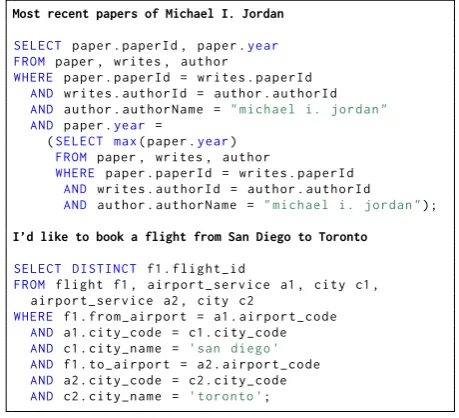
Most recent papers of Michael I. Jordan
SELECT paper .paperId , paper .year
FROM paper , writes , author
WHERE paper . paperId = writes . paperId
AND writes . authorId = author . authorId AND author . authorName = " michael i. jordan " AND paper .year =
(SELECT max( paper .year) FROM paper , writes , author
WHERE paper . paperId = writes . paperId
AND writes . authorId = author . authorId AND author . authorName = " michael i. jordan ");
I’d like to book a flight from San Diego to Toronto
SELECT DISTINCT f1. flight_id
FROM flight f1 , airport_service a1 , city c1 , airport_service a2 , city c2
WHERE f1. from_airport = a1. airport_code
AND a1. city_code = c1. city_code AND c1. city_name = 'san diego ' AND f1. to_airport = a2. airport_code AND a2. city_code = c2. city_code AND c2. city_name = 'toronto ';
Figure 1: Utterances with corresponding SQL queries to answer them for two domains, an aca-demic database and a flight reservation database.
improves over time based on user feedback, and requires very little expert intervention.
To learn these semantic parsers, we (1) adapt neural sequence models to map utterances directly to SQL thereby bypassing intermediate represen-tations and taking full advantage of SQL’s query-ing capabilities, (2) immediately deploy the model online to solicit questions and user feedback on results to reduce SQL annotation efforts, and (3) use crowd workers from skilled markets to pro-vide SQL annotations that can directly be used for model improvement, in addition to being easier and cheaper to obtain than logical meaning rep-resentations. We demonstrate the effectiveness of the complete approach by successfully learning a semantic parser for an academic domain by simply deploying it online for three days.
This type of interactive learning is related to a number of recent ideas in semantic parsing,
[image:1.595.301.531.225.434.2]cluding batch learning of models that directly pro-duce programs (e.g., regular expressions (Locas-cio et al., 2016)), learning from paraphrases (of-ten gathered through crowdsourcing (Wang et al., 2015)), data augmentation (e.g. based on man-ually engineered semantic grammars (Jia and Liang, 2016)) and learning through direct interac-tion with users (e.g., where a single user teaches the model new concepts (Wang et al., 2016)). However, there are unique advantages to our ap-proach, including showing (1) that non-linguists can write SQL to encode complex, compositional computations (see Fig 1 for an example), (2) that external paraphrase resources and the structure of facts from the target database itself can be used for effective data augmentation, and (3) that ac-tual database users can effectively drive the overall learning by simply providing feedback about what the model is currently getting correct.
Our experiments measure the performance of these learning advances, both in batch on existing datasets and through a simple online experiment for the full interactive setting. For the batch evalu-ation, we use sentences from the benchmark Geo-Query and ATIS domains, converted to contain SQL meaning representations. Our neural learn-ing with data augmentation achieves reasonably high accuracies, despite the extra complexities of mapping directly to SQL. We also perform sim-ulated interactive learning on this data, showing that with perfect user feedback our full approach could learn high quality parsers with only 55% of the data. Finally, we do a small scale online exper-iment for a new domain, academic paper metadata search, demonstrating that actual users can pro-vide useful feedback and our full approach is an effective method for learning a high quality parser that continues to improve over time as it is used.
2 Related Work
Although diverse meaning representation lan-guages have been used with semantic parsers – such as regular expressions (Kushman and Barzi-lay, 2013; Locascio et al., 2016), Abstract Mean-ing Representations (AMR) (Artzi et al., 2015; Misra and Artzi, 2016), and systems of equations (Kushman et al., 2014; Roy et al., 2016) – parsers for querying databases have typically used either logic programs (Zelle and Mooney, 1996), lambda calculus (Zettlemoyer and Collins, 2005), or λ
-DCS (Liang et al., 2013) as the meaning
represen-tation language. All three of these languages are modeled after natural language to simplify pars-ing. However, none of them is used to query databases outside of the semantic parsing litera-ture; therefore, they are understood by few peo-ple and not supported by standard database impeo-ple- imple-mentations. In contrast, we parse directly to SQL, which is a popular database query language with wide usage and support. Learning parsers directly from SQL queries has the added benefit that we can potentially hire programmers on skilled-labor crowd markets to provide labeled examples, such as UpWork1, which we demonstrate in this work.
A few systems have been developed to di-rectly generate SQL queries from natural lan-guage (Popescu et al., 2003; Giordani and Mos-chitti, 2012; Poon, 2013). However, all of these systems make strong assumptions on the struc-ture of queries: they use manually engineered rules that can only generate a subset of SQL, re-quire lexical matches between question tokens and table/column names, or require questions to have a certain syntactic structure. In contrast, our ap-proach can generate arbitrary SQL queries, only uses lexical matching for entity names, and does not depend on syntactic parsing.
We use a neural sequence-to-sequence model to directly generate SQL queries from natural lan-guage questions. This approach builds on recent work demonstrating that such models are effective for tasks such as machine translation (Bahdanau et al., 2015) and natural language generation (Kid-don et al., 2016). Recently, neural models have been successfully applied to semantic parsing with simpler meaning representation languages (Dong and Lapata, 2016; Jia and Liang, 2016) and short regular expressions (Locascio et al., 2016). Our work extends these results to the task of SQL generation. Finally, Ling et al. (2016) generate Java/Python code for trading cards given a natural language description; however, this system suffers from low overall accuracy.
A final direction of related work studies meth-ods for reducing the annotation effort required to train a semantic parser. Semantic parsers have been trained from various kinds of annotations, including labeled queries (Zelle and Mooney, 1996; Wong and Mooney, 2007; Zettlemoyer and Collins, 2005), question/answer pairs (Liang et al., 2013; Kwiatkowski et al., 2013; Berant et al.,
2013), distant supervision (Krishnamurthy and Mitchell, 2012; Choi et al., 2015), and binary correct/incorrect feedback signals (Clarke et al., 2010; Artzi and Zettlemoyer, 2013). Each of these schemes presents a particular trade-off between annotation effort and parser accuracy; however, re-cent work has suggested that labeled queries are the most effective (Yih et al., 2016). Our approach trains on fully labeled SQL queries to maximize accuracy, but uses binary feedback from users to reduce the number of queries that need to be la-beled. Annotation effort can also be reduced by using crowd workers to paraphrase automatically generated questions (Wang et al., 2015); however, this approach may not generate the questions that users actually want to ask the database – an ex-periment in this paper demonstrated that 48% of users’ questions in a calendar domain could not be generated.
3 Feedback-based Learning
Our feedback-based learning approach can be used to quickly deploy semantic parsers to cre-ate NLIDBs for any new domain. It is a simple interactive learning algorithm that deploys a pre-liminary semantic parser, then iteratively improves this parser using user feedback and selective query annotation. A key requirement of this algorithm is the ability to cheaply and efficiently annotate queries for chosen user utterances. We address this requirement by developing a model that directly outputs SQL queries (Section 4), which can also be produced by crowd workers.
Our algorithm alternates between stages of training the model and making predictions to gather user feedback, with the goal of improv-ing performance in each successive stage. The procedure is described in Algorithm 1. Our neu-ral modelN is initially trained on synthetic data
T generated by domain-independent schema
tem-plates (see Section 4), and is then ready to answer new user questions, n. The results R of
execut-ing the predicted SQL queryqare presented to the
user who provides a binary correct/incorrect feed-back signal. If the user marks the result correct, the pair(n, q)is added to the training set. If the user marks the result incorrect, the algorithm asks a crowd worker to annotate the utterance with the correct query, qˆ, and adds (n,qˆ) to the training set. This procedure can be repeated indefinitely, ideally increasing parser accuracy and requesting
fewer annotations in each successive stage.
1 ProcedureLEARN(schema)
2 T ←initial data(schema)
3 whiletruedo
4 T ←T ∪paraphrase(T)
5 N ←train model(T)
6 forn∈new utterancesdo
7 q←predict(N , n)
8 R←execute(q)
9 f ←feedback(R)
10 iff =correctthen
11 T ←T ∪(n, q)
12 else iff =wrongthen
13 qˆ←annotate(n)
14 T ←T ∪(n,qˆ)
15 end
16 end
17 end 18 end
Algorithm 1:Feedback-based learning.
4 Semantic Parsing to SQL
We use a neural sequence-to-sequence model for mapping natural language questions directly to SQL queries and this allows us to scale our feedback-based learning approach, by easily crowdsourcing labels when necessary. We further present two data augmentation techniques which use content from the database schema and exter-nal paraphrase resources.
4.1 Model
We use an encoder-decoder model with global attention, similar to Luong et al. (2015), where the anonymized utterance (see Section 4.2) is encoded using a bidirectional LSTM network, then decoded to directly predict SQL query to-kens. Fixed pre-trained word embeddings from word2vec (Mikolov et al., 2013) are concatenated to the embeddings that are learned for source to-kens from the training data. The decoder predicts a conditional probability distribution over possi-ble values for the next SQL token given the pre-vious tokens using a combination of the prepre-vious SQL token embedding, attention over the hidden states of the encoder network, and an attention sig-nal from the previous time step.
ithSQL tokenqi, the decoder distribution is
p(qi|q1, . . . , qi−1)∝exp (Wtanh(Wˆ[hi :ci])) wherehirepresents the hidden state output of the decoder LSTM at the ith timestep, c
i represents the context vector generated using an attention weighted sum of encoder hidden states based on
hi, and,W andWˆ are linear transformations. If
sjis the hidden representation generated by the en-coder for the jth word in the utterance (k words long), then the context vectors are defined to be:
ci= k X
j=1
αi,j·sj
The attention weightsαi,j are computed using an inner product between the decoder hidden state for the current timestephi, and the hidden representa-tion of the jthsource tokens
j:
αi,j = exp(
hiTFsj) Pk
j=1exp(hiTFsj)
whereF is a linear transformation. The decoder
LSTM cell f computes the next hidden state hi, and cell state, mi, based on the previous hidden and cell states,hi−1,mi−1, the embeddings of the previous SQL tokenqi−1 and the context vector of the previous timestep,ci−1
hi,mi=f(hi−1,mi−1,qi−1,ci−1) We apply dropout on non-recurrent connections for regularization, as suggested by Pham et al. (2014). Beam search is used for decoding the SQL queries after learning.
4.2 Entity Anonymization
We handle entities in the utterances and SQL by replacing them with their types, using incremental numbering to model multiple entities of the same type (e.g., CITY NAME 1). During training, when the SQL is available, we infer the type from the associated column name; for example, Boston is a city in city.city name = ’Boston’. To rec-ognize entities in the utterances at test time, we build a search engine on all entities from the target database. For every span of words (starting with a high span size and progressively reducing it), we query the search engine using a TF-IDF scheme to retrieve the entity that most closely matches the span, then replace the span with the entity’s type. We store these mappings and apply them to the generated SQL to fill in the entity names. TF-IDF matching allows some flexibility in matching
en-tity names in utterances, for example, a user could sayDonald Knuthinstead ofDonald E. Knuth.
4.3 Data Augmentation
We present two data augmentation strategies that either (1) provide the initial training data to start the interactive learning, before more labeled ex-amples become available, or (2) use external para-phrase resources to improve generalization.
Schema Templates To bootstrap the model to
answer simple questions initially, we defined 22 language/SQL templates that are schema-agnostic, so they can be applied to any database. These tem-plates contain slots whose values are populated given a database schema. An example template is shown in Figure 2a. The <ENT> types repre-sent tables in the database schema,<ENT>.<COL> represents a column in the particular table and <ENT>.<COL>.<TYPE>represents the type associ-ated with the particular column. A template is instantiated by first choosing the entities and at-tributes. Next, join conditions, i.e.,JOIN FROMand JOIN WHEREclauses, are generated from the tables on the shortest path between the chosen tables in the database schema graph, which connects tables (graph nodes) using foreign key constraints. Fig-ure 2b shows an instantiation of a template using the path author writes paper paperdataset -dataset. SQL queries generated in this manner are guaranteed to be executable on the target database. On the language side, an English name of each en-tity is plugged into the template to generate an ut-terance for the query.
Paraphrasing The second data augmentation
Get all <ENT1>.<NAME> having
<ENT2>.<COL1>.<NAME> as <ENT2>.<COL1>.<TYPE>
SELECT <ENT1>.<DEF> FROM JOIN_FROM(<ENT1>, <ENT2>) WHERE JOIN_WHERE(<ENT1>, <ENT2>) AND
<ENT2>.<COL1> = <ENT2>.<COL1>.<TYPE>
(a) Schema template
SELECT author.authorId
FROM author , writes , paper , paperDataset , dataset WHERE author.authorId = writes.authorId
AND writes.paperId = paper.paperId AND paper.paperId = paperDataset.paperId AND paperDataset.datasetId = dataset.datasetId AND dataset.datasetName = DATASET_TYPE
Get all author having dataset as DATASET_TYPE
(b) Generated utterance-SQL pair
Figure 2: (a) Example schema template consist-ing of a question and SQL query with slots to be filled with database entities, columns, and values; (b) Entity-anonymized training example generated by applying the template to an academic database.
5 Benchmark Experiments
Our first set of experiments demonstrates that our semantic parsing model has comparable accuracy to previous work, despite the increased difficulty of directly producing SQL. We demonstrate this result by running our model on two benchmark datasets for semantic parsing, GEO880 and ATIS.
5.1 Data sets
GEO880 is a collection of 880 utterances issued to a database of US geographical facts (Geobase), originally in Prolog format. Popescu et al. (2003) created a relational database schema for Geobase together with SQL queries for a subset of 700 ut-terances. To compare against prior work on the full corpus, we annotated the remaining utterances and used the standard 600/280 training/test split (Zettlemoyer and Collins, 2005).
ATIS is a collection of 5,418 utterances to a flight booking system, accompanied by a rela-tional database and SQL queries to answer the questions. We use 4,473 utterances for training, 497 for development and 448 for test, follow-ing Kwiatkowski et al. (2011). The original SQL queries were very inefficient to execute due to the use ofIN clauses, so we converted them to joins (Ramakrishnan and Gehrke, 2003) while verifying that the output of the queries was unchanged.
Table 1 shows characteristics of both data sets. GEO880 has shorter queries but is more compo-sitional: almost 40% of the SQL queries have at
Geo880 ATIS SCHOLAR
Avg. NL length 7.56 10.97 6.69
NL vocab size 151 808 303
Avg. SQL length 16.06 67.01 28.85
SQL vocab size 89 605 163
% Subqueries>1 39.8 12.42 2.58
# Tables 1.19 5.88 3.33
Table 1: Utterance and SQL query statistics for each dataset. Vocabulary sizes are counted after entity anonymization.
least one nested subquery. ATIS has the longest utterances and queries, with an average utterance length of 11 words and an average SQL query length of 67 tokens. They also operate on approx-imately 6 tables per query on average. We will release our processed versions of both datasets.
5.2 Experimental Methodology
We follow a standard train/dev/test methodology for our experiments. The training set is augmented using schema templates and 3 paraphrases per training example, as described in Section 4. Ut-terances were anonymized by replacing them with their corresponding types and all words that occur only once were replaced by UNK symbols. The development set is used for hyperparameter tun-ing and early stopptun-ing. For GEO880, we use cross validation on the training set to tune hyperparam-eters. We used a minibatch size of 100 and used Adam (Kingma and Ba, 2015) with a learning rate of 0.001 for 70 epochs for all our experiments. We used a beam size of 5 for decoding. We report test set accuracy of our SQL query predictions by exe-cuting them on the target database and comparing the result with the true result.
5.3 Results
Tables 2 and 3 show test accuracies based on de-notations for our model on GEO880 and ATIS re-spectively, compared with previous work.2 To our
knowledge, this is the first result on directly pars-ing to SQL to achieve comparable performance to prior work without using any database-specific feature engineering. Popescu et al. (2003) and Giordani and Moschitti (2012) also directly pro-duce SQL queries but on a subset of 700 examples from GEO880. The former only works on seman-tically tractable utterances where words can be
System Acc.
Ours (SQL) 82.5
Popescu et al. (2003) (SQL) 77.5∗
Giordani and Moschitti (2012) (SQL) 87.2∗
Dong and Lapata (2016) 84.6†
Jia and Liang (2016) 89.3
[image:6.595.336.499.64.129.2]Liang et al. (2013) 91.1
Table 2: Accuracy of SQL query results on the Geo880 corpus; ∗ use Geo700; convert to
logi-cal forms instead of SQL; †measure accuracy in
terms of obtaining the correct logical form, other systems, including ours, use denotations.
System Acc.
Ours (SQL) 79.24
GUSP (Poon, 2013) (SQL) 74.8
GUSP++ (Poon, 2013) (SQL) 83.5
Zettlemoyer and Collins (2007) 84.6†
Dong and Lapata (2016) 84.2†
Jia and Liang (2016) 83.3
[image:6.595.74.290.65.180.2]Wang et al. (2014) 91.3†
Table 3: Accuracy of SQL query results on ATIS;
convert to logical forms instead of SQL;†
mea-sure accuracy in terms of obtaining the correct log-ical form, other systems, including ours, use deno-tations.
ambiguously mapped to schema elements, while the latter uses a reranking approach that also lim-its the complexity of SQL queries that can be han-dled. GUSP (Poon, 2013) creates an intermediate representation that is then deterministically con-verted to SQL to obtain an accuracy of74.8%on ATIS, which is boosted to 83.5% using manually introduced disambiguation rules. However, it re-quires a lot of SQL specific engineering (for ex-ample, special nodes for argmax) and is hard to extend to more complex SQL queries.
On both datasets, our SQL model achieves rea-sonably high accuracies approaching that of the best non-SQL results. Most relevant to this work are the neural sequence based approaches of Dong and Lapata (2016) and Jia and Liang (2016). We note that Jia and Liang (2016) use a data recombi-nation technique that boosts accuracy from 85.0 on GEO880 and 76.3 on ATIS; this technique is also compatible with our model and we hope to
experi-System GEO880 ATIS
Ours 84.8 86.2
- paraphrases 81.8 84.3
[image:6.595.85.279.268.399.2]- templates 84.7 85.7
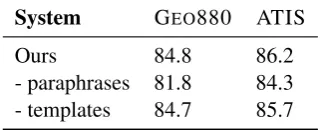
Table 4: Addition of paraphrases to the training set helps performance, but template based data aug-mentation does not significantly help in the fully supervised setting. Accuracies are reported on the standard dev set for ATIS and on the training set, using cross-validation, for Geo880.
ment with this in future work. Our results demon-strate that these models are powerful enough to di-rectly produce SQL queries. Thus, our methods enable us to utilize the full expressivity of the SQL language without any extensions that certain log-ical representations require to answer more com-plex queries. More importantly, it can be imme-diately deployed for users in new domains, with a large programming community available for anno-tation, and thus, fits effectively into a framework for interactive learning.
We perform ablation studies on the develop-ment sets (see Table 4) and find that paraphras-ing usparaphras-ing PPDB consistently helps boost perfor-mance. However, unlike in the interactive ex-periments (Section 6), data augmentation using schema templates does not improve performance in the fully supervised setting.
6 Interactive Learning Experiments
In this section, we learn a semantic parser for an academic domain from scratch by deploying an online system using our interactive learning algo-rithm (Section 3). After three train-deploy cycles, the system correctly answered 63.51% of user’s questions. To our knowledge, this is the first effort to learn a semantic parser using a live system, and is enabled by our models that can directly parse language to SQL without manual intervention.
6.1 User Interface
interactive learning. Screenshots of our interface are included in our Supplementary Materials.
Collecting accurate user feedback on predicted queries is a key challenge in the interactive learn-ing settlearn-ing for two reasons. First, the system’s re-sults can be incorrect due to poor entity identifi-cation or incompleteness in the database, neither of which are under the semantic parser’s control. Second, it can be difficult for users to determine if the presented results are in fact correct. This de-termination is especially challenging if the system responds with the correct type of result, for exam-ple, if the user requests “papers at ACL 2016” and the system responds with all ACL papers.
We address this challenge by providing users with two assists for understanding the system’s behavior, and allowing users to provide more granular feedback than simply correct/incorrect. The first assist istype highlighting, which high-lights entities identified in the utterance, for
ex-ample, “paper by Michael I. Jordan (AUTHOR)
in ICRA (VENUE) in 2016 (YEAR).” This as-sist is especially helpful because the academic database contains noisy keyword and dataset ta-bles that were automatically extracted from the pa-pers. The second assist isutterance paraphras-ing, which shows the user another utterance that maps to the same SQL query. For example, for the above query, the system may show “what papers doesMichael I. Jordan (AUTHOR)have inICRA (VENUE) in 2016 (YEAR).” This assist only ap-pears if a matching query (after entity anonymiza-tion) exists in the model’s training set.
Using these assists and the predicted results, users are asked to select from five feedback op-tions: Correct, Wrong Types, Incomplete Result,
Wrong Result and Can’t Tell. The Correct and
Wrong Result options represent scenarios when the user is satisfied with the result, or the result is identifiably wrong, respectively. Wrong Types
indicates incorrect entity identification, which can be determined from type highlighting.Incomplete Result indicates that the query is correct but the result is not; this outcome can occur because the database is incomplete. Can’t Tell indicates that the user is unsure about the feedback to provide.
6.2 Three-Stage Online Experiment
In this experiment, using our developed user in-terface, we use Algorithm 1 to learn a semantic parser from scratch. The experiment had three
stages; in each stage, we recruited 10 new users (computer science graduate students) and asked them to issue at least 10 utterances each to the system and to provide feedback on the results. We considered results marked as either Correct
orIncomplete Resultas correct queries for learn-ing. The remaining incorrect utterances were sent to a crowd worker for annotation and were used to retrain the system for the next stage. The crowd worker had prior experience in writing SQL queries and was hired from Upwork after complet-ing a short SQL test. The worker was also given access to the database to be able to execute the queries and ensure that they are correct. For the first stage, the system was trained using 640 ex-amples generated using templates, that were aug-mented to 1746 examples using paraphrasing (see Section 4.3). The complexity of the utterances is-sued in each of the three phases were compara-ble, in that, the average length of the correct SQL query for the utterances, and the number of tables required to be queried, were similar.
Table 5 shows the percent of utterances judged by users as either Correct or Incomplete Result
in each stage. In the first stage, we do not have any labeled examples, and the model is trained us-ing only synthetically generated data from schema templates and paraphrases (see Section 4.3). De-spite the lack of real examples, the system cor-rectly answers 25% of questions. The system’s ac-curacy increases and annotation effort decreases in each successive stage as additional utterances are contributed and incorrect utterances are labeled. This result demonstrates that we can successfully build semantic parsers for new domains by us-ing neural models to generate SQL with crowd-sourced annotations driven by user feedback.
exam-Stage 1 exam-Stage 2 exam-Stage 3
[image:8.595.313.505.120.439.2]Accuracy (%) 25 53.7 63.5
Table 5: Percentage of utterances marked as Cor-rect orIncompleteby users, in each stage of our online experiment.
Feedback Error Rate (%)
Correct SQL 6.1
Incorrect SQL 6.3
Table 6: Error rates of user feedback when the SQL is correct and incorrect. The Correct and
Incomplete results options are erroneous if the SQL query is correct, and vice versa for incorrect queries.
ples in the training set that may contribute to the deterioration of model accuracy over time. This quality of feedback is already sufficient for our neural models to improve with usage, and creating better interfaces to make feedback more accurate is an important task for future work.
6.3 SCHOLAR dataset
We release a new semantic parsing dataset for aca-demic database search using the utterances gath-ered in the user study. We augment these la-beled utterances with additional utterances lala-beled by crowd workers. (Note that these additional utterances were not used in the online experi-ment). The final dataset comprises 816 natural language utterances labeled with SQL, divided into a 600/216 train/test split. We also provide a database on which to execute these queries con-taining academic papers with their authors, cita-tions, journals, keywords and datasets used. Ta-ble 1 shows statistics of this dataset. Our parser achieves an accuracy of 67% on this train/test split in the fully supervised setting. In comparison, a nearest neighbor strategy that uses the cosine simi-larity metric using a TF-IDF representation for the utterances yields an accuracy of 52.75%.
We found that 15% of the predicted queries did not execute, predominantly owing to (1) access-ing table columns without joinaccess-ing with those ta-bles, and (2) generating incorrect types that could not be deanonymized using the utterance. The main types of errors in the remaining well-formed queries that produced incorrect results were (1) portions of the utterance (such as ‘top’ and ‘cited
by both’) were ignored, and (2) some types from the utterance were not transferred to the SQL query.
2 4 6 8 10 12
Stages 0.0
0.1 0.2 0.3 0.4 0.5 0.6 0.7 0.8 0.9
Fra
cti
on
Co
rre
ct
Simulated Interactive Learning on Geo880
Ours
Without templates Without paraphrasing
2 4 6 8 10 12
Stages 0.0
0.1 0.2 0.3 0.4 0.5 0.6 0.7 0.8 0.9
Fra
cti
on
Co
rre
ct
Simulated Interactive Learning on ATIS
Ours
Without templates Without paraphrasing
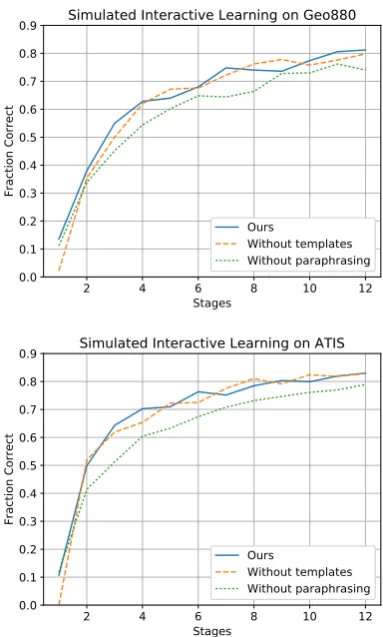
Figure 3: Accuracy as a function of batch num-ber in simulated interactive learning experiments on Geo880 (top) and ATIS (bottom).
6.4 Simulated Interactive Experiments
We conducted additional simulated interactive learning experiments using GEO880 and ATIS to better understand the behavior of our train-deploy feedback loop, the effects of our data augmen-tation approaches, and the annoaugmen-tation effort re-quired. We randomly divide each training set into
K batches and present these batches sequentially
to our interactive learning algorithm. Correctness feedback is provided by comparing the result of the predicted query to the gold query, i.e., we as-sume that users are able to perfectly distinguish correct results from incorrect ones.
Figure 3 shows accuracies on GEO880 and
Batch Size 150 100 50
% Wrong 70.2 60.4 54.3
Table 7: Percentage of examples that required an-notation (i.e., where the model initially made an incorrect prediction) on GEO880 vs. batch size.
is reduced as more labeled data is obtained. Tem-plates did not improve accuracy on ATIS, possibly because most ATIS queries involve two entities, i.e., a source city and a destination city, whereas our templates only generate questions with a sin-gle entity type. Nevertheless, templates are impor-tant in a live system to motivate users to interact with it in early stages. As observed before, para-phrasing improves performance at all stages.
Table 7 shows the percent of examples that require annotation using various batch sizes for
GEO880. Smaller batch sizes reduce
annota-tion effort, with a batch size of50requiring only 54.3%of the examples to be annotated. This re-sult demonstrates that more frequent deployments of improved models leads to fewer mistakes.
7 Conclusion
We describe an approach to rapidly train a seman-tic parser as a NLIDB that iteratively improves parser accuracy over time while requiring mini-mal intervention. Our approach uses an attention-based neural sequence-to-sequence model, with data augmentation from the target database and paraphrasing, to parse utterances to SQL. This model is deployed in an online system, where user feedback on its predictions is used to select utter-ances to send for crowd worker annotation.
We find that the semantic parsing model is comparable in performance to previous systems that either map from utterances to logical forms, or generate SQL, on two benchmark datasets, GEO880 and ATIS. We further demonstrate the effectiveness of our online system by learning a semantic parser from scratch for an academic do-main. A key advantage of our approach is that it is not language-specific, and can easily be ported to other commonly used query languages, such as SPARQL or ElasticSearch. Finally, we also re-lease a new dataset of utterances and SQL queries for an academic domain.
Acknowledgments
The research was supported in part by DARPA, under the DEFT program through the AFRL (FA8750-13-2-0019), the ARO (W911NF-16-1-0121), the NSF (1252835, 1562364, IIS-1546083, IIS-1651489, CNS-1563788), the DOE (DE-SC0016260), an Allen Distinguished Investi-gator Award, and gifts from NVIDIA, Adobe, and Google. The authors thank Rik Koncel-Kedziorski and the anonymous reviewers for their helpful comments.
References
Yoav Artzi, Kenton Lee, and Luke Zettlemoyer. 2015. Broad-coverage CCG semantic parsing with AMR. In Proceedings of the 2015 Conference on Empiri-cal Methods in Natural Language Processing. Asso-ciation for Computational Linguistics, pages 1699– 1710. https://doi.org/10.18653/v1/D15-1198.
Yoav Artzi and Luke Zettlemoyer. 2013. Weakly su-pervised learning of semantic parsers for mapping instructions to actions. Transactions of the Asso-ciation for Computational Linguistics 1(1):49–62. http://aclweb.org/anthology/Q13-1005.
Dzmitry Bahdanau, Kyunghyun Cho, and Yoshua Ben-gio. 2015. Neural machine translation by jointly learning to align and translate. In Proceedings of the 2015 International Conference on Learn-ing Representations. CBLS, San Diego, California. http://arxiv.org/abs/1409.0473.
Jonathan Berant, Andrew Chou, Roy Frostig, and Percy Liang. 2013. Semantic parsing on Free-base from question-answer pairs. In Proceed-ings of the 2013 Conference on Empirical Meth-ods in Natural Language Processing. Association for Computational Linguistics, pages 1533–1544. http://aclweb.org/anthology/D13-1160.
Bo Chen, Le Sun, Xianpei Han, and Bo An. 2016. Sentence rewriting for semantic parsing. In
Proceedings of the 54th Annual Meeting of the Association for Computational Linguistics (Vol-ume 1: Long Papers). Association for Computa-tional Linguistics, Berlin, Germany, pages 766–777. http://www.aclweb.org/anthology/P16-1073.
James Clarke, Dan Goldwasser, Ming-Wei Chang, and Dan Roth. 2010. Driving semantic pars-ing from the world’s response. In Proceed-ings of the Fourteenth Conference on Compu-tational Natural Language Learning. Associa-tion for ComputaAssocia-tional Linguistics, pages 18–27. http://aclweb.org/anthology/W10-2903.
Li Dong and Mirella Lapata. 2016. Language to logi-cal form with neural attention. InProceedings of the 54th Annual Meeting of the Association for Compu-tational Linguistics (Volume 1: Long Papers). Asso-ciation for Computational Linguistics, pages 33–43. https://doi.org/10.18653/v1/P16-1004.
Juri Ganitkevitch, Benjamin Van Durme, and Chris Callison-Burch. 2013. PPDB: The paraphrase database. In Proceedings of the 2013 Con-ference of the North American Chapter of the Association for Computational Linguistics: Hu-man Language Technologies. Association for Computational Linguistics, pages 758–764. http://aclweb.org/anthology/N13-1092.
Alessandra Giordani and Alessandro Moschitti. 2012. Translating questions to SQL queries with gener-ative parsers discrimingener-atively reranked. In Pro-ceedings of COLING 2012: Posters. The COL-ING 2012 Organizing Committee, pages 401–410. http://aclweb.org/anthology/C12-2040.
Robin Jia and Percy Liang. 2016. Data recombination for neural semantic parsing. In Proceedings of the 54th Annual Meeting of the Association for Compu-tational Linguistics (Volume 1: Long Papers). Asso-ciation for Computational Linguistics, pages 12–22. https://doi.org/10.18653/v1/P16-1002.
Chlo´e Kiddon, Luke Zettlemoyer, and Yejin Choi. 2016. Globally coherent text generation with neural checklist models. In Proceedings of the 2016 Conference on Empirical Methods in Natural Language Processing. Association for Computational Linguistics, pages 329–339. http://aclweb.org/anthology/D16-1032.
Diederik Kingma and Jimmy Ba. 2015. Adam: A method for stochastic optimization. InICLR.
Jayant Krishnamurthy and Tom Mitchell. 2012. Weakly supervised training of semantic parsers. In
Proceedings of the 2012 Joint Conference on Empir-ical Methods in Natural Language Processing and Computational Natural Language Learning. Associ-ation for ComputAssoci-ational Linguistics, pages 754–765. http://aclweb.org/anthology/D12-1069.
Nate Kushman, Yoav Artzi, Luke Zettlemoyer, and Regina Barzilay. 2014. Learning to automat-ically solve algebra word problems. In Pro-ceedings of the 52nd Annual Meeting of the As-sociation for Computational Linguistics (Volume 1: Long Papers). Association for Computational Linguistics, Baltimore, Maryland, pages 271–281. http://www.aclweb.org/anthology/P14-1026.
Nate Kushman and Regina Barzilay. 2013. Using se-mantic unification to generate regular expressions from natural language. InProceedings of the 2013 Conference of the North American Chapter of the Association for Computational Linguistics: Human Language Technologies.
Tom Kwiatkowski, Eunsol Choi, Yoav Artzi, and Luke Zettlemoyer. 2013. Scaling semantic parsers with on-the-fly ontology matching. In Proceedings of the 2013 Conference on Empirical Methods in Natu-ral Language Processing. Association for Computa-tional Linguistics, Seattle, Washington, USA, pages 1545–1556. http://www.aclweb.org/anthology/D13-1161.
Tom Kwiatkowski, Luke Zettlemoyer, Sharon Goldwa-ter, and Mark Steedman. 2011. Lexical generaliza-tion in CCG grammar inducgeneraliza-tion for semantic pars-ing. InProceedings of the 2011 Conference on Em-pirical Methods in Natural Language Processing. Association for Computational Linguistics, pages 1512–1523. http://aclweb.org/anthology/D11-1140. Percy Liang, I. Michael Jordan, and Dan Klein. 2013. Learning dependency-based compositional semantics. Computational Linguistics 39(2). https://doi.org/10.1162/COLI a 00127.
Wang Ling, Phil Blunsom, Edward Grefenstette, Moritz Karl Hermann, Tom´aˇs Koˇcisk´y, Fumin Wang, and Andrew Senior. 2016. Latent predictor networks for code generation. InProceedings of the 54th Annual Meeting of the Association for Compu-tational Linguistics (Volume 1: Long Papers). As-sociation for Computational Linguistics, pages 599– 609. https://doi.org/10.18653/v1/P16-1057. Nicholas Locascio, Karthik Narasimhan, Eduardo
De Leon, Nate Kushman, and Regina Barzi-lay. 2016. Neural generation of regular expres-sions from natural language with minimal do-main knowledge. In Proceedings of the 2016 Conference on Empirical Methods in Natural Language Processing. Association for Computa-tional Linguistics, Austin, Texas, pages 1918–1923. https://aclweb.org/anthology/D16-1197.
Thang Luong, Hieu Pham, and D. Christopher Man-ning. 2015. Effective approaches to attention-based neural machine translation. In Proceed-ings of the 2015 Conference on Empirical Meth-ods in Natural Language Processing. Association for Computational Linguistics, pages 1412–1421. https://doi.org/10.18653/v1/D15-1166.
Tomas Mikolov, Ilya Sutskever, Kai Chen, Greg S Cor-rado, and Jeff Dean. 2013. Distributed representa-tions of words and phrases and their compositional-ity. InAdvances in neural information processing systems. pages 3111–3119.
for Computational Linguistics, pages 1775–1786. http://aclweb.org/anthology/D16-1183.
V. Pham, T. Bluche, C. Kermorvant, and J. Louradour. 2014. Dropout improves recurrent neural net-works for handwriting recognition. In 2014 14th International Conference on Frontiers in Handwriting Recognition. pages 285–290. https://doi.org/10.1109/ICFHR.2014.55.
Hoifung Poon. 2013. Grounded unsupervised se-mantic parsing. In Proceedings of the 51st An-nual Meeting of the Association for Computational Linguistics (Volume 1: Long Papers). Associa-tion for ComputaAssocia-tional Linguistics, pages 933–943. http://aclweb.org/anthology/P13-1092.
Ana-Maria Popescu, Oren Etzioni, and Henry Kautz. 2003. Towards a theory of natural language inter-faces to databases. In Proceedings of the 8th in-ternational conference on Intelligent user interfaces. ACM, pages 149–157.
Raghu Ramakrishnan and Johannes Gehrke. 2003.
Database Management Systems. McGraw-Hill, Inc., New York, NY, USA, 3 edition.
Subhro Roy, Shyam Upadhyay, and Dan Roth.
2016. Equation parsing : Mapping
sen-tences to grounded equations. In Proceed-ings of the 2016 Conference on Empirical Meth-ods in Natural Language Processing. Association for Computational Linguistics, pages 1088–1097. http://aclweb.org/anthology/D16-1117.
Adrienne Wang, Tom Kwiatkowski, and Luke Zettle-moyer. 2014. Morpho-syntactic lexical generaliza-tion for CCG semantic parsing. In Proceedings of the 2014 Conference on Empirical Methods in Nat-ural Language Processing (EMNLP). Association for Computational Linguistics, pages 1284–1295. https://doi.org/10.3115/v1/D14-1135.
I. Sida Wang, Percy Liang, and D. Christopher Man-ning. 2016. Learning language games through interaction. In Proceedings of the 54th Annual Meeting of the Association for Computational Lin-guistics (Volume 1: Long Papers). Association for Computational Linguistics, pages 2368–2378. https://doi.org/10.18653/v1/P16-1224.
Yushi Wang, Jonathan Berant, and Percy Liang. 2015. Building a semantic parser overnight. In Proceed-ings of the 53rd Annual Meeting of the Associa-tion for ComputaAssocia-tional Linguistics and the 7th In-ternational Joint Conference on Natural Language Processing (Volume 1: Long Papers). Association for Computational Linguistics, pages 1332–1342. https://doi.org/10.3115/v1/P15-1129.
Wah Yuk Wong and Raymond Mooney. 2007. Gener-ation by inverting a semantic parser that uses sta-tistical machine translation. In Human Language Technologies 2007: The Conference of the North
American Chapter of the Association for Compu-tational Linguistics; Proceedings of the Main Con-ference. Association for Computational Linguistics, pages 172–179. http://aclweb.org/anthology/N07-1022.
Wen-tau Yih, Matthew Richardson, Chris Meek, Ming-Wei Chang, and Jina Suh. 2016. The value of semantic parse labeling for knowledge base ques-tion answering. In Proceedings of the 54th An-nual Meeting of the Association for Computational Linguistics (Volume 2: Short Papers). Associa-tion for ComputaAssocia-tional Linguistics, pages 201–206. https://doi.org/10.18653/v1/P16-2033.
John M. Zelle and Raymond J. Mooney. 1996. Learn-ing to parse database queries usLearn-ing inductive logic programming. InProceedings of the Thirteenth Na-tional Conference on Artificial Intelligence.
Luke Zettlemoyer and Michael Collins. 2007. On-line learning of relaxed CCG grammars for parsing to logical form. In Proceedings of the 2007 Joint Conference on Empirical Meth-ods in Natural Language Processing and Com-putational Natural Language Learning (EMNLP-CoNLL). http://aclweb.org/anthology/D07-1071.