Munich Personal RePEc Archive
Reference Dependence and Choice
Overload
Deb, Joyee and Zhou, Jidong
School of Management, Yale University
2018
Online at
https://mpra.ub.uni-muenchen.de/86261/
Reference Dependence and Choice Overload
∗
Joyee Deb
†Yale School of Management
Jidong Zhou
‡Yale School of Management
April 2018
Abstract
This paper offers an explanation for choice overload based on reference-dependent preferences. We assume that consumers construct an ideal object that combines the best attributes of all objects in their choice set, and use this as a reference point. They exhibit loss aversion in any attribute that is worse than the reference point. When a consumer’s choice set expands, on the one hand, she is more likely to find a better object, but on the other hand, the reference point improves making all existing objects appear worse. We characterize when the latter reference-dependence effect dominates, thus making the probability of purchase decrease with the number of objects available. We also show that consumers’ propensity to choose can decrease with object complexity, measured by the number of attributes.
Keywords: choice overload, reference dependence, loss aversion
JEL classification: D11, D91
∗We are grateful to Jason Abaluck, Ravi Dhar, Laura Doval, Shane Frederick, Ryota Iijima,
Alessandro Lizzeri, Barry Nalebuff, Larry Samuelson and Leeat Yariv for their helpful comments. The research assistance of Zixiong Wang is greatly appreciated.
1
Introduction
There is widespread evidence that an abundance of choice can make decision mak-ing harder and indeed may cause people to buy less often, or be less satisfied with what they purchase. This is often termed “choice overload” or “paradox of choice”.
Iyengar and Lepper (2000) were among the first to show, in their well-known jam experiment, that consumers when faced with a larger number of choices were less likely to purchase.1 Similar evidence has been shown in a variety of contexts: A
study by Iyengar, Huberman, and G.Jiang (2004) documented evidence of a nega-tive impact on employee participation when a larger range of retirement plans were offered. Other things equal, every ten funds added was associated with 1.5-2% drop in participation rates. Bertrand, Karlan, Mullainathan, Shafir, and Zinman (2010) showed that offering a smaller range of loan products (1 vs 4 options) had the same effect on demand as a 25% decrease in interest rates. A survey by the Consumer Reports in 2014 also confirms that many consumers are overwhelmed by too many choices in supermarkets.2 In fact some retailers have started to reduce the number of
products they carry to make shopping easier.3
The evidence is, however, not unambiguous. There are also studies where choice overload does not arise. See, e.g., Scheibehenne, Greifeneder, and Todd (2010a) and
Chernev, B¨ockenholt, and Goodman (2015) for surveys of lab and field studies of choice overload. Moreover, there is recent experimental evidence that suggests that choice overload is more likely to arise when the decision maker faces a more complex decision. For instance, Scheibehenne, Greifeneder, and Todd (2010b) conducted an experiment with pens and mp3 players, and showed that choice overload is more likely to arise when the objects are more complex in terms of having a greater number of attributes.
This body of evidence is the starting point for our paper. We present a plausible
1There is some earlier related research, but those papers usually consider a small number of
objects and do not particularly focus on choice overload problem. For instance,Dhar(1997) studies whether the chance of taking the no-choice option is higher or lower when a new option is added to a singleton choice set, where the new option is similar to the existing one. Similarly Tversky and Shafir(1992) show experimentally, by expanding a singleton choice set, that it is possible to induce a decision maker to delay her purchase decision by adding an alternative.
2
https://www.consumerreports.org/cro/magazine/2014/03/too-many-product-choices-in-supermarkets /index. htm
mechanism that can result in choice overload, and is consistent with the evidence. In particular, we propose a simple and natural model of reference dependence with loss aversion and present the conditions under which choice overload can or cannot arise. We also show how the phenomenon of choice overload is affected by the complexity of the objects.
Our main premise is that when a decision maker chooses a multi-attribute object, she needs to make trade-offs between various attributes of the object, and she faces some disutility if her chosen object is worse on some attribute than other objects that she has seen. It is as if when the decision maker observes multiple options, she imagines an ideal object that combines the best attributes of all the objects she has seen, and uses it as a reference point when she evaluates each available object. A comparison with such a reference point can leave her dissatisfied with every object in the sample. This type of reasoning has been suggested and studied by psychologists, though it has not been explored in a formal decision model. For instance, Schwartz
(2004) writes:4
The existence of multiple alternatives makes it easy for us to imagine alternatives that don’t exist—alternatives that combine the attractive fea-tures of the ones that do exist. And to the extent that we engage our imaginations in this way, we will be even less satisfied with the alternative we end up choosing.
To fix ideas, consider the choice of a house. One might be interested in several attributes of a house: square footage, size of the backyard, quality of the view and style. Then, one goes house-hunting. The first open house is just the right size with a large backyard but no view, while the second is too large, with no backyard, an ocean view and constructed in mid-century style, while the third is small, has no backyard, has an ocean view and is in a modern minimalist style. As one samples more houses, one conjures up the image of an ideal house that combines the best features of each: a house that is the right size with a backyard, an ocean view and a modern minimalist design. Often, such an ideal house is not available, and purchase
4Sagi and Friedland(2007) provide some experimental evidence on the idea in Schwartz (2004).
A related idea in psychology is that due to the contrast effect, adding an “attractive but unattainable alternative” tends to decrease the attractiveness of available alternatives, especially when the decision needs to be made soon. See, for example, the experimental study byBorovoi, Liberman, and Trope
is delayed, because every house that is available compares unfavorably with the ideal. Similar situations can arise in many examples that involve choosing multi-attribute objects such as furniture, job offers, and partners.
Formally, we consider a consumer who faces a choice set ofn objects, each withm
attributes. The consumer values all attributes, and her instrinsic valuations are drawn independently from some distribution. Beyond the intrinsic valuations, the consumer evaluates any object relative to a reference point which is some “ideal object” that is based on the set of choices she faces. She suffers a psychological loss that depends on how an object compares on each attribute with the reference point. A consumer will purchase her favorite object from the choice set if it gives her a positive overall utility. We say choice overload arises if the likelihood of purchase decreases with the number of options available.
We examine two natural possibilities for reference points in this context. We consider a Utopian reference point, where the consumer imagines an ideal object that combines the best attributes from all the existing objects. We also consider an Expectation-based reference point, where before inspecting the existing objects, the consumer imagines an object that has the expected best value on each attribute and regards it as the reference point. We ask two key questions. Can choice overload arise out of this reference dependence? Further, does the likelihood of purchase also vary with complexity of the object (measured by the number of attributes)?
We first show that choice overload can arise with such reference-dependent pref-erences, and provide sufficient conditions for this to happen. To see the intuition behind why choice overload can arise, note that increasing the size of the choice set has two effects. On the one hand, it increases the chance that better options are avail-able, and so increases the consumer’s propensity to purchase if there is no reference dependence. We call this the “sample-size effect”. On the other hand, increasing the number of choices induces a better reference point, making every object in the choice set less desirable. We call this the “reference-dependence effect”. When the second effect dominates, choice overload arises.
We also examine the relationship between choice overload and product complex-ity. Since our premise is that consumers dislike trade-offs, one may wonder whether making a decision about an object with many attributes is more likely to give rise to choice overload because there are potentially many more trade-offs.5 As mentioned
earlier, Scheibehenne, Greifeneder, and Todd(2010b) provide experimental evidence of this. Indeed we find that a key prediction of our model is consistent with the evi-dence that choice overload is more likely in the case of objects with many attributes. We provide conditions under which the consumer in our model is less likely to buy when the number of attributes increases.
Other related literature. In a framework with standard consumers, it is usu-ally hard to generate choice overload. This is because when the choice set expands, a rational consumer can always choose to ignore the newly added options. However, if the average quality of the options somehow decreases as the choice set expands, then even rational consumers can suffer from a larger choice set if they cannot easily iden-tify each option’s quality.6 Kamenica(2008) offers a contextual inference explanation
of choice overload in this vein. In his model, a firm knows that consumers have het-erogeneous preferences and in equilibrium always provides the most popular varieties of a product. Then the average popularity of the available varieties decreases as the number of varieties increases. As a result, uninformed consumers who do not know their own preferences and so have to randomly choose are less likely to purchase. In a similar spirit,Kuksov and Villas-Boas(2010) offer a search model that features choice overload. They consider a Hotelling setup where there arenproducts located at 2i−1
2n ,
i= 1,· · · , n, respectively (which minimizes the expected consumer travelling distance when information is perfect). Consumers initially do not know which product is in which location, but can learn via a sequential search process. In such a setup, having more products implies more uncertainty of product match. When search is relatively costly, this can induce more consumers to leave the market without purchasing.7
Instead, we adopt a behavioral approach to explain choice overload. Our paper belongs to the large literature on choice-set dependent preferences (see, for example,
Tversky and Simonson (1993) and Bordalo, Gennaioli, and Shleifer (2013)). It also relates to work in decision theory that studies preferences over menus with ex-post regret. Sarver (2008) provides axioms that deliver a unique regret representation, and can be seen as providing an axiomatic foundation for our preferences, since our
and they employ non-compensatory choice procedures in the absence of a dominant option. For example, consumers may then stick to the default option even if it is dominated.
6Abaluck and Gruber (2018) provide empirical evidence in this vein from the health insurance
market in the state of Oregon. They show that a larger choice set makes consumers worse off mainly because it include worse choices on average.
utility function with a Utopian reference point can be interpreted as a particular case of the regret representation.8 Choice overload can also naturally arise if we introduce
cost of thinking and assume that the cost is higher when the choice set is larger (which requires that the decision maker cannot freely discard options). Ortoleva
(2013) axiomatizes a utility function with such a feature.9,10
Different from the decision theory literature, our paper takes a more applied per-spective. By assuming a utility function with a plausible behavioral component, we focus on studying how the number of options and the number of attributes affect the consumer choice behavior. In particular, the question of how object complexity af-fects choices has not been explored in the decision theory literature. We also examine how our framework can be extended to explain other commonly observed behavioral anomalies like the compromise effect and the attraction effect.
The rest of the paper is organized as follows. Section 2 contains the model. In Section 3, we illustrate the main intuition by considering a limiting case of our model with extreme reference dependence. In Section 4, we first investigate the Expectation-based reference point, because this turns out to be an easier setting to analyze. In Section 5, we discuss the Utopian reference point, and show that the results are qualitatively similar. In Section 6, we conclude with a discussion of some applications of our framework.
2
The Model
Consider a consumer who faces a choice set consisting of n multi-attribute options. Let xj = (xj
1,· · · , xjm) denote option j ∈ {1,· · · , n}, where x j
i is the consumer’s
8Buturak and Evren (2017) extend Sarver (2008) by introducing a default option that is not
subject to regret consideration and study the choice overload consequence of the modified setup. This is closer to our model as we also have a normalized outside option that is not subject to the reference-dependence effect.
9See alsoFrick(2016) andGerasimou(Forthcoming) where a larger choice set is associated with
a higher complexity related cost, even if a newly added option is a dominant option or dominated by the existing ones. This contrasts with our model where adding a dominant or dominated option never harms the decision maker.
valuation for optionj’s attributeiandm is the number of attributes each option has. Suppose that the consumer has an additive intrinsic utility function:
u(xj) = 1
m
m
X
i=1 xji ,
where for simplicity all attributes are assumed to be equally important. The qual-itative results will be largely unchanged if we allow different weights on different attributes. Suppose that xji is drawn independently from a distribution F(x) with support [x, x] and a continuous density f(x), where an infinite support is allowed. Suppose that the realization of each xji is i.i.d. across both j and i. Therefore, all
options are symmetric and all attributes of each option are symmetric. The symmetry assumptions are made mainly for tractability. Throughout the paper we assume
µ0 ≡E[xji]>0 ,
i.e., on average each attribute provides a positive utility.
This random utility model can have two interpretations: We can think of modeling a single consumer whose valuations for attributes are unknown to the analyst. In this case, we are interested in the ex-ante probability that the consumer will choose an option from her choice set. Alternatively, we can think of modeling a large number of ex-ante symmetric consumers whose valuations for attributes are drawn independently from the same distribution and can be known to the analyst. In this case, we are interested in the the fraction of consumers who will choose an option from the available choice set.
The consumer evaluates each option relative to an “ideal object” or a reference point r= (r1,· · · , rm). Specifically, the consumer’s valuation for option j is
u(xj)− λ
m
m
X
i=1
max{0, ri−xji} , (1)
where λ≥ 0 is the loss aversion parameter.11 The second term reflects the weighted
sum of the psychological losses from all the attributes which are worse than the
11This is the simplest possible loss-aversion setup. More generally we could consider a gain/loss
reference point. The standard case of no reference dependence corresponds toλ= 0.12 We consider two specifications of the reference point r:
(1) Utopian reference point. The consumer, as suggested in Schwartz’s quotation above, imagines an “ideal” option which has the best attributes from all available options, and this object acts as the reference point. That is, the reference point is
r =x1∨ · · · ∨xn with ri = max{x1i,· · ·, x n i}
Notice that ri is a random variable ex ante, and it increases in n stochastically.13
(2) Expectation-based reference point. Here, the consumer’s reference point is
r=E[x1∨ · · · ∨xn] with ri =E[max{x1i,· · ·, x n i}] =
Z x
x
xdF(x)n
where F(x)n is the CDF of max{x1
i,· · ·, xni}. The interpretation is that before the
consumer sees the available options, she imagines an ideal object that has the expected best possible value on each attribute, and this serves as the reference point. Notice that unlike the case of the Utopian reference point, here ri is a constant and it
increases in n deterministically. This is consistent with the idea that a larger choice set induces people to anticipate a better matched option.
We assume that if the consumer does not choose any of the options, she obtains an outside option that gives her utility normalized to zero. Hence, the consumer’s problem is to choose the option with the highest positive utility if any. LetPndenote
the probability that the consumer will select one of the n options.14
12In our model reference dependence occurs at the attribute level. This is psychologically
rea-sonable and has been extensively adopted in the literature of prospect theory (e.g.,Kahneman and Tversky(2000)).
13Sarver(2008) provides an axiomatic foundation for such preferences: Our utility function can
be interpreted as a special case of Sarver’s regret representation:
zj= 1
m
m
X
i=1
[xji−λ(max k {x
k i} −x
j i)],
whereiis an index of state,m1 is the probability of each possible state, andxji is optionj’s valuation at statei. Then theλterm captures the regret of choosing optionj when stateiis realizedex post.
14Alternatively, if we consider our model to be one of a large population of consumers with i.i.d.
Denote by
zij ≡x j
i −λmax{0, ri−xji} (2)
the valuation for option j’s attributei after taking into account loss aversion. Let
Hi(t1,· · ·, tn) = Pr(zi1 ≤t1,· · ·, z n i ≤tn)
be the joint CDF of zi = (zi1,· · · , zin). Note that z j i and z
k
i are correlated in the case
of Utopian reference point whereri is a random variable, but independent in the case
of expectation-based reference point where ri is a constant. Whenever there is no
confusion, let Hi(tj) be the marginal CDF of zji.
Define
zj ≡ 1
m
m
X
i=1 zij .
Let
H(t1,· · · , tn) = Pr(z1 ≤t1,· · · , zn ≤tn)
be the joint CDF of z = (z1,· · · , zn), and whenever there is no confusion let H(t j)
be the marginal CDF of zj. (Here, as well, zj and zk are correlated in the case of
Utopian reference point via the correlation in each attribute.). Then we have
Pn = Pr(max{z1,· · · , zn}>0) = 1−H(0,· · · ,0). (3)
We aim to investigate the following two questions: First, how doesPnchange with
n? Choice overload occurs if Pn decreases with n. Second, how doesPn change with
the complexity of the options which is measured by m, the number of attributes? For the first question, the basic trade-off is as follows: Asnincreases, if eachzjwere
independent of n, max{z1,· · · , zn} would increase stochastically due to the standard
“sample-size effect”. However, each zj actually decreases with nstochastically due to
3
Illustration: Strong Reference Dependence
We first consider the case with λ→ ∞ to illustrate the main intuition of the paper. First, consider the Utopian reference point. Whenλ→ ∞, a consumer will choose an option if and only if it is the dominant option in her choice set. This is because if an option is not the dominant one, it is worse than some other product at least in one attribute, which will make its utility go to−∞. In other words, the consumer cannot tolerate any trade-off among options.15 For a given product j with utility realization
xj = (xj1, . . . , xj
m), the probability that it is the dominant option is
Qm i=1F(x
j i)
n−1.
Then the ex-ante probability that product j is the dominant option is16
Z m
Y
i=1 F(xji)
n−1dF(xj
) = m Y i=1 Z x x
F(xji)
n−1dF(xj i) =
1
n
m
.
Therefore, the probability of having one dominant option out of n is
Pn =n×
1 n m = 1 n
m−1 .
It decreases in bothn(except whenm = 1) andm. The effect ofm is intuitive: For a given n, whenm increases, the chance of facing trade-offs increases so the consumer is less likely to buy. However, the effect of n on Pn is more surprising. For a given
m > 1, when n increases, each option is less likely to be the dominant option, but there are also now more options. But it tuns out that the first effect always dominates the second.
Next, consider the expectation-based reference point. Whenλ → ∞, an option is not acceptable if and only if at least one of its attributes is worse than the expected maximum of that attribute. This happens with probability 1−(1−F(ri))m, where
ri =
Rx
x xdF(x)
n. Then
Pn= 1−[1−(1−F(ri))m]n .
It is immediate that Pn decreases in m, since with more attributes it is more likely
15This is similar to assuming incomplete preferences by which consumers cannot compare two
options with trade-offs and so will remain indecisive when there is no dominant option.
16The same argument will work here even if we allow the utility from each attribute to be drawn
that at least one of them will be worse than ri. In other words, the propensity to
purchase decreases with complexity of the object. What is less clear is whether choice overload can ever arise, i.e., whether Pn can decrease with n : ifri were independent
of n, Pn would increase in n, but the reference-dependence effect via ri generates
an opposite force. In fact we can show that, for sufficiently large m, the reference dependence effect dominates so that Pn decreases in n.17 To see how, let us treat
bothn and m as continuous variables. Lett(n)≡1−F(ri), and note thatt′(n)<0.
Then
ln(1−Pn) =nln(1−t(n)m) ,
and its derivative with respect to n is
ln(1−t(n)m)
| {z }
sample-size effect
+n(−t′(n))mt(n)
m−1
1−t(n)m
| {z }
reference-dependence effect
. (4)
Let τ = 1−t(n)m, so τ →1 as m→ ∞. Then
lim
m→∞
(1−t(n)m) ln(1−t(n)m)
mt(n)m = limτ→1
τlnτ
(1−τ) logt(n)(1−τ) = 0 .
(The last step is from applying the L’Hospital’s rule.) Therefore, for a fixed n, (4) is strictly positive (soPn decreases in n) for sufficiently large m.
In the remainder of the paper, we consider general λ. The specification of the reference point does not affect our results qualitatively. But the Utopian reference point is analytically more challenging than the expectation-based one. So, we start with the simpler case.
4
Expectation-Based Reference Point
The consumer’s expectation-based reference point in attribute i is
ri =E[max{x1i,· · · , x n i}] =
Z x
x
xdF(x)n,
17For small m, however, it is possible that P
n increases in n. For instance, we can verify that for both the uniform distribution and the exponential distribution,Pn increases inn if and only if
and it is increasing in n. Using (2) we have
zij =
(
xji if xji ≥ri
xji −λ(ri−xji) if x j i < ri
.
Since ri is a constant, zij is a kinked increasing function of x j
i, and {zi1,· · · , zin} are
statistically independent of each other. Then the CDF of zji is
Hi(z) =
(
F(z+λri
1+λ ) ifz ≤ri
F(z) if z > ri
,
which has support [(1 +λ)x−λri, x] and is (weakly) increasing inn. The mean of zji
is
µ=µ0−λ
Z ri
x
F(x)dx , (5)
which clearly decreases inn . Sincezj = 1
m
Pm i=1z
j
i,{z1,· · · , zn}are also statistically
independent of each other. The CDF of zj, i.e. H(·), is an m-order convolution of
Hi(·). Then
Pn= Pr(max{z1,· · · , zn}>0) = 1−H(0)n . (6)
Notice that H(0) increases in n, which makes it ex-ante unclear how Pn varies with
n.
4.1
Choice overload
We first ask, for a fixed m, whether choice overload can arise at least for some range of n. We know that the lower bound of zj is (1 +λ)x−λr
i with ri =
Rx
x xdF(x) n.
We also know thatri is increasing inn. It follows that if this lower bound is positive
forn = 1 but negative for somen >1, then we will have P1 = 1 and Pn <1 for some
n >1, which will imply that choice overload arises for some range ofn. Therefore we have the following preliminary result.
Proposition 1. For a fixed m, if (1 +λ)x−λµ0 >0but (1 +λ)x−λri <0 for some
n >1 (where ri =
Rx
x xdF(x)
n), then P
n decreases in n at least for a range of n.
each zj = 1
m
Pm i=1z
j
i converges to the mean µ according to thelaw of large numbers.
Then a consumer will choose one option if and only if µ >0. In this case the sample-size effect vanishes and only the reference-dependence effect remains. Given that
µ decreases in n, the probability that the consumer will choose an option (weakly) decreases with n, i.e., limm→∞Pn decreases in n. If µ > 0 for n = 1 and µ < 0 for
a sufficiently large n, then the consumer will not choose any option if the number of options exceeds a threshold.18
Now consider, a finite but large m such that we can approximate H(·) by using the central limit theorem (CLT). If zij has a mean µ and a variance σ2, CLT implies
that approximately zj−µ∼N(0,σ2
m). Then
H(0) = Pr(zj −µ <−µ)≈Φ(−√mµ
σ),
where Φ is the CDF of the standard normal distribution. Therefore,
Pn= 1−H(0)n ≈1−Φ(−
√ mµ
σ)
n (7)
for a large m. (Notice that this formula justifies our previous discussion when m → ∞.) We have the following proposition.
Proposition 2. Let µ and σ2 be the mean and variance of zj
i, respectively. For a
given n,
1. If −µσ decreases at n, then for m large enough, there is no choice overload. 2. If µ < 0 and −µσ increases at n, there exists m1ˆ such that Pn+1 < Pn for
m >m1.ˆ
Proof. For the first part, notice that if −µ
σ decreases at n, then Pn approximated in
(7) must increase in n, such that there is no choice overload.
For the second part, let us treat n as a continuous variable. Let ρ(n) ≡ −µ σ.
Then our assumption implies ρ(n) >0 and ρ′(n)> 0. When m is sufficiently large,
18For instance, if xi
j were drawn from the uniform distribution over [0,1], one can check that
µ= 12(1−λ( n n+1)
2). Ifλ
∈(1,4),µ >0 forn= 1 andµ <0 if and only ifn≥ √λ1
−1. That is,Pn
will drop from 1 to 0 whennexceeds √1
Pn ≈1−Φ(√mρ(n))n. Consider
ln Φ(√mρ(n))n=nln Φ(√mρ(n)) .
Its derivative with respect to n is
log Φ(√mρ(n)) +nφ( √
mρ(n)) Φ(√mρ(n))
√
mρ′(n) ,
whereφ(·) is the density of the standard normal distribution. The sign of this deriva-tive is the same as that of
log Φ(√mρ(n))
φ(√mρ(n)) +n
√
mρ′(n)
Φ(√mρ(n)) . (8)
For a given ρ(n)>0, limm→∞√mρ(n) =∞. By L’Hospital’s rule, we have
lim
x→∞
log Φ(x)
φ(x) = limx→∞
φ(x)/Φ(x)
φ′(x) = limx→∞
φ(x)
φ′(x) = limx→∞(−
1
x) = 0 .
(The second last equality follows from the fact that φ′(x) =−xφ(x) for the standard
normal density function.) Therefore, for a fixedn, the first term in (8) tends to zero as m → ∞, while the second one is positive and bounded away from zero. This implies that Φ(√mρ(n))n increases in n (and soP
ndecreases in n) for a large m.
To illustrate, let us consider the uniform distribution example withF(x) =x and
ri = nn+1. The density function of zij is then
hi(z) =
(
1
1+λ if z ≤ri
1 if z > ri
for z ∈ [− nλ
n+1,1]. One can check that the mean of z
j
i is µ= 12
1−λ n n+1
2 , and
its variance is σ2 = 1 3
1 + n
1+n
3
(λ2−λ)−µ2. It is straightforward to verify that −µσ increases in n.
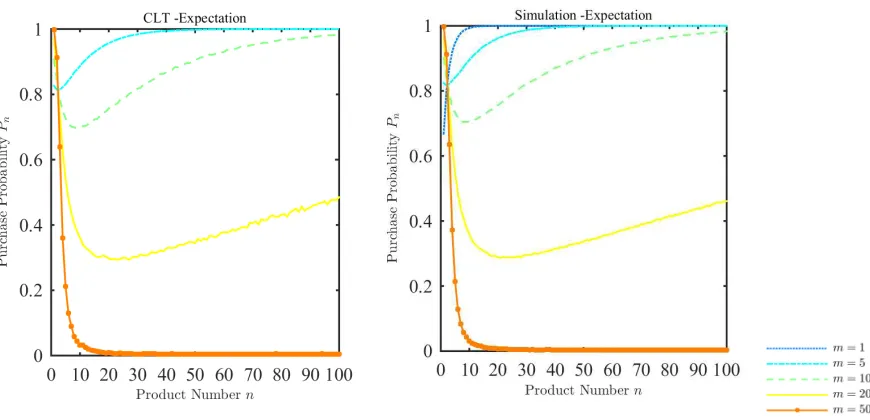
In Figure 1, the left panel depicts how the approximated Pn in (7) varies with n
with n (not restricting attention to large m). For m = 5, the two graphs are already almost identical, suggesting that our approximation works well even when m is not too large.
Figure 1: Pn with expectation-based reference points and uniform distribution: The left panel plots howPnvaries withnfor largem, using the Central Limit Theorem approximation. The right panel plots the exactPn = 1−H(0)n for different values ofm.
An observation that emerges from Figure 1is that whilePn decreases withn in a
certain range, eventually for sufficiently large n, Pn can increase again to 1. In fact,
we can show that limn→∞Pn = 1 for any fixed m if f(x) >0 everywhere in [x, x].19
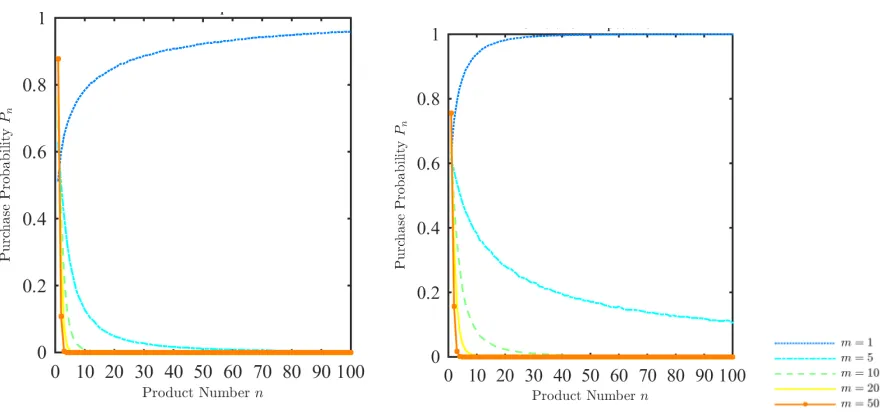
In other words, when there are enough options the sample-size effect dominates the reference-dependence effect such that there is no choice overload. However, this is not generally true if xji has an unbounded support. Figure 2 plots the exact Pn for
the exponential and normal distributions: In these cases, Pn always decreases in n
when m is not too small.
19The proof is as follows: Given f(x)>0 everywhere, so is hi(z). Then there exists a constant
κ > 0 independent of n, such that Pr(zij >0) =
Rx
0 hi(z)dz > xminz∈[0,x]hi(z)> κ. (The reason
we introduceκis thatxminz∈[0,x]hi(z) usually depends onn.) Then Pr(m1
Pm i=1z
j
i >0)> κm>0. This impliesH(0)<1−κmfor anyn. Then limn
Figure 2: Pn with expectation-based reference points under Exponential and Normal
distributions: The left panel shows howPnvaries with the number of optionsnfor different values ofmunder the exponential distribution. The right panel shows the same for the normal distribution.
4.2
Impact of option complexity
Next, we turn to the question of how the purchase probability Pn changes with m.
From Figures 1 and 2, we can see that Pn decreases in m when n is above a small
threshold. To further understand how the number of attributes (or the complexity of the options) might play an important role in the choice overload problem, consider two cases: m = ∞ and m = 1. Recall, that in the limiting case of m → ∞, choice overload arises if µ > 0 for n = 1 and µ < 0 for n large enough. Now consider the opposite case of choosing a single attribute object i.e., m = 1. In this case, H =Hi
and so we have
Pn = 1−H(0)n= 1−F(
λri
1 +λ)
n
.
Here both the sample-size effect and the reference-dependence effect are present. For the uniform distribution example with F(x) = x, one can check thatri = n+1n and
Pn= 1−
λ
1 +λ n n+ 1
n
.
Since both ( λ
1+λ)
n and ( n
n+1)n decrease in n, Pn must increase with n. So, in this
overload.
These two polar cases naturally gives rise to the question of how Pn varies withm
generally. To that end, we need to know how H(0) = Pr(m1 Pmi=1zij <0) changes in
m. One may conjecture that if zji has a negative mean, the sample mean m1 Pmi=1zji
should be negative more likely for a larger m. Conversely if zij has a positive mean, the sample mean should be positive more likely for a larger m. This is, however, not true in general.20 In the following we present sufficient conditions for this to be true:
one is when m is large, and the other is when n is large.
Consider a setting with large m, so that (as we have shown before) Pn ≈ 1−
Φ(−√mµ σ)
n. It is then clear that P
n decreases in m if µ < 0 and increases in m if
µ >0. We state this in the proposition below.
Proposition 3. There exists mˆ2 such that if m >mˆ2, then Pn is decreasing in m if
µ <0 and increasing in m if µ >0.
In other words, if reference-dependence effect is strong enough such thatµ < 0 and the options are already complicated, then the probability that a consumer chooses an option from her choice set decreases as the decision becomes more complex (as m
increases).
We next study the case when n is large. The following proposition characterizes when choice overload arises for symmetric and log-concave density functions.
Proposition 4. Suppose f is log-concave and symmetric. Then if µ0 < λ
1+λx, there
exists n1ˆ such that for n > ˆn1, Pn decreases in m. If µ0 > 1+λλx, there exists ˆn2 such
that for n >n2ˆ , Pn increases in m.
Proof. To prove this proposition we need a lemma.
Lemma 1. Consider a sequence of i.i.d. random variables{x1,· · · , xm} with a
com-mon density functionf(x)and meanE[x]. Supposef(x)is log-concave and symmetric about the mean. Then Pr(1
m
Pm
i=1xi < a) decreases inm if E[x]> a and increases in
m if E[x]< a.
20Here is a simple counter example: Consider two i.i.d. binary random variables z
1 and z2.
Suppose Pr(zi = −2) = α and Pr(zi = 1) = 1−α. Then Pr(z1+z2 = −4) = α2, Pr(z1+ z2 = −1) = 2α(1−α), and Pr(z1+z2 = 2) = (1−α)2. It is easy to see that in this example
Pr(z1+z2
The interested reader can refer to the Appendix for a proof of the lemma. Note that in our model, the density ofzij is not symmetric due to the reference point, even
if the density of xji is. So we cannot apply this lemma directly. Nevertheless, notice
that the density of zij is
hi(z) =
(
1 1+λf(
z+λri
1+λ ) if z ≤ri
f(z) if z > ri
,
andf(z+λri
1+λ ) is symmetric iff(z) is. Ifn is sufficiently large such thatri is close tox,
then the part ofz > ri becomes negligible andhi(z) becomes almost symmetric. Then
the lemma can be applied to obtain Proposition4. See the details in the appendix.
Notice that µ0 < λ
1+λx¯ is equivalent to limn→∞µ <0. So this result is consistent
with the above discussion that ifzji has a negative mean (e.g., becauseλis sufficiently large), it is more likely that m1 Pmi=1zji <0 whenm increases. The conditions for this result are satisfied in both the uniform and the normal example. They are not satisfied in the exponential example wheref is not symmetric, but the simulations in Figure2
show that Pn still goes down with m whenn is relatively large.
While we show above that Pn can decrease with m for a fixed n, one may ask
whether increased product complexity also increases the range of n over which Pn
decreases in n. Figure 1 suggests that this is indeed the case. Increased product complexity can amplify choice overload in the sense that choice overload happens for a larger range of n.
5
Utopian Reference Point
Recall that the Utopian reference point has the highest values on each attribute from the available objects in the choice set, i.e., ri = maxj{xji} in attribute i is a random
variable, and
zij = (1 +λ)xji −λri .
The support of zij is [x, x] if n= 1 and [(1 +λ)x−λx, x] ifn ≥2. The mean of zij is
µ= (1 +λ)µ0−λ
Z x
x
When n increases from 1 to infinity, it decreases from µ0 to (1 +λ)µ0−λx. Notice that {z1
i,· · · , zni} are now correlated due to the random reference point, and so are
{z1,· · · , zn}. This is the main difference compared to the case of the
expectation-based reference point. It turns out that, though this difference makes the analysis more difficult, it does not qualitatively affect the main results.
5.1
Choice overload
When m= 1, there is no choice overload in this setting, as we will discuss later. For
m >1, we have a result analogous to Proposition 1:
Proposition 5. For a fixed m >1, if 0< x < 1+1λ λ− m1−1x, then Pn decreases in
n at least for a range of n.
Proof. Given x > 0, we must have P1 = 1 in the current setup. It then suffices to showPn <1 for some n >1.21 Given the continuity of our distribution, we only need
to find that for somen there exists one realization of{xj1,· · · , xj
m}nj=1 such that every
option has a negative valuation. Consider n > m. Suppose optionj’s attributej has value xjj =xforj = 1,· · · , m, and xji =xfor all otherj andi. Then each of the first
m options has valuation
1
m[x+ (m−1)((1 +λ)x−λx)]<0
given the stated condition, and the other options have an even lower valuation.
As before, we next consider the case with largemsuch thatHcan be approximated by CLT. Let µ= (µ,· · · , µ) be the mean of zi = (zi1,· · · , zin), and let
Σ =
σ2 · · · σ12
... ... ...
σ12 · · · σ2
(10)
be its covariance matrix, where σ2 is the variance of zj
i and σ12 is the covariance of
(z1
i, zi2). Then when m is large, z =
1
mzi has approximately a multivariate normal
21Unlike the case of expectation-based reference point, it is now not enough to just show that the
distribution N(µ,m1Σ), andPn can be approximated as follows.
Lemma 2. When m is large,
Pn≈1−
Z ∞
−∞
Φ−
√
mµσ−√ρx √
1−ρ
n
φ(x)dx , (11)
where ρ = σ12/σ2 and Φ and φ are the CDF and density function of the standard normal distribution.22
Proof. Consider ann-dimensional random variablexwhich has a multivariate normal distribution N(µ, 1
mΣ). Define ˆx≡ √m
σ (x−µ). Then ˆx∼ N(0,Σ), whereˆ
ˆ Σ =
1 · · · ρ
... ... ...
ρ · · · 1
with ρ =σ12/σ2. That is, ˆx has an equicorrelated multivariate normal distribution.
Then
Pr(x<0) = Pr(ˆx<− √
m σ µ) =
Z ∞
−∞
Φ−√m
µ σ−
√ρx √
1−ρ
n
φ(x)dx . (12)
The last step is from the formula of calculating orthant probability for an equicorre-lated multivariate normal distribution (see, e.g., Steck and Owen, 1962).23 When m
is large, Pn≈1−Pr(x<0).
The term inside Φ(·) in (11) is complicated, so it is still hard to analytically investigate how Pn varies with n. This complication is caused by the correlation
among (z1
i,· · · , zin). Intuitivelyzi1 andzi2 are correlated only if the realization ofri is
x1
i or x2i (in which case they must be negatively correlated). The probability of this
event decreases when n increases, and so when n is large the correlation between z1
i
22Ifρ <0,√ρis a complex number and Φ(
·) is defined as follows:
Φ(a+ib) =e12b2
Z a
−∞
e−itbφ(t)dt .
It is an integration along a path in the complex plane parallel to thea-axis from−∞+ibtoa+ib.
23Notice that for a non-equicorrelated multivariate normal distribution, the orthant probabity
Pr(ˆx <0) usually does not have an analytical expression. Our result makes use of the fact that
and zi2 should be negligible (i.e. ρ ≈0). Therefore, when bothm and n are large, an
approximation of Pn is
1−Φ−√mµ σ
n
,
and so the result in Proposition 2applies.
As shown in the appendix, in the uniform distribution example we have
µ= 1 2−
n n+ 1 −
1 2
λ, σ2 = (1 +λ)
2
12 −
λ(n+ 1 +λ)
(n+ 2)(n+ 1)2, σ12=−
λ(n+ 1 +λ) (n+ 2) (n+ 1)2.
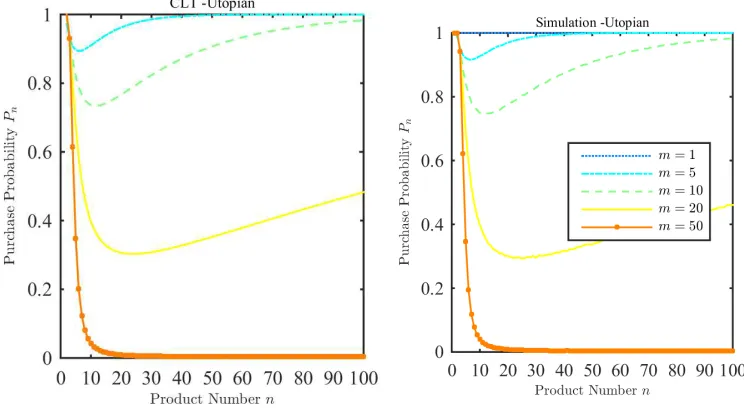
(As discussed above, hereσ12is indeed negative and goes to zero asn→ ∞.) Figure3
below depicts how the approximated Pn in (11) and the simulated true Pn in this
[image:22.612.91.463.341.545.2]example change with n when λ = 2. They are qualitatively similar to those in the case of expectation-based reference point.
Figure 3: Pn with Utopian reference points with the uniform distribution: The left panel shows howPn varies with the number of options n for largem, using the Central Limit Theorem approximation. The right panel plots the exactPn.
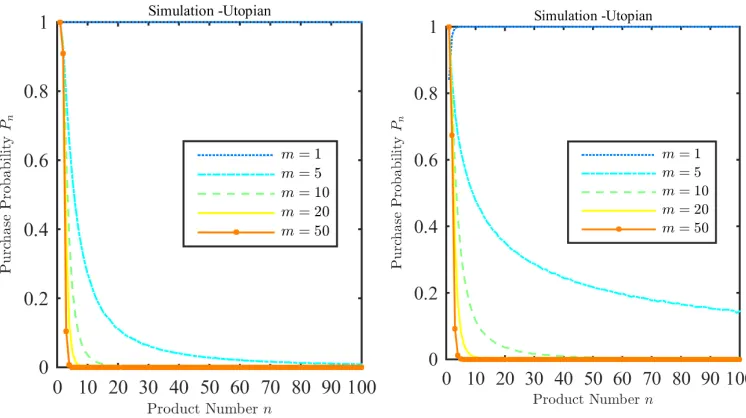
Figure 4: Pnwith Utopian reference points under exponential and normal distributions: The left panel shows how the true Pn varies withn under the exponential distribution. The right panel does the same for the normal distribution.
5.2
Impact of option complexity
The results on impact of the complexity of the object on the probability of purchase are also analogous to the case of expectation-based reference point. When m = 1, there is no choice overload. To see why, note that
Pn = Pr(max{x11,· · · , x
n
1} ≥0) = 1−F(0)
n
is clearly increasing in n. The intuition is straightforward: With m = 1 there is always a dominant option, and the dominant option is not subject to the reference-dependence effect.
On the other hand, when m is large, from (11) we see that Pn decreases in m if
µ < 0 and increases in m if µ > 0. This is also the same as in the previous case with expectation-based reference point. Finally, consider the case when n is large. A result similar to Proposition4 holds here. The proof is in the Appendix.
Proposition 6. Suppose that f is log-concave and symmetric. Then, if µ0 < λ
1+λx,
there exists n3ˆ such that forn >n3,ˆ Pn decreases in m. Ifµ0 > 1+λλx, there existsn4ˆ
6
Discussion
In this paper, we propose an explanation for choice overload that stems from reference dependent preferences. When consumers use a reference point that combines the best attributes of existing choices, then increasing the number of choices improves the reference point and can make each available choice look less appealing, thus giving rise to choice overload. Below we argue that our reference dependence framework can be extended to explain other behavioral anomalies beyond choice overload.
6.1
Reference dependence and other behavioral biases
Two of the most robust departures from standard rational choice are the compro-mise effect and the attraction effect. Both these effects are well documented both empirically and in experimental settings (e.g. Tversky and Simonson (1993)). The compromise effect refers to the phenomenon that the introduction of an “extreme” but not inferior option into the choice set increases the probability with which the de-cision maker chooses an “intermediate alternative.” It captures the dede-cision maker’s inclination to choose a “compromise option.” The attraction effect refers to the phe-nomenon that the introduction of a relatively inferior (or dominated) option into the choice set increases the probability that the decision maker chooses the dominating alternative in the choice set. It captures the idea that the decision maker is attracted to options that dominate some other option in the choice set. The attraction effect was first documented by Huber, Payne, and Puto (1982) and the compromise effect by Simonson (1989). In both cases, decision makers violate the regularity in a stan-dard choice model that the chance of an option being chosen cannot increase when the choice set is expanded. We show below that a modified version of our reference dependent preferences can also yield these two effects.
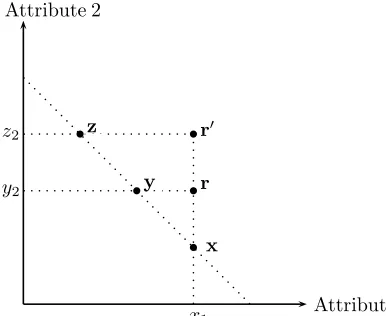
Reference dependence and the compromise effect. Consider the three two-attribute options x, y, and z in Figure5 below.
b
b b
b
b
Attribute 1 Attribute 2
x
x1
y r
r′
z
z2
[image:25.612.220.413.108.266.2]y2
Figure 5: Reference dependence and the compromise effect
with a reference point r is
1
m
m
X
i=1
[xi−l(max{0, ri−xi})] ,
where the loss function l(·) ≥ 0 is convex and l(0) = 0. The previous basic model is the special case with a linear l(·). For a transparent illustration, we focus on the two-attribute case with m = 2, and assume x1 +x2 =y1+y2 =z1 +z2 in Figure 5. Before option z is introduced, the reference point is r = (x1, y2) and the decision maker is indifferent between x and y. After option z is introduced, the reference point becomes r′ = (x1, z2). Then the decision maker is indifferent between x and z, and the utility from each of them equals half of
x1 +x2−l(z2−x2) =z1 +z2−l(x1−z1) .
While the utility of y becomes half of
y1+y2−l(x1 −y1)−l(z2 −y2) .
Since (x1−y1) + (z2 −y2) =z2−x2 (where we have usedx1 +x2 =y1+y2), option
that x is worse than y.
Reference dependence and the attraction effect. Consider the three two-attribute options x, y, and z in Figure?? below.
b
b b
b
b
Attribute 1 Attribute 2
y
z1
r x
r′
z
y1 x2
Figure 6: Reference dependence and the attraction effect
The attraction effect arises if adding option z (which is dominated by y but not
x) to a decision maker’s choice set increases the chance that optiony is chosen. To explain this effect, we now suppose that the decision maker regards the combination of the worst attributes from all the existing options as the reference point r, and the utility function becomes
1
m
m
X
i=1
[xi+g(max{0, xi−ri})] ,
where the gain function g(·) ≥ 0 is concave and g(0) = 0. A concave gain function implies that the decision maker prefers two small gains over a big gain which equals the sum of the two small gains. Again, for expositional simplicity we focus on the two-attribute case with m = 2, and assume x1 +x2 = y1 +y2, zi < yi, i= 1,2,
but z2 > x2. Before option z is introduced, the reference point is r = (y1, x2) and the decision maker is indifferent between xand y. After option z is introduced, the reference point becomes r′ = (z1, x2). Then the utility of xis half of
and the utility of y is half of
y1+y2+g(y1−z1) +g(y2−x2) .
Since (y1 −z1) + (y2 −x2) = x1 −z1 (where we have used x1 +x2 = y1 +y2), y
is preferred over x whenever g(·) is strictly concave. Intuitively, x now has a large advantage relative to r′ on attribute 1, while y has two relatively small advantages on both attributes. The concavity of the gain function then implies that x is worse than y.
Notice that this second alternative framework with the worst combination as ref-erence point can also explain the compromise effect. More generally, we can consider a utility function with two reference points r(the best combination) andr(the worst combination):
1
m
m
X
i=1
[xi−µl×l(ri−xi}+µg×g(xi−ri))],
where l(·) and g(·) have the same properties as above, and µl and µg indicate the
importance of loss and gain, respectively. In particular, µl can be interpreted as how
likely a consumer is “greedy” in the sense that she compares what is available to the best possibility, andµg can be interpreted as how likely a consumer is “contented” in
the sense that she compares what is available to the worst possibility. This framework can account for both attraction and compromise effect, and when the loss is more important than the gain it can also account for choice overload.
6.2
Other Applications
thereby weakening price competition. However, with our reference-dependent con-sumers the incentives for product differentiation are different. When firms invest in different attributes, consumers will imagine an ideal product which has all the poten-tial attributes being invested as a reference point. This will make each firm’s product less attractive and more consumers may thus leave the market. Taking into account this new effect, firms will have less incentive to differentiate and instead will invest in similar attributes to ensure that no firm is left behind significantly in any attribute.
Another application is product line design. Consider the classic Mussa-Rosen model where a firm can design products with different qualities to screen consumers with different willingness-to-pay for quality. If consumers have reference-dependent preferences as in our model, they will regard an ideal product which has the highest quality and the lowest price in the product line as the reference point. This will make each version of the product less attractive. Taking into account this effect, the firm will have an incentive to compress the product line. Exploring such applications is left for future research.
References
Abaluck, J., and J. Gruber (2018): “Less is More: Improving Choices by Lim-iting Choices in Health Insurance Markets,” mimeo.
Bachi, B., and R. Spiegler (2018): “Buridanic Competition,” Games and Eco-nomic Behavior, 107, 298–315.
Bertrand, M., D. Karlan, S. Mullainathan, E. Shafir, and J. Zinman
(2010): “What’s Advertising Content Worth? Evidence from a Consumer Credit Marketing Field Experiment,” The Quarterly Journal of Economics, 125(1), 263– 306.
Bordalo, P., N. Gennaioli, and A. Shleifer (2013): “Salience and Consumer Choice,” Journal of Political Economy, 121(5), 803–843.
Borovoi, L., N. Liberman, and Y. Trope(2010): “The effects of attractive but unattainable alternatives on the attractiveness of near and distant future menus,”
Buturak, G., and O. Evren (2017): “Chocie Overload and Asymmetric Regret,”
Theoretical Economics, 12(3), 1029–1056.
Chernev, A., U. B¨ockenholt, and J. Goodman (2015): “Choice Overload: A Conceptual Review and Meta-Analysis,” Journal of Consumer Psychology, 25(2), 333–358.
Dhar, R. (1997): “Consumer Preference for a No-Choice Option,” Journal of Con-sumer Research, 24(2), 215–231.
Frick, M. (2016): “Monotone Threshold Representations,” Theoretical Economics, 11(3), 757–772.
Fudenberg, D., R. Iijima, and T. Strzalecki (2016): “Stochastic Choice and Revealed Perturbed Utility,” Working paper version.
Gerasimou, G. (Forthcoming): “Indecisiveness, Undesirability and Overload Re-vealed Through Rational Choice Deferral,” Economic Journal.
Huber, J., J. W. Payne, and C. Puto (1982): “Adding Asymmetrically Domi-nated Alternatives: Violations of Regularity and the Similarity Hypothesis,” Jour-nal of Consumer Research, 9(1), 90–98.
Iyengar, S. S., G. Huberman, and G.Jiang (2004): “How Much Choice is Too Much? Contributions to 401(k) Retirement Plans,” in Pension Design and Structure: New Lessons from Behavioral Finance, ed. by O. S. Mitchell, and S. P. Utkus. Oxford University Press.
Iyengar, S. S., and M. R. Lepper(2000): “When Choice is Demotivating: Can One Desire Too Much of a Good Thing?,” Journal of Personality and Social Psy-chology, 79(6), 995–1006.
Kahneman, D., and A. Tversky (eds.) (2000): Choices, values, and frames. Cambridge University Press.
Ke, T., Z. Shen, and J. Villas-Boas(2016): “Search for information on multiple products,” Management Science, 62(12), 3576–3603.
Kuksov, D., and M. Villas-Boas(2010): “When More Alternatives Lead to Less Choice,” Marketing Science, 29(3), 507–524.
Ortoleva, P. (2013): “The Price of Flexibility: Towards A Theory of Thinking Aversion,” Journal of Economic Theory, 148, 903–934.
Proschan, F. (1965): “Peakedness of Distributions of Convex Combinations,” An-nals of Mathematical Statistics, 36(6), 1703–1706.
Ravid, D.(2015): “Focus, Then Compare,” mimeo, University of Chicago.
Sagi, A., and N. Friedland(2007): “The Cost of Richness: The Effect of the Size and Diversity of Decision Sets on Post-Decision Regret,” Journal of Personality and Social Psychology, 93(4), 515–524.
Sarver, T. (2008): “Anticipating Regret: Why Fewer Options May Be Better,”
Econometrica, pp. 263–305.
Scheibehenne, B., P. Greifeneder, and P. Todd (2010a): “Can There Ever Be Too Many Options? A Meta-Analytic Review of Choice Overload,” Journal of Consumer Research, 37(3), 409–425.
(2010b): “Less may be more when choosing is difficult: Choice complexity and too much choice,” Acta Psychologica, 133(1), 45 – 50.
Schwartz, B. (2004): The Paradix of Choice: Why More is Less. HarperCollins.
Simonson, I.(1989): “Choice Based on Reasons: The Case of Attraction and Com-promise Effects,” Journal of Consumer Research, 16(2), 158–174.
Tversky, A., and E. Shafir (1992): “Choice Under Conflict: The Dyamics of Deferred Decision,” Psychological Science, 4(6), 358–361.
Appendix A
A.1
Proof of Lemma
1
Proof. Denote ym ≡ Pmi=1xi/m. Notice that ym has the same mean E[x] and its
density is also symmetric. Given f is strictly log-concave and symmetric, Theorem 2.3 in Proschan (1965) implies that ym+1 is more peaked thanym in the sense that
Pr(|ym−E[x]| ≤t)<Pr(|ym+1−E[x]| ≤t) (13)
for any 0< t < x−E[x].
Suppose first E[x]> a. Substituting t =E[x]−a in (13) yields
Pr(a≤ym≤2E[x]−a)<Pr(a≤ym+1 ≤2E[x]−a) .
Then the symmetry of ym and ym+1 implies that
Pr(ym < a)>Pr(ym+1 < a) .
When E[x]< a, substituting t =a−E[x] in (13) yields the opposite result.
A.2
Proof of Proposition
4
Proof. We suppress the superscript j for convenience. Notice that
H(0) = Pr(
m
X
i=1
zi <0) = Pr( m
X
i=1
xi < λ m
X
i=1
max{0, ri−xi}).
When n is sufficiently large,ri ≈x and so
Pr(
m
X
i=1
zi <0)≈Pr(
1
m
m
X
i=1 xi <
λ
1 +λx) .
According to Lemma 1, the right-hand side decreases in m (so Pn increases in m)
if E[x] = µ0 > λ
1+λx, and increases in m (so Pn decreases in m) if E[x] = µ0E[x] < λ
A.3
Joint distribution with Utopian reference point
The following lemma characterizes the joint distribution of {z1
i,· · · , zni} in the case
of the Utopian reference point.
Lemma 3. (i) The joint CDF of zi = (zi1,· · · , zni) is
Hi(t1,· · · , tn) = n
X
j=1
Z tj
x
Y
k6=j
F
min{r,tk+λr
1 +λ }
dF(r) , (14)
where tj ∈[(1 +λ)x−λx, x] if n≥2 and tj ∈[x, x] if n= 1, and t∈[x, x].
(ii) The marginal CDF of zij is
Hi(tj) =F(tj)n+
Z x
tj
F
tj+λr
1 +λ
dF(r)n−1 . (15)
(iii) The marginal CDF of (z1
i, z2i)is
Hi(t1, t2) =F(t1)n+
Z t2
t1
F
t1+λr
1 +λ
dF(r)n−1+
Z x
t2
F
t1+λr
1 +λ
F
t2+λr
1 +λ
dF(r)n−2 (16)
for t1 ≤t2, and the expression for t1 > t2 is analogous. Proof. (i) Notice that
Hi(t1,· · · , tn) =
Z
r
Pr(zi1 ≤t1,· · · , zin≤tn|ri =r)dF(r)n ,
where F(r)n is the CDF of r
i. We claim that
Pr(z1i ≤t1,· · ·, z n
i ≤tn|ri=r) =
1
n
n
X
j=1
I{tj≥r}
F(r)n−1
Y
k6=j
F
min{r,tk+λr
1 +λ }
,
where I{·} is the standard indicator function. Conditional on ri = r, xji = r with
probability 1
n. In that case, z j
i =r, and so z j
i ≤tj holds iff tj ≥r. This explains the
indicator function term. For k 6= j, xk
i must be less than r (conditional on x j i = r).
Notice that
zk
i = (1 +λ)x k
i −λr≤tk⇔xki ≤
tk+λr
So the conditional probability that zk
i ≤tk is
F min{r,tk+λr
1+λ }
F(r) . (17)
Also notice that conditional xji = r, all zk
i, k 6= j, are independent of each other.
Then multiplying (17) over k 6=j and summing over j yeild the above expression. Therefore,
Hi(t1,· · · , tn) =
1 n n X j=1 Z r
I{tj≥r}
F(r)n−1
Y
k6=j
F
min{r,tk+λr
1 +λ }
dF(r)n .
This can be easily simplified to (14). (ii) Notice that
Hi(tj) =
Z
r
Pr(zij ≤tj|ri =r)dF(r)n .
Conditional on ri =r,xji =r with probability n1, in which casez j
i =r and so z j i ≤tj
iff tj ≥ r. With probability n−n1, x j
i < r in which case the conditional probability of
zij ≤tj is F
min{r,tj+λr
1+λ }
/F(r). Hence,
Hi(tj) =
Z
r
[1
nI{tj≥r}+
n−1
n
F min{r,tj+λr
1+λ }
F(r) ]dF(r)
n
.
This simplifies to (15). (iii) Notice that
Hi(t1, t2) =
Z
r
Pr(zi1 ≤t1, zi2 ≤t2|ri =r)dF(r)n .
By a similar logic as before, the integrand is equal to
1
nI{r≤t1}
F min{r,t2+λr
1+λ }
F(r) + 1
nI{r≤t2}
F min{r,t1+λr
1+λ }
F(r)
+n−2
n
F min{r,t1+λr
1+λ }
F min{r,t2+λr
1+λ }
F(r)2 .
It is useful to have the densify functions of zij and (zi1, zi2):
hi(tj) = F(tj)n−1f(tj) +
1 1 +λ
Z x
tj
f
tj +λr
1 +λ
dF(r)n−1 ,
and for t1 ≤t2
hi(t1, t2) =
1 1 +λf(
t1+λt2
1 +λ )f(t2)F(t2)
n−2+ 1
(1 +λ)2
Z x
t2
f
t1+λr
1 +λ
f
t2+λr
1 +λ
dF(r)n−2.
Now consider the uniform example with F(x) =x. When n ≥2 the support of t
is [−λ,1], and the support ofr is [0,1]. Then one can check that
hi(t) =
1
1+λ(1 +λt
n−1) if t ∈[0,1]
1
1+λ(1−(− t λ)
n−1) if t ∈[−λ,0) .
Then
µ= 1 2−
n n+ 1 −
1 2
λ and σ2 =E[(zij)2]−µ2 =
(1 +λ)2
12 −
λ(n+ 1 +λ) (n+ 2)(n+ 1)2 .
On the other hand, one can check that when t1 ≤t2,
hi(t1, t2) =
1−(−t1
λ ) n−2
(1+λ)2 if −λ≤t1 < t2 ≤0 or if −λ≤t1 <0< t2 < −
t1
λ ≤1
1+λtn−2
2
(1+λ)2 if −λ≤t1 <0<
−t1
λ < t2 ≤1 or if 0≤t1 < t2 ≤1
.
Then
E[z1iz2i] = 2
Z
t1≤t2
t1t2hi(t1, t2)dt1dt2 =
1 4
1−λ
n+ 2(n(1−λ) + 2(1 +λ)) ,
and
σ12 =E[zi1zi2]−µ2 =−
A.4
Proof of Proposition
6
The proof of Proposition6follows by deriving a multidimensional version of Lemma1, which we present below.
Lemma 4. Consider a sequence of i.i.d. n-dimensional random vectors{x1,· · · ,xm},
where xi = (x1i,· · ·, xni). Letf(x) be the joint density function of xi and let µ be the
mean. Suppose xji is symmetric across j = 1,· · · , n, so that µ = (µ,· · · , µ) and f(· · · , xji,· · · , xk
i,· · ·) = f(· · ·, xki,· · · , x j
i,· · ·) for any j 6= k. Suppose f(x) is
log-concave and symmetric about the mean (i.e., f(x−µ) = f(µ−x)). Then for any constant vector a = (a,· · · , a), Pr(1
m
Pm
i=1xi < a) increases in m if µ < a and
decreases in m if µ >a. Proof. Denote
ym ≡
1
m
m
X
i=1
xi .
It is clear that ym has the same mean µ and is also symmetric about µ. Given f is
log-concave and symmetric, a multivariate version of Theorem 2.3 inProschan(1965) (which is proved in Olkin and Tong, 1988) implies that ym+1 is more peaked thanym
in the following sense: for any compact, convex, and symmetric (about µ) A ⊂ Rn
which is non-empty and is a subset of the domain of xi, we have
Pr(ym+1 ∈A)>Pr(ym ∈A) . (18)
Suppose first µ < a, and let A in (18) be the hypercube [2µ−a, a]n which is
centered at µ and with a corner at a. Since A is compact, convex and symmetric about µ, Pr(ym ∈ A) increases in m. In the following, for convenience we consider
the two-dimensional case withn = 2. (The argument works for the general case.) Let us divide the domain of (y1
m, ym2) into multiple regions along the boundaries of A as
in the figure below.
Let Bi, i = 1,2, denote the probability that Pr(ym ∈ Bi). We want to show
3B1 + 2B2 decreases in m because Pr(ym < a) = 1−(3B1 + 2B2). From Pr(ym ∈
A) = 1−4(B1+B2) being increasing in m, we deduce that 4(B1+B2) decreases in m, so does B1 +B2. In the same time, if we apply the multivariate version of the
result by Proschan to the stripe which consists ofAand twoB2’s, we deduce 2B1+B2
ym2
y1m
2µ−a
a
µ
¯
x
x
2µ−a µ a ¯x
B1 B2
B2
B1
B1
B2
B1 B2
A
b