2587
Attacking Visual Language Grounding with Adversarial Examples:
A Case Study on Neural Image Captioning
Hongge Chen1*, Huan Zhang23*, Pin-Yu Chen3, Jinfeng Yi4, and Cho-Jui Hsieh2 1MIT, Cambridge, MA 02139, USA
2UC Davis, Davis, CA 95616, USA
3IBM Research, NY 10598, USA
4JD AI Research, Beijing, China
[email protected], [email protected]
[email protected], [email protected], [email protected] *Hongge Chen and Huan Zhang contribute equally to this work
Abstract
Visual language grounding is widely stud-ied in modern neural image caption-ing systems, which typically adopts an encoder-decoder framework consisting of two principal components: a convolu-tional neural network (CNN) for image feature extraction and a recurrent neural network (RNN) for language caption gen-eration. To study the robustness of lan-guage grounding to adversarial perturba-tions in machine vision and perception, we propose Show-and-Fool, a novel al-gorithm for crafting adversarial examples in neural image captioning. The pro-posed algorithm provides two evaluation approaches, which check whether neural image captioning systems can be mislead to output some randomly chosen captions or keywords. Our extensive experiments show that our algorithm can successfully craft visually-similar adversarial examples with randomly targeted captions or key-words, and the adversarial examples can be made highly transferable to other image captioning systems. Consequently, our ap-proach leads to new robustness implica-tions of neural image captioning and novel insights in visual language grounding.
1 Introduction
In recent years, language understanding grounded in machine vision and perception has made re-markable progress in natural language processing (NLP) and artificial intelligence (AI), such as im-age captioning and visual question answering. Im-age captioning is a multimodal learning task and has been used to study the interaction between lan-guage and vision models (Shekhar et al.,2017). It
takes an image as an input and generates a lan-guage caption that best describes its visual con-tents, and has many important applications such as developing image search engines with complex natural language queries, building AI agents that can see and talk, and promoting equal web ac-cess for people who are blind or visually impaired. Modern image captioning systems typically adopt an encoder-decoder framework composed of two principal modules: a convolutional neural network (CNN) as an encoder for image feature extraction and a recurrent neural network (RNN) as a decoder for caption generation. This CNN+RNN archi-tecture includes popular image captioning mod-els such as Show-and-Tell (Vinyals et al.,2015), Show-Attend-and-Tell (Xu et al.,2015) and Neu-ralTalk (Karpathy and Li,2015).
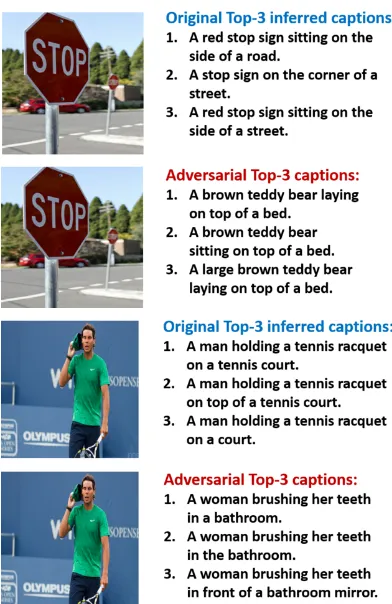
Figure 1: Adversarial examples crafted by Show-and-Fool using the targeted caption method. The target captioning model is Show-and-Tell (Vinyals et al.,2015), the original images are selected from the MSCOCO validation set, and the targeted cap-tions are randomly selected from the top-1 inferred caption of other validation images.
captions can be expressed in different ways and hence should not be viewed as different classes; and (ii) CNN v.s. CNN+RNN: attacking RNN models is significantly less well-studied than at-tacking CNN models. The CNN+RNN architec-ture is unique and beyond the scope of adversarial examples in CNN-based image classifiers.
In this paper, we tackle the aforementioned challenges by proposing a novel algorithm called Show-and-Fool. We formulate the process of crafting adversarial examples in neural image cap-tioning systems as optimization problems with novel objective functions designed to adopt the CNN+RNN architecture. Specifically, our objec-tive function is a linear combination of the dis-tortion between benign and adversarial examples as well as some carefully designed loss functions. The proposed Show-and-Fool algorithm provides two approaches to craft adversarial examples in neural image captioning under different scenarios:
1. Targeted caption method: Given a targeted caption, craft adversarial perturbations to any image such that its generated caption matches the targeted caption.
2. Targeted keyword method: Given a set of keywords, craft adversarial perturbations to any image such that its generated caption contains the specified keywords. The cap-tioning model has the freedom to make sen-tences with target keywordsin any order.
As an illustration, Figure 1shows an adversarial example crafted by Show-and-Fool using the tar-geted caption method. The adversarial perturba-tions are visually imperceptible while can success-fully mislead Show-and-Tell to generate the tar-geted captions. Interestingly and perhaps surpris-ingly, our results pinpoint the Achilles heel of the language and vision models used in the tested im-age captioning systems. Moreover, the adversar-ial examples in neural image captioning highlight the inconsistency in visual language grounding be-tween humans and machines, suggesting a possi-ble weakness of current machine vision and per-ception machinery. Below we highlight our major contributions:
• We proposeShow-and-Fool, a novel optimiza-tion based approach to crafting adversarial ex-amples in image captioning. We provide two types of adversarial examples, targeted caption and targeted keyword, to analyze the robustness of neural image captioners. To the best of our knowledge, this is the very first work on craft-ing adversarial examples for image captioncraft-ing.
• We propose powerful and generic loss functions that can craft adversarial examples and evaluate the robustness of the encoder-decoder pipelines in the form of a CNN+RNN architecture. In par-ticular, our loss designed for targeted keyword attack only requires the adversarial caption to contain a few specified keywords; and we al-low the neural network tomake meaningful sen-tences with these keywords on its own.
CNN models.
• We also show that Show-and-Fool can produce highly transferable adversarial examples: an adversarial image generated for fooling Show-and-Tell can also fool other image captioning models, leading to new robustness implications of neural image captioning systems.
2 Related Work
In this section, we review the existing work on vi-sual language grounding, with a focus on neural image captioning. We also review related work on adversarial attacks on CNN-based image clas-sifiers. Due to space limitations, we defer the sec-ond part to the supplementary material.
Visual language grounding represents a fam-ily of multimodal tasks that bridge visual and natural language understanding. Typical exam-ples include image and video captioning ( Karpa-thy and Li, 2015; Vinyals et al., 2015;Donahue et al.,2015b; Pasunuru and Bansal, 2017; Venu-gopalan et al., 2015), visual dialog (Das et al., 2017;De Vries et al., 2017), visual question an-swering (Antol et al., 2015; Fukui et al., 2016; Lu et al., 2016; Zhu et al., 2017), visual story-telling (Huang et al.,2016), natural question gen-eration (Mostafazadeh et al.,2017,2016), and im-age generation from captions (Mansimov et al., 2016;Reed et al.,2016). In this paper, we focus on studying the robustness of neural image captioning models, and believe that the proposed method also sheds lights on robustness evaluation for other vi-sual language grounding tasks using a similar mul-timodal RNN architecture.
Many image captioning methods based on deep neural networks (DNNs) adopt a multimodal RNN framework that first uses a CNN model as the encoder to extract a visual feature vector, fol-lowed by a RNN model as the decoder for cap-tion generacap-tion. Representative works under this framework include (Chen and Zitnick,2015; De-vlin et al., 2015; Donahue et al., 2015a; Karpa-thy and Li,2015;Mao et al.,2015;Vinyals et al., 2015;Xu et al.,2015;Yang et al.,2016;Liu et al., 2017a,b), which are mainly differed by the under-lying CNN and RNN architectures, and whether or not the attention mechanisms are considered. Other lines of research generate image captions using semantic information or via a compositional approach (Fang et al.,2015;Gan et al.,2017;Tran et al.,2016;Jia et al.,2015;Wu et al.,2016;You
et al.,2016).
The recent work in (Shekhar et al., 2017) touched upon the robustness of neural image cap-tioning for language grounding by showing its in-sensitivity to one-word (foil word) changes in the language caption, which corresponds to the untar-geted attackcategory in adversarial examples. In this paper, we focus on the more challenging tar-geted attack setting that requires to fool the cap-tioning models and enforce them to generate pre-specified captions or keywords.
3 Methodology of Show-and-Fool
3.1 Overview of the Objective Functions
We now formally introduce our approaches to crafting adversarial examples for neural image captioning. The problem of finding an adversar-ial example for a given imageI can be cast as the following optimization problem:
min
δ c·loss(I+δ) +kδk 2 2
s.t. I+δ ∈[−1,1]n. (1)
Here δ denotes the adversarial perturbation to I.
kδk2
2 = k(I +δ)−Ik22 is an `2 distance metric between the original image and the adversarial im-age. loss(·)is an attack loss function which takes different forms in different attacking settings. We will provide the explicit expressions in Sections 3.2and3.3. The termc >0is a pre-specified reg-ularization constant. Intuitively, with largerc, the attack is more likely to succeed but at the price of higher distortion on δ. In our algorithm, we use a binary search strategy to selectc. The box con-straint on the imageI ∈[−1,1]nensures that the adversarial exampleI+δ∈[−1,1]nlies within a valid image space.
For the purpose of efficient optimization, we convert the constrained minimization problem in (1) into an unconstrained minimization problem by introducing two new variables y ∈ Rn and
w∈Rnsuch that
y= arctanh(I) and w= arctanh(I+δ)−y,
(1) is equivalent to
minw∈Rn c·loss(tanh(w+y)) (2)
+ktanh(w+y)−tanh(y)k22.
In the following sections, we present our designed loss functions for different attack settings.
3.2 Targeted Caption Method
Note that a targeted caption is denoted by
S= (S1, S2, ..., St, ..., SN),
where St indicates the index of the t-th word in the vocabulary listV,S1is a start symbol andSN indicates the end symbol. N is the length of cap-tion S, which is not fixed but does not exceed a predefined maximum caption length. To encour-age the neural imencour-age captioning system to output the targeted captionS, one needs to ensure the log probability of the captionSconditioned on the im-age I +δ attains the maximum value among all possible captions, that is,
logP(S|I+δ) = max
S0∈ΩlogP(S
0|I+δ), (3)
where Ω is the set of all possible captions. It is also common to apply the chain rule to the joint probability and we have
logP(S0|I+δ) = N X
t=2
logP(St0|I+δ, S10, ..., St−10 ).
In neural image captioning networks,
p(St0|I + δ, S10, ..., St−10 ) is usually computed by a RNN/LSTM cellf, with its hidden stateht−1 and inputSt−10 :
zt=f(ht−1, St−10 )andpt=softmax(zt), (4)
wherezt := [zt(1), z (2) t , ..., z
(|V|)
t ] ∈R|V| is a vec-tor of the logits (unnormalized probabilities) for each possible word in the vocabulary. The vector
pt represents a probability distribution onV with each coordinatep(i)t defined as:
p(i)t :=P(St0=i|I+δ, S10, ..., St−10 ).
Following the definition of softmax function:
P(St0|I+δ, S01, ..., St−10 ) = exp(z (St0)
t )/ X
i∈V
exp(zt(i)).
Intuitively, to maximize the targeted caption’s probability, we can directly use its negative log
probability (5) as a loss function. The inputs of the RNN are the firstN −1words of the targeted caption(S1, S2, ..., SN−1).
lossS,log-prob(I+δ) =−logP(S|I+δ)
=−
N X
t=2
logP(St|I+δ, S1, ..., St−1). (5)
Applying (5) to (2), the formulation of targeted caption method given a targeted captionSis:
min
w∈Rnc·lossS,log prob(tanh(w+y))
+ ktanh(w+y)−tanh(y)k22.
Alternatively, using the definition of the soft-max function,
logP(S0|I+δ) = N X
t=2 [z(S
0
t)
t −log( X
i∈V
exp(zt(i)))]
= N X
t=2
z(S
0
t)
t −constant, (6)
(3) can be simplified as
logP(S|I+δ)∝
N X
t=2
z(St)
t = maxS0∈Ω
N X
t=2
z(S0t)
t .
Instead of making eachz(St)
t as large as possi-ble, it is sufficient to require the target word St to attain the largest (top-1) logit (or probability) among all the words in the vocabulary at position
t. In other words, we aim to minimize the differ-ence between the maximum logit except St, de-noted bymaxk∈V,k6=St{z
(k)
t }, and the logit ofSt, denoted byz(St)
t . We also propose a ramp function on top of this difference as the final loss function:
lossS,logits(I+δ) =
N−1 X
t=2
max{−,max
k6=St
{z(k)t }−z(St)
t },
(7) where > 0 is a confidence level accounting for the gap betweenmaxk6=St{z
(k) t }andz
(St)
t . When
z(St)
t > maxk6=St{z
(k)
t } +, the corresponding term in the summation will be kept at−and does not contribute to the gradient of the loss function, encouraging the optimizer to focus on minimizing other terms wherez(St)
captionSis
min w∈Rnc·
N−1 X
t=2
max{−,max
k6=St
{z(k)t } −z(St)
t }
+ktanh(w+y)−tanh(y)k22.
We note that (Carlini and Wagner,2017) has re-ported that in CNN-based image classification, us-ing logits in the attack loss function can produce better adversarial examples than using probabili-ties, especially when the target network deploys some gradient masking schemes such as defensive distillation (Papernot et al.,2016b). Therefore, we provide both logit-based and probability-based at-tack loss functions for neural image captioning.
3.3 Targeted Keyword Method
In addition to generating an exact targeted cap-tion by perturbing the input image, we offer an intermediate option that aims at generating cap-tions with specific keywords, denoted by K :=
{K1,· · · , KM} ⊂ V. Intuitively, finding an ad-versarial image generating a caption with specific keywords might be easier than generating an exact caption, as we allow more degree of freedom in caption generation. However, as we need to ensure a valid and meaningful inferred caption, finding an adversarial example with specific keywords in its caption is difficult in an optimization perspective. Our target keyword method can be used to investi-gate the generalization capability of a neural cap-tioning system given only a few keywords.
In our method, we do not require a target key-word Kj, j ∈ [M]to appear at a particular po-sition. Instead, we want a loss function that al-lows Kj to become the top-1 prediction (plus a confidence margin) at any position. Therefore, we propose to use the minimum of the hinge-like loss terms over allt∈[N]as an indication ofKj appearing at any position as the top-1 prediction, leading to the following loss function:
lossK,logits=
M X
j=1 min
t∈[N]{max{−,k6=Kmaxj
{z(k)t }−zt(Kj)}}.
(8) We note that the loss functions in (4) and (5) require an input St−10 to predict zt for each t ∈
{2, . . . , N}. For the targeted caption method, we use the targeted caption S as the input of RNN. In contrast, for the targeted keyword method we no longer know the exact targeted sentence, but
only require the presence of specified keywords in the final caption. To bridge the gap, we use the originally inferred caption S0 = (S10,· · · , SN0) from the benign image as the initial input to RNN. Specifically, after minimizing (8) forT iterations, we run inference onI+δand set the RNN’s input
S1as its current top-1 prediction, and continue this process. With this iterative optimization process, the desired keywords are expected to gradually ap-pear in top-1 prediction.
Another challenge arises in targeted keyword method is the problem of “keyword collision”. When the number of keywords M ≥ 2, more than one keywords may have large values of maxk6=Kj{z
(k) t } −z
(Kj)
t at a same positiont. For example, ifdogandcatare top-2 predictions for the second word in a caption, the caption can ei-ther start with “A dog ...” or “A cat ...”. In this case, despite the loss (8) being very small, a cap-tion with bothdogandcatcan hardly be gener-ated, since only one word is allowed to appear at the same position. To alleviate this problem, we define a gate functiongt,j(x)which masks off all the other keywords when a keyword becomes top-1at positiont:
gt,j(x) = (
A, if arg maxi∈Vzt(i) ∈ K \ {Kj}
x, otherwise,
where A is a predefined value that is significantly larger than common logits values. Then (8) be-comes:
M X
j=1 min
t∈[N]{gt,j(max{−,k6=Kmaxj
{zt(k)} −z(Kj)
t })}.
(9)
The log-prob loss for targeted keyword method is discussed in the Supplementary Material.
4 Experiments
4.1 Experimental Setup and Algorithms
We performed extensive experiments to test the ef-fectiveness of our Show-and-Fool algorithm and study the robustness of image captioning systems under different problem settings. In our experi-ments1, we use the pre-trained TensorFlow imple-mentation2of Show-and-Tell (Vinyals et al.,2015)
1
Our source code is available at: https://github.com/
huanzhang12/ImageCaptioningAttack
2https://github.com/tensorflow/models/tree/master/
with Inception-v3 as the CNN for visual feature extraction. Our testbed is Microsoft COCO (Lin et al.,2014) (MSCOCO) data set. Although some more recent neural image captioning systems can achieve better performance than Show-and-Tell, they share a similar framework that uses CNN for feature extraction and RNN for caption gen-eration, and Show-and-Tell is the vanilla version of this CNN+RNN architecture. Indeed, we find that the adversarial examples on Show-and-Tell are transferable to other image captioning mod-els such as Show-Attend-and-Tell (Xu et al.,2015) and NeuralTalk23, suggesting that the attention mechanism and the choice of CNN and RNN ar-chitectures do not significantly affect the robust-ness. We also note that since Show-and-Fool is the first work on crafting adversarial examples for neural image captioning, to the best of our knowl-edge, there is no other method for comparison.
We use ADAM to minimize our loss functions and set the learning rate to 0.005. The number of iterations is set to1,000. All the experiments are performed on a single Nvidia GTX 1080 Ti GPU. For targeted caption and targeted keyword meth-ods, we perform a binary search for 5 times to find the bestc: initiallyc = 1, andcwill be increased by10times until a successful adversarial example is found. Then, we choose a newcto be the aver-age of the largestcwhere an adversarial example can be found and the smallestcwhere an adversar-ial example cannot be found. We fix= 1except for transferability experiments. For each experi-ment, we randomly select 1,000 images from the MSCOCO validation set. We use BLEU-1 ( Pa-pineni et al., 2002), 2, 3, BLEU-4, ROUGE (Lin,2004) and METEOR (Lavie and Agarwal,2005) scores to evaluate the correlations between the inferred captions and the targeted cap-tions. These scores are widely used in NLP com-munity and are adopted by image captioning sys-tems for quality assessment. Throughout this sec-tion, we use thelogits loss(7)(9). The results of using thelog-prob loss(5) are similar and are re-ported in the supplementary material.
4.2 Targeted Caption Results
Unlike the image classification task where all pos-sible labels are predefined, the space of pospos-sible captions in a captioning system is almost infinite. However, the captioning system is only able to
3https://github.com/karpathy/neuraltalk2
Table 1: Summary of targeted caption method (Section3.2) and targeted keyword method (Sec-tion 3.3) using logits loss. The `2 distortion of adversarial noise kδk2 is averaged over success-ful adversarial examples. For comparison, we also include CNN based attack methods (Section4.5).
Experiments Success Rate Avg.kδk2
targeted caption 95.8% 2.213
1-keyword 97.1% 1.589
2-keyword 97.5% 2.363
3-keyword 96.0% 2.626
C&W on CNN 22.4% 2.870
[image:6.595.307.528.330.419.2]I-FGSM on CNN 34.5% 15.596
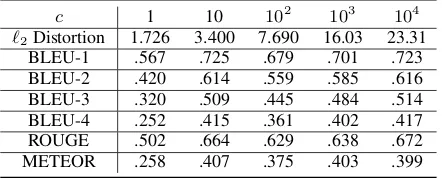
Table 2: Statistics of the 4.2% failed adversarial examples using the targeted caption method and logits loss (7). All correlation scores are computed using the top-5 inferred captions of an adversar-ial image and the targeted caption (higher score means better targeted attack performance).
c 1 10 102 103 104
`2Distortion 1.726 3.400 7.690 16.03 23.31
BLEU-1 .567 .725 .679 .701 .723
BLEU-2 .420 .614 .559 .585 .616
BLEU-3 .320 .509 .445 .484 .514
BLEU-4 .252 .415 .361 .402 .417
ROUGE .502 .664 .629 .638 .672
METEOR .258 .407 .375 .403 .399
output relevant captions learned from the train-ing set. For instance, the captiontrain-ing model can-not generate a passive-voice sentence if the model was never trained on such sentences. Therefore, we need to ensure that the targeted caption lies in the space where the captioning system can pos-sibly generate. To address this issue, we use the generated caption of a randomly selected image (other than the image under investigation) from MSCOCO validation set as the targeted captionS. The use of a generated caption as the targeted cap-tion excludes the effect of out-of-domain capcap-tion- caption-ing, and ensures that the target caption is within the output space of the captioning network.
rate. Moreover, our adversarial examples have small `2 distortions and are visually identical to the original images, as displayed in Figure1. We also examine the failed adversarial examples and summarize their statistics in Table2. We find that their generated captions, albeit not entirely identi-cal to the targeted caption, are in fact highly corre-lated to the desired one. Overall, the high success rate and low`2distortion of adversarial examples clearly show that Show-and-Tell is not robust to targeted adversarial perturbations.
4.3 Targeted Keyword Results
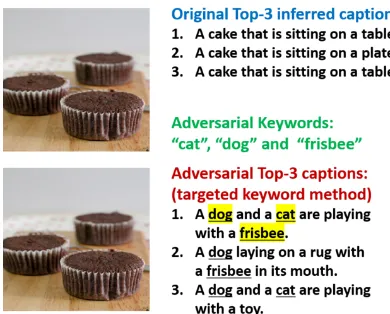
In this task, we use (9) as our loss function, and choose the number of keywords M = {1,2,3}. We run an inference step onI +δ everyT = 5 iterations, and use the top-1 caption as the input of RNN/LSTMs. Similar to Section4.2, for each image the targeted keywords are selected from the caption generated by a randomly selected valida-tion set image. To exclude common words like “a”, “the”, “and”, we look up each word in the targeted sentence and only select nouns, verbs, ad-jectives or adverbs. We say an adversarial image is successful when its caption containsallspecified keywords. The overall success rate and average distortion are shown in Table1. When compared to the targeted caption method, targeted keyword method achieves an even higher success rate (at least 96% for 3-keyword case and at least 97% for 1-keyword and 2-keyword cases). Figure 2 shows an adversarial example crafted from our targeted keyword method with three keywords -“dog”, “cat” and “frisbee”. Using Show-and-Fool, the top-1 caption of a cake image becomes “A dog and a cat are playing with a frisbee” while the ad-versarial image remains visually indistinguishable to the original one. WhenM = 2and3, even if we cannot find an adversarial image yielding all spec-ified keywords, we might end up with a caption that contains some of the keywords (partial suc-cess). For example, whenM = 3, Table3shows the number of keywords appeared in the captions (M0) for thosefailedexamples (not all 3 targeted keywords are found). These results clearly show that the4%failed examples are still partially suc-cessful: the generated captions contain about 1.5 targeted keywords on average.
4.4 Transferability of Adversarial Examples
[image:7.595.311.506.64.221.2]It has been shown that in image classification tasks, adversarial examples found for one machine
Figure 2: An adversarial example (kδk2 = 1.284) of an cake image crafted by the Show-and-Fool targeted keyword method with three keywords -“dog”, “cat” and “frisbee”.
Table 3: Percentage of partial success with differ-entcin the 4.0% failed images that do not contain all the3targeted keywords.
c Avg.kδk2 M0≥1 M0= 2 Avg.M0
1 2.49 72.4% 34.5% 1.07
10 5.40 82.7% 37.9% 1.21
102 12.95 93.1% 58.6% 1.52
103 24.77 96.5% 51.7% 1.48
104 29.37 100.0% 58.6% 1.59
learning model may also be effective against an-other model, even if the two models have dif-ferent architectures (Papernot et al., 2016a; Liu et al., 2017c). However, unlike image classifica-tion where correct labels are made explicit, two different image captioning systems may generate quite different, yet semantically similar, captions for the same benign image. In image caption-ing, we say an adversarial example is transfer-ablewhen the adversarial image found on model
Awith a target sentenceSAcan generate a similar (rather than exact) sentenceSBon modelB.
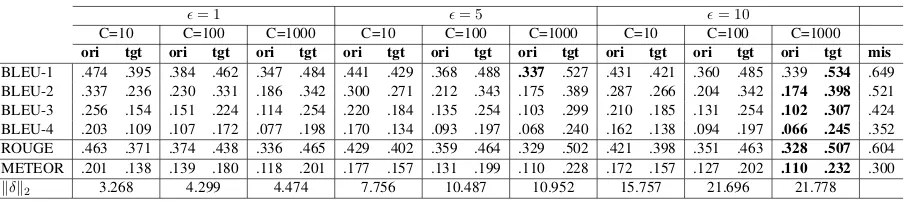
[image:7.595.317.515.347.418.2]Table 4: Transferability of adversarial examples from Show-and-Tell to Show-Attend-and-Tell, using differentandc. oriindicates the scores between the generated captions of theoriginalimages and the transferred adversarial images on Show-Attend-and-Tell. tgtindicates the scores between thetargeted captions on Show-and-Tell and the generated captions of transferred adversarial images on Show-Attend-and-Tell. A smallerorior a largertgtvalue indicates better transferability.mismeasures the differences between captions generated by the two models given the same benign image (model mismatch). When
C= 1000, = 10,tgtis close tomis, indicating the discrepancy between adversarial captions on the two models is mostly bounded by model mismatch, and the adversarial perturbation is highly transferable.
= 1 = 5 = 10
C=10 C=100 C=1000 C=10 C=100 C=1000 C=10 C=100 C=1000 ori tgt ori tgt ori tgt ori tgt ori tgt ori tgt ori tgt ori tgt ori tgt mis BLEU-1 .474 .395 .384 .462 .347 .484 .441 .429 .368 .488 .337 .527 .431 .421 .360 .485 .339 .534 .649 BLEU-2 .337 .236 .230 .331 .186 .342 .300 .271 .212 .343 .175 .389 .287 .266 .204 .342 .174 .398 .521 BLEU-3 .256 .154 .151 .224 .114 .254 .220 .184 .135 .254 .103 .299 .210 .185 .131 .254 .102 .307 .424 BLEU-4 .203 .109 .107 .172 .077 .198 .170 .134 .093 .197 .068 .240 .162 .138 .094 .197 .066 .245 .352 ROUGE .463 .371 .374 .438 .336 .465 .429 .402 .359 .464 .329 .502 .421 .398 .351 .463 .328 .507 .604 METEOR .201 .138 .139 .180 .118 .201 .177 .157 .131 .199 .110 .228 .172 .157 .127 .202 .110 .232 .300
[image:8.595.75.284.252.452.2]kδk2 3.268 4.299 4.474 7.756 10.487 10.952 15.757 21.696 21.778
Figure 3: A highly transferable adversarial exam-ple (kδk2 = 15.226) crafted by Show-and-Tell tar-geted caption method, transfers to Show-Attend-and-Tell, yielding similar adversarial captions.
To investigate the transferability of adversarial examples in image captioning, we first use the tar-geted caption method to find adversarial examples for 1,000 images in modelAwith differentcand, and then transfer successful adversarial examples (which generate the exact target captions on model
A) to modelB. The generated captions by model
B are recorded for transferability analysis. The transferability of adversarial examples depends on two factors: the intrinsic difference between two models even when the same benign image is used as the input, i.e., model mismatch, and the trans-ferability of adversarial perturbations.
To measure the mismatch between Show-and-Tell and Show-Attend-and-Show-and-Tell, we generate cap-tions of the same set of 1,000 original images from both models, and report their mutual BLEU,
ROUGE and METEOR scores in Table 4 under themiscolumn. To evaluate the effectiveness of transferred adversarial examples, we measure the scores for two set of captions: (i) the captions of original images and the captions of transferred ad-versarial images, both generated by Show-Attend-and-Tell (shown under columnoriin Table4); and (ii) the targeted captions for generating adversarial examples on Show-and-Tell, and the captions of the transferred adversarial image on Show-Attend-and-Tell (shown under column tgt in Table 4). Small values of ori suggest that the adversarial images on Show-Attend-and-Tell generate signif-icantly different captions from original images’ captions. Large values oftgtsuggest that the ad-versarial images on Show-Attend-and-Tell gener-ate similar adversarial captions as on the Show-and-Tell model. We find that increasing c or
helps to enhance transferability at the cost of larger (but still acceptable) distortion. WhenC= 1,000
and = 10, Show-and-Fool achieves the best
transferability results: tgtis close tomis, indicat-ing that the discrepancy between adversarial cap-tions on the two models is mostly bounded by the intrinsic model mismatch rather than the transfer-ability of adversarial perturbations, and implying that the adversarial perturbations are easily trans-ferable. In addition, the adversarial examples gen-erated by our method can also fool NeuralTalk2. Whenc = 104, = 10, the average`
Show-and-Fool also indicates the problem of common robustness leakage between different neural image captioning models.
4.5 Attacking Image Captioning v.s. Attacking Image Classification
In this section we show that attacking image cap-tioning models is inherently more challenging than attacking image classification models. In the classification task, a targeted attack usually be-comes harder when the number of labels increases, since an attack method needs to change the classi-fication prediction to a specific label over all the possible labels. In the targeted attack on image captioning, if we treat each caption as a label, we need to change the original label to a specific one over an almost infinite number of possible la-bels, corresponding to a nearly zero volume in the search space. This constraint forces us to develop non-trivial methods that are significantly different from the ones designed for attacking image classi-fication models.
To verify that the two tasks are inherently dif-ferent, we conducted additional experiments on attacking only the CNN module using two state-of-the-art image classification attacks on Ima-geNet dataset. Our experiment setup is as fol-lows. Each selected ImageNet image has a la-bel corresponding to a WordNet synset ID. We randomly selected 800 images from ImageNet dataset such that their synsets have at least one word in common with Show-and-Tell’s vocabu-lary, while ensuring the Inception-v3 CNN (Show-and-Tell’s CNN) classify them correctly. Then, we perform Iterative Fast Gradient Sign Method (I-FGSM) (Kurakin et al., 2017) and Carlini and Wagner’s (C&W) attack (Carlini and Wagner, 2017) on these images. The attack target la-bels are randomly chosen and their synsets also have at least one word in common with Show-and-Tell’s vocabulary. Both I-FGSM and C&W achieve 100% targeted attack success rate on the Inception-v3 CNN. These adversarial examples were further employed to attack Show-and-Tell model. An attack is considered successful if any word in the targeted label’s synset or its hyper-nyms up to 5 levels is presented in the resulting caption. For example, for the chain of hypernyms ‘broccoli’⇒‘cruciferous vegetable’⇒‘vegetable, veggie, veg’⇒‘produce, green goods, green gro-ceries, garden truck’⇒‘food, solid food’, we
in-clude ‘broccoli’,‘cruciferous’,‘vegetable’,‘veggie’ and all other following words. Note that this cri-terion of success is much weaker than the crite-rion we use in the targeted caption method, since a caption with the targeted image’s hypernyms does not necessarily leads to similar meaning of the tar-geted image’s captions. To achieve higher attack success rates, we allow relatively larger distortions and set∞ = 0.3(maximum`∞distortion) in I-FGSM and κ = 10, C = 100 in C&W. How-ever, as shown in Table1, the attack success rates are only 34.5% for I-FGSM and 22.4% for C&W, respectively, which are much lower than the suc-cess rates of our methods despite larger distor-tions. This result further confirms that perform-ing targeted attacks on neural image captionperform-ing re-quires a careful design (as proposed in this paper), and attacking image captioning systems is not a trivial extension to attacking image classifiers.
5 Conclusion
In this paper, we proposed a novel algorithm,
Show-and-Fool, for crafting adversarial examples and providing robustness evaluation of neural im-age captioning. Our extensive experiments show that the proposed targeted caption and keyword methods yield high attack success rates while the adversarial perturbations are still imperceptible to human eyes. We further demonstrate that Show-and-Fool can generate highly transferable adver-sarial examples. The high-quality and transferable adversarial examples in neural image captioning crafted by Show-and-Fool highlight the inconsis-tency in visual language grounding between hu-mans and machines, suggesting a possible weak-ness of current machine vision and perception ma-chinery. We also show that attacking neural image captioning systems are inherently different from attacking CNN-based image classifiers.
References
Stanislaw Antol, Aishwarya Agrawal, Jiasen Lu, Mar-garet Mitchell, Dhruv Batra, C Lawrence Zitnick, and Devi Parikh. 2015. VQA: Visual question
an-swering. InProceedings of the IEEE International
Conference on Computer Vision, pages 2425–2433.
Nicholas Carlini and David Wagner. 2017. Towards
evaluating the robustness of neural networks. In
IEEE Symposium on Security and Privacy, pages 39–57.
Pin-Yu Chen, Yash Sharma, Huan Zhang, Jinfeng Yi, and Cho-Jui Hsieh. 2018. EAD: elastic-net attacks to deep neural networks via adversarial examples.
AAAI.
Pin-Yu Chen, Huan Zhang, Yash Sharma, Jinfeng Yi, and Cho-Jui Hsieh. 2017. ZOO: zeroth order opti-mization based black-box attacks to deep neural
net-works without training substitute models. In
Pro-ceedings of the 10th ACM Workshop on Artificial In-telligence and Security, AISec@CCS, pages 15–26.
Xinlei Chen and C. Lawrence Zitnick. 2015. Mind’s eye: A recurrent visual representation for image
cap-tion generacap-tion. InCVPR, pages 2422–2431.
Abhishek Das, Satwik Kottur, Khushi Gupta, Avi Singh, Deshraj Yadav, José MF Moura, Devi Parikh,
and Dhruv Batra. 2017. Visual dialog. In
Proceed-ings of the IEEE Conference on Computer Vision and Pattern Recognition (CVPR), volume 2.
Harm De Vries, Florian Strub, Sarath Chandar, Olivier Pietquin, Hugo Larochelle, and Aaron Courville. 2017. Guesswhat?! visual object discovery through
multi-modal dialogue. InCVPR.
Jacob Devlin, Hao Cheng, Hao Fang, Saurabh Gupta, Li Deng, Xiaodong He, Geoffrey Zweig, and Mar-garet Mitchell. 2015. Language models for image
captioning: The quirks and what works. In
Proceed-ings of the 53rd Annual Meeting of the Association for Computational Linguistics and the 7th Interna-tional Joint Conference on Natural Language Pro-cessing (Volume 2: Short Papers), volume 2, pages 100–105.
Jeff Donahue, Lisa Anne Hendricks, Sergio Guadar-rama, Marcus Rohrbach, Subhashini Venugopalan, Trevor Darrell, and Kate Saenko. 2015a. Long-term recurrent convolutional networks for visual
recogni-tion and descriprecogni-tion. InCVPR, pages 2625–2634.
Jeffrey Donahue, Lisa Anne Hendricks, Sergio Guadar-rama, Marcus Rohrbach, Subhashini Venugopalan, Kate Saenko, and Trevor Darrell. 2015b. Long-term recurrent convolutional networks for visual
recogni-tion and descriprecogni-tion. InCVPR, pages 2625–2634.
Hao Fang, Saurabh Gupta, Forrest Iandola, Rupesh K Srivastava, Li Deng, Piotr Dollár, Jianfeng Gao, Xi-aodong He, Margaret Mitchell, John C Platt, et al. 2015. From captions to visual concepts and back.
InCVPR, pages 1473–1482.
Akira Fukui, Dong Huk Park, Daylen Yang, Anna Rohrbach, Trevor Darrell, and Marcus Rohrbach.
2016. Multimodal compact bilinear pooling for
visual question answering and visual grounding. In Proceedings of the 2016 Conference on Em-pirical Methods in Natural Language Processing (EMNLP), pages 457–468.
Zhe Gan, Chuang Gan, Xiaodong He, Yunchen Pu, Kenneth Tran, Jianfeng Gao, Lawrence Carin, and Li Deng. 2017. Semantic compositional networks
for visual captioning. InProceedings of the IEEE
Conference on Computer Vision and Pattern Recog-nition, pages 5630–5639.
Ian J Goodfellow, Jonathon Shlens, and
Chris-tian Szegedy. 2015. Explaining and
harness-ing adversarial examples. ICLR; arXiv preprint
arXiv:1412.6572.
Ting-Hao Kenneth Huang, Francis Ferraro, Nasrin Mostafazadeh, Ishan Misra, Aishwarya Agrawal, Ja-cob Devlin, Ross Girshick, Xiaodong He, Pushmeet Kohli, Dhruv Batra, et al. 2016. Visual storytelling. InProceedings of the 2016 Conference of the North American Chapter of the Association for Computa-tional Linguistics: Human Language Technologies (NAACL-HLT), pages 1233–1239.
Xu Jia, Efstratios Gavves, Basura Fernando, and Tinne Tuytelaars. 2015. Guiding the long-short term
mem-ory model for image caption generation. In
Com-puter Vision (ICCV), 2015 IEEE International Con-ference on, pages 2407–2415. IEEE.
Andrej Karpathy and Fei-Fei Li. 2015. Deep visual-semantic alignments for generating image
descrip-tions. InCVPR, pages 3128–3137.
Alexey Kurakin, Ian Goodfellow, and Samy Bengio.
2017. Adversarial machine learning at scale. ICLR;
arXiv preprint arXiv:1611.01236.
Alon Lavie and Abhaya Agarwal. 2005. Meteor: An automatic metric for mt evaluation with improved
correlation with human judgments. InProceedings
of the EMNLP 2011 Workshop on Statistical Ma-chine Translation, pages 65–72.
Chin-Yew Lin. 2004. Rouge: A package for
auto-matic evaluation of summaries. InText
summariza-tion branches out: Proceedings of the ACL-04 work-shop, volume 8. Barcelona, Spain.
Tsung-Yi Lin, Michael Maire, Serge Belongie, James Hays, Pietro Perona, Deva Ramanan, Piotr Dollár,
and C Lawrence Zitnick. 2014. Microsoft coco:
Common objects in context. InEuropean
confer-ence on computer vision, pages 740–755. Springer.
Chenxi Liu, Junhua Mao, Fei Sha, and Alan L Yuille. 2017a. Attention correctness in neural image
cap-tioning. InAAAI, pages 4176–4182.
Yanpei Liu, Xinyun Chen, Chang Liu, and Dawn Song. 2017c. Delving into transferable adversarial
exam-ples and black-box attacks. ICLR; arXiv preprint
arXiv:1611.02770.
Jiasen Lu, Jianwei Yang, Dhruv Batra, and Devi
Parikh. 2016. Hierarchical question-image
co-attention for visual question answering. InAdvances In Neural Information Processing Systems (NIPS), pages 289–297.
Elman Mansimov, Emilio Parisotto, Jimmy Lei Ba, and
Ruslan Salakhutdinov. 2016. Generating images
from captions with attention. ICLR; arXiv preprint
arXiv:1511.02793.
Junhua Mao, Wei Xu, Yi Yang, Jiang Wang, and Alan L. Yuille. 2015. Deep captioning with
mul-timodal recurrent neural networks (m-rnn). ICLR;
arXiv preprint arXiv:1412.6632.
Seyed-Mohsen Moosavi-Dezfooli, Alhussein Fawzi, Omar Fawzi, and Pascal Frossard. 2017. Universal adversarial perturbations. InCVPR.
Nasrin Mostafazadeh, Chris Brockett, Bill Dolan,
Michel Galley, Jianfeng Gao, Georgios
Sp-ithourakis, and Lucy Vanderwende. 2017. Image-grounded conversations: Multimodal context for
natural question and response generation. In
Pro-ceedings of the Eighth International Joint Confer-ence on Natural Language Processing (Volume 1: Long Papers), volume 1, pages 462–472.
Nasrin Mostafazadeh, Ishan Misra, Jacob Devlin, Mar-garet Mitchell, Xiaodong He, and Lucy Vander-wende. 2016. Generating natural questions about
an image. InProceedings of the 54th Annual
Meet-ing of the Association for Computational LMeet-inguistics (Volume 1: Long Papers), volume 1, pages 1802– 1813.
Nicolas Papernot, Patrick McDaniel, and Ian Good-fellow. 2016a. Transferability in machine learning: from phenomena to black-box attacks using adver-sarial samples. arXiv preprint arXiv:1605.07277.
Nicolas Papernot, Patrick McDaniel, Xi Wu, Somesh Jha, and Ananthram Swami. 2016b. Distillation as a defense to adversarial perturbations against deep neural networks. InSecurity and Privacy (SP), 2016 IEEE Symposium on, pages 582–597. IEEE.
Kishore Papineni, Salim Roukos, Todd Ward, and Wei-Jing Zhu. 2002. Bleu: a method for automatic
eval-uation of machine translation. In annual meeting
on association for computational linguistics (ACL), pages 311–318.
Ramakanth Pasunuru and Mohit Bansal. 2017. Multi-task video captioning with video and entailment
generation. In Annual Meeting of the Association
for Computational Linguistics (ACL), pages 1273– 1283.
Scott Reed, Zeynep Akata, Xinchen Yan, Lajanu-gen Logeswaran, Bernt Schiele, and Honglak Lee. 2016. Generative adversarial text to image
synthe-sis. InInternational Conference on Machine
Learn-ing, pages 1060–1069.
Ravi Shekhar, Sandro Pezzelle, Yauhen Klimovich, Aurelie Herbelot, Moin Nabi, Enver Sangineto, Raf-faella Bernardi, et al. 2017. Foil it! Find one
mis-match between image and language caption. In
An-nual Meeting of the Association for Computational Linguistics (ACL).
Christian Szegedy, Wojciech Zaremba, Ilya Sutskever, Joan Bruna, Dumitru Erhan, Ian Goodfellow, and Rob Fergus. 2014. Intriguing properties of neural
networks. ICLR;arXiv preprint arXiv:1312.6199.
Kenneth Tran, Xiaodong He, Lei Zhang, and Jian Sun.
2016. Rich image captioning in the wild. In
Com-puter Vision and Pattern Recognition Workshops (CVPRW), 2016 IEEE Conference on, pages 434– 441. IEEE.
Subhashini Venugopalan, Huijuan Xu, Jeff Donahue, Marcus Rohrbach, Raymond J. Mooney, and Kate
Saenko. 2015. Translating videos to natural
lan-guage using deep recurrent neural networks. In
NAACL-HLT, pages 1494–1504.
Oriol Vinyals, Alexander Toshev, Samy Bengio, and Dumitru Erhan. 2015. Show and tell: A neural
im-age caption generator. InCVPR, pages 3156–3164.
Qi Wu, Chunhua Shen, Lingqiao Liu, Anthony Dick, and Anton van den Hengel. 2016. What value do ex-plicit high level concepts have in vision to language
problems? InCVPR, pages 203–212.
Kelvin Xu, Jimmy Ba, Ryan Kiros, Kyunghyun Cho, Aaron C. Courville, Ruslan Salakhutdinov, Richard S. Zemel, and Yoshua Bengio. 2015. Show, attend and tell: Neural image caption generation with visual attention. InICML, pages 2048–2057.
Zhilin Yang, Ye Yuan, Yuexin Wu, William W. Cohen, and Ruslan Salakhutdinov. 2016. Review networks for caption generation. InNIPS, pages 2361–2369.
Quanzeng You, Hailin Jin, Zhaowen Wang, Chen Fang, and Jiebo Luo. 2016. Image captioning with seman-tic attention. InCVPR, pages 4651–4659.