LEARNING THE SEMANTICS OF MULTIMEDIA CONTENT WITH APPLICATION TO
WEB IMAGE RETRIEVAL AND CLASSIFICATION
Alexei Vinokourov, David R. Hardoon and John Shawe-Taylor
Dept. Computer Science, Royal Holloway, University of London, Egham, TW20 0EX, UK
{alexei, davidh, john}@cs.rhul.ac.uk
ABSTRACT
We use kernel Canonical Correlation Analysis to learn a se-mantic representation of Web images and their associated text. This representation is used in two applications. In first application we consider classification of images into one of three categories. We use SVM in the semantic space and compare against the SVM on raw data and against previ-ously published results using ICA. In the second applica-tion we retrieve images based only on their content from a text query. The semantic space provides a common rep-resentation and enables a comparison between the text and image. We compare against a standard cross-representation retrieval technique known as the Generalised Vector Space Model.
1. INTRODUCTION AND PREVIOUS WORK
With increasingly vast amount of multimedia content avail-able in digital form on- and offline, it has become crucially important to be able to process large amounts of mixed text / image / video information. A separate image / text data pro-cessing has been extensively explored in literature though only few works appear to have taken an advantage of com-bined data analysis. In this work we suggest a novel ap-proach in this area.
The best way to present the method being suggested in this study is, probably, to start from the bunch of approaches to semantically analyse text and/or image data. An opening accord in semantic text processing has been played by la-tent semantic indexing work [3] closely related to Principal Component Analysis (PCA). A number of follow-up meth-ods also have emerged, for example, Latent Semantic Ker-nel (LSK) [2]. The sparsity of text data, however, turned out to be an obstacle to further development of the approach. It has been realised that text documents in a collection can be considered to be generated by a mixture of a few indepen-dent sources, similarly in a way to newswire articles that come to a news agency from diverse sources. A pioneering work on analysis of text from this prospective has demon-strated the success of the approach [4]. Another landmark work in this area exploits Nonnegative Matrix Factorisation
(NMF), closely related to ICA, to analyse text and images content separately [6]. Naive Bayes and extending it Multi-nomial Hierarchical ASymmetric Analysis (MASHA) also have proved to be quite successful approaches in text as an ICA-related alternative to LSI/PCA [7].
However, in [5] it is shown that in combination the se-mantic multimedia content analysis of different types of data (text and images) can bring more advantage than the analy-sis of each type of the data separately for, particularly, data categorisation problem.
We have analysed previously the semantics of text using different sources of semantically the same content - original text in English and its translation in French and we have shown that by finding canonical correlations between orig-inals and their translations one can extract the translation-invariant semantics of the text [9]. It is therefore natural to apply the same method, named kernel Canonical Corre-lation Analysis (KCCA) to find correCorre-lations between web images and attached text. In this work the set of canoni-cal correlation directions, comprising the information about semantics of the text, is used not only to improve categori-sation of the images but also to retrieve them according to text queries.
In Section 2 we give the description of the algorithm, which, in contrast to previously published work [9], is ex-tended to show connection between KCCA via incomplete Cholesky decomposition and Gram-Schmidt procedure used in Latent Semantic Kernel [2]. In Section 3.1 we apply KCCA to classify images and attached text and compare it with plain Support Vector Machine (SVM) classification, and in Section 3.2 we explore image retrieval using projec-tion of text queries and images from a test collecprojec-tion onto KCCA components.
2. ALGORITHM DESCRIPTION
combin-ing two utmost cases in the denominator:
ρ = maxα,β
α0KxKyβ
q
α0K2
xα·β0Ky2β
ρ = maxα,β
α0KxKyβ
q
(α0K2
xα+κkαk2)·(β0Ky2β+κkβk2)
= maxα,β
α0KxKyβ
q
(α0K2
xα+κα0Kxα)·(β0Ky2β+κβ0Kyβ)
constricting(α0K2
xα+κα0Kxα) = 1and(β0Ky2β+κβ0Kyβ) =
1. The corresponding Lagrangain is
L(λα, λβ, α, β) = α0KxKyβ
−λα
2 (α 0K2
xα+κα0Kxα−1)
−λβ
2 (β 0K2
yβ+κβ
0K
yβ−1)
the derivatives are
∂f
∂α = KxKyβ−λα(K
2
xα+κKxα) (1)
∂f
∂β = KyKxα−λβ(K
2
yβ+κKyβ) (2)
we can show that
α0KxKyβ−λαα0(Kx2α+κKxα) = 0
β0KyKxα−λββ0(Ky2β+κKyβ) = 0
λα(α0Kx2α+κα
0K
xα)−λβ(β0Ky2β+κβ
0K
yβ) = 0
λα=λβ
Where the case is thatKxandKyare not full rank ma-trices, we explore the Gram-Schmidt decomposition algo-rithm, which is described in [2], as it is also known as the incomplete Cholesky decomposition. Complete decompo-sition of a kernel matrix is an expensive step and should be avoided with real world data. We slightly modify the Gram-Schmidt algorithm so it will use a precision parameter as a stopping criterion as shown in [1].
The projection is built up as the span of a subset of the projections of a set ofmtraining examples. These are se-lected by performing a Gram-Schmidt orthogonalisation of the training vectors in the feature space.
Given a kernelKand precision parameterη:
Initializations:
m=size ofK
sizeandindexare a vector with the same length ask f eata zeros matrix equal to the size ofk
fori= 1tomdo
norm2[i] =Kii;
Algorithm:
j= 1; whilePm
i=jnorm2[i]> ηdo
ij=argmaxi(norm2[i]); index[j] =ij;
size[j] =pnorm2[ij]; fori= 1tomdo
feat[i, j] = Ki,ij−
Pj−1
t=1f eat[i,t]·f eat[ij,t]
size[j] ;
norm2[i] =norm2[i]−feat(i, j)· feat(i, j); end;
j =j+ 1; end;
return feat[i, j]as thej−th feature of inputi;
Output:
Features satisfyingkK−f eat·f eat0k ≤η
To classify a new example:
forj= 1toT
newfeat[j] =(Ki,ij−
Pj−1
t=1newfeat[j, t]·feat[ij, t])/
/size[j]; end;
Setting via Gram-Schmidt decomposition
Kx =˜ RxR0x
Ky =˜ RxR0x
we can rewrite equation 1 and 2 as
RxR0xRyR0yβ−λ(RxR0xRxR0x+κRxR0x)α = 0
RyR0yRxR0xα−λ(RyRy0RyR0y+κRyRy0)β = 0
R0xRxR0xRyR0yβ−λR
0
x(RxR0xRxRx0 +κRxR0x)α = 0
R0yRyR0yRxR0xα−λR0y(RyRy0RyR0y+κRyRy0)β = 0
setting
Zxx = R0xRx
Zyy = R0yRy
Zxy = R0xRy
Zyx = R0yRx
˜
α = R0xα ˜
β = R0yβ
we rewrite the equation in the following manner where the
Zmatrices are invertable
ZxxZxyβ˜−λZxx(Zxx+κI) ˜α = 0
˜
β = (Zyy+κI) −1Z−1
yyZyyZyxα˜
λ
˜
β = (Zyy+κI) −1Z
yxα˜
λ
ZxxZxy(Zyy+κI)−1Zyxα˜ = λ2Zxx(Zxx+κI) ˜α
Zxy(Zyy+κI)−1Zyxα˜ = λ2(Zxx+κI) ˜α
Performing a complete Cholesky decomposition on(Zxx+
κI) =SS0and settingαˆ=S0·α˜
S−1Zxy(Zyy+κI)−1ZyxS−1
0
ˆ α=λ2αˆ
which is theAx=λxeigenproblem.
3. EXPERIMENTS 3.1. Learning multimedia content semantics
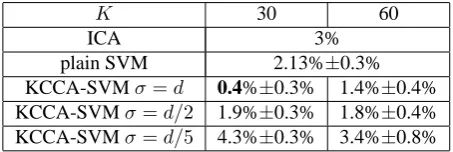
In the following application the problem of learning seman-tics of multimedia content by combining image and text data is addressed. The synthesis is addressed by the ker-nel Canonical Correlation Analysis described in Section 2. The learnt semantics is used for classification of images and their assigned text labels. The reported results show sub-stancially better classification than for text or image taken alone that clearly demonstrates the ability of the method to learn the connection between the two different representa-tions of multimedia Web content. The results also demon-strate an improvement over plain SVM classification in the combined Vector Space Model.
The semantic representation is obtained by projecting data onto the semantic space spanned by vector solutions of the KCCA problem. For example, to process an un-seen data pointxwe expand xinto the vector representa-tion for medium (image or text) space to get exand then project it onto thedcanonical F-correlation components:
[x] =αTZTexusing the appropriate vector of the appropri-ate medium, whereαisN×dmatrix whose columns are the first solutions of the KCCA problem for the given medium space sorted by eigenvalue in descending order. Here we assumed that(Φ(z),Φ(q))e is simply zT
e
x whereZ is the training corpus in the given space. The so-called semantics
W =Zαcan be exported and used in, for example, Support Vector Machine classification. We compute the new kernel which is the inner product of the projected data:
K0(xi, xj) =xTiW W Tx
j (3)
The multimedia image-text Web database was kindly provided by the authors of [5]. The data was divided into three classes (yahoo categories) - Sport, Aviation and Paint-ball - 400 records each and consisted of jpeg images re-trieved from the Internet with attached text. We randomly
[image:3.595.57.283.72.174.2]split each class into two halves which were used as training and test data accordingly. The extracted features of the data were used the same as in [5]: image HSV colour, image Ga-bor texture and term frequencies in text. The results of SVM classification without semantic projection are presented in Table 1 when classification error for the SVM with semantic kernel is given in Table 1. Using cross validation with small random subsamples of 50 points per each class the optimal set of parameters was found to be as the following: KCCA regularization parameterκ = 1.5and SVM generalization trade-off parameterC= 1(the input data was normalised). The best results were found with Gaussian kernel, parame-terσequal average distance between data points in the train corpusd, and 30 semantic vectors.
K 30 60
ICA 3%
plain SVM 2.13%±0.3%
KCCA-SVMσ=d 0.4%±0.3% 1.4%±0.4% KCCA-SVMσ=d/2 1.9%±0.3% 1.8%±0.4% KCCA-SVMσ=d/5 4.3%±0.3% 3.4%±0.8%
Table 1. SVM classification error with and without
seman-tic projection averaged over all three classes - Sport, Avia-tion and Paintball - and 10 runs.
3.2. Image retrieval using text queries
We next tested the use of the derived semantic space in an image retrieval task that uses only image content the aim is to allow retrieval of images from a text query but without reference to any labelling associated with the image. This can be viewed as a cross-modal retrieval task. We used the combined image and text database, described above, where we are trying to facilitate mate retrieval on a test set.
We set the value ofκfor the regularization by running the kernel-cca with the association between image and text randomized. Let λ(κ) be the spectrum without random-ization andλR(κ)be the spectrum with randomization (by spectrum it is meant that the vector whose entries are the eigenvalues). We expect forκ= 0that we may haveλ(κ) = λR(κ) =jthe all ones vector, since it is very possible that the examples are linearly independent. Though in practice only50%of the examples are linearly independent but this does not effect the method of selection ofκ. We choose
κso that theκfor which the difference between the spec-trum of the randomized set is maximally different (in the two norm) from the true spectrum.
[image:3.595.314.541.253.329.2]We find thatκ= 7and set the Gram-Schmidt precision pa-rameterη= 0.5.
Dividing the overall examples into 50:50, in a random manner, we obtain 600 training examples and 600 testing examples. Training on the training examples to obtainα˜for the image kernel andβ˜for the text kernel.
To perform the test image retrieval we compute the fea-tures of the images and text query using the Gram-Schmidt algorithm. Once we have obtained the features for the test query (text) and test images we project them into the se-mantic feature space usingβ˜andα˜ respectively. Now we can compare them using an inner product of the semantic feature vector. The higher the value of the inner product, the more similar the two objects are. Hence, we retrieve the images whoe inner products with the test query are highest. In the experiments we used the first 150α˜eigenvectors andβ˜eigenvectors (corresponding to the largest eigenval-ues). We computed the 10 and 30 images for which their semantic feature vector has the closest inner product with the semantic feature vector of the chosen text. A successful match is considered if the image that actually matched the chosen text is contained in this set.
Image Set GVSM success kernel-cca success
10 9.5% 36.34%
30 22.34% 50.67%
Table 2. Success cross-results between kernel-cca &
gener-alised vector space. (Linear kernel for image colour)
Image Set GVSM success kernel-cca success
10 8% 59.5%
30 19% 69%
Table 3. Success cross-results between kernel-cca &
gener-alised vector space. (Gaussian kernel for image colour )
We compared the performance of our method with a retrieval technique based on the Generalized Vector Space Model. This uses as a semantic feature vector the vector of inner products between either a text query and each training label or test iamge and each training image.
As shown in Tables 2 and 3 we compare the perfor-mance of the kernel-cca algorithm and generalised vector space model, where in Table 2 we use a linear kernel as above for the image colour while in Table 3 we use a Gaus-sian kernel wtihσ =max distance/20 . In both cases the kernel CCA method sharply outperforms GVSM. It is also
clear that the Gaussian kernel gives significally better re-sults for the KCCA though for GVSM it reduces the perfor-mance.
4. CONCLUSIONS AND FUTURE WORK
It has been demonstrated that the image / text classification is best with KCCA representation on combined data com-pared to plain SVM and non-combined data. It has also been shown that using this representation one can retrieve images with a mush better accuracy than with the generalised vec-tor space model. In future we will extend our experiments on other data collections. We will also use KCCA to derive text features from image and vice versa.
5. REFERENCES
[1] F. R. Bach and M. I. Jordan. Kernel indepedendent component analysis. Journal of Machine Learning
Re-search, 3:1–48, 2002.
[2] Nello Cristianini, John Shawe-Taylor, and Huma Lodhi. Latent semantic kernels. Journal of Intelligent
Informa-tion Systems, 18(2/3):127–152, 2002. Special Issue on
Automated Text Categorization.
[3] S. Deerwester, S.T. Dumais, G.W. Furnas, T.K. Lan-dauer, and R. Harshman. Indexing by latent semantic analysis. Journal of the American Society for
Informa-tion Science, 41:391–407, 1990.
[4] T. Kolenda, L. Hansen, and S. Sigurdsson. Advances in
Independent Component Analysis, chapter Independent
Components in Text, pages 229–250. Springer-Verlag, 2000.
[5] T. Kolenda, L. K. Hansen, J. Larsen, and O. Winther. In-dependent component analysis for understanding mul-timedia content. In H. Bourlard, T. Adali, S. Ben-gio, J. Larsen, and S. Douglas, editors, Proceedings of
IEEE Workshop on Neural Networks for Signal Pro-cessing XII, pages 757–766, Piscataway, New Jersey,
2002. IEEE Press. Martigny, Valais, Switzerland, Sept. 4-6, 2002.
[6] D.D. Lee and H.S. Seung. Learning the parts of objects by non-negative matrix factorization. Nature, pages
788–791, 1999.
[7] Alexei Vinokourov and Mark Girolami. A probabilistic framework for the hierarchic organization and classifi-cation of document collections. Journal of Intelligent
Information Systems, 18(2/3):153–172, 2002. Special
[8] Alexei Vinokourov, David R. Hardoon, and John Shawe-Taylor. Learning the semantics of multimedia content with application to web image retrieval and classification. In Submitted to Fourth International
Symposium on Independent Component Analysis and Blind Source Separation, Nara, Japan, 2003.
[9] Alexei Vinokourov, John Shawe-Taylor, and Nello Cris-tianini. Inferring a semantic representation of text via cross-language correlation analysis. In Advances of
Neural Information Processing Systems 15 (to appear),