2321
Joint Embedding of Words and Labels for Text Classification
Guoyin Wang, Chunyuan Li∗, Wenlin Wang, Yizhe Zhang
Dinghan Shen, Xinyuan Zhang, Ricardo Henao, Lawrence Carin Duke University
{gw60,cl319,ww107,yz196,ds337,xz139,r.henao,lcarin}@duke.edu
Abstract
Word embeddings are effective intermedi-ate representations for capturing semantic regularities between words, when learn-ing the representations of text sequences. We propose to view text classification as a label-word joint embedding problem: each label is embedded in the same space
with the word vectors. We introduce
an attention framework that measures the compatibility of embeddings between text
sequences and labels. The attention is
learned on a training set of labeled samples to ensure that, given a text sequence, the relevant words are weighted higher than the irrelevant ones. Our method maintains the interpretability of word embeddings, and enjoys a built-in ability to leverage alternative sources of information, in ad-dition to input text sequences. Extensive results on the several large text datasets show that the proposed framework out-performs the state-of-the-art methods by a large margin, in terms of both accuracy and speed.
1 Introduction
Text classification is a fundamental problem in natural language processing (NLP). The task is to annotate a given text sequence with one (or multiple) class label(s) describing its textual
con-tent. A key intermediate step is the text
rep-resentation. Traditional methods represent text
with hand-crafted features, such as sparse
lexi-cal features (e.g., n-grams) (Wang and Manning,
2012). Recently, neural models have been em-ployed to learn text representations, including con-volutional neural networks (CNNs) (Kalchbrenner
∗
Corresponding author
et al.,2014;Zhang et al.,2017b;Shen et al.,2017)
and recurrent neural networks (RNNs) based on long short-term memory (LSTM) (Hochreiter and
Schmidhuber,1997;Wang et al.,2018).
To further increase the representation flexibil-ity of such models, attention mechanisms
(Bah-danau et al.,2015) have been introduced as an
in-tegral part of models employed for text
classifi-cation (Yang et al., 2016). The attention module
is trained to capture the dependencies that make significant contributions to the task, regardless of the distance between the elements in the sequence. It can thus provide complementary information to the distance-aware dependencies modeled by RNN/CNN. The increasing representation power of the attention mechanism comes with increased model complexity.
Alternatively, several recent studies show that the success of deep learning on text classification largely depends on the effectiveness of the word
embeddings (Joulin et al., 2016; Wieting et al.,
2016;Arora et al.,2017;Shen et al.,2018a).
Par-ticularly, Shen et al.(2018a) quantitatively show
that the word-embeddings-based text classifica-tion tasks can have the similar level of difficulty regardless of the employed models, using the
con-cept of intrinsic dimension (Li et al.,2018). Thus,
simple models are preferred. As the basic build-ing blocks in neural-based NLP, word embed-dings capture the similarities/regularities between
words (Mikolov et al., 2013; Pennington et al.,
2014). This idea has been extended to compute embeddings that capture the semantics of word
se-quences (e.g., phrases, sentences, paragraphs and
documents) (Le and Mikolov, 2014;Kiros et al.,
poten-tial to outperform sophisticated deep neural mod-els.
It is therefore desirable to leverage the best of both lines of works: learning text representations to capture the dependencies that make significant contributions to the task, while maintaining low computational cost. For the task of text classifica-tion, labels play a central role of the final perfor-mance. A natural question to ask is how we can directly use label information in constructing the text-sequence representations.
1.1 Our Contribution
Our primary contribution is therefore to pro-pose such a solution by making use of the
la-bel embedding framework, and propose the
Label-Embedding Attentive Model (LEAM) to improve
text classification. While there is an abundant lit-erature in the NLP community on word embed-dings (how to describe a word) for text representa-tions, much less work has been devoted in compar-ison to label embeddings (how to describe a class). The proposed LEAM is implemented by jointly embedding the word and label in the same latent space, and the text representations are constructed directly using the text-label compatibility.
Our label embedding framework has the
fol-lowing salutary properties:(i)Label-attentive text
representation is informative for the downstream classification task, as it directly learns from a shared joint space, whereas traditional methods proceed in multiple steps by solving intermediate
problems.(ii)The LEAM learning procedure only
involves a series of basic algebraic operations, and hence it retains the interpretability of simple mod-els, especially when the label description is
avail-able. (iii)Our attention mechanism (derived from
the text-label compatibility) has fewer parameters and less computation than related methods, and thus is much cheaper in both training and test-ing, compared with sophisticated deep attention
models. (iv) We perform extensive experiments
on several text-classification tasks, demonstrating the effectiveness of our label-embedding attentive model, providing state-of-the-art results on
bench-mark datasets. (v) We further apply LEAM to
predict the medical codes from clinical text. As an interesting by-product, our attentive model can highlight the informative key words for prediction, which in practice can reduce a doctor’s burden on reading clinical notes.
2 Related Work
Label embedding has been shown to be effective in various domains and tasks. In computer vi-sion, there has been a vast amount of research on leveraging label embeddings for image
clas-sification (Akata et al.,2016), multimodal
learn-ing between images and text (Frome et al.,2013;
Kiros et al., 2014), and text recognition in
im-ages (Rodriguez-Serrano et al., 2013). It is
par-ticularly successful on the task of zero-shot
learn-ing (Palatucci et al.,2009;Yogatama et al.,2015;
Ma et al.,2016), where the label correlation
cap-tured in the embedding space can improve the
prediction when some classes are unseen. In
NLP, labels embedding for text classification has been studied in the context of heterogeneous
net-works in (Tang et al.,2015) and multitask learning
in (Zhang et al.,2017a), respectively. To the
au-thors’ knowledge, there is little research on inves-tigating the effectiveness of label embeddings to design efficient attention models, and how to joint embedding of words and labels to make full use of label information for text classification has not been studied previously, representing a contribu-tion of this paper.
For text representation, the currently best-performing models usually consist of an encoder and a decoder connected through an attention
mechanism (Vaswani et al.,2017;Bahdanau et al.,
2015), with successful applications to sentiment
classification (Zhou et al., 2016), sentence pair
modeling (Yin et al., 2016) and sentence
sum-marization (Rush et al., 2015). Based on this
success, more advanced attention models have been developed, including hierarchical attention
networks (Yang et al., 2016), attention over
at-tention (Cui et al., 2016), and multi-step
atten-tion (Gehring et al.,2017). The idea of attention is
motivated by the observation that different words in the same context are differentially informative, and the same word may be differentially important in a different context. The realization of “context” varies in different applications and model architec-tures. Typically, the context is chosen as the target task, and the attention is computed over the hidden layers of a CNN/RNN. Our attention model is di-rectly built in the joint embedding space of words and labels, and the context is specified by the label embedding.
Several recent works (Vaswani et al., 2017;
sim-ple attention architectures can alone achieve state-of-the-art performance with less computational time, dispensing with recurrence and convolutions entirely. Our work is in the same direction, shar-ing the similar spirit of retainshar-ing model simplicity and interpretability. The major difference is that the aforementioned work focused on self attention, which applies attention to each pair of word tokens from the text sequences. In this paper, we investi-gate the attention between words and labels, which is more directly related to the target task. Further-more, the proposed LEAM has much less model parameters.
3 Preliminaries
Throughout this paper, we denote vectors as bold, lower-case letters, and matrices as bold,
upper-case letters. We usefor element-wise division
when applied to vectors or matrices. We use◦for
function composition, and ∆p for the set of one
hot vectors in dimensionp.
Given a training set S = {(Xn,yn)}Nn=1 of
pair-wise data, whereX∈ X is the text sequence,
andy∈ Y is its corresponding label. Specifically,
yis a one hot vector in single-label problem and
a binary vector in multi-label problem, as defined later in Section 4.1. Our goal for text classification
is to learn a functionf : X 7→ Y by minimizing
an empirical risk of the form:
min
f∈F
1 N
N
X
n=1
δ(yn, f(Xn)) (1)
whereδ :Y × Y 7→Rmeasures the loss incurred
from predicting f(X) when the true label is y,
wheref belongs to the functional spaceF. In the
evaluation stage, we shall use the0/1loss as a
tar-get loss: δ(y,z) = 0ify = z, and1 otherwise.
In the training stage, we consider surrogate losses commonly used for structured prediction in
differ-ent problem setups (see Section4.1for details on
the surrogate losses used in this paper).
More specifically, an input sequence X of
length L is composed of word tokens: X =
{x1,· · · ,xL}. Each tokenxl is a one hot
vec-tor in the space ∆D, where D is the dictionary
size. Performing learning in∆D is
computation-ally expensive and difficult. An elegant frame-work in NLP, initially proposed in (Mikolov et al.,
2013; Le and Mikolov, 2014; Pennington et al.,
2014;Kiros et al.,2015), allows to concisely
per-form learning by mapping the words into an em-bedding space. The framework relies on so called
word embedding: ∆D 7→ RP, where P is the
dimensionality of the embedding space.
There-fore, the text sequence X is represented via the
respective word embedding for each token: V =
{v1,· · ·,vL}, where vl ∈ RP. A typical text
classification method proceeds in three steps, end-to-end, by considering a function decomposition
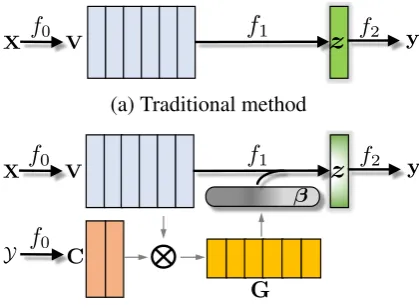
f =f0◦f1◦f2as shown in Figure1(a):
• f0:X7→V, the text sequence is represented
as its word-embedding form V, which is a
matrix ofP ×L.
• f1:V7→z, a compositional functionf1
ag-gregates word embeddings into a fixed-length
vector representationz.
• f2 :z 7→y, a classifierf2annotates the text
representationzwith a label.
A vast amount of work has been devoted to
de-vising the proper functions f0 and f1, i.e., how
to represent a word or a word sequence, respec-tively. The success of NLP largely depends on the
effectiveness of word embeddings in f0 (Bengio
et al.,2003;Collobert and Weston,2008;Mikolov
et al., 2013; Pennington et al., 2014). They are
often ptrained offline on large corpus, then
re-fined jointly via f1 and f2 for task-specific
rep-resentations. Furthermore, the design of f1 can
be broadly cast into two categories. The popu-lar deep learning models consider the mapping as a “black box,” and have employed sophisticated CNN/RNN architectures to achieve
state-of-the-art performance (Zhang et al.,2015;Yang et al.,
2016). On the contrary, recent studies show that
simple manipulation of the word embeddings,e.g.,
mean or max-pooling, can also provide
surpris-ingly excellent performance (Joulin et al., 2016;
Wieting et al.,2016;Arora et al.,2017;Shen et al.,
2018a). Nevertheless, these methods only lever-age the information from the input text sequence.
4 Label-Embedding Attentive Model
4.1 Model
By examining the three steps in the traditional pipeline of text classification, we note that the use of label information only occurs in the last step,
when learningf2, and its impact on learning the
representations of words inf0 or word sequences
inf1 is ignored or indirect. Hence, we propose a
new pipeline by incorporating label information in
V
<latexit sha1_base64="UZh7YjksYlFNc+xwF1GVx2T7SFE=">AAACCXicbVC7TsMwFHXKq5RXgJHFUCExVSlCArYKFsYikbZSE1WO47RWbSeyHVAVZWbhV1gYALHyB2z8DW6aAVqOZOn4nHvte0+QMKq043xblaXlldW16nptY3Nre8fe3euoOJWYuDhmsewFSBFGBXE11Yz0EkkQDxjpBuPrqd+9J1LRWNzpSUJ8joaCRhQjbaSBfegJ8oBjzpEIM6/Dkc6zzAsi2MnzWnEf2HWn4RSAi6RZkjoo0R7YX14Y45QToTFDSvWbTqL9DElNMSPm1VSRBOExGpK+oQJxovysWCWHx0YJYRRLc4SGhfq7I0NcqQkPTKWZbaTmvan4n9dPdXThZ1QkqSYCzz6KUgZ1DKe5wJBKgjWbGIKwpGZWiEdIIqxNejUTQnN+5UXinjYuG87tWb11VaZRBQfgCJyAJjgHLXAD2sAFGDyCZ/AK3qwn68V6tz5mpRWr7NkHf2B9/gAsmprB</latexit>
<latexit sha1_base64="UZh7YjksYlFNc+xwF1GVx2T7SFE=">AAACCXicbVC7TsMwFHXKq5RXgJHFUCExVSlCArYKFsYikbZSE1WO47RWbSeyHVAVZWbhV1gYALHyB2z8DW6aAVqOZOn4nHvte0+QMKq043xblaXlldW16nptY3Nre8fe3euoOJWYuDhmsewFSBFGBXE11Yz0EkkQDxjpBuPrqd+9J1LRWNzpSUJ8joaCRhQjbaSBfegJ8oBjzpEIM6/Dkc6zzAsi2MnzWnEf2HWn4RSAi6RZkjoo0R7YX14Y45QToTFDSvWbTqL9DElNMSPm1VSRBOExGpK+oQJxovysWCWHx0YJYRRLc4SGhfq7I0NcqQkPTKWZbaTmvan4n9dPdXThZ1QkqSYCzz6KUgZ1DKe5wJBKgjWbGIKwpGZWiEdIIqxNejUTQnN+5UXinjYuG87tWb11VaZRBQfgCJyAJjgHLXAD2sAFGDyCZ/AK3qwn68V6tz5mpRWr7NkHf2B9/gAsmprB</latexit>
<latexit sha1_base64="UZh7YjksYlFNc+xwF1GVx2T7SFE=">AAACCXicbVC7TsMwFHXKq5RXgJHFUCExVSlCArYKFsYikbZSE1WO47RWbSeyHVAVZWbhV1gYALHyB2z8DW6aAVqOZOn4nHvte0+QMKq043xblaXlldW16nptY3Nre8fe3euoOJWYuDhmsewFSBFGBXE11Yz0EkkQDxjpBuPrqd+9J1LRWNzpSUJ8joaCRhQjbaSBfegJ8oBjzpEIM6/Dkc6zzAsi2MnzWnEf2HWn4RSAi6RZkjoo0R7YX14Y45QToTFDSvWbTqL9DElNMSPm1VSRBOExGpK+oQJxovysWCWHx0YJYRRLc4SGhfq7I0NcqQkPTKWZbaTmvan4n9dPdXThZ1QkqSYCzz6KUgZ1DKe5wJBKgjWbGIKwpGZWiEdIIqxNejUTQnN+5UXinjYuG87tWb11VaZRBQfgCJyAJjgHLXAD2sAFGDyCZ/AK3qwn68V6tz5mpRWr7NkHf2B9/gAsmprB</latexit>
z
<latexit sha1_base64="5arKufyR9cN9ZiNsznhY2l36QxI=">AAACUnicbVJNTwIxEO3iFyIq6tFLIzHxRBZjot6IXjxiFCUBQrrdWaj2Y9N2MbDhPxoTD/4RLx60u3IQcJKmL++9aWemDWLOjPX9D6+wsrq2vlHcLG2Vt3d2K3v7D0YlmkKLKq50OyAGOJPQssxyaMcaiAg4PAbP15n+OAJtmJL3dhxDT5CBZBGjxDqqX3nqSnihSggiw7R7J4idpmk3iPDddFqa0wKwZJSLiodmLNyGc3LROFl0TTLHZNSvVP2anwdeBvUZqKJZNPuVt26oaCJAWsqJMZ26H9teSrRllIM7MzEQE/pMBtBxUBIBppfmM5niY8eEOFLaLWlxzv7NSIkwWX3O6ZoemkUtI//TOomNLnopk3FiQdLfi6KEY6twNmAcMg3U8rEDhGrmasV0SDSh1j1DyQ2hvtjyMmid1i5r/u1ZtXE1m0YRHaIjdILq6Bw10A1qohai6BV9om8Pee/eV8H9kl9rwZvlHKC5KJR/AHpCt3E=</latexit><latexit sha1_base64="5arKufyR9cN9ZiNsznhY2l36QxI=">AAACUnicbVJNTwIxEO3iFyIq6tFLIzHxRBZjot6IXjxiFCUBQrrdWaj2Y9N2MbDhPxoTD/4RLx60u3IQcJKmL++9aWemDWLOjPX9D6+wsrq2vlHcLG2Vt3d2K3v7D0YlmkKLKq50OyAGOJPQssxyaMcaiAg4PAbP15n+OAJtmJL3dhxDT5CBZBGjxDqqX3nqSnihSggiw7R7J4idpmk3iPDddFqa0wKwZJSLiodmLNyGc3LROFl0TTLHZNSvVP2anwdeBvUZqKJZNPuVt26oaCJAWsqJMZ26H9teSrRllIM7MzEQE/pMBtBxUBIBppfmM5niY8eEOFLaLWlxzv7NSIkwWX3O6ZoemkUtI//TOomNLnopk3FiQdLfi6KEY6twNmAcMg3U8rEDhGrmasV0SDSh1j1DyQ2hvtjyMmid1i5r/u1ZtXE1m0YRHaIjdILq6Bw10A1qohai6BV9om8Pee/eV8H9kl9rwZvlHKC5KJR/AHpCt3E=</latexit><latexit sha1_base64="5arKufyR9cN9ZiNsznhY2l36QxI=">AAACUnicbVJNTwIxEO3iFyIq6tFLIzHxRBZjot6IXjxiFCUBQrrdWaj2Y9N2MbDhPxoTD/4RLx60u3IQcJKmL++9aWemDWLOjPX9D6+wsrq2vlHcLG2Vt3d2K3v7D0YlmkKLKq50OyAGOJPQssxyaMcaiAg4PAbP15n+OAJtmJL3dhxDT5CBZBGjxDqqX3nqSnihSggiw7R7J4idpmk3iPDddFqa0wKwZJSLiodmLNyGc3LROFl0TTLHZNSvVP2anwdeBvUZqKJZNPuVt26oaCJAWsqJMZ26H9teSrRllIM7MzEQE/pMBtBxUBIBppfmM5niY8eEOFLaLWlxzv7NSIkwWX3O6ZoemkUtI//TOomNLnopk3FiQdLfi6KEY6twNmAcMg3U8rEDhGrmasV0SDSh1j1DyQ2hvtjyMmid1i5r/u1ZtXE1m0YRHaIjdILq6Bw10A1qohai6BV9om8Pee/eV8H9kl9rwZvlHKC5KJR/AHpCt3E=</latexit>f
1f0
X f2 y
(a) Traditional method
C
G
<latexit sha1_base64="usNIECuGP8YyDGtyIdesrnE+VfU=">AAACCXicbVC7TsMwFHV4lvIKMLIYKiSmKkVIwFbBUMYiEVqpiSrHcVqrthPZDqiKMrPwKywMgFj5Azb+BjfNAC1HsnR8zr32vSdIGFXacb6thcWl5ZXVylp1fWNza9ve2b1TcSoxcXHMYtkNkCKMCuJqqhnpJpIgHjDSCUZXE79zT6SisbjV44T4HA0EjShG2kh9+8AT5AHHnCMRZl6LI51nmRdEsJXn1eLet2tO3SkA50mjJDVQot23v7wwxiknQmOGlOo1nET7GZKaYkbMq6kiCcIjNCA9QwXiRPlZsUoOj4wSwiiW5ggNC/V3R4a4UmMemEoz21DNehPxP6+X6ujcz6hIUk0Enn4UpQzqGE5ygSGVBGs2NgRhSc2sEA+RRFib9KomhMbsyvPEPalf1J2b01rzskyjAvbBITgGDXAGmuAatIELMHgEz+AVvFlP1ov1bn1MSxessmcP/IH1+QPmwpqU</latexit>
<latexit sha1_base64="usNIECuGP8YyDGtyIdesrnE+VfU=">AAACCXicbVC7TsMwFHV4lvIKMLIYKiSmKkVIwFbBUMYiEVqpiSrHcVqrthPZDqiKMrPwKywMgFj5Azb+BjfNAC1HsnR8zr32vSdIGFXacb6thcWl5ZXVylp1fWNza9ve2b1TcSoxcXHMYtkNkCKMCuJqqhnpJpIgHjDSCUZXE79zT6SisbjV44T4HA0EjShG2kh9+8AT5AHHnCMRZl6LI51nmRdEsJXn1eLet2tO3SkA50mjJDVQot23v7wwxiknQmOGlOo1nET7GZKaYkbMq6kiCcIjNCA9QwXiRPlZsUoOj4wSwiiW5ggNC/V3R4a4UmMemEoz21DNehPxP6+X6ujcz6hIUk0Enn4UpQzqGE5ygSGVBGs2NgRhSc2sEA+RRFib9KomhMbsyvPEPalf1J2b01rzskyjAvbBITgGDXAGmuAatIELMHgEz+AVvFlP1ov1bn1MSxessmcP/IH1+QPmwpqU</latexit><latexit sha1_base64="usNIECuGP8YyDGtyIdesrnE+VfU=">AAACCXicbVC7TsMwFHV4lvIKMLIYKiSmKkVIwFbBUMYiEVqpiSrHcVqrthPZDqiKMrPwKywMgFj5Azb+BjfNAC1HsnR8zr32vSdIGFXacb6thcWl5ZXVylp1fWNza9ve2b1TcSoxcXHMYtkNkCKMCuJqqhnpJpIgHjDSCUZXE79zT6SisbjV44T4HA0EjShG2kh9+8AT5AHHnCMRZl6LI51nmRdEsJXn1eLet2tO3SkA50mjJDVQot23v7wwxiknQmOGlOo1nET7GZKaYkbMq6kiCcIjNCA9QwXiRPlZsUoOj4wSwiiW5ggNC/V3R4a4UmMemEoz21DNehPxP6+X6ujcz6hIUk0Enn4UpQzqGE5ygSGVBGs2NgRhSc2sEA+RRFib9KomhMbsyvPEPalf1J2b01rzskyjAvbBITgGDXAGmuAatIELMHgEz+AVvFlP1ov1bn1MSxessmcP/IH1+QPmwpqU</latexit>
z
<latexit sha1_base64="5arKufyR9cN9ZiNsznhY2l36QxI=">AAACUnicbVJNTwIxEO3iFyIq6tFLIzHxRBZjot6IXjxiFCUBQrrdWaj2Y9N2MbDhPxoTD/4RLx60u3IQcJKmL++9aWemDWLOjPX9D6+wsrq2vlHcLG2Vt3d2K3v7D0YlmkKLKq50OyAGOJPQssxyaMcaiAg4PAbP15n+OAJtmJL3dhxDT5CBZBGjxDqqX3nqSnihSggiw7R7J4idpmk3iPDddFqa0wKwZJSLiodmLNyGc3LROFl0TTLHZNSvVP2anwdeBvUZqKJZNPuVt26oaCJAWsqJMZ26H9teSrRllIM7MzEQE/pMBtBxUBIBppfmM5niY8eEOFLaLWlxzv7NSIkwWX3O6ZoemkUtI//TOomNLnopk3FiQdLfi6KEY6twNmAcMg3U8rEDhGrmasV0SDSh1j1DyQ2hvtjyMmid1i5r/u1ZtXE1m0YRHaIjdILq6Bw10A1qohai6BV9om8Pee/eV8H9kl9rwZvlHKC5KJR/AHpCt3E=</latexit><latexit sha1_base64="5arKufyR9cN9ZiNsznhY2l36QxI=">AAACUnicbVJNTwIxEO3iFyIq6tFLIzHxRBZjot6IXjxiFCUBQrrdWaj2Y9N2MbDhPxoTD/4RLx60u3IQcJKmL++9aWemDWLOjPX9D6+wsrq2vlHcLG2Vt3d2K3v7D0YlmkKLKq50OyAGOJPQssxyaMcaiAg4PAbP15n+OAJtmJL3dhxDT5CBZBGjxDqqX3nqSnihSggiw7R7J4idpmk3iPDddFqa0wKwZJSLiodmLNyGc3LROFl0TTLHZNSvVP2anwdeBvUZqKJZNPuVt26oaCJAWsqJMZ26H9teSrRllIM7MzEQE/pMBtBxUBIBppfmM5niY8eEOFLaLWlxzv7NSIkwWX3O6ZoemkUtI//TOomNLnopk3FiQdLfi6KEY6twNmAcMg3U8rEDhGrmasV0SDSh1j1DyQ2hvtjyMmid1i5r/u1ZtXE1m0YRHaIjdILq6Bw10A1qohai6BV9om8Pee/eV8H9kl9rwZvlHKC5KJR/AHpCt3E=</latexit>
<latexit sha1_base64="5arKufyR9cN9ZiNsznhY2l36QxI=">AAACUnicbVJNTwIxEO3iFyIq6tFLIzHxRBZjot6IXjxiFCUBQrrdWaj2Y9N2MbDhPxoTD/4RLx60u3IQcJKmL++9aWemDWLOjPX9D6+wsrq2vlHcLG2Vt3d2K3v7D0YlmkKLKq50OyAGOJPQssxyaMcaiAg4PAbP15n+OAJtmJL3dhxDT5CBZBGjxDqqX3nqSnihSggiw7R7J4idpmk3iPDddFqa0wKwZJSLiodmLNyGc3LROFl0TTLHZNSvVP2anwdeBvUZqKJZNPuVt26oaCJAWsqJMZ26H9teSrRllIM7MzEQE/pMBtBxUBIBppfmM5niY8eEOFLaLWlxzv7NSIkwWX3O6ZoemkUtI//TOomNLnopk3FiQdLfi6KEY6twNmAcMg3U8rEDhGrmasV0SDSh1j1DyQ2hvtjyMmid1i5r/u1ZtXE1m0YRHaIjdILq6Bw10A1qohai6BV9om8Pee/eV8H9kl9rwZvlHKC5KJR/AHpCt3E=</latexit>
<latexit sha1_base64="YJPS900Rs1XOpYUa1yiuV8LTbiU=">AAACM3icbVDLSgMxFM34rPVVdekmWARXZSqCuhPdCG4qdVRoS8lk7tRgHkOSUcrQj3Ljh7gRwYWKW//BzHQWVr0Qcjjn3uSeEyacGev7L97U9Mzs3Hxlobq4tLyyWltbvzQq1RQCqrjS1yExwJmEwDLL4TrRQETI4Sq8Pcn1qzvQhil5YYcJ9AQZSBYzSqyj+rWzroR7qoQgMsq6bUHsKMu6YYzbo1F1QgvBkrtCVDwyQ+EuXJB5YyH2a3W/4ReF/4JmCeqorFa/9tSNFE0FSEs5MabT9BPby4i2jHJwz6YGEkJvyQA6DkoiwPSywvQIbzsmwrHS7kiLC/bnREaEydd0nc7Vjfmt5eR/Wie18UEvYzJJLUg6/ihOObYK5wniiGmglg8dIFQztyumN0QTal3OVRdC87flvyDYbRw2/PO9+tFxmUYFbaIttIOaaB8doVPUQgGi6AE9ozf07j16r96H9zlunfLKmQ00Ud7XN5I5rWk=</latexit>
<latexit sha1_base64="YJPS900Rs1XOpYUa1yiuV8LTbiU=">AAACM3icbVDLSgMxFM34rPVVdekmWARXZSqCuhPdCG4qdVRoS8lk7tRgHkOSUcrQj3Ljh7gRwYWKW//BzHQWVr0Qcjjn3uSeEyacGev7L97U9Mzs3Hxlobq4tLyyWltbvzQq1RQCqrjS1yExwJmEwDLL4TrRQETI4Sq8Pcn1qzvQhil5YYcJ9AQZSBYzSqyj+rWzroR7qoQgMsq6bUHsKMu6YYzbo1F1QgvBkrtCVDwyQ+EuXJB5YyH2a3W/4ReF/4JmCeqorFa/9tSNFE0FSEs5MabT9BPby4i2jHJwz6YGEkJvyQA6DkoiwPSywvQIbzsmwrHS7kiLC/bnREaEydd0nc7Vjfmt5eR/Wie18UEvYzJJLUg6/ihOObYK5wniiGmglg8dIFQztyumN0QTal3OVRdC87flvyDYbRw2/PO9+tFxmUYFbaIttIOaaB8doVPUQgGi6AE9ozf07j16r96H9zlunfLKmQ00Ud7XN5I5rWk=</latexit>
<latexit sha1_base64="YJPS900Rs1XOpYUa1yiuV8LTbiU=">AAACM3icbVDLSgMxFM34rPVVdekmWARXZSqCuhPdCG4qdVRoS8lk7tRgHkOSUcrQj3Ljh7gRwYWKW//BzHQWVr0Qcjjn3uSeEyacGev7L97U9Mzs3Hxlobq4tLyyWltbvzQq1RQCqrjS1yExwJmEwDLL4TrRQETI4Sq8Pcn1qzvQhil5YYcJ9AQZSBYzSqyj+rWzroR7qoQgMsq6bUHsKMu6YYzbo1F1QgvBkrtCVDwyQ+EuXJB5YyH2a3W/4ReF/4JmCeqorFa/9tSNFE0FSEs5MabT9BPby4i2jHJwz6YGEkJvyQA6DkoiwPSywvQIbzsmwrHS7kiLC/bnREaEydd0nc7Vjfmt5eR/Wie18UEvYzJJLUg6/ihOObYK5wniiGmglg8dIFQztyumN0QTal3OVRdC87flvyDYbRw2/PO9+tFxmUYFbaIttIOaaB8doVPUQgGi6AE9ozf07j16r96H9zlunfLKmQ00Ud7XN5I5rWk=</latexit>
V
<latexit sha1_base64="UZh7YjksYlFNc+xwF1GVx2T7SFE=">AAACCXicbVC7TsMwFHXKq5RXgJHFUCExVSlCArYKFsYikbZSE1WO47RWbSeyHVAVZWbhV1gYALHyB2z8DW6aAVqOZOn4nHvte0+QMKq043xblaXlldW16nptY3Nre8fe3euoOJWYuDhmsewFSBFGBXE11Yz0EkkQDxjpBuPrqd+9J1LRWNzpSUJ8joaCRhQjbaSBfegJ8oBjzpEIM6/Dkc6zzAsi2MnzWnEf2HWn4RSAi6RZkjoo0R7YX14Y45QToTFDSvWbTqL9DElNMSPm1VSRBOExGpK+oQJxovysWCWHx0YJYRRLc4SGhfq7I0NcqQkPTKWZbaTmvan4n9dPdXThZ1QkqSYCzz6KUgZ1DKe5wJBKgjWbGIKwpGZWiEdIIqxNejUTQnN+5UXinjYuG87tWb11VaZRBQfgCJyAJjgHLXAD2sAFGDyCZ/AK3qwn68V6tz5mpRWr7NkHf2B9/gAsmprB</latexit>
<latexit sha1_base64="UZh7YjksYlFNc+xwF1GVx2T7SFE=">AAACCXicbVC7TsMwFHXKq5RXgJHFUCExVSlCArYKFsYikbZSE1WO47RWbSeyHVAVZWbhV1gYALHyB2z8DW6aAVqOZOn4nHvte0+QMKq043xblaXlldW16nptY3Nre8fe3euoOJWYuDhmsewFSBFGBXE11Yz0EkkQDxjpBuPrqd+9J1LRWNzpSUJ8joaCRhQjbaSBfegJ8oBjzpEIM6/Dkc6zzAsi2MnzWnEf2HWn4RSAi6RZkjoo0R7YX14Y45QToTFDSvWbTqL9DElNMSPm1VSRBOExGpK+oQJxovysWCWHx0YJYRRLc4SGhfq7I0NcqQkPTKWZbaTmvan4n9dPdXThZ1QkqSYCzz6KUgZ1DKe5wJBKgjWbGIKwpGZWiEdIIqxNejUTQnN+5UXinjYuG87tWb11VaZRBQfgCJyAJjgHLXAD2sAFGDyCZ/AK3qwn68V6tz5mpRWr7NkHf2B9/gAsmprB</latexit>
<latexit sha1_base64="UZh7YjksYlFNc+xwF1GVx2T7SFE=">AAACCXicbVC7TsMwFHXKq5RXgJHFUCExVSlCArYKFsYikbZSE1WO47RWbSeyHVAVZWbhV1gYALHyB2z8DW6aAVqOZOn4nHvte0+QMKq043xblaXlldW16nptY3Nre8fe3euoOJWYuDhmsewFSBFGBXE11Yz0EkkQDxjpBuPrqd+9J1LRWNzpSUJ8joaCRhQjbaSBfegJ8oBjzpEIM6/Dkc6zzAsi2MnzWnEf2HWn4RSAi6RZkjoo0R7YX14Y45QToTFDSvWbTqL9DElNMSPm1VSRBOExGpK+oQJxovysWCWHx0YJYRRLc4SGhfq7I0NcqQkPTKWZbaTmvan4n9dPdXThZ1QkqSYCzz6KUgZ1DKe5wJBKgjWbGIKwpGZWiEdIIqxNejUTQnN+5UXinjYuG87tWb11VaZRBQfgCJyAJjgHLXAD2sAFGDyCZ/AK3qwn68V6tz5mpRWr7NkHf2B9/gAsmprB</latexit>
f
0 XY
f
0f2 y
f
1 [image:4.595.77.287.62.216.2](b) Proposed joint embedding method
Figure 1: Illustration of different schemes for
doc-ument representationsz. (a) Much work in NLP
has been devoted to directly aggregating word
em-beddingV forz. (b) We focus on learning label
embeddingC(how to embed class labels in a
Eu-clidean space), and leveraging the “compatibility”
Gbetween embedded words and labels to derive
the attention scoreβfor improvedz. Note that⊗
denotes the cosine similarity betweenCandV. In
this figure, there are K=2 classes.
• f0: Besides embedding words, we also
em-bed all the labels in the same space, which act as the “anchor points” of the classes to in-fluence the refinement of word embeddings.
• f1: The compositional function aggregates
word embeddings into z, weighted by the
compatibility between labels and words.
• f2: The learning off2remains the same, as it
directly interacts with labels.
Under the proposed label embedding framework, we specifically describe a label-embedding atten-tive model.
Joint Embeddings of Words and Labels We
propose to embed both the words and the labels
into a joint space i.e.,∆D 7→ RP andY 7→ RP.
The label embeddings are C = [c1,· · · ,cK],
whereKis the number of classes.
A simple way to measure the compatibility of label-word pairs is via the cosine similarity
G= (C>V)G,ˆ (2)
whereGˆ is the normalization matrix of sizeK×L,
with each element obtained as the multiplication
of`2 norms of the c-th label embedding andl-th
word embedding:ˆgkl=kckkkvlk.
To further capture the relative spatial
informa-tion among consecutive words (i.e.,phrases1) and
introduce non-linearity in the compatibility mea-sure, we consider a generalization of (2).
Specif-ically, for a text phase of length 2r + 1
cen-tered at l, the local matrix block Gl−r:l+r in G
measures the label-to-token compatibility for the “label-phrase” pairs. To learn a higher-level
com-patibility stigmatizationulbetween thel-th phrase
and all labels, we have:
ul=ReLU(Gl−r:l+rW1+b1), (3)
whereW1 ∈R2r+1 andb1 ∈RK are parameters
to be learned, and ul ∈ RK. The largest
com-patibility value of thel-th phrasewrtthe labels is
collected:
ml=max-pooling(ul). (4)
Together,mis a vector of lengthL. The
compat-ibility/attention score for the entire text sequence is:
β=SoftMax(m), (5)
where the l-th element of SoftMax is βl =
exp(ml)
PL
l0=1exp(ml0)
.
The text sequence representation can be sim-ply obtained via averaging the word embeddings, weighted by label-based attention score:
z =X
l
βlvl. (6)
Relation to Predictive Text Embeddings
Pre-dictive Text Embeddings (PTE) (Tang et al.,2015)
is the first method to leverage label embeddings
to improve the learned word embeddings. We
discuss three major differences between PTE and
our LEAM:(i)The general settings are different.
PTE casts the text representation through hetero-geneous networks, while we consider text
repre-sentation through an attention model.(ii)In PTE,
the text representationz is the averaging of word
embeddings. In LEAM, z is weighted averaging
of word embeddings through the proposed
label-attentive score in (6).(iii)PTE only considers the
linear interaction between individual words and la-bels. LEAM greatly improves the performance by considering nonlinear interaction between phrase
1We call it “phrase” for convenience; it could be any
longer word sequence such as a sentence and paragraphetc.
and labels. Specifically, we note that the text em-bedding in PTE is similar with a very special case
of LEAM, when our window sizer = 1 and
at-tention scoreβis uniform. As shown later in
Fig-ure2(c) of the experimental results, LEAM can be
significantly better than the PTE variant.
Training Objective The proposed joint
embed-ding framework is applicable to various text clas-sification tasks. We consider two setups in this paper. For a learned text sequence representation
z=f1◦f0(X), we jointly optimizef =f0◦f1◦f2
overF, wheref2 is defined according to the
spe-cific tasks:
• Single-label problem: categorizes each text
instance to precisely one ofK classes,y ∈
∆K
min
f∈F
1 N
N
X
n=1
CE(yn, f2(zn)), (7)
where CE(·,·) is the cross entropy between
two probability vectors, and f2(zn) =
SoftMax(z0n), with z0n = W2zn +b2 and
W2 ∈RK×P,b2 ∈RKare trainable
param-eters.
• Multi-label problem: categorizes each text
instance to a set of K target labels {yk ∈
∆2|k= 1,· · · , K}; there is no constraint on
how many of the classes the instance can be assigned to, and
min
f∈F
1 N K
N
X
n=1
K
X
k=1
CE(ynk, f2(znk), (8)
wheref2(znk) = 1+exp(1z0
nk), andz
0
nk is the
kth column ofz0n.
To summarize, the model parameters θ =
{V,C,W1,b1,W2,b2}. They are trained
end-to-end during learning. {W1,b1} and{W2,b2}
are weights inf1 andf2, respectively, which are
treated as standard neural networks. For the joint
embeddings {V,C} in f0, the pre-trained word
embeddings are used as initialization if available.
4.2 Learning & Testing with LEAM
Learning and Regularization The quality of
the jointly learned embeddings are key to the
model performance and interpretability.
Ide-ally, we hope that each label embedding acts as
the “anchor” points for each classes: closer to the word/sequence representations that are in the same classes, while farther from those in different classes. To best achieve this property, we consider
to regularize the learned label embeddingsckto be
on its corresponding manifold. This is imposed by
the factckshould be easily classified as the correct
labelyk:
min
f∈F
1 K
K
X
n=1
CE(yk, f2(ck)), (9)
where f2 is specficied according to the problem
in either (7) or (8). This regularization is used as a penalty in the main training objective in (7) or (8), and the default weighting hyperparameter is set as 1. It will lead to meaningful interpretabil-ity of learned label embeddings as shown in the experiments.
Interestingly in text classification, the class
itself is often described as a set of E words
{ei, i = 1,· · · , E}. These words are
consid-ered as the most representative description of each class, and highly distinguishing between different
classes. For example, theYahoo!Answers Topic
dataset (Zhang et al., 2015) contains ten classes,
most of which have two words to precisely de-scribe its class-specific features, such as “Comput-ers & Internet”, “Business & Finance” as well as
“Politics & Government”etc. We consider to use
each label’s corresponding pre-trained word em-beddings as the initialization of the label embed-dings. For the datasets without representative class descriptions, one may initialize the label embed-dings as random samples drawn from a standard Gaussian distribution.
Testing Both the learned word and label
embed-dings are available in the testing stage. We
clar-ify that the label embeddingsCof all class
candi-datesY are considered as the input in the testing
stage; one should distinguish this from the use of
groundtruth label y in prediction. For a text
se-quence X, one may feed it through the proposed
pipeline for prediction:(i)f1: harvesting the word
embeddingsV,(ii)f2:Vinteracts withCto
ob-tainG, pooled as β, which further attendsV to
derive z, and (iii) f3: assigning labels based on
the tasks. To speed up testing, one may store G
Model Parameters Complexity Seq. Operation
CNN m·h·P O(m·h·L·P) O(1)
LSTM 4·h·(h+P) O(L·h2
+h·L·P) O(L)
SWEM 0 O(L·P) O(1)
Bi-BloSAN 7·P2+5·P O(P2·L2/R+P2·L+P2·R2) O(1)
[image:6.595.311.523.62.136.2]Our model K·P O(K·L·P) O(1)
Table 1: Comparisons of CNN, LSTM, SWEM and our model architecture. Columns correspond to the number of compositional parameters, com-putational complexity and sequential operations
4.3 Model Complexity
We compare CNN, LSTM, Simple Word
Embeddings-based Models (SWEM) (Shen et al.,
2018a) and our LEAM wrt the parameters and
computational speed. For the CNN, we assume
the same size m for all filters. Specifically, h
represents the dimension of the hidden units in
the LSTM or the number of filters in the CNN;R
denotes the number of blocks in the Bi-BloSAN;
P denotes the final sequence representation
dimension. Similar to (Vaswani et al., 2017;
Shen et al., 2018a), we examine the number of
compositional parameters, computational com-plexity and sequential steps of the four methods.
As shown in Table 1, both the CNN and LSTM
have a large number of compositional parameters.
Since K m, h, the number of parameters in
our models is much smaller than for the CNN and LSTM models. For the computational complexity, our model is almost same order as the most simple SWEM model, and is smaller than the CNN or
LSTM by a factor ofmh/Korh/K.
5 Experimental Results
Setup We use 300-dimensional GloVe word
em-beddings Pennington et al. (2014) as
initializa-tion for word embeddings and label embeddings in our model. Out-Of-Vocabulary (OOV) words are initialized from a uniform distribution with
range[−0.01,0.01]. The final classifier is
imple-mented as an MLP layer followed by a sigmoid or softmax function depending on specific task. We train our model’s parameters with the Adam
Optimizer (Kingma and Ba, 2014), with an
ini-tial learning rate of 0.001, and a minibatch size
of 100. Dropout regularization (Srivastava et al., 2014) is employed on the final MLP layer, with
dropout rate0.5. The model is implemented using
Tensorflow and is trained on GPU Titan X. The code to reproduce the experimental results
is at https://github.com/guoyinwang/LEAM
Dataset # Classes # Training # Testing
AGNews 4 120k 7.6k Yelp Binary 2 560 k 38k Yelp Full 5 650k 38k DBPedia 14 560k 70k Yahoo 10 1400k 60k
Table 2: Summary statistics of five datasets, in-cluding the number of classes, number of training samples and number of testing samples.
5.1 Classification on Benchmark Datasets
We test our model on the same five standard
benchmark datasets as in (Zhang et al.,2015). The
summary statistics of the data are shown in Table 2, with content specified below:
• AGNews: Topic classification over four cat-egories of Internet news articles (Del Corso
et al.,2005) composed of titles plus
descrip-tion classified into: World, Entertainment, Sports and Business.
• Yelp Review Full: The dataset is obtained from the Yelp Dataset Challenge in 2015, the task is sentiment classification of polarity star labels ranging from 1 to 5.
• Yelp Review Polarity: The same set of text reviews from Yelp Dataset Challenge in 2015, except that a coarser sentiment defini-tion is considered: 1 and 2 are negative, and 4 and 5 as positive.
• DBPedia: Ontology classification over four-teen non-overlapping classes picked from DBpedia 2014 (Wikipedia).
• Yahoo! Answers Topic: Topic classifica-tion over ten largest main categories from Ya-hoo! Answers Comprehensive Questions and Answers version 1.0, including question title, question content and best answer.
We compare with a variety of methods,
in-cluding (i) the bag-of-words in (Zhang et al.,
2015);(ii)sophisticated deep CNN/RNN models:
large/small word CNN, LSTM reported in (Zhang
et al.,2015;Dai and Le,2015) and deep CNN (29
layer) (Conneau et al.,2017);(iii)simple
compo-sitional methods: fastText (Joulin et al.,2016) and
simple word embedding models (SWEM) (Shen
et al., 2018a); (iv) deep attention models:
[image:6.595.73.291.62.113.2]Model Yahoo DBPedia AGNews Yelp P. Yelp F.
Bag-of-words (Zhang et al.,2015) 68.90 96.60 88.80 92.20 58.00
Small word CNN (Zhang et al.,2015) 69.98 98.15 89.13 94.46 58.59
Large word CNN (Zhang et al.,2015) 70.94 98.28 91.45 95.11 59.48
LSTM (Zhang et al.,2015) 70.84 98.55 86.06 94.74 58.17
SA-LSTM (word-level) (Dai and Le,2015) - 98.60 - -
-Deep CNN (29 layer) (Conneau et al.,2017) 73.43 98.71 91.27 95.72 64.26
SWEM (Shen et al.,2018a) 73.53 98.42 92.24 93.76 61.11
fastText (Joulin et al.,2016) 72.30 98.60 92.50 95.70 63.90
HAN (Yang et al.,2016) 75.80 - - -
-Bi-BloSAN(Shen et al.,2018c) 76.28 98.77 93.32 94.56 62.13
LEAM 77.42 99.02 92.45 95.31 64.09
[image:7.595.74.522.61.240.2]LEAM (linear) 75.22 98.32 91.75 93.43 61.03
Table 3: Test Accuracy on document classification tasks, in percentage. We ran Bi-BloSAN using the
authors’ implementation; all other results are directly cited from the respective papers.
2016);(v)simple attention models: bi-directional
block self-attention network (Bi-BloSAN) (Shen
et al.,2018c). The results are shown in Table3.
Testing accuracy Simple compositional
meth-ods indeed achieve comparable performance as the
sophisticated deep CNN/RNN models. On the
other hand, deep hierarchical attention model can improve the pure CNN/RNN models. The recently proposed self-attention network generally yield higher accuracy than previous methods. All ap-proaches are better than traditional bag-of-words method. Our proposed LEAM outperforms the state-of-the-art methods on two largest datasets,
i.e., Yahoo and DBPedia. On other datasets,
LEAM ranks the 2nd or 3rd best, which are simi-lar to top 1 method in term of the accuracy. This
is probably due to two reasons: (i) the number
of classes on these datasets is smaller, and (ii)
there is no explicit corresponding word embed-ding available for the label embedembed-ding initializa-tion during learning. The potential of label embed-ding may not be fully exploited. As the ablation study, we replace the nonlinear compatibility (3) to the linear one in (2) . The degraded performance demonstrates the necessity of spatial dependency and nonlinearity in constructing the attentions.
Nevertheless, we argue LEAM is favorable for text classification, by comparing the model size
and time cost Table 4, as well as convergence
speed in Figure 2(a). The time cost is reported
as the wall-clock time for 1000 iterations. LEAM maintains the simplicity and low cost of SWEM, compared with other models. LEAM uses much less model parameters, and converges significantly
Model # Parameters Time cost (s)
CNN 541k 171 LSTM 1.8M 598
SWEM 61K 63
Bi-BloSAN 3.6M 292
LEAM 65K 65
Table 4: Comparison of model size and speed.
faster than Bi-BloSAN. We also compare the per-formance when only a partial dataset is labeled,
the results are shown in Figure2(b). LEAM
con-sistently outperforms other methods with different proportion of labeled data.
Hyper-parameter Our method has an
addi-tional hyperparameter, the window sizerto define
the length of “phase” to construct the attention.
Larger r captures long term dependency, while
smallerrenforces the local dependency. We study
its impact in Figure2(c). The topic classification
tasks generally requires a larger r, while
senti-ment classification tasks allows relatively smaller
r. One may safely chooseraround50if not
fine-tuning. We report the optimal results in Table3.
5.2 Representational Ability
Label embeddings are highly meaningful To
provide insight into the meaningfulness of the
learned representations, in Figure 3 we
visual-ize the correlation between label embeddings and document embeddings based on the Yahoo date-set. First, we compute the averaged document
em-beddings per class:zk¯ = |S1
k| P
i∈Skzi, whereSk
is the set of sample indices belonging to classk.
[image:7.595.320.510.290.369.2]0 2K 4K
# Iteration
50 60 70 80
Accuracy (%) LEAM
CNN LSTM Bi-Blosa
0.1 1 10 100
Proportion (%) of labeled data
40 60 80
Accuracy (%) LEAM
CNN LSTM SWEM
76.0 76.5 77.0
Yahoo!
98.6 98.8 99.0
DBPedia
0 25 50 75 94.0
94.5 95.0
Yelp Polarity
0 25 50 75
# Window Size
61 62 63 64
Accuracy (%)
Yelp Full
[image:8.595.83.528.63.197.2](a) Convergence speed (b) Partially labeled data (c) Effects of window size
Figure 2: Comprehensive study of LEAM, including convergence speed, performance vs proportion of labeled data, and impact of hyper-parameter
0.1 0.0 0.1 0.2 0.3 0.4
Society Culture Science Mathematics Health
Education Reference Computers Internet Sports
Business Finance Entertainment Music Family Relationships Politics Government
(a) Cosine similarity matrix (b) t-SNE plot of joint embeddings
Figure 3: Correlation between the learned text sequence representationz and label embedding V. (a)
Cosine similarity matrix between averagedz¯per class and label embeddingV, and (b) t-SNE plot of
joint embedding of textzand labelsV.
text manifold for classk. Ideally, the perfect label
embeddingckshould be the representative anchor
point for classk. We compute the cosine
similar-ity betweenz¯kandckacross all the classes, shown
in Figure 3(a). The rows are averaged per-class
document embeddings, while columns are label embeddings. Therefore, the on-diagonal elements measure how representative the learned label em-beddings are to describe its own classes, while off-diagonal elements reflect how distinctive the label embeddings are to be separated from other classes. The high on-diagonal elements and low
off-diagonal elements in Figure 3(a) indicate the
superb ability of the label representations learned from LEAM.
Further, since both the document and label em-beddings live in the same high-dimensional space,
we use t-SNE (Maaten and Hinton, 2008) to
vi-sualize them on a 2D map in Figure 3(b). Each
color represents a different class, the point clouds are document embeddings, and the label embed-dings are the large dots with black circles. As can be seen, each label embedding falls into the
inter-nal region of the respective manifold, which again demonstrate the strong representative power of la-bel embeddings.
Interpretability of attention Our attention
scoreβ can be used to highlight the most
infor-mative wordswrtthe downstream prediction task.
We visualize two examples in Figure4(a) for the
Yahoo dataset. The darker yellow means more im-portant words. The 1st text sequence is on the topic of “Sports”, and the 2nd text sequence is “Entertainment”. The attention score can correctly detect the key words with proper scores.
5.3 Applications to Clinical Text
To demonstrate the practical value of label embed-dings, we apply LEAM for a real health care sce-nario: medical code prediction on the Electronic Health Records dataset. A given patient may have multiple diagnoses, and thus multi-label learning is required.
Specifically, we consider an open-access
[image:8.595.81.520.248.388.2]AUC F1
Model Macro Micro Macro Micro P@5
Logistic Regression 0.829 0.864 0.477 0.533 0.546
Bi-GRU 0.828 0.868 0.484 0.549 0.591
CNN (Kim,2014) 0.876 0.907 0.576 0.625 0.620
C-MemNN (Prakash et al.,2017) 0.833 - - - 0.42
Attentive LSTM (Shi et al.,2017) - 0.900 - 0.532
-CAML (Mullenbach et al.,2018) 0.875 0.909 0.532 0.614 0.609
[image:9.595.122.479.60.189.2]LEAM 0.881 0.912 0.540 0.619 0.612
Table 5: Quantitative results for doctor-notes multi-label classification task.
contains text and structured records from a hospital intensive care unit. Each record includes a variety of narrative notes describing a patients stay, including diagnoses and procedures. They are accompanied by a set of metadata codes from the International Classification of Diseases (ICD), which present a standardized way of indicating diagnoses/procedures. To compare with previous
work, we follow (Shi et al., 2017; Mullenbach
et al., 2018), and preprocess a dataset consisting
of the most common 50 labels. It results in 8,067 documents for training, 1,574 for validation, and 1,730 for testing.
Results We compare against the three
base-lines: a logistic regression model with bag-of-words, a bidirectional gated recurrent unit (Bi-GRU) and a single-layer 1D convolutional
net-work (Kim, 2014). We also compare with three
recent methods for multi-label classification of clinical text, including Condensed Memory
Net-works (C-MemNN) (Prakash et al.,2017),
Atten-tive LSTM (Shi et al., 2017) and Convolutional
Attention (CAML) (Mullenbach et al.,2018).
To quantify the prediction performance, we
fol-low (Mullenbach et al., 2018) to consider the
micro-averaged and macro-averaged F1 and area under the ROC curve (AUC), as well as the
preci-sion atn(P@n). Micro-averaged values are
cal-culated by treating each (text, code) pair as a sep-arate prediction. Macro-averaged values are cal-culated by averaging metrics computed per-label.
P@nis the fraction of thenhighestscored labels
that are present in the ground truth.
The results are shown in Table5. LEAM
pro-vides the best AUC score, and better F1 and P@5 values than all methods except CNN. CNN con-sistently outperforms the basic Bi-GRU architec-ture, and the logistic regression baseline performs worse than all deep learning architectures.
(a) Yahoo dataset
(b) Clinical text
Figure 4: Visualization of learned attentionβ.
We emphasize that the learned attention can be very useful to reduce a doctor’s reading burden.
As shown in Figure4(b), the health related words
are highlighted.
6 Conclusions
In this work, we first investigate label embed-dings for text representations, and propose the label-embedding attentive models. It embeds the words and labels in the same joint space, and mea-sures the compatibility of word-label pairs to
at-tend the document representations. The
learn-ing framework is tested on several large standard datasets and a real clinical text application. Com-pared with the previous methods, our LEAM al-gorithm requires much lower computational cost, and achieves better if not comparable performance relative to the state-of-the-art. The learned atten-tion is highly interpretable: highlighting the most informative words in the text sequence for the downstream classification task.
Acknowledgments This research was supported
References
Zeynep Akata, Florent Perronnin, Zaid Harchaoui, and Cordelia Schmid. 2016. Label-embedding for image classification. IEEE transactions on pattern analy-sis and machine intelligence.
Sanjeev Arora, Yingyu Liang, and Tengyu Ma. 2017. A simple but tough-to-beat baseline for sentence em-beddings.ICLR.
Dzmitry Bahdanau, Kyunghyun Cho, and Yoshua Ben-gio. 2015. Neural machine translation by jointly learning to align and translate. ICLR.
Yoshua Bengio, R´ejean Ducharme, Pascal Vincent, and Christian Jauvin. 2003. A neural probabilistic lan-guage model. Journal of machine learning research.
Ronan Collobert and Jason Weston. 2008. A unified architecture for natural language processing: Deep neural networks with multitask learning. In Pro-ceedings of the 25th international conference on Machine learning.
Alexis Conneau, Holger Schwenk, Lo¨ıc Barrault, and Yann Lecun. 2017. Very deep convolutional net-works for text classification. InProceedings of the 15th Conference of the European Chapter of the As-sociation for Computational Linguistics: Volume 1, Long Papers, volume 1, pages 1107–1116.
Yiming Cui, Zhipeng Chen, Si Wei, Shijin Wang, Ting Liu, and Guoping Hu. 2016. Attention-over-attention neural networks for reading comprehen-sion.arXiv preprint arXiv:1607.04423.
Andrew M Dai and Quoc V Le. 2015. Semi-supervised sequence learning. InAdvances in Neural Informa-tion Processing Systems, pages 3079–3087.
Gianna M Del Corso, Antonio Gulli, and Francesco Romani. 2005. Ranking a stream of news. In
Proceedings of the 14th international conference on World Wide Web. ACM.
Andrea Frome, Greg S Corrado, Jon Shlens, Samy Bengio, Jeff Dean, Tomas Mikolov, et al. 2013. De-vise: A deep visual-semantic embedding model. In
NIPS.
Jonas Gehring, Michael Auli, David Grangier, De-nis Yarats, and Yann N Dauphin. 2017. Convolu-tional sequence to sequence learning. arXiv preprint arXiv:1705.03122.
Sepp Hochreiter and J¨urgen Schmidhuber. 1997. Long short-term memory.Neural computation.
Alistair EW Johnson, Tom J Pollard, Lu Shen, H Lehman Li-wei, Mengling Feng, Moham-mad Ghassemi, Benjamin Moody, Peter Szolovits, Leo Anthony Celi, and Roger G Mark. 2016. Mimic-iii, a freely accessible critical care database.
Scientific data.
Armand Joulin, Edouard Grave, Piotr Bojanowski, and Tomas Mikolov. 2016. Bag of tricks for efficient text classification.EACL.
Nal Kalchbrenner, Edward Grefenstette, and Phil Blun-som. 2014. A convolutional neural network for modelling sentences. ACL.
Yoon Kim. 2014. Convolutional neural net-works for sentence classification. arXiv preprint arXiv:1408.5882.
Diederik P Kingma and Jimmy Ba. 2014. Adam: A method for stochastic optimization. arXiv preprint arXiv:1412.6980.
Ryan Kiros, Ruslan Salakhutdinov, and Richard S Zemel. 2014. Unifying visual-semantic embeddings with multimodal neural language models. NIPS 2014 deep learning workshop.
Ryan Kiros, Yukun Zhu, Ruslan R Salakhutdinov, Richard Zemel, Raquel Urtasun, Antonio Torralba, and Sanja Fidler. 2015. Skip-thought vectors. In
Advances in neural information processing systems.
Quoc Le and Tomas Mikolov. 2014. Distributed rep-resentations of sentences and documents. In Inter-national Conference on Machine Learning, pages 1188–1196.
Chunyuan Li, Heerad Farkhoor, Rosanne Liu, and Ja-son Yosinski. 2018. Measuring the intrinsic dimen-sion of objective landscapes. InInternational Con-ference on Learning Representations.
Yukun Ma, Erik Cambria, and Sa Gao. 2016. Label embedding for zero-shot fine-grained named entity typing. InCOLING.
Laurens van der Maaten and Geoffrey Hinton. 2008. Visualizing data using t-sne. Journal of machine learning research.
Tomas Mikolov, Ilya Sutskever, Kai Chen, Greg S Cor-rado, and Jeff Dean. 2013. Distributed representa-tions of words and phrases and their compositional-ity. InAdvances in neural information processing systems, pages 3111–3119.
James Mullenbach, Sarah Wiegreffe, Jon Duke, Jimeng Sun, and Jacob Eisenstein. 2018. Explainable pre-diction of medical codes from clinical text. arXiv preprint arXiv:1802.05695.
Mark Palatucci, Dean Pomerleau, Geoffrey E Hinton, and Tom M Mitchell. 2009. Zero-shot learning with semantic output codes. InNIPS.
Aaditya Prakash, Siyuan Zhao, Sadid A Hasan, Vivek V Datla, Kathy Lee, Ashequl Qadir, Joey Liu, and Oladimeji Farri. 2017. Condensed memory net-works for clinical diagnostic inferencing. InAAAI.
Jose A Rodriguez-Serrano, Florent Perronnin, and France Meylan. 2013. Label embedding for text recognition. InProceedings of the British Machine Vision Conference.
Alexander M Rush, Sumit Chopra, and Jason We-ston. 2015. A neural attention model for ab-stractive sentence summarization. arXiv preprint arXiv:1509.00685.
Dinghan Shen, Guoyin Wang, Wenlin Wang, Martin Renqiang Min, Qinliang Su, Yizhe Zhang, Chun-yuan Li, Ricardo Henao, and Lawrence Carin. 2018a. Baseline needs more love: On simple word-embedding-based models and associated pool-ing mechanisms. InACL.
Dinghan Shen, Yizhe Zhang, Ricardo Henao, Qinliang Su, and Lawrence Carin. 2017. Deconvolutional latent-variable model for text sequence matching.
AAAI.
Tao Shen, Tianyi Zhou, Guodong Long, Jing Jiang, Shirui Pan, and Chengqi Zhang. 2018b. Disan: Di-rectional self-attention network for rnn/cnn-free lan-guage understanding. AAAI.
Tao Shen, Tianyi Zhou, Guodong Long, Jing Jiang, and Chengqi Zhang. 2018c. Bi-directional block self-attention for fast and memory-efficient sequence modeling. ICLR.
Haoran Shi, Pengtao Xie, Zhiting Hu, Ming Zhang, and Eric P Xing. 2017. Towards automated icd coding using deep learning. arXiv preprint arXiv:1711.04075.
Nitish Srivastava, Geoffrey Hinton, Alex Krizhevsky, Ilya Sutskever, and Ruslan Salakhutdinov. 2014. Dropout: A simple way to prevent neural networks from overfitting. The Journal of Machine Learning Research.
Jian Tang, Meng Qu, and Qiaozhu Mei. 2015. Pte: Pre-dictive text embedding through large-scale hetero-geneous text networks. InProceedings of the 21th ACM SIGKDD International Conference on Knowl-edge Discovery and Data Mining, pages 1165–1174. ACM.
Ashish Vaswani, Noam Shazeer, Niki Parmar, Jakob Uszkoreit, Llion Jones, Aidan N Gomez, Łukasz Kaiser, and Illia Polosukhin. 2017. Attention is all you need. InAdvances in Neural Information Pro-cessing Systems, pages 6000–6010.
Sida Wang and Christopher D Manning. 2012. Base-lines and bigrams: Simple, good sentiment and topic classification. InACL.
Wenlin Wang, Zhe Gan, Wenqi Wang, Dinghan Shen, Jiaji Huang, Wei Ping, Sanjeev Satheesh, and Lawrence Carin. 2018. Topic compositional neural language model.AISTATS.
John Wieting, Mohit Bansal, Kevin Gimpel, and Karen Livescu. 2016. Towards universal paraphrastic sen-tence embeddings. ICLR.
Zichao Yang, Diyi Yang, Chris Dyer, Xiaodong He, Alex Smola, and Eduard Hovy. 2016. Hierarchi-cal attention networks for document classification. In North American Chapter of the Association for Computational Linguistics: Human Language Tech-nologies.
Wenpeng Yin, Hinrich Sch¨utze, Bing Xiang, and Bowen Zhou. 2016. Abcnn: Attention-based convo-lutional neural network for modeling sentence pairs.
TACL.
Dani Yogatama, Daniel Gillick, and Nevena Lazic. 2015. Embedding methods for fine grained entity type classification. InACL.
Honglun Zhang, Liqiang Xiao, Wenqing Chen, Yongkun Wang, and Yaohui Jin. 2017a. Multi-task label embedding for text classification. arXiv preprint arXiv:1710.07210.
Xiang Zhang, Junbo Zhao, and Yann LeCun. 2015. Character-level convolutional networks for text clas-sification. InNIPS.
Yizhe Zhang, Dinghan Shen, Guoyin Wang, Zhe Gan, Ricardo Henao, and Lawrence Carin. 2017b. De-convolutional paragraph representation learning. In
NIPS.