Munich Personal RePEc Archive
Implementing corporate tax cuts at the
expense of neutrality? A legal and
optimisation analysis of fundamental
reform in practice
Kayis-Kumar, Ann
UNSW Australia
September 2018
Online at
https://mpra.ub.uni-muenchen.de/89769/
285
Implementing corporate tax cuts at the expense
of neutrality? A legal and optimisation
analysis of fundamental reform in practice
Ann Kayis-Kumar
Abstract
Governments and policy-makers are increasingly faced with the trade-off of protecting their tax revenue bases while maintaining their international competitiveness. This is exemplified by the international trend of jurisdictions reducing their headline corporate tax rates, which is often justified on the basis that these cuts will lead to improved efficiency and integrity outcomes. This article explores whether it is more efficient to implement corporate tax cuts or an alternative reform such as an economic rent tax which may better achieve the tax policy goals of efficiency and integrity.
In doing so, this article bridges the gap between applied legal research, economic theory and practical optimisation modelling. Specifically, this research presents a simulation analysis of the behavioural responses of a tax-minimising multinational enterprise to both existing and proposed tax regimes and compares efficiency and integrity outcomes upon implementing corporate tax cuts. This is complemented by a legal comparative analysis featuring case studies of an economic rent tax; namely, the Allowance for Corporate Equity (ACE) as introduced in Belgium and Italy. These case studies will focus on the political hurdles to implementing and sustaining these reforms, which will highlight key lessons learnt from the implementation of the ACE in practice.
Key words: Tax neutrality, Corporate tax reform, Allowance for Corporate Equity
BCom(Finance)/LLB(Hons) (UNSW), PhD (UNSW), School of Taxation and Business Law
286
1.
BACKGROUND
The advent of the global digital economy has heightened opportunities for aggressive tax planning by multinational enterprises (MNEs) and has spurred harmful tax competition between governments. Governments and policy-makers are increasingly faced with the trade-off of increased international competitiveness to encourage investment from MNEs with the need to protect their tax revenue bases.
Recently, prominent members of the G20 have signalled their intention to eventually reduce their headline corporate tax rates; this is exemplified by the US and the UK, who are both now targeting reductions to their corporate income tax (CIT) rates; to possibly as low as 15 per cent.1
There is a perception that cross-border anti-avoidance rules such as thin capitalisation and transfer pricing rules effectively protect the tax revenue base from aggressive tax planning behaviour in the cross-border intercompany context. However, the ability of these rules to restrict tax deductibility is often conflated with their ability to attain efficiency and integrity outcomes. Previous research by the author has demonstrated that these rules do not eliminate tax-induced distortions, which would be required to attain efficiency. On the other hand, economic rent taxation is generally considered in the economic literature to be an appropriate mechanism to eliminate tax-induced distortions.
Given the tension commonly experienced by policy-makers between lowering the headline rate of CIT as opposed to implementing economic rent taxes, this article compares the efficiency and integrity outcomes between these two reform approaches.
Academics and commentators such as De Mooij and Ederveen highlight the normative value in the argument for ‘a neutral tax treatment of incomes earned in different legal forms’.2 Previous research by the author has examined the conceptual case for why it
might be appropriate and feasible to restrict the tax deductibility of cross-border intercompany interest, dividends, royalties and lease payments given their mobility and fungibility.3 As such, it is arguably preferable for MNEs to be subject to economic rent
taxation, as is attained through reform proposals such as the allowance for corporate equity (ACE), in this context.
Even though the cross-border issue cannot be isolated from the rest of the tax system,4
the focus of this article is the cross-border dimension because distortions in tax laws are highly problematic in this context. For example, the phenomenon of thin capitalisation arises from the decisions of revenue authorities to create a tax-induced cross-border debt
1 See, for example, Mike Lane, ‘Autumn Statement 2016: The Impact on Multinationals’ (2016) 1333 Tax
Journal 10.
2 Ruud A de Mooij and Sjef Ederveen, ‘Corporate Tax Elasticities: A Reader’s Guide to Empirical
Findings’ (2008) 24(4) Oxford Review of Economic Policy 680, 696.
3 Ann Kayis-Kumar, ‘International Tax Planning by Multinationals: Simulating a Tax-Minimising
Intercompany Response to the OECD’sRecommendation on BEPS Action 4’ (2016) 31(2) Australian Tax Forum 363; Ann Kayis-Kumar, ‘Taxing Cross-Border Intercompany Transactions: Are Financing
Activities Fungible?’ (2015) 30(3) Australian Tax Forum 627.
4 Harry Grubert and Rosanne Altshuler, ‘Corporate Taxes in the World Economy: Reforming the
287 bias, which presents opportunities for tax base erosion.5 The tax-induced cross-border
debt bias incentivises behavioural responses to take advantage of the international classification differences between debt and equity,6 and distorts MNEs’ corporate
financing decisions.
2.
AGGRESSIVE TAX PLANNING AND THE NEUTRAL TAX TREATMENT OF INCOMES
A central thread in the literature concerning MNEs’ aggressive tax planning behaviour
is that the opportunities for these behaviours are created by governments and policy-makers themselves through the design of tax rules.7 This article assumes that where a
tax-minimising MNE has the opportunity to benefit from tax planning given the design of tax rules (including transfer pricing, thin capitalisation and debt/equity rules), it will adjust its behaviour accordingly. This could involve, for example, maximising overall deductions in higher-tax jurisdictions to minimise the group-wide tax liability and, in turn, the MNE’s overall net profit after tax. This highlights that there is an urgent imperative for tax rules impacting cross-border intercompany transactions to be designed such that efficiency and integrity outcomes are both prioritised and attained.
Accordingly, section 2.1 below highlights the policy challenge presented by tax-minimising behaviours by MNEs and how international tax competition may have the unintended consequence of encouraging aggressive tax planning. This is followed by an analysis in section 2.2 of the challenge presented by the existence of economic inefficiencies – or tax-induced distortions – in the tax treatment of cross-border intercompany activities, which of themselves give rise to tax planning opportunities for MNEs. Finally, section 2.3 observes that, given the trade-off between international competitiveness and tax revenue base protection, it is arguably more efficient – and, in turn, more effective – to instead align the tax treatment of cross-border intercompany transactions to eliminate the incentive for tax planning behaviours.
2.1 Profit shifting: aggressive tax planning and international tax competition
Despite criticisms of aggressive tax planning behaviour by MNEs, the philosophical framework of free market capitalism appears to justify this behaviour.8 This is
exemplified in the ‘efficiency’ argument, which is oft-cited by MNEs as a justification for utilising tax havens on the basis that tax-minimising behaviour can encourage greater investment by MNEs. While the economic literature espouses that the profit motive ensures that resources are being allocated efficiently, this reasoning hinges on the simplifying theoretical assumptions that firms operate in free and competitive markets. Yet, these underlying theoretical assumptions do not exist in the current global financial system. Only the largest MNEs are best positioned to exploit differences in
5 Ann Kayis-Kumar, ‘Thin Capitalisation Rules: A Second-Best Solution to the Cross-Border Debt Bias?’
(2015) 30(2) Australian Tax Forum 299; see also Dean Hanlon, ‘Thin Capitalisation Legislation and the
Australia/United States Double Tax Convention: Can They Work Together?’ (2000) 3(1) Journal of Australian Taxation 4.
6 Mihir A Desai, Testimony before the US Senate Committee on Finance and the US House Committee
on Ways and Means (13 July 2011) 4, available at:
http://www.finance.senate.gov/imo/media/doc/DesaiTestimonyFinal.pdf.
7 Philipp Genschel and Peter Schwarz, ‘Tax Competition: A Literature Review’ (2011) 9(2)
Socio-Economic Review 339, 364.
8 The profit motive provides the justification for internalising benefits while externalising costs, which
288 jurisdictions’ tax systems to minimise their tax liability. This process of tax arbitrage does not improve productivity nor does it constitute ‘true’ innovation.9
Using intercompany transactions, MNEs can shift intercompany expenses to, and intercompany income from, source countries to minimise tax payable with relative ease.10 De Mooij and Ederveen11 note the empirical evidence on profit shifting yielding
the largest corporate tax base elasticities. However, the scale of the problem is considered to be even more significant with academics including Seto positing that ‘… an unknown but presumably significant number of companies use aggressive intercompany pricing to reduce their overall tax liabilities and get away with doing so’.12
Given the significance afforded to the design of rules countering aggressive tax planning behaviour by MNEs, it is necessary to consider the impacts of changing these rules, as detailed in the empirical literature. Keen has observed that, even though both multilateral cooperation and unilateral anti-avoidance rules may reduce MNEs’ propensity to engage in profit shifting, this will likely also increase competitive pressure on foreign direct investments. So, if MNEs in high-tax jurisdictions are rendered unable
to engage in profit shifting there may be a greater incidence of relocating production to
other jurisdictions.13 This is tested through the simulation analysis conducted in section
4 below.
2.2 Base erosion: tax neutrality theories and cross-border intercompany transactions
A central premise of this article is that wherever possible tax-induced reductions in economic efficiency ought to be minimised. This is in line with the tax neutrality principle, which states that tax systems should strive to be neutral such that decisions are made on their economic merits, rather than for tax reasons. This is particularly problematic because economic inefficiencies – or tax-induced distortions – in the tax treatment of cross-border intercompany activities give rise to tax planning opportunities for MNEs. As such, there is an urgent imperative for a tax treatment of cross-border intercompany transactions with a strong conceptual basis.
However, the international tax literature often does not consider the fungibility of passive or highly mobile income in the cross-border intercompany context. This translates to a lack of funding neutrality in the design and evaluation of cross-border tax rules.
This is arguably at odds with a central goal of economics and the economic analysis of law; namely, efficiency optimisation.14 Admittedly, when applied in the tax law context,
9 Michael Porter and Mark Kramer, ‘Creating Shared Value’ (2011) 89(1/2) Harvard Business Review 62. 10 The OECD has noted “...the relative ease with which MNE groups can allocate capital to lowly taxed
minimal functional entities (MFEs). This capital can then be invested in assets used within the MNE group, creating base eroding payments to these MFEs”: see further OECD, Public Discussion Draft, BEPS Actions 8, 9 and 10: Discussion Draft on Revisions to Chapter I of the Transfer Pricing Guidelines (Including Risk, Recharacterisation and Special Measures), 1 December 2014 – 6 February 2015
(OECD, 2014) 38. For completeness, residence issues are beyond the scope of this article.
11 De Mooij and Ederveen, above n 2, 683-684.
12 Theodore P Seto, ‘Four Principles of Optimal Tax System Design’ (Legal Studies Paper No 2008-36,
Loyola Law School, March 2013) 5-6.
13 Genschel and Schwarz, above n 7, 364.
14 See, for example, Alex Raskolnikov, ‘Accepting the Limits of Tax Law and Economics’ (2013) 98(3)
289 the unique complexity of the tax optimisation problem renders the task of designing the optimal tax system immensely difficult compared to other areas of law such as competition policy, corporate law and securities regulation.15 There are three key challenges that give rise to this unique complexity.16 First, taxation inevitably gives rise to inefficiencies and some taxpayers’ inefficient responses to taxation cannot be fully
deterred by legal rules (the ‘undeterrability problem’). Second, it is impossible to fully resolve both the undeterrability problem and the ‘redistribution problem’; however, it is in theory possible to reach a compromise which balances the benefits of redistribution with the inevitable costs of tax-induced distortions. Third, there exists a fundamental disconnect between actual tax regimes and the design of optimal tax rules.
These issues are dramatically amplified in the cross-border setting, where the existing system is ‘so far from the optimal income tax baseline that the effort to reference it would be decidedly doomed’.17 Raskolnikov notes that there is no optimal rule for allocating interest expense by MNEs, nor is there an optimal theory of international taxation, corporate tax or capital income taxation.18 This sentiment is echoed by Weisbach, who makes the following two critiques: ‘[s]tandard optimal tax models do not even have firms … Neutralities, the standard tool of international tax policy, are not helpful’.19
In this context, this article makes two additional critiques. First, the literature does not
consider ‘optimised’ behavioural responses by MNEs in the limited context of tax
minimisation; nor does it anticipate how policy-makers could respond to those behavioural responses. Second, the tax neutrality theories that have been introduced as criteria for achieving economic efficiency at the international level have limited usefulness in the context of designing tax rules targeting base erosion by MNEs.20
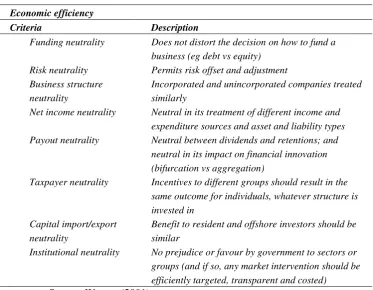
As such, it is meaningful to consider economic efficiency benchmark criteria for company taxation and apply those principles to the cross-border setting. Specifically, Warren provides a synthesis of neutrality criteria for company taxation, as extracted in
Fig. 1 below.21
15 Raskolnikov, above n 14, 524-525. 16 Ibid 525-527.
17 Ibid 551. 18 Ibid.
19 David A Weisbach, ‘The Use of Neutralities in International Tax Policy’ (University of Chicago
Coase-Sandor Institute for Law & Economics Research Paper No 697, 18 August 2014) 14-19.
20 Grubert and Altshuler, above n 4, 331-333; see further Michael J Graetz, ‘Taxing International Income:
Inadequate Principles, Outdated Concepts, and Unsatisfactory Policies’ (2001) 54(3) Tax Law Review
261, 280-282, who observes that increasing worldwide welfare does not necessarily increase national welfare in the case of international tax policy, thereby supporting national welfare, rather than worldwide efficiency, as a policy goal; see also Daniel Shaviro, ‘Why Worldwide Welfare as a Normative Standard
in US Tax Policy?’ (2007) 60(3) Tax Law Review 155, 164-165, who contends that, even if worldwide welfare improves national welfare by encouraging cooperative behaviour, unobserved defections should improve national welfare.
21 Neil Warren, ‘Modelling the Economic Outcomes from TVM: Is It Practical and Meaningful?’ in Yuri
290 Fig. 1: Economic Efficiency Benchmark Criteria
Economic efficiency
Criteria Description
1 Funding neutrality Does not distort the decision on how to fund a business (eg debt vs equity)
2 Risk neutrality Permits risk offset and adjustment 3 Business structure
neutrality
Incorporated and unincorporated companies treated similarly
4 Net income neutrality Neutral in its treatment of different income and expenditure sources and asset and liability types 5 Payout neutrality Neutral between dividends and retentions; and
neutral in its impact on financial innovation (bifurcation vs aggregation)
6 Taxpayer neutrality Incentives to different groups should result in the same outcome for individuals, whatever structure is invested in
7 Capital import/export neutrality
Benefit to resident and offshore investors should be similar
8 Institutional neutrality No prejudice or favour by government to sectors or groups (and if so, any market intervention should be efficiently targeted, transparent and costed)
Source: Warren (2001)
Cross-referencing Warren’s conceptual framework with Raskolnikov’s earlier critique, one key aspect that remains missing from the international neutrality debate is that of
‘funding neutrality’ (listed as criterion 1 in the above
Fig. 1).22
In addition to the challenges presented by the complexity of cross-border intercompany transactions, these funding options are often economically equivalent (or ‘fungible’) but are subject to disparate tax treatments. For example, the cost of debt financing is deductible whereas the cost of equity financing is not deductible. This is particularly problematic because such non-neutral tax treatments present opportunities for base erosion. However, fundamental reforms that aim to equalise the tax treatment across debt and equity financing do exist; for example, the Allowance for Corporate Equity
22Funding neutrality is arguably a subset of ‘capital ownership neutrality’, which has a broad focus on
291 (ACE) as introduced in Belgium and Italy, which is the focus of the legal analysis23 in
section 3 and the modelling in section Error! Reference source not found..
2.3 Implementing corporate tax cuts at the expense of funding neutrality: the trade-off between international competitiveness and base protection
Governments and policy-makers are increasingly faced with the trade-off of increased international competitiveness to encourage investment from MNEs with the need to protect their tax revenue bases. Tax competition is often considered a force that drives down corporate income taxes across countries in a ‘race to the bottom’.24 This is a
product of reactionary policies and the outcome of a reduced revenue take is reduced scope for fiscal stimulus due to tightened budget constraints.
The central argument of this article is that tax-induced behavioural distortions (or inefficiencies) create profound problems for governments and policy-makers25 and so
should not be overlooked when enacting tax reforms such as corporate tax cuts.
The Organisation for Economic Co-operation and Development (OECD) is currently considering best practice approaches to designing rules to prevent base erosion and profit shifting (BEPS) by MNEs. However, the OECD makes a distinction between combating BEPS and reducing distortions between the tax treatment of various methods of financing.26
Yet, it is the decision of the revenue authorities to create distortions which actually results in these tax base erosion opportunities.27 Rather than merely addressing the
behavioural symptoms of these distortions, such as debt shifting via excessive interest deductions,28 it is arguably more effective to instead align the tax treatment of
cross-border intercompany transactions to eliminate the tax incentive for said tax planning behaviour. Accordingly, the behaviourally distortive effects of tax rules should be of
primary concern regardless of one’s normative perspective and policy-makers concerned about tax planning need to consider the efficiency of the lines they draw. For example, while reducing the headline CIT rate may in turn reduce the magnitude of allowable debt deductions, eliminating the debt distortion requires more than reductions to corporate tax rates.
23 The rationale grounding this analysis is that tax policy developments can be better understood when
legal analysis is synthesised with economic and political science analysis, thereby providing a more nuanced understanding of the underlying purpose, scope and timing of reforms.
24 Marta Božina Beroš and Marin Beroš, ‘Fairness through Regulation? Reflections on a Cosmopolitan
Approach to Global Finance’ (2013) 7(1) The Journal of Philosophical Economics 2; Genschel and Schwarz, above n 7.
25 Distortive effects are not merely inefficient; they also affect fairness and administrability: Seto, above n
12, 3.
26It is clear that both the OECD’s BEPS project and the thin capitalisation rules’ raisons d’être are
primarily concerned with protecting national tax revenue bases. ‘In discussing fixed ratio rules it is important to note that in some cases these tests were also introduced to play a wider tax policy role rather than with a focus on combating base erosion and profit shifting. For example, a number of countries introduced such rules specifically to reduce existing distortions between the tax treatment of debt and equity’: OECD, BEPS Action 4: Interest Deductions and Other Financial Payments: Public Discussion Draft, 18 December 2014-6 February 2015 (OECD, 2014) 47.
27 Hanlon, above n 5.
28 Previous work by the author conceptualises the cross-border debt bias as the ‘disease’ and the
behavioural response of MNEs of engaging in debt shifting or thin capitalisation as merely the
292 Indeed, an ACE such as that introduced in Belgium and Italy presents a more robust approach to eliminating the debt distortion. These reforms are examined in turn in section 3 below.
3.
CASE STUDIES OF
ACE-VARIANTS: TO IMPLEMENT CORPORATE TAX CUTS OR
INTRODUCE AN ACE-VARIANT?
As highlighted in the previous section, there is a marked tension commonly experienced by policy-makers between either lowering the CIT rate (coupled with base broadening measures) or implementing an economic rent tax such as the ACE (which is often associated with a reduction in tax revenue).29 Further, leading commentators observe
that, where a jurisdiction has repealed its ACE-variant, this was not brought about by any fundamental problem with the theoretical ACE,30 nor any technical flaw in the ACE
system.31 Rather, the abolition of these ACE-variants was simply in line with the
dominant trend of reducing headline corporate income tax rates in the context of ‘tax -rate cut-cum-base broadening’.32
There has generally been bipartisan support for a target of lowering CIT rates in the face of increasing international tax competition, largely prompted by the forces of globalisation as countries pursue highly mobile capital investments made by large MNEs.33
However, the theory of capital income taxation in a small open economy, which concludes that the tax incidence for small open economies is shifted entirely to the domestic factors of production such as labour and land, assumes perfect capital mobility.34
It remains unclear who ultimately bears the burden of corporate taxes, with Menezes observing that:35
The argument for a reduction in the corporate tax rate was predicated in part in the simple theory of tax incidence expounded above. There are, however, several reasons why labour might not bear most of the burden of corporate taxes. Indeed, the issue of who effectively bears the burden of corporate income tax is yet to be resolved.
29 Daniel Shaviro, ‘Should Corporate Tax Reform Efforts Emphasize an “Allowance for Corporate
Equity” (ACE)?’, 3; available at: http://www.law.nyu.edu/sites/default/files/ECM_PRO_068214.pdf.
30 Alexander D Klemm, ‘Allowances for Corporate Equity in Practice’ (IMF Working Paper WP/06/259,
November 2006).
31 Michael Keen and John King, ‘The Croatian Profit Tax: An ACE in Practice’ (2002) 23(3) Fiscal
Studies 401, 417.
32 Ibid.
33 John Diamond, George Zodrow and Robert Carroll, ‘Macroeconomic Effects of Lower Corporate
Income Tax Rates Recently Enacted Abroad’ (Ernst & Young Report, Prepared for the Reforming America’s Taxes Equitably (RATE) Coalition, March 2013) 18.
34 Theoretically, it is also suboptimal for a small open economy faced with perfect capital mobility to levy
a source-based tax on the normal return to capital: Peter Birch Sørensen and Shane Matthew Johnson,
‘Taxing Capital Income: Options for Reform in Australia’ in Melbourne Institute (ed), Australia’s Future
Tax and Transfer Policy Conference, Proceedings of a Conference (Melbourne Institute of Applied Economic and Social Research, 2010) 179, 187.
293 While this article does not purport to enter this debate, given the global trend of lowering CIT rates it is instructive to briefly earmark the six reasons set out below against said reform.36
First, the home bias persists, capital markets are not perfect37 and a CIT rate reduction
in the host country only transfers tax revenues to countries that tax their MNEs on their worldwide income but allow foreign tax credits for the corporate taxes paid at source, thereby failing to change both the effective tax burden and the investment behaviour of MNEs.38
Second, the empirical evidence on the actual corporate tax burden borne by wages remains unclear, with the literature strongly questioning the theoretical suggestion that the tax incidence for small open economies is shifted entirely to the domestic factors of production such as labour and land. Further, reducing the CIT rate does not result in immediate flow-on benefits to workers in the form of extra capital, higher productivity and wages.39
Third, since the CIT is levied on both normal returns to capital and rents, a reduction in the headline CIT rate will necessarily reduce the tax on economic rents; thereby reducing the tax on investment that would occur in any event.40
Fourth, reducing the CIT rate will disproportionately benefit larger, more profitable firms, with no impact on already loss-making firms.
Fifth, the emerging literature focusing on the real economic effects of CIT rate changes shows that while CIT rate increases uniformly reduce employment and income, CIT rate reductions are ineffectual in boosting economic activity 41 except when
implemented during recessions.42
Sixth, further reductions to the CIT rate will widen the wedge between the highest personal income tax bracket and the CIT rate, implying that further reductions in the CIT rate should not be made in isolation from changes in personal income tax because this presents a further deviation from business structure neutrality.43
These factors create considerable uncertainty regarding the benefits of CIT reductions.
Further, it is noteworthy that the CIT system has the highest efficiency costs among Australia’s federal taxes, with the efficiency losses resulting from taxing normal returns
36 Further, it is arguable that simply lowering the headline CIT rate does not constitute tax reform per se. 37 Kalok Chan, Vicentiu Covrig and Lilian Ng, ‘What Determines the Domestic Bias and Foreign Bias?
Evidence from Mutual Fund Equity Allocations Worldwide’ (2005) 60(3) Journal of Finance 1495; Menezes, above n 35, 4.
38 So, in order to protect the domestic corporate tax base, many countries implement thin capitalisation
rules, transfer pricing rules, controlled foreign corporation (CFC) rules and additional anti-avoidance tax rules: OECD, Tax Policy Reform and Economic Growth, OECD Tax Policy Studies No 20 (OECD Publishing, 2010) 54.
39 Menezes, above n 35, 4, and references cited therein. 40 Menezes, above n 35, 4.
41 Alexander Ljungqvist and Michael Smolyansky, ‘To Cut or Not to Cut? On the Impact of Corporate
Taxes on Employment and Income’ (NBER Working Paper No 20753, National Bureau of Economic
Research, December 2014) 31-32, and references cited therein.
42 Ibid 8.
294 likely to be above 40 per cent.44 On the other hand, taxing only economic rents results
in no deadweight loss. However, as observed by Ganghof, ‘[t]he result was not only neoliberalism by surprise[ 45 ] but also neoliberalism by default …interactions of
economic, partisan and institutional factors may lock countries into rather inefficient tax structures, at least temporarily’.46 Accordingly, it is imperative to increase the
efficiency of business taxation, where possible.
In this context, there are many reform proposals addressing the business taxation distortion, including the ACE, Cash flow tax, Comprehensive Business Income Tax (CBIT), dual income tax (DIT) and Residence-based shareholder tax.47 Specifically, this
article’s focus is the distortion between debt and equity financing. Of various fundamental reform proposals only the ACE has been experimented with in practice, so this is the focus of this article.
The ACE maintains the current deductibility of actual interest payments and adds a notional return on equity to be deductible against corporate profits, at the risk-free nominal48 interest rate.49
The ACE has garnered substantial support from leading academics since its theoretical inception and is experiencing increased interest from policy-makers internationally.50
In terms of its historical development, the ACE originated in the 1970s with the basic economic idea contained in the report of the Meade Committee,51 which proposed
alternatives to the UK tax system. This was followed by research published by leading commentators Boadway and Bruce,52 and was further elaborated in detail by the IFS
Capital Taxes Group,53 and Devereux and Freeman.54
The literature has predominantly focused on economic concepts, despite recognising the relevance and importance of law, accountancy and politics.55 Further, the ACE literature
44 Australia’s Future Tax System Review Panel (Dr Ken Henry, chair), Australia’s Future Tax System:
Report to the Treasurer (December 2009) (Henry Review); Menezes, above n 35, 5.
45 Susan C Stokes, Mandates and Democracy: Neoliberalism by Surprise in Latin America (Cambridge
University Press, 2001).
46 Steffen Ganghof, ‘The Politics of Tax Structure’ (MPIfG Working Paper 06/1, Max Planck Institute for
the Study of Societies, January 2006) 26-27.
47 See Peter B Sørensen, ‘Can Capital Income Taxes Survive? And Should They?’ (2007) 53(2) CESifo
Economic Studies 172, 218, Table 4.
48That is, ‘calculated by reference to a normal commercial rate of interest, fixed by the government’: see
further, Malcolm Gammie, ‘Corporate Tax Harmonization, An “ACE” Proposal: Harmonizing European Corporate Taxation through an Allowance for Corporate Equity’ (1991) 31(8) European Taxation 238.
49 Ruud A de Mooij and Michael P Devereux, ‘An Applied Analysis of ACE and CBIT Reforms in the
EU’ (2011) 18(1) International Tax and Public Finance 93, 96.
50 Christian Keuschnigg, ‘The Design of Capital Income Taxation: Reflections on the Mirrlees Review’
(2011) 32(3) Fiscal Studies 437; Gammie, above n 48; Michael P Devereux and Peter B Sørensen, ‘The Corporate Income Tax: International Trends and Options for Fundamental Reform’ (European
Commission Economic Paper 264, December 2006).
51 Institute for Fiscal Studies, The Structure and Reform of Direct Taxation: Report of a Committee
chaired by Professor J E Meade (George Allen & Unwin, 1978).
52 Robin Boadway and Neil Bruce, ‘A General Proposition on the Design of a Neutral Business Tax’
(1984) 24(2) Journal of Public Economics 231.
53 Institute for Fiscal Studies, Equity for Companies: A Corporation Tax for the 1990s, Fourth report of
the IFS Capital Taxes Group, Commentary No 26 (Chameleon Press, 1991), available at: http://www.ifs.org.uk/comms/comm26.pdf.
54 Michael Devereux and Harold Freeman, ‘A General Neutral Profits Tax’ (1991) 12(3) Fiscal Studies 1. 55 Alan Auerbach, Michael Devereux and Helen Simpson, ‘Taxing Corporate Income’, in Stuart Adam,
295 currently has a corporate tax neutrality focus grounded in the economics paradigm. Importantly, ACE-based reforms have great potential from an anti-avoidance law perspective, which is especially pertinent for international company tax purposes.56
Further, simulations by de Mooij and Devereux show that even with the inclusion of tax havens, which halve the positive welfare effect of implementing a revenue-neutral ACE in high-tax countries, a European ACE still raises welfare. De Mooij and Devereux
observe that the benefits of a more efficient tax system in terms of both investment and financial structure significantly outweigh the negative spillovers vis-à-vis profit
shifting.57
The original objectives and perceived benefits of the ACE include encouraging domestic investment and employment, and achieving tax neutrality by granting tax relief for equity financing. In principle, many leading commentators, policy-makers and corporations support the ACE. However, implementing and sustaining fundamental reform of the corporate income tax system is difficult. Accordingly, it is necessary to consider how an ACE eventuates in practice. De Mooij and Devereux observe that the Belgian and Italian ACE-variants are the closest to the theoretical ACE.58 As such, these
two jurisdictions are the focus of this article.
3.1 Applied literature analysing ACE-variants
The majority of the English-language ACE literature provides a distinct focus on economic modelling rather than engaging in any legal analysis.59 One exception is an
OECD report providing a descriptive exposition with detailed reference to particular amendments and developments, yet there remains a gap in relation to a critical analysis geared at suggesting design improvements for similar reforms in the future.60
A recent contribution in this area has been the comparative analysis of the Belgian and Italian ACE-variants by Zangari,61 who presents the case for why the design of the
Italian ACE-variant allows for a more robust reform than the Belgian NID; namely, due to its anti-avoidance framework. However, Zangari provides a comparison between the technical aspects of these ACE-variants in practice, rather than in-depth comparative legal analysis. Accordingly, there remains scope in the literature to provide a more thorough comparative analysis, with an emphasis on legislative drafting and the underlying policy intentions for amendments over time.
University Press, 2010) 837; see also Keuschnigg, above n 50; see further, Graeme Cooper,
‘Implementing an Allowance for Corporate Equity’ (2012) 27(2) Australian Tax Forum 241.
56 S Bond, ‘Company Tax Issues’ (Presentation delivered to The Institute for Fiscal Studies, 2006). 57 De Mooij and Devereux, above n 49, 115.
58 Ruud de Mooij and Michael Devereux, ‘Alternative Systems of Business Tax in Europe: An Applied
Analysis of ACE and CBIT Reforms’ (European Union Taxation Papers, Working Paper No 17, 2009).
59 Alessandra Staderini, ‘Tax Reforms to Unfluence Corporate Financial Policy: The Case of the Italian
Business Tax Reform of 1997-98’ (Banca D’Italia Working Paper No 423, November 2001); Silvia
Giannini, ‘Le riforme italiane nella tassazione di impresa negli anni ’90 in una prospettiva europea’
(Paper presented at Seminario di Economia Pubblica Istituto di Economia e Finanza, Università Cattolica del Sacro Cuore, 22 February 2001); Filippo Oropallo and Valentino Parisi, ‘Will Italy’s Tax Reform
Reduce The Corporate Tax Burden? A Microsimulation Analysis’ (SIEP Working Paper No 403, May 2005); Daniela Federici and Valentino Parisi, ‘Corporate Taxation and Exports’ (MPRA Paper No 41012, 3 September 2012).
60 OECD, Action Plan on Base Erosion and Profit Shifting (OECD Publishing, 2013).
61 Ernesto Zangari, ‘Addressing the Debt Bias: A Comparison between the Belgian and the Italian ACE
296 As such, sections 3.2 and 3.3 below analyse the Belgian and Italian ACE-variant experiences, with a focus on the political hurdles to implementing and sustaining these reforms.
3.2 Belgium’s ACE-variant
The Belgian corporate tax system is considered a classical double taxation system, modified by an exemption for dividends from qualifying participations held by corporate shareholders and a reduced rate for dividends from participations held by individual shareholders. 62 Tax practitioners have long considered Belgium an
interesting jurisdiction for various tax-planning and structuring purposes.63
Even prior to the introduction of the Notional Interest Deduction (NID),64 dividends
could be received nearly tax-free, interest paid on loans taken out to acquire shares was tax-deductible and capital gains on shares were generally tax-exempt.65 The NID
(otherwise known as the ‘Intérêts notionnels et déduction fiscales pour capital à risque’,
“Notionele Interestaftrek” or ‘Capital Risk Deduction’) was introduced in 2005 to encourage equity financing following two key pressures; first, pressure from the European Commission to abandon the Belgian coordination centre regime,66 and second,
pressure resulting from the expansion of the European Union to countries with lower corporate tax rates, such as Cyprus, Latvia, Lithuania, and Hungary, which emphasised the need for Belgium to strengthen its position on the international tax map.
3.2.1 The Belgian NID: political hurdles to implementation
When initially introduced in Belgium, leading commentators observed that Belgium’s NID reform was very close to the pure version of the ACE,67 with the Parliamentary
focus appearing to be the tax neutrality property of the NID to overcome the debt-equity distortion.68 The originating explanatory notes69 detail the political, philosophical,
62 Jan Široký, ‘There are several factors, which influence the actual range of the corporate tax: the relation
between the personal income tax and the corporate income tax’ (2006) 5, available at: http://kvf.vse.cz/storage/1168944278_sb_siroky.pdf.
63 Howard Liebman, ‘International Tax Planning: Belgium Is Taking Steps to Enhance Its Attractiveness’,
Jones Day Commentary (July 2005), available at: http://www.jonesday.com/international-tax-planning-belgium-is-taking-steps-to-enhance-its-attractiveness-07-26-2005/.
64Loi du 22 juin 2005 instaurant une déduction fiscale pour capital à risque – Wet tot invoering van een
belastingaftrek voor risicokapitaal van 22 juni 2005 [Law introducing an allowance for corporate equity of 22 June 2005], published in Belgian Official Gazette of 30 June 2005, p 30077 (Notionele
Interestaftrek, Belgisch Staatsblad / Loi instaurant une déduction fiscal pour capital à risqué, Moniteur Belge).
65 Liebman, above n 63.
66 Marc Quaghebeur, ‘Belgium Targets Risk Capital Deduction Abuses’ (2007) 48 Tax Notes
International 627. Belgium introduced this regime in 1982, which aimed at providing MNEs with a tax-effective vehicle to coordinate and centralise their management and financial services in so-called
‘coordination centres’.
67 Marcel Gérard, ‘Belgium Moves to Dual Allowance for Corporate Equity’ (2006) 46(4) European
Taxation 156; André Decoster, Marcel Gerard and Christian Valenduc, ‘A Decade of Tax Cuts’, in Etienne de Callataÿ and Françoise Thys-Clément (eds), The Return of the Deficit:Public Finance in Belgium over 2000-2010 (Leuven University Press, 2012) 95, 111-112.
68 Decoster, Gerard and Valenduc, above n 67, 112.
69Loi du 22 juin 2005 instaurant une déduction fiscale pour capital à risque – Wet tot invoering van een
297 economic and tax policy rationales for implementing the Belgium ACE-variant, and the anticipated impact of this reform.
However, it is also important to recognise that Belgium did not have wide political support for the NID reform; indeed, the green and socialist parties opposed the NID, which was criticised as being used as ‘a weapon in the election campaign of 2004’.70
Further, the rationale of highlighting the urgency of the NID in light of the dramatic decline in investment in Belgium was criticised in the parliamentary debates as a rushed and underhanded political strategy.71 Despite ongoing political debate for over one year,
which resulted in limitations to the NID, there were only two parliamentary sittings, which was criticised as resulting in insufficient debate on the broader reform of corporate income tax.72 This was considered especially problematic by opposition
parties, who made comparisons to the reform processes in neighbouring countries such as the Netherlands.73
Nonetheless, the parliamentary debates indicate that a large majority of the committee subscribed to the philosophy underpinning the reform, with the proposal receiving generally positive feedback and unconditional approval by the VLD (the Flemish liberal party).74 However, the design parameters had mixed reviews; some parliamentarians
believing the design was too generous and others considering it inadequate. Finance Minister Didier Reynders interpreted this as indicating that the Bill was balanced,75 and
earmarked an evaluation period to identify areas for improvement.76 At its inception,
this Bill was touted as a pioneer in tackling tax discrimination between debt and equity finance.77
However, there has been much scepticism about the real motivation for implementing this reform, as observed by the National Bank of Belgium:78
The memorandum put to the Parliament stresses the neutrality property of the reform because it enables corporate income tax to overcome the well-known debt equity bias. It ends by indicating that the reform also provides an alternative for financial companies using the coordination centre regime. Most would argue – rightly – that of the two motivations the second was the more important and the neutrality properties are more a consequence of the reform than its main policy motivation.
When it was introduced, Finance Minister Didier Reynders and Prime Minister Guy Verhofstadt organised roadshows in Asia, the United States, and India to promote the NID and explain that the deduction reduced the corporate income tax rate from 33.99 per cent to about 26 per cent.79 They were accompanied by representatives of some
70Chambre des ReprésentantsdeBelgique,Compte Rendu Intégral avec Compte Rendu Analytique
Traduit des Interventions–Belgische Kamer van Volksvertegenwoordigers, Integraal Verslag met Vertaald Beknopt Verslag van de Toespraken (Belgium) [House of Representatives, Full Report with a Summary Record of Translated Interventions], 22 June 2005,59 [15.02].
71 Ibid [15.12]. 72 Ibid 59-60 [15.12]. 73 Ibid 61 [15.20]. 74 Ibid 53 [15.01]. 75 Ibid 53-54 [15.01]. 76 Ibid 58 [15.01]. 77 Ibid 58-59 [15.01].
298 banks and tax advisory firms who explained how the NID could be used for group finance companies and treasury centres, for acquisition structures, and for post-acquisition restructuring.80 Subsequently, many MNEs moved their corporate treasury
centres to Belgium.81
It is important to recognise the context to these statements. Even though the official tax rate has fallen over 7 per cent in three years, the effective tax rate at the time was over 21 per cent – higher than the EU average, as noted in the explanatory materials.82 The
extrinsic materials also indicate that parliamentarians made reference to the Forbes suggestion that Belgium had the third highest marginal tax rate in the world; cited as
support for the proposition that Belgium’s tax rates were high and corporate investment
and economic stimulus was in need of bolstering (taking into account considerations of economics and taxation). Further, the parliamentary debates refer to the high unemployment rate as an economic problem with the NID presented as a strategy to lowering corporate tax and giving the Belgian economy a new impetus.83
Budgetary issues generally tend to pose one of the most significant political hurdles to implementing fundamental tax reform. Even though the budgetary cost of the NID was a significant issue, the government mentioned that it expected a EUR 58 million return on the NID reform.84 This was despite the revenue cost of EUR 566 million, which was
largely accepted by parliament, with budgetary compensation measures and savings provisions (including abolishing corporate tax credits and opting-in to the NID at the expense of opting-out of ‘investment reserve’ provisions) amounting to EUR 400 million. The extrinsic materials make reference to the following 10-point benefits of the NID, anticipating that the NID would: (i) incentivise equity finance thereby encouraging investment; (ii) facilitate employment; (iii) stimulate financing; (iv) reduce bankruptcy risk thereby improving credit ratings; (v) anchor investments in Belgium thereby reducing relocation risk; (vi) stimulate the establishment of new companies; (vii) ensure consistency with EU guidelines thereby providing the necessary legal certainty; (viii) facilitate an attractive investment climate; (ix) improve Belgium’s competitiveness,85
and (x) facilitate private corporations’ investment in construction and property through equity finance.86
The parliamentary debates highlight the criticisms in the design of the NID. For example, one of the major obstacles to the implementation of the NID was contained in Article 9, which barred companies from distributing the portion of their profits that corresponds to the NID deduction by way of a dividend unless they retained an amount equal to the amount of the NID deduction for a period of at least four years. In the extrinsic materials prepared in June 2005, one of the key anti-abuse mechanisms contained in Article 9 was reduced to three years following concerns that a period of four years would make equity less appealing than debt finance and could undermine the effectiveness of the NID. Even though the design was the subject of passionate political debate87 and was ultimately a
80 Quaghebeur, above n 66.
81 Marc Quaghebeur, ‘Belgium Removes Obstacle to Risk Capital Deduction’, Worldwide Tax Daily
229-3 (229-30 November 2005).
82Chambre des ReprésentantsdeBelgique, above n 70,62 [15.20]. 83 Ibid 60-61 [15.19]-[15.20].
84 Ibid 53 [15.01]. 85 Ibid 55 [15.02]. 86 Ibid 59 [15.02].
87 Parliamentary reports show dialogue such as ‘Mr. Bogaert, I suggest that you take the sequel to the
299 compromise, the parliament considered that Article 9 should be further relaxed in subsequent legislative amendments.88 Nonetheless, this provision was amended even
before the commencement date of the NID, with Belgian Prime Minister Guy Verhofstadt delivering a public announcement on 17 November 2005 that this obstacle to the NID would be lifted.89 While this revision arguably aligned the NID more closely
to its theoretical underpinnings in the ACE, it is largely an administrative issue rather than one of tax policy design which encourages the use of equity financing at the risk of making the system more vulnerable to abuse from aggressive tax planning. The key criticism was that the NID was largely agreed to in principle, but the provisions and administrative aspects were unnecessary to the point that it was criticised as largely missing its objectives in practice.90 This highlights how translating ACE theory into
practice through a robust tax reform design is one of its most challenging aspects, as anticipated by the wider ACE literature91 and as experienced by jurisdictions in the
past.92
Separately, there was political opposition to the limited scope of the NID, which some parliamentarians argued ought to be extended to personal income tax.93 This reflects the
ACE literature, which anticipates that one key challenge in designing and implementing ACE reform is that it does not operate as a backstop to the personal income tax system.94
Even though leading commentators have suggested that tax neutrality cannot be achieved unless there is a personal-level ACE,95 the domestic shareholder position is
less relevant in a small, open economy where the marginal investor is likely to be a foreign investor.96 While it is difficult to pinpoint the non-resident investor as the
marginal investor, it is plausible for a small, open economy like Belgium.97
3.2.2 The Belgian NID: subsequent amendments and economic, political and administrative issues
The NID has been continually amended by the Belgian parliament since its introduction in 2005, culminating in the continued reduction in the NID rate and the abolition of carry-forwards further limiting the scope of the NID. These two legislative changes have taken the NID further away from its original legislative purpose and underlying ACE principles. First, reducing the tax deduction provided for equity financing risks eliminating the neutrality properties of the ACE and simply providing a sweetener for
88 Ibid 69 [15.52]. 89 Quaghebeur, above n 81.
90Chambre des ReprésentantsdeBelgique, above n 70,64 [15.20].
91 John Isaac, ‘A Comment on the Viability of the Allowance for Corporate Equity’ (1997) 18(3) Fiscal
Studies 303.
92 The ACE-variant adopted in Brazil is more akin to a system of dividend deductibility; see further,
Klemm, above n 30, 24.
93Chambre des ReprésentantsdeBelgique, above n 70,58 [15.11].
94 OECD, Reforming Corporate Income Tax, OECD Observer: Policy Brief (2008).
95 OECD, Fundamental Reform of Corporate Income Tax, OECD Tax Policy Studies No 16 (OECD
Publishing, 2007) 88, 139.
96 Business Tax Working Group (Chris Jordan, chair), Discussion Paper (August 2012) 21, available at:
https://static.treasury.gov.au/uploads/sites/1/2017/06/BTWG_discussion_paper_2012.pdf.
97 Belgium has been recently described as a small, open economy by economists; see, for example, Philip
300 equity financing;98 and second, abolishing carry-forwards exacerbates the asymmetric
treatment of profits and losses.99
However, when considering any subsequent legislative amendments to the NID reform, a holistic understanding of the political landscape is an imperative starting point. From 2007, Belgium was confronted by an ongoing political crisis at federal level.100 During
that time, the outgoing conservative/socialist government continued to handle current affairs, and in October 2007, following much political pressure, decided to conduct an investigation into alleged abuses by Belgian companies and Belgian banks of the NID.101
A key political issue in practice is that the NID is thought to benefit the larger MNEs more so than small and medium enterprises (SMEs). This is because the larger MNEs are able to put substantial amounts of equity capital into their treasury arms or internal finance companies thereby eroding their corporate tax base.102 This challenges whether
the NID is genuinely beneficial for the domestic economy or whether it presents a tax break for the most profitable MNEs who are able to tax plan and bypass anti-avoidance rules and maintain very low effective tax rates. However, leading practitioners and economists observe that the NID also benefit SMEs by incentivising business capitalisation and thereby protecting businesses during the global financial crisis (GFC).103 Further, it is arguable that this is an obvious feature of the NID which is why
it was such an attractive investment reform to begin with. Some legal practitioners have observed that ‘the purpose of introducing the notional interest deduction was just to make Belgium fiscally attractive to foreign investors and to offer a credible and competitive alternative for the coordination centres whose system was condemned by the European authorities’.104 Indeed, it is arguable that since the NID resulted in
substantial investment by both local and overseas MNEs, it thereby encouraged a larger capital base, which ensured that those companies were well-positioned to withstand the GFC because of their capital buffers.
Nonetheless, the pressure from lobby groups and media sentiment that MNEs were unfairly advantaged by the NID remains substantial. By way of background, SMEs and MNEs currently have an average tax rate of approximately 34 per cent and 5 per cent respectively. This has resulted in industry lobby groups such as Le Syndicat des Indépendants & des PME calling for reform to the NID to ‘reconcile the existing blatant
98 The Mirrlees Review recommended that the normal rate of return be utilised; see further, Auerbach,
Devereux and Simpson, above n 55; Rachel Griffith, James R Hines, Jr and Peter Birch Sørensen,
‘International Capital Taxation’, in Stuart Adam, Tim Besley, Richard Blundell, Stephen Bond, Robert Chote, Malcolm Gammie, Paul Johnson, Gareth Myles and James M Poterba (eds), Dimensions of Tax Design: The Mirrlees Review, Vol 1 (Oxford University Press, 2010) 914.
99 Stephen R Bond and Michael P Devereux, ‘On the Design of a Neutral Business Tax under
Uncertainty’ (1995) 58(1) Journal of Public Economics 57.
100 Marc Hooghe, ‘The Political Crisis in Belgium (2007-2011): A Federal System without Federal
Loyalty’ (2012) 48(1) Representation 131.
101 Quaghebeur, above n 66.
102 Projet de Loi-Programme, Chambre des Représentants de Belgique, 24 February 2012, Doc 53
2081/001, 95, available at: http://www.lachambre.be/FLWB/pdf/53/2081/53K2081001.pdf.
103 F-X G [François-Xavier Giot], ‘Renforcer le système des intérêts notionnels’, L’avenir (online) (2
February 2013), available at:
http://www.lavenir.net/article/detail.aspx?articleid=DMF20130202_00263523.
104 N Thémelin, ‘The only consequence of the announcement effects of notional interest: the legal
uncertainty’, Afschrift news report (19 September 2013), available at: http://www.afschrift.be/en/the-
301 discrimination between hundreds of small SMEs that pay 3-4 times more taxes that multinational companies’.105
Political concerns regarding aggressive tax planning led to the broadening of Belgium’s
thin capitalisation rule, which specifically targets inter-company loans with a 5:1 debt to equity ratio limitation. Further, subsequent explanatory notes106 reveal a link between
the reduced scope of the NID and the increased incidence of thin capitalisation rules in Belgium. The relationship between reducing the scope of the ACE-variant and the increased implementation of thin capitalisation rules in Belgium suggests an inversely proportional relationship between these two reforms which has not been addressed in the English-language literature. Future research by the author will explore this aspect in further detail.
This presents arguably the most substantial hurdle to implementing and sustaining ACE-based reform; it is politically very difficult to quantify (and therefore justify) the benefit of the NID and very easy to point to the loss of revenue; for example, in Belgium EUR 3-4 billion is claimed in NID deductions annually. However, in an increasingly globalising economy with capital mobility there is no certainty that regulatory
tightening will prevent a loss of revenue. Belgium’s thin capitalisation rules are
relatively lenient. Even so, many MNEs are now moving out of Belgium as a result of the overall regulatory tightening including inter alia tightening thin capitalisation rules, increasing interest withholding tax rates, tightening anti-abuse rules and levying capital gains tax on shares.
So, even though MNEs were subject to relatively low effective tax rates under the NID reform it is conceivable that this at least incentivised businesses to operate from, and develop in, Belgium – this influx in inbound investment may have, in turn, had a multiplier effect.
Nonetheless, the most significant political pressure point and media criticism of
Belgium’s NID is in relation to its cross-border impact; specifically, the tax avoidance opportunities that it presents for MNEs. However, policy-makers are unable to deliver targeted reform in the cross-border context due to EU anti-discrimination law. This exemplifies the impact that politics has on tax policy developments and practice, most recently culminating in the European Court of Justice determining on 4 July 2013 that the NID rules and in particular the refusal to apply the NID to a foreign permanent establishment’s net assets violates the freedom of establishment.107 It goes without
saying that this resulted in the Council of Ministers resolving to amend the legislative provisions within three months of the judgment of the European Court of Justice.
Over the past few years, there has been increased media pressure and pressure from all sides of politics to abolish the NID. This resulted in the NID becoming a ‘hot topic’ at the 2014 Federal election.108
105‘Intérêts notionnels: le SDI plaide pour un système plus "fair-play"’, Le Soir (online) (5 July 2013),
available at: http://www.lesoir.be/275803/article/actualite/fil-info/fil-info-belgique/2013-07-05/interets-notionnels-sdi-plaide-pour-un-systeme-plus-fair-play (author translation) (accessed 11 December 2013).
106La Chambre des représentants de Belgique – Belgische Kamer van volksvertegenwoordigers [Senate
Explanatory Notes], Project de Loi-Programme du 24 février 2012 – Ontwerp van Programmawet van 24
februari 2012 (nº 53-2081/001), Art 139, 94-98 (Belgium).
302 Media reports indicated that political parties such as the Christian democratic party
Centre démocrate humaniste (CDH) promised to abolish the NID as part of their election campaigns:109
The gain for public finances would be reinvested without waiting for the new term in a decrease of 10 per cent of the corporate tax rate, benefiting all, whether
SMEs, TPE or independent … This reform that we can carry out without delay … deleting a liberal but also socialist mismanagement … Notional
interest for everybody, right now: SME, SOHO and independent.
It goes without saying that the tax policy uncertainty from first implementing, then modifying, phasing down, and now considering the abolition of the NID erodes business confidence. Leading practitioners agree that abolishing the NID will diminish the attractiveness of Belgium as a destination for inbound investment:110
It is therefore true that the notional interest deduction has allowed many companies to reduce their taxable result, but that is precisely the goal that is pursued, with full knowledge of the facts, by the political parties that were at the origin of the construction and of which some criticize the construction
heavily today … This constant legal uncertainty incites some companies to seek calmer climes, sometimes by establishing themselves at just a few miles from our borders, this to the detriment of competitiveness, the economy and the image of Belgium on the international stage. This is of course regrettable.
The fate of the Belgian NID remains unclear, with the reform surviving the 2014 Federal election despite talks of its abolition. Meanwhile ACE-variants have been the subject of
other European governments’ reviews of comprehensive corporate taxation reform options, with Switzerland characterising their potential ACE-variant also as a ‘notional
interest deduction’.111
3.3 Italy’s ACE-variants
Prior to 1997, the Italian corporate income tax system, which was designed as a full imputation system,112 had not been subject to major reforms for nearly three decades.
However, by 2004, Italy transitioned from an imputation system to a classical system, with a participation exemption regime introduced to mitigate double taxation of corporate profits.113 Italy’s move away from an imputation system is in line with many
other EU member countries.
109‘Le cdH veut supprimer les intérêts notionnels pour baisser sans attendre l'impôt’, Le Vif (online) (31
August 2013), available at: http://www.levif.be/info/actualite/belgique/le-cdh-veut-supprimer-les-interets-notionnels-pour-baisser-sans-attendre-l-impot/article-4000387901382.htm (author translation).
110 Thémelin, above n 104.
111Regarding Switzerland, see: PwC, ‘The impactof Swiss Corporate Tax Reform III (CTR III)’
(Position paper of PwC Switzerland, May 2015); the Swiss Federal Council recently removed the NID measure from the CTR III reform package. PwC opines that it ought to be reintroduced in the course of the parliamentary debate. See also, for example, in relation to Sweden: Linklaters, ‘Proposed new tax
regime for cost of capital’ (12 June 2014), available at:
http://www.linklaters.com/News/LatestNews/2014/Pages/Proposed-new-tax-regime-cost-capital.aspx.
112 Lothar Lammersen and Robert Schwager R, The Effective Tax Burden of Companies in European
Regions: An International Comparison, ZEW Economic Studies Vol 28 (Springer, 2006) 75.
113‘Effective for tax periods starting on or after 1 January 2004, Italy applies a classical system of
taxation of corporate profits. The former imputation system is abolished and replaced by a 95%
303 Italy provides a unique and interesting case study because it implemented two variants under two different corporate-shareholder tax systems. The first was the ACE-variant operating in Italy from 1998-2001 termed the Dual Income Tax (Italian DIT).
Although inspired by the Nordic DIT, Italy’s DIT was very different as it only affected capital income. This has leading commentators describing it as “the most confusing name”.114 Companies were liable to pay the statutory corporate income tax rate on
above-normal profits; with the normal return on capital subject to a reduced tax rate fixed by the government; a nominal return on capital calculated by reference to the average interest rate on bonds plus a risk premium.
The second is the new ACE implemented in 2012, termed the Aiuto alla Crescita Economica (Italian ACE). Leading commentators observe that the Italian ACE shares the main characteristics of the theoretical ACE.115 The Italian tax system also has
elements of a Comprehensive Business Income Tax (CBIT) due to the local business tax, the IRAP, and also because of the limit to the deductibility of interest, in force since 2008. Accordingly, the Italian corporate income tax system can be characterised as combination of a partial ACE and a partial CBIT, thereby mitigating the debt-equity distortion from both directions.
3.3.1 The Italian DIT: political hurdles to implementation
An understanding of Italy’s political dynamics is imperative in assessing tax policy reforms. Originating from a context of taxpayer discontent and widespread tax planning and tax evasion, the then centre-left government introduced the Italian DIT as part of its
‘Visco’ reforms. The relevant extrinsic materials detail that the Italian DIT was introduced to encourage greater neutrality in corporate financing decisions and facilitate competitiveness by making Italy an attractive investment destination.116
3.3.2 The Italian DIT: subsequent amendments and economic, political and administrative issues
Revenue neutrality concerns resulted in two key restrictions being placed on the original DIT which reduced its initial effectiveness.117 First, the opportunity cost of equity
finance was not deductible from taxable income, rather it was taxed at a reduced rate; and second, only post-reform equity is considered in the Italian DIT deduction calculations under an incremental approach (similarly to the Belgian NID).
While leading academics observed that over time, the second restriction would not be problematic in the long term, the short-term political repercussions were significant. The Italian DIT was criticised as largely benefiting large and profitable firms, who were more likely to issue new equity, while companies in the South and SMEs were less
hold the participation in a business capacity. Individual shareholders not holding the participation in a business capacity are also entitled to the 60% exemption if they own more than 2% of the voting power or 5% of the capital in listed companies, or more than 20% of the voting power or 25% of the capital in other companies (substantial participation). Otherwise, dividends derived by individuals are subject to a final withholding tax at a rate of 12.5%’; see further, A Uricchio, ‘Italian Individual Taxation’ (Lecture, University of Bari, 2014) 18; available at: https://nanopdf.com/download/italian-individual-taxation_pdf.
114 Klemm, above n 30, 7.
115 Antonella Caiumi, Lorenzo Di Biagio and Marco Rinaldi, ‘Corporation Tax in Italy: Evidence from
Tax Return Data’ (2013), available at: https://editorialexpress.com/cgi-bin/conference/download.cgi?db_name=IIPF69&paper_id=460.
116 Luigi Bernardi, ‘Some Issues on the Italian Tax Reforms and the European Tax Environment:
Introductory Remarks’ (Società Italiana di Economia Pubblica, Working Paper No 457, September 2005).