❖ Received: 30–03–05 / Accepted: 23–05–05 Abstract
This article describes a small-scale project aimed at developing a systematic evaluation of a Self Access
Centre (SAC) located at a private university in Bogotá. The objectives of the project were first, to identify the most common strategies used by the SAC’s users and find out if this SAC was enhancing autonomy.
The second objective was to discover some of the strengths and weaknesses of the SAC. The results showed that students used indirect strategies which might show some autonomy, since these strategies are related to the management of our own language learning. The results also demonstrated that students need some counselling with both the language and technology.
Key Words: Evaluation, Self Access Centres (SACs), autonomous learning, learning strategies.
Resumen
Este artículo describe un mini-proyecto de investigación encaminado a desarrollar una evaluación sistemática del Centro de Recursos (C.R.) de una universidad privada de Bogotá. El estudio pretendía
primero, descubrir el tipo de estrategias de aprendizaje del inglés más utilizadas por los usuarios de dicho Centro y a través de esto determinar si este C.R. promovía la autonomía de los estudiantes. En segundo lugar, se buscaba examinar las fortalezas y debilidades del C.R. como tal. Los resultados demostraron que las estrategias más usadas por los estudiantes son las indirectas. Esto indica cierta autonomía ya que estas estrategias tienen que ver con el hecho hacerse responsable del desarrollo del idioma que se está aprendiendo. Entre las debilidades del Centro se encuentra la ausencia de una persona que apoye a los usuarios tanto con el idioma como con el uso de las herramientas que encuentran allí.
Palabras Claves : Evaluación, Centro de Recursos, aprendizaje autónomo, estrategias de aprendizaje.
Julia Zoraida Posada Ortíz
Evaluating Students’ Autonomous
Learning Through Their Uses of a
INTRODUCTION
Self-access centres (SACs) for language learning have enjoyed growing popularity in recent years. By providing an environment with a variety of machines and materials that users can exploit , and some kind of catalogue, such centres offer a wider and more flexible range of opportunities for language use than is possible in most classrooms. In short, they are a means for improving learning.
SACs are supposed to enhance learners’ autonomy. However, it would be interesting to explore if they accomplish this purpose by carrying out some research about it. By doing this kind of research we will start evaluating the use of SACs. This small-scale project aimed at finding out the more frequent group of strategies used by SACs’ users and at exploring how SACs’ theory relates to practice in terms of what students actually do there and how they perceive the centres. I addressed the following questions: Which group of strategies are used most frequently by the users of a SAC? What are the students’ perceptions of the SAC?
The research was carried out at a Language Institute of a private university in Bogotá with 15 students. The Institute has a SAC provided with computers equipped with English Discoveries and Internet. Students can make use of the Centre whenever they want. To carry out the small-scale project, two basic instruments were used. The first one was “the speakers of other languages” version of Strategy Inventory for Language Learning (SILL) designed by Rebeca Oxford (1990) (see appendixes A and B). The second one was a survey to find out the type of activities students did at the SAC and the frequency of their visits (see appendix C). The relationship between SACs and students’ autonomy was explored by looking at the relationship between the SILL’s results and the surveys. In what comes next there is a definition of the main constructs of the study.
Understanding Key Concepts
second language, autonomous learning: What in the world is it? and finally, a typology of self -access centres.
Towards a definition of evaluation
I would like to adopt the definition given by Genesse and Upshur (1999), in the sense that evaluation is more “than grading students and deciding whether they should pass or fail”, but it is about “making decisions about instruction or plans for instruction” (p.3). This definition suited the purpose of the study since I wanted to know if there was some kind of autonomy or not in the learning attitudes of a group of a University SACs’ users. I wanted to know what happened when they used the self-access centre as a complement to classroom activities. As the concept of evaluation mentioned implies a systematic process which starts with the purpose of knowing what strategies the SAC visitors used and their relation with the theory of SACs that will be described further in this paper, I had to go through a process of collecting information from the students and their learning strategies, then interpret them and finally, make a decision, which is the key aspect of evaluation according to the authors cited above. I would like to state that I adopted this concept of evaluation because I think it implies a holistic view of the term, as evaluation is seen as a process that aims at improving second language teaching.
How students learn a second language
According to Oxford (1990), there are two major learning strategies commonly used by language students, direct and indirect (p.14). These strategies are subdivided into a total of six groups. They are as follows memory, cognitive and compensation, under the heading of direct learning strategies; metacognitive, affective and social, under the heading of indirect learning strategies. The first direct strategy refers to how students remember language, the second one to how students think about their learning and the third one enables students to make up for limited knowledge. The first indirect strategy refers to how students manage their own learning, the affective strategy is related to how students feel in the classroom and the last one involves learning by interaction with others.
These language learning strategies are defined by Oxford as “operations employed by the learner to aid the acquisition , storage, retrieval and use of information” (Oxford, 1990 p.8) and she states that they support each other.
If autonomy is understood as an attitude towards learning (Dickinson, 1993) we could say cognitive, metacognitive and social strategies are the main strategies used by autonomous learners. Nevertheless, it is also true that an autonomous learner has the ability to tell which strategies better suit his/her learning style (Dickinson, 1993). In the next section, I explore some
of the implications of autonomous learning and the possible relations between language learning strategies and autonomous learning.
Autonomous learning: what in the world is it?
According to Leslie Dickinson (1993) autonomy is “an attitude to language learning which may not necessarily have many external, observable features” (p. 330). However, she states that there are a number of characteristics that can be identified in autonomous learners such as their ability to formulate their own learning objectives, select and implement appropriate learning strategies and enrich them by identifying those which work for them and those which do not. Finally, autonomous learners are able to monitor their own learning.
for learners to embrace autonomy will depend on a range of factors related to the personality of the learner, the goals in undertaking the study of another language, the philosophy of the institution (if any) providing the instruction, and the cultural context within which the learning takes place (Nunan, 1988).
The levels of autonomy can be described in terms of two curricular domains, the experiential content domain, and the learning process domain. (Nunan, 1997 p. 194). The experiential content domain has to do with the topics, themes, language functions, that along with the linguistic domain, make up the syllabus. The learning process domain relates to methodology, and is concerned with the selection, creation, modification and adaptation of learning tasks and procedures. The experiential content domain has to do with what students will learn and the process learning domain has to do with the how. For this reason, for Nunan, encouraging learners to move towards autonomy is best done inside the classroom, by incorporating content goals and learning process goals hand in hand with the students, involving them in making choices, creating situations in which they are able to develop their own goals, content and learning process goals and helping them move beyond the classroom.
Some authors think there are certain dangers in the way the word autonomy is seen as a classroom practice. For instance, Pennycook (1997) considers that if as educators we start teaching students how to become autonomous we will start making this attitude part of a mainstream practice and we will lose its ultimate goal which is, according to him “to empower learners to use their learning to improve the conditions under which they and those around them live and work” (p.45).
by Dickinson (1993). By providing a SAC, the institution is to a certain extent already promoting autonomy. Therefore, autonomy, or at least its furtherance might be part of the university philosophy.
By identifying the strategies most commonly used by the SAC’s users and their perception of it, I aimed at identifying the role of the university SAC as a promoter of autonomy. The former objective is particularly relevant for this study as it involves an evaluation of the SAC. This evaluation implies a critical view of autonomy and SACs because the concepts of autonomous learning and SAC have become “buzz-words” of ELT (Little, 1991). There is a close relation between both of them that will be explored in the next part of this theoretical framework.
A typology of self-access centres
As defined by Miller and Rogerson-Revell (1993), self-access centres (SACs) is one of the four areas included in self-access language learning SALL (p.228). Self access is understood as providing the opportunities for learners “to make decisions over what they would like or need to study…and assume greater responsibility for their own language development” (Littlejohn, 1997 p.181). Miller and Rogerson-Revell have classified SACs into four main categories according to their organization of human and material resources and the type of learners who use them.
The four types of SACs are:
- Menu-driven: in which the materials are classified, and the information stored either electronically or on hard copy. It is called menu-driven because every time a learner needs to gain access to the system they can refer to the menu. Its end-users are university students who need to be trained on how to use the system.
- Controlled-access: a system where learners are directed to a specific set of materials by their tutors. It is directed to engineering and science students.
- Open-access: This system is usually part of a library. The material is open for use by students studying English and other library students. The categories mentioned above were made taking into account self-access centres created in countries like France, Malaysia and China. However, these categories can be used as a reference framework for different self-access centres in different places. For instance, the particular group of students who worked on this small-scale project had access to a centre in which they could work with English Discoveries, a multimedia software created in Israel in 1995. The software consists of 11 CD ROMS divided into 10 levels of English. There is one CD for absolute and false beginners called Let’s Start, 3 basic ones, 3 intermediate and 4 CDs for advanced level including review. Each CD ROM contains activities in order to develop the four skills of language. The students are trained on how to use the software and after that, they can gain access to the centre any time they want.
It is very difficult to classify the university SAC in which this study was carried out within only one of the categories stated above because it shares some characteristics with two of them. For instance, I could say it is a menu-driven, as its users need some training and the information is stored on software. It could also be a supermarket centre in the sense that students can choose what to work with: vocabulary, reading, writing or listening. Learners can work with or without a counsellor’s help as the system contains explanations of grammar and provides opportunities for self-correction. The menu-driven and supermarket self-access systems were created for university students and teacher students. This also fits the target population of the study as most of them are university students. Even though supermarket is intended to be for teacher students I think any learner could benefit from using a supermarket self-access centre.
curriculum, and finally the role of the users. The role of the users is clearly of utmost importance yet the danger exists that they may become mere consumers of a product or service, since everything has been placed in the self-access centre for them and they just do what has been scripted for them.
To sum up, I have described the concept of evaluation adopted for this small-scale project, I have also described some of the language learning strategies used by students and characterized an autonomous learner. This part also introduced four types of self-access systems as stated by Miller and (1993) Rogerson-Revell, I found these categories applicable to different contexts, and I have classified the self-access centre where this project took place within the menu-driven and supermarket ones as it shares some of the traits that characterize them. Finally, I stated that the self-access centres must be evaluated to see if they are actually enhancing students’ autonomy because it is true that self-access centres are part of a system.
This implication may lead to a mismatch between the general philosophy of self-access centres and the way in which some of them are laid-out, that is, with a set of activities to be done by the students which may lead them to become “passive” rather “active” as they might become doers of what has been scripted for them in the material and activities available to them in the self-access centres.
Research Design
The core of this project was to evaluate self-access centres’ theory in relation to practice in terms of what students actually do there and how they perceive the centres. The evaluation was based on two surveys carried out; the first one aimed at exploring the language learning strategies used by the SAC’s users, and the second one to identify the activities they do there and how they perceived the SAC. To find out this I addressed the following question:
Which group of language learning strategies are used most frequently by the users of a private University SAC?.
Type of Study
research are concerned with providing descriptions of phenomena that occur naturally, without the intervention of experiment of an artificial contrived treatment” (p.90). This was a case study because I focused my attention on 15 students from the whole number of possible visitors the SAC might have. I chose this type of study because “it is believed that individual performances will be more revealing than studying large groups of subjects”. (Seliger an Shohamy, 1990 p. 125).
The context
This study was carried out at the language institute of a private university in Bogotá. The aim of the language centre English program is to enable students to complete their undergraduate studies and take the First Certificate Exam (FCE). The FCE is part of the University of Cambridge Local Examinations Syndicate (UCLES). UCLES has developed a series of examinations with similar characteristics in order to ensure that standards of efficiency in Foreign Language teaching and learning are being met. Within the series of five levels, the FCE in English is at Cambridge Level Three or B2 according to the Common European Framework. The examination is made up of five papers: Reading, Writing, use of English, listening and speaking.
The EFL program for adults at the language centre consists of four levels distributed over four academic semesters. The successful completion of these semesters represents the minimum requirement for obtaining an undergraduate English Certificate at Intermediate Level. Each semester consists of 180 hours distributed over a 16-week period; 10 hours per week usually involving one 2-hour class per day.
The goal of the EFL program is for students to achieve a fair degree of communicative competence in English. The instructional approach of the program is within the communicative orientation language teaching, with strong emphasis on vocabulary development, speaking, listening comprehension and writing, and to a lesser degree, reading. There is a strong emphasis on accuracy and the activities focus on linguistic form.
Participants
A sample of 15 of the SAC’s users completed the Strategy Inventory for Language Learning (SILL) and the survey designed by myself (see appendixes A, B and C).The participants volunteered for the project. The students belonged todifferent levels.
Instruments
The two basic instruments for the current study were “the speakers of other languages version of the SILL and a survey” (see appendixes A, B and C). The SILL is a self-scoring paper and pencil survey which consists of 50 statements that aim at identifying the six learning strategies described earlier in this document. It was designed by Rebeca Oxford. The statements and instructions were translated into Spanish by the author of this article. The SILL and the survey were piloted with two students. The survey consisted of 7 open questions that pointed at finding the activities carried out by the SAC’s users and their perceptions of the centre as well as the number of visits. The questions were also posed in Spanish to make them clear and because I did not know the English proficiency of the students. The questions that appear in the survey talk about a laboratory since that is the way students call the SAC. My role as researcher was participant- observer.
Procedure
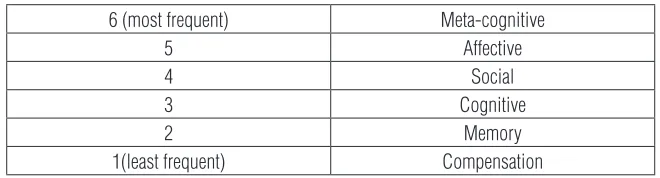
I visited the SAC for a period of three weeks at different times. As students showed up I explained to them the purpose of the study and asked them to complete the SILL and the survey. The collection was closed when 15 questionnaires had been returned. Average responses for each strategy were calculated across the 15 SILL questionnaires and ranked in order from 6 (most frequent) to 1 (least frequent). Each question in the survey was analysed as well.
Findings
ranked social and cognitive strategies in the middle-frequency average while memory strategies only ranked higher than compensation strategies.
Table 1. Rank ordering of language learning strategy group usage, as reported by SAC users
6 (most frequent) Meta-cognitive
5 Affective
4 Social
3 Cognitive
2 Memory
1(least frequent) Compensation
As a matter of first-cut analysis I stated earlier in this article that an autonomous learner might probably use cognitive, metacognitive and social strategies. The results show that my prediction was not far from the results actually found. The SAC’s users most frequently use metacognitive and social strategies which are indirect strategies. Indirect strategies are related to the general management of learning. This shows that somehow they are autonomous and that is why they use the SAC. However, the use of these strategies according to the results was reported to be used “usually” and “sometimes” by an average of 7 students out of the 15 that took part in the study. The same was true for the four ones that reported the use of social strategies.
Cognitive is a direct strategy that involves a manipulation or transformation of the target language by the learner and it is one of the most popular strategies to be used by language learners (Oxford, 1990 p.42). Direct and indirect strategies support each other. The students who took part in this study showed somehow this support as they arrange and plan their learning by going to the SAC to practice and deciding what task to perform. By doing so, they are combining metacognitive and cognitive strategies that is, an indirect with a direct strategy.
The analysis of the data from the SILL summarized in Table 1 demonstrated that memory strategies only ranked higher than compensation strategies. This may indicate students’ lack of use of mnemonics to remember vocabulary and verbal material for communication.
Compensation strategies were the least frequent strategy used by the participants. It might show that it is necessary to work on helping these learners to overcome knowledge limitations as compensation strategies “are intended to make up for an inadequate repertoire of grammar and vocabulary” (Oxford, 1990 p.47).
The students’ need for someone to talk to at the SAC shows the interactive nature of language learning and prooves self-access systems to be not a form of teacher-substitute but rather as a necessary resource for all language learners as long as it goes hand in hand with instruction and some kind of counseling.
Implications
This section presents the implications of the small-scale project for EFL contexts and especially those where SAC’s are implemented as a complement to classroom-based instruction. Previously I discussed the reasons that motivated me to evaluate the SAC located at the university where I was working.
From this evaluation, I learned that even though students found the SAC very well equipped and useful to practice and improve their English they needed some kind of counseling with language as well as with computers. This finding shows that although SACs provide the opportunities for personal involvement they should also provide interpersonal involvement as “the learner needs people to talk to, to listen to, to discuss, argue and exchange information with, to write to, to practice with, to learn from” (McCafferty, undated p.24). This is probably one of the reasons why in their description of the human resources required for a SAC, Miller, L. & Rogerson-Revell, P. (1993) include a language specialist and a computer “consultant”.
As English teachers we need to know the learning styles and strategies students bring to class to be able to provide them with a better atmosphere to learn. For this reason, applying the SILL at the beginning of a term or academic period could be a good means to achieve the purpose stated above. Although the participants in this study reported using metacognitive, affective and social strategies the most, there is still a need to work on memory and compensatory strategies. This is a sample of how the application of the SILL will inform us of the type of activities to be carried out in class in order to help our learners become more successful.
To summarise, systematic evaluation leads us to make informed decisions about teaching and learning and where to improve them. The results of the evaluation of a SAC located at a private university in Bogotá displayed that even though the students find the place a good resource for learning they need some counseling there.They also need some training on compensation and memory strategies to make the most of learning.
Conclusions
The purpose of this study was to explore how Self-access centre theory related to practice in terms of what students actually do there and how they perceive them, was also aimed at identifying the most frequently used learning strategies used by a group of SAC’s users.
In order to answer the question “which group of language learning strategies are used most frequently by the users of a SAC?, the data collected in this small-scale project showed that in theory, SACs are supposed to enhance students autonomy, in practice, SAC users’ most frequently used learning strategies are meta-cognitive, social and cognitive strategies, which might demonstrate that these are autonomous learners since these two strategies are indirect strategies. Indirect strategies are related to the general management of learning. Management of learning is a characteristic of autonomous learners since they are able to “take more responsibility for their own learning” (Dickinson 1993:331.). The fact that there were different preferences and not a high score on a particular strategy might show that these students have a relatively rich repertoire of strategies and have the confidence to ditch those that are not effective and try something else; which is another characteristic of autonomous learners stated by the author cited above.
The analysis of the survey design to answer the question, “what are the students perceptions of the SAC? demonstrated that students see the SAC as a good complement to classroom activities. However, they claimed they needed some kind of counselling related to the language and also to technology. As a complement to these human resources they also demanded material and technical resources such as A and D units as well as some readers.
students in these places, probably due to the social nature of language that makes it necessary to have someone to practice it with.
References
Brown, H. (2000). Principles of language learning and teaching. New York: Addison Wesley Longman, Inc.
Dickinson, L. (1993) Talking shop. Aspects of autonomous learning. In ELT Journal. 47
(4), 331-335.
Genesse, F. & Upshur, J. (1999). Classroom-based evaluation in second language education. Cambridge : CUP.
Little, D. (1991). Learner Autonomy. 1: Definitions Issues and Problems. Dublin:
Authentik.
Littlejohn, A. (1997). “Self-access work and curriculum ideologies”. In P. Benson and P. Voller (eds) Autonomy and Independence in Language Learning. London: Longman. MacCafferty, J.B. (undated). A consideration of a self-access approach to the learning of
English. London: The British Council.
Miller, L. & Rogerson-Revell, P. (1993). Self-access systems. In ELT Journal. 47 (3), 229-233.
Nunan, D. (1988) The learner.centred curriculum : A study in Second Language teaching. Cambridge : Cambridge University Press.
Nunan, D. (1997). Designing and adapting materials to encourage learner autonomy. In Benson, P and Voller P. Autonomy and independence in Language Learning. London: Longman .
Oxford, R. (1990). Language learning strategies. What every teacher should know. Boston
(Mas) : Heinle and Heinle Publishers.
Pennycook, A.(1997). Cultural alternatives and autonomy. In Benson, D & Voller, P. Autonomy and independence in language learning. London: Longman. (pp. 35-53) Quintero, A. (2003) Teachers’ informed decision-making in evaluation: corollary of ELT
curriculum as a human lived experience. In Colombian Applied Linguistics Journal. 5, 122-135.
Appendix A
ENCUESTA SOBRE ESTRATEGIAS DE APRENDIZAJE
Tomado de Oxford, R. (1990). Language Learning Strategies. What every teacher should know. Boston : Heinle and Heinle.
Strategy Inventory for Language Learning (SILL) Version 7.0 (ESL/EFL)
Traducción : Julia Zoraida Posada Ortiz Instrucciones
La siguiente encuesta tiene por objeto descubrir qué estrategias de aprendizaje usa usted cuando está en el laboratorio o con su tutor. Usted encontrará unas oraciones acerca del aprendizaje del inglés. Por favor léalas y marque el número que corresponda a lo que sea cierto en relación con lo que usted hace. Cada número tiene un significado.
1. Nunca o casi nunca cierto para mí
2. Usualmente no es cierto para mí
3. De algún modo cierto para mí
4. Usualmente cierto para mí
5. Siempre o casi siempre cierto para mí
Nunca o casi nunca cierto para mí significa rara vez
Usualmente no es cierto para mí significa menos de la mitad de las veces
De algún modo cierto para mí significa casi la mitad de las veces
Usualmente cierto para mí significa mas de la mitad de las veces
Siempre o casi siempre cierto para mí significa casi siempre.
Parte A
1. Pienso en la relación entre lo que ya sé y las cosas nuevas que aprendo 2. Uso las palabras nuevas en oraciones para recordarlas
3. Conecto el sonido de una nueva palabra en inglés con una imagen o dibujo de esa palabra para ayudarme a recordarla
4. Memorizo una palabra nueva imaginándome una situación en la que puedo usarla 5. Uso rimas para recordar las palabras nuevas
6. Uso láminas para tratar de recordar palabras nuevas 7. Actúo físicamente las palabras nuevas para recordarlas 8. Repaso las lecciones con frecuencia
9. Recuerdo la página, o la posición en el tablero de las palabras nuevas
Parte B
10. Repito en voz alta o escribo muchas veces las palabras nuevas 11. Trato de hablar como los hablantes nativos del inglés 12. Practico los sonidos del inglés
13. Uso las palabras que conozco de diferentes maneras 14. Empiezo conversaciones en inglés
15. Veo programas de televisión o películas en inglés 16. Leo por diversión en inglés
17. Escribo notas o mensajes en inglés
18. Primero leo rápidamente los textos en inglés y luego me detengo en detalles 19. Busco palabras que son similares en inglés y español
20. Trato de encontrar reglas en el uso del inglés
21. Divido las palabras en sus partes para poder entender su significado 22. Trato de no traducir palabra por palabra
23. Hago resúmenes de cosas que oigo o leo en inglés
Parte C
27. Leo en inglés sin necesidad de buscar cada palabra nueva que encuentro en el diccionario 28. Trato de anticiparme a lo que la persona que está hablando en inglés va a decir
29. Si no sé decir una palabra en inglés trato de explicar su significado (en inglés)
Parte D
30. Trato de encontrar todas las maneras posibles de usar el inglés 31. Noto los errores que cometo y trato de usar esto en mi favor 32. Pongo atención cuando alguien está hablando inglés
33. Trato de encontrar la manera de ser un mejor estudiante de inglés 34. Planeo mi horario de tal manera que me quede tiempo para estudiar inglés 35. Busco personas con las cuales pueda hablar inglés
36. Busco oportunidades para leer en inglés
37. Tengo objetivos claros acerca de cómo mejorar mis habilidades en inglés 38. Pienso en mi progreso como estudiante de inglés
Parte E
39. Trato de relajarme cada vez que siento miedo de usar el inglés 40. Me animo a hablar en inglés aunque tenga miedo de cometer errores 41. Me premio cuando uso bien el inglés
42. Noto si estoy tenso o nervioso cuando estoy estudiando inglés 43. Escribo mis sentimientos acerca de aprender inglés en un diario 44. Le cuento a alguien cómo me siento cuando estoy estudiando inglés
Parte F
45. Si no estoy entendiendo algo en inglés le pido a la otra persona que vaya más despacio o que repita
46. Le pido a los hablantes nativos de inglés que me corrijan cuando estoy hablando 47. Practico inglés con otros estudiantes
48. Pido ayuda a angloparlantes 49. Hago preguntas en inglés
Appendix B
Nombre________________________ Edad________ E-mail____________ Nivel________
ENCUESTA SOBRE ESTRATEGIAS DE APRENDIZAJE Hoja de respuestas
Hoja de respuestas Versión 7.0 (ESL/EFL) © R. Oxford, 1989
PARTE A PARTE B PARTE C PARTE D PARTE E PARTE F
1.____ 10. ____ 24. ____ 30. ____ 39. ____ 45. ____ 2.____ 11. ____ 25. ____ 31. ____ 40. ____ 46. ____ 3.____ 12. ____ 26. ____ 32. ____ 41. ____ 47. ____ 4.____ 13. ____ 27. ____ 33. ____ 42. ____ 48. ____ 5.____ 14. ____ 28. ____ 34. ____ 43. ____ 49. ____ 6.____ 15. ____ 29. ____ 35. ____ 44. ____ 50. ____
Appendix C SURVEY
Nombre__________________ edad___________ e-mail_______________ Nivel________________
¿Cada cuánto viene al laboratorio?
________________________________________________________________ ¿Qué aspectos positivos tiene el laboratorio?
_________________________________________________________________________ ______________________________________________________________________ ¿Qué aspectos negativos?
______________________________________________________________________ ______________________________________________________________________ El laboratorio está provisto de computadores con English Discoveries e Internet para que usted pueda practicar el inglés. ¿Qué otro tipo de recursos le gustaría encontrar en él para practicar inglés?
Asiste a tutorías Sí ________ No____________
Si su respuesta es afirmativa ¿Cada cuánto asiste a tutorías? En qué horario? ¿Con qué profesor? ______________________________________________________________________ ¿Qué prefiere para practicar venir al laboratorio o asistir a tutorías? ¿Por qué?
______________________________________________________________________ ¿Qué tipo de actividades realiza en el laboratorio?
THE AUTHORS
Julia Zoraida Posada Ortíz holds a Masters Degree in Applied Linguistics to the Teaching of English from Universidad Distrital Francisco José de Caldas. She is a full time teacher at Universidad de Ibagué –Coruniversitaria. ESOL Examiner for Cambridge. Specialist in teaching Literature from Universidad del Quindio.