A Fully Abstract Denotational Model for Higher-Order Processes
(Extended Abstract)
M. Hennessy
CSAI
University
of
Sussex
Brighton BN1 9QH, UK
Abstract
A higher-order process calculus is defined in which one can describe processes which transmit as messages other processes; it may be viewed as a generalisation of the lazy A-calculus. W e present a denotational model for the language, obtained b y generalising the domain equation for Abramskys model of the lazy A-calculus. It is shown t o be fully abstract with respect t o three different behavioural preorders. The first is based on observing the ability of processes t o perform an action in all contexts, the second on testing and the final one on satisfying certain kinds of modal formulae.
1
Introduction
The basic mathematical theory of process alge- bras is well-developed and fairly well understood, [Mi189, Hoa85, BW90, Hen881. Much of this funda- mental work has been carried out for “pure” process algebras, where the actions are taken to be simple syn- chronisation pulses along channels, but more recently theories have been developed for languages where vari- ous kinds of data are passed along the communication channels. For example in [Tho89, Tho901 processes may pass other processes as values; it is this type of process description language which is the topic of the present paper.
Here there are two kinds of action prefixing, c ? X . P , meaning input a process along the channel c and bind it to the process variable X in the term
P ,
and c ! Q . P , meaning output the process Q along the channel c and then act like the process P. Thus c ? X . ( XI
R)
represents a process which can input any process and run it in parallel with R. Combining this with c!Q.Pwe obtain the process c ! Q . P
I
c ? X . ( XI
R ) which can perform a communication to become the process PI
(QI
R ) . This idea is pursued in depth in [Tho901where a number of different formalisations are inves- tigated. The resulting language is shown to be very powerful in that it can simulate, in some sense, both the A-calculus and the if-calculus of [MPW92]. The connection between the if-calculus and various highet- order process calculi and their relative merits is fur- ther pursued in [San92]. Here we do not address such issues. Rather we investigate the possibility of pro- viding an adequate semantic theory for higher-order process calculi. In particular we provide a fully ab- stract denotational model for one such higher-order language.
The starting point for the development of this model is the lazy A-calculus. At a very naive level this is a primitive higher-order process language. The A-term Ax.p may be viewed as a process which is wait- ing to receive another process along the communica- tion channel
A
to be subsequently bound toz
in pwhile the application term pq represents sending the process q to the process p . In [AbrSO] this language is interpreted in the model obtained by solving the domain equation
D
=F i
F =
D - D .
Each A-term is interpreted either as I, in the CUE
when it gives rise to a divergent computation, or is an element of
F,
i.e. a function over A-terms. Ato C l , where C is some space suitable for modelling output. One simple suggestion for C is the Carte- sian product
D
xD,
with the elements of the pair representing, respectively, the process Bent along the channel and the residual of the output action.It
turns out that a slightly more complicated form of product is actually necessary, which we denote by DThe analogy between A-terms and higher-order processes given above is rather tenuous but it has helped us motivate a model obtained by solving the recursive domain equation
D.
P = ( N - C . L ) X ( N - F L ) F = P - P
c
= P @ PMoreover one can easily imagine how the combina- tors of input and output might be interpreted over this model. But a reasonable process algebra contains other combinators. At first glance the choice combi- nator
+
would appear to present problems. The A- calculus is completely deterministic in its extensional behaviour but nondeterminism is an essential aspect of process algebras. However in [BouSl] it is shown how to interpret a nondeterministic version of the A- calculus in the domainD;
this is in fact a prime al- gebraic lattice and in particular it has a join operatorv.
The domain P is also a prime algebraic lattice and thus we can use exactly the same approach, interpret- ing the choice combinator+
as V. Moreover having an interpretation of prefixing and choice means that using an expansion theorem we can obtain an interpre- tation of the parallel combinatorI.
Finally it turns out that we can also interpret in a straightforward fashion certain forms of channel scoping; that called dynamic scoping in [ThoSO].Having outlined a possible denotational semantics for a higher-order process calculus the next question we must address is: how reasonable is this as a model of the behaviour of processes? To answer this question we again pursue the analogy with the A-calculus. How good is D as a model of the behaviour of A-terms ?
This question is answered in a very precise manner in [AbrSO, BouSl] and we can give a very similar answer for P.
In [AbrSO] an observational preorder is defined on A-terms in terms of their ability to converge to a “func- tional term” of the form A2.r using a lazy evaluation strategy. Let us denote this by p JJ and for two A-terms p , q let p 4 q if p JJ implies q
U.
Let p
Lo
q if for every contextC[
1,
i.e. aterm with one “hole” [ ] in it, Cb] 4 C[q].
In [AbrSO] it is shown that, subject to certain expres- sivity requirements, the domain D is fully abstract with respect to the observational preorder
&,
.
That is, pLu
q if and only if the interpretation of p in the domain D is dominated by the interpretation of q ; the domain properly reflects the ability of A-terms to act like functions. A similar result holds for the the non- deterministic or parallel version of the A-calculus of [BouSO, BouSl] where p is interpreted as it is possi- ble for p to converge to a functional term, although in these papers a different phraseology is used.Viewing the A-calculus as a primitive higher-orcler process calculus p
U
can be interpreted as: p is willing to offer a communication on the communication chm- ne1 A. So let us generalise this predicate to arbitrary processes from our higher-order process calculus by defining:p
is willing to offer a communication. if there exists some channel on which p
The main result of this paper is that, subject once more to expressivity requirements, the model
P
is fully-abstract with respect to the observational p re- order&,
,
with this new interpretation of4.
That is, the interpretation of the process p in the domain P is dominated by that of q if and only if for every contextC[]
if C[p] is willing to offer a communication on some channel then so is C[q].We also prove full abstraction for two other observa- tional preorders between processes and both can also be motivated by reference to similar results for the lazy A-calculus. The ability to examine a A-term in an arbitrary context gives one complete control over that term; the context can for example send the term to a collection of subterms each of which can examine
an aspect of its behaviour and then pass it on to other subterms for further examination. However each of these subterms can only use the term under exarni- nation in a limited manner: they can only supply an argument for the term to be applied to. So a sim- pler behavioural preorder may be defined on
A-
terins based on their reaction to a sequence of arguments:p
LT
q if ( . . . @ I ) . . . T ” )U
implies(.
. .
(prl). . .
rn)U
for every sequence of A- terms PI,. . .
,
T ~ .out about their behaviour is to send them a parame- ter, i.e. communicate with them. This is very similar in spirit to the theory of testing for processes, origi- nally presented in [DH84] and expounded at length in [Hen88]. There a test e (represented as another pro- cess) is applied to a process p by running e and p in parallel, thereby allowing them t o communicate, and the application is successful if e reaches some ‘‘SUCC~SS-
ful” state. The test e may be viewed as a generalis* tion of the sequence of parameters r1,
. . .
r , supplied to the A-term and the successful state plays the role of4.
So let us generaliseL7
to higher-order pro- cessea by saying p may satisfy the test e if there is a successful application of e to p andp
LT
q if p may satisfy e implies q may sat- isfy e for every test e .We show that P is also fully abstract with respect to
The full abstraction results in [AbrSO, BouSl] rely heavily on a logical characterisation of the domain D, [CCSO, AbrSl]. Ehentially the compact elements of
D
can be described by formulae,#J,
from a logic in such a way thatD
is isomorphic to the filters gener- ated by the logic. Further the interpretation of the A-calculus inD
can be completely captured by a pro- gram logic whose judgements are of the form I- p :4
and this program logic is central to the proofs of full abstraction. A similar program can be carried out for the modelP
and the resulting logic is a simple modal logic whose formulae express the ability of pro- cesses to receive and transmit along communication channels. Furthermore we can interpret this modal language operationally over processes using a satisfac- tion relation between processes and formulae; it is called a realizability interpretation in [BouSl]. This gives a further method for comparing behaviourally processes :C
-7
let p
LL
q if p+
4
implies q+
4
for every formulae4.
We also show that P is fully abstract with respect to
C This is analogous to the modal characterisa- -I2
-
tion of bisimulation equivalence for processes given in [HM85].
To sum up the three behavioural preorders C C - 0 , -7
and
5,
coincide over higher-order processes defin- able in our language and further they are characterised precisely by the model P.The literature on higher-order process algebras is rather limited. We have already refered to [ThoSO],
on whose language we base our algebra. Their re- lationship with the 77-calculus is studied in [SanQ!2] while [AR87,
GMPSO,
Nie891 present higher-ordm programming languages which contains among other constructs a sophisticated type structures for the val- ues transmitted between processes. The addition of parallelism to the A-calculus is studied extensively in [BouSO, BouS1, Bou921; in particular fully-abstract models, filter models of logics, are constructed for the observational preorder over parallel-A-terms. Howevctr all of this research concentrates on developing a be- havioural theory of these languages. The only denotic tional model for such languages of which the author is aware is presented in [JPgO]; this is for a very simple subset of the 7-calculus of [Bou89], a mild generalisii- tion of the A-calculus, and moreover the model is on1 y shown to be adequate.Most details of the proofs are omitted from this extended abstract. They may be found in the full version of the paper, [Hen92], which also contains a more leisurely account of the various concepts and techniques used.
2
The Language
The syntax of the language is given by
T
.._
..-
N I LI
T + TI
n?FI
n!CI
X
I
F TI
G ( D ,
G E
Aus ProcessesAbstractions
F
::= ( X ) T ConcretionsC
::= [TITwhere n ranges over a set of channel names
N ,
;Yranges over a set of process variables
X
and Auz is a set of auxiliary operators. In this paper we use a particular set of such operators: for each pair of sub- sets,d,B
ofN ,
a binary infix parallel operator&
and for each function r fromN
toN
which is almolit everywhere the identity a unary postfix renaming 01)- erator {r}. In( X ) T
the prefix(X)
acts aa a bindcr for occurrences ofX
inT
and this leads to the stan- dard notion of free and bound occurrences of variables, a-conversion and of substitution. We use process to mean a closed process-term from this language and P,Q,
.
. .
are used to denote typical processes.Input:
n?F F
output:
n!C
-%
c
P
2
A implies P+
Q
2
A Choice:Application:
T { Q / X }
5
A
implies F Q2
A where F is ( X ) TPar allelism :
P
A
A , name(c)E
A U {T} impliesP
AIB
Q
A
AAIBQ
P
3
F, QP
AIB
Q
2
FQiAIB
Q 2 Communication:[Q1]Q2 implies
Renaming:
P
5
A implies P { r }3
A { r }where
if F is ( X ) T then F A ~ B P denotes ( X ) ( T A ( B P ) (and similarly for P
AIB
F ) and F { r ) denotes [image:4.617.84.282.105.391.2]if
C
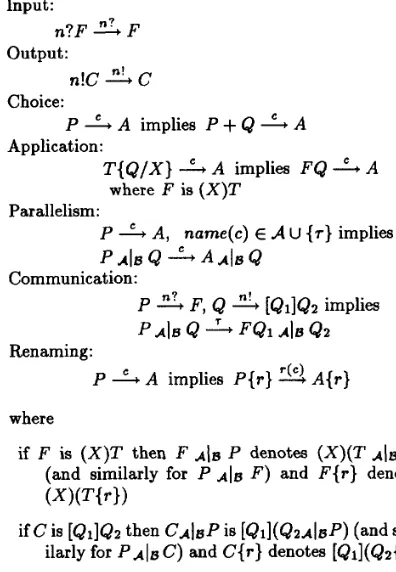
is [Q1]Q2 then C A ~ B P is [ Q ~ ] ( Q ~ A ~ B P ) (and sim- ilarly for P A ~ B C) and C { r } denotes [ Q ~ ] ( Q ~ { P } ) ( X ) ( T { d )Figure 1: The Operational semantics
judgements, of the form
where P and Q are proceases, F is a closed abstraction term and
C
a closed concretion term. The relations-%
and-%
describe the communication capabilities of processes while5
describes the affect of an actual communication;P
A
Q means that P may perform a communication and thereby be transformed into Q and this may be considered as the counterpart toP-
reduction in the A-calculus.With this operational semantics the language may be
mechanism. To see this let us use the more usual nota- tion P
I
Q for P & r Q and P\A in place of P B ~ N NJrL whereB
isN
-
d;
this latter process acts like P ex- ceptthat
all channels inA
are local. Now consider the termn ? ( x ) ( x
I
P )
I
(n![QIR)\Awhere
Q
is a process using some channels from A. The occurrences of channels fromA
in Q are governed bythe restriction, i.e. they are local. Now a communi- cation using the channel n is possible and when it happens the process is transformed into
The result is that Q has escaped from the restriction by being sent from one process t o the other.
Based on this operational semantics we give three different behavioural equivalences or preorders. The first is motivated from the view of the lazy A-calculus advocated in [AbrSO, BouSO], as explained in the In- troduction. To define
&,
it is sufficient to define the convergence predicate4
on processes:p J. if there exists some q and channel n such that p -* T q -, c for c
=
n! or c = n?.The second behavioural preorder,
sT
,
is a di- rect application of the general framework of testing, [Hen88], again as explained in the Introduction. Here the idea is that two processes are deemed to be equiv- alent unless there is a test or experiment which dis- tinguishes between them. Processes are considered to be independent entities or “black boxes” and a test consists of a series of interactions between the process and the tester which continue until such time as the the tester reaches what it considers to be a successful state. The tester has no control over the process; it simply tries to communicate with the process, the pro- cess may deem to reply and if it does the tester may proceed with the experiment in a manner dependent on the reply of the process. In the present setting we take as a teat any process which may use a new dis- tinguished name w and say it is in a successful state if it can perform the action w ! . The application of the testE
to the processP
is defined to be a maximal sequence of the formseen as a simple extension t o CHOCS from [ThoSO]. Channel restriction or hading is implemented by the parameterised parallel operator; in p Q all Occur- rences of names not from A in P are local to P and similarly for
B
inQ.
With this view of restriction our operational semantics implements a dynamic scopingE
1
p=
Eo
I
po2,
and it is a successful application if there exists an n
2
0 such that E,
%.
Then we say P may E if there exists an application of E to P which is successflil. FinallyP
LT
Q if for every teat E P mayE
implies Q may E.The third behavioural preorder is based on a “real- izability” interpretation for the language using a gen- eralised modal language
L.
Formulae represent prop- erties of processes and may indeed be an appropri- ate generalisation to concurrent systems of the notion of “type” commonly used for functional programming languages. For each of the syntactic categories, pro- cesses, abstractions and concretions, we have a corre- sponding set of formulae,Lp,
LF,
Lc
respectively. These are defined byPro ceases :
W E L P
4
ELF
implies (n?)$ EcP
4
EL~
implies ( n ! ) 4 EtP
4 1 , .
. .
, 4 k ,
II,
EL p
implies 41,.. .
,
4 k
-+ 11,E
tF
41
,
.
.
.
,
&,
4
ELp
implies[h,
.
. .
,4k]+
Ecc
Abstractions :Concretions:
The satisfaction relation,
bo,
is also typed in that it is only defined between closed terms of each syntactic category and modal formulae from the corresponding language. It is defined as follows, where P=&
A is an abbreviation for PL*
PIA
A. :P
bo
w for every process PP
2
F,
F4
implies Pbo
( n ? ) ~P
S-
C,
c
bo
4
impliesP
bo
( n ! ) ~if (VP, P
bo
4
implies F P bo 11,) thenF
bo
$4
if Q1
bo
$
and Q2bo
11,
then [Qi]Q2bo
[$I4
-
Note that
bo
depends entirely on the behaviour of terms and not on their structure.Let P
gr
Q if Pbo
4
impliesQ
bo
4
for every formula4.
We aim to show that the three behavioural pre- orders,
Lo,
gT
andgr
coincide. The modal language is the key to the proof as it provides a cru- cial link with a natural denotational semantics which can be shown to be fully-abstract with respect to each of these preorders.3
TheModel
We have already seen the domain equation for the model in the introduction but it remains to explain both the construction Br and why it is necessary. In analogy with the view of the domain D for the lazy A-calculus in [BouSO] if domain for processes,
P,
isan algebraic lattice then we can interpret the choice operator
+
as the binary join, But if we use aa the domain of concretions C the Cartesian product P xI?
the join operation in C is defined pointwise; it satisfies the law:(21, Y1)
v
(22, Y2)=
(21v
22, Y1v
Y2).In such a model the processes m![ n!
+
k!
] N I L andm![ n! ] N I L
+
m![IC!
] N I L (where we useI!
as a shor1;- hand for the process l![NIL]NIL, whenever it makt:s sense) would be identified although one can easily find a test to distinguish them. It turns out that we require a product which satisfies the weaker law:(2, Y1)
v
( 2 , Y2)=
(2, Y1v
Y2).Such a product can be defined in the category of prime algebraic lattices with continuous functions. In this category we say f is mulidinear if it preserves LI in each of its arguments, i.e. f(d1,
.
.
.
,
dj V d ; ,. . .
dk):=
f(d1,.
. .
,
d,,. .
.dk) V f(d1,..
.
,
d i , ..
.dk), for each i , a function of two arguments is called rightlinear when- ever it preserves join in its second argument, i.e.f(z, yl V y2)
=
f(z, y1) V f(z, y2) and for functions of one argument we abbreviate “multilinear” to “lin- ear”. For any pairD1
,
D2, letD1
Br
D2 be the prime algebraic lattice which satisfies1. there exists a rightlinear continuous injection
iQpr:D1 x
Dz
-
D1Br
D2,2. for any rightlinear continuous f : D1 x D2 I-+
E
there exists a unique continuous linearf@‘:
D1 @r D2-
E
which makes the following diagram commute:D1 x D2
Di 0 2 f@r + 1;
The construction of D1 Br D2 is given in [Hen921 as :.s
We us now briefly outline the interpretation of the language in this model. Most of the syntactic con-
structs are straightforward. Output on the channel Refl
n is interpreted by the linear function nmt:
C
-
P
defined bynout(c)
=<
Ax EN.(x
=
n + CI,I)
,
Ax EN . 1
>
and input by the linear function ni,:
F
-
P
defined in an analogous manner:nin(f)
=<
ASE N . I
General :
Weak
Trans
Ax
EN.^
= n 4 f1,I>
Processes : Let U range over the set of environments, ENV,
mappings from
X
to P. Then the interpretation of CPl0 [Nll]pa
=
I
cp2the language is given by:
0 [n?F]pa
=
ni,([F]~u)( n ! q P a
=
nout(EClc4 Abstractions :4 1 4
[G(T)PPU
=
S ( K l P )where for each auxiliary function symbol
G
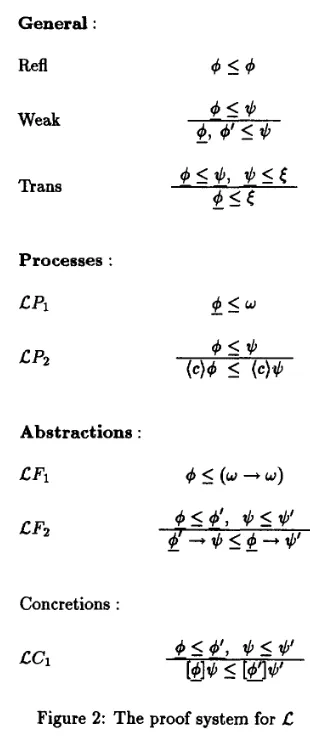
we have a corresponding multilinear function g of the appropri- ate type. The details are given in the appendix.Following [CC90, Sc0821 we can also give a logical presentation of both the denotational model and the interpretation of the language. First we examine the model. Consider the logic in Figure 2. The judge- ments are of the form
&
<
$ where&
is a non-empty vector of formulae and we assume that all the formulae$i and
3
have the same type. Let us write I- 45
3
if
4
5
3
can be derived using these inferencerules a n a more generally I-4
5
3
if4
5
3j can be derived for each j. This logiFchGact&ises precisely to the model in the sense that each formulae4
E
L A ,
for A = P, F,C ,
can be interpreted as an element[4]
inA
so thatFigure 2: The proof system for C
0
Ilk] I
[&I
if and only if I-4
- -
I
$This interpretation is given by:
Definition 3.1
Processes : [U]
= I
[(.!MI
=
nOut([41)E(nW1
= nin([4]) Abstractions :(4
--+$1
=[a
j [$]Concretions :
[@I$]
=
[a
8 rwhere
+
represents the usual step function defined bye
d < x
I
otherwise0
This relationship between the model and the logic c.an be elegantly described in terms of filters. An A-filter
d j e(z)
=
0 is prime
0 every prime element is denoted by some formula,
and therefore every compact element
is
denoted by some vector of formulae if we define[&I
to be [image:6.617.342.497.85.454.2]is a non-empty subset
F
of vectors of formulae fromLA
with the property that4
E
F
andL
I-4
<
$implies $ E
F .
Let FilA be the set of all ATfilter; ordered %y set inclusion.Theorem 3.2 For A
=
P,F ,
C , FilA is a domainand isomorphic to
A.
0The primes of the domain P are all denotable by formulae from
LP
and the functions corresponding to the auxiliary operators, because they are multilinear, are determined by their effect on primes. So these functions can also be described in terms of logic; ifG
is of arityA
we define a functionG:
(12')~-
Pj
(P),
from vectors of formulae to finite sets of formulae, with the property that g ( [ & ] ,
. . .
,
[4k])
=
EG(q5J)B; on the left hand side g represents the semantic function ap- plied to the elements8411,.
. .
,
[dk)B while on the righthand side G is a function applied to a vector of for- mulae and the resulting finite set of formulae is inter- preted in the obvious way using V.
The function { r } over formulae is defined by the two clauses
0 w { r }
=
w0 ((C)(&)$)W =
.(.)(+)€
where€
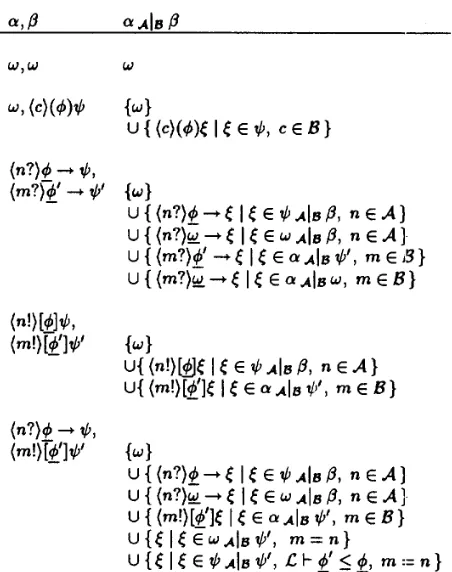
= ${PI.The main difficulty is in defining the parallel function
A ~ B . This is given in tabular form in Figure 3, where
some of the symmetric cases have been omitted.
To
make these definitions more compact we have used the notation ( c ) ( 4 ) $ to mean (.?)I$-
j $ when c i s m? and(m!)[&f~ when it is m!.
Theorem 3.3 g(8411,.
.
.,
144)
=
[G(&)]
for every G in Aux.Proof: By structural induction on
-
4.
0Next we show that the interpretation of the pro- cess language in the denotational model can also be captured in a logical form. We design a program logic whose judgements are of the form
I'I-"A:c$
where
4
E CA for each A = P,F,
C
andI'
is an as-sumption. A assumption is a finite map from
X
to non-empty finite subsets ofL p .
We will actually rep- resent these finite subsets as vectors of the form&.
Let I'(X) denote w whenever X is not in the domain of I' and I'[X H41
represent the assumption obtainedfrom I' in the ol%ous way
-
it coincides with I' for [image:7.616.314.540.95.381.2]W
Figure 3: The parallel operator on formulae
every name except
X
which it maps to4.
We will also use I' Fa A :4
as an abbreviation for &e A judge- ments I' I-' A :&,
1<
i<
A and by and large we omit the superscripts from consequence relations, ren- deringt-"
ast-.
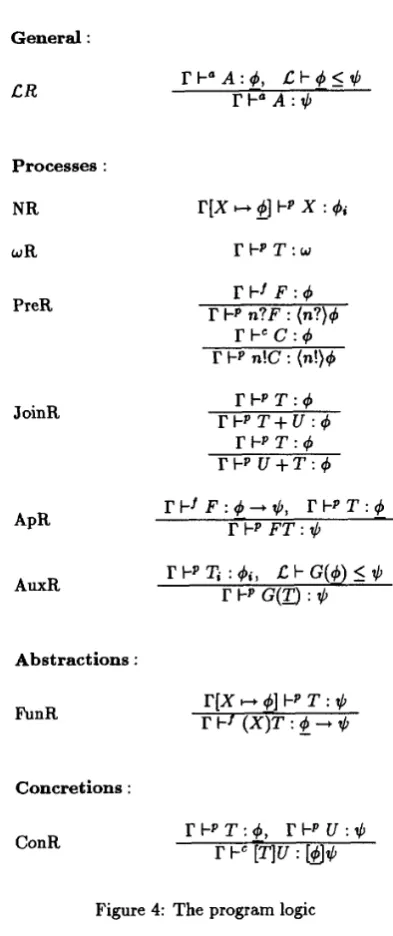
The rules for deriving judgements are given in Figure 4. Note that the rule AuxR uses the interpretation of the auxiliary operators over the for- mulae. In order to establish that the processG ( E )
satisfies a property $ in general it is necessary to es- tablish that each Tj satisfies
4i
for a vector of formulae4
suchL
I- G(@<
$. This is not a very practical way to proceed and a more realistic program logic woulld replace the rule AuxR with individual rules which use the syntactic structure of the termsG(Z).
However the present rule is adequate for our purposes.This program logic can be interpreted over the denotational model in the following manner. For
U
E
E N V let U I' if [I'(X)]5
u ( X ) for all X . Thenwe write
I'
ba
A :4
if U-
I' implies
841
5
[A]..I ' k a A : 4
General :L R
Processes :
NR
w R
PreR
JoinR
APR
A w R
Abstractions :
FunR
Concretions :
ConR
I'l-PT:w
r l - - f F : d
I'
I-p n?F : (n?)4I' l-p n!C : (n!)t$
[image:8.620.95.292.88.557.2]r I - c c : d
Figure 4: The program logic
I'baA:q5
Proof: It is sufficient to show that
I'
ba
A
:Q
satisfies the defining rules ofI'
Fa A :4.
Note that the rule A w R is justified by Theorem 3.3. 0Theorem 3.5 (Completeness) I'
b*
A :4
impliesProof: For any assumption
I'
letar
be the envi- ronment defined by.r(X)
=
[I'(X)].
Then one can show by induction over A that[#I
5
[Alar impliesI
'
kaA
:4.
The result now follows because+
I' 0We can also interpret the program logic using the realizability or observational interpretation of sect ion two. Soundness is straightforward but the more diffi- cult completeness will be given in the next section.
If p is a closed substitution we write p
bo
I' if for everyX
E X p ( X )bo
r ( X ) andI'
'$'
A : q b ifp
bo
I' implies Ab
4.
Note that I'bo
A :4
refers to the operational behaviour of A while I'b"
A :4
refers to its denotational interpretation.
Proposition 3.6 I' I- A :
4
implies I'bo
A :4.
Proof: Again it is sufficient to prove that the relation I'
bo
A
:4
satisfies all the defining rules ofI'
I- A :4.
04
Full
Abstraction
In this section we prove the main results of the pa- per, connecting the denotational interpretation with the various behavioural preorders.
First some notation. Each element p of P may be considered as a pair of functions which we denote by
p ! and p? respectively. Moreover for each n in
N '
it will be convenient to denote p ( n ) and p ( n ) as p( n!) and p(n?) respectively. The first lemma shows that the denotational interpretation is consistent with the operational semantics.Lemma 4.1 1. For c of the f o r m m? or m!,
P
-2
A implies [AIL
5
[ P ] ( c )2.
P
A
Q implies[Q]
5
[PI.Proof: Both statements are proved simultaneously by induction on the length of the derivation of the
operational judgements. 0
As an immediate corollary we have the following d e -
Theorem 4.2 (Adequacy)
P
JJ if and only if[PI
#
1.
Proof: First suppose that
P
4,
i.e.P
L*
P'
for some c. The first part of the previous lemma implies [ P q ( c )#
1 while the second part implies [ P I5
[PI,
i.e. [P](c)
#
1 and therefore that[P]
#
1. Conversely suppose [PI#
I, i.e. for some c, [ P ] ( c )#
1. Then by the completeness theorem for the program logic, Theorem3.5,
I- P : ( c ) w . By the soundness of the program logic with respect to the realizability interpretation, Proposition3.6,
bu
P
: (c)w, i.e. PA.
Note that we have in fact established the slightly stronger result: P
&
if and only if [ P ] ( c )#
1 0As an immediate corollary we have one direction of the full abstraction result:
Corollary 4.3 For closed terms [PI
5
IQ] implies PLOO-
Proof: Let C [
]
be any closed context such that C [ P ]A.
We must show that C[Q] which, by the adequacy result is equivalent to showing [C[Q]](c)#
and another application of the adequacy result gives [C[P]](c)
#
1. It therefore follows that [C[Q]](c)#
1. 0
1.
But[PI
5
[Ql
implies I[C[Plll5
Ec[Q11
To prove the converse we need a a definability result.
Theorem 4.4 (Definability) For every n , i
E
.JV
and4
E I?' there exists a closed process termP;"
and a closed abstraction t e r m F;" of the f o r m ( X ) ( q * ' { , , ~ l a X ) , whereqp'
i s closed, such that f o r any n , i not occurring in4
1. for all d E P, [ n ! ]
5
[F;"]d if and only if[4]
5
d2.
[P;q
=
141.
Proof: For convenience we use T D"
U
to denote the term Tel^-{,,)
n?(Y)U whereY
is some variable not occurring in U. First suppose we have defined F;;', where4
=
41. .
. 4 k
Then we let F;#' denote the term-
-
( X M q ; '
{"}I@
X ) b + il D" (.. .
(q:
{"}lo
X I . *.)I
where [n +
i]
denotes the renaming which renames nto i and leaves all other names untouched. In a similar
vein if
P;*'
have been defined we let P;li denote+
.
. .
+
P i t
and trivially [P;"]=
[P$ V. . .
V El';:]. The definitions of the requGed terms are by inductionon the structure of
4:
The proof that these terms have the required prope,r- ties is carried out by structural induction on formulae. It depends on the fact that [F;C]d is either I or [ n ! ] .
for every d. 0
Theorem 4.4, together with adequacy, gives a con- verse:
Proposition 4.5 For closed terms P
,&
Q implres[PI
I
IQ]-
Proof: To prove [ P ]
5
[Q] it is sufficient to prove[+]
5
[Q] for any4
such that[4]
5
[PI.
For such a4
the definability theorem implies that [ n ! ]5
[F,"ti][I'], for all n ,i
not appearing in4,
which can be rewrittenas [ F ; ' ] [ P l ( n ! )
#
1. By the adequacy theorem this implies F;"Pa.
In general F;"R if and onlyif
T;?'
{nlj(
R3
and sinceP
LT
Q it follows thatF;"Q which, again by the adequacy theorem, iin- plies In!]
5
[F;"][Q].
Employing the definability re-o
sult once more we obtain[+]
5
IQ].As an immediate corollary we have
Corollary 4.6 (Full Abstraction) For closed t e n n s P
Lo
Q if and only if PLT
Q if and only ifP
gr
Q if and only if[PI
5
[Q].of Proposition
3.6
it is therefore sufficient to show Pk0
q5 implies I-P
:9.
By the completeness result Theorem3.5
this is equivalent to showingP
b0
4
implies [q5]
5
[PD. The more general result Abo
q5 impliesI+]
5
[A]
for A any closed process, abstrac- tion or concretion term, can be established by induc- tion on4;
the case when4
has the form (c)$ uses Lemma 4.1 while the case&
-+4
depends on the fact that [P;.i] =141
-
for any n ,i
not occurring in&
and therefore, by Proposition3.6,
that P;.iko
&.
0-
5
Conclusions
We have presented a semantic model of higher- order processes and shown it to be fully abstract with respect t o a number of observational preorders. But these results raise many questions, some quite specific about our technical development and others more gen- eral.
It has been shown in [San921 that higher-order pro- cess languages can be simulated in the ?r-calculus but this is not to say that such languages are superfluous. They may provide convenient specification formalisms at an appropriate level of abstraction for describing the behaviour of sophisticated systems such as dis- tributed operating or control systems,
[LB92].
If this is the case then what kind of combinators should such a language have and can we model them using this se-mantic domain? Another question concerns the chan- nel scoping mechanism used in the language. As we have seen
P
is adequate for modelling dynamic scoping but it has been argued in [Tho901 that static scoping of channels leads to a more natural language. At the moment it is not clear how to amend the definition ofP
so as to correctly model static scoping.The program logic presented in section 6 provides the theoretical basis for a proof system for deriv- ing properties of higher-order processes. As already pointed out this logic is not very realistic as to prove a parallel process p
AIB
q has a property 2c, it is nec- essary to find two formulae 41,1$2 such that we canprove that p has the property
41
and q 4 2 and thenprove that the characteristic formula q51&& logically
implies
4.
However this rule AusR could, at least in the case of the parallel operator, be replaced by more useful or easily applicable rules. The exact form these replacement rules should take remains to be seen.Another line of possible future research concerns the behavioural preorders being modelled. That stud-
ied in the present paper is very weak, at least com- pared to many preorders defined for first-order pro- cess calculi. For such calculi it essentially corresponds to trace inclusion: P
5 Q
if every sequence of ac- tions whichP
can perform can also be performed byQ.
This is very weak as it does not take into consid- eration the possible deadlocks or divergences of pro- cesses. For example it does not distinguish between the process a.P and a.P+
a.NIL or a.P+
a.R
whereR
represents some process which can only perfcrm an infinite internal computation. There are a large number of more discriminating behavioural preorders and equivalences in the extensive literature on pro- cess algebras, for example bisimulation equivalence [Mi189], failures equivalence [Hod51 and the testing preorders of [Hen88]. These may easily be extended to higher-order processes and the approach to be-havioural preorders in the definition of can a.lso be strengthened so as to include information on dePd- lock. The simplest modification is to base the basic comparison 4 between processes not on their abi; ity t o perform actions but on their ability to converge: P
4
if there is no infinite internal computation from P, P5
Pi5
. .
.
A
and P may4
if there ex- ists someQ
such thatP
&
Q
andQ
4.
The b2sic comparison could now be defined by-0
P 4
Q
if P may .lJ. implies P may4.
The resulting behavioural preorder is different than that which we have studied as it differentiates NIL from s1 whereas they are identified in our theory. An
even stronger comparison could be defined by
P 4
Q
if PU
impliesQ
4.
This leads to a behavioural theory which in general differentiates between processes of the form a.P, a.]>+ a.NIL and
Q.P
+
a.R. It remains to be seen if fully abstract denotational models can be constructed for these theories.Appendix: The auxiliary functions
To interpret the auxiliary functions over the domitin
P
it is convenient to introduce some notational con- ventions. The first concerns the “lifting” operation. Suppose t(g) is a meta-expression involving the vazi- ables g with the property that t(2) E E for all valuesvi from a set
E i .
Then if wi E E i , t(g) denotes the value in E l determined byI
if 3i.wj =I
The second convention is a convenient way of describ- ing functions over tensor products. Let A ( d i , d 2 ) E
D1
x D2.t represent a r i g h t F a r function in[D1
xD2
-
E].
Then we use A* ( d l ,4 )
E D1x
D2.t to represent its unique extension to a linear function inThe most difficult function to define is that cor- responding t o the parallel operator
a l ~ .
Informally the definition simply mimics the usual interleaving interpretation of parallelism. Formally it takes the form Y ParA,s whereY
is the least fixpoint operator and P w A , ~ is a function of type [ P x P-
P ]-
[P x P -+ PI. Intuitively ifF
is of type P x P-
P
then P a r A , B F , when applied to two processesx
and y calculates the resulting process by “unioning” t e gether three different components. The first considers possible moves from z and calculates their residuals by applyingF
recursively, the second does the same for y while the third calculates the possible results of communication betweenx
and y using any channel inN .
Formally ParA,BF(x, y) is defined by[Dl Bt D2
-
E].V ~ E A miflAd E P-F(z(m?)d, y)
v
mout Cl(m) VV m E B minAd E P . F ( z , y(m?)d)
v
mod C r ( m ) VVmEN
(
ABr(d, d’) EP
x P . F ( z ( m ? ) d , d’) )y(m!)v
( ~ @ ‘ ( d ,6)
E P x P.F(~‘, y(m?)d) ) z ( m ! )where
C l ( m )
=
(6)
ED
x D.d F(d‘, y) )z(m!) C r ( m ) = ( ABr(d,6)
E P x P . F ( z ,b)
Br d )y(m!)The other auxiliary function, renaming, is handled in a similar manner. It is interpreted as
Y
Rent where for each renaming r Ren,:[P
-
P] c)[P
-
P]is defined by
R e n , F x
=
v
r(m)i,Ad E P.F(z(m?)d) mENv
r(m!)ou*C(m)where
C ( m ) = (ABr(d, d’)
E
P x P . d B r F ( b ) ) z ( m ! )Acknowledgements: Thanks to Gerard Boudol for his detailed comments on a first draft of this paper.
This work has been supported by the SERC grant GR/H16537
References
[AbrSO]
[AbrSl]
[AR87]
[Bou89]
[BouSO]
S. Abramsky.
The lazy lambda calcu- lus. In D. Turner, editor, Research Topits in Functional Programming, pages 65-11:’. Addison-Wesley, 1990.Samson Abramsky. Domain theory in log- ical form. Ann. Pure Appl. Logic, 51:1-7:‘, 1991.
E. Astesiano and G. Reggio. SMoLS-
driven concurrent calculi. In T A P S O F T 1987, Lecture Notes in Computer Sci- ence 351, Lecture Notes in Computer Sci- ence, pages 169-201, 1987.
G. Boudol. Towards a lambda-calculus for concurrent and communicating systems. In
J. D i u , editor, Proc. TAPSOFT 89, pagcs 149-161. Springer-Verlag, 1989. LNCS 35 1.
G. Boudol. A lambda-calculus for parall’s1 functions. Technical Report 1231, INRIA- Sophia Antipolis, 1990.
[BouSl] G. Boudol. Lambda-calculi for (strict) par- allel functions. Technical Report 138’7, INRIA-Sophia Antipolis, 1991. To appear in Information and Computation.
[Bou92] G. Boudol. A calculus of communicating objects, 1992. To appear as INRIA RI.- search Report.
[BW90] J. Baeton and W. Weijland. Process Al- gebra, volume 18 of Cambridge R a c t s :in Computer Schnce. Cambridge University Press, 1990.
[CC901 F. Cardone and
M.
Coppo. Two exteii- siona of curry’s type inference system. I:n P. Odifreddi, editor, Logic an Comput<:r Science, pages 19-25. Academic Press, 1990.[GMPSO] A. Giacalone, P. Mistra, and S. Prasad. Op- erational and algebraic semantics for facile: A symmetric integration of concurrent and functional programming. In Proceedings of
ICALP 90, volume 443 of Lecture Notes in Computer Science, pages 765-780, 1990.
[Hen881 M. Hennessy. An Algebraic Theory of Pro- cesses. MIT Press, 1988.
[Hen921 M. Hennessy. A fully abstract denotational model for higher-order processes. Technical Report 6/92, CSAI, University of Sussex, 1992.
[HM85] M. Hennessy and
R.
Milner. Algebraic laws for nondeterminism and concurrency. Jour- nal of the Association for Computing Ma- chinery, 32(1):137-161,1985.[Hoa85] C.A.R. Hoare. Communicating Sequential Processes. Prentice-Hall, 1985.
[JP90] R. Jagadeesan and
P.
Panangaden. A domain-theoretic model for a higher-order process calculus. In M.S.Paterson, editor, Proc. ZCALP 90, pages 181-194. Springer- Verlag, 1990. LNCS 443.[LB92] L. Leth and B.Thomsen. Some facile chemistry. Technical Report ERCC-92-14, ERCC, 1992.
[Mi1891
R.
Milner. Communication and Concur- Ten c y. Prentice-Hall, 1989.[MPW92] R. Milner, J. Parraw, and D. Walker. A cal- culus of mobile proceses, part i. Informa- tion and Computation, 100(1):140, 1992.
[Nie89] F. Nielson. The typed A-calculus with first- class processes. In Proceedings of Parle 89, volume 366 of Lecture Notes in Computer Science, 1989.
[San921 D. Sangiorgo. Ezpressing Mobility in Pro- cess Algebras: First-Order and Higher- Order Paradigms. Phd thesis, Edinburgh University, Scotland, 1992.
[Tho891 B. Thomsen. A calculus of higher lor- der communicating systems. In Conference Record of the Sixteenth Annual ACM Sym- posium on Principles of Programming L m - guages, pages 143-154, 1989.
[Tho901 B. Thomsen. Calculi for Higher-Onler Communicating Systems. Phd thesis, Im- perial College, 1990.
[Sco82] D. S. Scott. Domains for denotational se-