1
Network Orchestration for Value Platform Development
Helen Perks (Corresponding Author)1, Christian Kowalkowski2,3, Lars Witell2,4, and Anders Gustafsson4
1 Nottingham University Business School, Nottingham, UK.
2 Department of Management and Engineering, Linköping University, SE-581 83 Linköping, Sweden
3 Department of Marketing, CERS – Centre for Relationship Marketing and Service Management, Hanken School of Economics, PO Box 479, FIN-00101 Helsinki, Finland 4 CTF Service Research Center, Karlstad University, SE-651 88 Karlstad, Sweden
Abstract
The traditional firm and product-centric view of platforms is changing. Platforms are increasingly developed around value that is co-created with a network of actors. In such settings, lead firms shape their environments and develop value platforms through network orchestration. This study examines how lead firms mobilize network relationships to support and build novel value platforms. The research adopts a multiple case study methodology, investigating the development of six value platforms in network settings within Europe. A large-scale interview program over several years was conducted. The findings unravel practices constituting four overarching network orchestration mechanisms in the value platform development context; envisioning, inducing innovativeness, legitimizing, and adjusting. The study explains the relationships and interplay between the orchestration mechanisms and articulates theoretical and managerial contributions.
Keywords: value platforms, network orchestration, mechanisms, business networks, value-creating systems
This is a so-called personal version (author's manuscript as accepted for publishing after the review process but prior to final layout and copy editing) of the article. Readers are kindly asked to use the official publication in references.
Original article:
Perks, M., C. Kowalkowski, L. Witell, and A. Gustafsson (2017), ”Network orchestration for value platform development,” Industrial Marketing Management.
2
1. Introduction
Increasingly, the competitive advantage of firms stems from platforms rather than product portfolios or standalone offerings (Thomas, Autio, and Gann, 2014). Platforms are ascribed to the success of high-tech companies such as Apple, Google, Intel, and Microsoft (Cusumano and Gawer, 2002; Gawer and Cusumano, 2014; Meyer and Lehnerd, 1997). They enable the co-creation of value among network members, through which the lead firm (and other network members) can achieve business growth and competitive advantage (Gawer and Cusumano, 2014; Nambisan and Sawhney, 2011). Several academic streams have studied the platform concept, including technology strategy (Cusumano and Gawer, 2002; Meyer and Mugge, 2001), operations management (Huang et al., 2007; Meyer and Lehnerd, 1997), product innovation (Nambisan and Sawhney, 2011; Simpson et al., 2005; Sköld and Karlsson, 2007), industrial economics (Armstrong, 2006; Evans, 2003), marketing (Chakravarty et al., 2014; Sawhney, 1998; Sawhney et al., 2005; Sridhar et al., 2011), and information systems (Lusch and Nambisan, 2015).
The platform concept has traditionally been technology and product-based, located within complex system industries (Simpson et al., 2005; Gawer and Cusumano, 2014). Platforms are however shifting towards a value and network-centric notion in that they evolve from the joint actions of network actors rather than the features and attributes of products (Lusch and Nambisan, 2015). This study is concerned with such value platforms. These are dynamic configurations of tangible and intangible resources that act as foundations for value-creating systems (Parolini, 1999), upon which network members co-create value through a set of specific activities. In network settings, lead firms (platform leaders) shape their environments and orchestrate the network to further develop the value platform (Gawer and Cusumano, 2014). Such lead firms can initiate value platform development and support their network-centric emergence and reconfiguration over time (see also Möller and Rajala, 2007; Möller and Svahn, 2009).
3
research seeks to identify network orchestration mechanisms, along with underlying practices, and their interplay in value platform development. An orchestration practice is an observable, repeated and routinized single or set of activities of the lead firm related to the development of the value platform. An orchestration mechanism is an overarching assembly of practices that produces an effect on the value platform development, which is not inherent in any one of the practices alone. We are interested in intentional and purposeful network orchestration practices and mechanisms.
The paper progresses as follows. The first section introduces the theoretical underpinning of the study by drawing on two core concepts; network orchestration and value platform, and discusses how they relate to each other in the context of value platform development. The study’s multiple case study methodology is then detailed, putting particular attention to the framing and explanation of the data analysis around practices and mechanisms. The findings follow which unravel and demonstrate a complex array of network orchestration practices. Further analysis derives their association with four overriding network orchestration mechanisms that are shown to underpin the construction of value platforms. The connections and interplay between these mechanisms are elucidated. The discussion articulates and discusses three contributions and concludes with implications for management and further research.
2. Theoretical background
2.1 Network orchestration
4
through deliberate activity1. It resonates with studies of networks that adopt an actor-defined perspective, such that a central network actor strives to configure its business relationships through networking activities (e.g., Jarillo, 1988; Kowalkowski et al., 2013).
If networking activities are conducted in a routinized way (Reckwitz, 2002) we refer to them as practices. Consistent with research within industrial network theory (e.g., Möller and Svahn, 2009; Partanen and Möller, 2012) and organizational studies (e.g., Paquin and Howard-Grenville, 2013), we take the view that network orchestration should be understood not as a static structural position but as a set of evolving practices. We refer to such sets of practices as mechanisms. Mechanisms, being an overarching concept (Easton, 1998), describe “an assembly of elements producing an effect not inherent in any one of them. A mechanism is not so much about ‘nuts and bolts’ as about ‘cogs and wheels’…the wheelwork or agency by which an effect is produced” (Hernes 1998, p. 74). Over time, mechanisms—and their underlying practices—may change the lead firm’s position relative to other network members. However, individual practices alone may be insufficient to drive change in a network setting. The distinction between mechanism and practice is hence important to make. The limited influence that the lead firm may have over network members is acknowledged in industrial network theory (Ford, 2011; Håkansson and Ford, 2002), whereas organizational studies of orchestration tend to imply stability and linearity within the network (Müller-Seitz, 2012). Industrial marketing scholars like Anderson et al. (1994) and Ford (2011) highlight the interdependent nature of business relationships within networks and that the ability to influence others depends on such things as the firm’s network position. In every relationship, “there is a blend of cooperative and conflicting interests and a well-functioning relationship makes this blend a constructive development force” (Håkansson and Eriksson, 1993, p. 28). As Håkansson and Eriksson (1993) point out, network actors build up structures of resources and activities that cause inertia and reluctance to change. They find that successful orchestration is not only a matter of convincing network members with rational arguments, but also of influencing them by capitalizing on the relationship or even making use of indirect relationships to put pressure on them.
1 These types of networks, being sets of connected exchange relationships (Cook and Emerson, 1978), are often
5
Hence, no orchestration activities are controlled by a single network actor. The more capabilities and supporting infrastructure a new business requires, the less likely it is that a single actor can manage the process (Möller and Svahn, 2009). Instead, orchestration represents a collaborative effort within an intentionally formed network (Huxham and Vangen, 2000). Furthermore, previous research suggests that conditions for and aspects of network orchestration differ greatly depending on the type of business network. Möller and Svahn (2006) distinguish between three ideal types of value systems in intentionally created business networks. These span from stable, well-defined systems with high levels of determination and well-known activities/actors, to emerging systems with low levels of determination, new value-creation activities, and a combination of old and new actors. In existing networks that are relatively stable, emphasis is placed on the exploitation of each actor’s specialized knowledge. Typically, lead firms strive to achieve high systemic efficiency through integration and coordination. Rather, if the goal is renewal of existing market offerings and business processes, emphasis is placed on balancing knowledge exploitation and exploration. Finally, in new networks, through which lead firms strive to shape markets and create new technologies and businesses, emphasis is placed on sensing and seizing of fragmented and emergent knowledge. As inter-organizational networks are formed and evolve, emphasis shifts from sense making to agenda setting along with the formation of means for collaboration, joint learning, and market growth (Möller and Svahn, 2009; Ritvala and Salmi, 2010). In order to collaboratively mobilize value co-creation and leverage networks, platforms are seen as such means for network members to come together in a more integrated and synchronized way (Gawer, 2009; Palo and Tähtinen, 2011). In the following, the concept of value platform is further discussed.
2.2 Value platform
6
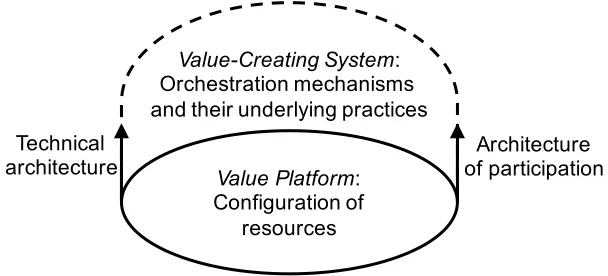
[image:6.595.145.449.462.600.2]In this study, we specifically develop the concept of “value platform”. We view value platforms as dynamic configurations of (tangible and intangible) resources that act as a foundation upon which network members co-create value through a set of specific practices.2 Analogous with Wernerfeldt’s (1984, p. 172) definition of resource, a platform’s tangible and intangible resources at a given time could be specified as those resources which are tied semi-permanently to the platform. Resources per se are static (Ketchen, Hult, and Slater, 2007). It is the activities of network members that maintain, transform and adapt resources. Hence platform resources are created, activated and given meaning and value by network members Möller and Svahn (2006) conceptually distinguish between the set of activities and the resource configuration upon which the activities are based and we follow this line of logic. Being a configuration of tangible and intangible resources, the value platform concept thus relates to but differs from network-based concepts such as Parolini’s (1999) description of “value-creating system” and Möller and Svahn’s (2006) view on “value system”, which refer to a set of activities carried out by the network actors. In our study, these activities are akin to network practices (i.e., routinized deeds) and their overarching orchestration mechanisms. In accordance with literatures on platforms we thus make a distinction between the platform as a manageable object and the value co-creation activities enabled by the platform (see Figure 1).
Figure 1: Value platform as a foundation for value-creating system
2 Analogous with the three fundamental elements in industrial network theory—actors, resources, and
activities—we refer to network members, value platforms (resource configurations), and practices (routinized activities). The characteristics attributed to a value platform has some similarity with what Möller and Svahn (2003) refer to as a “strategic net”. Nets are intentional inter-organizational structures which firms design for specific purposes; they are “coalitions of autonomous but interdependent firms that are willing to coordinate some of their actions” (Möller and Svahn, 2006, p. 988). Hence, a net is more related to specific actors in the network whereas a value platform—a concept rooted in literatures on platforms—is more concerned with resources organized in a common structure which facilitates network actors’ value co-creation activities (cf., Gawer and Cusumano, 2014).
Value Platform: Configuration of
resources
Value-Creating System: Orchestration mechanisms and their underlying practices Technical
7
As illustrated by Figure 1, the platform frames the value creation and business renewal potential of the network’s value-creating system (cf., Möller and Rajala, 2007). Hence, value platforms connect different types of network actors through intentionally created constellations. The value platform concept combines the view of the ‘platform ecosystem stream’, for which the platform is a set of shared technologies and standards, and that of the ‘organizational stream’ (albeit firm centric), for which the platform is a structure that stores organizational routines (cf., Thomas et al., 2014). Value platforms are hence based on not only a “technical architecture” and other tangible resources (as in the case of traditional, firm-centric and product-firm-centric platforms) but also intangible resources. These take the form of an “architecture of participation”; that is, a set of organizational norms, rules, and activities that its connected network members use to coordinate and co-align their actions (Lusch and Nambisan, 2015; Nambisan and Sawhney, 2011). Value platforms can facilitate value co-creation by enabling novel offerings (through innovative combinations of products and services), processes, and other types of knowledge not previously available to the network. Grounded in service literature and its focus on value in use (Macdonald et al., 2016; Vargo and Lusch, 2008), this definition suggests that the value of the platform is determined by the network actors based on the platform’s perceived ability to facilitate (or hinder) achievements of the actors’ goals.
The concept of value platform resonates with the migrations taking place in many industries as firms transition from producers of superior products and services to co-creators of superior value-in-use (Kowalkowski, Gebauer, and Oliva, 2017; Raddats et al., 2017). Here the lead firm takes a larger responsibility for not only improving value creation in customers’ businesses but also in managing interdependencies with other network members (Windahl and Lakemond, 2006). A value platform should bring clarity to the way its network members come together to co-create value and share the value captured among themselves. This is particularly important in cases where the lead firm, which is responsible for the platform development efforts, relies on other actors but has limited ability to influence them.
2.3 Network orchestration for value platform development
8
if the lead firm is the principal actor orchestrating the network, network partners also potentially play a vital role in the development of the value platform. Hence the lead firm but also other network actors enhance, change, and redirect the value platform over time (cf., Eloranta and Turunen, 2016).
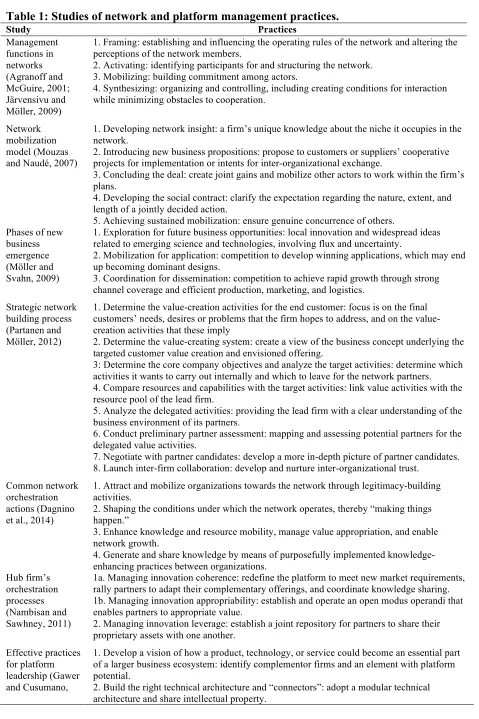
Table 1 shows exemplars of empirical and conceptual work on network and platform management. While there are many similarities between key practices for network and platform management, research on assembling and managing inter-organizational networks often takes a process perspective, elaborating frameworks with interlinked process stages. Research on platform leadership, on the other hand, does not necessarily distinguish specific stages when discussing effective practices. Given its explicit focus on platforms and their underlying technical core, it is of no surprise that practices concerning technical architecture and other tangible resources are more pronounced in this stream of research (e.g., Gawer and Cusumano, 2014). In both streams of research, practices supporting an architecture of participation for coordinating and aligning the actions of network members are evident. However, research on assembling and managing inter-organizational networks (and industrial network theory in particular) more comprehensively discusses such practices, emphasizing the importance of building commitment (Järvensivu and Möller, 2009) and legitimacy (Dagnino, Levanti, and Li Destri, 2016), and developing a social contract (Mouzas and Naudé, 2007) among actors. In addition, it emphasizes lead firms’ roles in not only ensuring value appropriation among these actors but also in facilitating the activities needed for end customers’ value creation (Partanen and Möller, 2012) such as exchange and co-creation of specialized knowledge (Lipparini, Lorenzoni, and Ferriani, 2014). Despite differences in the levels of analysis, theoretical frameworks, and terminology used, Dagnino, Levanti, and Li Destri (2016) find that such traits are common in all studies of network orchestration.
- Take in Table 1 here -
9
potential network members. Legitimacy can act as a constraint on organizations (Dowling and Pfeffer, 1975) but is crucial for the success of new business initiatives (Zimmerman and Zeitz, 2002) such as when new offerings and technologies need to be embraced across several organizations (Suchman, 1995). Legitimacy is portrayed as an operational resource that firms extract from their network and that they employ to achieve their goals (Suchman, 1995). In a business network, the legitimacy of a firm is linked to its activities and its employment and integration of various types of resources (Dacin et al., 2007), such as platform development. Overall, the critical role of orchestration is acknowledged for establishing and managing inter-organizational networks (Möller and Rajala, 2007; Möller and Svahn, 2009; Müller-Seitz, 2012) and a growing body of literature addresses platform dynamics (Eloranta and Turunen, 2016). In our empirical work, we seek to build on this knowledge by eliciting and explaining the orchestration practices by which lead firms influence and manage their network in developing novel value platforms.
3. Methodology
While studies of platform management are extensive, empirical research on network orchestration for platform development is still nascent. To contribute to theory development on the value platform concept, the study was performed following an exploratory multiple case study approach (Eisenhardt, 1989). Case study is a research strategy focusing on understanding the dynamics present within a single setting (Yin, 2014; Eisenhardt, 1989). The study’s focus on the development of value platforms through lead firm network orchestration provides challenges since the study object is not a bounded or clearly defined system (Piekkari et al., 2010; Yin, 2014). Since value platform is an emergent theoretical concept, we wanted to study multiple and varied empirical cases. Following Eisenhardt and Graebner (2007), we adopted a multiple case study methodology due to the ability of qualitative data to explicate complex social processes.
10
between the value platform and the network as well as to identification of patterns in the interplay between different network orchestration mechanisms.
3.1 Case selection and data collection
The value platforms were selected as cases. We used a criterion-based theoretical sampling approach, and initially defined criteria regarding adherence to our theoretical definition of value platforms in order to identify and select suitable cases (Eisenhardt, 1989). Based on our view of value platforms as (1) dynamic configurations of tangible and intangible resources; on which (2) network members can co-create value through a set of specific activities; we identified a number of potential value platforms. The value platforms varied in complexity, which enabled us to identify a range of lead firm network orchestration practices. Hence, the value-creating systems (Möller and Svahn, 2006) also varied, from renewal of existing systems to the emergence of new ones. In addition, the choice of cases was based on full access to the lead firm and access to other network actors and that the addition of the case would add variability to our view of value platforms. In the case studies, the research focused on identifying the orchestration practices of the lead firm. Ultimately the lead firm benefits if the platform progresses to incur network value.
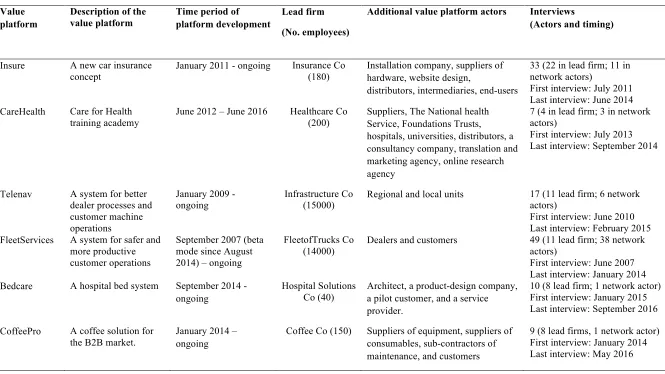
Six value platforms fulfilled the selection criteria adherence and access. The names of the value platforms and the lead firms have been changed to protect the confidentiality of the participating firms. The value platforms are called Bedcare, CareHealth, CoffeePro, FleetServices3, Insure, and Telenav. The case lead firms come from Western Europe, representing different industries. Table 2 provides a description of each lead firm and value platform.
- Take in Table 2 here -
Data collection was adjusted to the specifics of each case. In all 126 interviews were conducted across the six value platforms. Multiple interviews were performed over time, between two and six times, with 13 key respondents in the lead firms. Other network actors were interviewed to get an alternative perspective on the lead firm orchestration practices. In addition, this provided an understanding of the effects of network orchestration on other actors connected to the value platform. Key respondents among network actors were identified through snowball sampling (Coleman, 1958).
3 A study of the evolution of the value-creating system in the FleetServices case has been published by
11
To aid data collection and ensure consistent interviewing procedures, an interview guide was developed. This focused on the theoretical concepts of value platform and network orchestration (Miles and Huberman, 1984). The first part put attention to the value platform and the network, followed by questions about the development of the value platform over time focusing on the network orchestration practices of the lead firm. The interviews lasted 30-190 minutes, with the majority lasting 60-120 min. Most of the interviews were recorded and transcribed. Field notes were taken in the cases when respondents asked not to be recorded.
The interview data was complemented with different types of secondary data. In Insure, this included minutes of meetings, accounts, copies of documents, various procedure and review documents, service scripts, copies of correspondence between network actors, website designs and brochures. In FleetServices, this included a rich repertoire of internal documents (including platform strategy and management plans and documents targeted at dealers and customers) and public documents (press releases, web sites, social media). Through site visits, facilities tours and observation of meetings, the researchers were able to observe employees at work and communicating with other actors in the network. Field notes were developed as a further source. In addition, data was collected through lead firm-initiated workshops where multiple representatives from different actors participated. In other cases, such as Bedcare, CareHealth, CoffeePro, and Telenav, the interviews provided most of the data. Secondary data, including internal documents (sales guides, transition guide from old to new version of platform, and training programs) and public documents (technical guides, marketing material, apps and videos) complemented the interview data. Table 3 provides an overview of each case and data collection details. Further details about data collection in each case is available in an appendix.
- Take in Table 3 here -
3.2 Data analysis
12
was used for validation of lead firm orchestration practices and to identify the effects of these practices on the value platform and the different network actors. When these interviews revealed additional information, we validated the new information with the lead firm representatives. Secondary data was used to validate these initial insights.
Second, we performed a cross-case analysis (Yin, 2014). To increase internal validity and make sure that the meaning of the network orchestration practice had not changed in the cross-case analysis, each case was revisited and coded with the identified network orchestration practices. Delving deeper into the impact and nature of the network orchestration practices in the cross-case analysis enabled us to unravel the orchestration mechanisms, which are higher-level constructs. These are overriding mechanisms (Easton, 1998), unveiled from the myriad of observed network orchestration practices. These underpin and explain the development of value platforms in network settings and act as an assembly of practices producing an effect not inherent in any one of the practices alone. Four overarching network orchestration mechanisms emerged that are key for value platform development. We made cross-case observations about how each network orchestration practice related to these mechanisms. The effectiveness of the network orchestration practices was coded as facilitating or impeding, according to how it influenced the development of the value platform. The network orchestration practices across the cases were then clustered in terms of their association with each of the identified mechanisms. Through interpretation and crosschecking by four experienced researchers, patterns emerged in terms of the way each mechanism influenced the development of the value platform.
Third, we analyzed the relationships between the four orchestration mechanisms. We disentangled the deployment of the orchestration mechanisms by the lead firms and inferred the within-case interplay between them. We then analyzed how these identified relationships between the orchestration mechanisms played out across the cases. This allowed us to further pinpoint and substantiate the major relationships between the orchestration mechanisms.
4. Findings
13
There is an array of different practices through which the lead firms in our cases orchestrate the network for the development of the value platform, but not all practices are found in each case. The practices manifest themselves differently across the cases and can facilitate or impede the way the value platforms develop. Following the analysis explained in the method section, practices cluster around four higher-level orchestration mechanisms. These are:
• Envisioning network value for the platform. This mechanism entails envisioning
the potential value of the platform for its members and understanding how the network can collaboratively build and enhance this value.
• Inducing innovativeness of network members towards the value platform. This
mechanism is characterized by investments and activities of the lead firm to support and direct the innovativeness of network partners towards value for the platform.
• Legitimizing the value platform through the network. This mechanism relates to
both value platform legitimizing by the lead firm, and also to inducing the network to legitimize the value platform.
• Involving the network in organizational adjustments towards the value platform.
This mechanism is characterized by network-influenced adjustments of the lead firm’s internal structures and routines towards the emergent value platform.
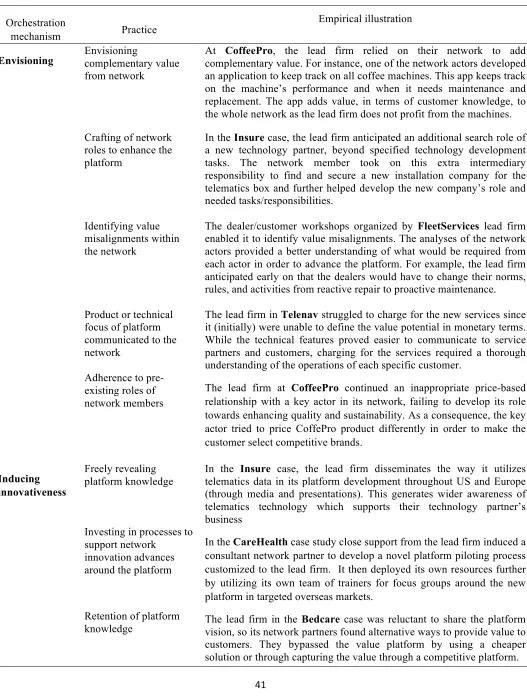
In the following section we explain each mechanism, show the underlying practices associated with each mechanism and demonstrate the facilitating or impeding nature of the derived practices. Illustrations from the cases are provided throughout the text and table 4 provides further evidence of the practices within the cases.
- Take in Table 4 here -
4.1 Envisioning network value for the platform
14
problematic. We show how anticipating network-led platform value requires both a future and a network orientation. However, this may be beyond many firms in the early stages of value platform development. Study findings related to both the facilitating and impeding nature of lead firm practices associated with this mechanism are provided below.
4.1.1 Facilitating practices
Envisioning complementary value from network
The cross-case analysis shows evidence of practices to identify where complementary future value is likely to emerge. This means going beyond the core platform, even envisioning value coming from other seemingly non-related businesses of the network partners. The findings show how lead firms adopting this practice engage in shaping nascent ideas and areas, which are ambiguous and ill defined. In theInsure case, for instance, the lead firm predicted in early stages of its platform development the nature of complimentary resources that could accrue from external partners. For example, it contacted the Association of Senior Police Officers to jointly craft incremental value around the insurance platform, whereby police are automatically alerted in a vehicle emergency. The police created new resources by setting up novel criteria for how and when to be notified. The lead firm subsequently exchanged resources by providing them with information about incidents and causes related to the positioning and signage of speed cameras. Police then reconfigured their own resources and processes around this added value. The lead firm at FleetServices adopted early envisioning practices by investing in visioning resources. These took the form of workshops on selected markets with leading dealers and customers. These increased shared understanding of each party’s needs, communicated potential value to all actors and enhanced the lead firm’s understanding of service provision.
Crafting of network roles to enhance the platform
15
forward. She is a very senior lecturer in infection control next to Guys and Saint Thomas hospital in London.” She explained how the lead firm hosted a series of events where it was able to amass critical resources and “bring all these people together, who are forum leaders, and it allows us to be seen as involved in the conversation as well, rather than being a supplier of product.” The lead firm purposefully invested in a new coordinating resource, namely a safety improvement facilitator role as a “conduit between the patients and us – to bring their voice to us,” commented a key respondent. Similarly, the lead firm deployed scouting techniques for potential partners, inviting nurses and clinicians to join the network.
Identifying value misalignments within the network
Facilitating practices encompass not only identifying value potential but also value misalignments within the network. Here there is evidence of lead firms identifying network partners whose potential value is likely to be misaligned with the platform.In the Insure case, for example, the lead firm was uncertain of the relationship management resources of an existing network partner. Increasing the number of customer touchpoints was a critical element of the platform value and this key partner did not have the prerequisites to develop customer relationship-oriented resources. It was unlikely to invest in new resources aligned to the same value vision as other network partners and its likely disrupting force was envisioned early on.
4.1.2 Impeding practices
Product or technical focus of platform communicated to the network
Two of the case lead firms showed evidence of an inability to understand or articulate the complexity and intangibility of the developing value platform resources. This meant potential value was communicated to the network in terms of tangible product attributes. This, in turn, constrained the ability of the network to creatively experiment with platform development ideas. One example of this is Telenav, where one of the global product managers explained how they struggle to define the intangible nature of the platform value and translate this into monetary value to the customer. Even several years after the first generation of platform-based services was launched, “we really struggle to understand how can we sit in front of the customer and ask them to pay us for a service” (senior manager at Telenav).
16
Many of the lead firms from the case studies rigidly stuck to existing ways of managing the network as the value platform emerged. This seems a natural response where there is a high degree of ambiguity over potential new lead firm and network roles vis-à-vis the platform. However, it appears that sticking to known and familiar roles can reinforce a product/technical focus for the emergent platform.For example, the lead firm in Telenav did not attempt to understand the value potential of the network. It failed to anticipate the new and critical role of specific existing resources, namely dealers, in the eventual success of the platform. The Service Director explained, “While we had some customer input, much of it was our own thoughts and beliefs. We thought we understood how a dealer and a customer business works and then we built a “one size fits all” and we ended up with a solution that was not 100% good for anybody.” At FleetServices the lead firm recognized the need to achieve value alignment, but it failed to invest early on in practices to change the scope of a critical actor; the dealers. Unwilling to take on a more extensive service role, dealer behavior proved to constrain, for a long period, the development of the value platform.
4.2 Inducing innovativeness of network members towards the value platform
This mechanism is characterized by lead firm investments in resources to induce innovativeness by the network; by carrying out innovation activities on behalf of the network; and by sharing pivotal platform knowledge-based resources. In network orchestration, lead firms mobilize organizations towards the network (Möller and Svahn, 2009). Intentional management of the network requires a capacity to intervene with other network partners and shape the overall conditions of the way the network operates (Muller-Seitz and Sydow 2012; Paquin and Howard-Grenville, 2013). In the platform-constructing context, a network-led approach means letting go. It means inducing network members to provide new value for the platform as perceived and evaluated by themselves.
4.2.1 Facilitating practices
Freely revealing platform knowledge
17
the pressures and workload of their customers facing reduced workforces, so supported their customer partners by providing free of charge infection control audits. This was a valuable aspect of the platform value. “We’re actually removing a burden from the customer teams themselves,” commented an employee in the lead firm. The lead firm also recognized early on the need for timely sharing of platform information among network members. It invested in speedy response to network members’ innovation problems: “sometimes a problem exists on the spot, and you didn’t think of it before, so you would like it to be quick. With Richard and all the other employees of Healthcare Co, including technical support, I am provided with an answer within a day or even a few minutes” (Senior Manager Respondent, Healthcare Co).
Investing in processes to support network innovation advances around the platform
The evidence shows the development of processes to support network-centric innovation oriented towards the platform. These typically entailed direct investment in platform-oriented resources for the network, such as materials, facilities, ICT and engagement portals. However, some of the lead firms went beyond the boundaries of the platform to allow network-centric experimentation for new unanticipated value to surface. There was even evidence of such support encouraging the business growth of network partners beyond the focal platform. Insurance Co, for example, invested in resources to support a racing day for the best performing customers. Racing was the passion of its installation company network partner. This induced the partner to commit resources to further develop and establish this initiative, which in turn became part of the platform value. The lead firm also encouraged the installation company to instigate box installation at its own premises on Saturdays (rather than at customers’ homes). This provided the network partner with opportunities to sell additional services and products (e.g. radios) and expand its business beyond the platform. The lead firm in CoffeePro invested in a new resource (a coffee academy) for its network. Free resources, such as training in the process of delivering a good cup of coffee, were provided. Environmental sustainability was emphasized, which was a critical underlying value for the platform. This subsequently directed key members of the network towards resource investments which stressed sustainability, aligned to the platform value.
4.2.2 Impeding practices
18
Where the lead firm does not share platform details, network members can deem the platform ambiguous. The cases showed evidence of practices to retain platform knowledge. In the FleetServices case, for example, the lead firm failed to communicate the nature of the platform to its dealers, despite its efforts to envision network value. Its dealers struggled to recognize how value was derived in the platform: “what the customer pays goes to the manufacturer. How are we then going to earn money? I doubt this new service will give me increased service sales income through preventative maintenance” (Owner of dealer firm connected to FleetServices). Hence the dealers were constrained in their ability to direct resource investments around the platform.
Firm-centric assessment of capabilities and resources of network members
Some of the lead firms in the study retained fixed and firm-centric perspectives of the capabilities and resources of their network members. In assessing the way the network could add value to the platform they typically considered only traditional and existing resources and skill sets of their network. This thwarted their ability to appropriately direct and support novel value and network-centric innovativeness around the platform. In the Telenav case, the lead firm had profound knowledge of the competences and engagement of its independent dealers when it came to the product business. However, managers lacked and failed to develop in-depth knowledge of dealer capabilities for seizing platform-enabled business opportunities.
4.3 Legitimizing the value platform through the network
19
4.3.1 Facilitating practices
Developing and communicating metrics around emergent value
The findings show ample evidence of the lead firm providing performance metrics of elements of the value emanating from the network. Where these are then communicated to the network, such practices provide strong legitimacy of the value platform to the network. This further encourages network members to work on enhancing the value. CareHealth utilized network members to provide performance metrics demonstrating the emergent value of the platform. It developed and deployed a new disseminating resource based on a structured process of success stories, spread by distributors and consultants. These were stored and made available on an online resources portal. The marketing manager explained how this also serves as a conduit to explain and promote the platform value. He commented; “it presents a consistent message about what we are aiming to do. Historically it has been fragmented – everyone doing and making their things a bit, using their creative freedom and we don’t end up with anything consistent. We are now addressing that…” (Marketing manager, CareHealth case). Similarly, the lead firm in Bedcare developed tangible performance metrics, such as reduced carbon footprints and the reduction of multidrug-resistant bacteria. Further, these performance metrics were tailored for network partners and internal senior management, indicating different value of the platform for each stakeholder group.
Demonstrating the platform value to others beyond the network
Some of the lead firms went beyond the immediate network to legitimize the emergent platform. Firms adopting this practice typically made use of existing communication resources, such as social media (e.g., Facebook and YouTube), to demonstrate the value platform to potential users outside their networks. For instance, the FleetServices lead firm made use of YouTube to give publicity to testimonials from its pilot customers and to explain the new fleet management concept to a broader audience. This practice also served to change the perception of the firm among potential network members, towards a more tech-savvy and service-oriented company.
4.3.2 Impeding practices
20
The findings show several lead firms developing poor quality metrics to assess new and emergent platform-based resources. Such indicators were weak in their ability to convince others of the value of the emergent platform. Several lead firms in the case studies failed to tailor metrics to diverse stakeholders. Instead, they developed a standardized blanket set of metrics. Hence the value of emergent platform-based resources was not apparent to many network members. In Bedcare, for example, the lead firm developed platform metrics that demonstrated current value based on existing resources; that is, single patient bed care facilities. It failed to develop medical evidence of the future value of the platform when scaled up to an entire hospital. In the CoffeePro case, the lead firm lacked metrics to support its envisioned move out of a pure cost competition to a value competition, which was core to the platform. Similarly, the lead firm in the Telenav case was unable to provide convincing business illustrations of the platform value. Several of its network members considered the available platform data of poor quality, and the communicated metrics did not address the most pressing customer needs. This led to high levels of resistance from dealers (and several internal units) to the new platform and they failed to actively promote the new platform. As the global product manager commented, “you would not believe the resistance we are meeting—it’s a hell of a bell.”
4.4 Involving the network in organizational adjustments towards the value platform
The fourth mechanism is characterized by network involvement in lead firm adjustments towards the value platform. Such adjustments involve shifts in existing resources, routines and structures towards the emergent value platform. Previous research has shown how lead firm managers employ practices to improve the efficiency and speed of resource exchange processes (Provan and Kenis, 2008). This often necessitates changes to existing ways of working. Managing and mobilizing the network towards the value platform can create network overload (Hansen, 2002) and disrupt existing routines of the firm. Adaptation of existing routines is therefore required to achieve better fit with the emergent network-led value platform. Our study shows how network participants can support such adaptations.
4.4.1 Facilitating practices
Seeking advice from network on potential organizational adjustments
21
explained; “Actually it made us realize there’s holes in what we’re doing. We’ve had to sort of fill the holes. Our network partner said “look they’re (customers) asking these sorts of questions. We’ve got to give them that sort of information” (manager, Insure). This led to investments in new resources, namely staff to manage an internal process to analyze touchpoints with customers. The Insure lead firm re-orientated its strategy towards new customer co-creation value: “What we are moving to is a strategic approach to the interactions with the customer. What we don’t want is ad-hoc decisions that have been taken because every month they could change and as opportunities come up you want to plan forwards and have a number of well thought our mechanisms to do that. We’re taking on board what our suppliers and customers are saying” (marketing manager, Insure). Other resource investments included a new service center in order to increase customer interactions, which in turn was core to its new platform. Hospital Solutions Co also sought input from its broader network before gradually shifting resource investments from competency building in manufacturing towards building service provision and sales capabilities.
Verifying intended adjustments with network members
The findings show some evidence of lead firms testing and verifying such adjustments with the network. This practice entailed, for example, network-coordinating resources, such as setting up working groups to harness network viewpoints on future investments. It involved sharing future intentions and plans with the network. HealthCare Co, for example, undertook several focus groups with key actors in the network to garner views before committing new resources to the platform. As a senior manager commented “if we got a bad reaction from them it made us think more about doing it.”
4.4.2 Impeding practices
Fixing resources and routines around original value
22
the network became apparent. Only after the technical architecture was replaced could many of the initial technical limitations be overcome. Furthermore, the existing organizational structures fixed around original product-oriented value made necessary shifts onerous. For example, the managing director of a sales company initiated a vanguard app-based service but had to go through cumbersome processes to get approval from the corporate IT division. Because of all the bureaucracy, he was told by his superior to proceed by “flying below the radar” to avoid losing the first-mover advantage. Evidently, the rigid centralized processes did not accommodate for such rapid, technology-driven resource adaptation in the local organization.
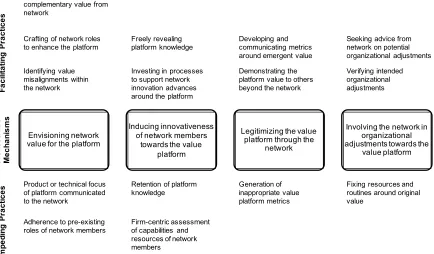
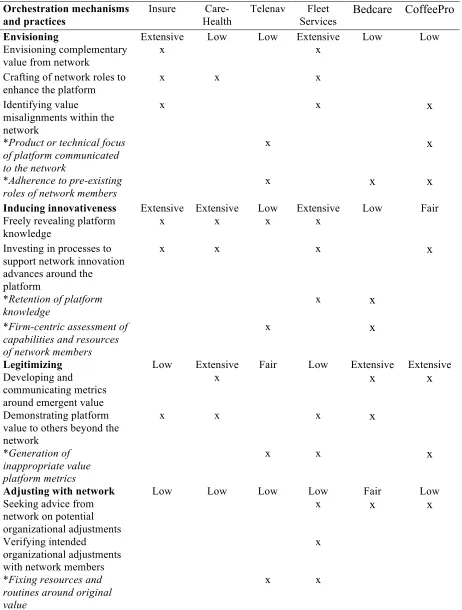
In conclusion to this section of the findings, table 5 depicts a synthesis of the cross-case comparison. It portrays the different orchestration mechanisms, and underlying practices, across the cases and shows their application in each case. Figure 2 provides a visual corollary of the conceptual analysis provided.
[image:22.595.85.519.416.670.2]– Take in Table 5 here –
Figure 2: Orchestration mechanisms and nature of associated practices
Envisioning network value for the platform
Inducing innovativeness of network members
towards the value platform
Legitimizing the value platform through the
network
Involving the network in organizational adjustments towards the
value platform Envisioning
complementary value from network
Crafting of network roles to enhance the platform
Identifying value misalignments within the network
Product or technical focus of platform communicated to the network
Adherence to pre-existing roles of network members
Freely revealing platform knowledge
Investing in processes to support network innovation advances around the platform
Retention of platform knowledge
Firm-centric assessment of capabilities and resources of network members
Demonstrating the platform value to others beyond the network Developing and communicating metrics around emergent value
Generation of inappropriate value platform metrics Verifying intended organizational adjustments Seeking advice from network on potential organizational adjustments
23
4.5 Relationships between the orchestration mechanisms
The findings show that we cannot consider the derived mechanisms in isolation. It is the connectedness between them that is important in explaining the effectiveness of the way lead firms orchestrate the network for value platform development. The mechanisms can build on and strengthen each other. It is also the case that certain mechanisms need to be in place for the other mechanisms to operate. In this second section of the findings we explain the major relationships between the mechanisms that appear to critically impact on the development of the value platform. Supportive evidence from across the cases is given.
4.5.1 Relationship between envisioning and inducing innovativeness
The results provide strong evidence that envisioning supports the lead firm’s ability to induce innovativeness of the network around the emergent platform. Setting and communicating a clear vision provides direction for platform-based innovation to occur in the network. The case evidence shows that if the lead firm envisioning is weak or poorly shared, it is difficult to induce innovativeness. Network members struggle to interpret what they should or might do in innovating around the platform. The nature of this relationship is demonstrated in the case evidence;
24
4.5.2 Relationship between inducing innovativeness and legitimizing
The case study findings suggest a strong relationship between inducing innovativeness and legitimizing mechanisms. As lead firms induce and support innovativeness of the network around the platform, so network members develop platform-oriented innovation outcomes. These provide the basis for performance metrics to legitimize both network and lead firm innovation efforts. These metrics, in turn, provide support and confidence to the network to dedicate further resource investments in the platform. Where the lead firm is weak in inducing innovation, network members are driven to innovate alone without direction from the lead firm. Hence metrics may be misaligned with the platform, which can thwart effective legitimizing around the emergent platform. The findings suggest that the envisioning mechanism underpins this relationship. Effective envisioning supports speedy and centric innovative efforts by the network. Where there is no vision by the lead firm, platform-oriented innovation is weak by the network, with a subsequent dearth of performance metrics to legitimize. This is illustrated across the cases;
Insurance Co effectively induced innovativeness of the network, which in turn formed the basis of metrics developed by the network members themselves. Healthcare Co, on the other hand, relied heavily on network members to craft their own innovation roles. Progress metrics from the network were not forthcoming, pushing the lead firm to generate is own tailored performance data with limited network input. FleetofTrucks Co failed to disseminate platform details and metrics, leading to ineffective legitimizing. Hospital Solutions Co, having failed to share the platform vision, was driven to develop its own platform metrics misaligned with the platform value as perceived by the network. Coffee Co recently did a shift in the platform vision; hence, the metrics are misaligned as the vision is getting re-shaped. Finally,
Infrastructure Co struggled to induce innovativeness from the network, as the platform vision was communicated in inappropriate technical terms; network members did not value subsequent technical performance metrics, intended to legitimize the emergent platform.
4.5.3 Relationship between legitimizing and adjusting
25
metrics that can be used to garner support and resources from senior management to adapt internal routines and resources to foster further innovation (internally and from network) towards the platform.
The findings show that without shared envisioning, the other network actors are driven to craft their own interpretation of platform value and will innovate independently. This in turn thwarts the development of platform-centric performance metrics, which are not then available to support internal adjustments. A consequence of this is difficulties in convincing senior management of the need to make internal changes to support platform development. The nature of this relationship is demonstrated across the cases;
Insurance Co, the lead firm at Insure, encouraged the network to develop its own metrics and involved them in verifying internal changes in resources and routines. This led to successful internal adjustments towards the emerging value platform. Hospital Solutions Co and Infrastructure Co, the lead firms at Bedcare and Telenav respectively, legitimized in technical terms and the network strained to understand the platform value, resulting in poor innovativeness. Weak network innovation performance exacerbated difficulties in justifying further resource commitments and convincing senior management of the need for internal adjustments. Coffee Co, the lead firm at CoffeePro, whilst supporting its network, has an emergent platform vision and is still stuck to existing internal roles and routines. Healthcare Co spent considerable resources supporting the network around CareHealth, but advances were not aligned to a shared platform and it lacked necessary metrics to garner internal support for additional resources for the platform development.
5. Discussion and theoretical contributions
26
Second, we empirically derive practices constituting four overriding network orchestration mechanisms through which value platforms are developed. Extending the findings of Möller and Svahn (2006), who unravel knowledge and learning mechanisms across diverse business networks, the extant study shows that orchestration mechanisms operate across established and newly formed organizations. Also, previous research has studied intentional network management mechanisms largely to achieve accomplishment of the business idea (Dharaj & Parkhe, 2006; Owen-Smith & Powell, 2009; Möller and Svahn, 2009; Dagnino et al, 2016) or to advance the project (Paquin and Howard-Grenville, 2013). In contrast, this study focuses on platform development as the context in which networks are orchestrated. Our contribution lies in pinpointing specific practices, which can both facilitate or impede the way firms orchestrate the network, specifically for value platform development.
Third, building on prior research that has identified interlinked stages and practices for network development and management (Järvensivu and Möller, 2009; Muozas and Naudé, 2007; Partanen and Möller, 2012), we highlight the interplay of the derived orchestration mechanisms. We explain the way such mechanisms are interlinked and relate to each other. This resonates with mechanism-based theorizing in organizational studies: “If a regression tells us about a relation between two variables—for instance, if you wind a watch it will keep running—mechanisms pry the back off the watch and show how” (Davis and Marquis, 2005, p. 336). These theoretical contributions are further explained and discussed below.
27
complementary value, role planning, and identifying value misalignments) relate to the ideas underlying the value platform as the focal object of the vision.
This study also puts attention to the way early envisioning influences subsequent value platform development; the relationship between envisioning and inducing innovativeness becomes critical. Gawer and Cusumano (2014) and Nambisan and Sawhney (2011) argue that lead firms should pursue a strong platform vision, such as determining the overall design and basic technical architecture as is the case for network-centric platforms. However, they acknowledge that lead firms are seldom able to predetermine elements of value. In the extant study, we show that if the lead firm too tightly specifies the platform vision, often along technical or product lines, the network is constrained in innovating. Existing literature on platforms (e.g., Chakravarty et al., 2014; Jiang et al., 2005; Sridhar et al., 2011) frequently adopts a technology-based view on platform development or winner-takes-all logic under which companies strive to win the war for product leadership (Cusumano and Gawer, 2002). Indeed, our findings demonstrate that adopting a technical or product-centric vision is likely the easier route for lead firms experimenting with value platforms and struggling to develop novel pathways. Yet, we show that breaking away from traditional firm or product-centric visions and trajectories is crucial in cases where firms pursue growth through novel network-led value platforms.
Prior research has emphasized orchestration mechanisms to appropriate innovation from the network (Dhanaraj & Parkhe, 2006). In our study we show that firms induce the network to create new value by innovating around the platform. We concur with Järvensivu and Möller (2009) regarding the importance of altering the existing perceptions of network members. Since network members hold knowledge of the value they want and are able to create, an open architecture for participation guided by a vision needs to be in place and disseminated to the network. Network actors need to believe in the shared vision. If not, they lack guidance and can innovate in directions that are misaligned with the platform or change allegiances. Furthermore, they can develop new value, and make internal adjustments, that support other parts of their business, maybe far removed from the platform. We propose that envisioning— developing and communicating a shared vision for the value platform—helps the lead firm guide the network towards innovative advances targeted around the emergent platform.
28
the network-centric platform. Networks involve a wide range of actors who can make legitimacy judgments (Bitektine and Haack, 2015; Provan and Kenis, 2008). van Riel et al (2013) proposed that inter-organizational networks achieve legitimacy by evaluating the technical and managerial features of the intended innovation. To convince network members, lead firms capitalize on existing relationships, use objective performance metrics, and influence actors through others (Håkansson and Eriksson, 1993). To date, prior research has advocated legitimacy building around the innovation (van Riel et al, 2013), the lead firm (Dagnino et al, 2016), and the network (Human and Provan, 2000; Low and Johnston, 2010). We extend this line of thinking to the platform development context and show how firms legitimize new reconfigurations around value platforms. Firms become inter-dependent not only on mutually developing the platform, but on legitimizing the platform’s value and success. Legitimacy building in the platform development context involves practices related to the development of platform-based metrics that are meaningful to the network. To succeed, dissemination to network participants and beyond to their own networks as well as lead-firm management is required.
29
To sum up, the extant study has investigated network orchestration mechanisms in relation to the development of the value platform. The effects on activities of network members beyond this scope have not been explicitly drawn out but should not be underestimated. Network orchestration mechanisms can generate new metrics around the emergent value, enhanced innovativeness of network members and legitimization of their creative activities. Network partners can leverage such metrics to shift allegiances if inclined to do so. Demonstration of the way they develop complementary value can be appealing to competitors of the lead firm and can encourage network partners to move on to stronger roles in other networks.
6. Managerial implications
From a managerial standpoint, the findings from this study can assist practitioners in formulating and implementing a strategy for network-centric and value-centric platform leadership.
First, the findings suggest that lead firms should refrain from focusing chiefly on the platform’s technical architecture and what has been done in the past. Also, as typical in many innovation projects, it is tempting for many firms to adopt an inside-in approach. This means firms focus on what is technically possible and known, fixating around existing routines and capabilities. Whilst investing in and supporting network partners is generally acknowledged as important by managers, enabling the network to craft and nurture value around their platform can be unnerving. The findings from this study delineate a number of practices, which support this process. Deploying such practices requires attention to both the selection of partners and the nurturing of organization-wide support.
30
Second, the findings alert managers to the need to nurture organizational support for the emergent value platform from an early stage. Many of the adverse practices, unraveled from across our cases, relate to organizational inertia or resistance to change. Whilst this is a commonly known blockage to innovation, a network-centric platform approach makes change particularly onerous. Specifically, senior management needs to embrace a strategic intent to be network-centric in developing value platforms. The study findings suggest that managers need to allow and support network-led interpretations of what the platform entails. This means internally redefining how to make sense of innovation coming from the network by employing different metrics and parameters than is usual in innovation efforts. To do so, middle level managers should initiate internal workshops to disseminate and educate the wider and more senior members of the organization about the value platform. This should not only concern platform-specific performance indicators and success stories but also the network-integrating process itself. Managers should also invite network members to be part of such regular workshops, telling their own stories and spreading diverse perspectives on the process.
Third, our research shows that the network orchestration mechanisms cannot be considered in isolation. Managers should put in place ways to adopt a holistic view of value platform evolution. They should put attention to the inter-dependencies and network-wide consequences of the practices they adopt. Leveraging one set of practices may have adverse effect if another set of practices is not deployed. For example, having a network-inspired vision for the platform is unlikely to accrue benefits unless the firm develops metrics and indicators to show progress towards achieving that vision. Managers can evaluate their firms’ strengths in each of the sets of practices underpinning the identified mechanisms. It is unlikely they have the skills to leverage across all areas. Understanding the inter-dependencies between the mechanisms can direct managers towards investing in required resources and capabilities as needed.
7. Limitations and further research
31
marginal and did not affect the validity of the findings across the cases. However, further research could focus on identifying differences in orchestration mechanisms dependent on the characteristics of the value platform such as novelty and complexity. An additional extension of the research would be to validate the proposed orchestration mechanisms and their relationships in a cross-sectional study. This would involve developing measures for the identified practices underlying the mechanisms and test the proposed relationships.
Second, this study focuses on value platform development where the network is orchestrated by lead firms. It hence focuses on practices performed by lead firms. Whilst other network actors were interviewed, this was primarily to triangulate data rather than to uncover and detail their practices. This approach is commonly adopted in network research, but its limitations in forwarding a network perspective are heeded. While value appropriation is a key issue in platform management (Nambisan and Sawhney, 2011) and strategic network construction and operating (Dhanaraj and Parkhe 2006; Partanen and Möller, 2010), given the research design, this study has not focused on disentangling specifically how partners can appropriate value from the platform. Further research might explore this issue by also studying the practices of other network actors.
Finally, while studies of platform development privilege managed networks rather than emergent ones, additional research might assess initiated, influenced, and actively co-developed value platforms by other actors beyond the traditional lead firm. Innovation research shows that many novel value propositions are the results of customer and other stakeholder input (Lilien et al., 2002). Adopting additional stakeholder perspectives would enrich the lead firm orientation adopted in this study.
References
Agranoff, R. and McGuire, M. (2001). Big questions in public network management research. Journal of Public Administration Research and Theory, 11(3), 295-326.
Anderson, J.C., Håkansson, H. and Johanson, J. (1994). Dyadic business relationships within a business network context. Journal of Marketing, 58(4), 1-15.
Armstrong, M. (2006). Competition in two-sided markets. The RAND Journal of Economics, 37(3), 668-691.
32
Cattani G and Ferriani S (2008). A core/periphery perspective of individual creative
performance: Social networks and cinematic achievements in the Hollywood Film Industry, Organization Science, 29, 824-844.
Chakravarty, A., Kumar, A. and Grewal, R. (2014). Customer Orientation Structure for Internet-Based Business-to-Business Platform Firms. Journal of Marketing, 78(5), 1-23. Coleman, J. S. (1958). Relational analysis: The study of social organizations with survey methods. Human Organization, 17, 28–36.
Cook, K.S. and Emerson, R.M. (1978). Power, equity and commitment in exchange networks. American sociological review, 721-739.
Corsaro, D., Ramos, C., Henneberg, S.C. and Naudé, P. (2012). The impact of network configurations on value constellations in business markets—The case of an innovation network. Industrial Marketing Management, 41(1), 54-67.
Cusumano, M.A. and Gawer, A. (2002). The elements of platform leadership. MIT Sloan Management Review, 43(3), 51-58.
Dacin, M.T., Oliver, C. and Roy, J.P. (2007). The legitimacy of strategic alliances: An institutional perspective. Strategic Management Journal, 28(2), 169-187.
Dagnino, G.B., G. Levanti and A. Mocciaro Li Destri, (2016), Structural dynamics and intentional governance in strategic interorganizational network evolution: A multilevel approach, Organization Studies, 37(3), 349-373.
Davis, G. F. and Marquis, C. (2005). Prospects for organization theory in the early twenty-first century: institutional fields and mechanisms. Organization Science, 16(4), 332-343. Dhanaraj, C. and Parkhe, A. (2006). Orchestrating innovation networks. Academy of Management Review, 31(3), 659-669.
Dowling, J. and Pfeffer. J. (1975). Organizational legitimacy: Social values and organizational behavior." Pacific Sociological Review, 18(1), 122-136.
Eisenhardt, K.M. (1989). Building theories from case study research. Academy of Management Review, 14(4), 532–550.
Eisenhardt, K.M. and Graebner, M.E. (2007). Theory building from cases: Opportunities and challenges. Academy of Management Journal, 50(1), 25-32.
Eloranta, V. and Turunen, T. (2016). Platforms in service-driven manufacturing: Leveraging complexity by connecting, sharing, and integrating. Industrial Marketing Management, 55, 178-186.
Evans, D.S. (2003). Some empirical aspects of multi-sided platform industries. Review of Network Economics, 2(3), 325-382.
Ford, D. (2011). IMP and service-dominant logic: Divergence, convergence and development. Industrial Marketing Management, 40(2), 231-239.