A Tensor Analysis Improved Genetic Algorithm for Online
Bin Packing
Shahriar Asta, Ender Özcan
ASAP Research Group School of Computer ScienceUniversity of Nottingham Nottingham, NG8 1BB, U.K.
{sba,exo}@cs.nott.ac.uk
ABSTRACT
Mutation in a Genetic Algorithm is the key variation opera-tor adjusting the genetic diversity in a population through-out the evolutionary process. Often, a fixed mutation prob-ability is used to perturb the value of a gene. In this study, we describe a novel data science approach to adaptively gen-erate the mutation probability for each locus. The trail of high quality candidate solutions obtained during the search
process is represented as a 3rd order tensor. Factorizing
that tensor captures the common pattern between those so-lutions, identifying the degree of mutation which is likely to yield improvement at each locus. An online bin packing problem is used as an initial case study to investigate the proposed approach for generating locus dependent mutation probabilities. The empirical results show that the tensor approach improves the performance of a standard Genetic Algorithm on almost all classes of instances, significantly.
Keywords
packing, data science, tensor, mutation
1.
INTRODUCTION
There is a wide variety of population based approaches, solving computationally hard problems, which are referred to as ‘knowledge-based’ evolutionary computation methods. Knowledge can be extracted and used in many ways in vari-ous stages of the evolutionary process. For instance, Knowl-edge Based Genetic Algorithm (KBGA) [26] used problem domain knowledge to produce an initial population and guide the operators of a Genetic Algorithm (GA) using that knowl-edge at all the stages of the evolution. In [11] problem spe-cific ‘knowledge’ was represented in form of ground facts and training examples of Horn clauses. This knowledge is exploited in a GA for inductive concept learning and is used in mutation and crossover operators to evolve populations
Permission to make digital or hard copies of all or part of this work for personal or classroom use is granted without fee provided that copies are not made or distributed for profit or commercial advantage and that copies bear this notice and the full cita-tion on the first page. Copyrights for components of this work owned by others than ACM must be honored. Abstracting with credit is permitted. To copy otherwise, or re-publish, to post on servers or to redistribute to lists, requires prior specific permission and/or a fee. Request permissions from [email protected].
GECCO ’15, July 11 - 16, 2015, Madrid, Spain
c
2015 ACM. ISBN 978-1-4503-3472-3/15/07. . . $15.00
DOI:http://dx.doi.org/10.1145/2739480.2754787
of if-then rules. [23] employed prior problem specific ‘knowl-edge’ to generate locus level bias probabilities when selecting allele for crossover, resulting in a Knowledge Based Nonuni-form Crossover (KNUX). In [9], a mutation operator was designed based on knowledge capturing the distribution of candidate solutions in Extremal Optimization context. This method was successfully applied to PID tuning. The ap-proach proposed in [35] utilized rough set theory to explore hidden knowledge during the evolutionary process of a GA. The extracted knowledge is then used to partition the solu-tion space into subspaces. Each subspace is searched using a separate GA.
In this study, we use tensor analysis to generate mutation probabilities for each locus of a chromosome, also referred to as individual, representing a candidate solution. Tensorial techniques are powerful analysis methods for high dimen-sional data and are nowadays widely used in data mining and machine learning applications. In our approach, within a GA, the trail of high quality solutions, where each solution has a matrix form, is represented as a 3rdorder tensor.
Fac-torizing such a tensor reveals the latent relationship between various chromosome locations through identifying common subspaces of the solutions where mutation is more likely to succeed in producing better offspring. In addition to sub-space learning, one would expect a powerful data mining approach to discover the related genes. Possession of such information should naturally result in having similar proba-bility values for closely related genes. Our experiments show that tensor factorization achieves this objective and identi-fies genes which should have similar mutation likelihoods due to their close relationship.
An online bin-packing problem is used as a case study to analyse the performance of the proposed approach. The approach in [24] represents candidate solutions to a given packing problem as index policies (e.g., [14]). These policies have a matrix form in which an entry scores each potential packing option separately and the highest value option is selected. Due to this implicit two dimensional encoding of policies as candidate solutions, their trail during the evolu-tionary search process takes the form of a 3rd order tensor.
this paper, we show that by modifying mutation probabili-ties using tensor analysis, the performance of this framework can be improved significantly (when compared to the results achieved for our implementation of the GA approach in [24] as well as standard heuristics) on almost all instances.
The structure of the paper is as follows: Section 2 gives basic definitions of the bin-packing problem, the instances that we use, and the existing standard heuristics. In Sec-tion 3, index policies (policy matrices) are introduced and the original GA framework which evolves these policies is presented. Subsequently, Section 4 gives an introduction to tensorial representation and the factorization method used in this study. Section 5 describes the proposed approach which integrates tensor analysis into the GA approach. The setting used during the experiments as well as the exper-imental results are given in Section 6. Finally, Section 7 concludes the study and discusses future research directions.
2.
ONLINE BIN PACKING PROBLEM
An online bin packing problem deals with the packing of items having various sizes which arrive one at a time. Each item has to be immediately packed into one of the open bins before the next item arrives and its size is revealed. This decision process is extremely difficult, since the future impact of the decisions made is extremely difficult to predict. Each bin has a fixed capacity ofC >1. The size of each item is chosen from a given range [smin,smax] wheresmin>0
and smax < C. If an item is placed into an empty bin,
a new bin is opened immediately, guaranteeing that there always exists a new empty bin. A bin is closed whenever its remaining capacity is too small to take in any new item.
A parameterized stochastic generator is used to produce uniform bin packing instances. Such a generator is repre-sented by the formalismU BP (C,smin,smax,N) (adopted
from [24]). In this formalismCis the bin capacity,sminand
smax are minimum and maximum item sizes and N is the
number of total items. As an example,U BP(30,4,25,105
) is a random instance generator, producing a class of problem
instances where each one is a sequence of 105 integer
val-ues. Each value represents the size of items and is randomly
drawn from the range [4,25]. It should be remembered that
UBP’s are instances of distributions. The actual sequence representing an instance varies depending on the seed given to the random number generator. That is, the generator is seeded with different seed values to generate a different se-quence of items at each time used. This is indeed the case when our approach is tested as it will be seen in the coming sections.
Note that there are various instances available in the lit-erature ([30] and [13]), however, these instances are devised for offline bin packing algorithms and usually consist of a small number of instances. That is the reason why we gen-erate our own random instances. In this study, we always
deal with instances for which the number of items is 105
. Therefore, throughout the remainder of the paper, we use a shortened notation for UBP’s, omitting the last term. For example the UBP in the above example is simply denoted byU BP(30,4,25)
There are well known ‘human-designed’ heuristics for on-line bin packing such as First Fit (FF), Best Fit (BF) and Worst Fit (WF) [17, 27, 10]. The FF heuristic assigns the item to the first open bin where an assignment is feasible. The BF heuristic places the current item into the bin with
the least remaining space among all open bins whereas the WF heuristic assigns the item to the bin with the largest re-maining space. Another well known heuristic for online bin packing is the harmonic based approach [22, 28]. Compared to other heuristics, harmonic based algorithms provide a bet-ter worst case performance ratio. However, the assumption is the items sizes are chosen from the range (0,1]. The har-monic algorithm partitions the range into sub-intervals and each arriving item is assigned to its category depending on its size.
The performance of a bin packing solution can be evalu-ated based on various criteria. For example, one could use
the number of bins usedB for this purpose. B increases as
larger number of items (N) are considered. Another
per-formance evaluation criteria is the average generic fullness
Fgf which provides an insight into the variation of resulting
fullness between bins. Consider that the fullness of bin t
is equal to ft,t ∈ {1, . . . , B} then the average generic bin
fullness is calculated as: Fgf = 1/BPtft2. In our study
however, average fullness is considered as the fitness value of function evaluations. Average fullness, denoted byFaf is
the value of the occupied space, averaged over the number of used bins and is calculated according to Eq.1 below.
Faf = 1/B
X
t
ft (1)
3.
POLICY MATRIX REPRESENTATION
A packing policy/heuristic can be represented as a matrix, referred to as ‘policy matrix’. In a policy matrix, each entry
at therthrow and sth column, denoted asW
r,sis a score.
Wr,s determines the priority of placing an item of sizesin
a bin with remaining capacityr. The values for scoresWr,s
are integer values and chosen from a range [wmin, wmax].
Given a policy matrix, one could simply scan the remaining bin capacity of existing (and feasible) open bins, assign each bin a score from the policy matrix, and then choose the bin with the highest score. The placement of an item in an open bin is feasiblewhen the bin has sufficient free space to
ac-commodate that item (r≥s). During the packing process,
an open empty bin is always considered as an option. Some elements of the policy matrix do not require a
place-ment strategy. For instance, cases were s > r can never
occur, i.e , a policy matrix always has a lower triangular structure. Thus, not all the elements in the policy matrix correspond to real cases and therefore no policy is required to handle such cases. The elements for which a handling policy is required are referred to as active entries whereas the rest of elements are called inactive entries. In other words, inactive entries correspond to pairs of item size and bin remaining capacity which either can never occur or are irrelevant. The active entries along columns of the policy matrix contain score values and represent a policy for a spe-cific item size. Since the policy for a certain item size can be very different than that of other item size, the scores in each column are considered to be independent from each other.
remaining bin capacity for the current item size. Assume that, currently, only bins with remaining capacities of 9 and 10 are open. As always, the empty bin is also available for item placement. The scores associated with remaining bin capacities 9 and 10 are 4 and 1 respectively. The empty bin has a score of 2. Since the bin with the remaining capacity 9 has the highest score, the item is placed in this bin.
In all policy matrices, the last row represents the scores assigned to the empty bin for different item sizes. Suppose that, in the previous example, the score associated to the empty bin is 7 (instead of 2 in Figure 1). In this case, the item would be no longer put in bin with remaining capacity 9. Instead it would be placed in the empty bin (bin with re-maining capacity 15) and a new empty bin would be opened immediately.
Ties can occur and the tie breaking strategy employed here is first fit. As an example, assume that the arriving item has a size 8. Therefore, in order to determine which bin to choose for item placement, the scores in column 8 will be investigated. Assume that currently there are open bins with all possible remaining bin capacities as well as the always available empty bin. Scanning the scores, bins with remaining capacities 8 and 10 emerge as top scoring ones because they both have the highest score which is 7. However, due to the first fit tie breaking strategy, the first bin from the top is chosen and the item is put in the bin with remaining capacity 8.
r\s 1 2 3 4 5 6 7 8 9 10 11 12 13 14 15 1: . . . . 2: . . . . 3: . . . . 4: . . . . 5: . . . . 6 . . . . 6: . . . . 3 7 . . . . 7: . . . . 7 4 2 . . . . 8: . . . . 1 2 2 7 . . . . 9: . . . . 4 3 6 4 5 . . . . 10: . . . . 1 7 3 7 2 4 . . . . . 11: . . . . 12: . . . . 13: . . . . 14: . . . . 15: . . . . 2 5 6 5 3 4 . . . . .
Figure 1: An example of a policy matrix for
U BP(15,5,10)
There is a growing interest on automating the design of heuristics (e.g. for some recent work see [29, 7]). In [24], a GA framework was proposed in which policy matrices as described above were evolved, resulting in automatic gener-ation of heuristics in form of index policies. In addition to this original study, there has been a number of studies re-lated to this topic. For example, in [25], an approach based on policy matrices was proposed for analysing the effect of the mutation operator in Genetic Programming (GP) in a regular run using online bin packing. In [4] dimensionality reduction was considered for policy matrices in that they were derived from one dimensional vectors (say, policy vec-tors). Evolving policy vectors in a fashion similar to the evo-lution of policy matrices was shown to produce high quality solutions. In [5] an Apprenticeship Learning approach was proposed where an agent observes and learns the actions of high quality policy matrices during packing and generalizes its knowledge to unseen instances of various sizes exhibiting
high performance particularly for larger instances. In [36], policy matrices are seen as heuristics with many parameters and are approached from a parameter tuning perspective. The Irace package was used to tune policies during train-ing. Trained policies were then tested on unseen instances with performances close to that of the GA framework and significantly better than the man-made heuristics. In this study, we use the same GA with the same settings as de-scribed in [24], however, we present a tensor-based approach for improving its performance via an adaptive locus based mutation operator, instead of using a generic one.
4.
TENSOR ANALYSIS
There is a plethora of applications and research areas ben-efiting from tensorial representation and tensor analytic ap-proaches. Tensor tools have a great record of contribution to many research fields, such as, computer vision [33], video processing [20], data compression [34], web mining [1] and etc. Generally speaking, many problems produce data which are high dimensional in nature. For instance, video streams constitute a data which is three dimensional (pixel coordi-nates and time) or higher (when information such as audio, text, change of environment and etc are also considered). The traditional approach in data mining has been to col-lapse this data into a two dimensional dataset in order to apply machine learning techniques and perform tasks such as classification and prediction. However, recent research ([33],[2] and [1]) shows that preserving the natural dimen-sionality of the data is useful in that it keeps the informa-tion regarding latent relainforma-tionship between variables along different dimensions. Tensor representation fulfils this re-quirement as tensors are multidimensional arrays and can
represent data with high dimensions. Theorderof a tensor
indicates its dimensionality where each dimension of a ten-sor is referred to as amode. The interested readers can refer to a comprehensive survey on tensors and their applications in [19] for further information. The method widely used to extract the latent relationship between various modes of data involves in factorising (decomposing) the tensor into its basic factors. Basic factors are then used in different ways depending on the objective of the algorithm. The ten-sor decomposition methods are mainly generalizations of the Singular Value Decomposition (SVD) to higher dimensions. Higher Order SVD (HOSVD) [21], Tucker decomposition [32], Parallel Factor (a.k.a PARAFAC or CANDECOMP or CP) [16] and Non-negative Tensor Factorization (NTF) [31] are among numerous factorization methods proposed by re-searchers. In this paper, we use CP factorization ([3]) as described in the following subsection with the goal of en-abling an adaptive locus based mutation operator within a GA for online bin packing.
4.1
CP Factorization
We use, boldface Euler script letters, boldface capital let-ters and boldface lower-case letlet-ters to denote tensors (e.g., T), matrices (e.g., M) and vectors (e.g., v), respectively. Scalar values (e.g., tensor, matrix and vector entries) are in-dexed by lower-case letters. For instance,tpqr is the (p, q, r)
entry of a 3rd−order (three dimensional) tensorT.
Fac-Figure 2: Factorizing a tensor to K components.
torizing a 3rd order tensor1
T of sizeP×Q×R using the
CP factorization results in another tensor ˆT which
approx-imatesT as in Equation 2. This process is also illustrated
in Figure 2.
ˆ
T =
K
X
k=1
λkak◦bk◦ck (2)
In Eq.2, λk ∈ R+, ak ∈ RP,bk ∈ RQ and ck ∈ RR for
k= 1· · ·K, whereKis the number of desired components. A component is expressed as (λk ak◦bk◦ck) and the
re-sulting vectors (e.g.,ak,bkandck) are called basic factors.
λk is the weight of thekth component. Note that “◦” is
the outer product operator. The outer product of three vec-tors produces a 3rd-order tensor. For instance, the product
λa1◦b1◦c1 results in a 3rd-order tensor where each tensor
entry, indexed aspqris computed through a simple
multi-plication likeapbqcr. In a special case, the outer product of
two vectorsakandbk produces a matrixBkof size P×Q
for each componentk
Bk=ak◦bk (3)
The matrix Bk will be referred to as the Basic Frame
throughout the paper. The basic frame Bk quantifies the
relationship between the object pairs across the first two dimensions in each component. In other words, this quantity indicates the “level of interaction” between pairs of object,
each from a separate tensor dimension, in componentk[19].
The ALS algorithm approximates the original tensor T
by minimizing the error difference betweenT and the
esti-mation ( ˆT). This error is denoted asεand calculated as in
Eq.4 (the subscriptF refers to the Frobenious norm as in
Eq.5).
ε=1
2||T −T ||ˆ
2
[image:4.595.65.281.54.130.2] [image:4.595.318.558.513.647.2]F (4)
||T −T ||ˆ 2F =
P
X
p=1
Q
X
q=1
R
X
r=1
tpqr−ˆtpqr
2
(5)
The approximated tensor is, to some extent, a generalized representation of the original tensor and immune to data anomalies, such as, missing data. Basic factors produced by the factorization method can be used to represent the high dimensional data in a compressed manner. The tensor factorization exhibit other interesting characteristics. It en-ables the detection of more comprehensible sub-space from
1
In this study we only focus on 3rdorder tensors.
the original data. This can be very useful in many appli-cations. In computer vision, for instance, [18] and [20] sep-arately showed that factorization of a 3rd-order tensor of a
video sequence results in basic frames which reveal the loca-tion and funcloca-tionality of synchronously moving human body parts. Evolutionary algorithms are among many approaches which produce high dimensional data. This possibility was first acknowledged in [3] where the trail of a hyper-heuristic search algorithm was represented as a tensor. The space of heuristics where the hyper-heuristic conducts the search was then partitioned using the basic factors obtained from factorizing the tensor. The proposed tensor based approach achieves impressive results despite its simplicity. The search history formed by GA can be turned into multi-dimensional data in a similar fashion to the search history of a hyper-heuristic as described in [3]. For example, collecting high quality individuals (candidate solutions) from the popula-tions in several successive generapopula-tions while GA operates, naturally, yields a 3rd-order tensor, representing the
chang-ing individuals in time.
5.
PROPOSED APPROACH
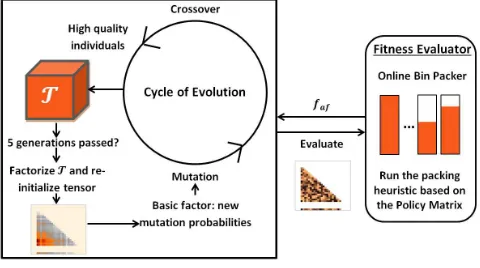
In the original framework [24], policy matrices are pro-duced using GA in a train and test fashion. The evolu-tionary cycle is performed for a given stochastic sequence generator (UBP) resulting in a policy matrix for that UBP. At the beginning, a random population of policy matrices is generated. At each generation, mutation and crossover are applied to the individuals (policy matrices). Each individual representing a packing policy/heuristic is then handed over to a separate evaluator (bin packer) which applies the policy to a stream of items, returning the fitness (Eq.1) as feedback. The cycle of evolution continues until the stopping criterion is met. Our method modifies the training procedure as il-lustrated in Figure 3. During every 5 generations, a tensor (T) containing the top 20% individuals (policy matrices) is constructed and factorized into its basic factor, producing a basic frame. The elements of the basic frame is used as mu-tation probabilities for the next 5 generations from which a new tensor is constructed. Subsequent to training, the best individual is then tested on several unseen instances for evaluation.
Figure 3: The GA+TA framework
The tensor T has the size C ×C×R where R is the
number of the top 20% individuals andCis the bin capacity
policy matrices are put into the tensor is precisely the order in which they are generated by the GA framework. This tensor is then factorized whereKin Eq.2 is set to 1. That is, the original tensorT is approximated by ˆT as the following
ˆ
T =λa◦b◦c (6)
where the length of the vectorsa,bandcare C,C andR
respectively. As depicted in Figure 4, the outer product of
vectorsaandbresults in a basic frameBwhich is exactly
the shape of a policy matrix with the sizeC×C (Eq.3 is
used with k = 1 to produce B). The difference between
Band a policy matrix is that instead of containing integer
score values in the range of [wmin, wmax], it contains real
values between 0 and 1. These values point towards regions in policy matrices where change of score values has been a common pattern among good quality matrices.
Figure 4: Extracting the basic frame for K = 1 in Eq.2.
Thus, the values inBare perceived as mutation
probabil-ity of each locus for the next 5 generations. That is, during the next 5 generations, a gene indexed (i, j) is mutated with a probabilityB(i, j). The initial mutation probabilities are
fixed as 1
chromosomeLength for the first 5 generations. Data
collection for tensor construction occurs at the same time
when the generated basic frameBhas been applied.
6.
EXPERIMENTS
In this section, after providing the details of our experi-mental setting, we discuss the results. In order to to gain a better understanding of our approach, the basic frames achieved from our experiments are investigated first. Subse-quently, we compare our approach to the original framework by conducting a comparative study between the performance of the two algorithms on ten different classes of instances.
6.1
Experimental Setting
The setting used for the GA framework is adopted from [24]. That is, for each training phase, the number of genera-tions is set to 200 while the population size is⌈C/2⌉. Tour-nament selection is the strategy of choice for parent selection and the tour size is 2. Crossover and mutation operators are uniform and traditional respectively and the crossover prob-ability is equal to 1.0. As discussed in Section 3, the scores in policy matrices are chosen from the range [wmin, wmax].
In our experimentswmin= 1 andwmaxis equal to the
max-imum number of active entries along the columns of the pol-icy matrix (i.e. for the polpol-icy matrix in Figure 1,wmax= 7).
For tensor operations, Matlab Tensor Toolbox [6] has been used. The GA framework is implemented in the C language. In order to use the toolbox, the Matlab DeployTool has been used to generate an executable of the Matlab code. This executable is then called when necessary from the C code
without a need to load the Matlab environment. The ap-proach proposed in this paper is compared to the original GA framework. Throughout the experiments, our approach is referred to by the GA+TA whereas the original work in [24] is referred to by GA. The experiments regarding the original GA framework have been repeated here (instead of using the results reported elsewhere) and the train-test con-ditions (seeding etc.) for both GA and GA+TA are the same.
6.2
Basic Frames: An Analysis
[image:5.595.68.279.238.301.2]As discussed in Section 5, the GA+TA algorithm fre-quently constructs and factorizes a tensor of high quality candidate solutions. The factorization process results in the basic frame which is used as a mutation probability. This section is dedicated to the analysis of these basic frames and the manner with which they evolve along side the main cycle of evolution.
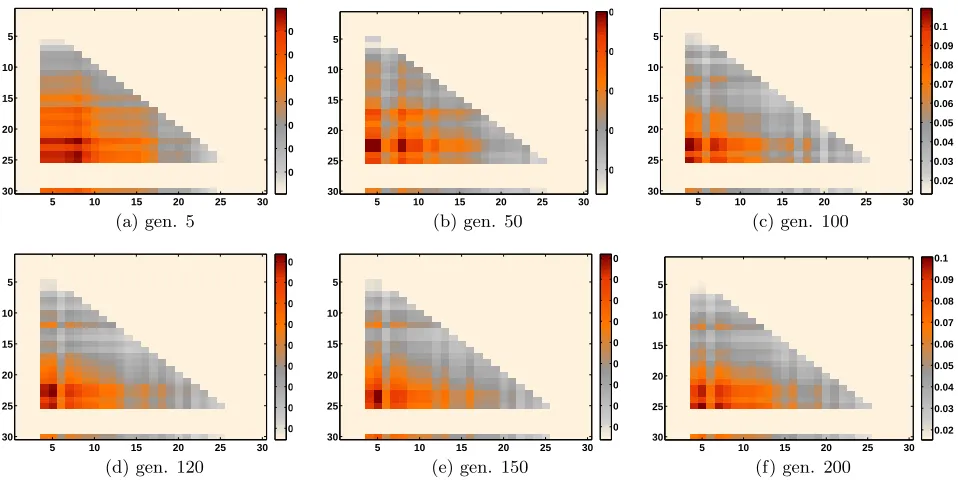
Figure 5 illustrates the gradual change in probabilities produced by tensor analysis throughout the generations. The instance generator on which the policies were trained in Fig-ure 5 isU BP(30,4,25). The basic frame generated after the first factorization (Figure 5(a)) is notably less detailed com-pared to the ones generated in later generations. However, during the time, a common pattern seems to emerge. This pattern reveals that, for this UBP, good quality matrices tend to frequently change the score values corresponding to small item sizes and large remaining bin capacities. Thus, subjecting these locus to mutation more frequently would probably result in better packing performance.
Different UBP’s indicate different patterns though. For instance, Figure 6 shows one of the basic frames produced for the instance generatorU BP(40,10,20). Using this ba-sic frame, the best policy matrix was found during training. The pattern here is certainly different from those in Figure 5 indicating a whole different group of items sizes and remain-ing bin capacities as the most frequently changremain-ing genes. It also is less focused and more disconnected compared to the basic frames in Figure 5(d).
A closer look at Figure 5 shows another interesting aspect of the generated basic frame. It seems that in addition to finding common changing locus in the chromosome, the basic frame also identifies groups of different genes with similar (if not equal) probabilities. In other words, basic frames seems to partition genes into groups (with no clear border) where genes within each group are related. This is no surprise and it is one of the achievements of the ALS algorithm. In Eq.6,
the factoracaptures the gene patterns corresponding to bin
remaining capacity whilebdoes the same for gene patterns
concerning the item size. The factorccaptures the temporal
profile of the patterns in the first two factors. Hence, our approach is able to detect recurring gene patterns along each dimension (remaining capacity and item size). Moreover,
when constructing the tensor, only good quality solutions
were allowed in the tensor. Thus, any pattern detected along each dimension is equally promising. The basic frame is
calculated from the outer product of a and b, combining
5 10 15 20 25 30 5
10
15
20
25
30
0.02 0.03 0.04 0.05 0.06 0.07 0.08
(a) gen. 5
5 10 15 20 25 30 5
10
15
20
25
30
0.02 0.04 0.06 0.08 0.1
(b) gen. 50
5 10 15 20 25 30 5
10
15
20
25
30
0.02 0.03 0.04 0.05 0.06 0.07 0.08 0.09 0.1
(c) gen. 100
5 10 15 20 25 30 5
10
15
20
25
30 0.02
0.03 0.04 0.05 0.06 0.07 0.08 0.09 0.1
(d) gen. 120
5 10 15 20 25 30 5
10
15
20
25
30
0.02 0.03 0.04 0.05 0.06 0.07 0.08 0.09 0.1
(e) gen. 150
5 10 15 20 25 30 5
10
15
20
25
30 0.02
0.03 0.04 0.05 0.06 0.07 0.08 0.09 0.1
(f) gen. 200
Figure 5: Various basic frames achieved in different stages of the search for an instance generated by
U BP(30,4,25). The basic frame in 5(d) is the probability matrix using which the best policy is achieved (gen 121)
regions with similar score values2 in the basic frame (as it
is visible in both figures 5 and 6), the genes are considered to berelated.
10 12 14 16 18 20 5
10
15
20
25
30
35
40
[image:6.595.66.545.50.290.2]0.02 0.04 0.06 0.08 0.1
Figure 6: The basic frame for U BP(40,10,20) using which the best policy matrix was found.
It is important to stress the fact that the produced basic frames are in no way representing the index scores generated by the GA framework. That is, we are not trying to infer score values in the policy matrix from the corresponding elements of a basic frame. The policy matrix in Figure 7 is generated using the probabilities in Figure 5(d) and solves instances generated by U BP(30,4,25) instance generator. It is evident from the figures that although the two matrices are similar in dimensions, they are not similar at all when
2
Not to be confused with the scores in the policy matrix. The score here refers to the quantity achieved from the fac-torization procedure.
5 10 15 20 25 30
5
10
15
20
25
30 0
[image:6.595.365.506.369.499.2]5 10 15 20 25
Figure 7: The best policy matrix obtained by
GA+TA for U BP(30,4,25)using the basic frame en-tries (see Figure 5(d)) as mutation probabilities.
it comes to the contents. The rough structure of the policy matrix itself compared to the smooth structure of the basic frame confirms that there is little correlation between scores and mutation probabilities.
6.3
Experimental Results
The experimental results show that our algorithm (GA+TA) outperforms the original GA framework on almost all
in-stances significantly. A Wilcoxon sign rank test is
per-formed to confirm this. Table 1 summarizes the results. The only instance generator on which GA+TA seems to be under-performing is UBP(60,15,25). On all other instances, GA+TA outperforms the GA framework.
[image:6.595.113.235.403.541.2]per-formance of the GA algorithm even slightly. Nevertheless, the GA+TA algorithm has improved the performance sub-stantially. One major reason that contributes to the success of the GA+TA algorithm is the representation. Tensor fac-torization algorithms are designed for high dimensional data where it is expected that various dimensions of data are cor-related. Perhaps the study in [20] is a very good example confirming this argument. Thus, matrix representation of packing policies prepares a suitable ground for analytic al-gorithms with an expectation of existing relations between various dimensions of data. The fact that the first dimen-sion of a policy matrix is dedicated to remaining bin capac-ities and the second to item sizes fits very well to the fac-torization algorithm. This is something which couldn’t be achieved if the policies were vectorized (as in [4]). Therefore, the representation matters and it has a great contribution to the performance of GA+TA. However, apart from rep-resentation, the strength of tensor analytic approaches has also a great impact on the performance. In previous study [3] introduced the use of these approaches in heuristic re-search for the first time. The impressive results achieved in this study confirms this and is encouragement for further re-search in transferring tensor analytic approaches to the field of (meta)heuristic optimization.
7.
CONCLUSION
In this study, a powerful data mining tool, namely, tensor analysis is integrated into a GA framework [24] for solving an online bin packing problem. Online bin packing policies
with matrix representation enables construction of a 3rd
-order tensor as the high quality candidate solutions vary from one generation to another under the genetic operators in GA. This construction process is repeated periodically throughout the evolutionary process. At the end of each period, the obtained tensor is factorized into its basic fac-tors. Then those basic factors are used to identify recurring gene patterns identifying the frequency with which genes are modified in high quality solutions. This information is di-rectly used to set the mutation probability for each gene, accordingly. The empirical results show that the proposed tensor analysis approach is capable of adaptation at the gene level during the evolutionary process yielding a successful locus based mutation operator. The tensor analysis embed-ded into GA significantly improves the performance of the generic GA with standard mutation on almost all online bin packing instance classes used during the experiments.
8.
REFERENCES
[1] E. Acar, D. Dunlavy, and T. Kolda. Link prediction on evolving data using matrix and tensor
factorizations. InIEEE International Conference on
Data Mining Workshops, 2009. ICDMW ’09., pages 262–269, Dec 2009.
[2] A. Anandkumar, R. Ge, D. Hsu, S. M. Kakade, and M. Telgarsky. Tensor decompositions for learning
latent variable models.CoRR, abs/1210.7559, 2012.
[3] S. Asta and E. ¨Ozcan. A tensor-based selection hyper-heuristic for cross-domain heuristic search.
Information Sciences, 299(0):412 – 432, 2015. [4] S. Asta, E. ¨Ozcan, and A. J. Parkes. Dimension
reduction in the search for online bin packing policies. InProceedings of the 15th Annual Conference
Companion on Genetic and Evolutionary
Computation, GECCO ’13 Companion, pages 65–66, New York, NY, USA, 2013. ACM.
[5] S. Asta, E. ¨Ozcan, A. J. Parkes, and A. S. Etaner-Uyar. Generalizing hyper-heuristics via apprenticeship learning. In M. Middendorf and
C. Blum, editors,Evolutionary Computation in
Combinatorial Optimization, volume 7832 ofLecture Notes in Computer Science, pages 169–178. Springer Berlin Heidelberg, 2013.
[6] B. W. Bader, T. G. Kolda, et al. Matlab tensor toolbox version 2.5. Available online, January 2012. [7] E. K. Burke, M. R. Hyde, G. Kendall, G. Ochoa,
E. ¨Ozcan, and J. R. Woodward. Exploring
hyper-heuristic methodologies with genetic programming. In J. Kacprzyk, L. C. Jain, C. L.
Mumford, and L. C. Jain, editors,Computational
Intelligence, volume 1 ofIntelligent Systems Reference Library, pages 177–201. Springer Berlin Heidelberg, 2009.
[8] J. Carroll and J.-J. Chang. Analysis of individual differences in multidimensional scaling via an n-way generalization of ˆa ˘AIJeckart-youngˆa ˘A˙I decomposition.
Psychometrika, 35(3):283–319, 1970.
[9] J. Chen, Y. Xie, and H. Chen. A population-based extremal optimization algorithm with
knowledge-based mutation. In Y. Tan, Y. Shi, and C. Coello, editors,Advances in Swarm Intelligence,
volume 8794 ofLecture Notes in Computer Science,
pages 95–102. Springer International Publishing, 2014. [10] E. G. Coffman Jr, G. Galambos, S. Martello, and
D. Vigo. Bin packing approximation algorithms: Combinatorial analysis. In D.-Z. Du and P. Pardalos,
editors,Handbook of Combinatorial Optimization,
volume 1 ofIntelligent Systems Reference Library,
pages 151–207. Kluwer Academic Publishers, 1999. [11] F. Divina and E. Marchiori. Knowledge-based
evolutionary search for inductive concept learning. In
Y. Jin, editor,Knowledge Incorporation in
Evolutionary Computation, volume 167 ofStudies in Fuzziness and Soft Computing, pages 237–253. Springer Berlin Heidelberg, 2005.
[12] D. M. Dunlavy, T. G. Kolda, and E. Acar. Temporal link prediction using matrix and tensor factorizations.
ACM Trans. Knowl. Discov. Data, 5(2):10:1–10:27, Feb. 2011.
[13] E. Falkenauer. A hybrid grouping genetic algorithm for bin packing.Journal of Heuristics, 2:5–30, 1996. [14] J. C. Gittins. Bandit processes and dynamic allocation
indices.Journal of the Royal Statistical Society. Series B (Methodological), 41(2):pp. 148–177, 1979.
[15] R. A. Harshman. Foundations of the PARAFAC procedure: Models and conditions for an”
explanatory” multi-modal factor analysis.UCLA
Working Papers in Phonetics, 16(1):84, 1970.
[16] R. A. Harshman.PARAFAC: Methods of three-way
factor analysis and multidimensional scaling according to the principle of proportional profiles.PhD thesis, University of California, Los Angeles, CA, 1976. [17] D. S. Johnson, A. Demers, J. D. Ullman, M. R. Garey,
Table 1: Performance comparison of the GA+TA, GA and BF algorithms for each UBP over 100 trials. The valuesavg,min andmax indicate the mean, minimum and maximum bin fullness in persentages, respectively. The ‘vs’ column in middle highlights the results of the Wilcoxon sign rank test where > (<) means that GA+TA is significantly better (worse) than GA within a confidence interval of 95%. Similarly, ≥ shows that GA+TA performs slightly better than GA (with no statistical significance). The sign=refers to equal performance.
Instance GA+TA GA BF
avg min max vs avg min max avg min max
UBP(6,2,3) 99.99 99.99 100 = 99.99 99.99 100 92.29 92.26 92.31
UBP(15,5,10) 99.62 99.28 99.88 ≥ 99.58 99.16 99.86 99.62 99.15 99.89
UBP(20,5,10) 98.28 98.19 98.34 > 97.89 97.68 98 91.55 91.45 91.62
UBP(30,4,20) 99.53 99.41 99.61 > 99.09 98.95 99.23 96.84 96.80 96.90
UBP(30,4,25) 99.53 99.23 99.7 > 98.39 98.06 98.57 98.38 98.31 98.46
UBP(40,10,20) 96.27 95.99 96.39 > 96.08 95.86 96.35 90.23 90.12 90.31
UBP(60,15,25) 99.47 99.14 99.77 < 99.68 99.1 99.91 92.55 92.43 92.66
UBP(75,10,50) 98.53 98.4 98.6 > 98.27 98.12 98.36 96.08 96.04 96.13
UBP(80,10,50) 98.66 98.58 98.72 > 98.07 97.98 98.13 96.39 96.32 96.44
UBP(150,20,100) 98.22 98.12 98.32 > 97.78 97.68 97.86 95.82 95.77 95.87
for simple one-dimensional packing algorithms.SIAM
Journal on Computing, 3(4):299–325, 1974. [18] T.-K. Kim and R. Cipolla. Canonical correlation
analysis of video volume tensors for action
categorization and detection.IEEE Trans. Pattern
Anal. Mach. Intell., 31(8):1415–1428, Aug. 2009. [19] T. G. Kolda and B. W. Bader. Tensor decompositions
and applications.SIAM Rev., 51(3):455–500, Aug.
2009.
[20] B. Krausz and C. Bauckhage. Action recognition in videos using nonnegative tensor factorization. In
ICPR, pages 1763–1766. IEEE, 2010.
[21] L. D. Lathauwer, B. D. Moor, and J. Vandewalle. A
multilinear singular value decomposition.SIAM J.
Matrix Anal. Appl., 21(4):1253–1278, Mar. 2000. [22] C. C. Lee and D. T. Lee. A simple on-line bin-packing
algorithm.Journal of the ACM, 32(3):562–572, 1985.
[23] H. Maini, K. Mehrotra, C. K. Mohan, and S. Ranka.
Knowledge-based nonuniform crossover. InIEEE
World Congress on Computational Intelligence, volume 8-4, pages 22–27, Jun 1994.
[24] E. ¨Ozcan and A. J. Parkes. Policy matrix evolution for generation of heuristics. InProceedings of the 13th annual conference on Genetic and evolutionary computation, GECCO ’11, pages 2011–2018, New York, NY, USA, 2011. ACM.
[25] A. J. Parkes, E. ¨Ozcan, and M. R. Hyde. Matrix
analysis of genetic programming mutation. In
Proceedings of the 15th European Conference on Genetic Programming, EuroGP’12, pages 158–169, Berlin, Heidelberg, 2012. Springer-Verlag.
[26] A. Prakash, F. T. Chan, and S. Deshmukh. Fms scheduling with knowledge based genetic algorithm
approach.Expert Systems with Applications,
38(4):3161 – 3171, 2011.
[27] W. T. Rhee and M. Talagrand. On line bin packing
with items of random size.Mathematics of Operations
Research, 18(2):pp. 438–445, 1993.
[28] M. B. Richey. Improved bounds for harmonic-based
bin packing algorithms.Discrete Applied Mathematics,
34(1-3):203 – 227, 1991.
[29] P. Ross. Hyper-heuristics. In E. K. Burke and
G. Kendall, editors,Search Methodologies:
Introductory Tutorials in Optimization and Decision Support Techniques, chapter 17, pages 529–556. Springer, 2005.
[30] A. Scholl, R. Klein, and C. J¨urgens. Bison: A fast hybrid procedure for exactly solving the
one-dimensional bin packing problem.Computers &
Operations Research, 24(7):627 – 645, 1997. [31] A. Shashua and T. Hazan. Non-negative tensor
factorization with applications to statistics and
computer vision. InICML, pages 792–799, 2005.
[32] L. R. Tucker. Some mathematical notes on three-mode factor analysis. Psychometrika, 31:279–311, 1966c. [33] M. A. O. Vasilescu and D. Terzopoulos. Multilinear
analysis of image ensembles: Tensorfaces. In A. Heyden, G. Sparr, M. Nielsen, and P. Johansen,
editors,ECCV (1), volume 2350 ofLecture Notes in
Computer Science, pages 447–460. Springer, 2002. [34] D. Wang, J. Zhou, K. He, C. Liu, and J. Xia. Using
tucker decomposition to compress color images. In2nd
International Congress on Image and Signal Processing, 2009. CISP ’09., pages 1–5, Oct 2009. [35] G. Yan, G. Xie, Z. Chen, and K. Xie.
Knowledge-based genetic algorithms. In G. Wang, T. Li, J. Grzymala-Busse, D. Miao, A. Skowron, and
Y. Yao, editors,Rough Sets and Knowledge
Technology, volume 5009 ofLecture Notes in Computer Science, pages 148–155. Springer Berlin Heidelberg, 2008.
[36] A. Yarimcam, S. Asta, E. ¨Ozcan, and A. J. Parkes.
Heuristic generation via parameter tuning for online
bin packing. InEvolving and Autonomous Learning