Honors Theses Honors Program
2019
The Relationship Between Stress and Cognitive Functioning
The Relationship Between Stress and Cognitive Functioning
Gabrielle Jasmin Assumption College
Follow this and additional works at: https://digitalcommons.assumption.edu/honorstheses
Part of the Psychology Commons
Recommended Citation Recommended Citation
Jasmin, Gabrielle, "The Relationship Between Stress and Cognitive Functioning" (2019). Honors Theses. 55.
https://digitalcommons.assumption.edu/honorstheses/55
This Honors Thesis is brought to you for free and open access by the Honors Program at Digital Commons @ Assumption University. It has been accepted for inclusion in Honors Theses by an authorized administrator of Digital Commons @ Assumption University. For more information, please contact
The Relationship Between Stress and Cognitive Functioning Gabrielle Jasmin
Faculty Supervisor: Professor Leamarie Gordon, Ph.D.
Psychology Department
A Thesis Submitted to Fulfill the Requirements of the Honors Program at Assumption College
Abstract
Exposure to stress can negatively impact cognitive functions. The effects can depend on one’s health behaviors and mental health status. Participants in this study completed various surveys asking about their mental health status, their physical activity level, and other important information such as whether or not they take part in mindful meditation practices. In addition, they were randomly separated in two groups: a stress group who experienced the stressful version of the Trier Social Stress Test (TSST; Kirschbaum, Pirke, & Hellhammer, 1993), and a control group who experienced a non-stressful version of TSST. Participants then completed a Stroop task on a computer program, where the participants were asked to say the color of the word, rather than the word itself (Stroop, 1935). The participants’ reaction time and number of errors made were recorded. It was found that participants in the stress group reported higher levels of state anxiety and state depression than participants in the control group, as well as increased heart rate following the TSST. While previous studies have shown that when presented with threat words on the Stroop task, anxious participants are more likely to have a slower reaction time and have an increased amount of errors, participants in the present study’s stress group did not exhibit this pattern of behavior.
The Relationship between Health Behaviors and Cognitive Functioning Think about how difficult it would be to solve complex math problems. Now, think about solving these complex problems under any amount of stress. For many, already difficult tasks can become even more difficult when under stress. Stress is defined as a biological response to a specific trigger or situation and can accompany uncomfortable thoughts and emotions such as anxiety. These symptoms of stress can be related to a number of physical and mental health outcomes, including heart disease (Dimsdale, 2008), gastrointestinal problems (Qin, Cheng, Tang, Bian, 2014), depression (Yang, Zhao, Wang,Liu, Zhang, Li, Cui, 2015), and migraines (D’Amico, Libra, Prudenzano, Peccarisi, Guazzelli, Busson, 2000). Clearly, it is important to identify ways to reduce stress and limit its impact on health. While chronic stress is most predictive of negative health outcomes, acute stress, or everyday stressors like traffic or arguments with a friend, can have short-term impacts on behaviors such as emotion regulation (Richardson, 2017), cognitive control (Thomas, Campbell, Altareb, Yousif, 2010), and attention (Sänger, Bechtold, Schoofs, Blaszkewicz, &Wascher, 2014). The present study was designed to examine the relationship between health behaviors, stress, and cognitive functioning by exposing participants to acute psychological stress and seeing how it impacted cognitive functioning. It also explored whether health behaviors, such as exercise and meditation, can impact responses to stress.
The Physiological Effects of Stress
When faced with a perceived threat, the body enables a stress response to immediately allow the body to prepare for the intended survival. The biological response enables the fight or flight response in order to “escape” what is triggering the stress to occur (Goldstein, 2010). The
body releases chemicals and hormones, such as epinephrine, to increase the heartrate, as well as cortisol to control how your body perceives what is causing the stress (Sargis, n.d.). High levels of stress over a period of time can contribute to anxiety, as feelings of stress and anxiety often trigger the same biological response (Schneiderman, 2005). Repeated exposure to stress can also lead to an increased risk of heart disease, for example (Huang et al., 2013). Studies and research have shown that exposure to chronic stress can increase one’s risk of a cardiovascular disease, such as coronary heart disease (Lu et al. 2012). However, healthy behaviors, including
participating in physical activity or mindful meditations tasks, can positively affect one’s level of stress. Cognitive functioning can be negatively affected by the presence of stress. Studying the relationship between health behaviors, stress, and cognitive functioning is essential to
understanding how the three factors relate and positively or negatively affect one another. The stress response includes various behavioral and physical changes, including how one thinks and behaves. A natural reaction produced by the body, the stress response focuses on enhancing the body’s ability to survive and rid the potential threat. For example, an increase in one’s respiratory rate and blood pressure can occur when an individual’s body biologically reacts to a stressor (Ulrich-Lai, & Herman, 2009). During the stress response, the amygdala in the brain detects the perceived threat and sends a signal to the hypothalamus. The hypothalamus is able to communicate with the rest of the body through the nervous system. Through the autonomic nervous system, one is able to have involuntary bodily functions including breathing, blood pressure, and heart rate. The autonomic nervous system is broken down into the sympathetic and parasympathetic nervous system. The sympathetic nervous system allows the body to either “fight or flight”. The “fight or flight” response enables one to escape if in perceived danger. The parasympathetic nervous system allows the body to “rest and digest” (McCorry, 2007). The
parasympathetic nervous system allows the body to calm down and maintain digestion. The hypothalamus activates the sympathetic nervous system by sending signals to the adrenal glands. Adrenal glands produce epinephrine, which is pumped into the bloodstream. The presence of epinephrine in the blood produces numerous physiological changes throughout the body, such as an increase in heart rate and blood pressure. An individual can also experience rapid breathing, as well as an increase in oxygen to the brain. During this time period, the senses can become more efficient, as stress increases the ability of senses to detect information in the environment. The initial stress response happens very quickly, which is why people, in general, are not completely aware of the physiological changes that are occurring (McCorry, 2007).
Repeated exposure to stress can often cause negative effects. Stress can lead to a breakdown of one’s immune system, leading to frequent sicknesses (Yaribeygi et al., 2017). Chronic stress can cause be correlated to higher levels of pro-inflammatory cytokines and an increased level of inflammation. On a short-term level, inflammation can be beneficial as it can protect the body from pathogens and initiate wound healing (Morey, Boggero, Scott, &
Segerstrom, 2015). However, chronic inflammation caused by stress can negatively impact the immune system and lead to an increase risk of chronic diseases and viruses (Dhabhar, 2008). Stress can also cause chronic pain, as stress can cause tension in the neck, shoulders, and back (Schell, Theorell, Hasson, Arnetx, & Saraste, 2007). The overall tension in the body can lead to headaches and sore muscles (Ahmed, 2012). Stress also causes decreased energy, as well as insomnia, as stress activates the hypothalamic-pituitary-adrenal system, which contributes to feelings of wakefulness and inability to sleep. Hormones including cortisol, epinephrine, and norepinephrine also contribute to the mind being aroused (Han, Kim, & Shim, 2012). The body’s wakefulness may interfere with one’s ability to fall asleep and stay asleep for an appropriate
period of time depending on one’s sleep schedule. The interference of one’s sleep schedule could lead to less hours resting the mind and body and eventually less energy throughout the day (Han, Kim, & Shim, 2012). Stress can also cause cardiovascular disease, as heart disease can be linked with an increased level of stress in one’s work environment and increases inflammation throughout the body including the heart (Fioranello et al., 2018).
The Psychological Effects of Stress
The experience of anxiety, or persistent feelings of worry, fear, or hopelessness, is a common psychological reaction to stress and can accompany the physical symptoms like rapid breathing, sweating, trembling, and an increased heart rate (APA, 2013). Anxiety can be broadly categorized into trait anxiety or state anxiety.
Trait anxiety refers to feelings of distress more often than not (Schwarzer, 1997). This type of anxiety can describe a person’s characteristics. Rather than having a temporary feeling of distress, people with trait anxiety experience higher levels of stress more often. Trait anxiety may accompany a number of clinical disorders, including generalized anxiety disorder, panic
disorder, or mood disorders. For example, a person with generalized anxiety disorder may experience feelings of anxiety and distress over many different triggers over an extended period of time (Schwarzer, 1997). A mood disorder is a psychiatric condition that is categorized by chronic mood regulation problems. Depression is a symptom of many mood disorders, and often coincides with anxiety. For example, one mood disorder, major depressive disorder (MDD), affects approximately 14.8 million American adults, and is defined as the experience of low mood for an extended period of time. It is often accompanied by feelings of hopelessness, lethargy, loss of interest, low self- esteem, and anxiety (American Psychiatric Association,
2013). Although anxiety is not a mood disorder, it can affect mood, as depression can cause anxiety, and anxiety can cause depression (Horwitz, 2010).
While anxiety is clearly a symptom of many psychological disorders, not all people with trait anxiety have an actual diagnosis. Trait anxiety can also be referred to as being a “chronic worrier” or someone who is always “distraught” (Schwarzer, 1997). High functioning anxiety, or people who live with anxiety but do not identify themselves as having an actual disorder, can explain why some people with trait anxiety do not have an actual diagnosis. People with high functioning anxiety appear to have their life together, as they are high achievers, organized, proactive, and outgoing (Gardner, 2018). Underneath these positive characteristics, however, people with high functioning anxiety often experience nervous habits, overthinking,
procrastination, rumination, and expecting the worst (Gardner, 2018). People with high
functioning anxiety can often appear and function completely fine, which explains why not all forms of trait anxiety are clinical diagnoses.
The Anxiety and Depression Association of America (ADAA) recommends that those with anxiety diagnoses take medications, such as selective serotonin reuptake inhibitors (SSRIs) or serotonin norepinephrine reuptake inhibitor (SNRIs). SSRIs and SNRIs positively impact the symptoms of anxiety by blocking the reabsorption of serotonin and norepinephrine, leading to an increase of the hormones available (Farach, et al., 2012). Low levels of serotonin and
norepinephrine can be link to a variety of different psychiatric disorders, including anxiety and depression. By blocking the reuptake of serotonin and norepinephrine, symptoms of anxiety and depression can be decreased (Torrente, Gelenberg, & Vrana, 2011). Patients should also consider regular exercise, relaxation techniques, meditation, and breathing exercises to lift their mood and reduce their experience of persistent anxiety. By participating in regular exercise, breathing and
relaxation techniques the patient may feel a better sense of self and a purpose (Stonerock, Hoffman, Smith, & Blumenthal, 2015).
While trait anxiety is persistent and found in individuals with certain personality types or clinical diagnoses, state anxiety is a form of anxiety that most people can relate to on some level. State anxiety is defined as the current and present level of anxiety that can come in response to daily, or acute, stressors. State anxiety is how someone feels “right now” and in the moment (Julian, 2011). Common everyday stressors can include a big exam at school, an argument at home, getting stuck in traffic, financial issues, etc. These common events can often put someone in a “state” of anxiety or stress (Salleh, 2008). While state anxiety is common in a non-clinical setting, it is important to note that state anxiety can accompany a diagnosis. For example, individuals who experience state anxiety in response to certain types of stimuli, like having an extreme fear of heights or spiders, may have a clinical diagnosis of a phobia. Phobias are irrational persistent fears of a specific stimulus, where someone experiences intense feelings of fear and distress when exposed to the perceived threat (American Psychiatric Association, 2013). In the present study, I examine the impact of daily stressors in a non-clinical setting.
The Impact of Daily Stressors on Cognitive Functioning
Daily stressors can negatively impact cognitive functioning. Stress can cause structural changes in the brain to areas important for cognition, particularly memory, such as the amygdala, hippocampus, and other regions of the temporal lobe (Yaribeygi, Panahi, Sahraei, Johnston, & Sahebkar, 2017). For example, stress and stress hormones can negatively impact brain
functioning, causing short term difficulties in focusing on and completing normally simple cognitive tasks. Specifically, stress can negatively impact regions of the brain, including the hippocampus and prefrontal cortex, as well as executive functions including hand-eye
coordination and spatial memory (for review see Wu & Yan, 2017). Stress can also have long-term effects, such as accelerating cognitive decline across the lifespan in a number of areas, including the ability to effectively manage attentional resources (Scott et al., 2015).
In a study involving 48 healthy male participants, subjects partook in the Socially Evaluated Cold Pressor Test (SECPT; Plieger et al., 2017). The SECPT combines physiological and psychological stressors to induce stress in participants. For example, the participants were videotaped continuously (psychological stressor), while also placing their hands in ice cold water (physical stressor), while also involving the participant to look into a camera while being
videotaped (Plieger et al., 2017). Based on cortisol responses to the SECPT, participants were categorized as having high stress or low stress. They all then participated in the Frankfurter Attention-Inventory-2 (FAIR-2), which involves an attention task. The participants were instructed to draw lines between circles and squares that were given on a sheet of paper. The participants were also asked to indicate circles with three dots and squares with two dots while continuing to draw the line between the shapes. Throughout the attention task, there were also items designed to distract attention from the original task. Plieger et al. (2017) found that cognitive function, in this case attentional control was worse for people who had a strong stress response to the SECPT. This study also found that the magnitude of the stress response was positively correlated how stressful the performed task was perceived to be (Plieger et al., 2017).
Other effects of daily stressors on cognitive functions such as attentional bias, can be examined by considering performance on a version of the Stroop task that includes emotional stimuli. In the standard Stroop task (Stroop, 1935), participants are asked to name the color of the printed, rather than the word itself. Over the years, the basic Stroop task has been modified to answer a number of different questions about cognition. For example, Egloff and Hock (2001)
had 121 participants initially self-report trait anxiety levels using the state scale of the widely used State Trait Anxiety Inventory (STAI; Laux et al., 1981). After completing the STAI trait task, the participants completed a version of the Stroop task. The task consisted of participants viewing four cards and having to name as quickly as possible the color the words were presented in on each card. Two cards contained emotionally neutral words and two cards contained threat words. The two threat cards were separated into physical threat words (such as WAR) and ego-threat words (such as FAILURE). The cards contained the words in a column in either green, red, yellow, or blue. The participants were instructed to speak as fast and correctly as possible, and the time it took to name each color word on each card was measured. State anxiety,
measured during the Stroop task, was measured with a brief four point scale with eight items such as “I felt nervous” (Morris et al., 1981). The results of the experiment indicated a positive relationship between Stroop interference and state anxiety, but only for people with high levels of trait anxiety. These people demonstrated the greatest attentional bias toward threat words (Egloff & Hock, 2001).
A similar study examined emotional Stroop task performance in bilingual Arabic students. The test was designed to see how depressive stimuli, in this case threatening words, would affect response times on the Stroop task. The study focused on replicating other studies that were done with English-speaking participants. Approximately 261 participants completed a computerized version of the emotional Stroop task. The participants also completed the Beck Depression Inventory (Beck et al., 1961), which measured the depressive symptoms in an individual. The results of the emotional Stroop task concluded that the response time for depression related words correlated to the scores on the depression test. Higher scores on the Beck Depression Inventory correlated to higher scores on the emotional Stroop task (Thomas et
al., 2010). The study found results that were similar to studies done with English-speaking participants.
Some early studies have experimentally examined the effects of stress on cognition. Horowitz and Becker (1971) hypothesized that negative and repetitive thoughts would increase as stress increased. The study involved 30 female participants, whom were then separated into a stress group or control group. The stress group was instructed to watch a film entitled
“Subincision”, which shows scenes involving bodily injuries, nudity, harassment, and bleeding. The control group watched a non-stressful film entitled “The Runner” in which a runner runs through his childhood home and reminiscences on his childhood. The film involved humor and no stressful events. After having the participants watch the film, both the stress group and control group self-reported their feelings and emotions. The results showed that there was an increase in intrusive, negative thoughts after the subjects watched the stressful film in comparison to the control group that watched the non-stressful film. (Horowitz & Becker, 1971). An increase in intrusive thoughts assumes a decreased ability to inhibit unwanted thoughts, which is a sign of impaired cognitive functioning. Inhibitory control allows one to control’s one attention, as well as one’s thoughts and emotions (Diamond, 2012).
The Present Study
The present study explored whether exposure to an acute psychological stressor impacts cognitive functioning. Specifically, we examined whether the effects of stress impact 1) how we direct attentional resources, and 2) executive control, by experimentally inducing stress in participants and measuring reaction times on an emotional Stroop task. I tested the following predictions. First, I predicted that participants who experienced the stressor would self-report higher levels of state anxiety and state depression compared to participants who experienced a
non-stressful control task. Second, I predicted that participants in the stress group would show larger interference effects on the Stroop task compared to the control group.
Method Participants
A total of 50 participants were randomly assigned into a Stress group or a Control group. Twenty-five participants took part in the stress group, while 25 other participants participated in the control group. Participants varied in age from 18-25 years old. The participants included 23 males and 27 females. Self-report data from the demographic survey indicated that 78% of participants identified as white. In addition, five participants reported a diagnosis of anxiety, and four participants reported a diagnosis of depression. Importantly, the proportion of diagnoses did not differ between the Stress and Control groups, ps > .05.In order to encourage and gain participation, participants were given a $10 Amazon gift card.
Materials and Procedure
Heart rate was measured continuously throughout the experiment using Empatica E4 wristbands (see www.empatica.com), which reliably estimate average beats per min (BPM; Ragot, Martin, Em, Pallamin, & Diverrez, 2018). A button press on the watch at various time points throughout the experiment on the wristwatch provided a time marker that assisted in later data analysis. Following consent and random assignment, participants attached the wristband and watched a three-minute video meant to relax the participant’s mind and get them ready for the experiment. Participants then provided a baseline of self-assessed state anxiety and state-depression by completing the STISCA, or the State-Trait Inventory for Cognitive and Somatic Anxiety (Appendix A; Ree et al., 2008) and the S-DEP (Appendix B; Ritterband & Spielberger,
1996). They also completed a demographic survey answering questions about their weight and height, and the types of physical activities they do per the Godin Leisure-Time Exercise
Questionnaire (Godin & Shephard, 1997). This questionnaire provides a continuous measure of physical activity by assessing both the frequency and level (mild vs. strenuous) of physical activity (Appendix C). The two groups did not differ in average BMI or level of activity.
Next participants completed one of two versions of the TSST, or the Trier Social Stress Test (Kirschbaum et al., 1993). The participants in the stress group then completed the stressful version. In the stressful version, participants were given a speech prompt, paper, and a pen. Participants were asked to write a speech for five minutes about applying for a job in their field. After the five minutes were up, the speech notes were collected. The participant was then told that they would be videotaped while giving the speech they prepared from memory. The participants were informed that the speech was a test of their public speaking skills, as well as their memory, and that their video would be analyzed for nonverbal behavior. The participant was given three minutes to present the speech. If the participant stopped speaking during the three minutes, he or she was asked to keep going. After the speech, the participant was asked to complete subtraction problems, where numbers in the teens were subtracted from numbers in the thousands, while still being video recorded. The participants were asked to solve the problems in their head without using pen or paper. The participant was also asked the same problem until he or she got the answer correct. This was done for a total of three minutes. Participants in the control group experienced the non-stressful version of the TSST. They were given the same speech prompt, paper, and a pen. They were also asked to write a speech for five minutes about applying for a job in their field. After the five minutes were up, the speech notes were collected. Participants were then given a textbook chapter to read for three minutes. Participants were then
asked the same subtraction problems as the stress group but were allowed to complete the problems using pen and paper. The subtraction problems were not graded, and the participants were given as much time as they needed to complete each problem within the three minutes.
Following the TSST, both groups of participants completed the STICSA and S-DEP a second time. Participants were then asked to complete a version of the Stroop Task. The task consisted of six different trials- congruent, incongruent, two neutral trials, social threat, and physical threat. Each trial presented a screen with a 4x4 grid containing 16 words presented in red, yellow, green, and blue fonts. In the congruent trial, each word was the name of a color and was presented in the font color of the word itself. For example, the word “red” was in red font. In the incongruent trial color words were also presented, but in a different font color. For example, the word “red” was in blue font. Neutral trials included words such as “marble” shown in colored fonts. Physical threat trials included words such as “murder”, and social threat words included “lonely”. On these trials, words were presented randomly in one of the four possible font colors as well. See Appendix D for the Stroop stimuli. The participants were asked to speak into a microphone and say the color of the word, not the word itself in paragraph form. The participants were asked to read the words as if they were reading a paragraph and were asked to not correct any errors. The participants’ voices were recorded and had up to 15 seconds to respond to each trial. Following the Stroop task, participants completed the STICSA and S-DEP a third and last time. The wristband was removed from the participants’ wrist and participants were
compensated for taking part in the study. A debriefing form was given to each participant and each participant was asked if they had any questions or if they were curious about how the experiment turned out as a whole. After dismissing each participant, the heart rate data was uploaded to Empatica Manager, a program that successfully stores the heart rate data.
Results
Self-Reported Anxiety
A 2 (group: stress, control) by 3 (time point: baseline, post-TSST, final) mixed ANOVA examined scores on the STICSA. Group was a between subjects variable and time point was a within subjects. There was no anxiety difference between the control group and stress group, F
(1, 48) = 2.147, p >.01. The main effect of time point was significant, F (2, 96) = 8.126, p < .05. Most importantly, the interaction between time point and group was significant. Anxiety reports changed over time points, but differently based on what group the participant was in, F (2, 96) = 6.66 p < .01. In the control group, there was no change in self-reported anxiety across the three time points, all p’s > .05. However, in the stress group, there was a significant change.
Participants increased levels of anxiety from baseline to post TSST, t (24) = 2.364 p < .05. Anxiety decreased from post TSST to final, t (24) = 4.229 p < .01. See Table 1.
Self-Report Depression
The same ANOVA that was conducted on self-reported anxiety was conducted on S-DEP scores. There was no difference between the control group and stress group, F (1, 48) = 0.278, p
>.05. The main effect of time point was significant, F (2, 96) = 10.816 p < .01. More
importantly, the interaction between group and time point was significant. Depression reports changed over time points, but differently based on what group the participant was in, F (2, 96) = 7.59 p < .05. In the control group, there was no change in self-reported depression across the three time points, all ps > .05. However, in the stress group, there was a significant change. Participants increased levels of depression from baseline to post TSST, t (24) = 3.822 p < .05. Depression decreased from post TSST to final, t (24) = 4.207 p < .05. See Table 1.
Heart Rate
Heart rate was measured in average beats per minute (BPM). Each participant’s average BPM during one-minute increments at four times points during the experimental procedure was computed. Baseline refers to the time period following the initial relaxation video. TSST 1 refers to the time period following speech prep after participants are informed whether they must give the speech. TSST 2 refers to the time period following the math problems. Final refers to the period at the end of the experiment. Eight participants from the stress group and five participants from the control group were removed from this analysis because the heart rate band did not record, leaving a total of 38 participants in this analysis.
A 2 (group: stress, control) x 4 (time point: baseline, TSST 1, TSST 2, final) mixed ANOVA examined the heart rates among the participants. Group was a between subjects variable and time point was within subjects. There was no heart rate difference between the control group and stress group, F (1, 36) = 2.162, p >.05. However, the main effect of time point was significant, F (3, 108) = 23.56, p < .001. Most importantly, the interaction between time point and group was significant. Heart rate changed over time points, but differently based on what group the participant was in, F (3, 108) = 4.27 p < .01. In the stress group, there was a significant increase from baseline to TSST 1, t (21) = 5.305 p < .01. There was a significant decrease in heart rate from TSST to TSST 2, t (21) = 3.053 p < .01, as well as from TSST 2 to final, t (21) = 3.896 p < .01. Baseline and final heart rate averages did not differ. In the control group there was a different pattern. Control participants’ heart rates did not increase from
baseline to TSST 1, t (21) = 1.752 p > .05. However, a comparison between baseline and TSST 2 revealed that by the end of the paper and pencil math problems, control participants HR
decrease in heart rate, t (17) = 2.451 p < .05. As in the stress group, baseline and final heart rate averages did were not different. See Table 1 for heart rate means.
Stroop Task
Reaction times on the Stroop task were assessed as the total time it took participants to complete the color naming task on each trial type. Times were assessed as the onset of speech until the end of speech. Although participants were asked to name the colors as quickly as
possible, some participants did not complete the color naming task within the 15 second response collection time frame. These participants were given the maximum response times. In addition, a preliminary look at the data indicated that there was no difference in reaction times between the two neutral trials, nor between the social threat and physical threat trials. To simplify the analysis, the average reaction times for the two neutral trials were analyzed. In addition, the two threat trials were averaged.
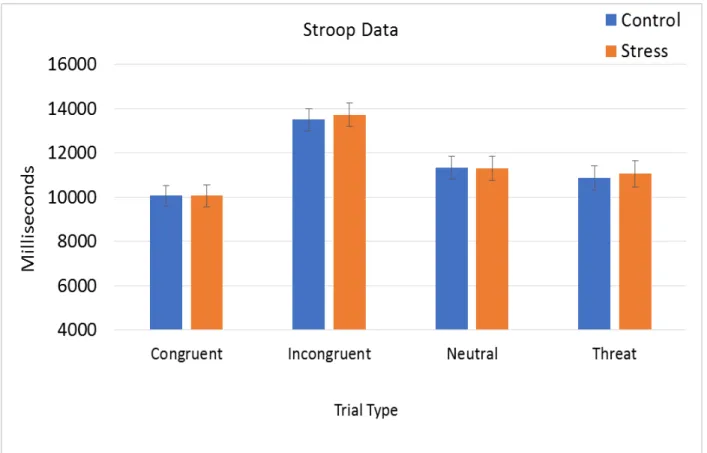
A one-way repeated measures ANOVA examined reaction times on the Stroop task to first establish that interference occurred on the task across groups. The ANOVA was significant,
F (3, 135) = 64.40, p < .01. Planned contrasts compared all trial types against congruent trials, as congruent trials should accompany the quickest reaction times and serve as a basis to look for interference effects. The analysis found that participants responded slower to incongruent trials than congruent trials, F (1, 45) = 143.30, p < .01. Interference was also observed for neutral, F
(1, 45) = 23.40, p < .01, and threat trials, F (1, 45) = 9.89, p < .01. See Figure 1 for mean reaction times.
Importantly for the present study, I also examined whether the amount of interference on each trial type differed between groups. A 2 (group: control, stress) by 3 (interference type: incongruent, neutral, threat) mixed ANOVA was done to analyze interference effects.
Interference for each trial type was calculated by subtracting the mean response time for each trial type from the baseline, congruent trial response times. The stress and control group did not have a difference in reaction times, as the main effect of group was not significant, F (1, 43) = .008, p >.05. The main of interference type was significant, F (2, 86) = 75.12, p < .01.
Participants showed greater interference for incongruent compared to neutral stimuli, t (45) = 10.23, p < .01, and greater interference for incongruent compared to threat stimuli, t (44) = 9.68,
p < .01. There was no difference in interference on neutral and threat stimuli, p > .05. There was no interaction between group and interference type.
Correlations
The stressor in this study did not impact reaction times on the Stroop task so I was unable to examine whether health related behaviors might impact that effect. However, it is still
interesting to look at whether the level of interference observed across both groups was related to health behaviors in any way. A series of correlations were conducted to explore possible
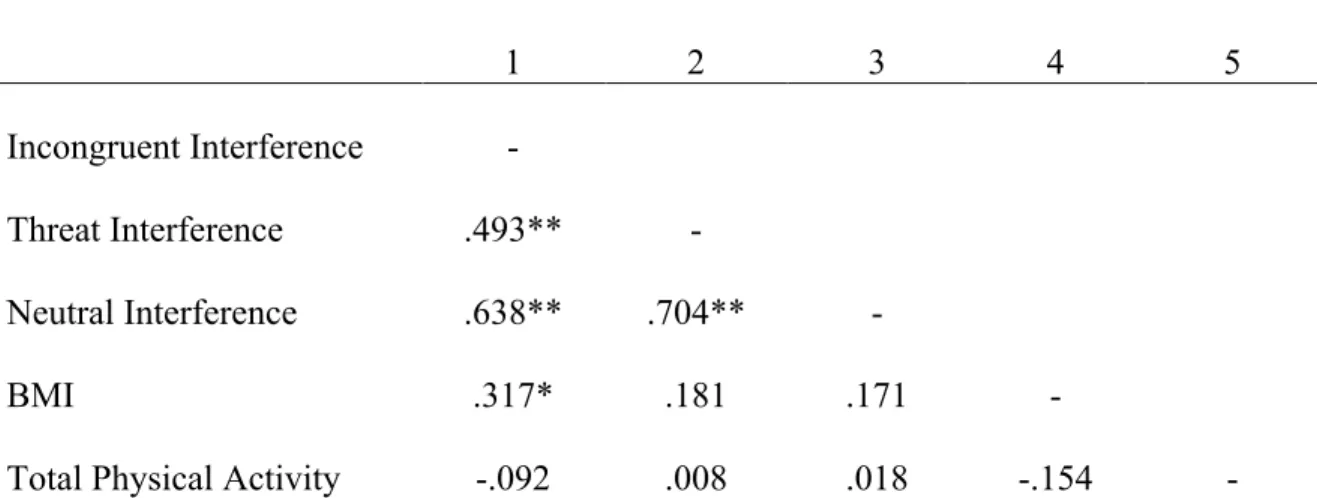
relationships between the following variables: Incongruent Interference, Neutral Interference, Threat Interference, BMI, and Total Physical Activity. All of the interference variables positively correlated with one another, but more interestingly, BMI positively correlated with incongruent interference, or in other word standard Stroop interference, r (40) = .317. p < .05. See Table 2 for all correlations.
Discussion
The main purpose of the present study was to examine the relationship between acute stressors and cognitive functioning. The participants were randomly separated in two groups: a stress group who experienced the stressful version of the Trier Social Stress Test (TSST;
version of the TSST. Participants then completed a computerized Stroop task, where the participants were asked to say the color of the word, rather than the word itself (Stroop, 1935). This study observed the participants’ reaction time to complete trials.
The data revealed that participants in the stress group reported higher levels of state anxiety and state depression than participants in the control group, as well as showed differences in heart rate across the experiment. Taken together, these findings suggest that the stressful version of the TSST successfully induced states of self-reported anxiety and depression in participants and further, that the physiological response to the task changed over time points, but differently based on what group the participant was in. The results of the study support my hypothesis that participants who experienced the stressor would be more affected both psychologically and physiologically.
The most interesting result of the heart rate analysis was that the interaction between time point and group was significant. Heart rate changed over time points, but differently based on what group the participantwas in. In the stress group, there was a significant increase from baseline to TSST 1. From there, heart rate began to decline again across the remainder of the experiment. In the control group, there was no significance from baseline to TSST 1, however heart rate increased by the end of the TSST. In other words, while both groups showed increased heart rate at points during the experiment, the stress group peaked immediately after being informed they would be recorded giving the speech (TSST 1 time point), and the control group peaked following the math problems (TSST 2). On the Stroop task, participants in the stress group did not demonstrate different patterns of interference on the Stroop task. That is, both groups had a standard Stroop interference effect, as shown by increased reaction times to name colors on incongruent compared to congruent trials. However, this interference effect was not
greater in the stress group as I originally predicted. Further, the stress group did not show an attentional bias toward threat-based words, which was one of my primary predictions in this study.
There are two possibilities as to why I did not observe that the Stress group showed more interference, particularly on threat trials, compared to the control group. First, since it is known that the stress task was least effective in creating stress in my study, it could be that stress just did not impact cognitive functioning. This would not be the first study to find this, at least with non-threatening Stroop stimuli. For example, Booth and Sharma (2009) used congruent and incongruent trials on the Stroop task, and found that being stressed actually decreased Stroop interference. However, it is important to note some differences between Booth and Sharma’s study and the present study. They induced stress during, not before, the Stroop task, and also controlled for working memory ability. Also, the researchers did not use threat-based words.
The other possibility that could explain why there was not a greater interference effect in the stress group has to do with the limitations of the present study. During the Stroop task,
participants may have not have accurately listened to the instructions of the task. During the task, some participants talked too slowly and deliberately, rather than responding as quickly as
possible. Interference would have most likely been revealed if the participants spoke in a fast, deliberate manner, as they were instructed to do at the beginning of the Stroop task. It is
important to note that if the participant did not follow the directions, the results could have been skewed.
It is also possible that the Stroop task may not have been presented at the appropriate time point in order to capture the period of the stress response that would actually impact cognitive functioning. It may be that the stress response occurs later than expected or that the
stress group did not speak into the microphone at a quick enough rate. By the end of the TSST, both the control and stress group had an elevated heart rate, so it is possible that both groups are similarly impacted prior to the Stroop task. One particular study that focused on the
physiological and emotional stress that can occur from performing the Stroop task itself explains how participants can experience elevated heart rates, as well as an increased level of
state-anxiety following the task (Renaud & Blondin, 1997). It is interesting to note that based on the physiological data both groups had higher levels of heart rates, but only the stress group self-reported feelings of anxiety and depression, based off the results of the STISCA and S-DEP. This suggests that participants don’t have a good conscious understanding of their own physiological responses to stress.
Although it isn’t necessarily unique to the present study, it is important to also note sampling limitations. All of the participants were mainly undergraduate students in the New England area. Although not all of the participants were students at Assumption College, more than 75% of the participants were, indicating there was no significant variation in age. Since the participants were mainly college students the overall length of the experiment had to be limited, as college students often have other commitments including school work, sports, or
extracurricular activities. College students are often in a rush and wanting to get assignments over with. The study may have had a similar effect on the participants, where some of the participants just wanted to complete the study as fast as possible. It was also difficult to control how the participants responded to the induced stress. Some individuals did not get stressed out if they were not taking the study or experiment seriously. It was difficult to guarantee that every individual in the stress group would become stressed out. Since individuals were most likely taking part in this experiment for a $10 Amazon gift card, there may have been a lack of
motivation in the participant, as well as a sense of carelessness. If the participant was just participating in the study to gain a $10 Amazon gift card, the participant may not have taken the study seriously. The participant could have reported feelings of anxiety and depression based on what they thought they should put, rather than what they were actually feeling. Participants also could have not answered truthfully. Even though the results of the study are confidential, the participant may have felt uncomfortable answering truthfully on the state anxiety and state depression questionnaires.
Despite the potential limitations, the present study yielded interesting results that could potentially be further investigated. For example, it would be interesting to see how partaking in physical activity directly after experiencing induced stress would impact the levels of one’s state anxiety and state depression levels. Physical activity can help boost one’s mood, as it releases euthymic endorphins. These “feel-good” endorphins enhance your mood and your overall well-being. Exercise also distracts one’s mind and allows one to focus on what the body is doing, rather than what the mind is thinking about. Getting in shape and seeing your body progress allows you to gain confidence about how you feel about yourself. Being with other people and socializing with other people who are exercising is another way that can help boost your mood (Saeed, 2010). In a future study, it would be interesting to see how physical activity could affect the physical and mental side effects of acute stress. It would also be interesting to see how stress would impact other forms of cognitive functioning tasks, such as memory and attention span tests. Therefore, expanding knowledge on the effects stress has on cognitive functioning can positively impact the field of psychology, as well as can help determine ways to reduce the negative impact of stress. Inducing stress and participating in the Stroop task is only one task that
can identify how stress impacts’ people’s lives, but there are unlimited amount of methods and techniques to determine the relationship between stress and cognitive functioning.
In sum, prior research suggests that exposure to stress can negatively impact cognitive function. It is interesting to consider whether one’s health behaviors can inform that relationship. Although the stress test was effective at increasing anxiety and depression in the present study, participants in the stress group were not shown to be negatively affected by the induced stress on the cognitive task. Although the present study did not show evidence for stress negatively
impacting cognitive function, it is important to continue to study how stress can impact how one performs on cognitive tasks because it could potentially lead to the development of stress
reducing mechanisms. Interestingly, I found that people in the control group had an increase in heart rate by the end of the non-stressful version of the TSST but did not report an increase in levels of stress. This is important to understand how stress can impact us, because even if one is not psychologically stressed, one could still be impacted physiologically and maybe not have the awareness that they are stressed. Future studies should focus on expanding the knowledge of what kind of stress and the timing of when stress needs to occur in order to negatively impact cognitive functioning.
References
Ahmed, F. (2012). Headache disorders: Differentiating and managing the common
subtypes. British Journal of Pain, 6(3), 124–132. doi:10.1177/2049463712459691 American Psychiatric Association. (2013). Diagnostic and statistical manual of mental
disorders (5th ed.). Arlington, VA: American Psychiatric Publishing.
Beck, A.T., Ward, C. H., Mendelson, M., Mock, J., & Erbaugh, J. (1961) An inventory for measuring depression. Archives of General Psychiatry,4, 561-571.
Booth, R., & Sharma, D. (2009). Stress reduces attention to irrelevant information: Evidence from the Stroop task. Motivation and Emotion, 33(4), 412-418. doi:10.1007/s11031-009-9141-5
D'Amico, D., Libro, G., Prudenzano, M. P., Peccarisi, C., Guazzelli, M., Relja, G., … Bussone, G. (2000). Stress and chronic headache. The Journal of Headache and Pain, 1(Suppl 1), S49–S52. doi:10.1007/s101940070026
Dhabhar F. S. (2008). Enhancing versus suppressive effects of stress on immune function: implicatiions for immunoprotection versus immunopathology. Allergy, Asthma, and Clinical Immunology: Official Journal of the Canadian Society of Allergy and Clinical Immunology, 4(1), 2–11. doi:10.1186/1710-1492-4-1-2
Diamond A. (2012). Executive functions. Annual review of psychology, 64, 135–168. doi:10.1146/annurev-psych-113011-143750
Dimsdale J. E. (2008). Psychological stress and cardiovascular disease. Journal of the American College of Cardiology, 51(13), 1237–1246. doi:10.1016/j.jacc.2007.12.024
Egloff, B., & Hock, M. (2001). Interactive effects of state anxiety and trait anxiety on emotional Stroop interference. Personality and Individual Differences,31(6), 875-882.
doi:10.1016/s0191-8869(00)00188-4
Farach, F. J., Pruitt, L. D., Jun, J. J., Jerud, A. B., Zoellner, L. A., & Roy-Byrne, P. P. (2012). Pharmacological treatment of anxiety disorders: Current treatments and future
directions. Journal of Anxiety Disorders, 26(8), 833–843. doi:10.1016/j.janxdis.2012.07.009
Fioranelli, M., Bottaccioli, A. G., Bottaccioli, F., Bianchi, M., Rovesti, M., & Roccia, M. G. (2018). Stress and inflammation in coronary artery disease: A Review
Psychoneuroendocrineimmunology-Based. Frontiers in Immunology, 9, 2031. doi:10.3389/fimmu.2018.02031
Gardner, A. (2018, January 08). What Is high-functioning anxiety–and could you have it? Retrieved from https://adaa.org/node/3370
Goldstein D. S. (2010). Adrenal responses to stress. Cellular and Molecular Neurobiology, 30(8), 1433–1440. doi:10.1007/s10571-010-9606-9 Han, K. S., Kim, L., & Shim, I. (2012). Stress and sleep disorder. Experimental
Neurobiology, 21(4), 141–150. doi:10.5607/en.2012.21.4.141
Horowitz M.J, Becker, S.S. (1971). Cognitive response to stressful stimuli. Arch Gen Psychiatry. 1971;25(5):419–428. doi:10.1001/archpsyc.1971.01750170035007 Horwitz A. V. (2010). How an age of anxiety became an age of depression. The Milbank
Huang, C. J., Webb, H. E., Zourdos, M. C., & Acevedo, E. O. (2013). Cardiovascular reactivity, stress, and physical activity. Frontiers in Physiology, 4, 314.
doi:10.3389/fphys.2013.00314
Julian L. J. (2011). Measures of anxiety: State-Trait Anxiety Inventory (STAI), Beck Anxiety Inventory (BAI), and Hospital Anxiety and Depression Scale-Anxiety
(HADS-A). Arthritis care & research, 63 Suppl 11(0 11), S467–S472. doi:10.1002/acr.20561 Kirschbaum, C., Pirke, K. M., Hellhammer, D. H. (1993). The 'Trier Social Stress Test' - A tool
for investigating psychobiological stress responses in a laboratory setting.
Neuropsychobiology, 28(1-2), 76-81.
Laux, L., Glanzmann, P., Schaffner, P., & Spielberger, C. (1981). Das State-Trait-Angstinventar (STAI) [The State-Trait Anxiety Inventory].
Lu, Y., Nyunt, M. S., Gwee, X., Feng, L., Feng, L., Kua, E. H., … Ng, T. P. (2012). Life event stress and chronic obstructive pulmonary disease (COPD): associations with mental well-being and quality of life in a population-based study. BMJ open, 2(6), e001674.
doi:10.1136/bmjopen-2012-001674
McCorry L. K. (2007). Physiology of the autonomic nervous system. American Journal of Pharmaceutical Education, 71(4), 78.
Morey, J. N., Boggero, I. A., Scott, A. B., & Segerstrom, S. C. (2015). Current directions in stress and human immune function. Current Opinion in Psychology, 5, 13–17. doi:10.1016/j.copsyc.2015.03.007
Morris, L.W., Davis, M.A.,Hutchings, C.H. (1981) Cognitive and emotional components of anxiety: Literature review and a revised worry-emotionality scale
Plieger, T., Felten, A., Diks, E., Tepel, J., Mies, M., & Reuter, M. (2016). The impact of acute stress on cognitive functioning: A matter of cognitive demands? Cognitive
Neuropsychiatry,22(1), 69-82. doi:10.1080/13546805.2016.1261014
Qin, H. Y., Cheng, C. W., Tang, X. D., & Bian, Z. X. (2014). Impact of psychological stress on irritable bowel syndrome. World Journal of Gastroenterology, 20(39), 14126–14131. doi:10.3748/wjg.v20.i39.14126
Ragot, M., Martin, N., Em, S., Pallamin, N., & Diverrez, J. (2018). Emotion recognition using physiological signals: Laboratory vs. wearable sensors. Proceedings of the AHFE 2017 International Conference on Advances in Human Factors and Wearable Technologies, July 17-21, 2017. doi:10.1007/978-3-319-60639-2_2
Ree, M. J., French, D., MacLeod, C., & Locke, V. (2008). Distinguishing cognitive and somatic dimensions of state and trait anxiety: Development and validation of the State-Trait Inventory for Cognitive and Somatic Anxiety (STICSA). Behavioural & Cognitive Psychotherapy, 36(3), 313-332.
Renaud, P., & Blondin, J. (1997). The stress of stroop performance: Physiological and emotional responses to color–word interference, task pacing, and pacing speed. International Journal of Psychophysiology,27(2), 87-97. doi:10.1016/s0167-8760(97)00049-4 Richardson, C. M. (2017). Emotion regulation in the context of daily stress: Impact on daily
affect. Science Direct,112, 150-156. doi:https://doi.org/10.1016/j.paid.2017.02.058 Ritterband, L. M., & Spielberger, C. (1996). Construct validity of the beck depression
inventory as a measure of state and trait depression in non-clinical populations.
Saeed, S. A., Antonacci, D. J., & Bloch, R. M. (2010 April 15). Exercise, yoga, and meditation for depressive and anxiety disorders. American Family Physician, 81(8): 981-986. Salleh M. R. (2008). Life event, stress and illness. The Malaysian Journal of Medical Sciences:
MJMS, 15(4), 9–18.
Sänger, J., Bechtold, L., Schoofs, D., Blaszkewicz, M., & Wascher, E. (2014). The influence of acute stress on attention mechanisms and its electrophysiological correlates. Frontiers in Behavioral Neuroscience, 8, 353. doi:10.3389/fnbeh.2014.00353
Sargis, R. M., MD,PhD. (n.d.). An Overview of the Adrenal Glands. Endocrineweb. Schell, E., Theorell, T., Hasson, D., Arnetz, B., & Saraste, H. (2007). Stress biomarkers'
associations to pain in the neck, shoulder and back in healthy media workers: 12-month prospective follow-up. European Spine Journal: Official Publication of the European Spine Society, the European Spinal Deformity Society, and the European Section of the Cervical Spine Research Society, 17(3), 393–405. doi:10.1007/s00586-007-0554-0 Schneiderman, N., Ironson, G., & Siegel, S. D. (2005). Stress and health: Psychological,
behavioral, and biological determinants. Annual Review of Clinical Psychology, 1, 607– 628. doi:10.1146/annurev.clinpsy.1.102803.144141
Schwarzer, R. (1997). Anxiety. Retrieved from
https://macses.ucsf.edu/research/psychosocial/anxiety.php
Scott, S. B., Graham-Engeland, J. E., Engeland, C. G., Smyth, J. M., Almeida, D. M., Katz, M. J., … Sliwinski, M. J. (2015). The effects of stress on cognitive aging, physiology and emotion (ESCAPE) project. BMC Psychiatry, 15, 146. http://doi.org/10.1186/s12888-015-0497-7
Stonerock, G. L., Hoffman, B. M., Smith, P. J., & Blumenthal, J. A. (2015). Exercise as
treatment for anxiety: systematic review and analysis. Annals of Behavioral Medicine: A Publication of the Society of Behavioral Medicine, 49(4), 542–556. doi:10.1007/s12160-014-9685-9
Stroop, J. R., (1935). Studies of interference in serial verbal reactions. Journal of Experimental Psychology, 18, 643-662.
Thomas, J., Campbell, C., Altareb, B., & Yousif, A. (2010). Emotional stroop interference for depression-related stimuli in a united arab emirates student population. Social Behavior and Personality: An International Journal,38 (5), 597-603.
doi:10.2224/sbp.2010.38.5.597
Plieger, T., Felten, A., Diks, E., Tepel, J., Mies, M., & Reuter, M. (2017). The impact of acute stress on cognitive functioning: A matter of cognitive demands? Retrieved from https://www.ncbi.nlm.nih.gov/pubmed/27892849
Torrente, M. P., Gelenberg, A. J., & Vrana, K. E. (2011). Boosting serotonin in the brain: is it time to revamp the treatment of depression?. Journal of Psychopharmacology, 26(5), 629–635. doi:10.1177/0269881111430744
Ulrich-Lai, Y. M., & Herman, J. P. (2009). Neural regulation of endocrine and autonomic stress responses. Nature reviews Neuroscience, 10(6), 397–409. doi:10.1038/nrn2647
Wu, J., & Yan, J. (2017). Editorial: Stress and cognition. Frontiers in Psychology, 8, 970. http://doi.org/10.3389/fpsyg.2017.00970
Yaribeygi, H., Panahi, Y., Sahraei, H., Johnston, T. P., & Sahebkar, A. (2017). The impact of stress on body function: A review. EXCLI journal, 16, 1057-1072.
Yang, L., Zhao, Y., Wang, Y., Liu, L., Zhang, X., Li, B., & Cui, R. (2015). The effects of psychological stress on depression. Current Neuropharmacology, 13(4), 494–504. doi:10.2174/1570159X1304150831150507
Table 1
Emotional Assessments (Averages Reported with SD in Parentheses)
Self-Report Anxiety Self-Report Depression Heart Rate
Time Point Stress Control Stress Control Stress Control
Baseline 32.40 (7.757) 29.60 (7.837) 26.52 (5.539) 26.80 (6.519) 73.24 (14.033) 80.36 (11.787)
TSST 1 n/a n/a n/a n/a 87.92
(13.392) (11.740) 86.28 TSST 2 36.36 (10.858) 29.60 (8.302) 31.60 (7.927) 27.72 (6.736) 81.56 (9.638) 87.53 (14.373) Final 29.64 (8.751) (8.809) 29.24 (6.122) 27.32 (8.113) 28.08 (9.635) 71.95 (12.075) 80.79
Table 2 Correlations 1 2 3 4 5 Incongruent Interference - Threat Interference .493** - Neutral Interference .638** .704** - BMI .317* .181 .171 -
Total Physical Activity -.092 .008 .018 -.154 -
Figure 1. Mean reaction time on the Stroop Task. Participants demonstrated interference on all trial types compared to baseline, congruent trials.
Appendix B: S-DEP
State-Trait Depression Questionnaire State Subscale (S-DEP; Ritterband & Spielberger, 1996)
Instructions: Please read the following statements that people may use to describe themselves. Please respond to each statement by circling the appropriate number to the right of each statement that indicates how you feel right now, that is, at this time.
Statement Not at all Somewhat Moderately so Very much so
1. I feel good. 1 2 3 4 2. I’m blue. 1 2 3 4 3. I feel down. 1 2 3 4 4. I’m cheerful. 1 2 3 4 5. I feel miserable. 1 2 3 4 6. I feel gloomy. 1 2 3 4 7. I’m happy. 1 2 3 4 8. I’m sad. 1 2 3 4 9. I’m enthusiastic. 1 2 3 4 10. I feel energetic. 1 2 3 4 11. I feel melancholic. 1 2 3 4 12. I’m depressed. 1 2 3 4 13. I’m downhearted. 1 2 3 4 14. I’m satisfied. 1 2 3 4
15. I’m full of energy. 1 2 3 4
16. I’m pleased. 1 2 3 4
ID _______________ Survey # ___________
Appendix C: Godin Leisure-Time Exercise Questionnaire Godin Leisure-Time Exercise Questionnaire
1. During a typical 7-Day period (a week), how many times on the average do you do the following kinds of exercise for more than 15 minutes during your free time (write on each line the appropriate number).
a) STRENUOUS EXERCISE
(HEART BEATS RAPIDLY)
(e.g., running, jogging, hockey, football, soccer, squash, basketball, cross country skiing, judo, roller skating, vigorous swimming,
vigorous long distance bicycling)
b) MODERATE EXERCISE
(NOT EXHAUSTING)
(e.g., fast walking, baseball, tennis, easy bicycling, volleyball, badminton, easy swimming, alpine skiing, popular and folk dancing)
c) MILD EXERCISE
(MINIMAL EFFORT)
(e.g., yoga, archery, fishing from river bank, bowling, horseshoes, golf, snow-mobiling, easy walking)
2. During a typical 7-Day period (a week), in your leisure time, how often do you engage in any regular activity long enough to work up a sweat (heart beats rapidly)?
Times Per Week
Appendix D: Stroop Stimuli