Evidence & Policy
Creating and implementing local health and wellbeing policy: networks, interactions
and collective knowledge creation amongst public sector managers
--Manuscript
Draft--Manuscript Number: EVIDPOL-D-17-00066R2
Full Title: Creating and implementing local health and wellbeing policy: networks, interactions and collective knowledge creation amongst public sector managers
Article Type: Research Article
Keywords: Knowledge creation, health and wellbeing, local policymaking, knowledge mobilisation Corresponding Author: Vicky Ward
University of Saint Andrews School of Management St Andrews, UNITED KINGDOM
First Author: Vicky Ward
Order of Authors: Vicky Ward Simon Smith Justin Keen Robert West Allan House
Abstract: Background: In the UK managers from multiple organisations are commonly tasked with collectively devising and implementing local health and wellbeing policies as a way of addressing increasing demand for healthcare. This requires them to create knowledge together but relatively little is known about how this occurs. This paper reports the results of research into how managers collectively create knowledge in order to address local health and wellbeing challenges.
Methods: We undertook a case study in three sites in England. Using statistical network modelling we identified clusters of actors and interviewed managers from heterogeneous clusters about their collective activities. We used interview and documentary data to construct accounts of collective knowledge creation.
Findings: Managers simultaneously work across stable bureaucratic networks and temporary taskforces in order to create and implement local health and wellbeing policy. They collectively create knowledge by enacting networks of relationships which enable them to share and build on routines and discourses and to reach out for new evidence, perspectives and skills. When creating knowledge, managers' ability to draw on and harmonize alternative programmes of action and their willingness to collectively negotiate is more important than their managerial status or position.
Conclusions: Managers should be encouraged to examine and discuss their alternative programmes of action and to see these as a catalyst for rather than barrier to
collectively creating and implementing local health and wellbeing policies and should be supported and valued for their ability to harmonize conflicting programmes of action. Order of Authors Secondary Information:
Funding Information: Health Services and Delivery Research Programme
(09/1002/02)
Vicky Ward
Author Comments: This article is being submitted for consideration as part of the special issue on Networks in Evidence, Policy and Practice
Response to Reviewers: Full final version has been uploaded as requested Additional Information:
Question Response
Key messages •Health and wellbeing managers use fluid and stable networks of relationships to create local policy
Please summarise the main messages from the paper in up to four bullet points. The contribution made by the paper to the field should be clear from these key messages. Each bullet point must be less than 100 characters.
•These networks enable managers to build on pre-existing discourses and reach out for new knowledge
•Creating knowledge relies on managers’ ability to harmonize conflicting programmes of action
•Narrative methods show how networks are enacted to overcome barriers to collective knowledge creation
1
Context
Policymaking in the 21st century is increasingly characterised by an emphasis on so-called
‘wicked’ policy problems which transcend any one professional or organisational remit. One such
example is in the broadly-constituted area of health and wellbeing which in the UK (and elsewhere) is replete with ‘national ambitions’ and policy solutions aimed at tackling unhealthy behaviour and slowing the rapidly increasing demand for healthcare (Department of Health 2008, Department of Health 2013). These interlinked policies include a high purchase tax and ban on smoking in public places, the use of health promotion messages (e.g. http://www.change4life.co.uk) and specific advice
and treatment (e.g. weight loss classes, nicotine replacement therapy).
Although national health and wellbeing policies are growing in scope and pace, they are often poorly defined and short on detail, leaving local health and wellbeing practitioners and managers with the task of devising and implementing local policies and solutions. This process, however, comes with a number of practical problems and uncertainties. These include identifying appropriate local
objectives and stakeholders, working out which local populations to focus upon and working out the practicalities of coordinating, organising and delivering health and wellbeing interventions across multiple organisations. These are further compounded by a high degree of uncertainty about ‘what works’ to achieve broad policy objectives such as a healthier population (Klijn & Koppenjan 2004).
Such uncertainty demands creativity and innovation on the part of those tasked with developing and implementing local health and wellbeing policies (Mantoura et al. 2007), meaning that collective knowledge creation (the process of interacting with others to work out what to do in uncertain situations) is also a key aspect of this landscape.
2
or collectively (Birken et al. 2012, Contandriopoulos et al. 2010, Ferlie et al. 2012). This typically focuses on the use of research-based knowledge and evidence within tightly-bounded situations and does not adequately account for the complex interrelationships between different forms of knowledge within local policymaking (Riley et al. 2012, Mulgan 2005), the ambiguous and pragmatic nature of the process itself (Ramsdal & Hansen 2017) or the multiplicity of divisions between those involved (Smith & Joyce). As a result a number of questions remain about whether and how health and wellbeing (and other public sector) managers collectively create knowledge to address local
challenges.
This paper reports the results of research designed to increase our understanding of how public sector managers collectively create knowledge across organisational boundaries. We focus
3
Theoretical background: organisational knowledge creation
Theories about how organisations create knowledge have grown in scope and pace since the mid-1990s with the publication of Nonaka and Takeuchi’s The Knowledge Creating Company (Nonaka &
Takeuchi 1995). They, and the authors who followed them, focused on the way in which knowledge is made available and amplified in order to create solutions to shared problems. Their initial concepts have been drawn on across a broad range of disciplines and settings with these ideas eventually coalescing under the term ‘organisational knowledge creation theory’ (Nonaka et al. 2006). One of the
most striking contributions of this new theoretical perspective was a shift in emphasis from studying how organisations process given or external information and knowledge to studying organisations as embodied ways of knowing. Knowledge, in this landscape, is a process (more than an object or resource) and is embedded and revealed through what people do (social practices) and what they say (narrative practices, reflexive practices) and therefore cannot be separated from people (Nonaka et al. 2006). Knowledge creation involves tapping the tacit, and often highly subjective, insights, informal skills and practices (or ‘know-how’) of employees in ways that can be acted on.
These broad observations about organisational knowledge creation have led to the establishment of three main areas of enquiry within the field. The first concerns the patterns of relationships within and between groups of people. These are seen as acting as a frame for the social interaction through which knowledge develops and emerging problems are solved (Lindblom & Cohen 1979, Nonaka & Takeuchi 1995) and as a mechanism for the aggregation of knowledge from different network actors (Kooiman 1993). Key debates in this area of enquiry concern the relative importance of heterogeneity, stability and self-organisation within and across networks for knowledge creation (Argote & Miron-Spektor 2011, Rodan & Galunic 2004, Rutten 2004, von Krogh 2009). The second area of enquiry concerns the ways in which individuals and groups of people interact. This stems from the
4
concerns the constraints and enablers to knowledge creation, with these ranging from network stability (Collinson & Wilson 2006) and performance management arrangements (Hartley & Benington 2006) to uncertainty and other socio-cognitive conflict which are understood to stimulate learning and knowledge combination (Alin et al. 2011, Nonaka & Takeuchi 1995).
Whilst networks and interactions are understood to be a key feature of the organisational
knowledge creation landscape, most of the literature pursues narrative descriptions of these networks (Lewis et al. 2008). Such work, which uses networks as organising ideas or metaphors for describing and explaining the relationships which enable actors to create knowledge and solve problems, has tended to place less emphasis on using empirical methods for studying relationships (Lewis 2011). One reason for this is that empirical network analysis is often used within an analytically rational framework whereby the configuration of a network is treated as a concrete phenomenon which produces a particular behaviour (Crossley 2012). In contrast, within the organisational knowledge creation literature, social and organizational phenomena are seen as irreducibly complex and networks viewed as a descriptive representation of underlying patterns of relationships which make a certain set of actions possible. In other words, patterns of relationships merely represent the potential routes for knowledge creation and different connections will be enacted according to the particular problem being addressed (Considine & Lewis 2009, Nonaka & Takeuchi 1995).
These insights about organisational knowledge creation provided us with a useful theoretical framework for our study and provided us with an important methodological steer for how to go about studying knowledge creation amongst public sector managers. We outline our approach in the following section.
Methods
Sample and setting
5
local health and wellbeing policies. We undertook our study in three sites in the North of England, each of which was defined by the geographical area covered by the local government authority. Ethical approval for our study was given by Leeds West NHS research ethics committee.
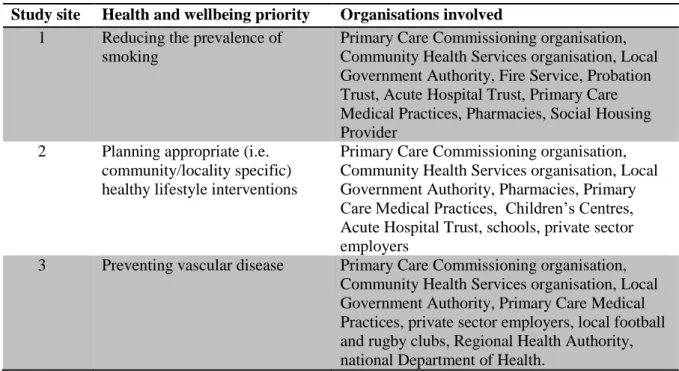
Recognising that collective knowledge creation occurs where groups of people attempt to solve common problems, we began by identifying the most pressing health and wellbeing priorities being faced by each local area. We identified these via discussions with local Directors of Public Health and 1-2 other senior managers who had a good overview of the priorities across their local area and of the organisations likely to be involved in tackling that priority. These are shown in table 1 below.
[Table 1 here]
Table 1: Priority areas for each study site and the organisations involved
Next, we undertook a series of short ‘network interviews’ to identify managers who were directly
involved in creating or implementing policies relevant to the local priority and shed light on their underlying patterns of relationships. We conducted 12 network interviews at each site. We selected the first 4 interviewees from our discussions with senior managers, a further 4 by modelling the patterns of relationships between the actors who they named, and a final 4 by modelling the patterns of relationships between the actors named by the first 8 interviewees. Using the question ‘who do you go to in order to get things done about [the local priority]?’ (which we chose as a way of focusing on
joint action) we generated lists of between 58 and 123 actors at each site. We modelled the
relationships between these actors using the concepts of latent position network models (Hoff et al. 2002) and latent position cluster models (Handcock et al. 2007), where clusters represent sites of ‘collective action’. In the resulting visual representation (see figure 1 below for an example)
6
Data collection
Having identified the local health and wellbeing priority and the managers involved in tackling it at each site, we adopted narrative process tracing methods to construct accounts which could shed light on how these patterns of relationships were being enacted, the collective action that these clusters of managers were involved in and whether/how they were collectively creating knowledge (George & Bennett 2005). We constructed our accounts from two types of data. Our primary data source was interviews with managers whom we identified as belonging to a single heterogeneous cluster (comprising managers from different organisations, backgrounds and roles) via our modelling methods. We chose heterogenous clusters to investigate whether these relationships were being enacted for the purpose of knowledge creation across organisational boundaries. Since we were interested in examining how managers were interacting (rather than what happens when people don’t have the opportunity to interact), we selected interviewees who were close to the centre and had a high degree of connection within a heterogeneous cluster, and those who connected the cluster to other clusters within the model.
We interviewed between 9 and 11 managers at each study site in the early summer of 2012, approximately 1 month after modelling their relationships. Each interview lasted between 60 and 90 minutes. Interviewees were provided with participant information prior to the interviews and
completed a consent form before the interviews commenced. We adopted a realist interview approach (Pawson & Tilley 1997), where our theory about collective knowledge creation was represented in our models of the relationships between groups of managers. We showed each interviewee versions of the diagrams which revealed the names of other managers known to them and asked them to tell us about any collective activities which those actors had recently been involved in.
7
Analysis
Our analysis involved using our data to identify and construct coherent narrative accounts of collective knowledge creation. We reasoned that people often employ narrative reasoning and accounting in situations that demand inventiveness and actors need to acquire skills or mobilise ‘helpers’ with relevant skills.
Our starting point was our interview data which we examined using Greimas’s narrative model of transformation (Greimas 1966). The approach is based on the premise that the language we use provides important pointers towards episodes of transformational action (i.e. solving problems or undertaking new activities) and clues about how this is undertaken and accomplished. The approach has previously been used in studies of technology implementation (Groleau & Cooren 1999) and organisational routines (Cooren & Fairhurst 2004). Since organisational knowledge creation theory suggests that collective knowledge creation is closely tied to joint problem solving, we judged that this approach would also enable us to identify episodes of collective knowledge creation. According to Greimas, transformational action involves two key stages and five corresponding speech acts. In the first stage actors are stimulated and enabled to undertake a new task (this stage is narrativised through the speech acts of manipulation, commitment and competence) whilst the second stage focuses on the performance of the task and its evaluation (speech acts: performance, sanction). Greimas also recognized that stories can be told from different perspectives corresponding to the positions, interests and programmes of action of the participating actors or subjects, which makes his model particularly useful for studying inter-organizational knowledge creation.
Three members of the research team were involved in carrying out the analysis, and met regularly to review and refine the analytical procedure. The outputs of each analytical step were also shared and discussed amongst the team. Our analysis consisted of the following steps:
8
(which correspond to manipulation and commitment speech acts) and “able to/know how to” (which correspond to competence speech acts) (Greimas 1966).
2) We read and grouped the identified passages within each site according to the object of the activity (e.g. planning a health promotion event). Some activities included data from multiple interviewees.
3) Using the framework function in NVivo 9.2, we summarised the material into narrative fragments (Pentland & Feldman 2007). We followed a series of conventions to ensure consistency between coders and reversibility including retaining phrases such as ‘have to’, ‘want to’ and ‘able to’, indicating the actors involved and capturing expressions of subjectivity (e.g. I, we).
4) We returned to our interview data and meeting documents to identify, code and summarise any additional material which related to each activity. This enabled us to fill out some of the background details necessary to contextualise the activity and to identify data corresponding to performance and sanction speech acts which we were not able to identify using keyword searches.
5) The final stage of our analysis involved reordering the narrative fragments into a tellable sequence of events, because it was sometimes necessary to relax the structural rules based on
Greimas’s narrative model in order to create a story that ‘made sense’ and could shed light on whether
and how managers were collectively creating knowledge.
Once we had completed our narrative analysis, we compared the narratives with our latent cluster models in order to identify the network position of those who were involved in the narrative accounts. This enabled us to add further descriptive detail about the patterns of relationships between the actors involved in the narrative accounts and to consider the role of organisational and professional divisions in collective knowledge creation.
Results
9
creation. Project-based organising was a prominent feature of each account, this being represented by the involvement of a relatively well-defined cast of actors interacting in order to solve a common problem within a ‘project ecology’ of more enduring ties and institutions (Grabher 2004). In line with
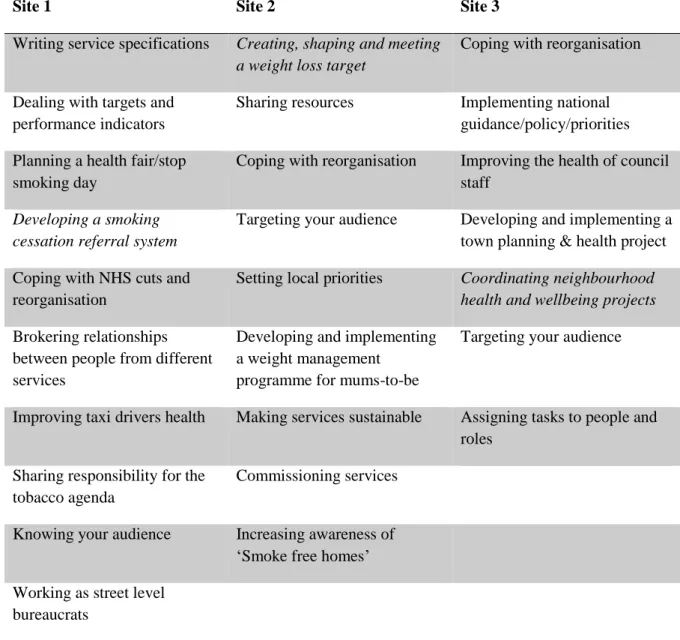
our theoretical focus on knowledge as a process which is revealed through social and narrative practices, it was these ‘common problems’ which constituted the focus of knowledge creation and the (often tentative) ‘solutions’ which constituted the knowledge which was being created. Table 2 gives
an idea of the object of knowledge creation in each account and shows that whilst the majority were accounts of practical time-bound activities, some were accounts of a group of actors’ general approach towards ongoing priorities.
[Table 2 here]
Table 2: Overview of accounts of collective knowledge creation
Below we present three of our accounts of collective knowledge creation (one from each site). These accounts (italicised in Table 2) have been selected on the basis that they were discussed by several interviewees, referred to in meeting documents and illustrate the main analytical and theoretical insights arising from our data set. For brevity we present the accounts in a diagrammatic overview (flow chart) and narrative description which is interwoven with our observations about how these relate to the key aspects of organisational knowledge creation theory outlined earlier
(interactions, patterns of relationships and constraints/enablers). Each account is also accompanied by a visual representation of the patterns of relationships at that study site.
Developing a smoking cessation referral system
We begin with an account from study site 1, where the overall priority was reducing the
prevalence of smoking. In this account a large cast of actors come together to develop and implement a new policy and system for referring a specific group of people into the local smoking cessation service. The cast of actors involved in collectively creating this knowledge includes Local
10
service managers and practitioners, primary care commissioning managers, other members of a local strategic tobacco control alliance and local taxi drivers (as the intended beneficiaries). Figure 1 below shows the patterns of relationships at the study site. To recap, individuals are placed close together when they were more likely to be connected to each other and are grouped together when they are most likely to be playing a role in some kind of collective action. Whilst the majority of actors involved in this account are members of Cluster E, which is both the largest and most heterogenous grouping of actors, enforcement staff are members of Cluster F, which represents a group of actors holding largely legislative roles.
[Figure 1 here]
Figure 1: patterns of relationships at study site 1
Figure 2 below provides an overview of the account, told from the perspective of the actors involved. This is presented as a flow chart which shows the key narrative fragments in sequence.
[Figure 2 here]
Figure 2 Developing a Smoking Cessation Referral System flow chart
This account started with an imaginative leap, made by one of the managers during a local Tobacco Alliance meeting:
“Mrs J**** has been on a speed awareness course. She’s actually been on a few speed
awareness courses, and as you probably know if you get caught speeding up to a certain level, instead of taking your penalty points and getting the fixed penalty notice, you can pay a lower fee and go on a half day awareness course.”
11
recently been introduced and through discussion at a series of Tobacco Alliance meetings a scheme was devised to offer those caught smoking a referral to smoking cessation services for education and advice. As long as the offer was taken up within a certain period of time, the fixed penalty notice would be waived. The group agreed that the scheme would focus, in the first instance, on local taxi drivers, who were deemed to be at high risk of poor health and to pose a risk to their passengers’
health through secondary smoke.
Pre-existing relationships and networks (both within and between clusters) appear to be the biggest influence on how these actors collectively created knowledge about reducing the prevalence of smoking. The generation of the initial idea was influenced by actors’ familiarity with practice in traffic policing, relationships with enforcement staff, exploratory conversations taking place in and around a regularised Tobacco Alliance group and the inclusion of taxi drivers as a priority target group in the networks of several local public services. The crediting of the idea to the Tobacco
Alliance group rather than any one individual also highlights the importance of these relationships and networks.
While there was enthusiasm for the scheme, problems had to be confronted. For example, concerns about data protection caused some headaches since the details of those caught smoking would have to be passed from the Local Government Authority to the NHS smoking cessation service and the details of those who had attended the service would then need to be passed back to the Local Government Authority so the fine could be waived. This problem was resolved through group and 1:1 discussion both within and outside the Tobacco Alliance meetings leading to the invention of a system for logging referrals and attendances without the need to share personal information. Similarly, there was concern about the possible loss of income streams from waiving the fines. Although the loss of income would only be in the order of hundreds of pounds, this led to a lot of internal discussion and negotiation between senior managers and middle managers within the Local Government Authority. Resistance was overcome by reminding senior managers that the less tangible long term cost of smoking was likely to be higher than any immediate lost revenue.
12
necessitated the creation of further processes and procedures, and that actors did not always find it easy to work together. Difficulties were overcome through learning about the outcomes and processes which were important to different interested parties and working out how to mesh these together (as in the case of the data protection issues) or appeal to those that were less tangible (as in the case of the lost revenue issue). In each case this involved work to align actors’ distinct, sometimes conflicting programmes of action, either by negotiation or by mobilising an integrating narrative common to services with a commitment to public health goals (i.e. risky behaviours like smoking acting as time-bombs for public budgets). The connections and relationships between those involved in health promotion and preventative services (including environmental health) and those involved in legislation (enforcement officers) were key to overcoming these potential barriers and issues.
Creating, shaping and meeting a weight loss target
Our second account is from study site 2, where the priority was planning appropriate healthy lifestyle interventions. It also involves a large cast of actors coming together – this time to create and implement a local weight loss target. The cast of actors involved in collectively creating this
knowledge includes public health commissioning managers, members of a local strategic partnership (including actors from the Local Government Authority and a range of NHS and community
organisations) and weight management service managers and practitioners from public, private and voluntary sector organisations. Figure 3 below shows the patterns of relationships at the study site. Whilst the majority of actors involved in this account are members of Cluster E, which contains a tightly-clustered group of actors from NHS and local authority organisations who are involved in commissioning and providing health and wellbeing services, two of those involved in the account are from cluster G, which includes voluntary and community groups and local government employees involved in providing weigh management and physical activity services. Note that the two clusters are particularly well connected.
[Figure 3 here]
13
Figure 4 below provides an overview of the account.
[Figure 4 here]
Figure 4 Creating, Shaping and Meeting a Weight Loss Target flow chart
This account started with the Local Strategic Partnership setting a weight loss target, to be implemented across the locality. It specified that a number of people who were seriously overweight had to lose 5% of their body weight, and maintain their new weight for 12 weeks. Services would receive outcome-based payments for hitting the targets. The target was applicable to organisations running weight loss services across the locality, which at the time included services in both the Local Government Authority and NHS community health services. In order to achieve the target, it was necessary for these services to work together and form reciprocal relationships. This included NHS managers contacting and negotiating with managers from Local Government Authority leisure facilities for free access to help people maintain their weight loss.
In this account a discrete external disturbance (the weight loss target) prompted the knowledge creation activity and encouraged joint problem-solving and coordination across a range of interested parties and organisations. Attempts to achieve the initial target led to the actors identifying and interacting in new ways with those perceived to have a role to play in weight loss services, including those they had not worked with previously.
Despite working hard together to achieve the target, both organisations found that the original target could not be achieved and, since this had big financial implications, it quickly became the only thing that managers and staff talked about, both during meetings and more informally, which
14
“… working with the gyms, Weight Watchers and Slimming World worked really well. The
voluntary sector was more difficult because there seemed to be different rules around what payments they would get for their activity …”
The first set of interactions enabled the actors to collectively deem the initial target
‘unmanageable’ and work out ways of adjusting it. The revised target led to an expansion of the group
of actors contributing to the knowledge creation effort and introduced know-how from other sectors (e.g. the private sector). Although relationships with voluntary sector organisations were in evidence, these were more difficult to enact and did not seem to help overcome the barriers to joint working.
The locality-wide target was later dropped and instead service providers were invited to propose targets which then provided the basis for contract negotiation. This introduced a significant element of competition and militated against the more integrated approach that had prevailed previously.
As the account progresses, it becomes clear that the new mode of interaction was too onerous to sustain for long and was seen to have an unfair impact on the voluntary sector. The solution was to retreat from cross-sector knowledge creation and revert to separately managed and monitored service contracts. Whilst the initial aim of encouraging collective knowledge creation through a shared weight loss target succeeded, the work required to sustain this activity across a large network of weight loss services with variable relationships and connections exceeded the perceived benefits.
At study site 2, the key problem narrativized by interviewees was the nature of the activity they were tasked with. The difficulty of harmonising their respective programmes of action was
compounded by the lack of an integrating narrative to legitimise the one-size-fits-all target. Narrative analysis revealed that although the target did induce network extension in an effort to mobilise new ‘helpers’, this extension also allowed actors to resist the target as an unworkable rule by enabling
them to identify and re-examine their own and others’ programmes of action.
Coordinating neighbourhood health and wellbeing projects
15
coordinate a series of local health and wellbeing projects in response to a national policy directive. These include managers from a range of departments across the Local Government Authority, locally elected councillors, members of a joint strategic health and wellbeing commissioning board, data analysts from a primary care organisation and community and voluntary organisations working in deprived local areas. Figure 5 below shows the patterns of relationships at the study site. All actors involved in this account are members of Cluster G, which contains a tightly-clustered group actors from a range of organisations (including general practitioners) all of whom had an identifiable focus or interest in public health and community-based primary prevention services.
[Figure 5 here]
Figure 5: Patterns of relationships at study site 3
Figure 6 below provides an overview of the account.
[Figure 6 here]
Figure 6 Coordinating neighbourhood health and wellbeing projects flow chart
This account begins when money became available for a programme of physical activity projects tied to a national policy imperative around lifestyle change. The local joint strategic commissioning board recognised that this programme needed a ‘home’ and tasked the public health team in the Local
16
“We wanted to base it on evidence, look at the information around physical activity and nutrition, prevalence of heart disease, diabetes, deaths from those conditions, and … look at
which areas seem to appear to be the worst…”
Similarly to the account from study site 2, the knowledge creation activity was also prompted by a discrete external disturbance - the availability of funding and a national policy directive. This came with several pre-determined expectations about how and with whom actors would interact in order to work out how to prioritise and allocate funding along with expectations about accountability
structures and timeframes. These led to the public health team using their networks of relationships to enrol data analysts from another organisation to help them with the process of selecting
neighbourhoods.
Once their selection was approved and the programme began to develop, managers began to develop new relationships with community groups and organisations in the selected neighbourhoods. They started by inviting representatives of these groups to planning days in order to identify local priorities then issued a call for proposals to groups and organisations which provided physical activity services. At times they used a targeted approach, based on further consultation within the community.
“We were asked to go away and do some further consultation … about who would be best placed to deliver the physical activity elements … so we went back into the communities and asked some people who were already doing physical activity …”
Initial expectations about accountability and timeframes also led to actors choosing to interact with members of the community (via planning days with trusted ‘opinion leaders’) in a relatively
controlled way. This subsequently influenced the relationships that they were able to develop since these opinion leaders were responsible for enrolling others in the collective knowledge creation effort by ‘spreading the word’. In effect, the urgency to get projects started constrained the possibilities for
developing and enacting a wider network of relationships to support collective knowledge creation. As the programme developed, managers were able to develop new relationships in the
17
Standardised forms of interaction (service level agreements) which were designed to enable greater operational control constrained many of the possibilities for enacting relationships for the purpose of collective knowledge creation further down the line. In the end, this led to managers recognising that they were unable to influence whether the results of the collective knowledge
creation activities would be retained, although they may have been able to enact other relationships to enter into new knowledge creation activities in other neighbourhoods.
The two key obstacles recounted by our interviewees both relate to coordinating a network of relationships: early in the account there were complaints about a lack of time for exploratory network search, inducing a preference for existing ties and trusted partners, while at the end we heard worries about loss of accreditation (due to the termination of project funding), experienced by public health managers as having to abandon the position of obligatory passage point in the network. Following this narrative trajectory shows how important are resources (of time, money or discursive power) in order to command the loyalty of ‘helpers’ in collective knowledge creation activities.
Discussion
In this section we consider our key insights about how health and wellbeing managers collectively create knowledge and how these compare to current theories about organisational knowledge creation. We also comment on the utility of our narrative method as a means of exploring data about networks of relationships.
First, much of the theorising and empirical work on organisational knowledge creation has
focused on the private sector, resulting in scepticism about its relevance to public sector organisations. Questions have been raised about the extent to which knowledge creation is possible against a
18
such harmonization was not possible (as in the weight loss target account), managers were still able to devise ways of collectively achieving their respective programmes of action (i.e. by resisting the unworkable target). Knowledge creation was prompted by the need to address local priorities which were often broad in scope and/or came with little detail about how they were to be met. Again, it was when such details needed to be filled in that we saw inventiveness, which sometimes included extending a network to mobilise new knowledge resources. This supports theoretical claims about the role of uncertainty as a catalyst for and key component of knowledge creation (Amin & Roberts 2008, Bogenrieder 2002, Erden et al. 2008, Macpherson 2005) and suggests that the ambiguity and
pragmatism inherent within local policymaking may support rather than constrain organisational knowledge creation (Ramsdal & Hansen 2017).
Second, one of the most prevalent theoretical stances is that organisational knowledge creation typically occurs when relatively small groups of people interact in order to solve a common problem. Projects are understood to provide a space where tacit and explicit knowledge interact and are converted into new knowledge forms (Nonaka & Takeuchi 1995) and for local knowledge to be integrated into common knowledge bases (Cohendet et al. 1999). Whilst managers at all three of our sites did interact in projects, many of these were set against a backdrop of relatively stable networks of relationships. The smoking cessation referral project, for instance, took place in the context of a large and relatively stable ‘tobacco alliance’ network, whilst the neighbourhood health and wellbeing
19
Third, organisational knowledge creation theory places middle managers at the centre of knowledge creation, with Nonaka and Takeuchi describing them as ‘knowledge engineers’ who
translate the grand theories of senior managers into the day-to-day realities of frontline practitioners and vice versa (Nonaka & Takeuchi 1995). Although, as with other aspects of knowledge creation theory, questions have been raised about whether managers’ organisational position is more or less
important than their ability to create and propagate discourses (Swan & Scarbrough 2005), they are nonetheless seen as the drivers of organisational knowledge creation. In contrast, our accounts suggest that actors’ ability to identify and harmonize alternative programmes of action (by drawing on
routines, official discourses, shared vision and targets) was more important than their managerial status or position in their respective organisations. In the smoking cessation referral account, for instance, the local authority’s need to know clients’ details and the health service’s need to respect strict privacy regulations was recognised by frontline staff in both organisations, authorising them to shape the innovation in important ways (by developing a system which did not depend on sharing personal information). This also calls into question observations about the multiplicity of divisions within knowledge creation and mobilisation, specifically those that place those divisions along professional and/or political lines (Smith & Joyce).
20
creation effort. In each case it appeared to be groups of actors who assumed responsibility for synthesising knowledge conversions between individuals, groups and organisations, simultaneously using local strategic priorities to drive on the ground activities and local practices to challenge and adapt strategic priorities. Negotiation therefore appears to be as much about negotiating between strategic priorities and frontline realities as between the interests and perspectives of different groups of actors.
Finally, our narrative method (both as an interview approach and a guide for data analysis) helped elicit how networks of relationships were enacted for collective knowledge creation, particularly when actors encountered barriers in the pursuit of non-routine tasks. Our narratives showed that underlying networks of relationships served to increase the visibility of alternative programmes of action and allowed actors to identify and negotiate the commensurability of these distinct programmes and the viability of their collective mission. They were also used to identify knowledge and other resources which could be drawn upon in pursuit of a collective task, but only if sufficient time was available for network search. Whilst our network approach enabled us to visualise and describe the patterns of relationships between actors, it was our narrative approach which enabled us to understand how these networks were enacted and to open the black box of collective knowledge creation.
Conclusion
21
implications for those who seek to support collective knowledge creation at the interface between policy and practice.
First, although there was some evidence of significant differences and conflicting programmes of action between the actors and organisations we studied, these did not always hamper collective knowledge creation. Instead, they provided actors with resources for collective negotiation which strengthened their knowledge creation efforts. The implications are that managers should be encouraged to examine and discuss their alternative programmes of action and to see these as a catalyst for rather than barrier to collectively creating and implementing local health and wellbeing policies.
Second, health and wellbeing managers create knowledge in simultaneously fluid and stable networks of relationships. Temporary taskforces were evident in each of our accounts, but these were often situated in the context of relatively stable networks of relationships (e.g. bureaucracies). To support the creation and implementation of local health and wellbeing policies organisations (individually and collectively) should foster and support both stable bureaucratic networks and temporary taskforces and – crucially – support managers to work simultaneously in both these settings.
Finally, health and wellbeing managers’ ability to create knowledge relies less on their power and
position than on their individual and collective ability to exploit the power of routines, targets and discourses and to harmonize conflicting programmes of action. Managers should be supported and valued for these activities, particularly when faced with the challenges of creating and implementing local health and wellbeing policies.
Funding acknowledgement & disclaimer
22
Acknowledgements
The authors would like to thank all those participating in the study and recognise the contributions of two researchers within the broader team who helped significantly with data collection (Paul G Dempster and Steven McDermott).
Alin, P, Taylor, JE, & Smeds, R, 2011, Knowledge Transformation in Project Networks: A
Speech Act Level Cross-Boundary Analysis,
Project Management Journal
, 42, 58-75
Amin, A, & Roberts, J, 2008, Knowing in action: Beyond communities of practice,
Research
Policy
, 37, 353-369
Araujo, L, 1998, Knowing and learning as networking,
Management Learning
, 29, 317-336
Argote, L, & Miron-Spektor, E, 2011, Organizational Learning: From Experience to
Knowledge,
Organization Science
, 22, 1123-1137
Birken, S, Lee, S-YD, & Weiner, B, 2012, Uncovering middle managers' role in healthcare
innovation implementation,
Implementation Science
, 7, 28
Bogenrieder, I, 2002, Social Architecture as a Prerequisite for Organizational Learning,
Management Learning
, 33, 197-212
Brown, JS, & Duguid, P, 2001, Knowledge and organization: A social-practice perspective,
Organization Science
, 12, 198-213
Byosiere, P, & Luethge, DJ, 2008, Knowledge domains and knowledge conversion: an
empirical investigation,
Journal of Knowledge Management
, 12, 67-78
Cohendet, P, Kern, F, Mehmanpazir, B, & Munier, F, 1999, Knowledge coordination,
competence creation and integrated networks in globalised firms,
Cambridge Journal
of Economics
, 23, 225-241
Collinson, S, & Wilson, DC, 2006, Inertia in Japanese organizations: Knowledge
23
Contandriopoulos, D, Lemire, M, Denis, J-L, & Tremblay, E, 2010, Knowledge exchange
processes in organizations and policy arenas: a narrative systematic review of the
literature,
The Milbank Quarterly
, 88, 444-483
Cooren, F, 2001, Translation and Articulation in the Organization of Coalitions: The Great
Whale River Case,
Communication Theory
, 11, 178-200
Cooren, F, & Fairhurst, G, 2004, Speech Timing and Spacing: The Phenomenon of
Organizational Closure,
Organization
, 11, 793-824
Department of Health, 2008,
Putting Prevention First, Vascular checks: risk assessment and
management
, London: Department of Health
Department of Health, 2013,
Cardiovascular Disease Outcomes Strategy
, London:
Department of Health
Erden, Z, von Krogh, G, & Nonaka, I, 2008, The quality of group tacit knowledge,
Strategic
Information Systems
, 17, 4-18
Ferlie, E, Crilly, T, Jashapara, A, & Peckham, A, 2012, Knowledge mobilisation in
healthcare: A critical review of health sector and generic management literature,
Social Science & Medicine
, 74, 1297-1304
George, AL, & Bennett, A, 2005,
Case studies and theory development in the social sciences
,
Cambridge Mass: MIT Press
Grabher, G, 2002, Fragile sector, robust practice: project ecologies in new media,
Environment and Planning
, 34, 1911-1926
Grabher, G, 2004, Learning in projects, remembering in networks? Communality, sociality,
and connectivity in project ecologies,
European Urban and Regional Studies
, 11,
103-123
24
Groleau, C, & Cooren, F, 1999, A Socio-Semiotic Approach to Computerization: Bridging
the Gap Between Ethnographers and Systems Analysts,
The Communication Review
,
3, 125-164
Hammersley, M, Foster, P, & Gomm, R, 2000, Case study and theory, in R. Gomm, M.
Hammersley, & P. Foster (eds),
Case study method,
London: Sage, 234-258
Handcock, MS, Raftery, AE, & Tantrum, JM, 2007, Model-based clustering for social
networks,
Journal of the Royal Statistical Society
170
,
301-354
Hartley, J, & Benington, J, 2006, Copy and paste, or graft and transplant? Knowledge sharing
through inter-organizational networks,
Public Money & Management
, 26, 101-108
Hoff, PD, Raftery, AE & Handcock, MS, 2002, Latent space approaches to social network
analysis,
Journal of the American Statistical Association,
97
,
1090-1098
Klijn, EH, & Koppenjan, JFM, 2004,
Managing uncertainties in networks: A network
approach to problem solving and decision-making
, London: Routledge
Lewis, JM, 2011, The future of network governance research: strength in diversity and
synthesis,
Public Administration,
89
,
1221-1234
Lewis, JM, Baeza, JI & Alexander, D, 2008, Partnerships in primary care in Australia:
Network structure, dynamics and sustainability,
Social Science & Medicine,
67
,
280-291
Lewis, RB, & Maas, SM, 2007, QDA Miner 2.0: Mixed-model qualitative data analysis
software,
Field Methods,
19, 87-108
Macpherson, A, 2005, Learning how to grow: resolving the crisis of knowing,
Technovation
,
25, 1129-1140
Mantoura, P, Gendron, S, & Potvin, L, 2007, Participatory research in public health: creating
25
Mulgan, G, 2005, Government, knowledge and the business of policy making: the potential
and limits of evidence-based policy,
Evidence & Policy
, 1, 215-226
Nonaka, I, & Takeuchi, H, 1995,
The knowledge-creating company; how Japanese
companies create the dynamics of innovation
, Oxford: Oxford University Press
Nonaka, I, von Krogh, G, & Voelpel, S, 2006, Organizational Knowledge Creation Theory:
Evolutionary Paths and Future Advances,
Organization Studies
, 27, 1179-1208
Pawson, R, & Tilley, N, 1997,
Realistic Evaluation
, London: Sage
Pentland, BT, & Feldman, M, 2007, Narrative Networks: Patterns of Technology and
Organization.,
Organization Science
, 18, 781-795
Ramsdal, H, & Hansen, GV, 2017, The organisation of local mental health services in
Norway: evidence, uncertainty and policy,
Evidence & Policy
, 13, 605-622
Rashman, L, Withers, E, & Hartley, J, 2009, Organizational learning and knowledge in public
service organizations: A systematic review of the literature,
International Journal of
Management Reviews, 11, 463-494
Riley, B, Norman, C, & Best, A, 2012, Knowledge integration in public health: a rapid
review using systems thinking,
Evidence & Policy
, 8, 417-431
Rodan, S, & Galunic, C, 2004, More than network structure: How knowledge heterogeneity
influences managerial performance and innovativeness,
Strategic Management
Journal
, 25, 541-562
Rutten, R, 2004, Inter-firm knowledge creation: A re-appreciation of embeddedness from a
relational perspective,
European Planning Studies
, 12, 659-673
Smith, KE, & Joyce, KE, 2012, Capturing complex realities: understanding efforts to achieve
26
Swan, J, & Scarbrough, H, 2005, The politics of networked innovation,
Human Relations
, 58,
913-943
von Krogh, G, 2009, Individualist and collectivist perspectives on knowledge in
organizations: Implications for information systems research,
Journal of Strategic
Information Systems
, 18, 119-129
West, R, House, AO, Keen, J, & Ward, V, 2015, Using the structure of social networks to
map inter-agency relationships in public health services,
Social Science & Medicine,
Figure 3 Developing a Smoking Cessation Referral System flow chart
We decided to introduce a referral system for taxi drivers to get more people through the door of the stop smoking service. The scheme was suggested by someone at a Tobacco Alliance meeting who made a connection to the approach used to refer people to “speed awareness” courses
The innovative idea was that if a taxi driver attended the stop smoking service the fine that they had been given by the environmental health team for smoking in their cab was waived. Taxi drivers are a high risk population
The environmental health team needed to have a way of checking that people had turned up for treatment once referred
The smoking cessation team needed to follow NHS data protection rules
The Local Authority was concerned about loss of revenue from fines, resolved through a lot of discussion and by reminding people about other strategic priorities
The scheme was the result of casual interaction between a number of organisations
Figure 5 Creating, Shaping and Meeting a Weight Loss Target flow chart
A local weight loss target was set: people had to achieve a 5% weight loss and maintain it for 12 weeks. It was a collectively owned 'bright idea'
Local organisations worked together to achieve the target and reciprocal relationships were formed
The target was impossible to achieve. This resulted in low morale and had big financial implications
Ultimately we had to revise the target, but even then the only way to attain it was to expand our network to include the private sector. We were able to work with them successfully because they were able to fit in
with the reward system. The new target is more realistic.
We managed to hit the revised target, but the reward system caused problems for the voluntary sector and opened another can of worms
The weight loss target doesn't exist any more and providers are now being asked to propose their own realistic targets. We do this as separate organisations
Figure 7 Coordinating neighbourhood health and wellbeing projects flow chart
Some money became available for a physical activity programme in line with the government’s Change4Life scheme and we were asked to develop a programme for commissioning and coordinating local projects
The broad direction was set by the Joint Strategic Commissioning Board, and also by local councillors, who asked us to target areas of poorest health and highest deprivation.
We worked with our contacts in the primary care data analysis team to construct area profiles according to our criteria. We used these to show which areas we should target, why, and how these were connected to
local strategic priorities
Our choices were approved by the commissioning board and we held planning days in each area. We invited people we knew from provider services and community groups working in those areas, and we asked them
what they thought should be done
We asked those who attended to spread the word once we were ready for people to come forward with projects and apply for funding
We managed to spread a sense of involvement beyond those who received funding by getting them involved in a promotional road show
In the case of a physical activity project we went directly to the Local Authority’s sport and active lifestyle team. Effectively we commissioned a specific project from them. It was a good way of enrolling them to a
broader public health philosophy and establishing working links
Once approved we use service level agreements to manage each project, and we don’t pay the money up front.
We don’t know what will happen next. We can’t influence whether organisations running projects mainstream the work after funding ceases. We’d like to replicate the programme in two more areas, but
nothing’s certain
Study site Health and wellbeing priority Organisations involved 1 Reducing the prevalence of
smoking
Primary Care Commissioning organisation, Community Health Services organisation, Local Government Authority, Fire Service, Probation Trust, Acute Hospital Trust, Primary Care Medical Practices, Pharmacies, Social Housing Provider
2 Planning appropriate (i.e. community/locality specific) healthy lifestyle interventions
Primary Care Commissioning organisation, Community Health Services organisation, Local Government Authority, Pharmacies, Primary Care Medical Practices, Children’s Centres, Acute Hospital Trust, schools, private sector employers
3 Preventing vascular disease Primary Care Commissioning organisation, Community Health Services organisation, Local Government Authority, Primary Care Medical Practices, private sector employers, local football and rugby clubs, Regional Health Authority, national Department of Health.
Site 1 Site 2 Site 3
Writing service specifications Creating, shaping and meeting a weight loss target
Coping with reorganisation
Dealing with targets and performance indicators
Sharing resources Implementing national guidance/policy/priorities Planning a health fair/stop
smoking day
Coping with reorganisation Improving the health of council staff
Developing a smoking cessation referral system
Targeting your audience Developing and implementing a town planning & health project Coping with NHS cuts and
reorganisation
Setting local priorities Coordinating neighbourhood health and wellbeing projects
Brokering relationships between people from different services
Developing and implementing a weight management
programme for mums-to-be
Targeting your audience
Improving taxi drivers health Making services sustainable Assigning tasks to people and roles
Sharing responsibility for the tobacco agenda
Commissioning services
Knowing your audience Increasing awareness of ‘Smoke free homes’
Working as street level bureaucrats