Dynamic Phasor Analysis and Design of Phase-Locked Loops for Single Phase Grid
Connected Converters
Mohamed Rashed, Christian Klumpner and Greg Asher
Department of Electrical and Electronic Engineering, The University of Nottingham, Nottingham, UK
e-mail:[email protected]
Abstract
Purpose– The purpose of the paper is to introduce the Dynamic Phasor Modelling (DPM) approach
for stability investigation and control design of single-phase Phase Locked Loops PLLs. The aim is to
identify the system instabilities not predicted using the existent analysis and design methods based on
the simplified average model approach.
Design/methodology/approach – This paper starts by investigating the performance of three
commonly used PLL schemes: the Inverse Park-PLL, the SOGI-Frequency-Locked-Loop and the
Enhanced-PLL, designed using the simplified average model and will show that following this
approach, there is a mismatch between their actual and desired transient performance. A new PLL
design method is then proposed based on the DPM approach that allows the development of
fourth-order DPM models. The small-signal eigenvalues analysis of the 4th order DPM models is used to
determine the control gains and the stability limits.
Findings – The DPM approach is proven to be useful for single-phase PLLs stability analysis and
control parameters design. It has been successfully used to design the control parameters and to predict
the PLL stability limits, which have been validated via simulation and experimental tests consisting of
grid voltage sag, phase jump and frequency step change.
Originality/value – this paper has introduced the use of DPM approach for the purpose of
single-phase PLL stability analysis and control design. The approach has enabled accurate control gains
design and stability limits identification of single-phase PLLs.
1- Introduction
Phase-locked loops (PLLs) are widely used for interfacing power electronic converters to single and
three-phase grids, (Chung, 2000; Golestan et al., 2013; Silvaet al., 2004; Velascoet al., 2011). They
are used to extract the information about the fundamental voltage component (phase angle, frequency
and voltage magnitude) under various grid disturbances such as the steady state presence of unbalance
and harmonics or transients: voltage sag, phase-jump and frequency change. The operation of
converters in single phase systems is more challenging because of reduced level of information
available in a single phase voltage compared to multiphase.
There are a few single-phase PLL schemes widely discussed in the literature that differ in their
structure and estimation laws: the Inverse Park-PLL (IP-PLL) (Filhoet al., 2008; Rashedet al., 2013),
the Synchronous Reference Frame PLL (SRF-PLL) (Nicastri et al., 2010), the Second-Order
Generalized Integrators (SOGI)-based Frequency-Locked Loop (FLL) (SOGI-FLL) (Rodr’iguezet al.,
2011), the D-filter-based estimation PLL (Shinnaka, 2011), the Enhanced PLL (EPLL)
(Karimi-Ghartemani, 2013; Karimi-Ghartemani et al., 2012) and the Modified Mixer Phase-Detector based
PLL (MMPD-PLL), (Thackeret al., 2011). Some of this research work has been aimed at studying the
design and performance analysis of single-phase PLLs. The design is typically performed using the
simplified average model of the PLL (Karimi-Ghartemani, 2013; Karimi-Ghartemani et al., 2012;
Thacker et al., 201; Freijedo et al., 2009) , which ignores the effect of inherently generated
double-frequency component during transient on PLL stability. In (Karimi-Ghartemani, 2013), a
comprehensive analysis and comparison of many single-phase PLL schemes is carried out using the
simplified average model. The study concluded that the small signal mathematical model and the
performance of the different PLL schemes were fairly similar, a conclusion which this paper will
challenge.
This paper proposes a modelling technique not previously used in PLL stability analysis and design.
The technique is known by Dynamic Phasor Modelling DPM and is suitable to represent and to predict
the single-phase-PLL dynamic and instability modes not seen by the conventional average modelling
technique used in the literature. In the DPM approach, the time-response of the system state variables
time-varying coefficients, (Stankovic et al., 1999; Sanderset al., 1991; Emadi, 2004; Caliskan et al.,
1999; Mattavelli et al., 1999). The DPM approach has been successfully applied for modelling and
analysis of single phase induction motors (Stankovicet al., 1999), PWM converters, (Sanderset al.,
1991), diode bridge rectifiers (Emadi, 2004), DC/DC converters, (Caliskan et al., 1999) and thyristor
controlled series capacitor compensators in power systems (Mattavelli et al., 1999).
The DPM approach is also used for the design and stability study of frequency and voltage droop
control of microgrids, (Marianiet al., 2014; Xianweiet al., 2011; De Brabandereet al., 2005; Wanget
al., 2012). The DPM is found effective in predicting system instabilities not seen by the conventional
quasi-steady-state small signal model, (De Brabandereet al., 2005; Wanget al., 2012).
In this paper, a 4thorder DPM is proposed and used for stability analysis, control design and
performance comparison of the three representative single phase PLL schemes: the IP-PLL,
SOGI-FLL and EPLL. The analysis will demonstrate the shortcomings of the conventional
simplified average modelling for determining the stability limits and control gain design of the
single-phase PLLs. The contribution of this paper lies in the following: Introducing the DPM
approach for the purpose of single-phase PLLs stability analysis and control design.
Accurate stability limits identification and control gains design of single-phase PLLs using
DPM approach.
The paper is organised in five sections. Section 2 gives the basics of the DPM and PLLs. The design
of the three PLL schemes using the simplified average model is presented in section 3. In section 4,
the simulation results of the PLL schemes under investigation are used to show the discrepancy
between their actual dynamic characteristics and the desired performance, and hence the inadequacy of
the simplified average model based design. Section 5 details the proposed 4th-order DPM small-signal
stability analysis, design and comparison of the three PLLs. Large signal disturbance investigation
and performance comparison of the three PLL schemes are presented in section 6 using simulation and
In this section, the fundamentals of the dynamic phasor modelling and the single-phase PLL concepts
will be presented.
2.1 Fundamentals of DPM
In dynamic phasor modelling approach, the Fourier series coefficients of system state-variables are
considered the DPM system-state-variables and the state equations are derived for these Fourier
coefficients. Therefore, a system state variable x() can be represented on the interval ((t-T), t]
using a Fourier series of the form, (Stankovicet al., 1999):
ݔ(߬) =∑ஶୀିஶ[〈ݔ〉(ݐ)]݁ఠ್ఛ (1)
Where, T is the time period for the base frequency, b = 2/T,〈ݔ〉(ݐ)is the kth complex Fourier
coefficient that is varying with time since the interval under consideration slides with time t. The
notation < > denotes the averaging operation that is applied to determine the kth complex Fourier
coefficient at time t. The averaging operation is
〈ݔ〉(ݐ) =ଵ்∫௧ ݔ(߬)݁ఠ್ఛ݀߬
௧ି் (2)
The kth-order DPM state-space differential equation is a state-space equation formed for the kth
frequency-order Fourier series coefficient of the system state variables. The Zero-Order (ZO) DPM
equation is the system state-space equation for the dc coefficients of the Fourier series for the system
state variables. In practice, the ZO-DPM is the simplified average model usually used in the literature
for conventional PLL design.
The derivative of the kthcomplex Fourier coefficient (2) is given by:
ௗ
ௗ௧(〈ݔ〉) =〈 ௗ
ௗ௧ݔ〉−݆݇߱〈ݔ〉 (3)
Also, the kthFourier coefficient for a nonlinear term (e.g. a product of two state variablesxandy) can
be obtained using the convolution property (Sanderset al., 1991) as follows:
〈ݔݕ〉=∑ஶ 〈ݔ〉(ି)〈ݕ〉
ୀିஶ (4)
Noting that the phasor〈ݔ〉ି is the complex conjugate of〈ݔ〉. The properties in (3) and (4) are
essential for deriving the PLL DPM from the time-domain state space model.
This mathematical approach will be used later to derive the DPM for the PLL schemes under study.
The structure of a typical PLL scheme that includes also the single-phase PLLs is originated from the
well-established three-phase SRF-PLL (Chung, 2000). The 3-phase SRF-PLL contains three main
components: the Phase Detector (PD), the filter (which is usually a PI controller), and the Voltage
Controlled Oscillator (VCO). These components aim at synchronising the PLL estimated output
voltage vector with the input voltage vector as represented by the two orthogonal voltage
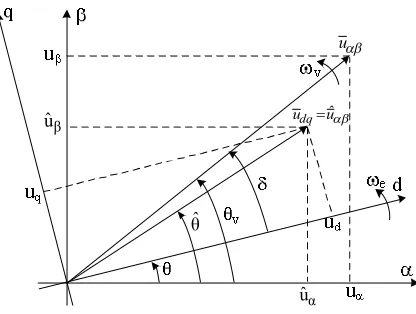
components as illustrated in the phasor diagram shown in Fig. 1. The PD generates an error signal
(referred as “adaptive law”) that is proportional to the phase difference between the input and the
estimated output voltage vectors. The error signal is utilised to modify the frequency of the VCO until
the average frequency and the phase angle of the input and the estimated (output) voltage vectors are
equal (Golestanet al., 2013).
In single phase PLLs (e.g. Fig.2), the measured grid voltage is fed as the -axis component of the
input voltage vector while the-axis is substituted by a virtual voltage component. The virtual -axis
voltage component can be constructed by applying a 90o phase shift to the measured-axis voltage
component (Silvaet al., 2004; Velascoet al., 2011) or substituted by the estimated -axis component,
(Filhoet al., 2008; Rodr’iguezet al., 2011; Karimi-Ghartemani, 2013). The main problem affecting
the performance of a single phase PLL is that any mismatch/error in the virtual -axis component
(during transient or steady state) will produce double-frequency ripple component that adversely
affects the dynamic performance and the stability of the PLL.
The relationships between the input and the estimated output voltage vectors and their phase angles
Fig. 1 Single-phase PLL phasor diagram.
Where uis the measured grid voltage whilstݑതఈఉ =ݑఈ+݆ݑఉ is the fictiousgrid voltage vector. If
Uv is the grid voltage magnitude, then ݑa=ܷ௩cos(ߠ௩). The estimated (output) voltage vector
ݑതఈఉ =ݑොఈ+݆ݑොఉ =ݑതௗhas the corresponding ud, uq components in the dq rotating reference frame.
The corresponding angles and the rotational speeds that will be used in the development of the DPM
of the PLL are also shown in Fig. 1. The phase angleis the phase angle difference between the phase
angle of the input voltage vector,vand the phase angleߠ.
3. Modelling and Control Design of Single-Phase PLLs
In this section, the IP-PLL, (Filhoet al., 2008), SOGI-FLL, (Rodr’iguezet al., 2011) and the EPLL
(Karimi-Ghartemani, 2013; Karimi-Ghartemani et al., 2012) single-phase PLL schemes will be
modelled and the phase angle, voltage magnitude and frequency estimation algorithms for the three
PLLs will be established utilising the simplified average model. This will be used in the next sections
to prove that the dynamic performance of the designed PLLs will not match with the design
specification.
The convention used in this paper is that the input of the PLL seen as a control system is the grid
voltage, while the outputs are the estimated grid voltage magnitude, frequency and phase angle, which
are defined as uout,outandout, independent on the estimation method used in each PLL. θˆ
u udqˆ
α u
ˆ
β uˆ
3.1 The Modelling and Control Design of the Inverse Park PLL
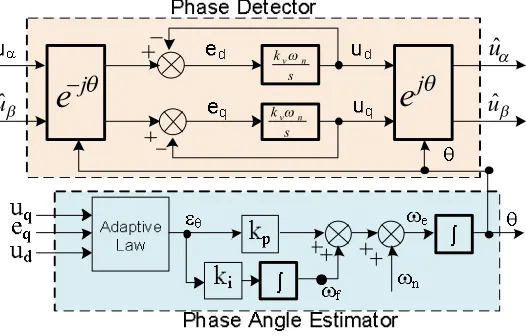
The typical model of the Inverse Park PLL (IP-PLL) expressed in rotating reference frame (Filhoet al.,
[image:7.595.168.431.152.320.2]2008; Karimi-Ghartemani, 2013) is shown in Fig. 2.
Fig. 2 The model of the Inverse Park Phase Locked Loop (IP-PLL)
The state space variable model for the IP-PLL (Fig. 2) in the rotating reference framedqis given by:
ݑሶௗ =݇௩߱ൣ0.5ܷ௩ܿݏ(ߜ)− 0.5ݑௗ+ 0.5ܷ௩ܿݏ(ߜ+ 2ߠ)− 0.5ݑௗܿݏ(2ߠ) + 0.5ݑݏ݅݊(2ߠ)൧ (5a) ݑሶ=݇௩߱ൣ0.5ܷ௩ݏ݅݊(ߜ)− 0.5ݑ− 0.5ܷ௩ݏ݅݊(ߜ+ 2ߠ) + 0.5ݑௗݏ݅݊(2ߠ) + 0.5ݑܿݏ(2ߠ)൧ (5b)
߱ሶ=݇(ߝఏ) (5c)
ߜ̇ =߱௩−݇ߝఏ−߱−߱ (5d)
Where:ߝఏ is the adaptive law (error signal) given by (6), and߱= (݇ߝఏ+߱+߱), ߜ=ߠ௩−ߠ,
ௗ
ௗ௧ߠ=߱, ௗ
ௗ௧ߠ௩=߱௩ andnis angular speed (rad/s) corresponding to the nominal grid frequency
(50Hz).
The adaptive lawߝఏ for IP-PLL phase angle estimation was obtained as in (Filhoet al., 2008; Rashed
et al., 2013):
ߝఏ=௨௨ (6)
It should be noted that in the literature, the simplified average model typically used in PLL design
(Filhoet al., 2008; Karimi-Ghartemani, 2013; Thacker et al., 2011; Freijedo et al., 2009) is obtained
by ignoring the double-frequency sine and cosine terms in (5a-b).
For the development of the dynamic-phasor differential equations used in the modelling of the PLL
schemes under study in this paper for the purpose of stability analysis and control design, the time
j
e
j
e
u
ˆ
uˆ
s kvn
s kvn
period T in (1),(2) is set equal to 2/〈߱〉and hence߱in (3) is substituted by〈߱〉. Then, the
generalised kth-order dynamic-phasor state-space differential equations for (5) are given by:
ௗ
ௗ௧〈ݑௗ〉= −݆݇〈߱〉〈ݑௗ〉+݇௩߱〈݁ௗ〉 (7a) ௗ
ௗ௧〈ݑ〉= −݆݇〈߱〉〈ݑ〉+݇௩߱〈݁〉 (7b) ௗ
ௗ௧〈߱〉= −݆݇〈߱〉〈߱〉+݇〈ߝఏ〉 (7c) ௗ
ௗ௧〈ߜ〉= −݆݇〈߱〉〈ߜ〉− 〈݇ߝఏ+߱+߱〉+〈߱௩〉 (7d)
where,ed, eqare
݁ௗ = 0.5ܷ௩ܿݏ(ߜ)− 0.5ݑௗ+ 0.5ܷ௩ܿݏ(ߜ+ 2ߠ)− 0.5ݑௗܿݏ(2ߠ) + 0.5ݑݏ݅݊(2ߠ) (7e)
݁= 0.5ܷ௩ݏ݅݊(ߜ)− 0.5ݑ− 0.5ܷ௩ݏ݅݊(ߜ+ 2ߠ) + 0.5ݑௗݏ݅݊(2ߠ) + 0.5ݑܿݏ(2ߠ) (7f) The DPM of the nonlinear terms such asܿݏ(2ߠ),ݏ݅݊(2ߠ)and (uq/ud) in (7e,f), (6) are obtained as in
Appendix 1. The ZO-DPM that corresponds to k = 0 in (7) is then given by:
〈ݑሶௗ〉=݇௩߱(0.5〈ܷ௩〉− 0.5〈ݑௗ〉) (8a)
〈ݑሶ〉=݇௩߱〈0.5ܷ௩ߜ− 0.5ݑ〉 (8b)
〈߱ሶ〉= ݇〈ߝఏ〉 (8c)
〈ߜ̇〉=〈߱௩〉− 〈݇ߝఏ+߱+߱〉 (8d)
and
〈݁ௗ〉= 0.5〈ܷ௩〉− 0.5〈ݑௗ〉 (8e)
〈݁〉= 0.5〈ܷ௩〉〈ߜ〉− 0.5〈ݑ〉 (8f)
From now on, unless otherwise mentioned, the averaging operation symbol < >0 will be ignored for
simplicity.
In the following sections, the ZO-DPM such as in (8), which is the simplified average model typically
used in the literature in the PLL design, will be used for the design of the phase angle, voltage
magnitude and frequency estimator to achieve the design specifications set for the small signal closed
loop transfer function (CLTF) of (out/v), (uout/Uv) and (out/v) for all PLL schemes under study.
Afterwards, the actual dynamic performance of the designed PLLs will be proven not to match the
design specifications and hence proving the shortcoming of using the ZO-DPM for single-phase PLL
design.
First, the small signal ZO-DPM for the adaptive law (6) is derived in Laplace form using (8) for the
∆ߝఏ= ௦ା.ହ.ହೡఠೡఠ∆ߜ (9)
(9) shows that∆ߝఏis linearly dependent on via the transfer function of a LPF. To eliminate the
LPF influence in (9), a new phase angle adaptive law to replace (6) is introduced in this paper:
ߝఏ= ௨ ௨+ 2ቀ
௨ቁ (10)
which results in a small signal ZO-DPM of
∆ߝఏ= ∆ߜ (11)
identical (for comparison purpose) to the small signal adaptive law model of the other PLL scheme
(EPLL) as it will be shown later. Fig. 3 depicts the resulting small signal ZO-DPM for the IP-PLL
[image:9.595.183.415.322.365.2]phase angle estimator using the proposed adaptive law in (10),(11).
Fig. 3 Small signal ZO-DPM for the IP-PLL phase angle estimator
In the IP-PLL, the outputsߠ௨௧and uoutare set equal toߠ and ud. Hence, the small signal ZO-DPM
CLTF for the IP-PLL phase angle estimator (from Fig. 3) is given by:
∆ఏೠ ∆ఏೡ =
∆ఏ ∆ఏೡ=
௦ା
௦మା௦ା (12)
Where kpand kiare the gains of the PI controller.
The small signal CLTF for the output (estimated) voltage magnitude is also derived from (8) and is
equivalent to a first order LPF (13) with a time constant of2/kvn:
∆௨ೠ ∆ೡ =
∆௨ ∆ೡ=
.ହೡఠ
௦ା.ହೡఠ (13)
The gain kv(13) determines the dynamic response of the voltage magnitude estimation. On the other
hand, the kp and kigains of the PI controller (12) determine the dynamic characteristics for the
phase-angle estimation. The values of kpand kiare chosen to achieve a damping coefficient = 1 for (12) as
recommended in (Karimi-Ghartemaniet al., 2012; Freijedoet al., 2009). In this paper, kpis selected to
be equal tokvn so that the CLTF poles of (12) coincide with the CLTF pole of the voltage magnitude
estimator in (13). And hence,݇= (݇௩߱⁄2)ଶ. Therefore, the small signal ZO-DPM CLTF poles of
the PLL voltage and phase-angle estimators are located on the real axis at(−݇௩߱⁄2). Then, the
phase-angle estimator small signal CLTF (13) can be expressed as:
∆ఏೠ ∆ఏೡ =
∆ఏ ∆ఏೡ=
ೡఠ௦ା(.ହೡఠ)మ
௦మାೡఠ௦ା(.ହೡఠ)మ (14)
In (Rodr’iguezet al., 2011), the small signal CLTF for the frequency estimatorout/vwas equivalent
to a first order LPF. In this paper (for comparison purpose) we will also carry out the design to achieve
a LPF behaviour for the CLTF of the frequency estimator. Therefore,outfor IP-PLL is proposed here
to be:
߱௨௧=߱− 0.5݇ߝఏ (15)
which yields a LPF small signal ZO-DPM CLTF of;
∆ఠబೠ ∆ఠೡ =
.ହೡఠ
௦ା.ହೡఠ (16)
It should be noted from (13), (14) and (16) that the CLTF poles for the PLL estimators (out, uoutand
out) are located at -0.5kvn and kv becomes the only gain that determines the small signal dynamic
response of the PLL estimators. Having only one control gain is deliberate to simplify the comparison
of the PLLs in this paper.
In the next sections, small signal ZO-DPM CLTFs will be derived for the SOGI-FLL and EPLL
estimators to be identical to (13), (14) and (16), which if the ZO-DPM design approach is adequate, it
will result in identical performance matching the design specification.
3.2 The Modelling and Control Design of the SOGI-FLL
The typical implementation of the SOGI-FLL (Rodr’iguezet al., 2011) is shown in Fig. 4. Compared
to the IP-PLL, SOGI-FLL model is implemented in the stationary reference frame. For comparison
purpose, the stationary frame SOGI-FLL model needs to be transformed to the rotating reference
Fig. 4 Typical model of the SOGI-FLL
The model for the SOGI-FLL phase detector (Fig.4) as presented in (Rodr’iguezet al., 2011) is
ݑො̇ఈ= [(ݑ∝−ݑො∝)݇௩−ݑොఉ]߱ & ݑො̇ఉ =߱ݑො∝ (17)
The transformed SOGI-FLL (Fig. 4) model expressed in the rotating reference frame (assuming slow
varyinge) is:
ݑሶௗ=݇௩߱ൣ0.5ܷ௩cos(ߜ)− 0.5ݑௗ+ 0.5ܷ௩cos(ߜ+ 2ߠ)− 0.5ݑௗcos(2ߠ) + 0.5ݑsin(2ߠ)൧ (18a) ݑሶ=݇௩߱ൣ0.5ܷ௩sin(ߜ)− 0.5ݑ− 0.5ܷ௩sin(ߜ+ 2ߠ) + 0.5ݑௗsin(2ߠ) + 0.5ݑsin(2ߠ)൧ (18b)
߱ሶ=݇(ߝఠ) (18c)
ߜ̇ =߱௩−݇ߝఠ −߱−߱ (18d)
where:ߝఠ is the adaptive law and is given by (19), ߱= (݇ߝఠ +߱+߱)and݀ߠ ݀ݐ⁄ =߱.
The model in (18) is quite similar to that of IP-PLL (5). However, the SOGI-FLL is robust to grid
frequency variation sincenin (5) is replaced by the estimated valueein (18).
The frequency adaptive law as given in (Rodr’iguezet al., 2011) is:
ߝఠ =ିೡఠഀ௨ෝഁ
௨ෝഀమା௨ෝഁమ (19)
The small-signal ZO-DPM based transfer function of the adaptive law in (19) around the equilibrium
point(e=n, uq= 0) is:
∆ߝఠ = .ହೡఠ
௦ା.ହೡఠ(∆ߜ̇) (20)
Equation (20) shows that contrary to the small signal model given in (Rodr’iguezet al., 2011), the
adaptive law small signal transfer function is equivalent to the transfer function of a first order LPF
^
α u
^ β u
^
α u
Integral controller as in (Rodr’iguez et al., 2011). The PI controller gains are set kp = 1 and ki =
0.5kvein order to obtain a small-signal CLTF equivalent to that of the IP-PLL (16). Hence, the small
[image:12.595.194.402.152.193.2]signal ZO-DPM for the frequency estimator (19)-(20) is represented by the block diagram in Fig. 5.
Fig. 5 Small signal ZO-DPM for the SOGI-FLL frequency estimator
with the small-signal ZO-DPM based CLTF:
∆ఠೠ ∆ఠೡ =
∆ఠ ∆ఠೡ=
.ହೡఠ
௦ା.ହೡఠ (21)
The SOGI-FLL output phase angleߠ௨௧is given by, (Rodr’iguezet al., 2011):
ߠ௨௧=ߠ= ܽݐܽ݊൬௨ෝ∝
௨ෝഁ൰=ߠ+ܽݐܽ݊ቀ ௨
௨ቁ (22)
Then, the small signal ZO-DPM based CLTF for the phase angle estimator is derived using (21), (22)
and (18) at the equilibrium point(e=n, uq= 0) and given by:
∆ఏೠ ∆ఏೡ =
∆ఏ ∆ఏೡ=
ೡఠ௦ା(.ହೡఠ)మ
௦మାೡఠ௦ା(.ହೡఠ)మ (23)
which is equivalent to (14) for the IP-PLL. Furthermore, the estimated voltage magnitude in
SOGI-FLL is calculated as
ݑ௨௧=ݑො=ටݑௗଶ+ݑଶ (24)
and the small signal ZO-DPM based CLTF for (24) at the equilibrium point (e=n; uq= 0) is
derived and given by:
D௨ೠ
∆ೡ = ∆௨ෝ ∆ೡ=
.ହೡఠ
௦ା.ହೡఠ (25)
From (21),(23),(25), the SOGI-FLL is designed to provide identical small signal ZO-DPM CLTF to
that for IP-PLL frequency (16), phase angle (14) and voltage magnitude (13) estimators. This
procedure will be repeated for the EPLL in the next section.
3.3 The Modelling and Control Design of the EPLL
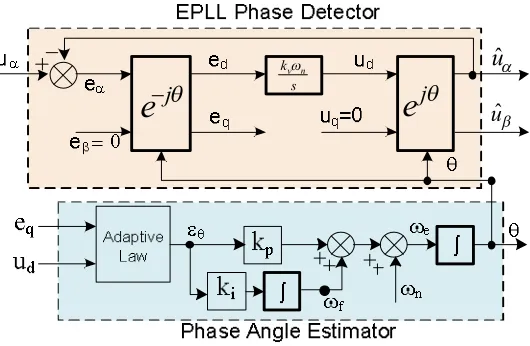
The typical EPLL model (Karimi-Ghartemani, 2013; Karimi-Ghartemani et al., 2012) is represented
by the block diagram given in Fig. 6.
n v n v k s k 5 . 0 5 . 0
(s 0.s5kvn)
Fig. 6 Typical model of the EPLL
The EPLL model in the rotating reference frame is:
ݑሶௗ=݇௩߱[0.5ܷ௩cos(ߜ)− 0.5ݑௗ+ 0.5ܷ௩cos(ߜ+ 2ߠ)− 0.5ݑௗcos(2ߠ)] (26a)
߱ሶ=݇(ߝఏ) (26b)
ߜ̇ =߱௩−݇ߝఏ−߱−߱ (26c)
݁= [0.5ܷ௩sin(ߜ)− 0.5ܷ௩sin(ߜ+ 2ߠ) + 0.5ݑௗsin(2ߠ)] (26d) Where, the adaptive lawߝఏfor phase angle estimation as used in (Ghartemani, 2013; Karimi-Ghartemaniet al., 2012) is:
ߝఏ=ଶ
௨ (27)
The small signal ZO-DPM transfer function for the adaptive law (27) at the equilibrium point (eq= 0)
is:
∆ߝఏ= ∆ߜ (28)
which is identical to (11) for IP-PLL and hence kp, kiand the ZO-DPM CLTF of the phase angle
estimator for the EPLL are equal to that given in (12) and (14).
In the EPLL,uout= udand hence the small-signal ZO-DPM CLTF of the voltage magnitude estimator
is derived from (26) and given by:
∆௨ೠ ∆ೡ =
∆௨ ∆ೡ=
.ହೡఠ
௦ା.ହೡఠ (29)
Similar to the IP-PLL, the output frequencyoutfor the EPLL is calculated as.
߱௨௧= ߱− 0.5݇௩߱ߝఏ (30)
with the small-signal ZO-DPM CLTF of:
∆ఠೠ= .ହೡఠ
j
e
j
e
u
ˆ
uˆ
with this, the small signal ZO-DPM CLTFs for phase angle, frequency and voltage magnitude
estimators for all three PLL schemes under study have been designed to be identical and this should
lead to identical dynamic performance. Also, the transfer functions show that the PLLs should remain
stable in a very wide range of kv. In the next section, the performance of the designed PLLs (using the
ZO-DPM) will be investigated using simulations with different values of kv which should help in
validating the ZO-DPM based design approach and identifying the potential differences in actual
dynamic performance.
4. Performance Comparison of PLL Schemes Designed Using the ZO-DPM
The PLL schemes presented in Figs 2, 4 and 6 and using the adaptive laws in (10), (19) and (27) and
having the control gains kp and kidesigned to provide identical ZO-DPM based small signal CLTFs
are implemented using Simulink/Matlab. The simulation models are tested for three small step
changes in phase-angle, frequency and voltage magnitude for different values of gain kv. The higher
[image:14.595.80.507.426.646.2]the value of kv, the faster the expected PLL dynamic response.
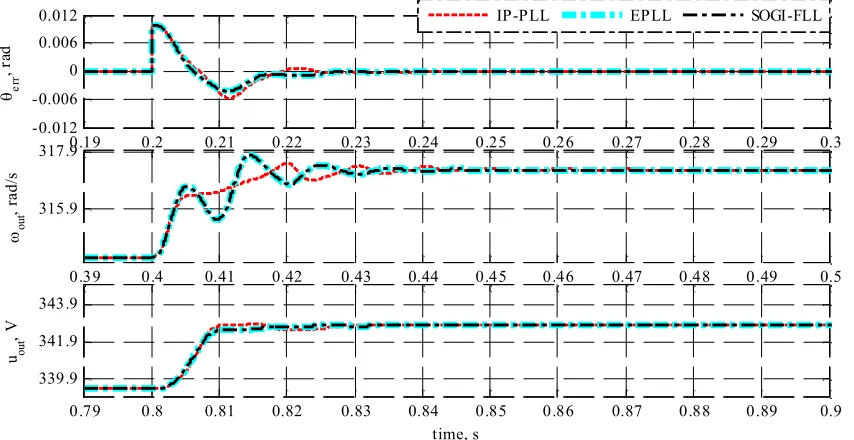
Fig. 7 Simulation results: PLLs testing under three small signal step changes for kv= 1. Top subplot: shows
phase angle response to a phase-angle step of 0.01 rad (at t=0.2s), middle subplot: shows frequency response to a frequency step of 1% (at t=0.4s), bottom subplot: shows voltage magnitude response to a voltage step of 1% (at
t=0.8s). “red” IP-PLL, “cyan” EPLL, “black” SOGI-FLL.
The simulation results from the three tests with kv= 1 is shown in Fig. 7. It is noted that the dynamic
response for all PLLs has a superimposed transient oscillation that decays quickly. The SOGI-FLL and
the EPLL response are visibly identical for all three tests, while the IP-PLL response differs slightly,
0.19 0.2 0.21 0.22 0.23 0.24 0.25 0.26 0.27 0.28 0.29 0.3
-0.012 -0.006 0 0.006 0.012
err
,r
ad
time, s
0.39 0.4 0.41 0.42 0.43 0.44 0.45 0.46 0.47 0.48 0.49 0.5
315.9 317.9
ou
t
,
ra
d/
s
time, s
0.79 0.8 0.81 0.82 0.83 0.84 0.85 0.86 0.87 0.88 0.89 0.9
339.9 341.9 343.9
u ou
t
,
V
time, s
with the largest mismatch noticed in the frequency step change test. The three tests are repeated for kv
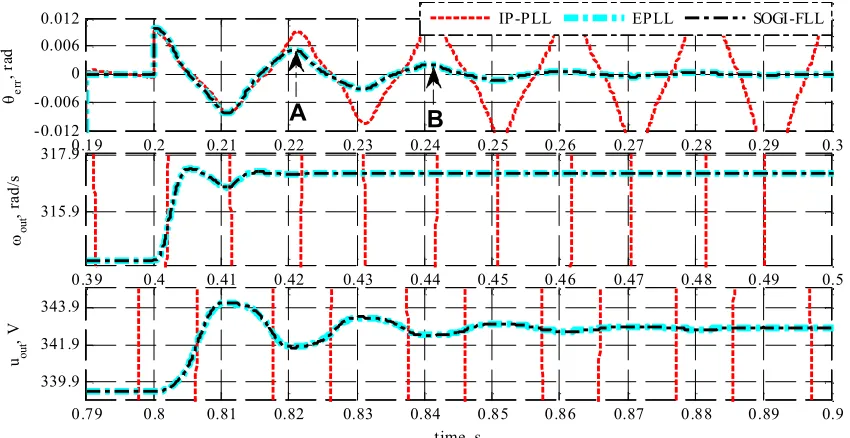
= 2 (faster PLL dynamic performance is expected). The simulation results are shown in Fig. 8. It is
clear that the IP-PLL becomes unstable in all three tests but the SOGI-FLL and the EPLL remain
stable but having slow decaying oscillations, although a higher kvshould have resulted in shorter time
[image:15.595.79.504.197.416.2]response, which contradicts the desired dynamic performance set for the ZO-DPM based design.
Fig. 8 Simulation results: PLLs testing under small signal step changes for kv= 2. Top subplot: shows phase
angle response to a phase-angle step of 0.01 rad (at t=0.2s), middle subplot: shows frequency response to a frequency step of 1% (at t=0.4s), bottom subplot: shows voltage magnitude response to a voltage step of 1% (at
t=0.8s). “red” IP-PLL, “cyan” EPLL, “black” SOGI-FLL.
From the simulation results forerr() in (Fig. 8), the slow dynamic PLL eigenvalue that is responsible
of the slow decaying oscillation can be approximately determined by measuring the ratio magnitude
between two consecutive oscillation peaks A (A=0.005rad, tA=0.221s) and B (B=0.002rad,
tB=0.241s) which results in the position of the eigenvalue on the real axis of –ln(A/B)/(tA-tB)
-45.8s-1. This results in much slower response in comparison to -314.1 s-1, the desired PLL eigenvalue
as emerged from the ZO-DPM based design (14), for kv=2 (see text above (14)). The problem is that
this slow dynamic eigenvalue which is noted by the simulation results of the actual PLL was not
possible to be predicted by the ZO-DPM and this is why a higher order DPM is proposed to account
for the effect of selected frequency components that might have resulted in such slow dynamic
eigenvalue. The DPM developed in general form in §3 (e.g. for IP-PLL (7)) is customised to 4th-order
0.19 0.2 0.21 0.22 0.23 0.24 0.25 0.26 0.27 0.28 0.29 0.3
-0.012 -0.006 0 0.006 0.012
err
,r
ad
time, s
0.39 0.4 0.41 0.42 0.43 0.44 0.45 0.46 0.47 0.48 0.49 0.5
315.9 317.9
ou
t
,
ra
d/
s
time, s
0.79 0.8 0.81 0.82 0.83 0.84 0.85 0.86 0.87 0.88 0.89 0.9
339.9 341.9 343.9
u out
,
V
time, s
IP-PLL EPLL SOGI-FLL
5. Fourth-order Dynamical Phasor Model based Stability Analysis of the PLL Schemes
Under Investigation
5.1 Analysis of the 4th-order DPM for IP-PLL
The 4th-order DPM for the IP-PLL is established using (7), (10). The model is linearized and the small
signal eigenvalues are obtained for the equilibrium point uq = 0, ud = Uv. The linearized state space
model is of 36thorder (4 states for the zero-order and 8 states for each “complex” order from 1 to 4),
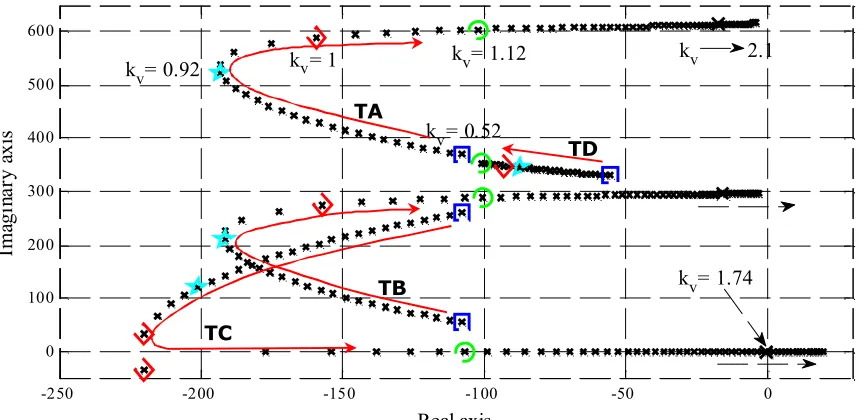
which for the sake of maintaining a reasonable paper length, are not detailed. Only four trajectories
(TA, TB, TC and TD) for the most dominant complex eigenvalues are plotted in Fig. 9 for 0.52< kv<
2.1. Four sets of the eigenvalues are highlighted for kv = 0.52 (blue square), 0.92 (cyan star), 1 (red
[image:16.595.76.510.332.542.2]diamond) and 1.12 (green circle) as shown in Fig. 9.
Fig. 9 The four most significant eigenvalue trajectories for the IP-PLL 4thorder DPM, (0.52< k v< 2.1).
The results show that for kv > 1.74, the eigenvalue TC moves to the right hand plane (instability
region), which is consistent with the simulation results presented in Fig. 8 for kv = 2 and in
contradiction with the ZO-DPM based small-signal analysis that untruly tells that the PLL is stable for
any values of kv. It is also noted that as kv increases from 0.52 to 0.92, the eigenvalues move further
into the left side of the s-plane. The increase of kv beyond 0.92 makes three eigenvalue trajectories
(TA, TB and TC) to reverse direction towards the unstable side of the s-plane one of which (TC) will
tend to cross the stability line first at kv> 1.74. Because the position of one eigenvalue (TD) starts (at
-250 -200 -150 -100 -50 0
0 100 200 300 400 500 600
Im
ag
in
ar
y
ax
is
kv 2.1
Real axis kv= 1
kv= 0.92 kv= 1.12
kv= 1.74 kv= 0.52
TA
TB
TC
kv=0.52) significantly on the right side compared to the other three and slowly moves left, whilst the
other three start moving right for kv>0.92, the optimum kvis chosen 1.12 so that the position of all four
eigenvalues are pushed as left as possible with respect to the real axis to maximize the dynamic
response.
5.2 Analysis of the 4th-order DPM for SOGI-FLL
The 4th-order DPM for the SOGI-FLL is derived from (18),(19). The linearized state-space model is
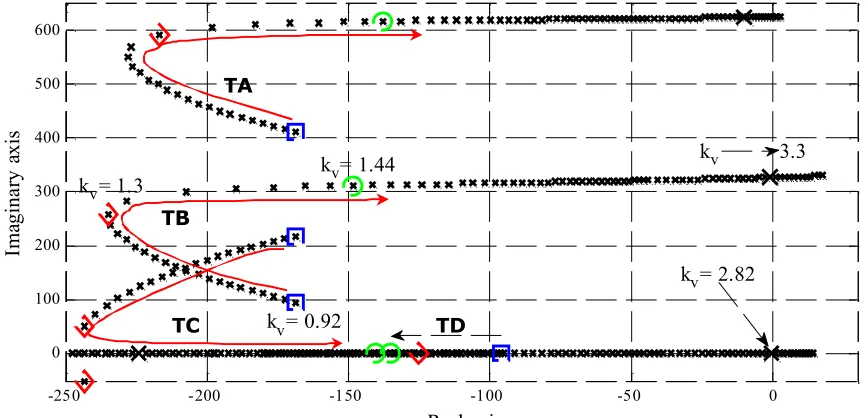
of 36thorder (not shown to minimise paper length) and the trajectories (TA, TB, TC and TD) of the
four most dominant complex eigenvalues are plotted in Fig. 10 for 0.92< kv< 3.3. It is found that the
eigenvalues for the SOGI-FLL (Fig. 10) are situated more to the left than the eigenvalues for IP-PLL
(Fig. 9), which means SOGI-FLL will actually provide better dynamic response than the IP-PLL that
contradicts the expected identical dynamic characteristic for all PLLs under study as imposed by the
ZO-DPM based design (§3). In Fig. 10, three sets of eigenvalues are highlighted for kv = 0.92 (blue
square), 1.3 (red diamond), 1.44 (green circle). This stability analysis based on eigenvalues confirms
that the SOGI-FLL is stable for kv< 2.82, which is consistent with the simulation results shown in Fig.
8. Based on the results in Fig. 10, it is recommended that kv < 1.44 to ensure the placement of all the
most dominant eigenvalues is situated as far left as possible into the s-plane. The stability limit is
found at kv= 2.82.
-250 -200 -150 -100 -50 0
0 100 200 300 400 500 600
Im
ag
in
ar
y
ax
is
kv 3.3
kv= 0.92
kv= 1.3 kv= 1.44
kv= 2.82
TA
TB
[image:17.595.72.506.535.744.2]5.3 Analysis of the 4th-order DPM for EPLL
The state space model for the EPLL (26), (28) is also used to derive the 4th-order DPM. The linearized
state space model is of 27thorder and the trajectories of the four most dominant complex eigenvalues
are plotted in Fig. 11 for 0.92< kv< 3.3. The EPLL eigenvalue trajectories reveal similar trend to that
of the SOGI-FLL. The EPLL is also found unstable for kv > 2.82. Three sets of eigenvalues are
highlighted for kv= 0.92, 1.3, 1.44 as shown in Fig. 11. The trajectories of the EPLL and SOGI-FLL
eigenvalues are almost the same as revealed by comparing Figs 10 and 11. Therefore, the
[image:18.595.83.510.279.492.2]recommended value for kvis equal to that for SOGI-FLL, i.e. kv< 1.44.
Fig. 11 The four most significant eigenvalue trajectories for the EPLL 4thorder DPM, (0.92 < k v< 3.3).
5.4 Validation by Simulation of the 4th-order DPMs
The analysis of the eigenvalues presented in the previous sections can be summarised in Table 1 which
contains the values of kv for operation at stability limit (top), for keeping all of the most dominant
eigenvalues as far left on the s-plane as possible as a design limit (middle) and a set of gains selected
in the paper (bottom) that agree with both previous limitations and were recommended to be used in
the large signal tests.
Table 1: Gain kvdesign values for the three PLLs under study.
IP-PLL SOGI-FLL EPLL
Stability limit kv < 1.72 kv < 2.82 kv < 2.82
Design limit kv< 1.12 kv< 1.44 kv< 1.44
Recommended in this paper kv=1 kv=1.3 kv=1.3
-250 -200 -150 -100 -50 0
0 100 200 300 400 500 600
Im
ag
in
ar
y
ax
is
kv 3.3
Real axis
kv= 2.82 kv= 0.92
kv= 1.3 kv= 1.44
TA
TB
The eigenvalues analysis of the 4th-order DPM of the PLL schemes under study is validated by
simulation. Fig. 12 illustrates the simulation results of the three PLL schemes for kv= 2.82 subjected
to small step changes in phase angle, frequency and voltage magnitude. All three tests show that the
IP-PLL is unstable while the SOGI-FLL and the EPLL response were both on the verge of instability.
These findings validate the obtained stability limits from the small signal eigenvalues analysis shown
in Figs 9-11 and hence prove the suitability of the 4th-order DPM for PLL stability analysis and control
[image:19.595.80.504.249.467.2]design.
Fig. 12 Simulation results: PLLs testing under small signal step changes for kv= 2.82. Top subplot: shows phase
angle response to a phase-angle step of 0.01 rad (at t=0.2s), middle subplot: shows frequency response to a frequency step of 1% (at t=0.4s), Bottom subplot: shows voltage magnitude response to a voltage step of 1% (at
t=0.8s). “red” IP-PLL, “cyan” EPLL, “black” SOGI-FLL.
In the next section, the three PLL schemes using the recommended design values for kvin Table 1 will
be tested and compared for large signal disturbances.
6. Large Signal Testing and Performance Comparison of the PLL Schemes
The models for the PLL schemes in Fig. 2, 4, 6 using the design adaptive laws derived in (10), (19)
and (27) will be tested by simulation and experimental implementation for large signal disturbances.
The recommended values for kv listed in the last row of Table 1 are used in both simulations and
experiments. The disturbances applied are: phase jump (∆ߠ௩= 1ݎܽ݀), voltage sag (∆ܷ௩= 80%of
0.19 0.2 0.21 0.22 0.23 0.24 0.25 0.26 0.27 0.28 0.29 0.3
-0.012 -0.006 0 0.006 0.012
err
,r
ad
time, s
0.39 0.4 0.41 0.42 0.43 0.44 0.45 0.46 0.47 0.48 0.49 0.5
315.9 317.9 319.9
ou
t
,
ra
d/
s
time, s
0.79 0.8 0.81 0.82 0.83 0.84 0.85 0.86 0.87 0.88 0.89 0.9
339.9 341.9 343.9 345.9 347.9
u ou
t
,
V
time, s
in grid voltage can cause the PLLs to slip and loose the locking state for one or more cycles. The
locking state is maintained attractive under large disturbance by limitingeto be within a band of ±30%
from the nominal-value such that 0.7n < e < 1.3n. Also, the absolute value of ud is used in the
denominator of the adaptive laws (10) and (27). The simulation models are implemented in
Matlab/Simulink. The models of the three PLL schemes are also implemented on a 32-bit floating
point DSP+FPGA laboratory digital platform equipped with 16 bit A/D converters specially designed
for real time control of power electronic systems. All three PLL schemes were running simultaneously
and independently in the DSP with a sampling time of 100 µs. A programmable electronic AC power
source (Chroma) is used to generate the various types of grid voltage disturbances needed for the
experimental validation such as phase jump, voltage sag and frequency step change tests. Because of
the existence of an LC filter on the output of the electronic power supply, there is a limitation of how
fast/sharp the voltage transients can be replicated and this can explain some of the differences that will
be seen in the next subsections between the simulation and the experimental results.
The DSP control algorithm which is executed every sampling time starts by acquiring the supply
voltage, then independently calculates the state variables for all three PLL schemes; at the end of
every sampling time, all state variables (including the measured supply voltage) are saved into a
memory buffer with a sufficient length to store the full response to the disturbance. The content of this
memory buffer is later transferred to the PC for visualisation. There is no post processing of data.
The simulation and experimental results of the three PLL schemes under investigation will be
compared in the following sections. The simulation results are shown in the left subplots of following
figures while the corresponding experimental results are shown in the right subplots.
6.1 Response Following the Phase Jump Test
The PLLs are tested for large and sudden phase jump of 1 rad. The PLLs with the ±30% e limit are
tested for phase jump response. The results in Fig. 13 show that all three PLL schemes are stable for a
large phase jump disturbance. It is noted that the SOGI-FLL phase tracking is faster simply because
than by direct integration ofewhich is subject to the ±30% limit. On the other hand, the EPLL and
IP-PLL have experienced slow phase-angle tracking responses because of the limits imposed toethat
is fed to the integrator. It is also noted that SOGI-FLL has provided smaller disturbance to the
estimated voltage magnitude (see bottom subplots of Fig. 13) during the phase jump. The results show
[image:21.595.97.500.199.357.2]that SOGI-FLL could be the most suitable choice for grids that suffer from frequent phase jumps.
Fig. 13 Response of the three PLL schemes to phase jump: (Top subplots) phase angle response, (bottom subplots) voltage magnitude response. “red” is for IP-PLL, “cyan” is for EPLL and “black” is for SOGI-FLL.
6.2 Response Following the Voltage Sag Test
Modern grid codes require the converters to continue operation even under severe voltage sags to
support the grid recovery by injecting reactive current. This will require PLLs to maintain tracking of
the grid voltage vector trajectory with minimal error in phase angle estimation. Typically, the voltage
sag transient that signals the beginning of a grid fault is the sharpest whilst the grid voltage recovery is
a much slower process (slow ramp). The designed PLLs are tested for a large voltage sag of 80%
applied at the zero crossing of grid voltage (worst case for voltage estimation) and setting the limit for
the estimated angular frequency as 0.7n <e < 1.3n. The simulation and the experimental results
are shown in Fig 14. The voltage tracking of all three PLL schemes is good with no cycle slip. The
EPLL have shown the faster voltage magnitude response to the step voltage change. The phase angle
Fig. 14 Response of the three PLL schemes to 80% voltage sag test; (top subplots) voltage magnitude response, (bottom subplots) phase angle response. “red” is for IP-PLL, “cyan” is for EPLL and “black” is for SOGI-FLL.
6.3 Response Following the Frequency Step Change Test
(a)
(b)
Fig. 15 Response of the three PLL schemes to frequency step change test: a) frequency step increase results, b) frequency step decrease results. (top subplots) frequency response, (bottom subplots) voltage magnitude
response. “red” is for IP-PLL, “cyan” is for EPLL and “black” is for SOGI-FLL.
The PLL schemes are tested for a sudden change in grid frequency. The frequency is changed by
applying a ±10% step of the nominal value (50Hz). The simulation and the experimental results are
[image:22.595.96.499.296.632.2]SOGI-FLL have nearly identical response, the IP-PLL has a slightly slower response. The error in the voltage
estimation of the IP-PLL was the smallest.
The conclusion of these tests is that all three PLL schemes perform well under all three large signal
disturbances. The SOGI-FLL was able to maintain its good phase angle dynamic response during the
phase jump test because the output phase angle is calculated directly from the PLL output voltage
vector using arctangent. However, during the voltage sag test which would result in errors in the
estimated voltage, it results in the largest phase angle error. The responses of the three PLL schemes to
a step change in grid frequency were similar, but with slightly slower dynamics for IP-PLL.
7. Conclusion
The use of Dynamic Phasor Modelling DPM is proposed in this paper to improve the modelling for
the purpose of stability analysis and design of three PLL schemes, the single-phase IP-PLL,
SOGI-FLL and EPLL PLL. First, the simplified average model usually used in the literature for single phase
PLL design and stability analysis has been used to design three PLL schemes to achieve identical
dynamic characteristics which when evaluated via simulation, are found to differ significantly.
For this reason, fourth-order DPMs have been developed for the three PLL schemes under study. An
analysis of the most predominant eigenvalues is used to determine the stability limits and the
recommended design gains which are then validated via simulation for small signal disturbances. The
actual small-signal dynamic response of the PLLs was as predicted by the 4th-order DPM eigenvalue
analysis.
The final validation of the 4th-order DPM based design of the PLL schemes is achieved by large signal
disturbance testing (phase jump, voltage sag and frequency step change) implemented both in
simulation and on an experimental digital control platform using (as input) actual voltage disturbances
produced by a programmable electronic AC power supply. The SOGI-FLL is found to be more
suitable for operation under severe phase jump situations. EPLL on the other hand, had the best
Appendix 1
Dynamic Phasor Modelling of Non-linear State Variables
The DPM of the nonlinear terms such asܿݏ(2ߠ)andݏ݅݊(2ߠ), e.g. in (5a,b) are given by:
〈ݏ݅݊(݉ ߠ)〉=ቊ∓ଵଶ݆… …݂ݎ݇= ±݉
0 … … … …ݐℎ݁ݎݓ݅ݏ݁ (A1a)
〈ܿݏ(݉ ߠ)〉=ቊଵଶ … …݂ݎ݇= ∓݉
0 … … … …ݐℎ݁ݎݓ݅ݏ݁ (A1b)
For the nonlinear cosine and sine terms function of and in (5a,b), Taylor expansion method is
applied before using the convolution property (4) to determine the DPM. The Taylor expansion for the
various nonlinear terms in (5a,b) assumingis small are expressed as:
ܿݏ(ߜ)~ 1 ; ݏ݅݊(ߜ)~ߜ
ܿݏ(ߜ+ 2ߠ) ~ cos(2ߠ)−ߜݏ݅݊(2ߠ) (A2)
ݏ݅݊(ߜ+ 2ߠ) ~ sin(2ߠ) +ߜܿݏ(2ߠ)
Then, the Fourier coefficients for the nonlinear terms in (A2) are derived by applying rules (4) and (A1):
〈ܿݏ(ߜ)〉 = 1 ; 〈ܿݏ(ߜ)〉ஷ = 0
〈ݏ݅݊(ߜ)〉= 〈ߜ〉
〈ܿݏ(ߜ+ 2ߠ)〉ଶ = 0.5 + 0.5݆〈ߜ〉− 0.5݆〈ߜ〉ିସ and 〈ܿݏ(ߜ+ 2ߠ)〉ஷଶ = 0 (A3)
〈ݏ݅݊(ߜ+ 2ߠ)〉ଶ= −0.5݆+ 0.5݆〈ߜ〉+ 0.5〈ߜ〉ିସ and 〈ݏ݅݊(ߜ+ 2ߠ)〉ஷଶ= 0
The nonlinear term (uq/ud) in (e.g. in (10), (27)) is approximated by assuming ud is mainly a dc
quantity with additional small ripple component, (Emadi, 2004) (i.e.ud=〈ݑௗ〉+ݑௗ) and hence (using
Taylor expansion method):
௨ ௨~ݑቂ
ଵ 〈௨〉బ−
௨
(〈௨〉బ)మቃ~ݑቂ ଶ 〈௨〉బ−
௨
(〈௨〉బ)మቃ (A4)
whereݑௗis the sum of the ripple components and <ud>0 is the DC component of ud. Then, the
convolution property (4) is applied to (A4) to give:
〈௨ ௨〉~ቂ
ଶ
〈௨〉బ〈ݑ〉− ଵ
References
Caliskan, V.A., Verghese, G.C. and Stankovi´c, A.M. (1999), “Multifrequency Averaging of DC/DC Converters”, IEEE Transactions on Power Electronics, Vol. 14, No. 1, pp. 124-133.
Chung Se-Kyo (2000), “A Phase Tracking System for Three Phase Utility Interface Inverters”, IEEE Transactions on Power Electronics, Vol. 15, No. 3, pp. 431-438.
De Brabandere, K., Bolsens, B., Van den Keybus, J., Driesen, J., Prodanovic, M. and Belmans, R. (2005), "Small-signal stability of grids with distributed low-inertia generators taking into account line phasor dynamics", 18th International Conference and Exhibition on Electricity Distribution, CIRED, Vol., No., 6-9 June, pp. 1-5.
Emadi, A. (2004), “Modeling of Power Electronic Loads in AC Distribution Systems Using the Generalized State-Space Averaging Method”, IEEE Transactions on Industrial Electronics, Vol. 51, No. 5, pp. 992-1000.
Filho, R.M.S., Seixas, P.F., Cortizo, P.C., Torres, L.A.B. and Souza, A.F. (2008), “Comparison of three single-phase PLL algorithms for UPS applications”, IEEE Transactions on Industrial Electronics, Vol. 55, No. 8, pp. 2923–2932.
Freijedo, F.D., Doval-Gandoy, J., López, Ó. and Acha, E. (2009), “Tuning of Phase-Locked Loops for Power Converters Under Distorted Utility Conditions”, IEEE Transactions on Industry Applications, Vol. 45, No. 6, pp. 2039-2047.
Golestan, S., Monfared, M., Freijedo, F. D. and Guerrero, J. M. (2013), “Advantages and Challenges of a Type-3 PLL”, IEEE Transactions on Power Electronics, Vol. 28, No. 11, pp. 4985-4997.
Karimi-Ghartemani, M. (2013), “A Unifying Approach to Single-Phase Synchronous Reference Frame PLLs”, IEEE Transactions on Power Electronics, Vol. 28, No. 10, pp. 4550-4556.
Karimi-Ghartemani, M., Khajehoddin, S.A., Jain, P.K. and Bakhshai, A. (2012), “Problems of startup and phase jumps in PLL systems”, IEEE Transactions on Power Electronics, Vol. 27, No. 4, pp. 1830– 1838.
Mariani, V., Vasca, F. and Guerrero, J.M. (2014), "Dynamic-phasor-based Nonlinear Modelling of AC Islanded Microgrids under Droop Control", 11th International Multi-Conference on Systems, Signals & Devices (SSD), Vol., No., 11-14 Feb., pp.1-6.
Mattavelli, P., Stankovi, A.M. and Verghese, G.C. (1999), “SSR Analysis with Dynamic Phasor Model of Thyristor-Controlled Series Capacitor” IEEE Transactions on Power Systems, Vol. 14, No. 1, February 1999, pp. 200-208.
Nicastri, A. and Nagliero, A. (2010) “Comparison and evaluation of the pll techniques for the design of the grid-connected inverter systems”, in Proc. IEEE Int. Symp. Ind. Electron., pp. 3865–3870. Rashed, M., Klumpner, C. and Asher, G. (2013), “Repetitive and Resonant Control for a Single-Phase Grid-Connected Hybrid Cascaded Multilevel Converter”, IEEE Transactions on Power Electronics, Vol. 28, No. 5, pp. 2224- 2234.
Rodr´ıguez, P., Luna, A., Candela, I., Mujal, R.,Teodorescu, R. and Blaabjerg, F. (2011), “Multiresonant frequency-locked loop for grid synchronization of power converters under distorted grid conditions”, IEEE Transactions on Industrial Electronics, Vol. 58, No. 1, pp. 127–138.
Sanders, S.R., Noworolski, J.M., Liu, X.Z. and Verghese, G.C. (1991), “Generalized Averaging Method for Power Conversion Circuits”, IEEE Transactions on Power Electronics, Vol. 6. No. 2., pp. 251-259
Shinnaka, S. (2011), “A novel fast-tracking d-estimation method for single-phase signals”, IEEE Transactions on Power Electronics, Vol. 26, No. 4, pp. 1081–1088.
Stankovic, A.M., Lesieutre, B.C. and Aydin, T. (1999), “Modeling and Analysis of Single-Phase Induction Machines with Dynamic Phasors”, IEEE Transactions on Power Systems, Vol. 14, No. 1, pp. 9-14.
Thacker, T., Boroyevich, D., Burgos, R. and Wang, F. (2011), “Phase-Locked Loop Noise Reduction via Phase Detector Implementation for Single-Phase Systems”, IEEE Transactions on Industrial Electronics, Vol. 58, No. 6, pp. 2482-2490.
Velasco, D., Trujillo, C., Garcera, G. and Figueres, E. (2011), “An active anti-islanding method based on phase-PLL perturbation”, IEEE Transactions on Power Electronics, Vol. 26, No. 4, pp. 1056–1066. Wang, L., Guo, X. Q., Gu, H. R., Wu, W.Y. and Guerrero, J.M. (2012), "Precise Modeling based on Dynamic Phasors for Droop-controlled Parallel-connected Inverters", IEEE International Symposium on industrial Electronics (ISIE), Vol., No., 28-31 May, pp. 475-480.
Xianwei, W., Fang Z., Haiping, G., Liang, M, Meijuan, Y. and Jinjun L. (2011), "Stability analysis of droop control for inverter using dynamic phasors method", IEEE Energy Conversion Congress and Exposition (ECCE), Vol., No., 17-22 Sept., pp. 739-742.
About the authors
Dr Mohamed Rashed received the PhD Degree in Electric Motor Drives from the University of Aberdeen, Aberdeen, UK, in 2002. From 2002 to 2005, he was a Postdoctoral Fellow at the Department of Engineering, the University of Aberdeen. He is an Associate Professor at the Department of Electrical Engineering, the Mansoura University, Egypt and currently is on leave working as a Research Fellow, Power electronics, Machines and Control Group, Department of Electrical and Electronic Engineering, The University of Nottingham, Nottingham, UK His research interests include the design and control of electric motor drive systems and power electronics for micro grids, renewable energy sources, and energy storage systems. Dr Mohamed Rashed is the corresponding author and can be contacted at: [email protected]
Dr Christian Klumpnerreceived the PhD Degree in Electrical Engineering from the “Politehnica” University of Timisoara, Timisoara, Romania, in 2001. From 2001 to 2003, he was a Research Assistant Professor in the Institute of Energy Technology, the Aalborg University, Aalborg, Denmark. From October 2003 to 2011, he was a Lecturer with the Department of Electrical Engineering, University of Nottingham, Nottingham, UK, where he is currently an Associate Professor. His current research interests include power electronics for various applications such as AC drives, connecting renewable energy sources and energy storage devices to the AC power grid. Dr Klumpner received the Isao Takahashi Power Electronics Award in 2005 at the International Power Electronics Conference organised by the Institute of Electrical Engineers of Japan in Niigata. He is also a recipient of the 2007 IEEE Richard M. Bass Outstanding Young Power Electronics Engineer Award.