arXiv:1607.03909v2 [astro-ph.GA] 9 Oct 2016
Preprint typeset using LATEX style AASTeX6 v. 1.0
THE EVOLUTION OF GALAXY NUMBER DENSITY ATZ <8 AND ITS IMPLICATIONS
Christopher J. Conselice, Aaron Wilkinson, Kenneth Duncan1, Alice Mortlock2 University of Nottingham, School of Physics & Astronomy, Nottingham, NG7 2RD UK
1Leiden Observatory, Leiden University, PO Box 9513, 2300 RA Leiden, the Netherlands
2SUPA, Institute for Astronomy, University of Edinburgh, Royal Observatory, Edinburgh, EH9 3HJ
ABSTRACT
The evolution of the number density of galaxies in the universe, and thus also the total number of galaxies, is a fundamental question with implications for a host of astrophysical problems including galaxy evolution and cosmology. However there has never been a detailed study of this important measurement, nor a clear path to answer it. To address this we use observed galaxy stellar mass functions up toz∼8 to determine how the number densities of galaxies changes as a function of time and mass limit. We show that the increase in the total number density of galaxies (φT), more massive than M∗ = 106 M⊙, decreases as φT ∼ t−1, where t is the age of the universe. We further show that this evolution turns-over and rather increases with time at higher mass lower limits of M∗>107
M⊙. By using the M∗ = 106 M⊙lower limit we further show that the total number of galaxies in the
universe up toz= 8 is 2.0+0−0..76×1012(two trillion), almost a factor of ten higher than would be seen in an all sky survey at Hubble Ultra-Deep Field depth. We discuss the implications for these results for galaxy evolution, as well as compare our results with the latest models of galaxy formation. These results also reveal that the cosmic background light in the optical and near-infrared likely arise from these unobserved faint galaxies. We also show how these results solve the question of why the sky at night is dark, otherwise known as Olbers’ paradox.
Keywords: Galaxies: Evolution, Formation, Structure, Morphology, Classification
1. INTRODUCTION
When discovering the universe and its properties we are always interested in knowing absolutes. For ex-ample, it is of astronomical interest to calculate how many stars are in our Galaxy, how many planets are surrounding these stars (Fressin et al. 2013), the total mass density of the universe (e.g., Fukugita & Peebles 2004), amongst other absolutes in the universe’s prop-erties. One of these that has only been answered in a rough way is the total number density evolution of galaxies, and thus also the total number of galaxies in the universe.
This question is not only of passing interest as a cu-riosity, but is also connected to many other questions in cosmology and astronomy. The evolution of the number densities of galaxies relates to issues such as galaxy formation/evolution through the number of sys-tems formed, the evolution of the ratio of giant galaxies to dwarf galaxies, the distant supernova and gamma-ray burst rate, the star formation rate of the universe, and how new galaxies are created/destroyed through merg-ers (e.g., Bridge et al. 2007; Lin et al. 2008; Jogee et al. 2009; Conselice et al. 2011; Bluck et al. 2012; Conselice
2014; Ownsworth et al. 2014). The number of galax-ies in the observable universe also divulges information about the mass density of the universe, background light at various wavelengths, as well as insights into Olbers’ Paradox. However, there still does not yet exist a good measurement for this fundamental quantity.
However, despite these surveys it is still uncertain how the total number density of galaxies evolves over time. This is an interesting question as we know that the star formation rate rises, and then declines at z < 8 (e.g., Bouwens et al. 2009; Duncan et al. 2014; Madau & Dickinson 2014), while at the same time galaxies become larger and less peculiar (e.g., Conselice et al. 2004; Pa-povich et al. 2005; Buitrago et al. 2013; Mortlock et al. 2013; Lee et al. 2013; Conselice 2014; Boada et al. 2015). However, we do not know how the total num-ber of galaxies at a given epoch evolves, and how this is associated with the general formation of the galaxy population as a whole.
There are a few reasons for why deep imaging pro-grams are not easily able to convert observations to to-tal numbers of galaxies. One of these issues is that all deep observations are incomplete. This is due to limi-tations in exposure times and depth such that certain galaxies will be detected more readily than other galax-ies. The result of this is an incompleteness down to the magnitude limit of even the deepest surveys, which can be corrected for, but which still leaves some uncer-tainty. However, the more important issue is that these observations do not reach the faintest galaxies, although from number density fits and theory we know that there should be many more faint galaxies beyond our current observational limits.
It is also important to address what we mean by the total number density of galaxies in the universe. This is not a simple quantity to define as the total number den-sity which exists now, the total number denden-sity which is observable in principle, and the total number density which is observable with current technology, are all dif-ferent questions with difdif-ferent answers. There is also the issue that we are limited by the cosmological hori-zon over what we can observe, and therefore there are galaxies we cannot see beyond it. Even the number of galaxies which exist in the universe today, i.e., if we could view the entire universe as is, and not be limited by light travel time, is a complicated question. Galaxies in the distant universe have evolved beyond what we can currently observe due to the finite nature of the speed of light, and presumably would look similar to those in the local universe. We address these issues in the pa-per. Our default and ultimate total number density of galaxies we investigate in this paper is how the number density evolves within the current observable universe up toz∼8.
For comparison purposes, we also carry out an analy-sis in the Appendix of the number of galaxies which are visible to modern telescopes, at all wavelengths, that we can currently observe. We then compare this to mea-surements of the total number that actually can be po-tentially observed in the universe based on measured
mass functions. We also discuss how these results re-veal information concerning galaxy evolution and back-ground light. We also give indications for future surveys and what fraction of galaxies these will observe.
This paper is divided up into several sections. §2 de-scribes the data we use throughout this analysis,§3 de-scribes the results of this paper including using fits of galaxy stellar mass functions to derive the total num-ber of galaxies which are in the universe. §4 describes the implications of these results and §5 is a summary. Throughout this paper we use a standard cosmology of H0= 70 km s−1 Mpc−1, and Ωm= 1−Ωλ = 0.3.
2. DATA
The data we use for this paper come from many sources, and results from previous papers. In the Ap-pendix we describe how many galaxies we can actually observe at present in the universe, based on the deep-est observations yet available. Here in the main paper we address the question of how many galaxies are po-tentially detectable within the universe if deep imaging, over all wavelengths, could be carried out in every loca-tion of the sky without any interference from the Galaxy, or other contamination.
For the bulk analysis and results of this paper we uti-lize mass functions of galaxies from the local universe up until z ∼ 8 to determine how the number density of galaxies evolves with time and redshift. These mass and luminosity functions are now just starting to be measured at high redshfits, and our primary data orig-inates from mass functions calculated using deep and wide near-infrared and optical surveys with Hubble and ground based telescopes.
As described in the next section, the mass functions we utilize are from Perez-Gonzalez et al. (2008), Kajisawa et al. (2009), Fontanta et al. (2004, 2006), Caputi et al. (2011), Pozzetti et al. (2007), Mortlock et al. (2011), Tomczak et al. (2014), Muzzin et al. (2013), and Mort-lock et al. (2015) for galaxies atz < 3. At the highest redshifts we use mass functions published in Duncan et al. (2014), Grazian et al. (2015), Caputi et al. (2011) and Song et al. (2015). We normalize all of these mass functions for each survey based on the Salpeter initial mass function (IMF) for stars between 0.1 M⊙and 100
M⊙. We also use only the co-moving number densities
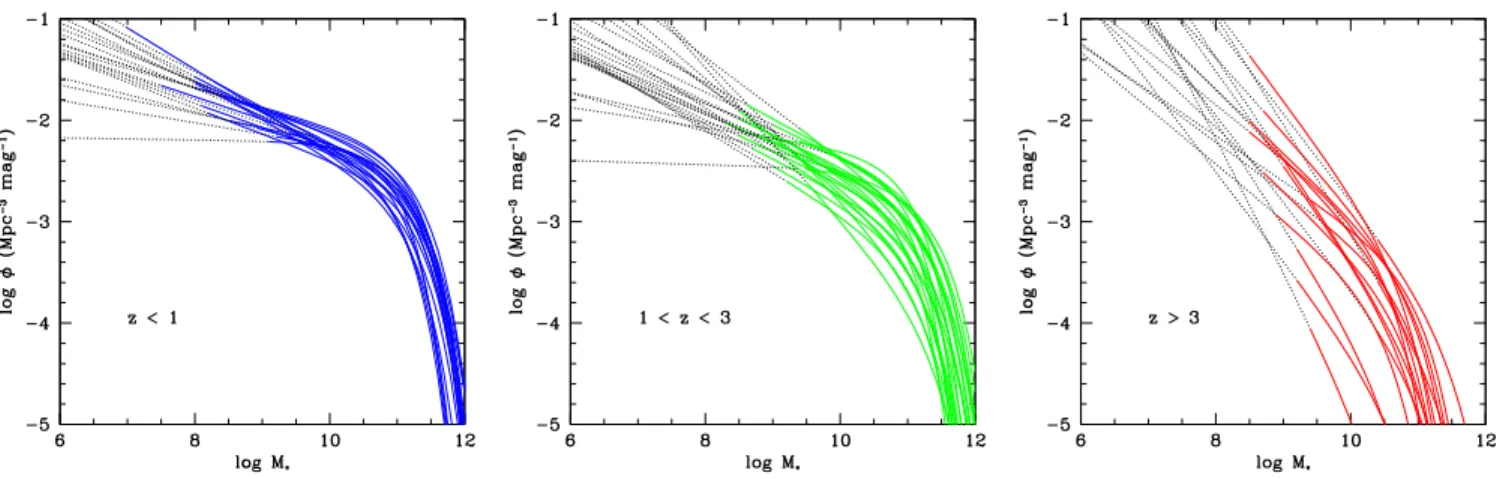
Figure 1. The mass functions which we use throughout this paper, plotted through best fitting Schechter function fits. These are all from the various studies described in §2. The mass functions are shown in terms of redshifts, such that the left panel shows systems atz <1, the middle panel shows 1< z <3 andz >3 (far right). These mass functions are shown such that the solid colored lines are the mass functions down to the limit of the respective data whereby it is complete, and the dotted lines show our extrapolation down to M∗= 106 M⊙. The ‘flattest’ mass function plot in the 1< z <3 regime is from Muzzin et al.
(2013) and the flattestz >3 mass function is from Grazian et al. (2015).
3. THE EVOLUTION OF GALAXY NUMBER
DENSITY
3.1. Introduction and Caveats
The primary method we use to determine the num-ber densities of galaxies in the universe is to integrate through the fitted mass functions the number of galaxies which are at a given redshift. This requires extrapolat-ing fitted stellar mass functions to reach down to a low mass limit of the galaxy population. There are many ways in which this can be done which we discuss be-low. One of the most important questions is the lower limit at which we should count galaxies from the mass functions. Due to the recent publication of stellar mass functions up toz∼8 (e.g., Duncan et al. 2014; Grazian et al. 2015; Song et al. 2015) we can now make this calculation for the first time. Another issue is whether or not the Schechter function can be extrapolated below the limit of the data in which it was originally fit. This is a question we investigate in detail.
This is complementary to the directly observed ap-proach presented in the Appendix, and is a more ac-curate way to measure the number of galaxies in the currently observable universe, if the mass functions are properly measured and parameterized accurately. How-ever this method is potentially fraught with pitfalls that have to be carefully considered and addressed. Not the least of which is that this measurement relies on much more than simple photometry and detection is-sues, which are also present when simply measuring the number of galaxies. The situation here involves other uncertainties involving the measurements of stellar masses and redshifts. Nonetheless, if we can account for these uncertainties, the integration of fitted mass
func-tions can tell us the number densities of galaxies within a given redshift interval with some measured uncertainty. We use this method to calculate the total number den-sity of galaxies which are within the currently observable universe as a function of redshift. To do this we do not directly integrate the observed mass functions, but use a parameterized fitted form as given by the Schechter (1976) function to determine the total number densities of galaxies as a function of redshift. The form of this function is given by:
φ(M) =b×φ∗ln(10)[10b(M−M∗)
](1+α)exp[−10b(M−M∗)] (1) where b = 1 for the mass function andb = 0.4 for the luminosity function, which would be written in terms of absolute magnitudes. For the mass function, M∗ is the
characteristic mass in log units and determines where the mass function changes slope, and M = log(M∗/
M⊙), is the mass in log units. Similarly for the
lu-minosity function, M∗ corresponds to the characteristic
magnitude. For both functionsφ∗ is the normalization,
and αdetermines the slope for fainter and lower mass galaxies. Our method is to use published values ofφ∗, αand M∗to calculate the integrated number of galaxies
within different redshift bins.
We use the Schechter function as a tool to calculate the total number density as overall it does a good job of representing the distribution of galaxy masses at all red-shifts in the ranges where we probe. We do not however know at what lower mass limit it remains valid, which is one uncertainty in our analysis. We discuss the use of a M∗ >106 M⊙limit below and the justification for
results would change if we were to use a different lower mass cut off limit.
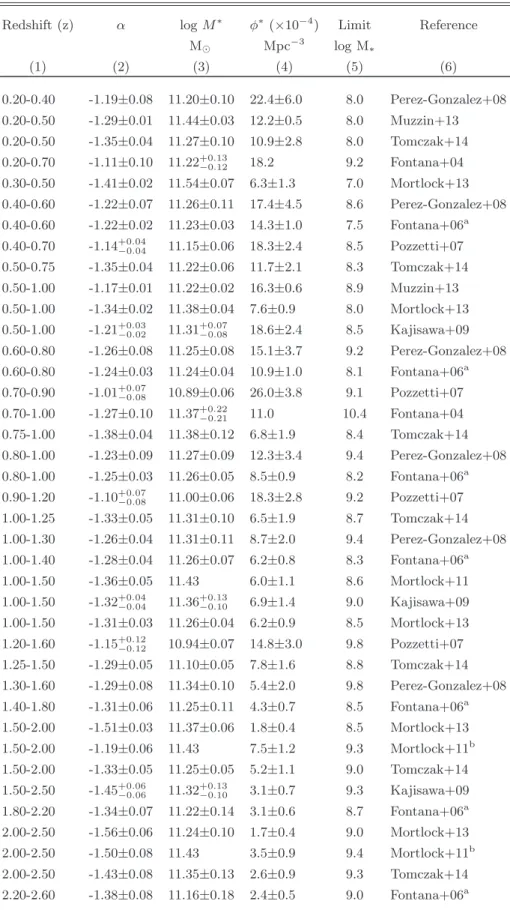
Table 1. Schechter Function Parameters
Redshift (z) α logM∗ φ∗(×10−4) Limit Reference M⊙ Mpc−3 log M∗
(1) (2) (3) (4) (5) (6)
0.20-0.40 -1.19±0.08 11.20±0.10 22.4±6.0 8.0 Perez-Gonzalez+08 0.20-0.50 -1.29±0.01 11.44±0.03 12.2±0.5 8.0 Muzzin+13 0.20-0.50 -1.35±0.04 11.27±0.10 10.9±2.8 8.0 Tomczak+14 0.20-0.70 -1.11±0.10 11.22+0.13
−0.12 18.2 9.2 Fontana+04 0.30-0.50 -1.41±0.02 11.54±0.07 6.3±1.3 7.0 Mortlock+13 0.40-0.60 -1.22±0.07 11.26±0.11 17.4±4.5 8.6 Perez-Gonzalez+08 0.40-0.60 -1.22±0.02 11.23±0.03 14.3±1.0 7.5 Fontana+06a 0.40-0.70 -1.14+0.04
−0.04 11.15±0.06 18.3±2.4 8.5 Pozzetti+07 0.50-0.75 -1.35±0.04 11.22±0.06 11.7±2.1 8.3 Tomczak+14 0.50-1.00 -1.17±0.01 11.22±0.02 16.3±0.6 8.9 Muzzin+13 0.50-1.00 -1.34±0.02 11.38±0.04 7.6±0.9 8.0 Mortlock+13 0.50-1.00 -1.21+0.03
−0.02 11.31 +0.07
−0.08 18.6±2.4 8.5 Kajisawa+09 0.60-0.80 -1.26±0.08 11.25±0.08 15.1±3.7 9.2 Perez-Gonzalez+08 0.60-0.80 -1.24±0.03 11.24±0.04 10.9±1.0 8.1 Fontana+06a 0.70-0.90 -1.01+0.07
−0.08 10.89±0.06 26.0±3.8 9.1 Pozzetti+07 0.70-1.00 -1.27±0.10 11.37+0.22
−0.21 11.0 10.4 Fontana+04 0.75-1.00 -1.38±0.04 11.38±0.12 6.8±1.9 8.4 Tomczak+14 0.80-1.00 -1.23±0.09 11.27±0.09 12.3±3.4 9.4 Perez-Gonzalez+08 0.80-1.00 -1.25±0.03 11.26±0.05 8.5±0.9 8.2 Fontana+06a 0.90-1.20 -1.10+0.07
−0.08 11.00±0.06 18.3±2.8 9.2 Pozzetti+07 1.00-1.25 -1.33±0.05 11.31±0.10 6.5±1.9 8.7 Tomczak+14 1.00-1.30 -1.26±0.04 11.31±0.11 8.7±2.0 9.4 Perez-Gonzalez+08 1.00-1.40 -1.28±0.04 11.26±0.07 6.2±0.8 8.3 Fontana+06a 1.00-1.50 -1.36±0.05 11.43 6.0±1.1 8.6 Mortlock+11 1.00-1.50 -1.32+0.04
−0.04 11.36 +0.13
−0.10 6.9±1.4 9.0 Kajisawa+09 1.00-1.50 -1.31±0.03 11.26±0.04 6.2±0.9 8.5 Mortlock+13 1.20-1.60 -1.15+0.12
−0.12 10.94±0.07 14.8±3.0 9.8 Pozzetti+07 1.25-1.50 -1.29±0.05 11.10±0.05 7.8±1.6 8.8 Tomczak+14 1.30-1.60 -1.29±0.08 11.34±0.10 5.4±2.0 9.8 Perez-Gonzalez+08 1.40-1.80 -1.31±0.06 11.25±0.11 4.3±0.7 8.5 Fontana+06a 1.50-2.00 -1.51±0.03 11.37±0.06 1.8±0.4 8.5 Mortlock+13 1.50-2.00 -1.19±0.06 11.43 7.5±1.2 9.3 Mortlock+11b 1.50-2.00 -1.33±0.05 11.25±0.05 5.2±1.1 9.0 Tomczak+14 1.50-2.50 -1.45+0.06
−0.06 11.32 +0.13
−0.10 3.1±0.7 9.3 Kajisawa+09 1.80-2.20 -1.34±0.07 11.22±0.14 3.1±0.6 8.7 Fontana+06a 2.00-2.50 -1.56±0.06 11.24±0.10 1.7±0.4 9.0 Mortlock+13 2.00-2.50 -1.50±0.08 11.43 3.5±0.9 9.4 Mortlock+11b 2.00-2.50 -1.43±0.08 11.35±0.13 2.6±0.9 9.3 Tomczak+14 2.20-2.60 -1.38±0.08 11.16±0.18 2.4±0.5 9.0 Fontana+06a
Table 1(continued)
Redshift (z) α logM∗ φ∗(×10−4) Limit Reference M⊙ Mpc−3 log M∗
(1) (2) (3) (4) (5) (6)
2.50-3.00 -1.69±0.06 11.26±0.12 0.9±0.4 9.3 Mortlock+13 2.50-3.00 -1.74±0.12 11.57±0.33 0.4±0.4 9.5 Tomczak+14 2.50-3.50 -1.59+0.13
−0.14 11.39 +0.32
−0.20 1.0±0.5 9.5 Kajisawa+09 2.60-3.00 -1.41±0.09 11.09±0.21 1.9±0.4 9.2 Fontana+06a 3.00-3.50 -1.45±0.11 10.97±0.27 1.5±0.3 9.4 Fontana+06a 3.00-3.50 -1.86+0.05
−0.04 11.45±0.07 0.4±0.2 10.4 Caputi+11 3.50-4.00 -1.49±0.12 10.81±0.32 1.1±0.3 9.6 Fontana+06a 3.50-4.25 -2.07+0.08
−0.07 11.37±0.06 0.1±0.1 10.4 Caputi+11 3.50-4.50 -1.53+0.07
−0.06 10.44 +0.19
−0.18 3.0 +1.8
−1.2 8.5 Song+15 3.50-4.50 -1.89+0.15
−0.13 10.73 +0.36
−0.32 1.9 +3.5
−1.3 8.5 Duncan+14 3.50-4.50 -1.63±0.09 10.96±0.18 1.2±0.4 8.5 Grazian+15 4.25-5.00 -1.85+0.27
−0.32 11.06±0.1 0.1±0.1 10.5 Caputi+11 4.50-5.50 -1.74+0.41
−0.29 10.90 +0.98
−0.46 1.2 +4.8
−1.2 8.7 Duncan+14 4.50-5.50 -1.67+0.08
−0.07 10.47 +0.20
−0.20 1.3 +1.0
−0.6 8.7 Song+15 4.50-5.50 -1.63±0.09 10.78±0.23 0.7±0.3 8.7 Grazian+15 5.50-6.50 -2.00+0.57
−0.40 11.09 +1.13
−1.06 0.1 +4.1
−0.1 9.0 Duncan+14 5.50-6.50 -1.55±0.19 10.49±0.32 0.7±0.5 8.9 Grazian+15 5.50-6.50 -1.93+0.09
−0.09 10.30 +0.14
−0.15 0.3 +0.3
−0.1 9.0 Song+15 6.50-7.50 -2.05+0.17
−0.17 10.42 +0.19
−0.18 0.1 +0.1
−0.5 9.2 Song+15 6.50-7.50 -1.88±0.36 10.69±1.58 0.1±0.1 9.2 Grazian+15
aFontana et al. (2006) fit the evolution of the Schechter parameters over redshift and not
within individual redshift bins. These values are thus derived by using their fitting formula for the parameters and their associated errors.
bMortlock et al. (2011) use a constant M∗
at log M∗= 11.43 across the redshift range they study from z = 1 to 3.
Note—This table lists the parameters of the fitted Schechter functions which we use to carry out our calculations. These fits are all normalized to have the same Salpeter IMF with Pozzetti et al. (2007), Duncan et al. (2014), and Mortlock et al. (2015) originally using a Chabrier IMF, and Muzzin et al. (2013) using a Kroupa IMF.
Because we are integrating these mass functions throughout the universe’s history we must use a vari-ety of surveys to account for the number of galaxies at different redshifts. Different redshift ranges require sur-veys done at different wavelengths, and various sursur-veys have found sometimes differing values for the Schechter parameters. In this paper we attempt a comprehensive examination of these mass functions which, particularly at low redshift, can give widely divergent number den-sities and forms of evolution. We find nearly identical results if we use the double forms of Schechter fits some-times presented for the fits to mass functions at lower redshifts, or if we use power-law fits to the mass
func-tions for the highest redshift galaxies.
mass functions, as parameterized by the Schechter func-tion, are shown in Figure 1. We also convert those stud-ies that use a Chabrier IMF - which are: Pozzetti et al. (2007), Duncan et al. (2014), Mortlock et al. (2015) and Muzzin et al. (2013) who uses a Kroupa IMF into a Salpeter IMF. The list of values we use in our analysis is shown in Table 1.
Note that we only consider those mass functions where the parameterαin the Schechter fit was allowed to vary. If a mass function result is obtained from fixing the value of α this biases the number of galaxies, as this value has a major impact on the number of fainter, and lower mass, galaxies in given volume (§3.2). We therefore ex-clude mass function results from studies who holdα con-stant when fitting for the other Schechter parameters.
Recently, the first measurements of the stellar mass function at high redshifts up to z ∼ 8 allows for this procedure to be carried out back to when we can study the earliest galaxies discovered to date. The mass func-tions we use come from Duncan et al. (2014) who use data from the GOODS-S CANDELS field, Grazian et al. (2015) who use GOODS-S and GOODS-N CAN-DELS data, and GOODS-S/N CANCAN-DELS and HUDF data from Song et al. (2015).
At higher redshifts mass functions are relatively new, thus we also examine observed luminosity functions in the ultra-violet, typically at 1500˚A to test for consis-tency. For this we use the luminosity functions pub-lished in Bouwens et al. (2011), McLure et al. (2009), McLure et al. (2013), Bouwens et al. (2015) and Finkel-stein et al. (2015). McLure et al. (2013) and Bouwens et al. (2015) discusses the results from the deepest HST data including the HUDF12 survey, which probes galax-ies to the highest redshifts atz= 8 andz= 9.
To convert our stellar mass limit to a UV magnitude limit we use the relations between these two quantities as calculated in Duncan et al. (2014). Duncan et al. (2014) fit the linear relation between the mass and light in the UV and how it evolves with redshift. We use these to determine the UV limit corresponding to our default mass limit of M∗ = 106 M⊙. This thereby permits us
to associate our stellar mass limit with a limit in abso-lute magnitude in the UV. We do not use these values in our calculations, but use these luminosity functions to check consistency with our results from the stellar mass functions. We find a high consistency with the stellar mass functions, including when we use the different vari-ations on the conversion between stellar mass and UV luminosity (e.g., Duncan et al. 2014; Song et al. 2015). Furthermore, our high-z mass functions all more or less agree at high redshift, with the exception of Grazian et al. (2015) whose results lead to a slightly lower value of
φT.
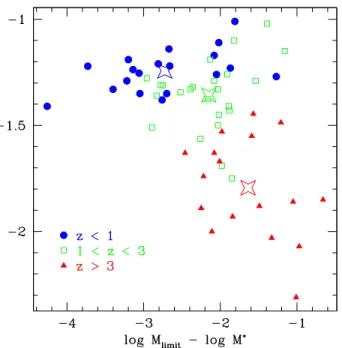
Figure 2. The relationship between the fitted value ofαand the depth of the data in which the mass function was fit in reference to the value of M∗ (see text). Systems which are more negative in log Mlimit - log M∗ have deeper observed
mass functions with the deepest data atz <1 probing a mass limit which is a factor of 104 lower than M∗. The colors of
the points denote the redshift range, with the blue circles those galaxies atz <1, the green boxes those at 1< z <3 and the red triangles those atz >3. The large open stars show the average values within each redshift range.
3.1.1. Integrating the Stellar Mass Function
The major aspect of this paper is that we integrate the fitted Schechter function for all of the mass function data below the limit in which the data is obtained. There are two distinct questions concerning doing this. One is if we are using fits from mass functions in which the data is not as deep as others, then are we technically able to retrieve the mass function correctly? As the number density depends strongly upon the value of the faint-end slopeα(§3.2) we can express this question another way: If we have data down to some limit, say M∗ and
fit the Schechter parameters, will we retrieve the same parameters if we were probing down to a low mass limit? The other issue, we address in the next subsection has to do with how low we should integrate these mass functions. Here we discuss the more technical point of whether the Schechter function can be extrapolated at all with fits that are based on a variety of mass functions of diverse depths.
8.5 9.0 9.5 10.0 10.5 11.0 Lowest mass bin, log10(M⋆)
−3.0 −2.5 −2.0 −1.5
α
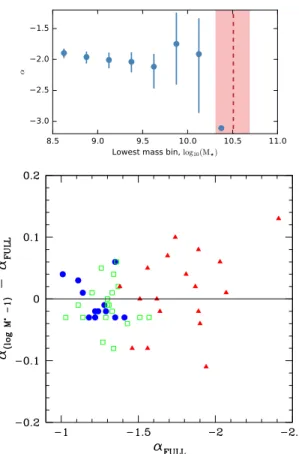
Figure 3. The two panels on this figure show our simulations and determinations based on actual data for how the faint end slope αchanges as a function of depth relative to the value of M∗. In the top panel we show an example using
the z ∼ 4 mass function from Duncan et al. (2014) which reaches a nominal depth of log M∗= 8.5, which is 100 times
deeper than the value of M∗ at this redshift. The vertical
dashed line shows this value of M∗, and the shaded pink
area shows the 1-sigma errors on the full M∗ fit, which is
the 16 and 84 percentiles in the marginalized distribution, with the best-fit dashed line being the 50th percentile of this distribution. Mathematically this is log M∗ = 10.50+0.19
−0.17.
The blue points show the retrieved value ofαwhen redoing the entire Schechter function fits, but only to the quoted mass depth on the x-axis. This fitting is done through a full Vmaxmethodology as outlined in Duncan et al. (2014) and
in the text. The bottom panel shows the difference between the fitted α values when using the full depth of the data (αFULL), and when only fitting down to a mass limit of log
M∗−1 (αlogM∗−1). Every mass function we use in this paper
is shown here. The colours denote the redshift range, as in Figure 2. As can be seen, we are able to retrieve the values ofαas long as we can reach at least 1/10 the value of M∗.
The other Schechter function parameters are also accurately retrievable in these simulations.
Figure 2 the fittedαvalues for these mass functions as a function of the depth of the data, parameterized by how deep the data is in reference to the fitted M∗ values. As
can be seen, we do not probe as deep at higher redshift. We also see a trend, well established now in several
pa-pers (e.g., Duncan et al. 2014; Song et al. 2015) that the value of the fittedαbecomes stepper at higher red-shifts. There is a slight trend such that the fitted value of αbecomes more steep (i.e., more lower mass galax-ies) for deeper data, although this is not present at the highest redshifts.
We also carry out two different simulations to demon-strate that we are able to retrieve the correct value of
α, and the other Schechter function parameters, M∗and φ∗, if we are probing about a factor of ten less massive
than M∗, or deeper. Figure 3 shows the results of these
simulations.
The first one on the top panel of Figure 3 shows a full refitting of the lowest redshift (z ∼ 4) mass func-tions from Duncan et al. (2014). These fits were redone using the emcee MCMC code (Foreman-Mackey et al. 2012). The resulting fits thus technically differ from those in Duncan et al. (2014), most significantly in the marginalized errors which are slightly smaller, but not in a significant way. The dashed vertical line shows the value of M∗ for this mass function when fit at its
deep-est level down to the M∗ = 108.5 M⊙limit, which is a
factor of 100 times less massive than the value of M∗.
The blue points show the value of the refittedαvalues of the Schechter function as a function of depth. As can be seen, within 0.5 dex of M∗ the mass function is
diffi-cult to fit correctly, providing an incorrectαor one with a large error bar. However when the depth of the data is larger than 0.5 dex from M∗ we obtain an accurate
measure ofα.
The bottom plot of Figure 3 shows a simulation whereby all of the mass functions we use were resampled to end at 1/10th the value of M∗ (1 dex in log space)
and then fit with the resulting faint end slope,αlogM∗−1. As shown in Figure 2, all of our mass functions are com-plete to 1/10 the value of M∗or deeper. These simulated
mass functions take into account the number of galaxies present in each bin, and therefore also the statistical un-certainty when dealing with smaller numbers of galaxies. We then compare this simulated value with the full mass range fitted value αFULL which probes to the depths shown in Figure 2. This difference is plotted as a function of the full valueαFULLin Figure 3. This shows that as a function of redshift, and shape of the mass function as parameterized byαFULL, the value ofαcan be easily retrieved when the depth of the mass function is at least 1/10th the value of M∗. This hold as well for
the other Schechter function parameters. We therefore use only those mass functions which are at least a factor of ten deeper than their fitted M∗value (Figure 2).
We must also consider the effects of the covariances between M∗, φ
various mass function fits (e.g., Fontana et al. 2006; Grazian et al. 2015; Weigel et al. 2016). For example, the best-fitting values ofα can be strongly affected by a few galaxies at the massive end of the mass function, which should in principal have little effect on the low-mass slope, but when fitting can. This covariance is such that there is a strong correlation between the values of
α, φ∗ and M∗ such that the value of α becomes more
negative as M∗increases, andφ∗ goes up when M∗ does
down. This is such that a higher fitted M∗ increases the
resulting value ofφT, and a more negativeαdoes so as well, therefore the covariance between these is a poten-tially serious issue. However, as there is a corresponding drop in the value ofφ∗ when M∗increases, this negates
to some extent the strong covariance betweenαand M∗.
The mass function fitting we use does not often pro-vide the covariance between these parameters in the re-spective results we use. The error bars on the fits how-ever do represent a good representation of the extent of the range of φT, when combined together. That is, the error onφTis calculated by taking the extent of the error-bar whenαis at its maximum negative extent, M∗
is at its highest value and φ∗ is at its lowest value for
an upper error limit, and vice-versa for the lower error limit.
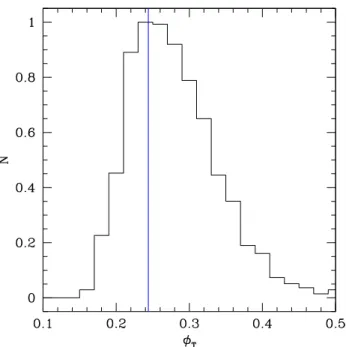
We investigate the total effect of this covariance by simulating the covariance for the z = 4 mass function from Grazian et al. (2015). We show the distribution of
φT values when we randomly sample 1000 times across the covariance of the Schechter function fitting parame-ters in Figure 4. The distribution ofφTis not Gaussian, but has a tail at higher values ofφT. However, the av-erage value of this distribution,φT= 0.27, which is just slightly higher than the value calculated with the best fitted Schechter values which is φT = 0.24. The error range calculated with our method is also similar to the distribution of these points. Other covariance analyses results in similar conclusions.
3.1.2. The Galaxy Stellar Mass Lower Limit
Another main issue with these mass functions is how deep to integrate to obtain the total number density of galaxies at a given redshift. Our choice here is impor-tant, as the total number can depend significantly on the limits used in the integration. Our initial and fiducial low-mass limit is M∗ = 106 M⊙, which is the typical
lower limit for dwarf galaxies in the nearby universe. Most systems at masses lower than this are star clusters within galaxies, or debris from galaxy interactions. For example, many of the galaxies in the Local Group and nearby clusters with masses lower than this are likely either of tidal origin, or are misidentified star clusters (e.g., Ibata et al. 2013; Penny & Conselice 2008).
While there are certainly some galaxies at lower
Figure 4. The relative distribution ofφTvalues derived from
the sampling of the co-variance between the parameters ofα,
φ∗and M∗ for one of the mass functions used atz= 4 from Grazian et al. (2015). The average value of the distribution isφT= 0.27 which is close to the derived value ofφT= 0.24
which is shown by the vertical blue line. The range here is also similar to the resulting errors we calculate forφT.
masses than this in the local universe, by using a M∗=
106M
⊙limit we limit our exposure to the risk of
extrap-olating the mass function too deeply. Because of the use of a limit whereby we are probing beyond the direct ob-servations, we cannot be 100% certain that the mass function is necessarily valid to these depths. Also, the exact value of this lower limit will drive the quantitative values of our total number density strongly. Therefore the nominal total number density we calculate is based on the number of galaxies greater than M∗ = 106 M⊙.
We also assume that the mass functions of high redshift galaxies do not change slope at lower mass limits than we currently probe. If they do so, then our results would be different. However, for the reasons given above, and below, this change in slope is unlikely as this change in mass function shape at low masses has not seen at any redshift including at lower redshift where we can probe deeper than at higher redshift.
We also justify using these mass limits, and thus ex-trapolating our mass functions down to M∗= 106 M⊙,
mass limit is needed to reionize the universe. As shown in papers such as Robertson et al. (2015), Duncan & Conselice (2015) and Dufy et al. (2014), the integration of the measured mass function at z∼7 to at least this M∗ = 106 M⊙limit is necessary and sufficient to
reion-ize the universe. While this does not imply that these galaxies are reionizing the universe, it does show that this limit is required if UV emission from galaxies is the ionization culprit. This is also consistent with recent de-terminations of the cosmic background light which show that there are a factor of 10 more galaxies than we can presently observe, per unit area, needed to account for this light (e.g., Mitchell-Wynne et al. 2015)
Furthermore, predictions of Cold Dark Matter show that the luminosity and mass functions of galaxies should be very steep with a mass function slope of
α ∼ −2 (e.g, Jenkins et al. 2001), it is thus reason-able to assume that measured luminosity and mass func-tions continue to increase past the arbitrary observa-tional limit we can reach with observations today. Fur-thermore these theoretical models show that there are indeed galaxies down to these low masses, both through dark matter halos and through simulated galaxies (e.g., Jenkins et al. 2001; Gonzalez-Perez et al. 2014; Hen-riques et al. 2015).
Furthermore, the stellar populations of low mass galaxies in the local universe show that many of the stars in these galaxies were formed at very early times, and thus were present at these high redshifts (e.g., Grebel, Gallagher & Harbeck 2003), and that by examining the mass function of Local Group galaxies we also obtain a high number of low mass systems with a retrieved steep
αvalue (e.g., Graus et al. 2015). We however later test how our results would change if we were to use a differ-ent observational limit to constrain this uncertainty.
3.2. Integrated Number Density Evolution
We integrate the fitted Schechter parameters for the various fits to the mass functions given in the papers de-scribed in the previous section to obtain a measurement of the total number densities of galaxies.
We calculate at a given redshift bin the total number density of galaxies (φT), given the parameters of the Schechter fit to the mass function,φ(M, z):
φT(z) =
Z M2
M1
φ(M, z) dM (2)
A good approximation for this integral into an analytical formula can be obtained by taking the approximation for the Schechter function when the stellar mass limit is low. The formula for this is given by:
φT(z)≈
−φ∗10(α+1)(M2−M∗)
(α+ 1) , (3)
showing that the number density is a function of all the Schechter function parameters, but is especially depen-dent on the value ofα, and the lower limit to integration
M2. However throughout this paper we do not use this approximation, but carry out direct numerical integra-tion of eq. 2.
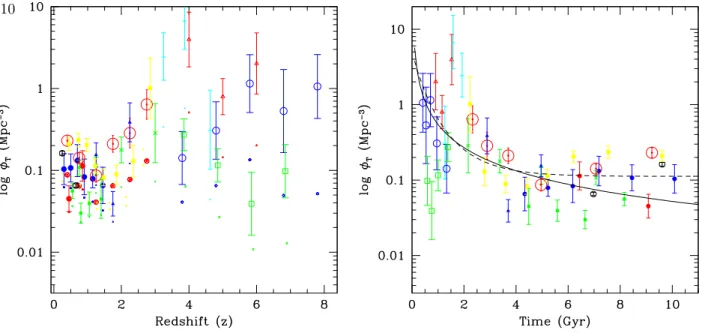
When we plot the integrated number densityφT (Fig-ure 5) for each data point from our various studies we find some difference, at the same redshifts, between the various surveys for calculating the total number den-sity from M1 = 106 M⊙to M2 = 1012 M⊙. We find a
general increase with redshift in the integrated number density, although some studies, such as Perez-Gonzalez et al. (2008) find a slight decline from z= 0 to z = 4. On the other hand, studies that are based on very deep NIR imaging, such as Kajisawa et al. (2009), Caputi et al. (2011) and Mortlock et al. (2011, 2015) find an increase with redshift inφT with higher redshift. This is due to the fact that the fitted α values are steeper at higher redshifts in these studies. More recent results also find a steep α at high redshifts, which provides a large value ofφT, including Tomczak et al. (2012), Dun-can et al. (2014), Grazian et al. (2015) and Song et al. (2015).
A steepαvalues continues to be found in preliminary mass functions of even deeper studies utilizing lensing from the Hubble Frontier Fields (Laporte et al. 2014) and the deepest HST field data, withαvalues approach-ing or exceedapproach-ing α = −2 (e.g., Bouwens et al. 2015; Livermore et al. 2016). Thus, there are more low mass galaxies per massive galaxy at high redshifts than in the local universe.
We summarize these results and their errors in Fig-ure 5. Note that the integration of the quantity given in eq. 2 and plotted here, shows that while there are gener-ally more galaxies at higher redshift, the exact number has some variation. From Figure 5 it is however clear that there is a rapid increase inφT up toz = 3 with a more mild increase at higher redshifts.
We also show in Figure 5 on the left panel the num-ber densities of galaxies down to the limit of integration which matches the completeness of each point in the original data. This is shown as the small points just be-low the main data points which have error bars. This shows that our extrapolations to the lowest mass limits is largest for the highest redshift galaxies by sometimes a factor of 10 or so, and much less at lower redshifts.
Figure 5. Figure showing the evolution of the co-moving total number densities for galaxies within the universe as a function of both redshift and time. Shown here are the various surveys which are used in these measurements. This includes measurements from Perez-Gonzalez et al. (2006) (blue solid circles atz <2); Fontana et al. (2004) (large solid red circles atz <1); Kajisawa et al. (2009) (green crosses at z <4); Mortlock et al. (2015) (large red open circles at z <4); Muzzin et al. (2013) (black squares atz <1); Pozzetti et al. (2007) (green boxes atz <2); Mortlock et al. (2011) (blue triangles at z <4); Caputi et al. (2011) (cyan up arrows atz∼4) and Tomczak et al. (2012) (solid yellow squares atz <3). For the higher redshift points we use the mass functions from Duncan et al. (2014) (red triangles atz >4); Song et al. (2015) (blue open circles atz >4) and Grazian et al. (2015) (green open boxes atz >4). The smaller symbols without error bars, usually towards the bottom of the plot on the left panel, show the integrated values for each mass function to the completeness limit reached by each survey. The solid line in the right panel is the best fits to the relation ofφT with time, while the dashed line is the merger model best fit
discussed in§4.3.
logφT(t) = (−1.08±0.20)×log(t)−0.26±0.06, (4)
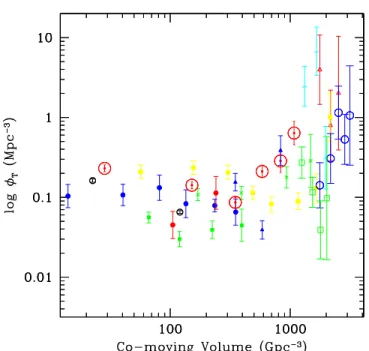
where tis the age of the universe in units of Gyr. This equation shows that the number of galaxies in the uni-verse declines with time, with an overall decrease which goes as∼1/t. We find that a fit with time can be pa-rameterized well in this way, although a fit with redshift does not produce a single well fit function. We also show in Figure 6 the change in the number densities of galax-ies as function of co-moving volume, showing that the majority of the galaxies in the universe are in the early universe. This also shows likewise that the average total number density of galaxies declines as time goes on.
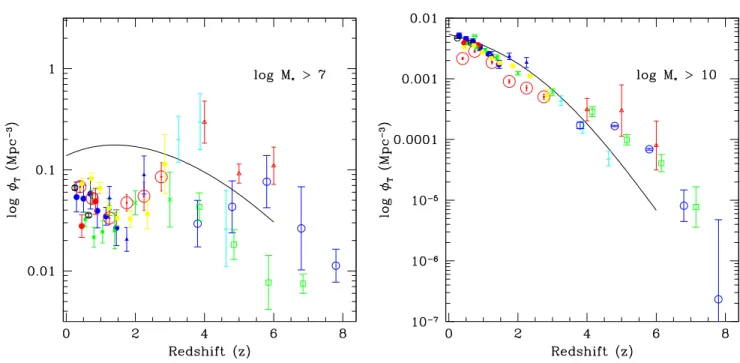
We also show in Figure 7 the number density evolution at higher mass limits of M∗ = 107 M⊙, and at M∗ =
1010 M
⊙. What we find when examining these results
at different masses is a few things. First it appears that there is a turn over in the evolution ofφT, such that for massive galaxies there is a step increase in the number density of galaxies above the limit of M∗ = 1010 M⊙.
This is opposite to what we find when we examine the evolution at the limit of M∗= 106 M⊙. This turn over
occurs at roughly M∗= 107 M⊙, as shown in Figure 7.
This demonstrates that at this limit the evolution ofφT
is nearly constant with redshift.
The implication for these results are discussed in the next section. Overall, we are now able to use these re-sults to determine how many galaxies are in the observ-able universe with our various mass limits, the likely methods by which galaxies are evolving in number den-sity, as well as the implications for background light in the optical and near infrared based on these results.
4. IMPLICATIONS
The major result from this paper is that we now have a scientific measurement of the evolution of the total galaxy number density up to z = 8. We investigate several implications for these results, including the to-tal number of galaxies in the universe, galaxy evolution, extragalactic background light, Olbers’ paradox and fu-ture galaxy surveys.
4.1. Comparison to Theory
Figure 6. Similar to Figure 5 but showing the change in total galaxy number density as a function of total co-moving volume out to a given redshift. This total galaxy density increases with larger volume as Vol1.28±0.38. The symbols are
the same as Figure 5. This figure shows that the majority of the galaxies in the currently observable universe are at high redshift.
Vogelsberger et al. (2013), but in summary includes hy-drodynamics, gravity, star formation with feedback, and radiative cooling. It does a reasonable job of matching observations of the galaxy population (e.g., Genel 2014). Here we compare directly with the predictions for the number of galaxies above a certain mass, or the cumu-lative number density of galaxies, which is exactly what we have discussed earlier in this paper. Torrey et al. (2015) provide an analytical formula to compare our values with. However, up to our redshifts of interest, these are only provided down to M∗ = 107 M⊙using a
Chabrier IMF. We thus compare our integration down to this mass limit with these models in Figure 7. We also convert our number densities to this IMF before comparing with the Torrey et al. (2015) results. We also compare with a higher mass limit of M∗ = 1010
M⊙. This comparison is shown in Figure 7 for these
two mass limits.
What can be seen in these figures is that the cumu-lative number density observed agrees reasonably well with the predictions for the highest mass galaxies at M∗>1010 M⊙, but does not do as well of a job at the
lower mass limits. The reason for this is that the low mass end of the mass function, particularly at lower red-shifts does not match the data, with the theory values being too high. Interestingly, this does not seem to be
the case at higher redshifts where the theory and data agree better. The reason for the disagreement at low redshift is likely due to the fact that the data show in-creasingly shallow values ofα, the faint end slope, com-pared to the simulation. This comparison also shows that our extrapolation down to low mass limit is not excessive as we are still below what is predicted in the-ory. Later in the next section we discuss the likely cause of this changing α value and why the total number of galaxies declines with time.
4.2. The Total Number of Galaxies in thez <8
Universe
The total number of galaxies in the universe is an in-teresting scientific question, although it may not reveal anything fundamental about the cosmology or underly-ing physics of the universe. None the less it is an in-teresting number that should be known and quantified, although expressing it has to be done within certain con-straints.
We use the results from §3 to investigate the total number of galaxies in the currently observable universe down to a mass limit of M∗ = 106 M⊙in two
differ-ent ways. We explore other limits that give differdiffer-ent answers later. The first is through simply taking the average total number of galaxiesφT at a given redshift in Figure 5 and calculating its scatter. When multiplied by the volume at that redshift bin this gives us the aver-age total number of galaxies within that volume, which uses all the available data. Then we calculate the total number as simply the sum of these average numbers at each bin. When we do this calculation we find that the total number of galaxies is given by,
Ntot,obs= 2.8±0.6×10¹²
up toz= 8, which is almost a factor of ten larger than what is obtained from direct counts from the deepest op-tical/NIR imaging data, as described in the Appendix.
To obtain another estimate of the total number of galaxies in the currently visible Universe down to M∗=
106 M
⊙we integrate equation (4) from 0 ≤ z ≤ 8
us-ing our best fit relation. This avoids havus-ing to use a single measurement of the mass function to obtain a re-sult, and as such our measurement is based on all the available data. Because the mass functions we use are taken from a variety of fields, we are also accounting for cosmic variance within our measurements. To calculate the maximum and minimum limits to our total count, we take into account the errors assigned to φ∗, α and
M∗.
Figure 7. The number density evolution for galaxies selection with differing mass limits than given on Figure 5. In the left hand panel we show the evolution of galaxies down to a limit of M∗= 107 M⊙, while on the right hand side we show the evolution
for a limit of M∗= 1010M⊙. The solid lines in both panels show the predicted number density evolution as parameterized by
Torrey et al. (2015). Note that the masses quoted here are those calculated with a Chabrier IMF to match the Torrey et al. (2015) models. The symbols and shapes of the points denote the same survey as described in Figure 5.
over the number densitiesφT(z) and volume:
Ntot,fit=
Z t2
t1
Z 4π
0
DH
(1 +z)2D2 A
E(z) φT(t)dΩdt (5)
Ntot,fit= (1.2+0−0..42)×10
12. (6)
where the volume is integrated over the entire sky through 4πin steradians andDAis the angular size
dis-tance, DH =c/H0 andE(z) = (ΩM(1 +z)3+ Ωλ)1/2.
Thus knowledge of the redshift and the time since the Big-Bang are required to perform this integration.
Performing this integral toz= 8 gives us 1.2 trillion individual galaxies, which is again is just less than a factor of ten times higher than the number of galaxies which in principle can be observed today in the uni-verse with present technology (see Appendix). We use the difference between this value of the total number of galaxies and that calculated with the average φT val-ues above to obtain a most likely value for the average number of galaxies. As both methods are equally valid measurements we take the average between them. This gives us the ultimate final value of the total number of galaxies within the currently visible universe down to M∗= 106(Ntot,final),
Ntot,final= (2.0−+00..76)×1012. (7)
This large value implies that there is a a vast number of galaxies that we have yet to discover at magnitudes fainter thanmmax∼29 as we discuss in Section§4.4.
However, as mentioned, this number depends strongly upon our use of a limit of M∗= 106 M⊙, and our
red-shift limit ofz = 8. It is important to explore how the total number would change if these limits were different. We find that the total number does not depend much upon the redshift limit. If we extend our study toz= 12 by using the same number densities we find atz= 8, our observational limit, then we find slightly more galaxies with the total number increasing by 65%. There maybe very few galaxies at redshifts higher than this.
In terms of the mass limit, there is more of a difference when using a lower limit. While we have argued earlier that the mass limit of M∗ = 106 M⊙is a natural one
for galaxies, it is important to discuss how the total number would change if we used a different stellar mass limit. If we use a factor of ten smaller limit of M∗= 105
M⊙, we find roughly a factor of∼7 more galaxies than
using the 106 M
⊙limit. Thus our limit in equation 7 is
at least 2×10¹²(two trillion) galaxies in the currently visible universe, the vast majority of which cannot be observed with present day technology as they are too faint.
4.3. Galaxy Evolution through Mergers and Accretion
One of the major results we find is that the total num-ber density of galaxies in the universe declines with time from from high to low redshift when using a M∗ = 106
M⊙limit. In fact, what we find is that measured mass
functions down to a limit of M∗= 106 M⊙gives a total
number density that declines by a factor of 10 within the first 2 Gyr of the universe’s history, and a further reduction at later times. This decline may further level off between redshifts of z = 1 and z = 2. The star formation rate during this time is also very high for all galaxies, which should in principle bring galaxies which wrer below our stellar mass limit into our sample at later times. This would naturally increase the number of galaxies over time, but we see the opposite. This is likely due to merging and/or accretion of galaxies when they fall into clusters which are later destroyed through tidal effects, as no other method can reduce the number of galaxies above a given mass threshold.
We can use straightforward argument to demonstrate that hierarchical galaxy formation must be occurring in the universe over time at this stellar mass limit. The first way we argue this is to calculate the number of galaxies in the nearby universe, and then infer the total number we would observe up to z= 8 if the co-moving number densities of galaxies remained the same. We then compare this with the total number of galaxies we can observe within the UDF-Max itself (see Appendix). Using the number densities from the GAMA survey (Baldry et al. 2012), and by assuming a homogeneous universe, we find that there would be∼2.8×10¹¹ galax-ies at z <8. If we use the inferred total number from eq. (7) then there are∼7 times more observable galax-ies than what we would predict in the universe if it had the same number density as in the local universe. There is likely no other way to remove these galaxies except through merging, destruction or accretion with other systems.
We investigate this further with a simple merger de-struction model whereby when an individual merger or destruction event occurs the number of galaxies within a volume decreases by one. Thus if there areNmmergers per unit volume per unit time, then the number density declines by Nm galaxies in that volume, and over that time period.
We parameterize this overall merger rate in units of the number of mergers per unit volume per unit time as as exponentially declining function:
R(t) =R0e−t/τ (8)
whereR0the merger rate in units of number of mergers per Gyr per Mpc3 at z = 0, and τ characterizes the global merger time-scale. In this characterization the number of mergers per unit volume which occur within a given redshift, or time, interval between time t1 and
t2, which is equivalent to a number density (φT) change, is given by
φT(t1)−φT(t2) =
Z t2
t1
R0e−t/τdt=R0τ(e−t1/τ−e−t2/τ) (9) if we measure this fromt1= 0, then the total integrated decline in the number densityφT(t) is given by:
φT(t) =φT(0)−R0τ×(1−e−t2/τ) (10) where φT(0) is the initial total number densities for galaxies at high redshift.
If we then use the observed data from Figure 5, and set φT(z = 8) =n0 = 0.7 Mpc−3 then we find that the best fitting parameters of this merger model are R0 = 1.28±0.20 mergers Gyr−1 Mpc−3, andτ = 1.29±0.35 Gyr. This model further predicts that at z = 1.5 the merger rate is R ∼ 0.05 mergers Gyr−1 Mpc−3. This compares well with the directly derived merger rates from Conselice (2006) who find that the merger rate for M∗ >108 M⊙galaxies is R ∼ 0.03 mergers Gyr−1
Mpc−3, while for M
∗ > 109 M⊙galaxies the rate is R∼0.01 mergers Gyr−1Mpc−3. These are also close to the values found by Lotz et al. (2011) for more massive mergers using an independent method, and to Bluck et al. (2012) who look at minor merger pairs.
Also, we find from Figure 7 that the number density evolution turns over for higher mass limits and in fact begins to increase with time for limits M∗ >107 M⊙.
This implies that the majority of the merging occurs at the lower mass range.
The major conclusion from this is that galaxy merg-ing and accretion/destruction is the likely method in which lower mass galaxies decline in number densities through cosmic time. As discussed in e.g., Conselice (2014) this is also a major way in which galaxy forma-tion occurs at these epochs. However, we have a limited amount of information concerning the merging history at z >3 (e.g., Conselice & Arnold 2009), yet some re-sults show that the merger history may be even more important at higher redshifts 1 < z < 3 than at lower (e.g., Ownsworth et al. 2014) and this may extend to even higher redshifts.
4.4. Background light and Olbers’ Paradox
One of the implications for our results is that there should be a significant number of galaxies in the Uni-verse which with current technology we cannot observe, even within deep HST images. This naturally leads to the issue of background light in the universe in the ob-served optical, as well as other problems such as Olbers’ paradox, or scientifically understanding why the sky is mostly dark at night.
We do not give a detailed scientific discussion of the background light issue, as understanding the contribu-tions of galaxies, as well as an absolute measurement of the background light in the optical is still contro-versial and difficult to measure (e.g., Bernstein 2007; Dominguez et al. 2011; Mitchell-Wynne et al. 2015). What we can do, using the results of this paper, is dis-cuss how many galaxies there are per unit area of the sky and what this implies about these background light observations.
First, using our final value of Ntot,final, we calculate that the projected density across all redshifts is on av-erage 10,000 galaxies per arcmin2, which corresponds to an average of∼3 galaxies per arcsec2. Using these num-bers we can determine what fraction of the sky should be covered by galaxies. If we take the hypothesis that these 3 per arcsec2 galaxies occupy all the area on the sky, this gives an average size for these galaxies of 0.32 arcsec in radius. This is similar to the effective radii found for the faintest galaxies in deep HST imaging, in-cluding the GOODS fields (e.g,. Ferguson et al. 2004; Bouwens et al. 2004), as well as deeper imaging from HST WFC3 (Ono et al. 2013) for the highest redshift systems. If the average galaxy is larger than 0.32 arcsec then it is certain that every part of the sky is occupied by part of a galaxy with stellar masses M∗ >106 M⊙at z <8. Thus is appears that there are enough galaxies to
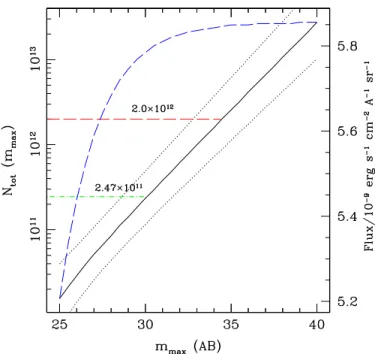
Figure 8. Plot showing the integrated number of galaxies as a function of magnitude (solid black line and errors as dotted lines), and the integrated flux density of galaxies in units of 10−9erg s−1cm−2˚A−1sr−1 as a function of magnitude (blue
dashed line). The two dashed horizontal lines show the ob-served total number of galaxies we can currently potentially observe with present day technology (green dot-dashed) and the predicted total number at z < 8 based on integrated stellar mass functions (red dashed).
nearly cover the entire sky when using a 106 M ⊙limit.
If we were to use a lower integration limit such as 105 M⊙the number of galaxies in the sky increases by a
fac-tor of∼7, making it nearly certain that all parts of the sky would be covered.
This demonstrates that, on average, every point in the sky should contain part of a galaxy in principle. Most of these galaxies are however at higher redshifts, with the majority (around 2/3) atz >5. With the corresponding surface density of galaxies∼0.8 galaxies arcsec−2atz < 5. Since most galaxies are extremely faint and cannot be easily observed with today’s technology, we can only detect the presence of these galaxies through the cosmic background light (e.g., Bernstein 2007; Dominguez et al. 2011).
mag-nitude down to some magmag-nitude limit.
Figure 8 shows that at magnitudes around 30, and fainter, we find an integrated flux value ∼5.8×10⁻⁹ergs−1cm−2˚A−1sr−1. This value does not increase very much at fainter magnitudes. This flux compares well with the limits on the optical back-ground from e.g., Bernstein (2007) who finds an optical background value in the I band of 7±4 × 10⁻⁹ergs−1cm−2˚A−1sr−1. Although the exact value of the background light in the optical is still quite uncer-tain, this agreement with the best measurements thus far is encouraging. Furthermore, we know that studies of Gamma-ray Bursts show that the intrinsic star forma-tion rate is a factor of 3-5 times higher than that mea-sured from deep imaging surveys (Ishida et al. 2011), demonstrating that there are many faint galaxies yet to be detected at high redshifts. Figure 8 however shows that while the faint galaxies we have not detected dom-inate the total number in the universe, they however do not contribute substantially to the unresolved back-ground optical light beyondm∼32.
We can however use this to address the issue of why the sky is dark at night, a long standing problem known as Olbers’ paradox since Bondi (1952). Our results re-veal perhaps a new solution to this paradox. There are various proposed solutions to Olbers’ paradox but most solutions can be placed into the one of two categories: (1) there are missing stars (and/or galaxies), or (2) the stars are there, but they cannot be observed for one reason or another. Possible reasons for not detecting distant star light have included scenarios such as: ab-sorption of light, hierarchical clustering, and the removal of energy from light in an expanding universe. The tra-ditional solution to the paradox is generally considered to be the fact that the universe is finite in age and size (Harrison 1987).
The human eye through L cone cells are sensitive out to a wavelength of 700nm. If we consider which galaxies we would be able to see out to this wavelength, we find that galaxies out toz∼5 would still be detected in prin-ciple. Galaxies at higher redshifts would not be detected as their light is all shifted into wavelengths longer than 700nm or at the highest redshifts would have their light blue-ward of Ly-αabsorbed by the Lyman-αforest. At observed wavelengths bluer than this, all the light which is in principle detectable would originate within the UV continuum. However all of this light is absorbed by gas, and perhaps dust, within the host galaxies and in the intergalactic medium near the galaxy itself, and along the site line to earth.
Thus, it would appear from this that absorption, long discarded as one objection to Olbers’ paradox, is one method for removing objects from optical light detec-tions. This rest-frame UV light would however ionize
hydrogen, which would then recombine, and in the pro-cess emit new light in the form of the Lyman-α line at 121.5 nm, and other lines which are mostly redder than Lyman-α(e.g., Bertone & Schaye 2012). However, this emission would be found mostly at observed near infrared wavelengths for systems atz > 5, outside the window of visible light detections. The method of ab-sorption thereby removes UV continuum light at wave-lengths lower than the Lyman-limit, and does not permit its re-introduction into the same, or bluer, wavelength range whereby it would be detectable within observed optical light. Furthermore, some of this light may also be absorbed by dust, which in the limited time-range available, when the universe was only a few Gyr old at most, would then be re-emitted into the far-infrared, again outside the range of optical light.
It would thus appear that the solution to the strict interpretation of Olbers’ paradox, as an optical light de-tection problem, is a combination of nearly all possible solutions - redshifting effects, the finite age and size of the universe, and through absorption.
4.5. Implications for Future Deep Surveys
In this section we investigate future surveys and how the results of this study have implications for future studies. In the next 10 years we will have telescopes that will image deeper than we currently can, with the ELTs and JWST, and other telescopes and surveys that will cover vastly larger areas such as Euclid and LSST. First, we answer the question of when we would expect to find the observed galaxy number counts to naturally turn over due to ‘running out’ of faint galaxies to detect. While we are far from reaching that limit today, if we as-sume that the slope of the number counts, as described in the appendix, remains constant at magnitudes fainter than 29, we can determine at what magnitude limit we will reach the total number of actual galaxies. We do this by integrating the observed number of galaxies in the UDF using eq. (A3) and eq. (A4) as a function of magnitude down to limits ranging from m=20 to m = 40. This integration allows us to infer the relationship between the total number of galaxies and the limiting magnitude reached. This relationship, shown in Fig-ure 8, is given by:
log Ntot= (4.97±0.03) + (0.21±0.01)×mmax (11)
We find that the magnitude limit for the total number of galaxies calculated with the mass functions (eq. 11) is mmax ∼ 34.9+0−0..68 AB mag, taking into account the errors in the total number of galaxies. If we consider galaxies down to 105this limit becomes 38.9+0.5
num-ber counts of galaxies begins to gradually decline at fainter magnitudes, unless than are a significant num-ber of galaxies with masses M∗<106M⊙at the highest
redshifts. This depth however will be very difficult to reach with even very deep surveys with JWST, and may require the next generation of large space telescopes to fully probe. This would also make deep observations of future telescope observations confusion limited if they can reach these faint magnitudes.
If we want to observe all the galaxies in the universe, even with imaging, it will require extensive telescope programmes that are likely several generations away. The Euclid mission planned for launch in 2020 will im-age 15,000 deg2 down to AB magnitude of 24.5 in the wide VIS filter which mimics in some ways the wide filter we construct in this paper using the UDF-Max image (see Appendix). The deep component of Euclid will be two magnitudes fainter over 40 deg2. Using our number counts we predict that Euclid will image around 3.7×10⁹galaxies in total, or<0.1% of all galaxies in the universe. This is significantly more than we have imaged at present with the Sloan Digital Sky Survey which has imaged roughly 1.4×10⁹galaxies and QSOs, or∼10−4 (0.05%) of all galaxies in the universe. LSST will find a similar number of galaxies. Thus we will have to wait at least several decades before even the majority of galaxies have basic imaging in a single band.
5. SUMMARY
We have investigated the fundamental question of the number density evolution of galaxies in the universe. We research this problem in a number of ways, and discuss the implications for galaxy evolution and cosmology. We use recently measured mass functions for galaxies up to z ∼ 8 to determine the number density evolution of galaxies in the universe. Our major finding is that the number densities of galaxies decrease with time such that the number densityφT(z)∼t−1, wheretis the age of the universe.
We further discuss the implications for this increase in the galaxy number density with look-back time for a host of astrophysical questions. Integrating the number densities, φT we calculation that there are (2.0+0−0..76)× 1012 galaxies in the universe up toz= 8 which in
prin-ciple could be observed. This is roughly a factor of ten more than is found through direct counting (see Ap-pendix). This implies that we have yet to detect a large population of faint distant galaxies.
In terms of astrophysical evolution of galaxies, we show that the increase in the integrated mass functions of all galaxies with redshift can be explained by a merger model. We show that a simple merger model is able to reproduce the decline in the number of galaxies with a merger time-scale of τ = 1.29±0.35 Gyr. The de-rived merger rate atz= 1.5 isR∼0.05 mergers Gyr−1 Mpc−3, close to the value found through structural and pair analyses. Most of these merging galaxies are lower mass systems based on the increase in number densities with time seen at lower limit selections, using higher masses, for the total number density calculation.
We finally discuss the implications of our results for future surveys. We calculate that the number counts of galaxies at magnitudes fainter than mmax = 29 will largely probe the lower mass galaxies at higher redshifts and eventually atmmax∼35 will turn over and decline due to reaching the limit of the number of galaxies in the universe, unless the mass limit for galaxies is much less than M∗ = 106 M⊙or there are many galaxies at z >12. We also show that this leads to a natural confu-sion limit in detection and that these galaxies are likely responsible for the optical and near-infrared background and provide a natural explanation for Olbers’ paradox. This large additional number of galaxies is also consis-tent with recent measures of the cosmic infrared back-ground light (e.g., Mitchell-Wynne et al. 2015).
In the future, as mass functions become better known with better SED modeling and deeper and wider data with JWST and Euclid/LSST, we will be able to mea-sure the total number densities of galaxies more precisely and thus obtain a better measure of this fundamental quantity.
We thank Neil Brandt, Harry Teplitz, and Caitlin Casey for useful discussions concerning non-optical deep detections in galaxy surveys. This work was supported by grants from the Royal Astronomical Society, STFC and the Leverhulme Trust. Support was also provided by NASA/STScI grant HST-GO11082. A.M. acknowl-edges funding a European Research Council Consolida-tor Grant.
APPENDIX
A. DIRECT GALAXY COUNTING IN THE HUBBLE ULTRA-DEEP FIELD
can observe, and quantifying how many galaxies we could detect if we observed the entire sky at the same depth as the Hubble Ultra-Deep Field, ignoring the effects of galactic extinction. Although popular press releases have discussed this number in the past, there has never been a published version of this calculation.
The Hubble Ultra Deep Field (HUDF) image was taken with the the Advanced Camera for Surveys (ACS) on the Hubble Space Telescope (Beckwith et al. 2006) (§3.1). The HUDF images are taken in the bands: F435W (B435), F606W (V606), F775W (i775), and F850L (z815). The central wavelengths of the filters we use, and their full-width at half-maximum, are: F435W (4297 ˚A, 1038 ˚A), F606W (5907 ˚A, 2342 ˚A), F775W (7764 ˚A, 1528 ˚A), F850L (9445 ˚A, 1229 ˚A).
The original HUDF imaging program used 400 orbits of Hubble time for a total exposure time of just under 1 Msec. Later additions of data were added over the years by programmes such as Bouwens et al. (2012). The field of view of the ACS image for the HUDF is 11 arcmin2. Detailed examination of the HUDF imaging from previous work shows that the original magnitude limit for point sources is mAB ∼28.5 in thez−band at 8σ depth using a 0.5′′aperture (e.g., Beckwith et al. 2006), with increased data driving this depth even fainter. This makes the HUDF easily the deepest optical imaging taken to date.
The result for the number of galaxies that can be observed with current technology which we calculate is largely based on these HUDF observations and through using simulations to carry out corrections for incompleteness. Estimates of this number from simply counting in deep fields has been provided in the past (e.g., Beckwith et al. 2006; Coe et al. 2006), yet we carry out this analysis in a different and more complete and careful way.
To do this calculation, we create a maximal depth HUDF image from which we carry out our counting analysis. We are also very careful to not only detect the faintest galaxies, but also to ensure that single galaxies are not over separated into separate systems or ‘shredded’ by the source extraction.
We supplement these counts with lower redshift counting where the HUDF area is not large enough to obtain a representative volume, as well as considerations for galaxies which are not detectable in observed optical wavelengths. First, we discuss in this section the number of galaxies retrieved through direct detections in a combined maximum depth optical HUDF image, where the bulk of galaxies in this field, which can be detected, are found.
A.1. The Maximum Ultra Deep Field Image (UDF-Max)
To maximize the signal to noise of the HUDF imaging we combine the four imaging bands -BV iz into one band which we call the “UDF-Max” image. We add these images together according to their relative weights of signal to noise (S/N) from their individual weight maps, and after ensuring that the PSF is matched between the bands. The relative weights are determined from the depth of observations in each band, such that the combination produces the highest possible signal to noise ratio in the resulting combined data. That is, these are added together according to their depth so as to maximize the signal to noise of the average galaxy. This will affect galaxies which are only detected in the redder/bluer bands, but we later discuss how we can ensure that these very red galaxies are still detected. The formula which we use to create this maximum depth image is given by:
UDF−Max = 1.95×B + 0.924×V + 1.98×i+ 4.12×z (A1)
Where UDF-Max is the new HDF-Max image, and BViz are the filters which are combined together. We then recalibrate this combined image to obtain a new zero point of M0 = 26.4 in AB magnitude units. This was done by converting counts per second in each band to a flux and then determining the zero point based on this flux combination. We then compute magnitudes in our constructed UDF-Max image as follows:
mmax=−2.5 logCmax+ 26.4 (A2)
whereCmax is the counts per second on the UDF-Max image. These magnitudes are then measured, and later used to calculate the total number of galaxies using the number counts of galaxies at each magnitude. We furthermore checked that all the objects detected in each individual band are also detected in the combined image. This is to ensure that, for example, galaxies detected only in the z-band, as e.g., high redshift drop out galaxies, are also detected in the UDF-Max image. This was indeed the case for all galaxies down to the detection limit in each band.
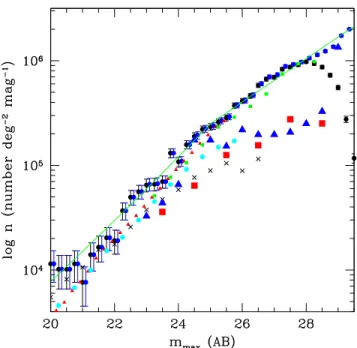
Figure A1. Plot showing the number counts of galaxies (n) within the UDF-Max as a function of magnitude (see§A.1.2). The black points show the raw counts of observed galaxies as a function of magnitude while the blue circle points show the corrected counts for exponential like profiles. Also shown here for comparison are number counts measured in the red and infrared. The small red triangles are from Capak et al. (2007) using the i-band from the COSMOS survey, while the cyan circles are from Metcalfe et al. (2006). The black crosses are from the H-band GOODS NICMOS Survey (GNS) (Conselice et al. 2011), the red boxes are from the Hubble Deep Field South H-band (Metcalfe et al. 2006) and the large blue triangles are from the Hubble Deep Field North (Thompson et al. 1999). Note how our points from the UDF-Max are all shifted to brighter fluxes, meaning that for the same galaxy, the magnitude is brighter in the HDF-Max than in any individual band.
and are able to successfully extract and deblend from each other, we adjust the SExtractor detection and separation parameters accordingly. We do this through an iterative process whereby we change the SExtractor detection and deblending parameters such that galaxies are SExtracted independently from each other. That is, we repeat our detection methods until the faintest galaxies are detected and deblended. This is done while at the same time ensuring that noise is not being detected as false positive objects.
Ultimately we detect our objects in the UDF-Max using a threshold of 1.7σ, and a minimum detection area of 5 pixels. The deblending parameters responsible for separating nearby objects from each other are set to 32 deblending sub-thresholds with a minimum contrast parameter of 0.05. We also combine the weight images from each of the four filter observations as above to remove noise which is otherwise detected as real objects by SExtractor. We find using our methods described above that there are 9,713 galaxies detected in the UDF-Max. The distribution of the counts of the galaxies in the UDF-Max at a given magnitude are shown as black circles in Figure A1. If we slightly tweak this value due to changing the detection parameters we get a variation on the few percent level in the number of galaxies detected.