EFFECT OF PHYTOHORMONES ON THE PHYSIOLOGICAL AND
PHYTOCHEMICAL TRAITS IN THE SEEDS OF
CEIBA PENTANDRA
Sumayya Sikandari*, Pratima Mathad and Manjula Rathod
Department of P G Studies and Research in Botany, Gulbarga University, Kalaburagi-585106
Karnataka, India.
ABSTRACT
The main aim of our present study was to test the efficiency of seeds
germination of Ceiba pentandra plant under various circumstances,
such as to algal extract of Oscillatoria willei, Chlorella vulgaris and
synthetic hormones like kinetin and IBA (Indole butyric acid) on
growth parameters of Ceiba pentandra seeds. The Oscillatoria willei
had shown very excellent results at 60mg/l00ml extract when
compared to the Chlorella species and other synthetic hormones. The
present study also focus for the assessment of primary and secondary
metabolities in seedlings grown in different aqueous concentration of
natural algal extracts and synthetic hormones. In the present
investigation, observed that the primary and secondary metabolities are
rich in Oscillatoria at 60mg/l00ml extract concentration when compared with natural algal
extract of Chlorella and synthetic hormones Kinetin and IBA. The present investigation,
suggested the extract of Oscillatoria is playing the important role as the growth hormone or
growth promoter and as fertilizer in Ceiba pentandra seeds. The further investigation is
needed to study the in detail the effect of Oscillatoria extract on Ceiba pentandra seeds.
KEYWORDS: Ceiba pentandra, Algal extracts, Phytohormones, Synthetic hormones, Seeds germination, Phytochemical traits.
INTRODUCTION
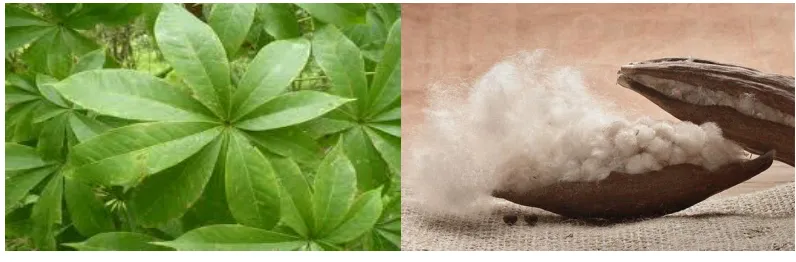
Ceiba pentandra is a fastest growing and emergent tropical forest tree species that can grow
up to 60m height belongs to the family Bombaceae native to Mexico, Central
America, Caribbean region and middle east. It is commonly called as Kapok tree or the English name, cotton tree/silk cotton tree, is derived from the floss and is a universal trade
Volume 5, Issue 12, 691-698. Research Article ISSN 2277– 7105
*Corresponding Author
Dr. Sumayya Sikandari
Department of P G Studies
and Research in Botany,
Gulbarga University,
Kalaburagi-585106
Karnataka, India. Article Received on 26 Sept. 2016,
Revised on 17 Oct. 2016, Accepted on 07 Nov. 2016
name. Various part of the plant are essential, used for various illness as laxative, as foliage
for goat, trunk for domestic plank and wood pulp for paper (Emmanuel et al 2011). The bark
contains a blackish mucilaginous gum which swells in water and resembles trasgacanth; it is
astringent and is used in India and Malaya for bowel-complaint and West Africa for
diarrhoea. It is also used for skin medicine on skin-infection, used for tooth-troubles in
Senegal. The fruit is collected for the valuable kapok floss and used for stuffing pillows,
mattresses and cushions. Due to its water repellent and buoyant, making it ideal for life
jackets, lifeboats and other naval safety apparatus. It is an excellent material for insulating
iceboxes, refrigerators, cold-storage plants, offices, theatres and aeroplanes. It is a good
sound absorber and is widely used for acoustic insulation; it is indispensable in hospitals,
since mattresses can be dry sterilized without losing original quality (Rex Immanuel and
Ganapathy, 2007). Because of its wide range of uses, it has been cultivated in the boundaries
of farmlands and social forestry plantations in India.
Kapok trees C. pentandra are cultivated as well as found naturally in the evergreen forests of
South India. They bloom at night and flowers emit a strong odour that attracts nocturnal
pollinators like bats (Thiruchenthil Nathan 2005). The extensive literature survey revealed
that Ceiba pentandra is important medicinal plant with diverse pharmacological spectrum.
The plant shows the presence of many chemical constituents which are responsible for varied
pharmacological and medicinal property. The evaluation needs to be carried out on Ceiba
pentandra in order to uses and formulation of the plant in their practical clinical applications,
which can be used for the welfare of the mankind (Elumalai and Nikhitha, 2012). However,
the potential of this tree species to grow and survive in the semi arid region of Hyderabad
Karnataka region is not well known. Therefore, the present investigation was carried out to
understand the effect of Phytohormones in the germination aspects of Ceiba pentandra seeds
[image:2.596.98.496.616.747.2]mainly to enhance the plantation and propagation of the of Ceiba pentandra plant.
MATERIALS AND METHODS
The Present study was carried out in the Plant Biotechnology Laboratory, Department of
Botany, Gulbarga University, Kalaburagi (Lattitude and Longitude of 17.31040 N and
76.87300 E respectively) Karnataka, India. The fruits of Ceiba pentandra plant were collected
to obtain the seeds in May 2014 from the Gulbarga University campus. The collected and
dried seeds of Ceiba pentandra were first sterilesed with mercuric chloride solution and later
with distilled water. The different varying concentrations of 10mg, 20mg, 40mg, 60mg, 80mg
and 100mg of natural algal extracts of Oscillatoria, Chlorella and synthetic hormones such
as Kinetin and IBA were weighed and dissolved in 100ml of water separately, later sterilised
seeds were placed over the blotting paper in the petriplates and were wetted with solutions
10mg/100ml, 20mg/100ml, 40mg/100ml, 60mg/100ml, 80mg/100ml, 100mg/100ml
concentrations of Oscillatoria, Chlorella , Kinetin and IBA, totally six petriplates with ten
number of seeds in each petriplate was taken and seventh petriplate with same number of
seeds but without phytohormones and algal extracts wetted with only water every time serve
as a control. Growth of the seeds in response to algal extracts and phytohormones was
calibrated by considering percentage of seeds germination on third day, sixth day and ninth
day in comparison with control.
The germinated seeds in different concentrations of algal extracts and synthetic hormones
were collected separately on tenth day and were shade dried for further phytochemical
estimations.
1. Estimation of total Carbohydrate (Anthrone`s method) Reagents
2.5N Hydrochloric acid,
Anthrone reagent: M200mg of Anthrone was dissolved in 100ml of ice cooled 95% concentrated H2SO4.
Standard Glucose Solution: (Stock) Dissolve 100mg in 100ml distilled water.
Working Standard: 10ml of stock diluted to 100ml with distilled water and few drops of toluene was added and stored in refrigerator.
100mg of the sample was hydrolyzed in boiling water bath for 3h with 5ml of 2N
sodium carbonate until the effervescences ceases. The volume was made to 100ml by adding
distilled water and centrifuged. The supernatant was collected and used for quantitative
estimation of carbohydrates. 0.5ml and 1ml of extract taken separately and the volume was
made up to 1ml by adding distilled water, 4ml of Anthrone reagent was added to the same
and kept the mixture in boiling water bath for 8 minutes. The content was cooled and read the
absorbance at 630nm. Standard graph was plotted using glucose and the amount of
carbohydrates present in sample was calculated. The standard graph drawn by plotting
concentration of the standard on the X-axis versus absorbance on the Y-axis. From the graph
the amount of carbohydrates present in the sample tube was calculated.
Graphical value volume of total extract
Carbohydrate in mg/100gm = --- X ---
Wt. of the plant material volume taken for reading
2. Estimation of proteins (Lowry et al., 1951) Reagents
2% NaNO3 in 0.1 N NaOH -Reagent-A
0.5% (CuSO4) 1% potassium sodium tartarate - Reagent-B
Alkaline Copper Solution: Mix 50 ml of Reagent A + 1ml of Reagent B prior to use (Reagent
C).
Follin-Ciocalteau Reagent: Reflux gently for 10 hours a mixture consisting 100g sodium tungstate (Na2WoO42H2O), 25g of sodium molybdate (Na2MoO42H2O), 700ml of water,
50ml of 85% phosphoric acid 1.5 liter flask. Add 150g Lithium sulphate, 50 ml water and
few drops of Bromine water. Boil the mixture for 15 minutes without condenser to remove
excess bromine cool the mixture and dilute to tint. Determine the acid concentration of the
reagent by titration with 1N NaOH to a phenolphthalein end point.
Protein Solution
Accurately 50mg of Bovine Serum Albumin (fraction) dissolved in distilled water and the
volume was made to 50ml by adding distilled water in a standard flask.
Working Standard
500mg of the powdered material was ground in pestle and mortar with a small quantity of
buffer (5-10ml) and centrifuged. The supernatant was used for the quantitative estimation of
proteins, 0.1ml of test solution mixed with 0.9ml of distilled water to make final volume 1ml.
To this 5ml of alkaline copper reagent was added and incubated for 10 minutes at room
temperature 0.5ml of Foline ciocalteu reagent (FCR) was added to the mixture thoroughly
and kept in dark for 30 minutes. The absorbance of blue coloured solution was measured at
660nm. A standard graph was plotted and used to calculate the amount of protein in the
sample.
Graphical value volume of total extract
Proteins in mg/100gm = --- X --- X100
Wt. of the plant material volume taken for reading
3. Estimation of Lipids
Principle: Oil from a known quantity of the seeds is extracted with petroleum ether. It is then distilled off completely, dried, the oil weighed and the % of oil is calculated.
Materials
Petroleum ether (40oc-160oc)
Whatman No 1 filter paper
Absorbant cotton
Soxhlet apparatus
Procedure
Fold a piece of filter paper in such a way to hold the powdered seed material. Wrap around a
second filter paper which is left open at the top like a thimble. A piece of cotton wool is
placed at the top to evenly distribute the solvent as it drops on the sample during extraction.
Place the sample packet in the tubes of the Soxhlet extraction apparatus. Extract with
petroleum ether for 6 hrs without interruption by gentle heating. Allow to cool and dismantle
the extraction flask. Evaporate the Pet.ether on a steam or water bath until no odour of ether
remains. Cool at room temperature. Carefully the dirt or moisture outside the flask was
removed and weighed the flask. Repeat heating until constant weight is recorded.
Lipid/Oil in ground sample % = Weight of oil(g) X 100
RESULTS
In this experiment an effort was made to see the comparative efficiency between the two
natural algal extracts and two synthetic hormones. In which it was found that the seeds
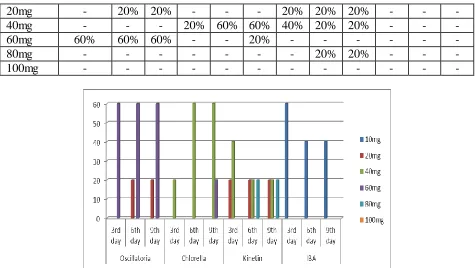
treated with 60mg of Oscillatoria extracts shows the good germination of 60% on 3rd day,
6th day as well as on 9th day of treatment equally similar and highest results were observed.
The lowest germinations were observed in the seeds treated with both the synthetic hormones
particularly IBA in which no growth was observed in any concentration from 20mg-100mg
but only germination was observed in the seeds treated with 10mg of IBA, 60% on 3rd day,
40% on 6th day and 40% on 9th day. Later, the seeds of above performed activity treated with
various extracts with different concentrations were subjected for the estimations of primary
metabolites.
The maximum concentration of carbohydrates was observed in the seeds treated with the
phytohormones Kinetin at concentration of 80mg/100ml was 26mg/100g, second highest
concentration of carbohydrates was at concentration 60mg/100ml of Oscillatoria was
18mg/100g.
The maximum concentration of proteins was observed in the seeds treated with the natural
extract Chlorella at concentration of 40mg/100ml was 6.4mg/100g, second highest
concentration of proteins was in control i.e., 06mg/100g.
The maximum concentration of Lipids was observed in the control i.e., 0.57g/100g and
second highest concentration of lipids was observed in the seeds treated with the
phytohormone Oscillatoria at concentration 60mg/100ml was 0.32g/100g.
The results obtained from this experiment shows the algal natural extracts can be the best
alternative to synthetic hormones. The algal members belonging to the class cynophyceae and
chlorophyceae can be the good biofertilizers as well as good growth hormones, further
research has to be carried out in this direction.
Table No 1 Effect of different concentrations of algal extracts and phytohormones on Percentage of seeds germination of Ceiba pentandra
Oscillatoria Chlorella Kinetin IBA
Concentr
ations 3
rd
day 6
th day 9th day 3rd day 6th day 9th day 3rd day 6th day 9th day 3rd day 6th day 9th day
20mg - 20% 20% - - - 20% 20% 20% - - -
40mg - - - 20% 60% 60% 40% 20% 20% - - -
60mg 60% 60% 60% - - 20% - - - -
80mg - - - 20% 20% - - -
100mg - - - -
Fig: 3 Effect of different concentrations of algal extracts and synthetic phytohormones on seeds germination of Ceiba pentandra.
Table No: 2 Estimations of Primary metabolites in germinated seeds at various concentrations
Concentration of phytohormones/100ml of
water
Oscillatoria Chlorella Kinetin IBA
10mg/100ml N.G N.G N.G 0.6mg/100gm
20mg/100ml 0.5mg/100gm N.G 0.8mg/100gm N.G
40mg/100ml N.G 6.4mg/100gm N.G N.G
60mg/100ml 2.3mg/100gm 1.8mg/100gm N.G N.G
80mg/100ml N.G N.G 1.08mg/100gm N.G
Control – 0.4mg/100g N.G – No Germination
Table No: 3 Estimations of Carbohydrates
Concentration of phytohormones/100ml of
water
Oscillatoria Chlorella Kinetin IBA
10mg/100ml N.G N.G N.G N.G
20mg/100ml 12mg/100gm N.G 0.10mg/100gm N.G
40mg/100ml N.G 18mg/100gm N.G N.G
60mg/100ml 18mg/100gm 6mg/100gm N.G N.G
80mg/100ml N.G N.G 26mg/100gm N.G
[image:7.596.61.536.69.337.2]N.G – No Germination
Table No: 4 Estimations of Lipids
Concentration of
phytohormones/100ml of water
Oscillatoria Chlorella Kinetin IBA
10mg/100ml N.G N.G N.G N.G
20mg/100ml 0.11gm/100gm N.G 0.12gm/100gm N.G
40mg/100ml N.G 0.19gm/100gm N.G N.G
60mg/100ml 0.32gm/100gm 0.28gm/100gm N.G N.G
80mg/100ml N.G N.G 0.27gm/100gm N.G
Control – 0.57/100g N.G – No Germination
REFERENCES
1. Emmanuel and omel. Investigations on the nutritional and medicinal potentials of Ceiba
pentandra leaf: A common vegetable in Nigeria. International Journal of Plant
Physiology and Biochemistry, June 2011; 3(6): 95-101.
2. Immanuel and Ganapathy Growth and physiological attributes of Ceiba pentandra seeds
and seedlings under salt. ARPN Journal of Agricultural and Biological Science stress.
November 2007; 2(6): 12-16.
3. Elumalai and Nikhitha Mathangi. A Review on Ceiba pentandra and its medicinal
features. Asian J. Pharm. Tech, 2012; 2(3): 83-86.
4. Thiruchenthil Nathan et al., Bat pollination of kapok tree, Ceiba pentandra. current