Optically Coupled 20 mA
Current Loop Receiver
Technical Data
HCPL-4200
Features
• Data Output Compatible with LSTTL, TTL and CMOS • 20 K Baud Data Rate at 1400
Metres Line Length • Guaranteed Performance
over Temperature (0°C to 70°C)
• Guaranteed On and Off Thresholds
• LED is Protected from Excess Current
• Input Threshold Hysteresis • Three-State Output
Compat-ible with Data Buses • Internal Shield for High
Common Mode Rejection • Safety Approval
UL Recognized -2500 V rms, for 1 Minute
CSA Approved
• Optically Coupled 20 mA Current Loop Transmitter, HCPL-4100, Also Available
Applications
• Isolated 20 mA Current • Loop Receiver in:
Computer Peripherals Industrial Control Equipment Data Communications
Equipment
Description
The HCPL-4200 optocoupler is designed to operate as a receiver in equipment using the 20 mA Current Loop. 20 mA current loop systems conventionally sig-nal a logic high state by transmit-ting 20 mA of loop current (MARK), and signal a logic low state by allowing no more than a few milliamperes of loop current (SPACE). Optical coupling of the signal from the 20 mA current loop to the logic output breaks ground loops and provides for a very high common mode
rejection. The HCPL-4200 aids in the design process by providing
guaranteed thresholds for logic high state and logic low state for the current loop, providing an LSTTL, TTL, or CMOS compatible logic interface, and providing guaranteed common mode rejection. The buffer circuit on the current loop side of the HCPL-4200 provides typically 0.8 mA of hysteresis which increases the immunity to common mode and differential mode noise. The buffer also provides a controlled amount of LED drive current which takes into account any LED light output degradation. The internal shield allows a guaranteed 1000 V/µs common mode transient immunity.
CAUTION: It is advised that normal static precautions be taken in handling and assembly of this component to prevent damage and/or degradation which may be induced by ESD.
Functional Diagram
Ordering Information
Specify part number followed by Option Number (if desired). HCPL-4200# XXX
300 = Gull Wing Surface Mount Lead Option 500 = Tape/Reel Package Option (1 K min)
Option data sheets available. Contact your Hewlett-Packard sales representative or authorized distributor for information.
Package Outline Drawings –
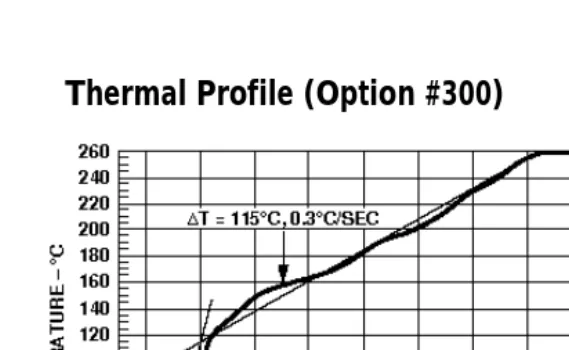
8 Pin DIP Package (HCPL-4200)Thermal Profile (Option #300)
Figure 1. Maximum Solder Reflow Thermal Profile.
(Note: Use of non-chlorine activated fluxes is recommended.)
Regulatory Information
The HCPL-4200 has been approved by the following organizations:UL
Recognized under UL 1577, Component Recognition Program, File E55361.
CSA
Approved under CSA Component Acceptance Notice #5, File CA 88324.
Insulation and Safety Related Specifications
Parameter Symbol Value Units Conditions
Min. External Air Gap L(IO1) 7.1 mm Measured from input terminals to output
(External Clearance) terminals, shortest distance through air
Min. External Tracking Path L(IO2) 7.4 mm Measured from input terminals to output
(External Creepage) terminals, shortest distance path along body
Min. Internal Plastic Gap 0.08 mm Through insulation distance, conductor to
(Internal Clearance) conductor, usually the direct distance
between the photoemitter and photodetector inside the optocoupler cavity
Tracking Resistance CTI 2 0 0 volts DIN IEC 112/VDE 0303 PART 1
(Comparative Tracking Index)
Isolation Group IIIa Material Group (DIN VDE 0110, 1/89, Table 1)
Absolute Maximum Ratings
(No Derating Required up to 70°C)Storage Temperature ... -55°C to +125°C Operating Temperature ... -40°C to +85°C Lead Solder Temperature ... 260°C for 10 s (1.6 mm below seating plane) Supply Voltage – VCC... 0 V to 20 V Average Input Current - II... -30 mA to 30 mA Peak Transient Input Current - II... 0.5 A[1]
Enable Input Voltage – VE... -0.5 V to 20 V Output Voltage – VO ... -0.5 V to 20 V Average Output Current – IO ... 25 mA Input Power Dissipation – PI... 90 mW[2]
Output Power Dissipation – PO... 210 mW[3]
Total Power Dissipation – P ... 255 mW[4]
Infrared and Vapor Phase Reflow Temperature
(Option #300) ... see Fig. 1, Thermal Profile
Recommended Operating Conditions
Parameter Symbol Min. Max. Units
Power Supply Voltage VCC 4.5 2 0 Volts
Forward Input Current ISI 0 2.0 mA
(SPACE)
Forward Input Current IMI 1 4 2 4 mA
(MARK)
Operating Temperature TA 0 7 0 °C
Fan Out N 0 4 TTL Loads
Logic Low Enable VEL 0 0.8 Volts
Voltage
Logic High Enable VEH 2.0 2 0 Volts
DC Electrical Specifications
For 0°C ≤TA ≤70°C, 4.5 V ≤VCC ≤20 V, VE = 0.8 V, all typicals at TA = 25°C and VCC = 5 V unless otherwise noted. See note 13.
Parameter Symbol Min. Typ. Max. Units Test Conditions Fig. Note
Mark State Input IMI 1 2 mA 2, 3,
Current 4
Mark State Input VMI 2.52 2.75 Volts II = 20 mA VE = Don’t Care 4, 5
Voltage
Space State Input ISI 3 mA 2, 3,
Current 4
Space State Input VSI 1.6 2.2 Volts II = 0.5 to 2.0 mA VE = Don’t 2, 4
Voltage Care
Input Hysteresis IHYS 0.3 0.8 mA 2
Current
Logic Low Output VOL 0.5 Volts IOL = 6.4 mA II = 3 mA 6
Voltage (4 TTL Loads)
Logic High Output VOH 2.4 Volts IOH = -2.6 mA, II = 12 mA 7
Voltage
Output Leakage IOHH 1 0 0 µA VO = 5.5 V II = 20 mA
5 0 0 µA VO = 20 V
Logic High Enable VEH 2.0 Volts
Voltage
Logic Low Enable VEL 0.8 Volts
Voltage
Logic High Enable IEH 2 0 µA VE = 2.7 V
1 0 0 µA VE = 5.5 V
0.004 2 5 0 µA VE = 20 V
Logic Low Enable IEL - 0.32 mA VE = 0.4 V
Current
Logic Low Supply ICCL 4.5 6.0 mA VCC = 5.5 V II = 0 mA
5.25 7.5 mA VCC = 20 V
Logic High Supply ICCH 2.7 4.5 mA VCC = 5.5 V II = 20 mA
3.1 6.0 mA VCC = 20 V
High Impedance IOZL -20 µA VO = 0.4 V VE = 2 V,
IOZH 2 0 µA VO = 2.4 V
1 0 0 µA VO = 5.5 V
5 0 0 µA VO = 20 V
Logic Low Short IOSL 2 5 mA VO = VCC = 5.5 V II = 0 mA 5
4 0 mA VO = VCC = 20 V
Logic High Short IOSH -10 mA VCC = 5.5 V II = 20 mA 5
-25 mA VCC = 20 V
Input Capacitance CIN 120 pF f = 1 MHz, VI = 0 V dc,
Pins 1 and 2 Current (VOUT > VCC)
Current Current
State Output Current Current
Circuit Output Current Circuit Output Current
II = 20 mA
VO = GND
VCC = 4.5 V
VE = Don’t Care
Switching Specifications
For 0°C ≤ TA≤ 70°C, 4.5 V ≤ VCC≤ 20 V, VE = 0.8 V, all typicals at TA = 25°C and VCC = 5 V unless otherwise noted. See note 13.
Parameter Symbol Min. Typ. Max. Units Test Conditions Fig. Note
Propagation Delay Time tPLH 0.23 1.6 µs VE = 0 V, 8, 9, 7
to Logic High Output Level CL = 15 pF 1 0
Propagation Delay Time tPHL 0.17 1.0 µs VE = 0 V, 8, 9, 8
to Logic Low Output Level CL = 15 pF 1 0
Propagation Delay Time tPLH - tPHL 6 0 ns II = 20 mA, 8, 9,
Skew CL = 15 pF 1 0
Output Enable Time to tPZL 2 5 ns II = 0 mA, 12, 13,
Logic Low Level CL = 15 pF 1 5
Output Enable Time to tPZH 2 8 ns II = 20 mA, 12, 13,
Logic High Level CL = 15 pF 1 4
Output Disable Time to tPLZ 6 0 ns II = 0 mA, 12, 13,
Logic Low Level CL = 15 pF 1 5
Output Disable Time to tPHZ 105 ns II = 20 mA, 12, 13,
Logic High Level CL = 15 pF 1 4
Output Rise Time tr 5 5 ns VCC = 5 V, 8, 9, 9
(10-90%) CL = 15 pF 1 1
Output Fall Time tf 1 5 ns VCC = 5 V, 8, 9, 1 0
(90-10%) CL = 15 pF 1 1
Common Mode Transient | C MH| 1,000 10,000 V/µs VCM = 50 V (peak) 1 6 1 1
Immunity at Logic High II = 12 mA,
Output Level TA = 25°C
Common Mode Transient | C ML| 1,000 10,000 V/µs VCM = 50 V (peak) 1 6 1 2
Immunity at Logic Low II = 3 mA,
Output Level TA = 25°C
Package Characteristics
For 0°C ≤ TA≤ 70°C, unless otherwise specified. All typicals at TA = 25°C.
Parameter Symbol Min. Typ. Max. Units Test Conditions Fig. Notes
Input-Output Momentary VISO 2500 V rms RH ≤ 50%, t = 1 min, 6, 14
Withstand Voltage* TA = 25°C
Resistance, Input-Output RI-O 1012 ohms V
I-O = 500 V dc 6
Capacitance, Input-Output CI-O 1.0 pF f = 1 MHz, VI-O = 0 V 6
Notes:
1. ≤ 1 µs pulse width, 300 pps. 2. Derate linearly above 70°C free air
temperature at a rate of 1.6 mW/ °C. Proper application of the derating factors will prevent IC junction temperatures from exceeding 125°C for ambient temperatures up to 85°C.
3. Derate linearly above 70°C free air temperature at a rate of 3.8 mW/ °C. 4. Derate linearly above 70°C free air
temperature at a rate of 4.6 mW/ °C.
5. Duration of output short circuit time shall not exceed 10 ms.
6. The device is considered a two terminal device, pins 1, 2, 3, and 4 are connected together and pins 5, 6, 7, and 8 are connected together.
7. The tPLH propagation delay is measured from the 10 mA level on the leading edge of the input pulse to the 1.3 V level on the leading edge of the output pulse.
8. The tPHL propagation delay is measured from the 10 mA level on the trailing edge of the input pulse to the 1.3 V level on the trailing edge of the output pulse.
9. The rise time, tr, is measured from the 10% to the 90% level on the rising edge of the output logic pulse. 10. The fall time, tf, is measured from the
90% to the 10% level on the falling edge of the output logic pulse.
11. Common mode transient immunity in the logic high level is the maximum (negative) dVCM/dt on the trailing edge of the common mode pulse,
VCM, which can be sustained with the output voltage in the logic high state (i.e., VO≥ 2 V).
12. Common mode transient immunity in the logic low level is the maximum (positive) dVCM/dt on the leading edge of the common mode pulse, VCM, which can be sustained with the output voltage in the logic low state (i.e., VO ≤ 0.8 V).
13. Use of a 0.1 µF bypass capacitor connected between pins 5 and 8 is recommended.
14. In accordance with UL 1577, each optocoupler momentary withstand is proof tested by applying an insulation test voltage ≥ 3000 V rms for 1 second (leakage detection current limit, Ii-o≤ 5 µA).
Figure 5. Typical Input Voltage vs. Temperature.
Figure 6. Typical Logic Low Output Voltage vs. Temperature.
Figure 7. Typical Logic High Output Current vs. Temperature.
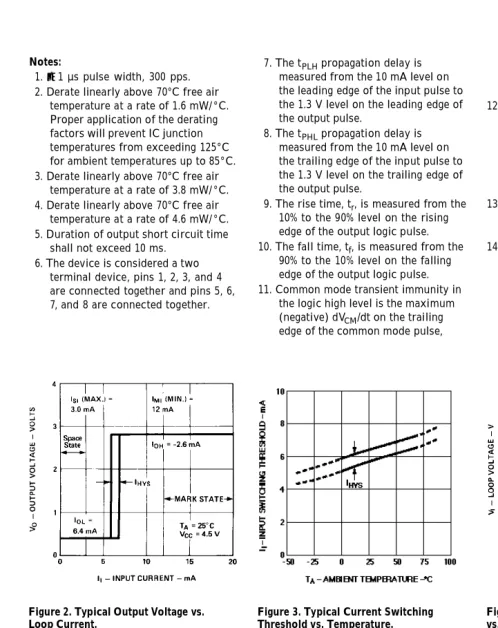
[image:7.842.62.560.96.724.2]Figure 2. Typical Output Voltage vs. Loop Current.
Figure 3. Typical Current Switching Threshold vs. Temperature.
Figure 8. Test Circuit for t PHL, tPLH, tr, and tf.
Figure 13. Waveforms for t PZH, tPZL, tPHZ, and tPLZ. Figure 12. Test Circuit for t PZH, tPZL, tPHZ, and tPLZ.
[image:8.842.65.209.343.489.2]Figure 9. Waveforms for t PHL, tPLH, tr, and tf.
Figure 10. Typical Propagation Delay vs. Temperature. Figure 11. Typical Rise, Fall Time vs. Temperature.
[image:8.842.315.457.344.490.2] [image:8.842.63.553.569.713.2]Figure 14. Typical Logic High Enable Propagation Delay vs. Temperature.
[image:9.842.314.455.70.213.2]Figure 15. Typical Logic Low Enable Propagation Delay vs. Temperature.
Figure 16. Test Circuit for Common Mode Transient Immunity.
Applications
Data transfer between equipment which employs current loop circuits can be accomplished via one of three configurations: simplex, half duplex or full duplex communication. With these configurations, point-to-point and multidrop arrangements are possible. The appropriate configuration to use depends upon data rate, number of stations, number and length of lines, direction of data flow, protocol, current source location and voltage compliance value, etc.
Simplex
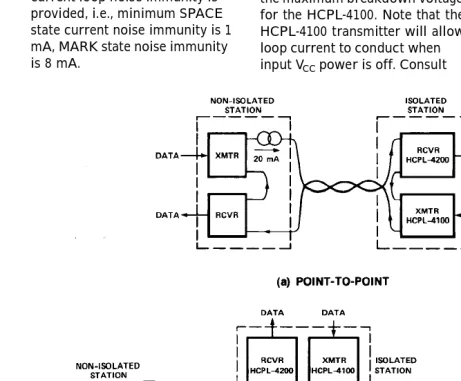
The simplex configuration, whether point to point or multi-drop, gives unidirectional data flow from transmitter to receiver(s). This is the simplest
configuration for use in long line length (two wire), for high data rate, and low current source compliance level applications. Block diagrams of simplex point-to-point and multidrop
arrangements are given in Figures 17a and 17b respectively for the HCPL-4200 receiver optocoupler.
For the highest data rate per-formance in a current loop, the configuration of a non-isolated active transmitter (containing current source) transmitting data to a remote isolated receiver(s) should be used. When the current source is located at the trans-mitter end, the loop is charged approximately to VMI (2.5 V).
Alternatively, when the current source is located at the receiver end, the loop is charged to the full compliance voltage level. The
lower the charged voltage level the faster the data rate will be. In the configurations of Figures 17a and 17b, data rate is independent of the current source voltage compliance level. An adequate compliance level of current source must be available for voltage drops across station(s) during the MARK state in multi-drop applications or for long line length. The maximum compliance level is determined by the trans-mitter breakdown characteristic.
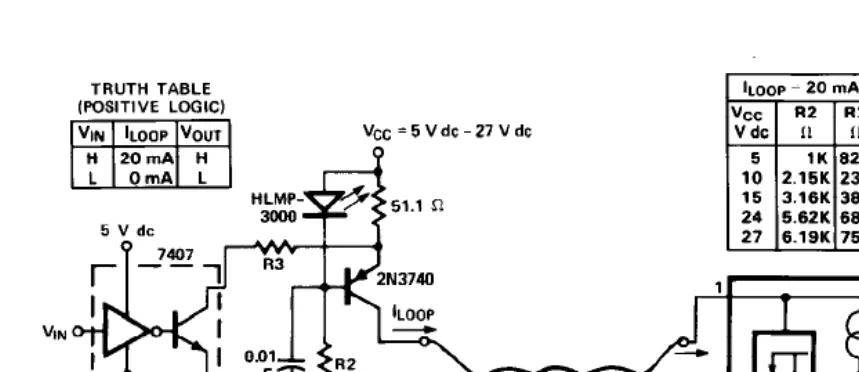
A recommended non-isolated active transmitter circuit which can be used with the HCPL-4200 in point-to-point or in multidrop 20 mA current loop applications is given in Figure 18. The current source is controlled via a
[image:9.842.62.368.274.395.2]Figure 17. Simplex Current Loop System Configurations for (a) Point-to-Point, (b) Multidrop.
and OFF states. This non-isolated active transmitter provides a nominal 20 mA loop current for the listed values of VCC, R2 and
R3 in Figure 18.
Length of current loop (one direction) versus minimum required DC supply voltage, VCC,
of the circuit in Figure 18 is graphically illustrated in Figure 19. Multidrop configurations will require larger VCC than Figure 19
predicts in order to account for additional station terminal voltage drops.
Typical data rate performance versus distance is illustrated in Figure 20 for the combination of a non-isolated active transmitter
and HCPL-4200 optically coupled current loop receiver shown in Figure 18. Curves are shown for 10% and 25% distortion data rate. 10% (25%) distortion data rate is defined as that rate at which 10% (25%) distortion occurs to output bit interval with respect to input bit interval. An input Non-Return-to-Zero (NRZ) test waveform of 16 bits
(0000001011111101) was used for data rate distortion measure-ments. Data rate is independent of current source supply voltage, VCC.
The cable used contained five pairs of unshielded, twisted, 22 AWG wire (Dearborn #862205). Loop current is 20 mA nominal.
Input and output logic supply voltages are 5 V dc.
Full Duplex
The full duplex point-to-point communication of Figure 21 uses a four wire system to provide simultaneous, bidirectional data communication between local and remote equipment. The basic application uses two simplex point-to-point loops which have two separate, active, non-isolated units at one common end of the loops. The other end of each loop is isolated.
Figure 18. Recommended Non-Isolated Active Transmitter with HCPL-4200 Isolated Receiver for Simplex Point-to-Point 20 mA Current Loop.
receiver, can be used at the isolated end of current loops. Cross talk and common mode coupling are greatly reduced when optical isolation is imple-mented at the same end of both loops, as shown. The full duplex
data rate is limited by the non-isolated active receiver current loop. Comments mentioned under simplex configuration apply to the full duplex case. Consult the HCPL-4100 transmitter opto-coupler data sheet for specified device performance.
Half Duplex
The half duplex configuration, whether point-to-point or multidrop, gives
non-simultaneous bidirectional data flow from transmitters to receivers shown in Figures 22a and 22b. This configuration allows the use of two wires to carry data back and forth between local and remote units. However, protocol must be used to determine which specific transmitter can operate at any given time. Maximum data rate for a half duplex system is limited by the loop current charging time. These considerations were explained in the Simplex config-uration section.
Figures 22a and 22b illustrate half duplex application for the combination of HCPL-4100/-4200 optocouplers. The unique and complementary designs of the HCPL-4100 transmitter and HCPL-4200 receiver optocouplers provide many designed-in benefits. For
example, total optical isolation at one end of the current loop is easily accomplished, which results in substantial removal of common mode influences, elimination of ground potential Figure 19. Minimum Required Supply
Voltage, VCC, vs. Loop Length for Current Loop Circuit of Figure 19.
Figure 20. Typical Data Rate vs. Distance.
differences and reduction of power supply requirements. With this combination of HCPL-4100/ -4200 optocouplers, specific current loop noise immunity is provided, i.e., minimum SPACE state current noise immunity is 1 mA, MARK state noise immunity is 8 mA.
Voltage compliance of the current source must be of an adequate level for operating all units in the loop while not exceeding 27 V dc, the maximum breakdown voltage for the HCPL-4100. Note that the HCPL-4100 transmitter will allow loop current to conduct when input VCC power is off. Consult
the HCPL-4100 transmitter optocoupler data sheet for specified device performance.
[image:12.842.73.534.229.610.2]For more information about the HCPL-4100/-4200 optocouplers, consult Application Note 1018.