www.wjpr.net Vol 7, Issue 9, 2018. 780
TO STUDY PHYTOCHEMICAL AND ANTIMICROBIAL ACTIVITY
OF CALOTROPIS
PROCERA
LEAF EXTRACTS
Afra Akbani1, Dr. Smita Chavan*2 and Arti Sharma3
1,3
Department of Botany, HPT Arts and RYK Science College, Nashik (MS), India.
2
Department of Botany, MJM Arts, Commerce and Science College, Karanjali, Tal, Peth,
Dist, Nashik (MS), India.
ABSTRACT
The plants are an important medicinal value and its different parts are
used in ayurvedic medicines. The present study was an attempt to
study Anatomy, phytochemical and antimicrobial activity of methanol,
ethanol and water extracts obtained from the leaves of calotropis
procera to understand the cellular organization and an attempt to
evaluate the medicinal potentials. The phytochemical screening
revealed the presence of alkaloids, flavenoids, tannins, saponins, and
cardiac glycoside with a very high content in methanol, water and then
in ethanol. The methanol, ethanol and water extracts of Calatropis
procera leaves were evaluated for antimicrobial activity against
gram+ve, gram-ve bacteria and fungi. Zone of inhibition diameters
were observed. 100µl methanol extract showed the inhibition for the above organism. But
ethanol and water extract did not have maximum impact in inhibition. The result of this study
validates the use of methanol extract of this species in ethanomedicine providing lead for
antifungal and antimicrobial for above strains.
KEYWORDS: Calotropis procera, Phytochemical, Antimicrobial, Leaf extract.
1. INTRODUCTION
On earth the plant produce natural products which are used as traditional medicine for various
diseases from thousand of year. Plants naturally synthesized and accumulate different types
of valuable secondary metabolites like alkaloids, glycosides, tannins, minerals and vitamin
etc.[1] Calotropis is a spreading shrub or small tree belongs to the family of Asclepiadaceae. It is found throughout the tropical world and they are native to the tropical and sub tropical part
Volume 7, Issue 9, 780-786. Research Article ISSN 2277– 7105
Article Received on 10 March. 2018,
Revised on 31 March 2018, Accepted on 21 April 2018,
DOI: 10.20959/wjpr20189-11983
8533
*Corresponding Author
Dr. Smita Chavan
Department of Botany,
MJM Arts, Commerce and
Science College, Karanjali,
Tal, Peth, Dist, Nashik
www.wjpr.net Vol 7, Issue 9, 2018. 781 of Asia.[2] Leaves opposite grey, green large up to 50 cm long and 10cm broad with a pointed tip to rounded basal lobes. Flower waxy white petals 5, purple tipped inside and with a
central purplish crown. The Calotropis plant produced large quantity of latex, which is milky
liquid consisting of several biologically active compound like proteins, amino acids,
carbohydrates, lipids, vitamins, alkaloids, resins and tannins.[3] The latex is used as an abortifacient, spasmogenic and carminative properties, antidysentric, antisyphilitic,
antirheumatic, antifungal, mullusccide, diaphoretic and for the treatment of leprosy, bronchial
asthma and skin infection. The root and leaves of Calotropis are used traditionally for
treatment of abdominal, tumours boils, skin diseases, wound and insect bites.[4] Different parts of the plant have been reported to possess a number of biological activities such as
proteolytic, antimicrobial, larvicidal, nematocidal, anticancer, anti-inflammatory. Its flowers
possess digestive and tonic properties.[5] The root of the plant is used as a carminative in the treatment of dyspepsia. The leaves of Calotropis procera are used by various tribes of central
India as a curative agent for jaundice. The present work report the phytochemical properties
and antimicrobial activity of leaf extracts of C.procera.
2. MATERIALS AND METHODS
2.1. Plant material collection
Fresh leaves of Calotropis was collected from near college campus and identified with help
of flora. The collected leaves cleaned for debris using tap water and rinsed in sterile distilled
water. The leaves were shed dried and grinded in powder and stored in air tight bottles for
further use.
2.2. Preparation of plant extract
The stored powder weighs exactly 10 gm for each extraction and was packed in soxhlet
apparatus and extracted with methanol, ethanol and water separately for 8 hours.
2.3. Preliminary Phytochemical Screening
Phytochemical screening was carried out using standard procedure. The tests are briefly
described below.
2.3.1. Detection of Alkaloids: A 1 ml of filtrate taken into the test tube and a drop of
Mayer’s reagent (Mayer’s test[6]
) was added by the side of test tube to produce white or
www.wjpr.net Vol 7, Issue 9, 2018. 782 few drops of Wagner’s reagent and appearance of reddish-brown precipitate confirms the test
is positive.
2.3.2. Detection of Carbohydrates and Glycosides: Take 1 ml of filtrate and few drops of
Barrfoed’s reagent (Barrfoed’s test) was added and heated in a boiling water bath for 2 min;
a red precipitate indicates presence of sugars.
2.3.3. Carbohydrate: 1 ml of the filtrate was added about 1 ml of iodine solution; a purple
colour at the interphase indicates the presence of carbohydrate.
2.3.4. Detection of Saponins: The 1 ml extract was diluted with distilled water and made up
to 20ml. The suspension is shaken in a graduated cylinder for 15 min and there is formation
of two cm layer of foam indicates the presence of Saponin.
2.3.5. Detection of Proteins and Amino Acids: In 2 ml of filtrate adds a few drops of
Million’s reagent and a white precipitate indicate the presence of proteins and amino acid.
For second test mix filtrate and few drops of ninhydrin solution in test tube and added 2 ml of
aqueous filtrate; a characteristic purple colour indicates presence of amino acids.
2.3.6. Detection of Phenolic Compounds: The extract is dissolved in 5 ml of D.W; a few
drops of neutral 5% ferric chloride solution are added; a dark green colour indicates the
presence of phenolic compound.
2.3.7. Detection of Gum and Mucilage: The extract (100 mg) is dissolved in 10 ml of D.W.
and to this 25ml of absolute alcohol is added with constant stirring; white cloudy precipitate
indicates the presence of gums and mucilage.
2.3.8. Terpenoids and Steroids: 4mg of extract was treated with 0.5 ml of chloroform; then
concentrated solution of sulphuric acid was added slowly and red violet colour for steroids.
2.3.9. Tannins: - In a test tube 0.5 ml extract solution, 1 ml of water and 1-2 drops of ferric
chloride solution was added; blue colour was observed for gallic tannins and black colour for
catecholic tannins.
2.3.10. Fixed Oils and fats: A few drops of 0.5 N alcoholic potassium hydroxide solution
www.wjpr.net Vol 7, Issue 9, 2018. 783 heated on water bath for two hours. Formation of soap partial neutralization of alkali
indicates the presence of mixed oil and fats.
2.4. TEST ORGANISMS
Five pathogenic microorganisms in total, including three bacteria, viz., Staphylococcus
aureus, E. coli and Pseudomonas and two fungal strains, viz., Aspergillus niger and
Aspergillus flavous were procured from microbiology department HPT Arts and RYK
Science College, Nashik.
2.5. ANTIMICROBIAL STUDIES
Bacterial strains were grown and maintained on Nutrient Agar medium, while fungi were
maintained on Potato dextrose agar (PDA) medium. The antibacterial activity of different
extracts was tested using agar disc diffusion method. The bacterial and fungal isolates
collected in prepared slants of nutrients gar were sub cultured in to prepared nutrient broth
and incubated at 37oC for 24 h.The well plate diffusion method and disk diffusion assay were used to determine the growth inhibition of bacteria and fungi by plant extract. The nutrient
agar plates and P.D.A plates were seeded with the bacterial and fungal strain. Five holes of
6.0 mm diameter each were made with sterile cock borer and filled with 25%, 50%, 75%,
100% plant extract & pure solvent as control for about 100 micro litters. The inoculated
plates were allowed to congeal for 1 hour and then were incubated at 37oC for 24 hours. After 24 h incubation, the plates were observed for zones of inhibition which were recorded in
centimetres (cm).
3. RESULTS AND DISCUSSION
Physical characteristic of the extracts indicate that there were variations in the colour, odour
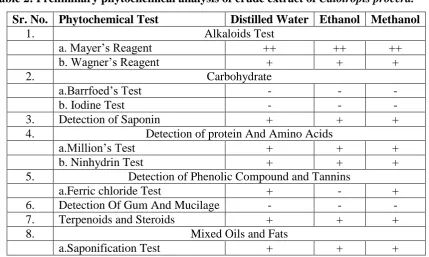
and texture of the extracts (Table.1). Table 2 presents the phytochemical compound
recovered from the extract of the plant part screened in which presence of alkaloids, saponins,
proteins, amino acids, phenols, terpenoid and steroids, mixed oil and fats. This support the
earlier finding of Mainasara et al,[7] Shobowale et al,[8] Kawo et al,[9] Korii and Alawa,[4] Swapnali et al,[2] Kumar et al,[5] Shrivastava et al,[10] Morsy et al.[11] Among phytochemicals, alkaloids are one of the largest groups in plants having amazing effect on human and this led
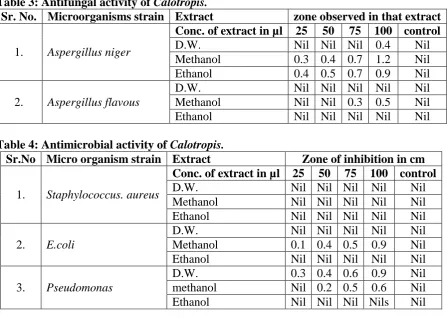
to the development of powerful painkiller medicine. Subramanian & Saratha.[12] Table 3 & 4 present the antifungal and antibacterial activity pattern of the extracts. The results shows that
methanol and ethanol leaf extract of calatropis have antifungal activities on Aspergilus niger
www.wjpr.net Vol 7, Issue 9, 2018. 784 except 75 μl and 100 μl concentrations of methanol. However the antifungal effect was more
pronounced against Aspergilus niger, which was seen to be more sensitive to the leaf
methanolic extract at a concentration of 100 μl with zones of inhibition of 1.2 cm
respectively. The effect of Calatropis procera agrees with the work of Manoorkar et al[3] and Shobowale et al,[8] which showed antifungal activity against A.niger. Antibacterial efficacy of different solvent extracts of C. procera is shown in table 3.methanol and D.W. have shown
better activity against these pathogenic organisms. In case of antibacterial activity, it was
only inhibited by leaf methanol and distilled water extract of highest recorded zone of
inhibition at (0.9 cm) 100 μl against Pseudomonas, this result is similar to that of Kumar et
[image:5.595.81.511.417.674.2]al, [5] Mainasara et al.[7] However kawo et al[9] showed there was no activity of ethanol leaf extract of C. procera against pseudomonas at all concentration.
Table 1: Physical characteristics of different extracts of Calotropis.
Sr. No Initial Weight
of Powder(gm)
Final Weight Of powder(gm)
Weight Of Crude Extract(gm)
Color Of
Extract Odour Texture
Distilled Water 10 7.82 2.18 Golden Brown Pleasant Fruity Soft
Ethanol 10 8.93 1.07 Dark Green Slightly repulsive Oily
Methanol 10 8.24 1.76 Dark Green Slightly repulsive Oily
Table 2: Preliminary phytochemical analysis of crude extract of Calotropis procera.
Sr. No. Phytochemical Test Distilled Water Ethanol Methanol
1. Alkaloids Test
a. Mayer’s Reagent ++ ++ ++
b. Wagner’s Reagent + + +
2. Carbohydrate
a.Barrfoed’s Test - - -
b. Iodine Test - - -
3. Detection of Saponin + + +
4. Detection of protein And Amino Acids
a.Million’s Test + + +
b. Ninhydrin Test + + +
5. Detection of Phenolic Compound and Tannins
a.Ferric chloride Test + - +
6. Detection Of Gum And Mucilage - - -
7. Terpenoids and Steroids + + +
8. Mixed Oils and Fats
www.wjpr.net Vol 7, Issue 9, 2018. 785 Table 3: Antifungal activity of Calotropis.
Sr. No. Microorganisms strain Extract zone observed in that extract
1. Aspergillus niger
Conc. of extract in µl 25 50 75 100 control
D.W. Nil Nil Nil 0.4 Nil
Methanol 0.3 0.4 0.7 1.2 Nil
Ethanol 0.4 0.5 0.7 0.9 Nil
2. Aspergillus flavous
D.W. Nil Nil Nil Nil Nil
Methanol Nil Nil 0.3 0.5 Nil
Ethanol Nil Nil Nil Nil Nil
Table 4: Antimicrobial activity of Calotropis.
4. CONCLUSION
The remarkable phytochemical, fungicidal and bactericidal effects of C. procera leaf extract
suggest that the leaf extract may be useful source for the development of antifungal and
antibacterial agent against pathogenic fungi and bacteria as well as used as phytomedicine.
5. ACKNOWLEDGEMENT
The authors are thankful to University Grant Commission for providing financial support for
the research work. The authors express sincere gratitude toward the principal Mr.
Suryavanshi, HPT Arts, and RYK Science College, Nashik for providing necessary facilities
for the work. Authors are thankful to Dr. S.G. Auti, Head Department of Botany for valuable
guidance and help.
6. REFERENCES
1. Shambharkar R, Gogle D. (Phytochemical screening of some medicinal plants used for
cancer treatment by tribal people of Gadchiroli, India). Wor, J. Pha. Res, 2017; 7(1):
1109-1113.
2. Swapnali MG, Madhuri VP, Raghunath TM. (Phytochemical screening and antimicrobial
activity of ethanol extract of Calotropis procera root). Int. J. Res. Phytochem. Pharmacol,
2012; 2(3): 143-146.
Sr.No Micro organism strain Extract Zone of inhibition in cm
1. Staphylococcus. aureus
Conc. of extract in µl 25 50 75 100 control
D.W. Nil Nil Nil Nil Nil
Methanol Nil Nil Nil Nil Nil
Ethanol Nil Nil Nil Nil Nil
2. E.coli
D.W. Nil Nil Nil Nil Nil
Methanol 0.1 0.4 0.5 0.9 Nil
Ethanol Nil Nil Nil Nil Nil
3. Pseudomonas
D.W. 0.3 0.4 0.6 0.9 Nil
methanol Nil 0.2 0.5 0.6 Nil
www.wjpr.net Vol 7, Issue 9, 2018. 786 3. Manoorkar VB, Mandge SV, Gachande BD. (Antifungal Activity of Leaf and Latex
Extracts of Calotropis procera (Ait.) against Dominant Seed-Borne Storage Fungi of
Some Oil Seeds). Biosci. Discover, 2015; 6(1): 22-26.
4. kori P, alawa P. (Antimicrobial activity and phytochemical analysis of Calotropis
gigantea root, latex extracts). IOSR Journal of Pharmacy, 2014; 4(6): 7-11.
5. Kumar SS, Sivamani P, Baskaran C, Mohamed MJ. (Evaluation of Anti Microbial
Activity and Phytochemical analysis of Organic Solvent extracts of Calotropis gigantea.
IOSR Journal of Pharmacy, 2012; 2(3): 389-394.
6. Evans WC. (Trease and Evans Pharmacology. 14th edn. Harcourt Brace and company.):
Asia. Pvt. Ltd. Singapore, 1997.
7. Mainasara M M, Aliero BL, Aliero AA, Dahiru SS. (Phytochemical and Antibacterial
Properties of Calotropis Procera (Ait) R. Br. (Sodom Apple) Fruit and Bark Extracts).
International Journal of Modern Botany, 2011; 1(1): 8-11.
8. Shobowale OO, Ogbulie NJ, Itoandon EE, Oresegun MO, Olatope SOA. (Phytochemical
and Antimicrobial Evaluation of Aqueous and Organic Extracts of Calotropis procera Ait
Leaf and Latex). Nigerian Food Journal, 201; 1(1): 77 – 82.
9. Kawo AH, Mustapha A, Abdullahi BA, Rogo LD, Gaiya ZA, Kumurya AS.
(phytochemical properties and antibacterial activities of the leaf and latex extracts of
calotropis procera (ait.f.) ait.f.). Bayero Journal of Pure and Applied Sciences, 2009; 2(1):
34-40.
10.Shrivastava A, Singh S, Singh S. (Phytochemical Investigation of Different Plant Parts of
Calotropis procera). International Journal of Scientific and Research Publications, 2013;
3(8): 1-4.
11.Morsy N, Emad A, Sherif Al, Tayseer MA, Abdel-rassol. (Phytochemical analysis of
Calotropis procera with antimicrobial activity investigation). Main Group Chemistry,
2016; 15: 267–273.
12.Saratha V, Subramanian SP. (evaluation of antifungal activity of calotropis gigantea latex
extract: an in vitro study). International Journal of Pharmaceutical Sciences and Research,