Abstract—This paper presents a case study of lean
manufacturing implementation in Malaysian automotive components manufacturer. Semi-structured interview and open-ended questionnaire were used to investigate on how to successfully implement lean manufacturing in Malaysia manufacturing industry. The interview was conducted at a case study company with two managerials who are familiar with lean manufacturing implementation projects. The case study company was selected due to its achievement as a Toyota Production System Model Company awarded by the Malaysia Japan Automotive Industries Cooperation. The finding shows that this case study company used the project approach in their early stage of implementing lean manufacturing projects. The project based is a small scale project where the focus of lean manufacturing implementation is to solve the problems at a small area. They form a team with five full-time members, determine a model line for lean manufacturing implementation project, and then did the continuous improvements effort with focus on reducing the level of inventory. By reducing the level of inventory, this case study company was able to reduce other form of wastes including over production, waiting times, excessive transportation, excessive processing, excessive motion, and defective products. In the project based approach the company, conducted continuous improvement efforts until saturated level of major improvement and achieving a stable condition for the model line. Through their efforts and achievements in implementing lean manufacturing, this case study company has become a reference and role model for the other manufacturing companies in Malaysia.
Index Terms—Lean manufacturing, automotive components
manufacturer, Malaysia
I. INTRODUCTION
HE lean manufacturing (LM) or Toyota Production System (TPS) was pioneered by a Japanese automotive company, Toyota, during 1950’s. Due to its global superiority in cost, quality, flexibility and quick respond,
Manuscript received March 23, 2011; revised April 15, 2011. This work was supported in part by University Malaysia Sarawak and Ministry of Higher Education Malaysia.
Lean Manufacturing Implementation in Malaysian Automotive Components Manufacturer: a Case Study.
Muslimen, R. is with the Dept. of Mechanical and Manufacturing Engineering, Faculty of Engineering, Universiti Malaysia Sarawak, 94300 Kota Samarahan, Sarawak, MALAYSIA (e-mail:
Yusof, S. M. is with the Faculty of Mechanical Engineering, Universiti Teknologi Malaysia, 81310 UTM Skudai, Johor, MALAYSIA (e-mail:
Abidin, A.S.Z. is with the Dept. of Mechanical and Manufacturing Engineering, Faculty of Engineering, Universiti Malaysia Sarawak, 94300 Kota Samarahan, Sarawak, MALAYSIA (e-mail: [email protected] ).
LM was transferred across countries and industries [1]. LM has become a widely acceptable and adoptable best manufacturing practice across countries and industries [2]. The primary goals of LM were to reduce the cost of product and improve productivity by eliminating wastes or non-value added activities [3].
The success of LM implementation depends on several factors and approaches. Prior study has identified four critical success factors: leadership and management, financial, skills and expertise, and supportive organizational culture of the organization [4]. Other researchers also suggested that applying the full set of lean principles and tools also contribute to the successful LM transformation [5], [6]. However, in reality not many companies in the world are successful to implement this system [7], [8]. Furthermore, previous researchers insist that there is no “cookbook” to explain step by step of the LM process and how exactly to apply the tools and techniques [9], [10], [11]. Many manufacturing companies have implemented LM in many different ways and names in order to suit with their environment and needs. Therefore, it is important to conduct the research in order to identify the approaches and processes in LM implementation.
Some studies have been done in Malaysian manufacturing industries regarding on LM implementation. Reference [12] focussed to examine the adoption of LM in the Malaysian electrical and electronics industries. Reference [13] focused on exploring the extent of LM implementation in Malaysian automotive manufacturing industries. Both of the studies found that most of the Malaysian manufacturing industries have implemented LM up to a certain extent and in-transition towards LM. However, the findings based on Malaysian manufacturing industries do not provide on how to implement and what approach to be used to successfully implement LM.
Therefore, the purpose of this study is to investigate on how to implement and what suitable approach to be used in order to successfully implement LM in Malaysian manufacturing industries. The investigation focuses on the LM implementation approach in Malaysian automotive components manufacturer. From this study, it will give one of the several approaches in implementing LM that has been practiced in Malaysian automotive components manufacturer. This study will present and highlight the early stage of the LM implementation approach by the case study company. The next stage of the LM implementation approach will be presented in future publication that will highlight the continuous improvement of LM
Lean Manufacturing Implementation in
Malaysian Automotive Components
Manufacturer: a Case Study
Rasli Muslimen, Sha’ri Mohd Yusof, Ana Sakura Zainal Abidin
implementation approach in order to sustain the efforts and success.
II. RESEARCH METHODOLOGY
The research methodology used in this research is a case study methodology. The case study method allows researchers to retain the holistic and meaningful characteristics of the real-life events [14]. A case study was performed in one of the automotive components manufacturer in Malaysia. This company selected was based on its achievement as a Toyota Production System (TPS) Model Company awarded by Malaysia Japan Automotive Industries Cooperation (MAJAICO) in year 2007. MAJAICO is a five year project from 2006 until 2011 initiated under the Malaysia Japan Economic Partnership Agreement (MJEPA) to develop and improve the Malaysian automotive industry to become more competitive as global automotive players. The main function of MAJAICO is to introduce continuous improvement activities in manufacturing companies mainly through total implementation of lean manufacturing.
Interview was conducted at the case study company with two executives; Manager of Safety Environment & Quality Management, and Assistant Manager of Toyota Production System & Skill Development. Both of them are from Total Quality Management Department and very familiar with the LM implementation projects. Interview was conducted through prepared semi-structured and open-ended questionnaires. The semi-structured interview and open-ended questions were used where interviewees were encouraged to explain why the line operated in a certain way [15].
The semi-structured and open-ended questionnaires were utilized to gain insights regarding the status of LM implementation approach in this case study company. For this case study company, the semi-structured and open-ended questionnaire consists of three sections;
(a). The company’s background information (year of establishment, start of production, ownership, number of employees, products, customers, and achievements)
(b). The understanding of lean manufacturing (c). The implementation of lean manufacturing.
In order to find out the approach of LM implementation from this company, a number of questions were tailored to enable the extraction of ideas that give a true reflection on the interviewee’s practices. Therefore, set a number of questions in this case study that embodied the companies’ understanding of LM and LM implementation. For example, the key questions in section (b) and (c) of the semi-structured and open-ended questionnaires were as follows:
How long it takes to complete the first implementation project of LM in your company? Do you think it is necessary to hire consultant to
assist the implementation of LM? How about your company’s practice?
Who is the person responsible to lead the implementation of LM in your company?
Where has LM been implemented in your company? What were the criterions for choosing that specific
area?
How many people involved in the project?
What kind of waste does LM eliminated in the project?
During the interview, it was tape recorded with the permission from the interviewees to avoid any missing points of information given by them. Finally, the overall information obtained from the interview was summarised and verified with the interviewees. Findings from the interview were analyzed and discuss in the findings and discussion section.
III. BACKGROUND OF COMPANY
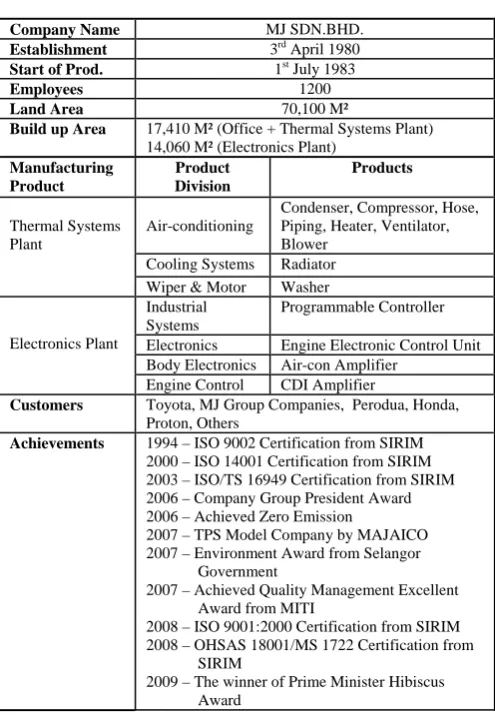
From the section (a) of the semi-structured and open-ended questionnaires, the company’s background information was gained and illustrated in Table 1.
The name of this company is changed to MJ Sdn.Bhd. in terms of confidential issues. The company was established on 3rd April 1980 and starts their production on 1st July 1983. They have two manufacturing plants; Thermal Systems Plant and Electronics Plant. In Thermal Systems Plant, they have three product divisions; Air-conditioning, Cooling Systems, and Wiper & Motor Division where they produce nine products namely condenser, compressor, hose, piping, heater, ventilator, blower, radiator, and washer. And in Electronics Plant, they have four product divisions; Industrial Systems, Electronics, Body Electronics, and Engine Control Division where they produce four products namely programmable controller, engine electronic control unit, air-con amplifier, and CDI amplifier.
TABLE 1
COMPANY’S PROFILE
Company Name MJ SDN.BHD.
Establishment 3rd April 1980
Start of Prod. 1st July 1983
Employees 1200
Land Area 70,100 M²
Build up Area 17,410 M² (Office + Thermal Systems Plant)
14,060 M² (Electronics Plant)
Manufacturing Product
Product Division
Products
Thermal Systems Plant
Air-conditioning
Condenser, Compressor, Hose, Piping, Heater, Ventilator, Blower
Cooling Systems Radiator Wiper & Motor Washer
Electronics Plant
Industrial Systems
Programmable Controller
Electronics Engine Electronic Control Unit
Body Electronics Air-con Amplifier Engine Control CDI Amplifier
Customers Toyota, MJ Group Companies, Perodua, Honda,
Proton, Others
Achievements 1994 – ISO 9002 Certification from SIRIM
2000 – ISO 14001 Certification from SIRIM 2003 – ISO/TS 16949 Certification from SIRIM 2006 – Company Group President Award 2006 – Achieved Zero Emission
2007 – TPS Model Company by MAJAICO 2007 – Environment Award from Selangor Government
2007 – Achieved Quality Management Excellent Award from MITI
2008 – ISO 9001:2000 Certification from SIRIM 2008 – OHSAS 18001/MS 1722 Certification from SIRIM
2009 – The winner of Prime Minister Hibiscus Award
IV. FINDINGS AND DISCUSSIONS
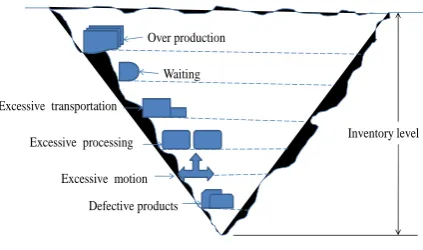
Lean manufacturing implementation in this company was started in 1996. At that time, the concept of lean manufacturing is still new and the knowledge in this company is still at a very low level. In 2002, the president of the company from headquarter in Japan came and asked to start lean manufacturing activities where one team was formed with five full-time members. At the early stage of lean manufacturing implementation in this company, the project based approach was used. The project based is a small scale project where the focus of LM implementation in this company is to solve the problem at the small area. From the interview, the authors have formulated the lean manufacturing implementation approach by this company as shown in Figure 1.
[image:3.595.42.290.70.428.2]First, this company forms a small team with five full- time members to run the lean manufacturing implementation project. A few Japanese experts from headquarter in Japan came to teach and shared their knowledge of lean manufacturing implementation with the team members.
Fig. 1. Lean manufacturing implementation approach
Second, one model line was determined in order to run the lean manufacturing implementation project. The selection of the model line was based on the following characteristics; small area, bottleneck area, and delivery area. Before running the lean manufacturing implementation, the buffer stock was ready and prepared at the model line for any shortages of the product during lean manufacturing implementation.
Finally, at the project base approach by this company, the focus of lean manufacturing implementation is reducing the level of inventory. For this company, inventory is the mother of other wastes. Reference [16], the father of Toyota Production System identified seven types of waste:
Waste of over production Waste of waiting inventory
Waste of unnecessary transportation Waste of waiting times
Waste of unnecessary processing Waste of unnecessary motion Waste of defected products
Inventory level Over production
Waiting
Excessive transportation
Excessive processing
Excessive motion
Defective products
In the project base approach by this company, they did the continuous improvement effort at the selected model line. This continuous improvement effort is continued until a saturated level of major improvement is made and they reached the stable condition of the model line. In certain cases stabilizing the model line, the interviewee highlighted they did the major improvements for up to ten times. The duration to complete the LM implementation project by this case study company is within three to six months. After that, they will continue the next LM implementation project to another area following the same approach.
This direction and approach in LM implementation is similar with a traditional Toyota approach where they begin with a model line. In Toyota, they helped their external suppliers to implement TPS through their Operation Management Consulting Group lead by Taiichi Ohno [17]. However, findings from the interview session regarding the assistant from the consultant show different approach. In this case study company, they did not hire any external consultant. They solely depended on the internal consultant from their own group companies and their skill workers that have been trained in Japan. They also used their own facilities and their companies’ facilities in order to implement lean manufacturing tools and techniques. For this case study company, they did the basic LM implementation largely common sense, and suit with their environment and needs.
The analysis done by reference [18], found that the major difficulties companies encounter in attempting to apply lean are a lack of direction, a lack of planning and a lack of adequate project sequencing. In this case study company, they have clear direction from the top management, proper planning done by the full-time team members, and have a long term project in LM implementation. This long term project will be discussed further in the next stage of LM implementation approach. It can be said that this company has their own strength and capabilities in order to implement lean manufacturing and further develop their LM
implement lean manufacturing in Malaysian automotive components manufacturer. The findings from the interview session with semi-structured and open-ended questionnaire shows that the case study company used the project based approach in implementing lean manufacturing. They form a team with five full-time members, determine a model line, and did the continuous improvements effort until the model line was stabled. In their LM implementation project, they focus on reducing the level of inventory as the mother of the other wastes. After they reduce the inventory level, the other wastes has been highlighted and continuously reduce. The other wastes are over production, waiting times, excessive transportation, excessive processing, excessive motion, and defected products.
In order to conduct the lean manufacturing projects, they have full support and clear direction from top management level especially from their president of the company. They have proper planning through their LM approach and implemented by the five full-time members that produce the full-time results. They follow the same approach in another area after having completed the first LM implementation project. As a result of LM implementation effort by this case study company, in year 2007 this company has been awarded as Toyota Production System Model Company by MAJAICO.
As a lean production system model company, this company has become a reference and role model in implementing lean manufacturing for other manufacturing companies in Malaysia. Future work will involve presenting the next stage of LM implementation approach by this company towards sustaining lean manufacturing implementation.
ACKNOWLEDGMENT
The authors would like to thank the case study company in Malaysia for their willingness to participate in this study and future work.
REFERENCES
[1] R. J. Schonberger, "Japanese production management: An
evolution - with mixed success," Journal of Operations Management, vol. 25, pp. 403-419, 2007.
[2] M. Holweg, "The genealogy of lean production," Journal of Operations Management, vol. 25, pp. 420-437, 2007.
[3] J. P.Womack, D. T.Jones, and D. Roos, The Machine That
Change The World New York: Rawson Associates Scribner, 1990.
[4] P. Achanga, E. Shehab, R. Roy, and G. Nelder, "Critical Success Factors for Lean Implementation within SMEs," Journal of Manufacturing Technology Management, vol. 17, pp. 460-471, 2006.
[5] C. Herron and P. M. Braiden, "Defining the foundation of lean manufacturing in the context of its origins," IET International Conference on Agile Manufacturing, pp. 148-157, 2007. [6] T. James, "Wholeness as well leanness," IET Manufacturing
Engineer, pp. 14-17, 2006.
[image:4.595.66.278.76.201.2][10] N. Oliver, "Lean production practices," British Journal of Management, pp. 1-10, 1996.
[11] A. Nanni, M. Gregory, and K. Platt, "Performance measurement system design," International Journal of Operations and Production Management, vol. 15, pp. 80-116, 1995.
[12] Y. C. Wong, K. Y. Wong, and A. Ali, "A Study on Lean
Manufacturing Implementation in the Malaysian Electrical and Electronics Industry," European Journal of Scientific Research, vol. 38, pp. 521-535, 2009.
[13] N. Nordin, B. M. Deros, and D. A. Wahab, "A survey on lean manufacturing implementation in Malaysian automotive industry," International Journal of Innovation, Management and Technology, vol. 1, pp. 374-380, 2010.
[14] R. K. Yin, Case Study Research: Design and Methods, Fourth ed. vol. 5. United States of America: SAGE Publications Inc., 2009.
[15] D. Simons and K. Zokaei, "Application of lean paradigm in red meat processing," British Food Journal, vol. 107, pp. 192-211, 2005.
[16] T. Ohno, Toyota Production System Beyond Large - Scale
Production. Oregon: Productivity Press, 1988.
[17] J. K. Liker, Becoming Lean: Inside Stories of U.S.
Manufacturers. New York: Productivity Press, 1998.