Auto Building Extraction from HD Satellite Image
for the Application of Map Development
Awantika Singh1, Akhilesh Sharma2
1, 2
Department of Computer Science & Engineering, Chouksey Engineering College, Bilaspur India
Abstract: Building extraction from very high resolution (VHR) symbolism assumes a significant job in urban arranging, fiasco the executives, route, refreshing geographic databases, and a few other geospatial applications. Contrasted and the conventional structure extraction approaches, profound learning systems have as of late demonstrated remarkable execution in this undertaking by utilizing both abnormal state and low-level component maps., Eextraction information from satellite pictures is considered as a fundamental field of research in remote recognizing and machine vision. Various estimations for extraction of structures from satellite pictures have been shown up until this point. These computations generally have considered radiometric, geometric, edge area and shadow criteria approaches to manage play out the structure extraction. In this paper basically we present a system which is able to get the information from the HD satellite images. As per our propose approach we are able to capture the building information in very less time & accuracy of our proposed approach is far batter than previous existing approach.
Keywords: GIS, building Extraction, Satellite image processing, Corner, Line
I. INTRODUCTION
Since the beginning of humankind, individuals are driven by budgetary, social, characteristic and distinctive components to change their living space. Especially in current ages, there is an impact in urbanization, suggesting that individuals move from commonplace to urban regions because of modernization and industrialization. This mass improvement of people is commonly joined by tremendous changes in a urban space and these movements are regularly appeared by structure advancement and demolition. A structure is a significant bit of the life of a person as it expect the activity of a place of living or work. Accordingly, the relocation of individuals prompts new structures being constructed and others getting pounded. This infers structures or even more generally the urban establishment reflects and includes human activities in a zone. New structures are constructed and others are surrendered and get pulverized as the quantity of occupants in a urban area sways. The gigantic addition of the quantity of occupants in earth prompts a practically identical uplifting of the human activities. Since such activities can be explicitly associated with improvement assignments in a domain, the changes in a urban circumstance are altogether extended. The speed, with which urban changes occur, has provoked huge issues in the urban change area and mapping. This reality drives us to the issue of urban change seeing that we as society need to go up against. As urban change checking, we imply the task of perceiving and watching changes that occur in a urban circumstance. Changes in road system, lodging and other man-impacted structures to have a spot with the class of urban changes. Regardless, in the arrangement of this proposition, we focus on changes in structure establishment as they are demonstrated by structure advancement and demolition. Building disclosure from satellite pictures was for all intents and purposes incomprehensible a few decades back due to low objectives satellite pictures that did not allow the unmistakable evidence of individual structures in an image. As needs be, building extraction must be practiced by using ethereal pictures or as an element of the general issue of land spread request from satellite pictures that considered and evaluated urban improvement. In any case, the latest two decades, there were essential advances in the development of the sensors satellites pass on and nowadays the catch of high-objectives multi-absurd satellite pictures is feasible. These high-objectives pictures portray the urban condition with exceptional detail, making the area and course of action of individual structures and other man-made structures from satellite pictures possible and more precise than some other time in late memory. Building distinguishing proof from 2D high-objectives satellite pictures is a PC vision, photogrammetry and remote identifying errand that can be utilized in a couple of utilizations that require the creation of urban maps or the examination of urban changes.
troublesome. A couple of frameworks have been proposed to handle the issue of structure recognizable proof. These methods of insight can be described in two imperative arrangements reliant on the dimensionality and taking care of technique for the available data. The chief order contains estimations that methodology 3D data to perceive structures. Data that have a spot with this class are LiDAR point fogs and Digital Surface Models, which acquired from laser/radar sensors, give information about the stature of a region. In this way, they can be considered as 31 coarse 3D depiction of the concentrated urban condition. Inside seeing 3D data, building extraction can be practiced either by a sensible height edge [1] or by 2D line extraction and after that mapping to 3D space [2]. In [3] and [4], the planes in the 3D space were perceived as an approach to delineate the rooftops of the structures. 3D formats were utilized by Karantzalos and Paragios in [5] and Hammoudi and Dornaika in [6], as a way to deal with recognize structures. Since the height of structures is a basic flag towards their partition from various things that appear in a urban circumstance, methodologies that rely upon 3D data can achieve high precision and exactness as simply couple of tall trees can be wrongly seen as structures subject to the stature information. The hindrance of such theories is that the 3D data can be exceptionally wrong, familiarizing basic missteps with the structure extraction errand. This is in light of the fact that 3D data depend particularly on the objectives of the sensors and the watching technique used for the data gathering. In addition, sudden changes in the stature of the scene can provoke inconsistencies in the height information of neighboring pixels. Finally, 3D data are ordinarily hard to acquire by virtue of the stunning cost of acquisition and subsequently, most procedures can't misuse 3D information. In the second order of structure area methods, there are figurings that methodology 2D data, as multi-apparition pictures. These figurings can be requested in two general subcategories subject to whether they process pictures at the article or pixel level. Pixel-based methods of insight analyze pixels and social occasion them subject to ordinary properties. One of the vital undertakings to divide an object of energy from an image relied upon the prospect of "snakes" [7]. A "wind" is an essentialness restricting, deformable spline influenced by goal and picture controls that pull it towards the points of confinement of an object of interest. In light of the examination on "snakes", Caselles et al. were the first to display geodesic powerful structures [8] as an approach to piece an object of excitement from an image reliant on considerations from Euclidean curve shortening progression. Such an investigation has incited imperativeness minimisation and level-set division computations that can be used for structure extraction. In such a structure, essentialness limits can be built up that can depict the properties of most structures in an image and by constraining such limits, the required structures can be recognized. An imperativeness limit can rely upon surface and shading information, yet also on shape information, making the division technique progressively incredible, given that the things to be evacuated have known shape. Such techniques pushed others to find fitting initialisation shapes by structure up a circuitous cast computation [9] and using outline theory [10], or despite building up a proper essentialness work for structure division [10].
Paper centers around implementation of building extraction, gives the subtleties of proposed building extraction calculations, and gives advancement parameters and trial results. The rest of the paper is organized as follows. Necessary background and underlying principle on watermarking is given in Section II whereas Section III describes proposed methodology & Implementation details. Experimental results and its analysis are given in Section V. Finally, Section VI concludes the paper.
II. LITRECTUREREVIEW
modified generation of structures from flying pictures. The first is an estimation for normally organizing line sections over different pictures. The figuring uses geometric necessities reliant on the multi-see geometry together with photometric objectives got from the line neighborhood, and achieves an execution of better than 95% right matches multiple viewpoints. A New Method For Building Extraction In Urban Areas From High-Resolution Lidar Data, 2002[23]: In this paper, another methodology for the motorized time of 3D building models from direct watched point fogs made by LIDAR sensors is presented. By a hierarchic use of solid expansion using a skew screw up movement work, the LIDAR centers being around the scene are separated from spotlights on structures and other thing classes, and a modernized region appear (DTM) can be prepared. Building Extraction From High Resolution Color Imagery Based On Edge Flow Driven Active Contour And Jseg, 2008[24]: According to this framework includes three phases. At first, anisotropic spread and gathering are associated as pre-getting ready for denoising and shading quantization and a short time later creating cutoff is removed by powerful shape driven by edge-stream. Finally, building housetop compositional polygons are parceled by JSEG. Building Extraction from Satellite Images, 2013[25]: The fact of the matter is to isolate rectilinear structures by using theory. Theory age is polished by using edge disclosure and line age procedures. Hypothesis affirmation is finished by using information got both from the shading division of HSV depiction of the image. Thing Based Building Extraction from High Resolution Satellite Imagery, 2012[26]: In this paper, we propose a novel article based strategy for modified and amazing acknowledgment and extraction of working in high spatial objectives pictures. To achieve this goal, we use enduring and variable features together. Stable features are gotten from inborn characteristics of structure wonder and variable features are expelled using reparability and Thresholds examination gadget. Semantically-careful airborne diversion from multi-measured data, 2015[27]: In this philosophy for organizing various sensors close by semantic information to redesign scene depictions. We propose a probabilistic generative model for get-together semantically-instructed aeronautical multiplications from multi-particular data inside an enduring logical structure. The system, called Semantically-Aware Aerial Reconstruction (SAAR), not simply tries reasoned scene geometry, appearance, and semantic discernments to get a significant order of the data. Semantic Segmentation based Building Extraction Method using Multi-source GIS Map Datasets and Satellite Imagery, 2018[28]: This paper delineates our proposed structure extraction system , they proposed a semantic division and social occasion learning based structure extraction procedure for high objectives satellite pictures. A couple of open GIS map datasets were utilized through combining with the multispectral WorldView-3 satellite picture datasets for improving the structure extraction results. Hd maps: Fine-grained road division by parsing ground and airborne pictures, 2016[29]: In this paper we present an approach to manage redesign existing maps with fine grained division classes, for instance, parking spots and walkway, similarly as the number and zone of road ways. Towards this goal, we propose a capable philosophy that can assess these fine grained arrangements by doing joint finding over both, monocular raised imagery, similarly as ground pictures taken from a stereo camera pair mounted over a vehicle. Basic to this is pondering the course of action between the two sorts of imagery, as despite when the estimations are taken with refined GPS+IMU systems, this plan isn't enough exact. 2011[30]: this paper present the building extortion using the concept of Gabor filter. Basically there is mainly three challenges is faced by the current available Watermarking technique and those challenges are:
A. Lack of Accuracy Issue
B. Fake building detected by the previous existing process
C. Due to difference in structure of building previous approaches are not able to identify those building
D. There is need of process on HD satellite images but previous approaches are not upto the mark and did not do proper justice
with time
III. PROPOSEDMETHADOLOGY&IMPLIMENTATION
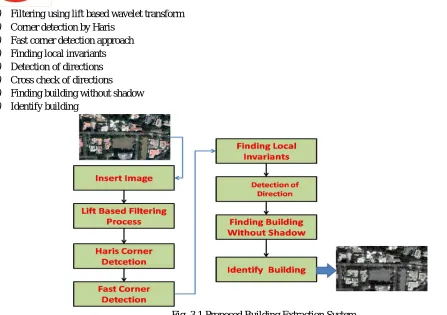
In this section we discuss about the implementation details of previous existing work and our proposed work. Here we implement the multiple previous existing works which are base on gabor filter based building detection, morphology based building detection and our proposed algorithm which is based on lift based Wavelate & fast corner detection based approach.. Here are those previous existing approaches:
A. Gabor filter based building extraction
B. Proposed LWT & Fast corner Based building extraction:
1) Filtering using lift based wavelet transform
2) Corner detection by Haris
3) Fast corner detection approach
4) Finding local invariants
5) Detection of directions
6) Cross check of directions
7) Finding building without shadow
[image:4.612.48.495.69.384.2]8) Identify building
Fig. 3.1 Proposed Building Extraction System
IV. RESULTANALYSIS
In this section we present the comparative study about our proposed approach with all different type of existing approach. Here we will use some existing scientific parameter which will prove proper justification for our proposed approach. Those parameters are:
A. False Building
B. Correct building
C. Overall Accuracy
D. Time Complexity
1) Test Images
A1 A2 A3
According to table 4.1, 4.2 & 4.3 we can see the comparative analysis between all those parameters. As we can see our proposed approach is far better than all previous existing approaches. Our proposed approach is make proper justification with parameters and also with the time complexity. According to comparative analysis in terms on of time complexity as we know for any application time complexity is a main barrier , our proposed approach have approximately double time improvement as compare to gabor based approach.
Table 4.1 Image Quality Comparison in proposed and previous existing approaches for test image A1 with 20 Buildings
Approach
False
Building Correct building
Overall Accuracy
Time Complexity
Gabor based 52 16 38% 73 Sec
Proposed 37 20 68% 34 Sec
Table 4.2 Image Quality Comparison in proposed and previous existing approaches for test image A2 with 24 Buildings
Approach
False
Building Correct building
Overall Accuracy
Time Complexity
Gabor based 58 20 41 74 Sec
Proposed 15 24 62.5% 46 Sec
Table 4.3 Image Quality Comparison in proposed and previous existing approaches for test image A3 with 11 Buildings
Approach
False
Building Correct building
Overall Accuracy
Time Complexity
Gabor based 77 11 15% 144 Sec
Proposed 23 8 47% 22 Sec
V. CONCLUSIONS
As we know 21st century is combination of remarkable technology like 5G, 4D, Live projection etc. As we know we there is need of a system which will do proper analysis of building extraction from satellite images. As we did proper research on previous existing approaches and we got conclusion that there is lots of research gaps which needs to feel improve in future research. As per our proposed approach we are able to resolve the previous existing issues which are false detection, less accurate, t9me complexity. According to our proposed approach we are able to extract the building information in very less time. Here we are also able to make justice with quality
REFERENCES
[1] A. Brunn and U. Weidner, “Extracting buildings from digital surface models,” in IAPRS,1997, pp. 3–4.
[2] C. Wang and P. Hsu, “Building detection and structure line extraction from airborne LiDARdata,” Journal of Photogrammetry and Remote Sensing, vol. 12, no. 4, pp. 365–379, Dec 2007.
[3] E. Baltsavias, S. Mason, and D. Stallmann, “Use of DTMs/DSMs and orthoimages to supportbuilding extraction,” in Automatic Extraction of Man-made Objects from Aerial and Space Images. Verlag, April 1995, pp. 199–210.
[4] J. Hu, S. You, U. Neumann, and K. Park, “Building modeling from LiDAR and aerialimagery,” in Proceedings of ASPRS, 2004.
[5] K. Karantzalos and N. Paragios, “Large-scale building reconstruction through informationfusion and 3-d priors,” IEEE Transactions on Geoscience and Remote Sensing, vol. 48, no. 5,pp. 2283–2296, May 2010.
[6] K. Hammoudi and F. Dornaika, “A featureless approach to 3d polyhedral building modelingfrom aerial images,” Sensors, vol. 11, no. 1, pp. 228–259, 2011. [7] M. Kass, A. Witkin, and D. Terzopoulos, “Snakes: Active contour models,” InternationalJournal of Computer Vision, vol. 1, no. 4, pp. 321–331, 1988. [8] V. Caselles, R. Kimmel, and G. Sapiro, “Geodesic active contours,” in Proceedings of 5th International Conference on Computer Vision, June 1995, pp. 694–
699.
[9] L. Theng, “Automatic building extraction from satellite imagery,” Engineering Letters,vol. 13, no. 3, Nov 2006.
[10] K. Karantzalos and D. Argialas, “A region-based level set segmentation for automatic detection of man-made objects from aerial and satellite images,” Photogrammetric Engineeringand Remote Sensing, vol. 75, no. 6, pp. 667–677, 2009.
[11] V. Dey, Y. Zhang, and M. Zhong, “Building detection from pan-sharpened GeoEye-1 satelliteimagery using context based multi-level image segmentation,” in International Symposium on Image and Data Fusion (ISIDF), Aug 2011, pp. 1–4.
[13] Benz, U.C., Hofmann, P., Willhauck, G., Lingenfelder, I. and Heynen, M., 2004. Multi-Resolution, Object-Oriented Fuzzy Analysis of Remote Sensing Data for GIS-Ready Information. ISPRS Journal of Photogrammetry and Remote Sensing, 58(3-4): 239-258.
[14] Blaschke, T., 2010. Object based image analysis for remote sensing. ISPRS Journal of Photogrammetry and Remote Sensing. Vol. 65 (2010) 2_16.
[15] Li, Weijia, et al. "Semantic Segmentation based Building Extraction Method using Multi-source GIS Map Datasets and Satellite Imagery." Proceedings of the IEEE Conference on Computer Vision and Pattern Recognition Workshops. 2018.
[16] Dutta, D. and Serker, N.H.M.K., 2005. Urban Building Inventory Development using Very High Resolution Remote Sensing Data for Urban Risk Analysis. International Journal of Geoinformatics, , 1(1).
[17] Hofmann, P. (2001) Detecting urban features from IKONOS data using an object-oriented approach. First Annual Conference of the Remote Sensing & Photogrammetry Society. Munich, Germany.
[18] Hofmann, P., Strobl, J., Blaschke, T. and Kux, H., 2008. Detecting Informal Settlements from QuickBird Data in Rio de Janeiro Using an Object-Based Approach. In: T. Blaschke, S. Lang and G.J. Hay (Editors), Object-Based Image Analysis. Springer, Berlin Heidelberg, pp. 531-553
[19] Nussbaum, S., and Menz, G., 2008. Object-Based Image Analysis and Treaty Verification. Springer Science+Business Media B.V.
[20] ABrunn, Ansgar, and Uwe Weidner. "Extracting buildings from digital surface models." International Archives of Photogrammetry and Remote Sensing 32.3 SECT 4W2 (1997): 27-34.
[21] Kraus, Karl, and Norbert Pfeifer. "Determination of terrain models in wooded areas with airborne laser scanner data." ISPRS Journal of Photogrammetry and remote Sensing 53.4 (1998): 193-203.
[22] Haala, Norbert, and Claus Brenner. "Extraction of buildings and trees in urban environments." ISPRS Journal of Photogrammetry and Remote Sensing 54.2-3 (1999): 130-137.
[23] Baillard, Caroline, et al. "Automatic line matching and 3D reconstruction of buildings from multiple views." ISPRS Conference on Automatic Extraction of GIS Objects from Digital Imagery. Vol. 32. 1999.
[24] Rottensteiner, Franz, and Christian Briese. "A new method for building extraction in urban areas from high-resolution LIDAR data." International Archives of Photogrammetry Remote Sensing and Spatial Information Sciences 34.3/A (2002): 295-301.
[25] Song, Yonghak, and Jie Shan. "Building extraction from high resolution color imagery based on edge flow driven active contour and JSEG." IAPRSIS 37 (2008): 185-190.
[26] Bhadauria, A., H. Bhadauria, and Anuj Kumar. "Building extraction from satellite images." IOSR Journal of Computer Engineering 12.2 (2013): 76-81. [27] Attarzadeh, R., and M. Momeni. "Object-based building extraction from high resolution satellite imagery." International Archives of the Photogrammetry 29
(2012): 57-60.
[28] Cabezas, Randi, Julian Straub, and John W. Fisher. "Semantically-aware aerial reconstruction from multi-modal data." Proceedings of the IEEE International Conference on Computer Vision. 2015.
[29] Máttyus, Gellért, et al. "Hd maps: Fine-grained road segmentation by parsing ground and aerial images." Proceedings of the IEEE Conference on Computer Vision and Pattern Recognition. 2016.