Evaluation and Analysis
Deyi Xiong
∗Institute for Infocomm Research
Min Zhang
∗∗Institute for Infocomm Research
Aiti Aw
†Institute for Infocomm Research
Haizhou Li
‡Institute for Infocomm Research
Linguistic knowledge plays an important role in phrase movement in statistical machine trans-lation. To efficiently incorporate linguistic knowledge into phrase reordering, we propose a new approach: Linguistically Annotated Reordering (LAR). In LAR, we build hard hierarchical skele-tons and inject soft linguistic knowledge from source parse trees to nodes of hard skeleskele-tons during translation. The experimental results on large-scale training data show that LAR is comparable to boundary word-based reordering (BWR) (Xiong, Liu, and Lin 2006), which is a very compet-itive lexicalized reordering approach. When combined with BWR, LAR provides complementary information for phrase reordering, which collectively improves the BLEU score significantly.
To further understand the contribution of linguistic knowledge in LAR to phrase reordering, we introduce a syntax-based analysis method to automatically detect constituent movement in both reference and system translations, and summarize syntactic reordering patterns that are captured by reordering models. With the proposed analysis method, we conduct a comparative analysis that not only provides the insight into how linguistic knowledge affects phrase move-ment but also reveals new challenges in phrase reordering.
1. Introduction
The phrase-based approach is a widely accepted formalism in statistical machine trans-lation (SMT). It segments the source sentence into a sequence of phrases (not necessarily syntactic phrases), then translates and reorders these phrases in the target. The reason for the popularity of phrasal SMT is its capability of non-compositional translations and
∗1 Fusionopolis Way #21-01 Connexis Singapore 138632. E-mail: [email protected]. ∗∗1 Fusionopolis Way #21-01 Connexis Singapore 138632. E-mail: [email protected].
†1 Fusionopolis Way #21-01 Connexis Singapore 138632. E-mail: [email protected]. ‡1 Fusionopolis Way #21-01 Connexis Singapore 138632. E-mail: [email protected].
local word reorderings within phrases. Unfortunately, reordering at the phrase level is still problematic for phrasal SMT. The default distortion-based reordering model simply penalizes phrase movement according to the jump distance, without considering any linguistic contexts (morphological, lexical, or syntactic) around phrases.
In order to utilize lexical information for phrase reordering, Tillman (2004) and Koehn et al. (2005) propose lexicalized reordering models which directly condition phrase movement on phrases themselves. One problem with such lexicalized reordering models is that they are restricted only to reorderings of phrases seen in training data. To eliminate this restriction, Xiong, Liu, and Lin (2006) suggest using boundary words of phrases (i.e., leftmost/rightmost words of phrases), instead of phrases, as reordering evidence. Although these lexicalized reordering models significantly outperform the distortion-based reordering model as reported, only using lexical information (e.g., boundary words) is not adequate to move phrases to appropriate positions.
Consider the following Chinese example with its English translation:
[VP [PPd(while)dd(develop)dd(related)dd(legislation)d] [VP [VVd d(consider)] [NP [DNP [NPdd(this) dddd(referendum)] [DEGd(of)]] [NPd
d(results)]]]]1
consider the results of this referendum while developing related legislation
In this example, boundary wordsdanddare able to decide that the translation of the PP phrased...dshould be postponed until some phrase that succeeds it is translated. But they cannot provide further information about exactly which succeeding phrase should be translated first. If high-level linguistic knowledge, such as the syntactic context VP→PP VP, is given, the position of the PP phrase can be easily determined since the pre-verbal modifier PP in Chinese is frequently translated into a post-verbal counterpart in English.
In this article, we focus on linguistically motivated phrase reordering, which in-tegrates high-level linguistic knowledge in phrase reordering. We adopt a two-step strategy. In the first step, we establish a hierarchical skeleton in phrasal SMT by in-corporating Bracketing Transduction Grammar (BTG) (Wu 1997) into phrasal SMT. In the second step, we inject soft linguistic information into nodes of the skeleton.
There are two significant advantages to using BTG in phrasal SMT. First, BTG is able to generate hierarchical structures.2 This not only enhances phrasal SMT’s capability for hierarchical and long-distance reordering but also establishes a platform for phrasal SMT to incorporate knowledge from linguistic structure. Second, phrase reordering is restricted by the ITG constraint (Wu 1997). Although it only allows two orders (straight orinverted) of nodes in any binary branching structure, it is broadly verified that the ITG constraint has good coverage of word reorderings on various language pairs (Wu, Carpuat, and Shen 2006). This makes phrase reordering in phrasal SMT a more tractable task.
After enhancing phrasal SMT with a hard hierarchical skeleton, we further inject soft linguistic information into the nodes of the skeleton. We annotate each BTG node
1 In this article, we use Penn Chinese Treebank phrase labels (Xue et al. 2000).
2 Chiang (2005) also generates hierarchical structures in phrasal SMT. One difference is that Chiang’s hierarchical grammar is lexicon-sensitive because the model requires at least one pair of aligned words in each rule except for the “glue rule.” The other difference is that his grammar allows multiple
with syntactic and lexical elements by projecting the source parse tree onto the BTG binary tree. The challenge, of course, is that BTG hierarchical structures are not always aligned with the linguistic structures in the source language parse tree. To address this issue, we propose an annotation algorithm. The algorithm is able to label any BTG nodes during decoding with very little overhead, regardless of whether the BTG nodes are aligned with syntactic constituent nodes in the source parse tree. The annotated linguistic elements are then used to guide phrase reordering under the ITG constraint.
We call this two-step phrase reordering strategylinguistically annotated reorder-ing (LAR)(Xiong et al. 2008a). Xiong, Liu, and Lin (2006) also adapt a two-step reorder-ing strategy based on BTG. However, they use boundary words as reorderreorder-ing features at the second step. To distinguish this from our work, we call their approachboundary word–based reordering (BWR). LAR and BWR can be considered as two reordering variants for BTG-based phrasal SMT, which have similar training procedures. Further-more, they can be combined.
We evaluate LAR vs. BWR using the automatic metric BLEU (Papineni et al. 2002). The BLEU scores show that LAR is comparable to BWR and significantly improves phrase reordering when combined with BWR.
We want to further study what happens when we combine BWR with LAR. In particular, we want to investigate to what extent the integrated linguistic knowledge (from LAR) changes phrase movement in an actual SMT system, and in what direction the change takes place. The investigations will enable us to have a better understanding of the relationship between phrase movement and linguistic context, and therefore to explore linguistic knowledge more effectively in phrasal SMT.
Because syntactic constituents are often moved together across languages during translation (Fox 2002), we particularly study how linguistic knowledge affects syntactic constituent movement. To that end, we introduce a syntax-based analysis method. We parse source sentences, and align the parse trees with reference translations as well as system translations. We then summarize syntactic reordering patterns using context-free grammar (CFG) rules from the obtained tree-to-string alignments. The extracted reordering patterns clearly show the trace of syntactic constituent movement in both reference translations and system translations.
With the proposed analysis method, we analyze the combination of BWR and LAR vs. BWR alone. There are essentially three issues that are addressed in this syntax-based comparative analysis.
1. The first issue concerns syntactic constituent movement in human/ machine translations. Fox (2002) investigates syntactic constituent movement in human translations. We study syntactic constituent movement in both human translations and machine translations that are generated by an actual SMT system and compare them.
2. The second issue concerns the change of phrase movement after rich linguistic knowledge is integrated into phrase reordering. To gain a better insight into this issue, we study phrase movement patterns for 13 specific syntactic constituents.
3. The last issue concerns which constituents remain difficult to reorder even though rich linguistic knowledge is employed.
constraint. Section 3 describes algorithms which extract training instances for reorder-ing models of BWR and LAR. Section 4 introduces the BWR model as our baseline reordering model. Section 5 describes LAR and the combination of LAR with BWR. Section 6 elaborates the syntax-based analysis method. Section 7 reports our evaluation results on large-scale data. Section 8 demonstrates our analysis results and addresses the various issues discussed above. Section 9 discusses related work. And finally, Section 10 summarizes our main conclusions.
2. Background
2.1 BTG-Based Phrasal SMT
We establish a unified framework for BTG-based phrasal SMT in this section. There are two kinds of rules in BTG, lexical rules (denoted asrl) and merging rules (denoted asrm):3
rl:Ap →x/y
rm:Ap →[Al,Ar]|Al,Ar (1)
A lexical rule translates a source phrasex into a target phrase yand generates a leaf nodeAin the BTG tree. Merging rules combine left and right neighboring phrasesAl andAr into a larger phraseAp in an ordero∈ {straight,inverted}. In this article, we use “[]” to denote a straight order and “” an inverted order.
We define a BTG derivationDas a sequence of independent applications of lexical and merging rules (D=rl1..n
l,r m
1..nm). Given a source sentence, the decoding task of BTG-based SMT is to find a best derivation, which yields the best translation.4
We assign a probability to each rule using a log-linear model with different features and corresponding weightsλ, then multiply them to obtainP(D). To keep in line with the common understanding of standard phrasal SMT (Koehn, Och, and Marcu 2003), here we re-organize these features into a translation model (PT), a reordering model (PR), and a target language model (PL) as follows:
P(D)=PT(rl1..n
l)·PR(r m
1..nm)λR·PL(e)λL·exp(|e|)λw (2)
whereexp(|e|) is the word penalty. The translation model is defined as
PT(rl1..nl)= nl
i=1
P(rli)
P(rl)=p(x|y)λ1·p(y|x)λ2·p
lex(x|y)λ3·plex(y|x)λ4·exp(1)λ5 (3)
wherep(·) represents the phrase translation probabilities in both directions,plex(·) de-notes the lexical translation probabilities in both directions, and exp(1) is the phrase penalty.
3 The subscriptsl,r,pofAdo not mean that we categorizeAinto three different nonterminals. We use them to represent the left node, right node, and parent node.
Similarly, the reordering model is defined on the merging rules as follows:
PR(rm1..nm)= nm
i=1
P(rmi ) (4)
One of the most important and challenging tasks in building a BTG-based phrasal SMT system is to defineP(rm).
2.2 Reordering Under the ITG Constraint
Under the ITG constraint, three nodes{Al,Ar,Ap}are involved when we consider the orderobetween the two children{Al,Ar}in any binary subtrees. Therefore it is natural to define the ITG reorderingP(rm) as a function as follows:
P(rm)=f(Al,Ar,Ap,o) (5)
whereo∈ {straight,inverted}.
Based on this function, various reordering models are built according to different assumptions. For example, the flat reordering model in the original BTG (Wu 1996) assigns prior probabilities for the straight and inverted order assuming the order is highly related to the properties of language pairs. It is formulated as
P(rm)=
ps, o=straight
1−ps,o=inverted (6)
Supposing French and English are the source and target language, respectively, the value ofps can be set as high as 0.8 to prefer monotone orientations because the two languages have similar word orders in most cases.
The main problem of the flat reordering model is also the problem of the standard distortion model (Koehn, Och, and Marcu 2003): Neither model considers linguistic contexts. To be context-dependent, the ITG reordering might directly model the condi-tional probabilityP(o|Al,Ar). This probability could be calculated using the maximum likelihood estimate (MLE) by taking counts from training data, in the manner of the lexicalized reordering model (Tillman 2004; Koehn et al. 2005):
P(o|Al,Ar)= CountCount(o(,AAl,Ar)
l,Ar) (7)
Unfortunately this lexicalized reordering method usually leads to a serious data sparse-ness problem under the ITG constraint becauseAlandArbecome larger and larger due to the merging rules, and are finally unseen in the training data.
To avoid the data sparseness problem yet be contextually informative, attributes of Al andAr, instead of nodes themselves, are used as reordering evidence in a new perspective of the ITG reordering (Xiong, Liu, and Lin 2006). The new perspective treats the ITG reordering as a binary-classification problem where the possible orderstraight
3. Reordering Example Extraction
Because we consider the ITG reordering as a classification problem, we need to obtain training instances to build a classifier. Here we refer to a training instance as a reorder-ing example, which is formally defined as a triple of (o,bl,br) whereblandbr are two neighboring blocks ando∈ {straight,inverted}is the order between them.
Theblockis a pair of aligned source phrase and target phrase
b=(ci2 i1,e
j2
j1) (8)
wherebmust be consistent with the word alignmentM
∀(i,j)∈M,i1 ≤i≤i2 ↔j1≤j≤j2 (9)
By this, we require that no words inside the source phrase ci2
i1 are aligned to words outside the target phraseej2
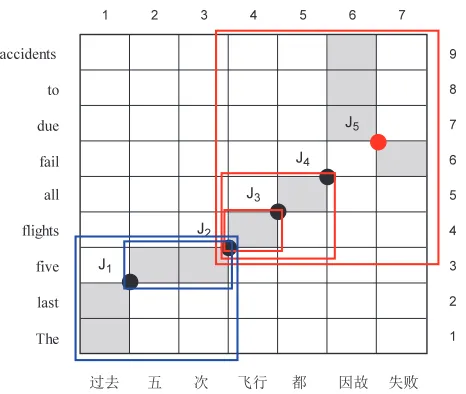
j1 and that no words outside the source phrase are aligned to words inside the target phrase. This definition is similar to that of the bilingual phrase except that there is no length limitation over blocks. Figure 1 shows a word alignment matrix between a Chinese sentence and English sentence. In the matrix, each block can be represented as a rectangle, for example, blocks (c4
4,e44), (c54,e54), (c74,e94) in red rectangles, and (c3
2,e33), (c31,e31) in blue rectangles.
[image:6.486.50.283.419.616.2]In this section, we discuss two algorithms for extracting reordering examples from word-aligned bilingual data. The first algorithmAExtractor (described in Section 3.1) extracts reordering examples directly from word alignments by extending the bilin-gual phrase extraction algorithm. The second algorithmTExtractor(described in Sec-tion 3.2) extracts reordering examples from BTG-style trees which are built from word alignments.
Figure 1
A word alignment matrix between a Chinese sentence and English sentence. Bold dots represent
3.1 AExtractor: Extracting Reordering Examples from Word Alignments
Before we describe this algorithm, we introduce the concept of junctionin the word alignment matrix. We define a junction as a vertex shared by two neighboring blocks. There are two types of junctions: astraight junction, which connects two neighboring blocks in a straight order (e.g., black dotsJ1–J4in Figure 1) and aninverted junction, which connects two neighboring blocks in an inverted order (e.g., the red dot J5 in Figure 1).
The algorithm for AExtractor is shown in Figure 2. This completes three sub-tasks as follows.
1. Find blocks (lines 4 and 5). This is similar to the standard phrase extraction algorithm (Och 2002) except that we find blocks with arbitrary length. 2. Detect junctions and store blocks in the arrays of detected junctions (lines 7
and 8). Junctions that are included the current block can be easily detected by looking at the previous and next blocks. A junction can connect
multiple blocks on its left and right sides. For example, the second
junctionJ2in Figure 1 connects two blocks on the left side and three blocks on the right side. To store these blocks, we maintain two arrays (left and right) for each junction.
3. Select block pairs from each detected junction as reordering examples (lines 12–16). This is the most challenging task for AExtractor. Because a junction may havenblocks on its left side andmblocks on its right side, we will obtainnmreordering examples if we enumerate all block pairs. This will quickly increase the number of reordering examples, especially
those with the straight order. To keep the number of reordering examples tractable, we define various selection rulesrto heuristically select special block pairs as reordering examples.
We define four selection rules as follows.
1. strINV: We select the smallest blocks (in terms of the target length) for straight junctions, and the largest blocks for inverted junctions. Take the straight junctionJ2in Figure 1 as an example, the extracted reordering example is (straight,dd|five,dd|flights).
2. STRinv: We select the largest blocks (in terms of the target length) for straight junctions, and the smallest blocks for inverted junctions. Still taking the straight junctionJ2as an example, this time the extracted reordering example is (straight,dddd|The last five,ddddddd| flights all fail due to accidents).
3. RANDOM: For any junction, we randomly select one block pair from its arrays.
4. COMBO: For each junction, we first select two block pairs using selection rule strINV and STRinv. If there are unselected blocks, we randomly select one block pair from the remaining blocks.
3.2 TExtractor: Extracting Reordering Examples from BTG-Style Trees
A potential problem for AExtractor is caused by the use of heuristic selection rules: keeping some block pairs as reordering examples while abandoning other block pairs. The kept block pairs are not necessarily the best training instances for tuning an ITG order predictor. To avoid this problem we can extract reordering examples from the BTG trees of sentence pairs. Reordering examples extracted in this way are naturally suitable for BTG order prediction.
There are various ways to build BTG trees over sentence pairs. One can use BTG to produce bilingual parses of sentence pairs, similar to the approaches proposed by Wu (1997) and Zhang and Gildea (2005) but using the more sophisticated reordering models BWR or LAR. After parsing, reordering examples can be extracted from bilingual parse trees and a better reordering model is therefore induced from the extracted reordering examples. Using the better reordering model, the bilingual sentences are parsed again. This procedure is run iteratively until no performance gain is obtained in terms of translation or parsing accuracy. Formally, we can use expectation-maximization (EM) training in this procedure. In the expectation step, we first estimate the likelihood of all BTG trees of sentence pairs with the current BTG model. Then we extract reordering examples and collect counts for them, weighted with the probability of the BTG tree where they occur. In the maximization step, we can train a more accurate reordering model with updated reordering examples. Unfortunately, this method is at high com-putational cost.
they are also neighboring on both the source and target sides, we combine them and create a new node to dominate them. In this way, we can transform the decomposition tree into a BTG-style tree. Note that not all multi-branching nodes can be binarized. We extract reordering examples only from binary nodes.
Figure 3 shows the BTG-style tree which is built from the word alignment in Figure 1 according to the method mentioned here. From this tree, we can easily extract four re-ordering examples in a straight order and one rere-ordering example in an inverted order.
4. Boundary Word-Based Reordering
Following the binary-classification perspective of the ITG reordering, Xiong, Liu, and Lin (2006) propose a reordering model which exploits the maximum entropy (MaxEnt) classifier for BTG order prediction
PRb(rm)=Pθ(o|Al,Ar,Ap)=
exp(iθihi(o,Al,Ar,Ap))
oexp(
iθihi(o,Al,Ar,Ap)) (10) where the functionshi∈ {0, 1}are reordering features and theθiare the weights of these features.
Xiong, Liu, and Lin (2006) define reordering features using the boundary words of the source/target sides of both children{Al,Ar}. Supposing that we have a reordering example (inverted,d7d15d|on July 15,ddddddddd|held its presidential and parliament elections), leftmost/rightmost source words{d, 15d,dd,dd}and target words{on, 15, held, elections}will be extracted as boundary words. Each boundary word will form a reordering feature as follows
hi(o,Al,Ar,Ap)=
1, fn=bval,o=inverted
0, otherwise
wherefndenotes the feature name, andbvalis the corresponding boundary word. There are two reasons why boundary words are used as important clues for reordering:
[image:9.486.57.325.478.616.2]1. Phrases frequently cohere across languages (Fox 2002). In cohesive phrase movement, boundary words directly interact with the external contexts of
Figure 3
phrases. This suggests that boundary words might contain information for phrase reordering.
2. The quantitative analysis in Xiong, Liu, and Lin (2006, page 525) further shows that boundary words indeed contain information for order prediction.
To train a BWR model, we follow three steps. First, we extract reordering examples from word-aligned bilingual data as described in the last section, then generate reorder-ing features usreorder-ing boundary words from the reorderreorder-ing examples, and finally estimate feature weights.
5. Linguistically Annotated Reordering
In order to employ more linguistic knowledge in the ITG reordering, we annotate each BTG node involved in reordering using linguistic elements from the source-side parse trees. The linguistic elements include: (1) the head wordhw, (2) the part-of-speech (POS) taghtof the head word, and (3) its syntactic categorysc. In this section, we describe the annotation algorithm and the LAR model, as well as the combination of LAR and BWR.
5.1 Annotation Algorithm
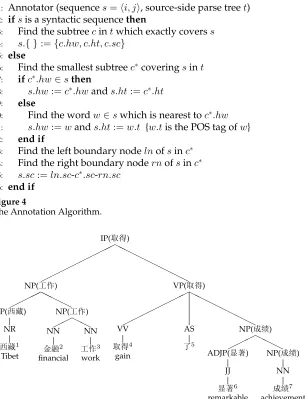
There are two steps to annotating a BTG node using source-side parse tree information: (1) determining the sequence on the source side which is exactly covered by the node, then (2) annotating the sequence according to the source-side parse tree. If the sequence is exactly covered by a single subtree in the source-side parse tree, it is called asyntactic sequence, otherwise it is anon-syntactic sequence. One of the challenges in this an-notation is that phrases (BTG nodes) do not always cover syntactic sequences; in other words, they are not always aligned to constituent nodes in the source-side tree. To solve this problem, we generate a pseudo head word andcomposite categorywhich consists of the syntactic categories of three relevant constituents for the non-syntactic sequences. In this way, our annotation is capable of labelling both syntactic and non-syntactic phrases and therefore providing linguistic information for any phrase reordering.
The annotation algorithm is shown in Figure 4. For a syntactic sequence, the an-notation is trivial. Anan-notation elements directly come from the subtree that covers the sequence exactly. For a non-syntactic sequence, the process is more complicated. Firstly, we need to locate the smallest subtreec∗covering the sequence (line 6). Secondly, we try to identify the head word/tag of the sequence (lines 7–12) by using its head word directly if it is within the sequence. Otherwise, the word within the sequence which is nearest tohwwill be assigned as the head word of the sequence. Finally, we determine the composite category of the sequence (lines 13–15), which is formulated as L-C-R. L/R refers to the syntactic category of the left/rightboundary nodeofs, which is the highest leftmost/rightmost sub-node ofc∗not overlapping the sequence. If there is no such boundary node (the sequencesis exactly aligned to the left/right boundary ofc∗), L/R will be set to NULL. C is the syntactic category ofc∗. L, R, and C together describe the external syntactic context ofs. The composite category we define for non-syntactic phrases is similar to the CCG-style category in Zollmann, Venugopal, and Vogel (2008).
Figure 4
The Annotation Algorithm.
Figure 5
A syntactic parse tree with the head word annotated for each internal node. The superscripts on leaf nodes denote their surface positions from left to right.
5.2 Reordering Model
The linguistically annotated reordering model PRa is a MaxEnt-based classification model, which can be formulated as
PRa(rm)=pθ(o|A ap
p,Aall,Aarr )=
exp(iθihi(o,A ap
p,Aall ,Aarr ))
oexp(
iθihi(o,A ap
p ,Aall,Aarr ))
(11)
[image:11.486.57.366.288.466.2]Table 1
Annotation samples according to the tree shown in Figure 5.
sequence hw ht sc
1, 2 dd NN NULL-NP-NN
2, 3 dd NN NP
2, 4 dd VV NP-IP-NP
3, 4 dd VV NP-IP-NP
hw/ht= the head word/tag, respectively;sc= syntactic category.
Each merging rule involves three nodes (Aapp ,Aall,Aarr ) and each node has three linguistic elements (hw,ht,sc). Therefore, the model has nine features in total. Taking the left node Aall as an example, the model could use its head word was a feature as follows:
hi(o,Aapp ,Aall,Aarr )=
1, Aall .hw=w,o=straight
0, otherwise
Training an LAR model also takes three steps. Firstly, we extract annotated reorder-ing examples from source-side parsed, word-aligned bilreorder-ingual data usreorder-ing the reorderreorder-ing example extraction algorithm and the annotation algorithm. We then generate features using the linguistic elements of these examples. Finally we tune feature weights to build the MaxEnt model.
5.3 Combining LAR and BWR
LAR and BWR can be combined at two different levels:
1. Feature level.Because both LAR and BWR are trained under the maximum entropy principle, we can combine linguistically annotated features from LAR and boundary word features from BWR together and train a single MaxEnt model. We call this methodAll-in-Onecombination. 2. Model level.We can also train two reordering models separately and
integrate them into BTG-based SMT
P(D)= PT(rl1..nl) ·PRb(rm1..nm) λRb
·
PRa(rm1..nm)λRa ·PL(e)λL·exp(|e|)λw (12)
wherePRbis the BWR reordering model andPRais the LAR reordering model. We call this combinationBWR+LAR.
We will empirically compare these two combination methods in Section 7.4.
6. A New Syntax-Based Reordering Analysis Method
we leverage the alignments between source-side parse trees and reference/system translations to summarize syntactic reordering patterns and calculate syntax-based measures of precision and recall for each syntactic constituent.
6.1 Overview
The alignment between a source parse tree and a target string is a collection of rela-tionships between parse tree nodes and their corresponding target spans.5 Asyntactic reordering pattern (SRP)is defined as
α→β1...βn∝[i1]...[in]
The first part of an SRP is a CFG structure on the source side and the second part [i1]...[in] indicates the order of target spansβT1...βTnof nonterminalsβ1...βnon the target side.6
Let’s take the VP structure VP→PP1VP2 as an example to explain how the pre-cision and recall can be obtained. On the target side, the order of PPT1 and VPT2 might be [1][2] or [2][1]. Therefore we have two syntactic reordering patterns for this structure:
VP→PP1VP2∝[1][2] and VP→PP1VP2 ∝[2][1]
Suppose that the two reordering patterns occur a times in the alignments between source parse trees and reference translations,btimes in the alignments between source parse trees and system translations, andctimes in both alignments. Then the reordering precision/recall for this structure isc/bandc/a, respectively. We can further calculate the F1-score as 2×c/(a+b). These syntax-based metrics intuitively show how well the reordering model can reorder this structure. By summarizing all reordering patterns of all constituents, we can obtain an overall precision, recall, and F1-score for the tested reordering model.
This new syntax-based analysis for reordering is motivated in part by recent work which transforms the order of nodes in the source-side parse tree before translation (Xia and McCord 2004; Collins, Koehn, and Kucerova 2005; Li et al. 2007; Wang, Collins, and Koehn 2007). Here we focus on the order transformation of syntactic con-stituents performed by reordering models during translation. In addition to aligning parse trees with reference translations, we also align parse trees with system transla-tions so that we can learn the movement of syntactic constituents carried out by the reordering models and investigate the performance of the reordering models by com-paring both alignments.
For notational convenience, we denote syntactic reordering patterns that are ex-tracted from the alignments between source parse trees and reference translations as REF-SRPand those from the alignments between source parse trees and system trans-lations asSYS-SRP. We refer to those present in both alignments under some conditions
that will be described in Section 6.4 asMATCH-SRP. To conduct a thorough analysis on the reorderings, we carry out the following steps on the test corpus (source sentences + reference translations):
1. Parse source sentences.
2. Generate word alignments between source sentences and reference translations as well as word alignments between source sentences and system translations.
3. According to the word alignments of Step 2, for each multi-branching nodeα→β1...βnin the source parse tree generated in Step 1, find the target spansβT1...βTn and their order [i1]...[in] in the reference and system translations, respectively.
4. Generate REF-SRPs, SYS-SRPs, and MATCH-SRPs according to the target orders generated in Step 3 for each multi-branching node.
5. Summarize all SRPs and calculate the precision and recall as described above.
We further elaborate Steps 2–4 in the Sections 6.2–6.4.
6.2 Generating Word Alignments
To obtain word alignments between source sentences and multiple reference transla-tions, we pair the source sentences with each of the reference translations and include the created sentence pairs in our bilingual training corpus. Then we run GIZA++ on the new corpus in both directions, and apply the “grow-diag-final” refinement rule (Koehn et al. 2005) to produce the final word alignments.
To obtain word alignments between source sentences and system translations, we store the word alignments within each phrase pair in our phrase table. When we output the system translation for a source sentence, we trace back the original source phrase for each target phrase in the system translation. This will generate a phrase alignment between the source sentence and system translation. Given the phrase alignment and word alignments within the phrase stored in the phrase table, we can easily obtain word alignments between the whole source sentence and system translation.
6.3 Generating Target Spans and Orders
Given the source parse tree and the word alignment between a source sentence and a reference/system translation, for each multi-branching nodeα→β1...βn, we firstly determine the target spanβTi for each child nodeβifollowing Fox (2002). If one child node is aligned to NULL, we define a special target span for it. The order for this special target span will remain the same as the child node occurring inβ1...βn.
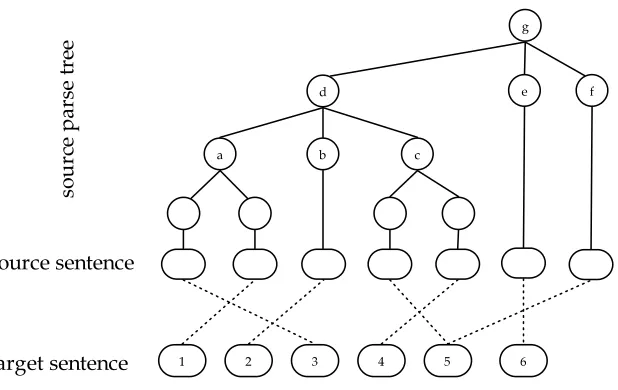
Figure 6
An example source parse tree with the word alignment between the source sentence and the target translation. Dotted lines show the word alignment.
Figure 6 overlap ((1, 3) vs. (2, 2)). Therefore these two nodes are to be combined into a new node, whose target span is (1, 3).
After performing all necessary node combinations, if there are no more overlaps, we call the multi-branching nodereorderable, otherwisenon-reorderable. To get a clearer picture of the reorderable nodes, we divided them into two categories:
r
fully reorderableif all target spans of child nodes don’t overlap;r
partially reorderableif some child nodes are combined due tooverlapping.
In Figure 6, both nodes a and c are fully reorderable nodes.7 Node d is a partially reorderable node. Nodegis a non-reorderable node because (1) the target spans of its child nodes dandf overlap, and (2) child nodesdandf cannot be combined because they are not neighbors.
Because we have multiple reference translations for each source sentence, we can define multiple orders for{βTi}n1. If one node is non-reorderable in all reference trans-lations, we call it REF-non-reorderable, otherwise REF-reorderable. To specify the reorderable attribute of a node in the system translation, we prefix “SYS-” to { non-reorderable, non-reorderable, fully-non-reorderable, partially-reorderable}.
6.4 Generating SRPs
After we obtain the orders of the child nodes for each multi-branching node, we gener-ate REF-SRPs and SYS-SRPs from the fully/partially reorderable nodes. We obtain the
MATCH-SRP for each multi-branching node by comparing the obtained SYS-SRP with the REF-SRPs for this node under the following conditions:
1. Because we have multiple reference translations, we may have different REF-SRPs. We compare the SYS-SRP with the REF-SRP where the
reference translation for this node (the sequence within the target span of the node defined by the REF-SRP) has the shortest Levenshtein distance (Navarro 2001) to that of the system translation.
2. If there are combined nodes in SYS/REF-SRPs, they are treated as a unit when comparing, without considering the order within each combined node. If the order of the SYS-SRP and the selected REF-SRP matches, we have one MATCH-SRP for the node.
Let’s give an example to explain these conditions. Suppose that we are processing the structure VP→PP1ADVP2VP3. We obtain four REF-SRPs from four different ref-erence translations and one SYS-SRP from the system output. Here we only show the orders:
Ref.a : [3][1][2] Ref.b : [3][2][1] Ref.c&d : [2][3][1] SYS : [3][1&2]
Referencesc andd have the same order. Therefore we have three different REF-SRPs for this structure. In the SYS-SRP, PP1and ADVP2are combined and moved to the right side of VP3. Supposing that the system translation for this structure has the shortest edit distance to that of Referenceb, we use the order of Referencebto compare the system order. In the Referenceborder, both PP1and ADVP2are also moved to the right side of VP3. Therefore the two orders of Referenceband SYS match. We have one matched SRP for this structure.
7. Evaluation
Our system is a BTG-based phrasal SMT system, developed following Section 2. We integrate the boundary word–based reordering model and the linguistically annotated reordering model into our system according to our reordering configuration. We car-ried out various experiments to evaluate the reordering example extraction algorithms of Section 3, the linguistically annotated reordering model vs. boundary word–based reordering model, and the effects of linguistically annotated features on the Chinese-to-English translation task of the NIST MT-05 using large scale training data.
7.1 Experimental Setup
Table 2 Corpora used.
Corpus LDC catalog Chinese words English words
United Nations LDC2004E12 68.63M 76.99M
Hong Kong News LDC2004T08 15.07M 15.89M
Sinorama Magazine LDC2005T10 10.26M 9.64M
FBIS LDC2003E14 7.09M 9.28M
Xinhua LDC2002E18 0.40M 0.43M
Chinese News Translation LDC2005T06 0.28M 0.31M
Chinese Treebank LDC2003E07 0.10M 0.13M
Multiple Translation Chinese LDC2004T07 0.10M 0.11M
Total —— 101.93M 112.78M
obtain many-to-many word alignments. From the word-aligned corpora, we extracted bilingual phrases.
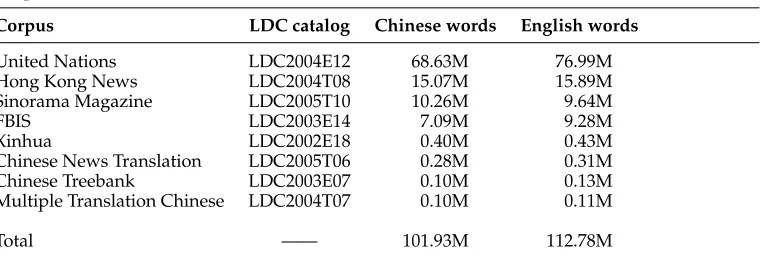
We used all corpora listed in Table 2 except for the United Nations corpus to train our reordering models, which consist of 33.3M Chinese words and 35.79M English words. We ran the reordering example extractor AExtractor and TExtractor of Section 3 on the chosen word-aligned corpora. We then extracted boundary word features from the reordering examples. To extract linguistically annotated features, we parsed the Chinese side of the chosen parallel text using a Chinese parser (Xiong, Liu, and Lin 2005) which was trained on the Penn Chinese Treebank with an F1-score of 79.4%. We ran the off-the-shelf MaxEnt toolkit8 to tune the reordering feature weights with the iteration number set to 100 and Gaussian prior to 1 to avoid overfitting.
We built our 4-gram language model using the SRILM toolkit (Stolcke 2002), which was trained on the Xinhua section of the English Gigaword corpus (181.1M words). We selected 580 short sentences (not exceeding 50 characters per sentence) from the NIST MT-02 evaluation test data as our development set (18 words/31 characters per sentence). The NIST MT-05 test set includes 1,082 sentences with an average of 27.4 words/47.6 characters per sentence. The reference corpus for the NIST MT-05 test set contains four translations per source sentence. Both the development and test sets were also parsed using the parser mentioned above.
Our evaluation metric is the case-insensitive BLEU-4 (Papineni et al. 2002) using the shortest reference sentence length for the brevity penalty. The model feature weights are tuned on the development set to maximize BLEU using MERT (Och 2003). Statistical significance in BLEU score differences is tested by paired bootstrap re-sampling (Koehn 2004).
7.2 Bias in AExtractor
As described in Section 3, AExtractor selectively extracts reordering examples. This selective extraction raises three questions:
1. Is it necessary to extract all reordering examples?
2. If it is not necessary, do the heuristic selection rules impose any bias on the reordering model? For example, if we use the strINV selection rule, meaning that we always extract the largest block pairs for inverted reordering examples, does the reordering model prefer swappings on larger blocks to those on smaller blocks?
3. Does the bias have a strong impact on the performance in terms of BLEU score?
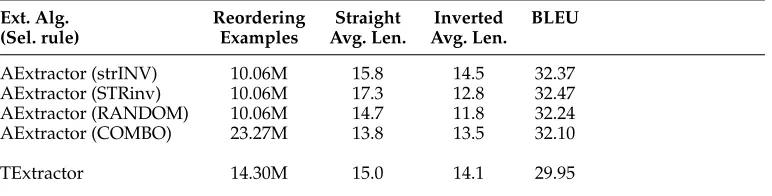
The answer to the first question is no. Firstly, it is practically undesirable to extract all reordering examples because even a very small training set will produce millions of reordering examples if we enumerate all block pair combinations. Secondly, extracting all reordering examples introduces a great amount of noise into training and therefore undermines the final reordering model. In Table 3, we show the number of reorder-ing examples extracted usreorder-ing different extraction algorithms and selection rules. The AExtractor with the COMBO selection rule extracts the largest number of reordering examples. However, it does not obtain the highest BLEU score compared with other selection rules which extract a smaller number of reordering examples. This empirically suggests that there is no need to extract all reordering examples.
To answer the second question, we trace the best BTG trees produced on the test set by our system. The BWR reordering model is trained on reordering examples which are extracted using different selection rules. Then we calculate the average number of words on the target side which are covered by binary nodes in a straight order. We refer to this number asstraight average length. Similarly,inverted average lengthis calculated on all binary nodes in an inverted order. The third and fourth columns of Table 3 show the two average variables. Comparing these average numbers, we clearly observe that two selection rules indeed impose noticeable bias on the reordering model.
r
The strINV selection rule, which always extracts the largest block pairs for inverted reordering examples, has the largest inverted average length. This indicates that the strINV rule biases the reordering model towards larger swappings. [image:18.486.50.436.568.666.2]r
On the contrary, the STRinv selection rule, which extracts the largest block pairs for straight reordering examples and smallest pairs for inverted reordering examples, has the largest straight average length and aTable 3
Comparison of reordering example extraction algorithms and selection rules. We only use BWR as the reordering model for this comparison.
Ext. Alg. Reordering Straight Inverted BLEU
(Sel. rule) Examples Avg. Len. Avg. Len.
AExtractor (strINV) 10.06M 15.8 14.5 32.37
AExtractor (STRinv) 10.06M 17.3 12.8 32.47
AExtractor (RANDOM) 10.06M 14.7 11.8 32.24
AExtractor (COMBO) 23.27M 13.8 13.5 32.10
relatively much smaller inverted average length. This suggests that the STRinv rule makes the reordering model prefer smaller swappings.
Note that the selection rules RANDOM and COMBO do not impose bias on the length of extracted reordering examples compared with strINV and STRinv. The latter two se-lection rules have special preferences on the length of reordering examples and transfer these preferences to the reordering models as shown in Table 3.
Because the preference for reordering larger/smaller blocks is imposed by the reordering example extraction algorithm with special selection rules, one might wonder whether we can allow the decoder to decide its own reordering preference. We add two new features to our translation model: reordering count penalty (rc) and reordering length penalty (rl). We accumulate rc whenever two neighboring BTG nodes are re-ordered. And at the same time we add the number of words which are covered by these two neighboring nodes torl. Their weights are tuned using MERT to maximize BLEU score on the development set with other model feature weights. These two features are similar to the widely used word/phrase penalty features. Tuning the weights of the word/phrase penalty features, we can allow the decoder to favor shorter or longer phrases. Similarly, with the two new features rcand rl, we can allow the decoder to favor shorter or longer reorderings.
We conducted experiments using reordering examples which are extracted with the RANDOM and COMBO selection rules because these two rules do not impose bias on the length of reordering examples. Observing the optimized weights of rc and rlon the development set, we find that the decoder rewards larger rcbut smallerrl. This means that the decoder prefers shorter reorderings to longer reorderings. However, the BLEU scores on the test set are 31.89 and 32.0 for RANDOM and COMBO, respectively, which are worse than the BLEU scores of RANDOM and COMBO without using rc
and rlin Table 3, and also worse than the performance of strINV and STRinv which impose preferences on reordering examples. This seems to suggest that the preference for shorter/longer reorderings imposed by the reordering example extraction algorithm is better than that decided by the decoder itself.
Finally, for the last question, we observe from Table 3 that BLEU scores are not that much different although we have quite the opposite bias imposed by different selection rules. The changes in BLEU score, which happen when we shift from one selection rule to the other, are limited to a maximum of 1.2%. Among the four selection rules, the STRinv rule achieves the highest BLEU score. The reason might be that the bias towards smaller swappings imposed by this rule helps the decoder to reduce incorrect long-distance swappings (Xiong et al. 2008b).
7.3 AExtractor vs. TExtractor
We further compared the two algorithms for reordering example extraction. In Table 3, we find that TExtractor significantly underperforms in comparison to AExtractor. This is because the transformation from decomposition trees to BTG trees is not complete. Many crossing links due to errors and noise in word alignments generated by GIZA++ make it impossible to build BTG nodes over the corresponding words. It would be better to use alignments induced by the ITG and EM procedure described in Section 3.2 but this has a very high cost.
7.4 LAR vs. BWR
Table 4 shows the results of the different integration of BWR and LAR into our systems. Only using LAR achieves a BLEU score of 32.17, which is comparable to that of BWR. This suggests that LAR is promising given that:
r
LAR uses many fewer features than BWR does. According to our statistics, LAR contains only 166.1k linguistically annotated features whereas BWR has 451.4k boundary word features.r
Syntactic divergences between the source and target languages as well as parse errors prevent the effective use of syntactic knowledge for phrase reordering (see the in-depth analysis in Section 8.2.2).Although BWR marginally outperforms LAR (32.47 vs. 32.17), simple boundary word features are not adequate to move phrases to appropriate positions because they cannot recognize syntactic contexts which are very relevant to phrase reordering. Therefore the best way to reorder a phrase is to combine BWR and LAR so that we can use syntactic information on the one hand and not worry too much about syntactic divergences on the other hand.
As described in Section 5.3, we can combine BWR and LAR at two levels: the feature level and the model level. When we combine them at the model level, we achieve an absolute improvement of 0.83 and 1.13 BLEU points over BWR and LAR, respectively, which are both statistically significant (p <0.01). This shows that LAR and BWR are complementary to each other and in particular that using linguistic knowledge can significantly improve a very competitive lexicalized reordering model (BWR).
The other combination method All-in-One (at the feature level) also obtains signif-icant improvements over BWR and LAR but marginally underperforms compared to BWR+LAR. In our later experiments we use the combination method BWR+LAR.
7.5 Varying Training Data Size
[image:20.486.45.450.571.645.2]To investigate how LAR improves BWR when we vary our training data size, we carried out experiments on three different training data sets:FBIS(7.09M Chinese words, 9.28M English words);Large1, which includes all corpora listed in Table 2 except for the United Nations corpus (33.3M Chinese words, 35.79M English words); and Large2, which
Table 4
BLEU scores for LAR, BWR, and their combinations.
Reordering Configuration BLEU
BWR 32.47
LAR 32.17
All-in-One 33.03**++
BWR+LAR 33.30**++
Table 5
BLEU scores on different training data sets. Large1 refers to the corpora listed in Table 2 except for the United Nations corpus. Large2 includes all corpora listed in Table 2.
Training Data BWR BWR+LAR Improvement
FBIS 24.97 26.52 1.55
Large1 29.96 30.78 0.82
Large2 32.47 33.30 0.83
consists of Large1 and the United Nations corpus (101.93M Chinese words, 112.78 English words). The language model remains the same for these three data sets because it is trained on a much larger data set (181.1M words).
Table 5 shows the results. We observe that BWR+LAR is able to achieve a larger improvement of 1.55 BLEU points over BWR on smaller training data. When we enlarge the training data set from FBIS to Large1, both BWR and BWR+LAR improve quite a bit. The difference between them is narrower, 0.82 BLEU points, but still significant. When we continue to use more training data (Large2), the improvement obtained by integrating LAR becomes stable at the 0.8 level.
7.6 Effects of Linguistically Annotated Features
We conducted further experiments to evaluate the effects of individual linguistically an-notated features. Using the reordering configuration of BWR+LAR, we augment LAR’s feature pool incrementally: firstly using only syntactic categories9(sc) as features (170 features in total), then constructing composite categories (cc) for non-syntactic phrases (sc+cc) (8.6K features), and finally introducing head words and their POS tags into the feature pool (sc+cc+hw+ht) (166.1K features). This series of experiments demon-strates the impact and degree of contribution made by each feature for reordering. The experimental results are presented in Table 6, from which we have the following observations:
1. Syntactic category alone improves the performance statistically
significantly. The baseline feature setscwith only 170 features improves the BLEU score from 32.47 to 32.87.
2. Other linguistic information, provided by the categories of boundary nodes (cc) and head word/tag pairs (hw+ht), also improves phrase reordering. Producing composite categories for non-syntactic BTG nodes and integrating head word/tag pairs into LAR as reordering features are both effective, indicating that context information complements syntactic category for capturing reordering patterns.
Table 6
The effect of the linguistically annotated reordering model. (sc) is the baseline feature set, (sc+cc) and (sc+cc+hw+ht) are extended feature sets for LAR.
Reordering Configuration BLEU
BWR 32.47
BWR + LAR (sc) 32.87*
BWR + LAR (sc+cc) 33.06**
BWR + LAR (sc+cc+hw+ht) 33.30**++
* = almost significantly better than BWR (p<0.075); ** = significantly better than BWR (p<0.01); ++ = significantly better than BWR + LAR (sc) (p<0.01).
8. Analysis
We first obtain system translations of the test corpus. We generate word alignments between source sentences and system/reference translations as described in Section 6.2. Then we follow the analysis steps of Section 6.1 to investigate syntactic constituent movement in the reference translations and system translations which are generated using two different reordering configurations: BWR+LAR vs. BWR. In LAR, we use the best reordering feature set (sc+cc+hw+ht).
8.1 Syntactic Constituent Movement: Overview
If a syntactic constituent is fully reorderable or partially reorderable, it is considered to be movable as a unit. To denote the proportion of syntactic constituents to be moved as a unit, we introduce two variablesREF-R-rateandSYS-R-rate, which are defined as
SYS-R-rate= count(SYS-reorderable nodes)
count(multi-branching nodes) (13)
REF-R-rate= count(REF-reorderable nodes)
count(multi-branching nodes) (14)
Table 7 shows the statistics of REF/SYS-reorderable nodes on the test corpus. From this table, we have the following observations:
1. A large number of nodes are REF-reorderable, accounting for 79.82% of all the multi-branching nodes. This number shows that, in reference
translations, a majority of syntactic constituent movement across
Chinese–English can be performed by directly permuting constituents in a sub-tree.
2. The R-rates of BWR and BWR+LAR are 77.46% and 81.79%, respectively. The R-rate of BWR+LAR is obviously higher than that of BWR, which suggests that BWR+LAR tends towards moving more syntactic
Table 7
Statistics of multi-branching and REF/SYS-reorderable nodes per sentence.
BWR BWR+LAR
multi-branching node 18.68
REF-reorderable node 14.91
REF-R-rate 79.82%
SYS-fully-reorderable node 13.16 14.01
SYS-partially-reorderable node 1.31 1.26
SYS-R-rate 77.46% 81.79%
8.2 Syntactic Constituent Movement among Multiple Reference Translations
8.2.1 Differences in Movement Orientation.Because each source sentence is translated by four different human experts, we would like to analyze the differences among reference translations, especially on the orders of constituents being translated. Table 8 shows the overall distribution over the number of different orders for each multi-branching constituent among the reference translations.
In most cases (75.4%), four reference translations have completely the same order for syntactic constituents. This makes it easier for our analysis to compare the system order with the reference order. However, there are 22% cases where two different orders are provided, which shows the flexibility of translation. According to our study, noun phrases taking DNP or CP modifiers, as well as DNPs and CPs themselves, are more likely to be translated in two different orders. Table 9 shows the percentages in which two different orders for these constituents are observed in the reference corpus.
DNP and CP are always used as pre-modifiers of noun phrases in Chinese. They often include the particle word d (of) at the ending position. The difference is that DNP constructs a phrasal modifier whereas CP constructs a relative-clause modifier. There is no fixed reordering pattern for DNP and CP and therefore for NP which takes DNP/CP as a pre-modifier. In the DNP→NP DEG structure, the DEG (d) can be
Table 8
Distribution of number of different orders by which syntactic constituents are translated in references.
Number of different orders 1 2 3 4
[image:23.486.55.437.599.663.2]Percentage 75.40 22 2.33 0.33
Table 9
Two-order translation distribution of 4 NP-related constituents.
Constituent 2-order translation percentage
NP→DNP NP 16.93
NP→CP NP 9.43
CP→IP DEC 24.79
translated into ’s or of, which are both appropriate in most cases, depending on the translator’s preference. If the former is chosen, the order of DNP and therefore the order for NP→DNP NP will both be straight: [1][2]. Otherwise, the two orders will be inverted: [2][1]. Similarly, there are also different translation patterns for CP→IP DEC and NP→CP NP. CP can be translated into “that+ clause” or adjective-like phrases in English. Figure 7 shows an example where the CP constituent is translated into an adjective-like phrase. Although the “that+ clause” must be placed behind the noun phrase which it modifies, the order for adjective-like phrases is flexible (see Figure 7).
For those constituents with different reference orders, we compare the order of the system translation to that of the reference translation which has the shortest edit distance to the system translation as described herein so that we can take into account the potential influence of different translations on the order of syntactic constituents.
8.2.2 REF-Non-Reorderable Constituents.We also study REF-R-rates for the 13 most fre-quent constituents listed in Table 10. We find that two constituents, VP1 →PP VP2and NP1 → CP NP2, have the lowest REF-R-rates, 58.20% and 61.77%, respectively. This means that about 40% of them are REF-non-reorderable. In order to understand the reasons why they are non-reorderable in reference translations, we further investigate REF-non-reorderable cases for the constituent type VP1→PP VP2and roughly classify the reasons into three categories as follows.
1. Outside interruption.The reordering of PP and VP2is interrupted by other constituents outside VP1. For example, the Chinese sentence[NPd d/somebody ] [VP1[PPd...d/when...] [VP2[d/say NP[...] ] ] ]is translated intowhen..., somebody said .... Here the translation of the first NP which is outside VP1is inserted between the translations of PP and VP2and therefore interrupts their reordering. Outside interruption accounts for 21.65% of REF-non-reorderable cases.
[image:24.486.51.272.499.614.2]2. Inside interruption.The reordering of PP and VP2is interrupted by the combination of PP’s subnodes with VP2’s subnodes. Inside interruption accounts for 48.45% of REF-non-reorderable cases, suggesting that it is the major factor which decreases the reorderability of VP→PP VP. Because both PP and VP have their own complex sub-structures, the inside
Figure 7
Table 10
F1-scores ( BWR+LAR vs. BWR) for the 13 most frequent constituents in the test corpus.
Constituents indicated inboldhave relatively lower F1score for reordering.
Type Constituent Percent. (%) SYS-R-rate (%) F1-score (%)
BWR BWR+LAR BWR BWR+LAR
VP
VP→VV NP 8.12 79.22 84.10 76.97 80.53
VP→ADVP VP 4.30 63.45 65.86 70.83 73.67
VP→PP VP 1.87 60.32 70.37 39.29 40.33
VP→VV IP 1.82 79.35 86.14 77.16 82.26
NP
NP→NN NN 6.88 84.68 85.18 76.17 79.10
NP→NP NP 5.12 82.13 84.93 69.25 72.17
NP→DNP NP 2.14 69.75 74.83 56.68 56.61
NP→CP NP 2.12 59.67 73.43 48.75 54.48
Misc.
IP→NP VP 6.78 71.99 79.80 63.22 65.79
PP→P NP 3.63 80.63 85.95 82.75 84.93
CP→IP DEC 3.51 83.94 87.89 69.91 72.24
QP→CD CLP 2.74 66 65 67.52 68.47
DNP→NP DEG 2.43 85.98 89.84 67.5 68.75
interruption is very complicated and includes a variety of cases, some of which are quite unexpected. Here we show two frequent examples of inside interruption:
a. The preposition in the PP and the verb word/phrase of VP2are aligned to only one target word or one continuous phrase. For example,d...dd/pressure,d...ddd/be confident of,d...ddd/ suffer from, and so on. This is caused by the lexical divergence problem.
b. The PP is first combined with the verb word of VP2in an inverted order, then combined with the remainder of VP2in a straight order. For example,[PP [Pd] [omission1]] [VP [VVddd] [omission2]] might be translated intolearned from omission1that omission2.
3. Parse error.This accounts for 29.90% of REF-non-reorderable cases.
Although these reasons are summarized from our analysis on the constituent type VP→PP VP, they can be used to explain other REF-non-reorderable constituents, such as NP→CP NP.
8.3 Syntactic Constituent Movement in System Translations
Table 11
Syntactic reordering precision and recall of BWR+LAR vs. BWR on the test corpus.
Precision Recall F1
BWR 70.89 68.79 69.83
BWR+LAR 71.32 73.08 72.19
8.3.2 The Effect of Linguistic Knowledge on Phrase Movement. To understand the change in phrase movement caused by linguistic knowledge, we further investigate how well BWR and BWR+LAR reorder certain constituents, especially those with high distribu-tion probability. Table 10 lists the 13 most frequent constituents, which jointly account for 51.46% of all multi-branching constituents. Except for NP→DNP NP, the reorder-ing F1score of all these constituents in BWR+LAR is better than that in BWR.
Our hypothesis for the phrase movement change in BWR+LAR is that the integrated linguistic knowledge makes phrase movement in BWR+LAR pay more respect to syn-tactic constituent boundaries. The overall R-rates of BWR+LAR vs. BWR described in Section 8.1 indicate that BWR+LAR tends towards moving more syntactic constituents together than BWR does. We want to know whether this is also true for a specific constituent type. The fourth and fifth columns in Table 10 present the R-rate for each individual constituent type that we have analyzed. It is obvious that the R-rate of BWR+LAR is much higher than that of BWR for almost all constituents. This indicates that higher R-rate is one of the reasons for the higher performance of BWR+LAR.
To gain a more concrete understanding of this change, we show two examples for the reordering of VP→PP VP in Figure 8. In both examples, BWR fails to move the PP constituent to the right of the VP constituent, whereas BWR+LAR does it successfully. By tracing the binary BTG trees generated by the decoder, we find that BWR generated a very different BTG tree from the source parse tree whereas the BTG tree in BWR+LAR almost matches the source parse tree. In the first example, BWR combines the VP phrase
Figure 8
[image:26.486.50.441.449.628.2]ddwith ddand then combines dd. The preposition word d is combined with the NP phraseNHK, which makes the translation ofNHK interrupt the reordering of VP→PP VP in this example. The BWR tree in the second example is even worse. The non-syntactic phrase dd dd in the VP phrase is first combined with dd dd, which is a sub-phrase of PP preceding VP in an inverted order. The remaining part of the VP phrase is then merged. This merging process continues regardless of the source parse tree. The comparison of BTG trees of BWR+LAR and BWR in the two examples suggests that reordering models should respect syntactic structures in order to capture reorderings under these structures.
Our observation on phrase movement change resonates with the recent efforts in phrasal SMT that allow the decoder to prefer translations which show more respect for syntactic constituent boundaries (Cherry 2008; Marton and Resnik 2008; Yamamoto, Okuma, and Sumita 2008). Mapping to syntactic constituent boundaries, or in other words, syntactic cohesion (Fox 2002; Cherry 2008), has been studied and used in early syntax-based SMT models (Wu 1997; Yamada and Knight 2001). But its value has receded in more powerful syntax-based models (Galley et al. 2004; Chiang 2005) and non-syntactic phrasal models (Koehn, Och, and Marcu 2003). Marton and Resnik (2008) and Cherry (2008) use syntactic cohesion as a soft constraint by penalizing hypotheses which violate constituent boundaries. Yamamoto, Okuma, and Sumita (2008) impose this as a hard constraint on the ITG constraint to allow reorderings which respect the source parse tree. They all report significant improvements on different language pairs, which indicates that syntactic cohesion is very useful for phrasal SMT. Our analysis demonstrates that linguistically annotated reordering provides an alternative way to incorporate syntactic cohesion into phrasal SMT.
8.4 Challenges in Phrase Reordering and Suggestions
We highlight three constituent types in Table 10 (indicated in bold) which are much more difficult to reorder, as indicated by their relatively lower F1 scores. The lower F1 scores indicate that BWR+LAR is not fully sufficient for reordering these constituents although it performs much better than BWR. We find two main reasons for the lower F1 scores and provide suggestions accordingly as follows.
1. Constrained decoding.We observe that in reorderable constituents which involve long-distance reorderings, their boundaries are easily violated by phrases outside them. To prohibit boundary violations, we propose constrained decoding. In constrained decoding, we define specialzones in source sentences. Reorderings and translations within the zones cannot be interrupted by fragments outside the zones. We can also define other constrained operations on the zones. For example, we can prohibit swappings in any zones which contain punctuation (Xiong et al. 2008b). The beginning and ending positions of a zone are automatically learned. To be more flexible, they are not necessarily constituent boundaries. Constrained decoding is different from both soft constraints (Cherry 2008; Marton and Resnik 2008) and hard constraints (Yamamoto, Okuma, and Sumita 2008). It can be considered as in between both of these because it is harder than the former but softer than the latter.
interruptions have to be allowed to obtain fluent translations for these constituents. However, the allowance of interruptions is sometimes beyond the representability of BTG rules. For example, to solve the lexical divergence problem, bilingual rules with aligned lexicons have to be introduced. To capture reorderings of these constituents, we propose to integrate special reordering rules with richer contextual information into BTG to extend BTG’s ability to deal with interruptions. Completely replacing BTG with richer formalisms, such as hierarchical phrase (Chiang 2005) and tree-to-string (Liu, Liu, and Lin 2006) or string-to-tree (Marcu et al. 2006), introduces a huge extra cost. Instead, integrating a small number of reordering rules into BTG to model reorderings of non-reorderable constituents would be more desirable.
8.5 Discussion
In the definition of syntactic reordering patterns, we only consider the relative order of individual constituents on the target side. We do not consider whether or not they remain contiguous on the target side. It is possible that other words are inserted be-tween spans of two contiguous constituents. We use the term gap to refer to when this happens. The absence of a gap in the definition of syntactic reordering patterns may produce more matched SRPs and therefore lead to higher precision and recall. Table 12 shows the revised overall precision and recall of syntactic reordering patterns when we also compare gaps. The revised results show that BWR+LAR still significantly outperforms BWR. This also applies to the 13 constituents identified in Table 10. The analysis results obtained before are still valid when we consider gaps.
9. Related Work
9.1 Linguistically Motivated Phrase Reordering
[image:28.486.49.432.618.662.2]There are various approaches which are devoted to incorporating linguistic knowledge into phrase reordering. Generally, these approaches can be roughly divided into three categories: (1) reordering the source language in a preprocessing step before decoding begins; (2) estimating phrase movement with reordering models; and (3) capturing reorderings by synchronous grammars. The preprocessing approach applies manual or automatically extracted reordering knowledge from linguistic structures to transform the source language sentence into a word order that is closer to the target sentence. The second reordering approach moves phrases under certain reordering constraints and estimates the probabilities of movement with linguistic information. In the third
Table 12
Revised overall precision and recall of BWR+LAR vs. BWR on the test corpus when we consider the gap in syntactic reordering patterns.
Precision Recall F1
BWR (gap) 46.28 44.91 45.58
![Figure 3The BTG-style tree built from the word alignment in Figure 1. We use ([i, j], [p, q]) to denote a treenode, where i, j and p, q are the beginning and ending indices in the source and target language,respectively.](https://thumb-us.123doks.com/thumbv2/123dok_us/1271254.655183/9.486.57.325.478.616/figure-alignment-figure-treenode-beginning-indices-language-respectively.webp)